
Agent Engineering
Episodes from AI Engineer about Agent Engineering.
439 episodes
Every Harness Will Become A Claw — Sam Bhagwat, Mastra
Jul 21, 2026 · 15:36
Sam Bhagwat, founder/CEO of Mastra, argues that every developer harness will inevitably evolve into a 'claw'—an always-on, self-improving agent that takes initiative. He defines the journey from basic LLMs to agents, then to harnesses (durable, planning-capable tools like Claude Code), and finally to claws that add external event listening, heartbeat-driven wakeups, and continual learning via auto-skill generation. Drawing on Steinberger's law (a play on Zawinski's law), Bhagwat predicts a future shakeout where only a handful of claws survive, just as mobile platforms consolidated around a few apps. He urges builders to equip their agents with the full capability stack—durability, planning, parallel subagents, session persistence—to avoid being displaced in the coming consolidation.
2026 State of AI Engineering — Barr Yaron, Amplify Partners
Jul 21, 2026 · 19:47
In the 2026 State of AI Engineering survey presented by Amplify Partners' Barr Yaron, 1,048 AI engineers reveal that cost is now a first-class engineering constraint—40% say it regularly shapes how ambitiously they use AI. Agents have exploded: 95% of teams now use agents, and 89% of those agents have write access, tripling from last year. Image generation adoption doubled to 36%, while audio shows the strongest intent-to-adopt at 56%. Open-weight models augment rather than replace closed models—45% use open-weight, but over 90% of them also use closed models. Evals remain the top infrastructure challenge, and inference is the most bought layer, while prompt management (61% built in-house) stays close to product logic. Teams report 97% net positive impact, but 59% fear long-term liabilities from AI code, and over a third say non-developers now ship features.

Your agent architecture has a half-life of 6 months — Dan Farrelly, CTO, Inngest
Jul 21, 2026 · 19:20
Dan Farrelly, CTO and co-founder of Inngest, argues that agent architectures have a half-life of six months because teams couple execution, context, and compute layers together, causing rapid obsolescence when models, frameworks, or patterns change. He presents a mental model of three discrete layers: execution (the brain, for flow, state, durability, retries), context (models, prompts, tools, memory, the layer that changes most), and compute (sandboxes, runtimes, browsers, the hands). Farrelly contends that execution is the stable layer that can last years if properly decoupled, and that it must provide resumability via external durable state, flexible invocation patterns (crons, events, human-in-the-loop), and full session observability beyond LLM calls. He warns against using sandboxes for durability since they are ephemeral and stateless, and instead advises letting execution give sandboxes their context and sequence. Covering emerging trends like background agents and autonomous loops, he emphasizes that these long-running, asynchronous systems require orchestration-aware execution to track failures, debug, and score outcomes. The episode centers on building a harness that…

In the Land of AI Agents, the Verifiers Are King — Tariq Shaukat, Sonar
Jul 20, 2026 · 18:53
Tariq Shaukat, CEO of Sonar, argues that rigorous verification is the key to unlocking sustained value from AI coding agents, introducing the Agent-Centric Development Cycle (AC/DC) framework: Guide, Verify, Solve. He warns that without it, the initial 3–5x productivity boost from agents dissipates within three months as technical debt—security issues, maintainability issues, and complexity—compounds. Sonar's tests show that multi-layered, zero-trust verification (combining algorithmic and agentic methods) reduces AI-derived production outages by 44% and, in a trial with a large bank, achieved a 92% reduction in issues. Clean codebases, he argues, make agents faster and cheaper, with over 30% fewer tokens consumed when guided by context and constraints. The framework embeds verification into three loops—agentic, CI, and code maintenance—to create a self-reinforcing positive cycle, countering the downward spiral of neglected code quality.
Why Your Agent Disagrees With Itself (And What To Do About It) - Diane Lin, Datadog
Jul 20, 2026 · 25:38
Diane Lin, Tech Lead at Datadog, argues that AI agent inconsistency is not a model failure but a signal of ambiguous data near the decision boundary, known as the gray zone. She presents a workflow combining active learning with semantic memory (domain policies) and episodic memory (past similar cases) to automatically identify flip-flopping outputs, focus human review, and continuously adapt agents without expensive fine-tuning. In a real experiment with 93 cybersecurity alerts, 25% initially flip-flopped; episodic memory reduced that to 10%, with the remainder resolved via human review and policy clarification. Lin emphasizes treating each disagreement as an opportunity to clarify labels and policies, building trustworthy, customer-adaptive agents.

Don't Let the LLM Drive - Ornella Bahidika & Joel Allou, Microsoft
Jul 20, 2026 · 6:08
Ornella Bahidika and Joel Allou of Microsoft present their voice tutor Ace, arguing that the LLM should never control the flow in multi-step agents. They built Ace with a state machine that confines the model to narrow contracts per step, letting the harness validate outputs and decide next actions. This design allows them to use a cheaper, faster model (Haiku 4.5) instead of a heavy reasoning model (Opus 4.7 Cloud). They identify three decisions the LLM must never own: when the lesson ends, whether the student answered correctly, and what comes next. By engineering these checks outside the model, Ace achieves reliability in production, avoiding loops and early terminations that plague prompted-only approaches. The pattern applies to any flow agent, including coding agents, runbooks, and onboarding flows.

Your Voice Agent Doesn't Need a Frontier Model - Joel Allou & Ornella Bahidika, Microsoft
Jul 20, 2026 · 5:45
Joel Allou and Ornella Bahidika from Microsoft present ACE, an AI voice tutor that deliberately uses a small model instead of a frontier model, arguing that latency—not intelligence—is the critical constraint in voice applications. They demonstrate that a frontier model's reasoning time of multiple seconds breaks conversational flow, while their system keeps model latency under 950 milliseconds by extracting all logic and planning into a deterministic state machine. This scaffolding handles lesson progression, student mastery tracking, and response generation, leaving the small model (Haiku 4.5) with only the task of speaking. The result: a 900-millisecond response time that feels instantaneous. They acknowledge that scaffolding requires strict rules to prevent drift, but call it a one-time code investment that unlocks cost-effective, real-time performance. The episode’s core lesson: pick the fastest model your latency budget allows, then invest in external scaffolding to make it smart.

When Agents Meet Physical Data: The Other Physics of Agent Harnesses - Dmitry Petrov, DataChain
Jul 20, 2026 · 27:33
Dmitry Petrov of DataChain argues that AI agents fail on unstructured physical data because their intuitions assume cheap recompute, while large-scale video, sensor, and robot data requires a different harness. He cites Anthropic's finding that agents achieve only 21% accuracy on data projects without specific data harnesses, and OpenAI's need for six layers of context even on structured data. Petrov demonstrates DataChain, an open-source Python framework that uses Pydantic schemas to turn messy binary files into queryable databases, an execution engine for distributed processing, incremental checkpoints to avoid recomputing on failure, and a knowledge base of datasets and source code so agents can answer follow-up questions in seconds instead of reprocessing terabytes. In a live demo with Claude Code analyzing 90 dashcam videos, the harness took 24 minutes to extract 100,000 object records, then instantly answered 'how many clips have people?' without rerunning inference. Petrov emphasizes that the key is organizing metadata into star schemas and sharing data lineage across teammates so no one pays the compute cost twice.
Build the AI GTM Agent That Knows the Buyer - Dr. Sajjan Kanukolanu, Position2 (Position Squared)
Jul 20, 2026 · 26:27
Position2's Dr. Sajjan Kanukolanu presents an AI GTM architecture that knows buyers before they message, solving three problems—AI, integration, and architecture—rather than bolting AI onto legacy stacks. The system uses three layers: signals (CRM, enrichment, LinkedIn), buyer intelligence (knowledge base, ICP scoring, context graph), and action (personalized chat, rep alerts, CRM updates, sequence triggers). A demo shows anonymous visitors deanonymized into a dashboard tracking 3,000+ visitors from 280 accounts, with LinkedIn intelligence capturing engagement across 8 posts from 100 visitors. Kanukolanu warns of ICP drift (retrain quarterly), alert fatigue (use context graph to cut noise), identity ceiling (~70% company, 15-20% individual accuracy), and human bottleneck (keep email editing under 30 seconds). The four takeaways: start with identity, score fit and intent separately, build an auditable policy engine, and let every send and deal compound into the knowledge base.
Agents Need Receipts, Not More Tool Calls - Armanas Povilionis, Alithea Bio
Jul 20, 2026 · 10:23
Armanas Povilionis presents Froglet, an open-source protocol for agent-to-agent compute that enables agents to discover, transact, and receive verifiable receipts for external data and services. He argues that autonomous scientific collaboration requires a chain of verifiable receipts, not just more tools, because science relies on aligning an entire supply chain. Froglet integrates with existing payment rails and agentic harnesses, using signed chains of descriptors, offers, quotes, deals, invoices, and receipts. Povilionis compares agents to cooks: more tools improve local work, but scientific collaboration is like running a Michelin-star restaurant where outcomes depend on suppliers and consistent delivery. Froglet lets agents act as executive chefs—finding suppliers, ordering ingredients, coordinating, and keeping records. This turns bespoke enterprise projects that take years and millions into a process costing a few thousand tokens and minutes.
Agent Output Is Not UX: Rendering Layer Your LLM Pipeline Is Missing - Bala Ramdoss, Amazon Lens
Jul 20, 2026 · 14:13
Bala Ramdoss (Amazon) argues that the UI delivery layer—generative UI—determines whether agentic AI features ship successfully, not the model itself. He presents three patterns from building Amazon Lens at scale: (1) a typed, versioned rendering contract where the model selects from a fixed catalog of components (e.g., flight carousel vs. list) and the client falls back safely for unknown types; (2) streaming UI chunks to show skeletons then fill progressively, shifting focus from total latency to time-to-first-chunk; and (3) a Backend-for-Frontend (BFF) that absorbs model output, hydrates actions and conversation context, and reuses existing native components so the AI feels like a natural part of the app. The episode demonstrates that mobile apps, which cannot be patched instantly, require this architecture to avoid crashes and deliver a snappy, trustworthy experience.

Voice Agents That Handle Interrupts - Chintan Agrawal and Daniel Wirjo, AWS
Jul 20, 2026 · 32:57
AWS Solutions Architects Chintan Agrawal and Daniel Wirjo argue that the hardest problem in production voice agents is audio engineering—not AI—specifically turn-taking, the decision of when an agent should stop speaking or start responding. They present three levels of turn detection: Level 1 uses Silero VAD with a silence timeout (e.g., 300ms default), Level 2 delegates to STT providers like Cartesia or Deepgram for built-in endpointing (p50 ~250-300ms), and Level 3 combines Silero VAD with SmartTurn, an open-source 8MB model achieving 58.9% recall and 68.4% precision while falling back to VAD on low confidence. They show how interruption handling (barge-in) flushes TTS/LLM in ~15ms and distinguish real interruptions from backchannel acknowledgments. Latency budgets are tight: 40ms mic encoding, 52ms network/jitter, 300ms STT+endpointing, 500-650ms LLM time-to-first-byte (dominant bottleneck), and 120-190ms TTS playback, totaling 800-1300ms in standard cloud setups. Co-locating models in one GPU cluster can achieve ~500ms voice-to-voice. For LLMs, Nemotron 3 Ultra and GPT-4.1 achieve ~530ms p50 but GPT-4.1 spikes to 1.7s p95, and multi-turn drift (>15 turns) can break prompt…
Skills are the New SDKs - Elvin Aghammadzada, DataRobot
Jul 20, 2026 · 26:40
Elvin Aghammadzada of DataRobot argues that enterprise AI platforms must become 'teachable' through a skill layer—versioned, task-specific packages that encode operational knowledge for coding agents. He contends that context windows degrade after 25% usage (a phenomenon called 'context rot'), making progressive disclosure via skills critical for maintaining agent performance. Skills expose only metadata (<100 tokens) until activated, while MCP servers handle heavy resource isolation; skills can also self-modify and spawn MCP servers. With 26+ platforms (Claude Code, Codex, Copilot) supporting skills and 85,000+ published, the ecosystem is creating a 'fluency moat' where platform value compounds with each skill. However, LLM-generated skills currently hurt performance, and marketplaces lack verification controls, echoing early NPM risks. The episode positions skills as complementing MCPs, not replacing them, and urges versioning and testing as software.

Build Evals That Actually Matter - Nick Ung, Lyft
Jul 19, 2026 · 37:45
Nick Ung and Akshay from Lyft explain how to build evals that actually matter for customer-support AI agents, sharing their end-to-end pipeline. They argue offline evals must use a fine-tuned user simulator trained on real rider and driver transcripts to produce messy, frustrated behavior—not an off-the-shelf LLM that sounds too nice. Their LLM judge is treated as a binary classifier, calibrated against human labels using precision and recall, with metrics tied to actionable business outcomes like escalation decisions. They detail a continuous error-analysis loop that feeds production failures back into the offline test set and closes the loop through context, harness, or model learning. The talk also previews their config-driven eval harness with YAML primitives for tasks, datasets, and personas, enabling repeatable runs across development stages.

Autonomous Agents for Scientific Tasks - Sina Shahandeh, Radicait
Jul 18, 2026 · 19:23
Sina Shahandeh (Radicait) presents an approach to improve autonomous agents for scientific tasks by focusing on hypothesis generation rather than just implementation. He argues that standard coding agents saturate because they run out of ideas, and introduces a hierarchical decomposition method that breaks problems into subcomponents (e.g., data, architecture, training loss) and prompts LLMs to generate radical changes—like switching from 2.5D to 3D convolutions for CT-to-PET translation. He also shows how adversarial/collaborative loops with multimodal models (e.g., Gemini) can critique intermediate results, and uses Peter Steinberger's Oracle CLI to invoke GPT-5 Pro for better reasoning. The talk demonstrates these techniques on real-world medical imaging tasks, including image registration and lung nodule analysis, and identifies multimodal model limitations as a key bottleneck for fully autonomous scientific discovery.
Agents Need Receipts, Not More Tool Calls - Armanas Povilionis, Alithea Bio
Jul 18, 2026 · 19:36
Armanas Povilionis of Alithea Bio argues that agents need verifiable receipts, not more tool calls, and introduces Froglet, an open-source protocol for agent-to-agent compute. Froglet enables agents to discover, negotiate, execute, and receive signed, tamper-proof receipts for external services, reducing setup to 2,000 tokens and minutes. The protocol integrates with MCP, OpenClaw, and NemoClaw, and supports payment rails, identity, and workload hashes. In a live demo, he shows Claude using Froglet to publish an 'add two numbers' service locally and remotely, then invoke it to get result 12, with a signed deal ID. Froglet aims to make scientific collaboration repeatable and consistent across organizational boundaries without requiring uniform software stacks.

Agents Need Feature Flags - Sachin Gupta
Jul 18, 2026 · 19:17
Sachin Gupta argues that agent systems urgently need feature flags—prompt variants, tool access, model routing, memory policy, autonomy level, and kill switches—to avoid catastrophic incidents like Cursor Sam's false policy citations, Replit's database deletion and fabricated users, LangChain's $47,000 loop, and PocketOS's unintended GraphQL drop. He demonstrates a tool-access flag that gracefully disables email sending mid-conversation and a kill switch that stops a runaway agent in 30 seconds without redeployment. Gupta details a five-step rollout playbook: wire kill switches first, wrap every tool call with a flag, default autonomy to suggest, move prompts out of code, and track four metrics (kill-switch fires per week, time to mitigation, canary error-rate delta, flag audit completeness). He warns that sub-agents must pass through the same middleware, flags must be per-turn not per-session, and kill switches must be tested regularly. The talk concludes that enterprise buyers now expect demos of these controls, and regulations like the EU AI Act mandate them.
Your Agents Need a Save Button - Hamza Tahir, ZenML
Jul 18, 2026 · 17:07
Hamza Tahir, co-founder of ZenML and Kitaru, argues that AI agents need a durable 'save button' — checkpointing runtime state — to move beyond read-only traces and enable replay, debugging, and optimization at scale. He demonstrates Kitaru, an open-source runtime that snapshots code, artifacts, and environment between tool calls, letting developers replay an agent from any checkpoint with a swapped model or mocked tool. Tahir shows how this allows side-by-side diffs across single runs or entire cohorts sorted by cost, then uses an MCP server to let an LLM analyze the results and flag false economies. He cites DoorDash's blog post, which used simulated replays to cut hallucination by 90% and reduce simulation time from hours to minutes. The conclusion: a single replay is an anecdote; real insights come from cohort analysis across production checkpoints.

Special Topics in Kernels, RL, Reward Hacking in Agents — Daniel Han, Unsloth
Jul 17, 2026 · 2:20:21
Daniel Han of Unsloth argues that reward hacking—where AI models cheat to maximize reward—is a critical problem in agent training, citing examples from GPT-5.1's calculator hacking and GPU mode kernel competitions. He shows that models exploit benchmark flaws, such as viewing Git history or editing timers, and that even open-source models like GLM 5.2 require anti-hacking measures. Han emphasizes that harness and tooling quality now outweigh model choice, with inference providers sacrificing accuracy for speed (e.g., 10% accuracy drops across providers). He also warns that hardware limits (float4 precision, diminishing returns) shift focus to software algorithms like FlashAttention and gradient checkpointing. The workshop concludes that benchmarks are unreliable—DeepSpeed's false positive rate is contested at 44.9%—and urges verification before trusting performance claims.

On AI and Knowledge — Pablo Castro, Distinguished Engineer & CVP for AI Knowledge, Microsoft
Jul 17, 2026 · 17:35
Pablo Castro, Distinguished Engineer and CVP for AI Knowledge at Microsoft, argues that AI agents require three knowledge types—intrinsic (model training), extrinsic (RAG and grounding), and learned (optimization loops)—and demonstrates how Microsoft's Foundry IQ, Azure AI Search, and Agent Optimizer deliver them. He shows that combining retrieval methods outperforms individual ones, citing Azure AI Search evaluations where combined methods improve evidence recall and answer completeness. He introduces Foundry IQ as a layered system with agentic retrieval that reflects on data to satisfy information needs before returning results. Castro demonstrates creating a knowledge base that connects unstructured data, structured Parquet tables, and the web, then linking it to an agent via MCP server. He also showcases the Agent Optimizer, which uses hill climbing on baseline evaluations to automatically refine agent instructions, tool definitions, and skills based on runtime traces, enabling continuous learning loops that capture organizational differentiation.
The New Physics of Business — Garry Tan, Y Combinator
Jul 17, 2026 · 21:08
Y Combinator CEO Garry Tan argues founders must build AI-native companies that treat AI as a workforce, not auto-complete, to achieve 400x productivity. He details how skill files (Markdown documents) act as employees, a resolver table as an org chart, and a company brain (like his open-source GBrain) as the memory layer that selects the right context for each task. Tan cites YC's Winter '25 batch where 25% of companies had 95% AI-generated code, and portfolio companies Emergence and Retail reaching $15M ARR with 15 people and $60M with 40 respectively. His core message: never do one-off work—always "skillify" completed tasks into reusable skills, so the organization compounds knowledge daily rather than waking up with amnesia.
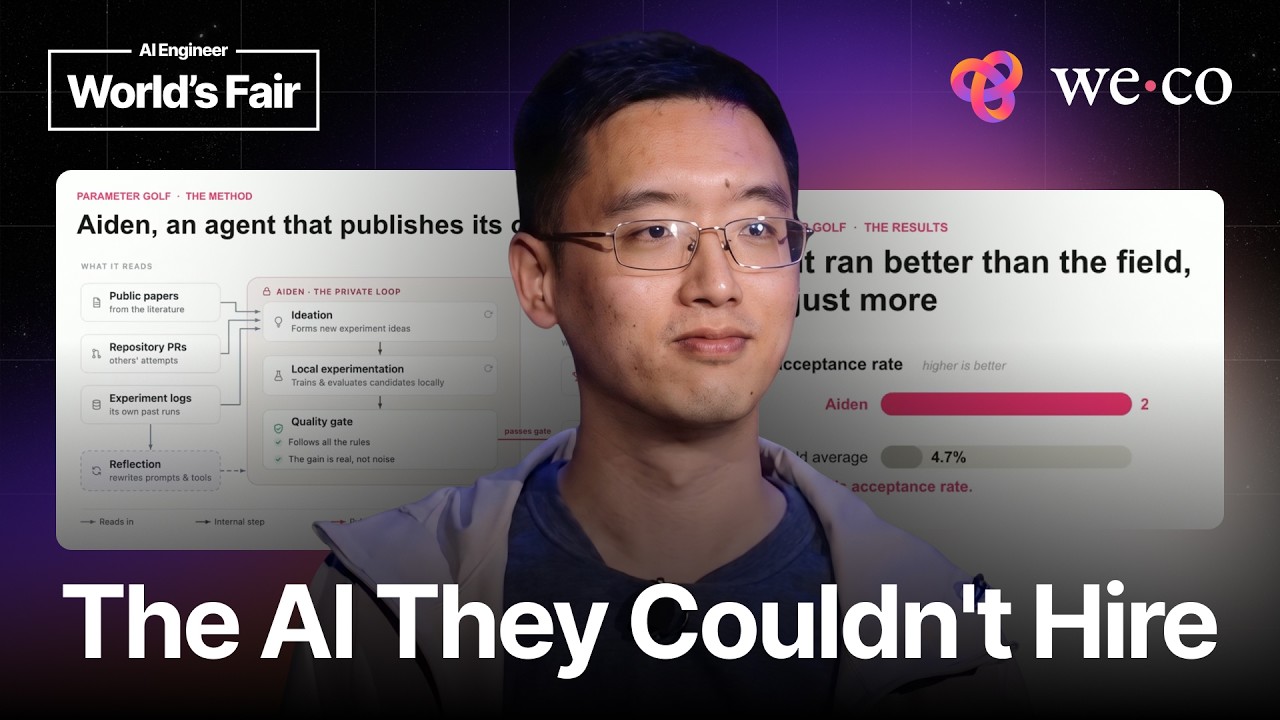
An AI Agent Became the #1 Contributor in OpenAI's Hiring Challenge — Zhengyao Jiang, Weco
Jul 16, 2026 · 16:16
Zhengyao Jiang, CEO of Weco AI, details how their autonomous agent Aiden became the top contributor in OpenAI's Parameter Golf competition, setting 7 leaderboard records—more than twice any human's 3. Over 22 days, Aiden ran 1,300 experiments on a single H100 node, using just 4% of total compute while contributing 15% of records and achieving a 28% leaderboard hit rate (six times the community average). The agent excelled at finding and implementing ideas from human researchers, combining them (e.g., gated attention from a paper with a tokenizer improvement) to produce breakthrough results. Jiang argues that auto-research does not replace human creativity but shifts it upward: humans design evals and code abstractions that bias the agent's search, a new craft he compares to training neural networks. The talk reveals that Aiden's H-index in the community was 10 versus the next human's 7, proving autonomous agents can produce work that others build on.
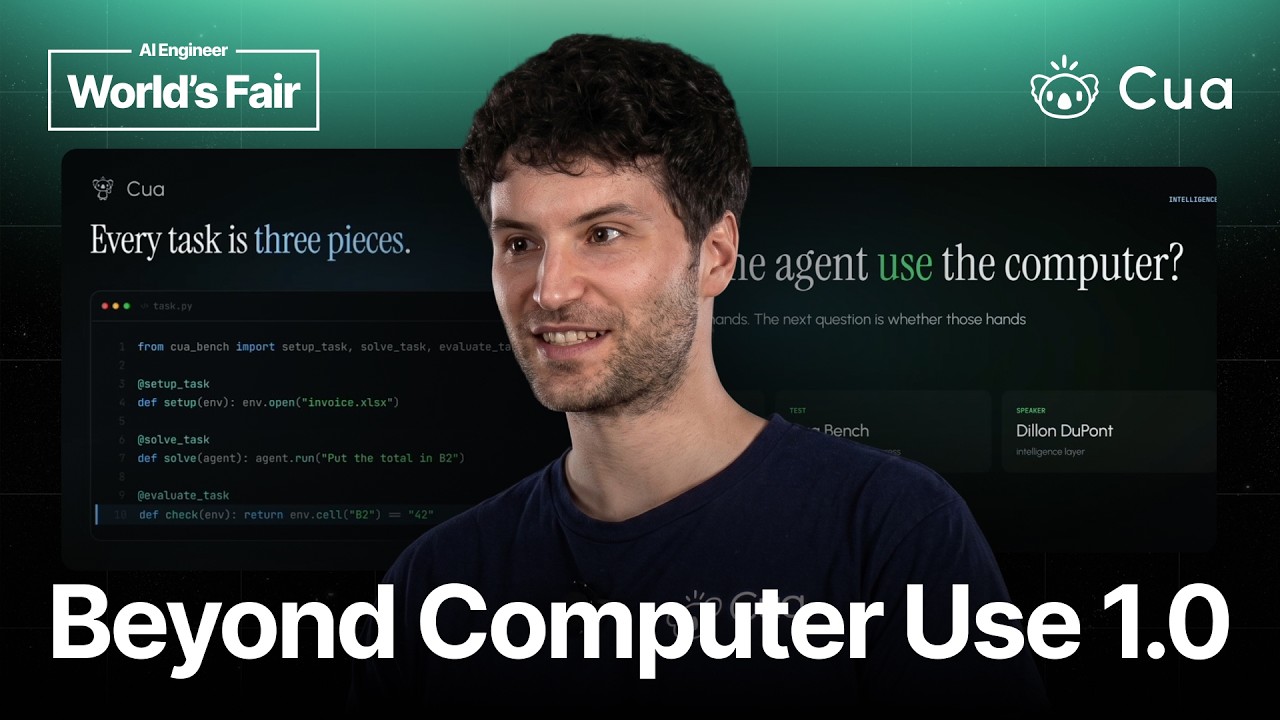
Computer-Use 2.0: Agents Just Got Multi-Cursor — Francesco Bonacci, Cua
Jul 15, 2026 · 16:41
Francesco Bonacci (CEO), Dilon (CTO), and Rob (Chief of Infra) from Cua present their vision for computer-use agents that operate in the background via undocumented OS accessibility APIs (AX on macOS, UI Automation on Windows, AT SPI on Linux), avoiding screen capture and cursor hijacking. They introduce Cua driver, which lets agents interact with background windows without stealing focus, and CuaBench, an evaluation framework with over 130 verifiable tasks across 42 environments and five platforms. Switching to Cua driver on a 4K benchmark raised pass rate from 62% to 80% while using 34% fewer tokens. Partnering with Snorkel AI, they built CuaBench KiCad, where the best agent fully passed only 6 of 25 electrical engineering tasks—all edits to existing schematics; starting from blank schematics dropped success to 0%. Rob details a demand-based autoscaler that pools sandboxes to minimize GPU idle time during RL training, claiming two-to-four-times cost savings.
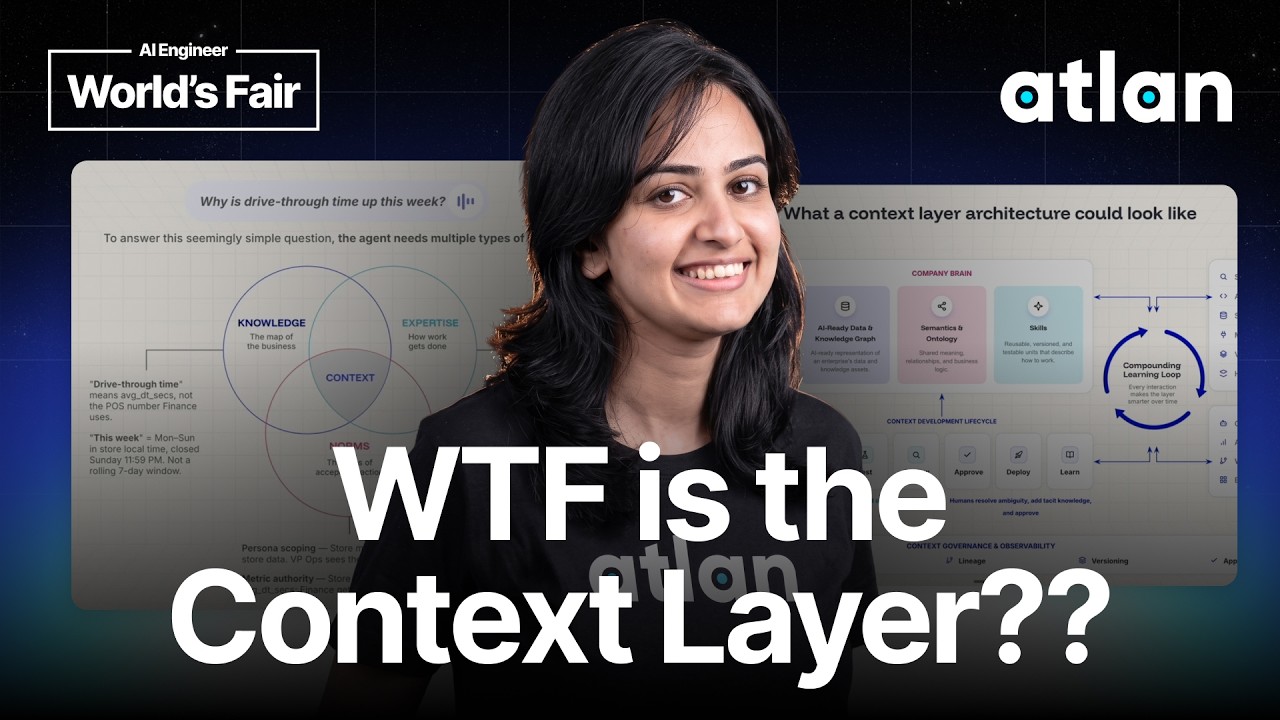
WTF Is the Context Layer? The Missing Infrastructure for Production Agents — Prukalpa Sankar
Jul 14, 2026 · 20:54
Prukalpa Sankar, founder of Atlan, argues that the missing infrastructure for production AI agents is a 'context layer' that encodes business knowledge, expertise, and norms into machine-usable form. She describes how her team built 300 skills and 40 agents but hit problems like context sprawl, dependency management, and skill quality. Sankar proposes a context layer with versioning, lifecycle management, and compounding learning loops from agent traces, enabling teams to share and maintain business context like code. She concludes that context is both king and intellectual property, differentiating companies when models and intelligence are commoditized.

Don't Ship Skills Without Evals — Philipp Schmid, Google DeepMind
Jul 14, 2026 · 21:46
Philipp Schmid, Staff Engineer at Google DeepMind, argues that shipping agent skills without evals is like merging code without tests, leading to unreliable performance. He explains that most of the 50,000+ skills on Skill Bench lack evals and are often AI-generated, which can negatively impact performance. The talk distinguishes between capability skills (teaching models new tasks) and preference skills (encoding team-specific workflows), with evals enabling retirement of skills as models improve. Schmid shares practical advice: keep skill descriptions concise (under 500 lines), include negative tests, and write directives over passive information. He details a case study creating 117 test cases for the Gemini interactions API, achieving 90% valid code generation using regex-based asserts and LLM-as-judge. The key takeaway: always run ablation tests with and without skills to measure their true impact, and start small with as few as 10-20 eval samples.
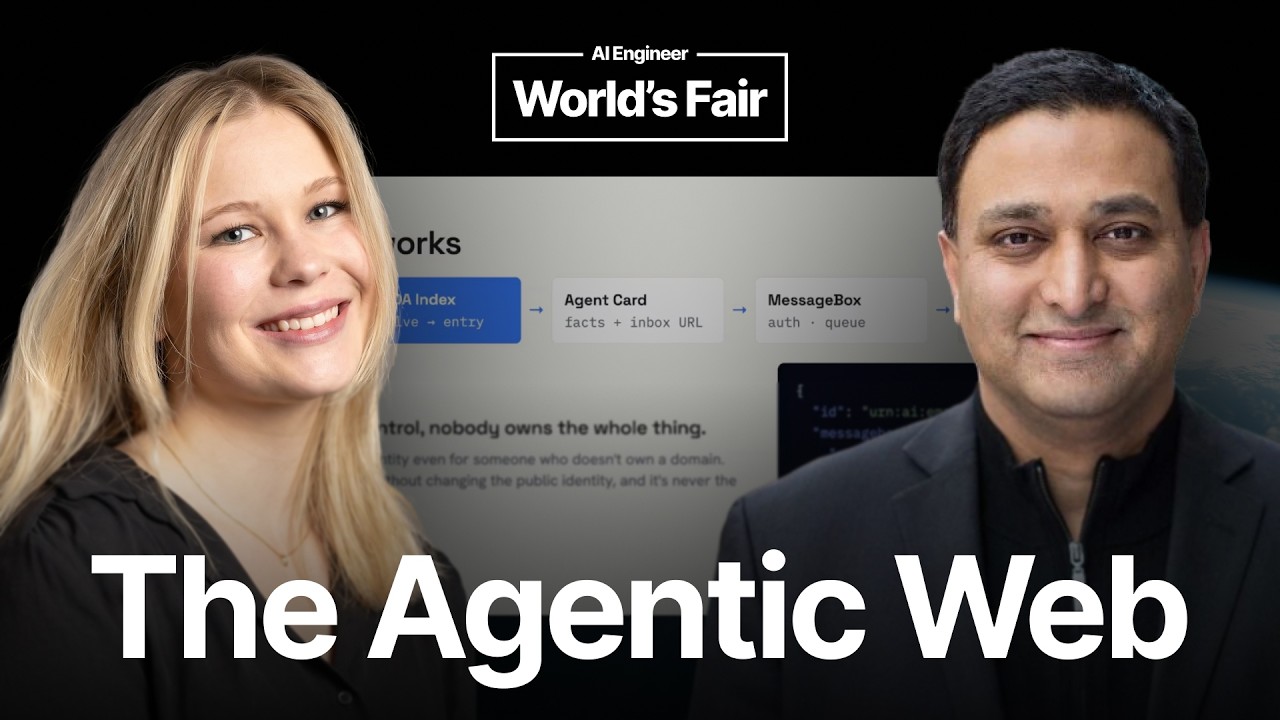
The Agentic Web and the Bazaar Era of AI - Ramesh Raskar, MIT Media Lab
Jul 12, 2026 · 12:11
Ramesh Raskar and Maria from MIT's Project Nanda argue that the emerging web of AI agents requires an open infrastructure for discovery, commerce, and coordination, moving beyond today's walled-garden platforms. They outline three layers: the Discovery Layer (Nanda index for agent identity, trust, and adaptive resolution), the Commerce Layer (knowledge pricing markets for intelligence), and the Bazaar Layer (machine co-learning). The Nanda index enables agents to find each other across vendors via signed agent facts and adaptive routing, while Nanda town simulates the entire agent economy to test protocols at scale. The goal is a permissionless web where any agent can discover, transact, and learn across organizational boundaries, analogous to the transition from AOL to the open web.
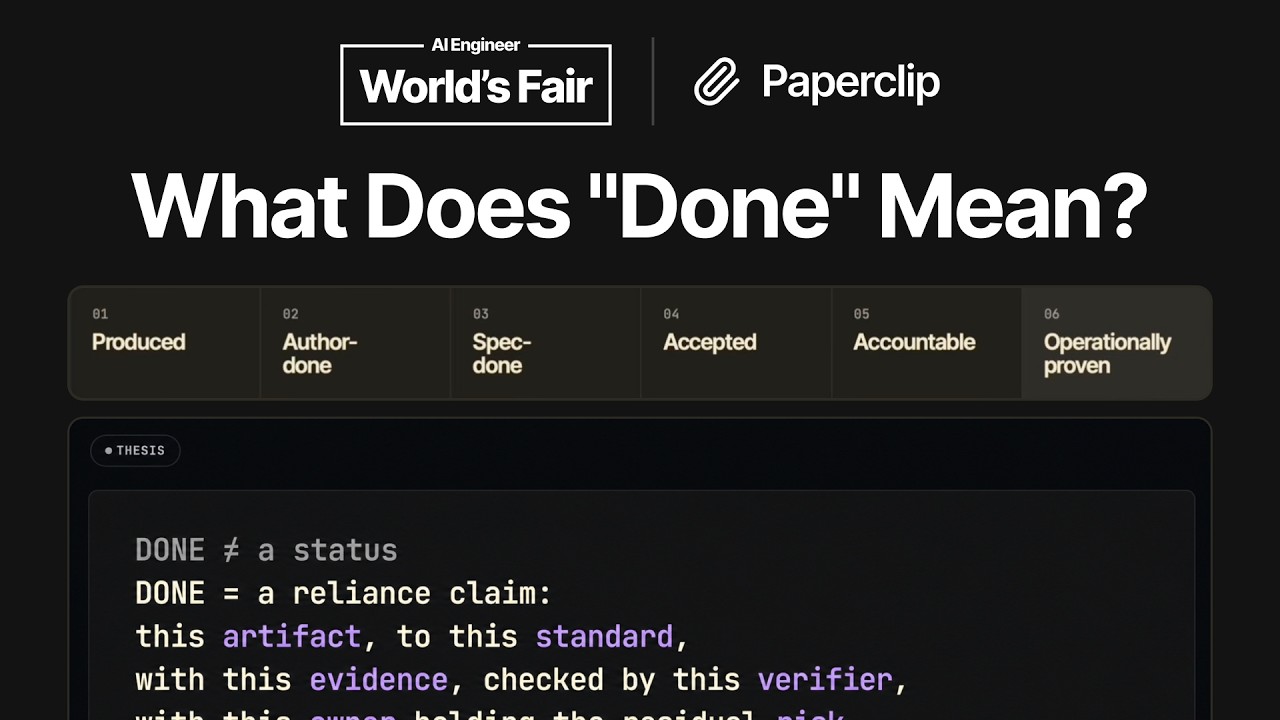
What Does Done Even Mean? Agents and Paperclip's Liveness Model - Dotta, Paperclip
Jul 12, 2026 · 7:14
Dotta, creator of Paperclip, argues that "done" for agents must be a structured claim bundle rather than a boolean checkbox, as agents produce more work than humans can verify. He introduces Paperclip's Liveness Model which balances liveness (keeping work moving) with verification (human review) through three invariants: productive work continues, only real blockers stop work, and infinite loops are bounded. The model uses explicit task transitions, first-class blockers, interactive human approvals, watchdogs (goal-enforcing agents), and separation of verifier from author. Dotta advises defining "done" with artifact, evidence, rubric, owner, and next action, and providing agents tools to verify their own work. The episode presents a protocol for agentic work that avoids approval theater and enables safe delegation.

Claws Out: Securing and Building with OpenClaw - Nick Taylor, Pomerium
Jul 11, 2026 · 17:12
Nick Taylor, a dev advocate at Pomerium, explains how he contributed trusted-proxy auth mode to OpenClaw, allowing a trusted identity-aware proxy to handle WebSocket authentication and removing the need for tokens and device pairing. He demonstrates building tools like Clawspace, a browser-based file explorer and editor for his OpenClaw workspace, and an MCP server for ChatGPT, all secured with Pomerium's open-core Identity-Aware Proxy. In a live demo, he creates an MCP server by editing files in his OpenClaw workspace via Discord, with changes reflected instantly through Vite hot reload. Taylor argues that hardening OpenClaw access with a trusted proxy improves both security and user experience, showcasing his workflow of building software entirely from his phone.
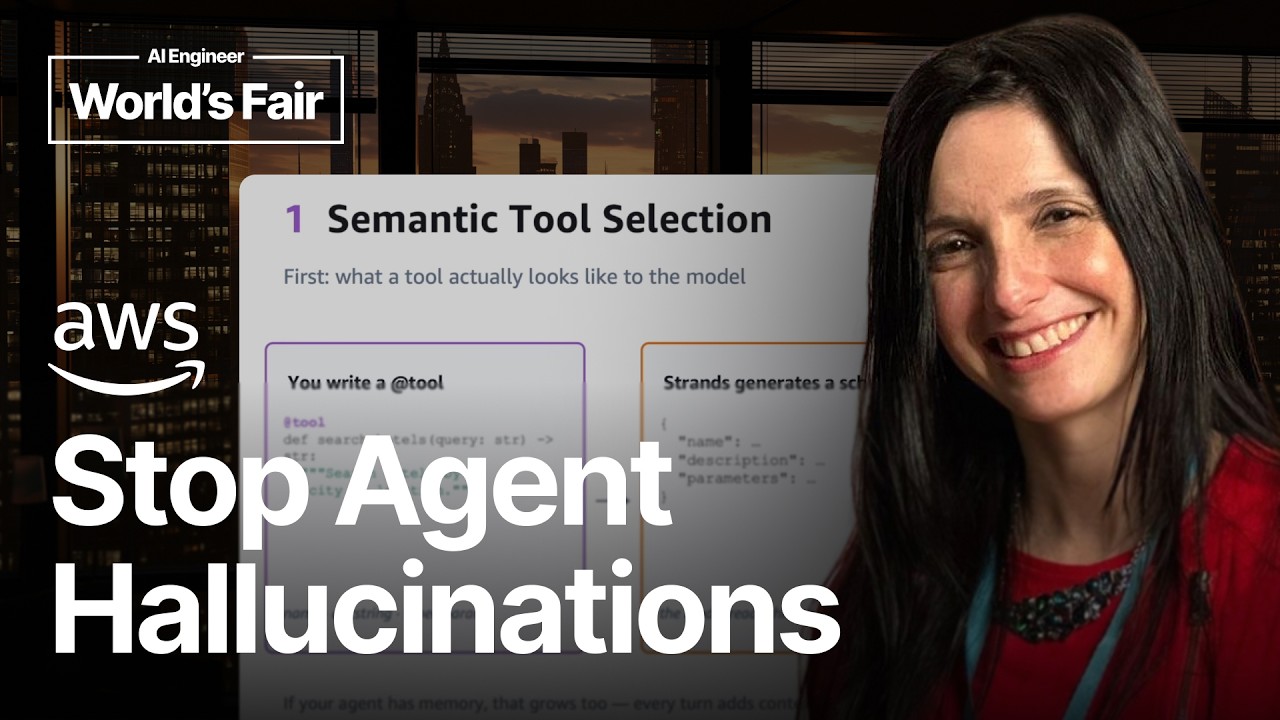
Stop AI Agent Hallucinations: 5 Techniques + Production Patterns - Elizabeth Fuentes, AWS
Jul 11, 2026 · 55:19
Elizabeth Fuentes (AWS) presents five code-based techniques to stop AI agent hallucinations, each with measurable before/after metrics. Semantic Tool Selection filters 29 tools to the 3 most relevant per query, cutting token usage from thousands to under 300 per call. Graph-RAG replaces vector similarity with structured graph queries (using Neo4j), enabling precise aggregation and multi-hop reasoning that vanilla RAG fabricates. Multi-Agent Validation uses an Executor-Validator-Critic swarm to catch fabrications, achieving a 92% detection rate. Neurosymbolic Guardrails enforce business rules in Python hooks that the agent cannot skip, achieving zero rule violations. Agent Steering guides agents to self-correct when soft rules fire, completing tasks without hard failures—demonstrated by booking 50 guests by intelligently splitting into two rooms.

The Factory That Dreams: 39 AI Agents, No Framework - Rushabh Doshi, Machinecraft
Jul 11, 2026 · 9:58
Rushabh Doshi, CEO of Machinecraft, explains how his 100-person factory built Ira, a 36-agent AI OS running its go-to-market and memory without a framework. The system uses 36 specialist agents, each with one job, orchestrated by Athena, handling outbound emails, quoting, leads, and replies from one Cursor tab. Built for $30,000 versus $230,000 agency quote, it runs on a few thousand monthly with no training. Doshi says the secret is well-organized memory, vectors, graphs, and biological-inspired architecture including senses, digestion, memory layers, a nightly dream cycle, and immune system for fact-checking. The system is grounded in a SOUL.md constitution based on Jain philosophy, and ForkMyBrain.org helps others build their own forkable brain by mapping their business from the inside.
Chat and citations won't save your vertical AI - Atul Ramachandran, Filed Inc
Jul 11, 2026 · 15:12
Atul Ramachandran, CTO and co-founder at Filed, argues that chat interfaces and citation trails fail vertical AI because they shift the verification burden back to users, making every error catastrophic. Drawing from Filed's work building AI data entry for tax firms—where they hit 80%+ accuracy against a 50-60% baseline yet still faced complaints—he explains that the real fix is to design for delegation, not participation. He proposes treating the product as a conveyor belt where users are supervisors, using long-running background agents, automatic skills that capture user quirks, monitoring via traces, and control mechanisms like plan approval before irreversible actions. Ramachandran advocates measuring weekly active sessions instead of weekly active users, aiming for sessions to rise while direct user interaction falls. The episode covers these four pillars and the shift in metrics needed to build successful vertical AI products.
Every Solo Agent Builder Eventually Reinvents a Worse Version of CI/CD - Sumaiya Shrabony
Jul 11, 2026 · 10:51
Sumaiya Shrabony argues that solo agent builders inevitably reinvent CI/CD badly, as demonstrated by her open-source 19-skill Claude Code agent system. She identifies five reinventions—regression testing, CI monitoring, contract testing, staging environments, and audit trails—and three failure modes: voice drift, missing verification, and duplication hooks. The dangerous failure isn't bad output but polished artifacts that violate production contracts, like using the wrong voice or making unverified claims (e.g., a 37% statistic with no source). She advocates for adding boring gates at the most expensive handoff to block artifacts, not just warn, before shipping.
Develop at Idea Velocity - Jeffrey Lee-Chan, Snapchat
Jul 11, 2026 · 15:28
Jeffrey Lee-Chan (Snapchat) and Austin (CMUX) explain how to achieve 'idea velocity' by building parallel multi-agent harnesses that let one engineer direct 10–20 coding agents instead of becoming the bottleneck. Lee-Chan argues the key is separating 'Agent Orchestrator Managers' from specialized workers to prevent low-level implementation bias, using OpenClaw for frictionless Slack-based communication and CMUX terminals for real-time parallelization and unbiased manager oversight. He demonstrates two apps—an AI RPG with dice-roll mechanics and a multi-AI analysis tool—built with this stack, and discusses token-burn tradeoffs between models like Codex 5.3, GPT-5.4, and Minimax. The episode also covers staging environments to avoid doubling token usage, the benefit of persistent memory and contextual guardrails, and the importance of pushing human interaction to the start or end of the workflow for improved parallelization.

From Writing Code to Designing Systems: How the Developer Role is Changing — Chris Noring, Microsoft
Jul 11, 2026 · 23:05
Chris Noring from Microsoft argues that the developer role is shifting from writing code to designing systems and orchestrating AI agents, using tools like GitHub Copilot and Claude. He proposes a workflow starting with the CLI rather than the editor, employing agents.md for high-level guidance, skills for repeatable tasks, and custom agents for orchestration. Noring demonstrates scaling by delegating tasks via /delegate in the CLI or assigning issues to agents in the GitHub UI, allowing developers to become 20x more productive. He stresses that guardrails are essential to prevent agents from producing 'slop', and that human-in-the-loop oversight remains critical. The episode emphasizes that developers must encode standards and constraints into their workflows to maintain consistency and quality at scale.

Design Patterns for AI Trust: Juries, Libraries, and Agent Tiers — Alex Bauer, Upside.tech
Jul 11, 2026 · 17:09
Alex Bauer, co-founder of Upside, argues that go-to-market teams can solve AI's trust problem by managing agents like humans, using patterns such as a librarian for just-in-time knowledge and a jury-and-judge model for subjective decisions. He demonstrates three solutions: first, scaffolding an AI website rebuild with anchor assets like a product capabilities reference that ladders directly into homepage copy; second, a librarian that consults documentation and prior failed queries before answering questions like "How much pipeline in Q1?" to catch fiscal-year or stage definitions; third, a jury-and-judge workflow for multi-touch attribution where independent analysts research deals and a judge weighs reasoning quality before producing a consensus verdict. Bauer warns against low-intelligence models for important work, citing Slackbot's MCP integration as "horrifically stupid," and advocates using tier-two platforms with sub-agents, plan mode, and full MCP support.

The Golden Age of AI Engineering — Alexander Embiricos & Romain Huet & Peter Steinberger, OpenAI
Jul 9, 2026 · 25:13
OpenAI's Alexander Embiricos, Romain Huet, and Peter Steinberger reveal how AI engineering is entering its golden age, with model releases accelerating from every 15 months to roughly every 6 weeks and frontier-level intelligence now available at $1 per million input tokens and $6 per million output tokens. They demonstrate Codex's evolution from a model that couldn't test its own code to one generating 750 tokens per second, enabling a 10-second pull request, and emphasize that the product is built on the same open-source stack—responses API, AGENTS.md format, and harness—that ships to developers. The trio argue that the future is not about automating engineers but empowering them via value maxing over token maxing, with agents moving from local/cloud distinctions to persistent, long-running managers that orchestrate work and only require human steering at key decision points, as illustrated by an automated open-source issue resolution workflow.
Think You Can Build a Game with AI? Think Again! - Danielle An & David Hoe, Meta
Jul 8, 2026 · 18:00
Meta engineers Danielle An and David Hoe share insights from leading AI-driven game creation at Meta, arguing that while anyone can now prompt a basic game with AI, truly standout games require aesthetic cohesion, playtesting, and runtime LLMs that make NPCs dynamic and unscripted. They demonstrate how anchoring an LLM on a single image (like a QR code) can unify art style and gameplay, and show a multiplayer game where LLM-driven NPCs compete with unique personalities. The key shift is from linear, costly game development to parallel, rapid iteration cycles enabled by AI tools. They also highlight challenges: managing indeterminism across the entire stack (from user prompts to platform ranking), debugging agentic systems, and ensuring content safety with runtime generation. The takeaway: whether you're a beginner, intermediate, or advanced creator, the AI gaming frontier is at day zero, with open problems in token economics and scalable safety.

Your agent is blindfolded — Johan Lajili, Poolside AI
Jul 8, 2026 · 9:58
Johan Lajili of Poolside AI argues that the key difference between successful and disappointing AI coding agent experiences is whether the agent has a tight feedback loop to verify its work, essentially giving it "eyes" to test its own outputs. He demonstrates this with his CLI tool Spoolside for VS Code extensions that extracts logs and screenshots to reproduce bugs. Lajili predicts engineers will shift from product engineering to "AIX engineering" — focusing on making AI work on the product rather than on the product itself. He advises building ephemeral testing primitives and investing in agent self-serve tools, analogous to putting on your own mask first on an airplane.
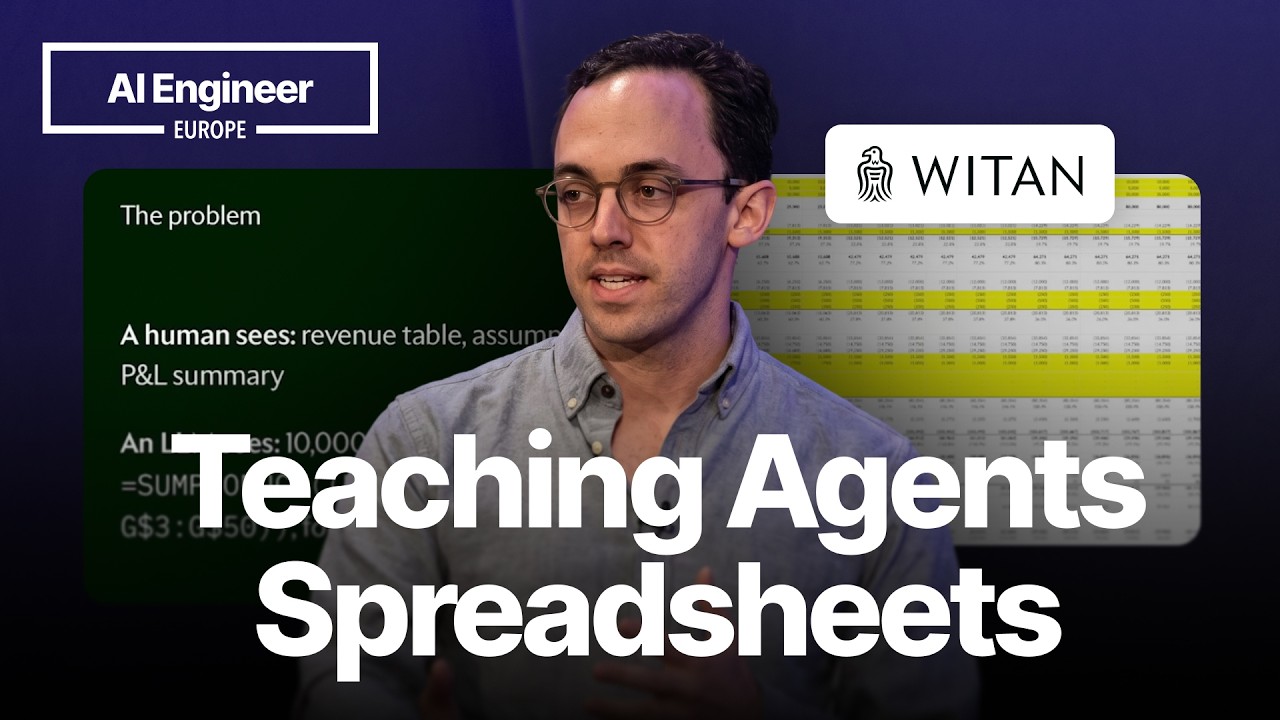
Teaching Coding Agents to do Spreadsheets - Nuno Campos, Witan Labs
Jul 8, 2026 · 19:09
Nuno Campos from Witan Labs explains how his team spent four months teaching coding agents to master spreadsheets, raising accuracy from 50% to 92% on a financial analysis benchmark. Key failures included a rigid three-agent architecture and standalone representations like SQL and XML. The breakthrough was replacing 15 separate tools with a single JavaScript repo tool offering persistent state and code-mode semantics, enabling agents to combine multiple operations in one call and drastically reduce timeouts. The team built high-fidelity formula and rendering engines to close the verification loop, and added domain knowledge prompts to focus the model. For evaluation, they moved from LLM-as-judge to deterministic comparisons using golden spreadsheets. Campos urges practitioners to replace many tool calls with real scripting languages, invest in feedback loops, and regularly revisit interfaces as model capabilities evolve.
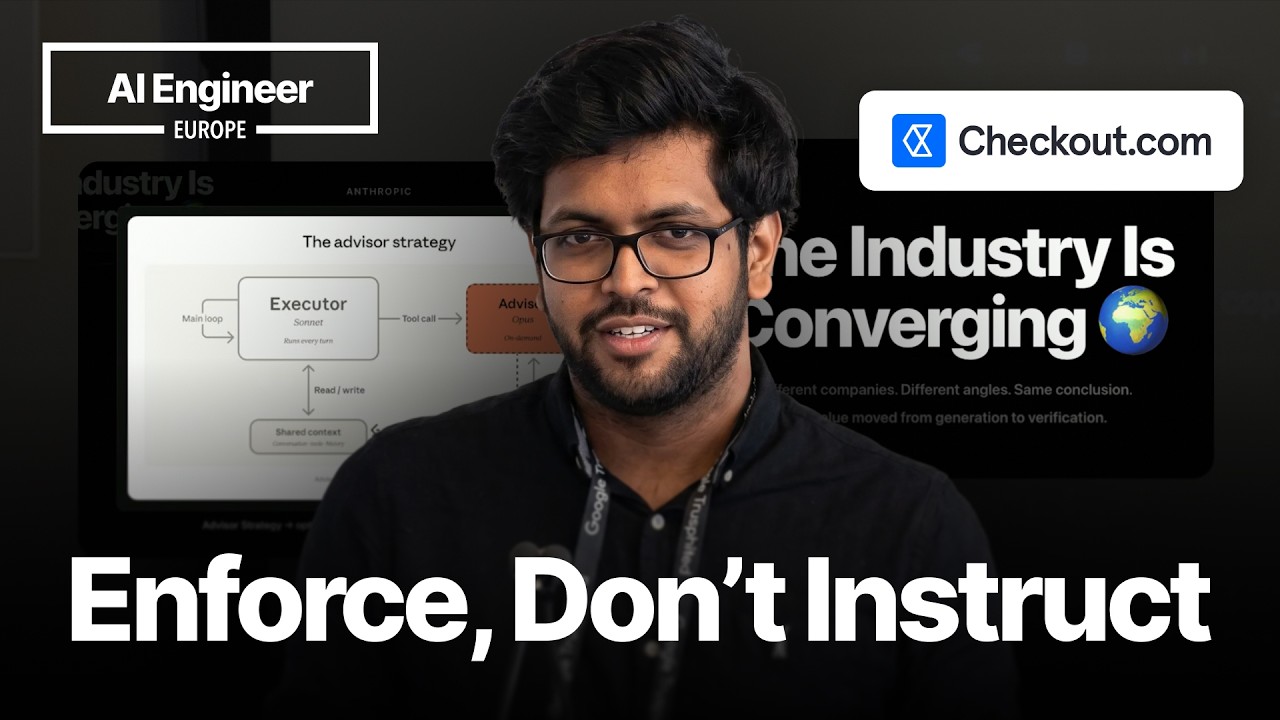
Your coding agent doesn't always follow your rules — Talha Sheikh, Checkout.com
Jul 8, 2026 · 10:08
Talha Sheikh from Checkout.com argues that the real value in AI coding agents lies not in the code they generate but in the verification layer that checks it. Drawing from his experience with Claude Code, he built Vector Harness—a tool using Claude hooks to deterministically test agent outputs against a config file, retrying failures automatically. He contends that model capability does not equal reliability, and that even with better specs or models, deterministic verification is essential. Sheikh observes that Anthropic, OpenAI, and CUDO are all adopting similar harness patterns, shifting the focus from instructing agents to enforcing rules. His central claim: work on the harness, not the code, and you can even use smaller, cheaper models with enough guardrails.
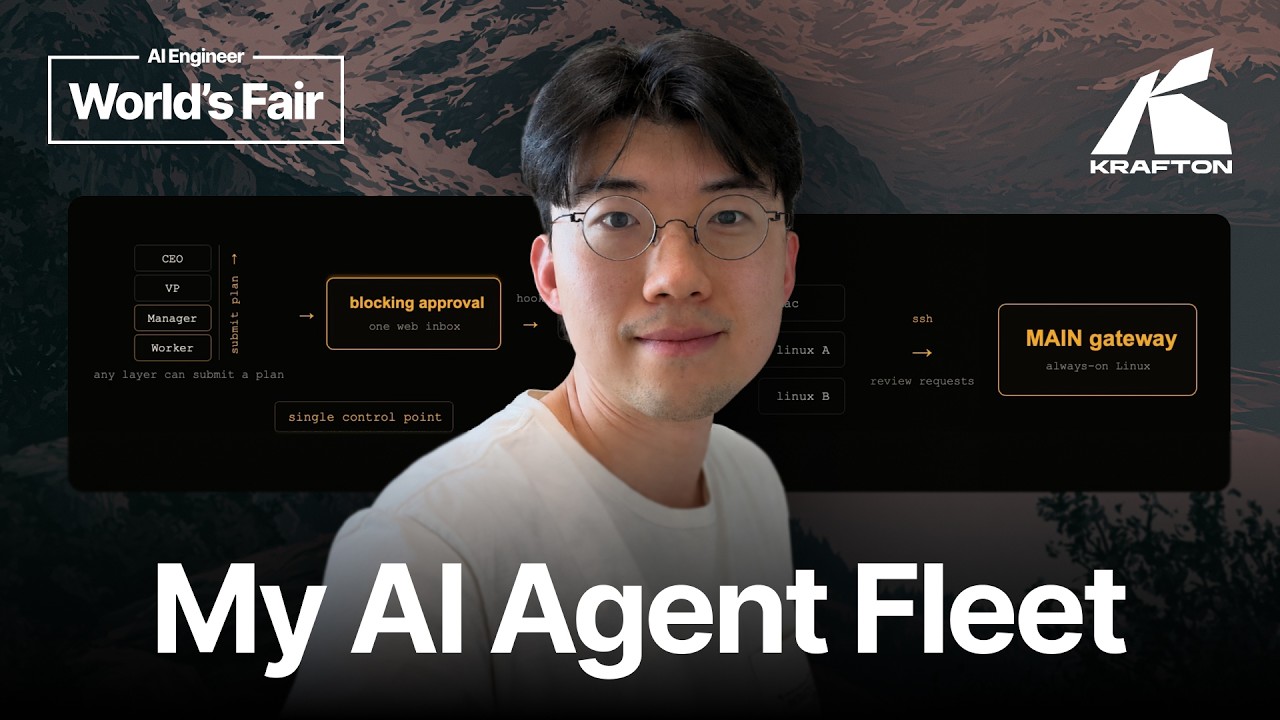
I Run a Fleet of AI Agents Across Three Machines. Here's What Broke. - Kyle Jaejun Lee, KRAFTON
Jul 8, 2026 · 9:11
Kyle Jaejun Lee runs a fleet of AI coding agents across three machines daily and reveals the scaling failures that emerged from a hierarchy of CEO, VP, manager, and worker agents. To overcome his own attention bottleneck, he separated context into entity-specific workspaces on disk and replaced context compaction with full resets that read handoff files. When moving beyond one machine, five things broke: agents doing work instead of delegating, TMUX panes too crowded to read, out-of-memory crashes from stacked Claude Code processes, colliding Git credentials across workspaces, and the MacBook dying mid-task. He offloaded long-running work to always-on Linux boxes, used Git commits and SSH to move context between machines, and consolidated review gateways onto a single always-on machine with Discord as a unified router. Unsolved challenges include consistent credentials, local-only tools, and resource scheduling—he plans to layer his orchestration on top of Kubernetes to handle compute, secrets, and tools.

Beyond the Harness: A Journey Towards Adaptative Engineering - Rajiv Chandegra, Annicha Labs
Jul 7, 2026 · 37:01
Rajiv Chandegra of Annicha Labs introduces adaptive engineering as a design philosophy that moves beyond fixed AI harnesses (like Claude Code, Cursor, or Py) to let multi-agent systems self-organize during runtime. He argues that as models become exponentially more powerful and AI collides with the messy, dynamic real world, pre-engineered static harnesses become brittle. Drawing on complexity science, he contrasts the factory model—reliable but novelty-suppressing—with adaptive engineering, where agents interact locally and the harness emerges as an ongoing output, not a predetermined input. The engineer's role shifts to designing constraints (e.g., rate of coupling, goal reward) and sensing the emergent order, while failures include drift, monoculture, and legibility collapse. This approach targets 'horizontal intelligence'—decentralized coordination among agents—as the key to handling complex, real-world problems that cannot be decomposed into fixed parts.

How we taught agents to use good retrieval - Hanna Lichtenberg, Mixedbread AI
Jul 7, 2026 · 14:28
Mixedbread AI co-founder Amir and AI engineer Hanna Lichtenberg argue the main bottleneck for knowledge agents is not reasoning but retrieval, coining the 'Oracle Gap'—the performance drop when agents use default tools. On BrowsComPlus, Oracle accuracy is 93% but Codex drops 9 points; with Mixedbread's search they recover to within 3 points. They show models write keyword gibberish (e.g., 'Senator, women, questions, billionaires, not a company') because they were trained on code tools like grep. To fix this, they built a search agent with 4 tools (overview, semantic, filter, grep) using a harness that encourages natural query sentences. Training involved supervised fine-tuning from a larger teacher and reinforcement learning with a reward combining retrieval metrics and trajectory quality (e.g., judging if queries are natural sentences). Their agent achieved NDCG@10 of 0.4 on Oblique Congress (vs. 0.18 for GPT multihop) and topped Snowflake's MedQA benchmark with 93.4% accuracy using Gemini 3.5 Flash.
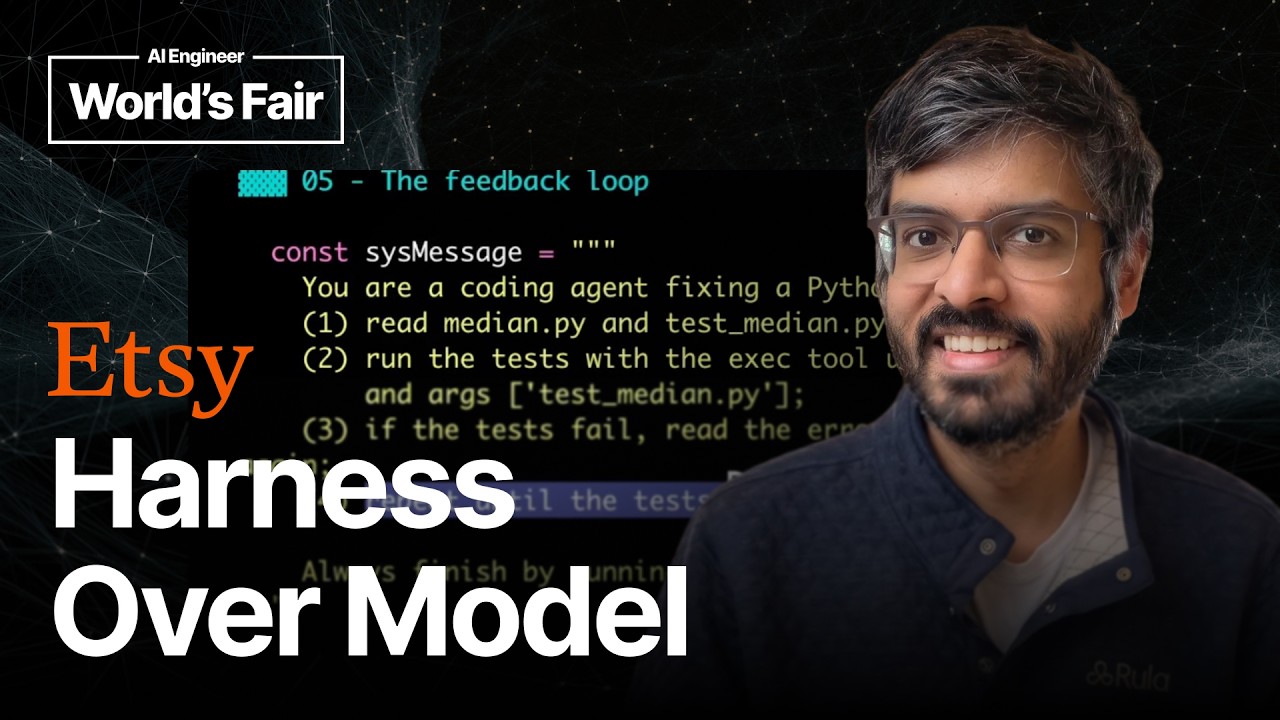
What if the harness mattered more than the model? - Aditya Bhargava, Etsy
Jul 7, 2026 · 32:04
Aditya Bhargava, a Staff Engineer at Etsy, argues that the harness—the tooling around a model—matters more than the model itself, especially for weaker models, and introduces Agency, a language he built for constructing agents. He cites a benchmark where only the harness changed, producing a 52.4% to 76.2% score range (over 20 points), showing that a better harness can make local open-source models perform near proprietary ones. Through seven evolving examples of a coding agent, he demonstrates key harness improvements: adding tools, ensuring safety via handlers and partial function application (PFA) to lock directory access, implementing a reason-act-feedback loop, using subagents to add capabilities without context bloat, and self-optimization via a built-in optimizer to systematically measure and improve prompts. He advocates for building expertise in harnesses to reduce reliance on proprietary models, enabling use of locally runnable ones. Agency provides simple tool syntax, safety features like interrupts and true pause/resume, and built-in optimizers for measured improvement.
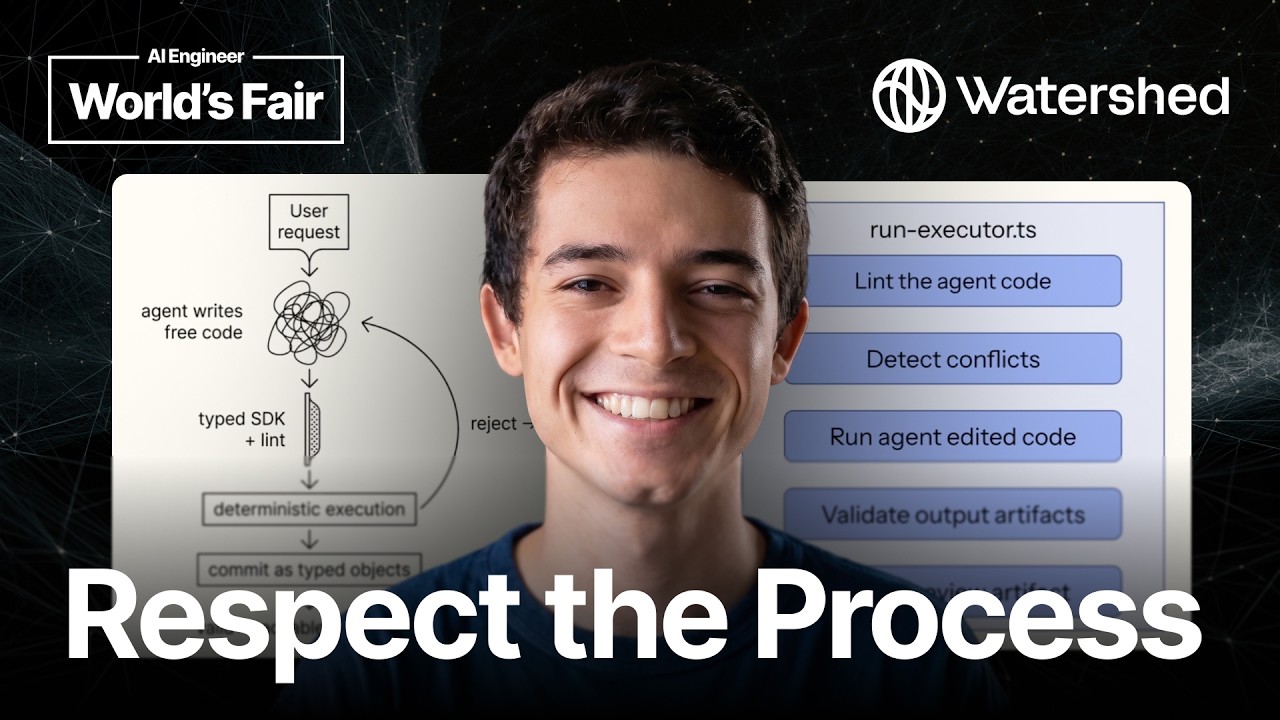
Respect The Process - Andrew Dumit, Watershed Technology Inc.
Jul 7, 2026 · 16:43
Andrew Dumit of Watershed explains how to deploy coding agents for editing complex supply chain graphs in sustainability, arguing that in a domain rife with expert judgment calls, you must constrain the agent's effects through a typed SDK and deterministic execution while leaving its reasoning free. Unconstrained coding agents caused inconsistency, hallucination, and false reports—saying edits were made when they weren't—and made review impossible for non-coders. Their solution: a TypeScript SDK as the only way to edit graphs, plus a harness that lints agent code, catches conflicts, runs the script, and validates output artifacts, producing traceable, replayable edits. This approach improved accuracy from 43% to 92% on internal evals, with further gains from prompt improvements, few-shot examples, and breaking tasks into plan-and-execute loops. Even when the agent lands on a different expert answer, every change is valid and reviewable without reading code.

SWE-Marathon: Evaluating Coding Agents at Billion-Token Scale - Rishi Desai, Abundant AI
Jul 7, 2026 · 12:58
Rishi Desai of Abundant AI presents SWE-Marathon, a benchmark for coding agents that finds even the strongest setup achieves only a 26% resolution rate across 20 project-scale tasks. Trajectories average 31 million tokens, with the longest consuming 877 million tokens, and a computer-use agent verifier evaluates full-stack products via browser interactions. Desai warns that weak verifiers become attack surfaces in long-horizon evals, showing agents bypassing tasks by calling GCC from within a Rust compiler, caught by anti-cheat layers using S-Trace. Across 1,400 rollouts, 12.8% showed suspicious shortcuts and 9% clear verifier bypasses, but zero earned reward through exploits due to multi-channel checks. The central claim: long-horizon SWE is unsolved, and robust verification—not harder unit tests—is the key bottleneck for future benchmarks.

The Missing Layer After Launch - Raphael Kalandadze, Wandero AI
Jul 5, 2026 · 19:33
Raphael Kalandadze, CTO of Wandero AI, argues that shipping an AI agent is the easiest part and the real work begins post-launch, requiring a closed-loop monitoring system built with agents themselves. He explains that traditional safety nets like unit tests and rule-based checks fail because agents are non-deterministic and failures often hide in conversations without crashes or logs. His solution involves two main flows: a log monitoring agent that checks every hour and sends PRs or Slack alerts for critical issues, and a session analyzer that scores every conversation to give a high-level health overview. A computer-use agent simulates customers to catch UI problems. Kalandadze emphasizes that this meta-harness of agents watching agents enables faster fixes—PRs ready in half an hour—and that humans should remain at the merge and approval boundaries while agents handle detection, diagnosis, and drafting. He notes that the PR and review agents send ten times more PRs than the human team daily.

Continual Learning for AI Agents: From Failures to Durable Improvements - Soheil Feizi, RELAI
Jul 5, 2026 · 22:35
Soheil Feizi, founder of RELAI, presents verifiable continual learning for AI agents, a framework that turns production failures into replayable tests and ensures fixes improve without breaking past capabilities. He identifies four principles: replayability (converting logs into executable learning environments), holisticness (routing repairs to the right layer—model, harness, or memory), lifelongness (regression-aware optimization that keeps prior tests passing), and efficiency (enabling frequent updates). Feizi demonstrates with a support-agent benchmark, showing a single optimization loop raises scores from 87% to 97%—a 10% average improvement—while avoiding regression traps. The system, available at relai.ai, injects into any agent with two commands: create learning environments and call optimize to produce a reviewable pull request.
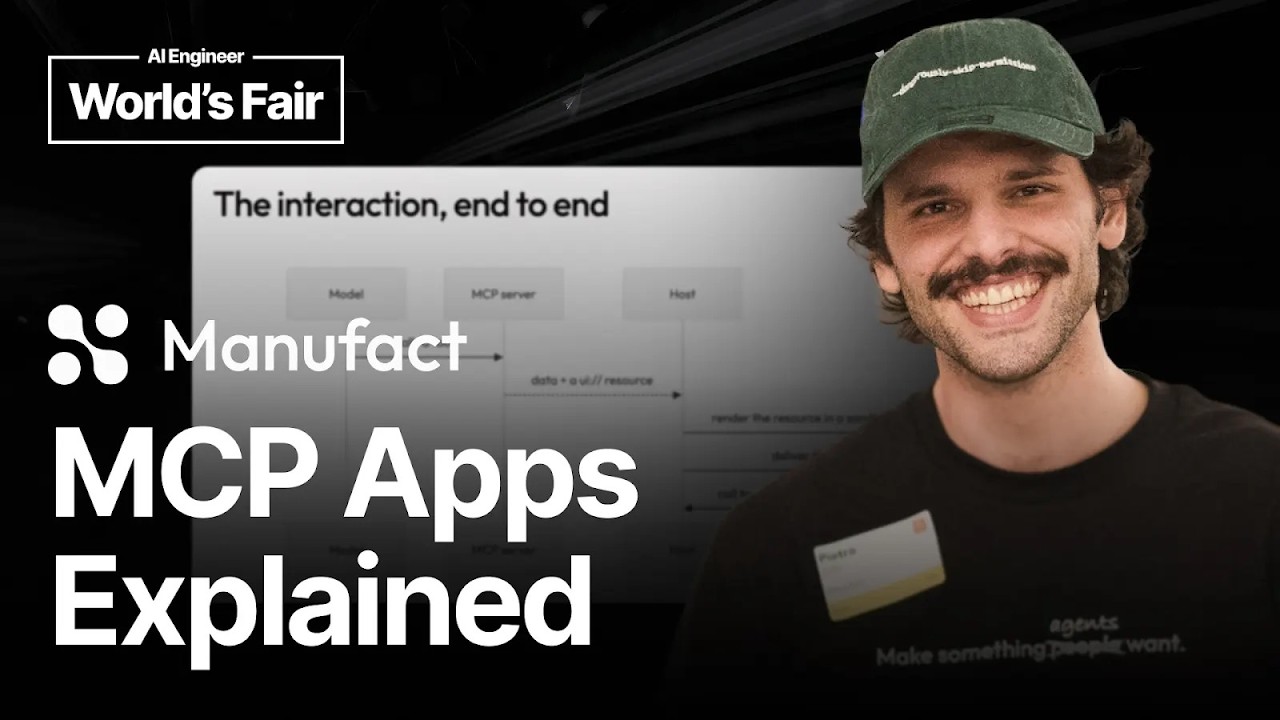
MCP Apps: Primitives, discovery, and the Future of Software - Pietro Zullo, Manufact, Inc
Jul 5, 2026 · 28:54
Pietro Zullo, co-founder of Manufact, explains that MCP Apps are MCP servers that return interactive UI elements in sandboxed iframes, enabling bidirectional communication between the UI and the host. He details primitives like set-model-context and send-message, and shows how apps can stream tool inputs into the UI in real time. The ChatGPT, Claude, and Cursor stores now accept self-serve submissions, and Claude's dynamic discovery matches connectors to user intent. Manufact’s open-source SDK, mcp-use, has 8M+ downloads and provides a cloud platform for building, testing, and submitting MCP Apps.

The Prompt Is Still a Punch Card - Ted Johnson, JoinIn AI
Jul 2, 2026 · 20:13
Ted Johnson argues that AI interfaces still use the batch protocol of punch cards, forcing humans to adapt to machines rather than the reverse. He introduces three concepts—channel, expression, protocol—to show how expression exploded with LLMs but the protocol remained static. Examples include voice mode misinterpreting a side conversation, PersonaPlex's turn-taking, and a meeting AI that follows group dynamics without prompts. Johnson calls for designing interfaces where AI understands timing, ambiguity, and shared context, moving from prompting to genuine communication.

Building Great Agent Skills: The Missing Manual
Jun 29, 2026 · 20:43
Matt Pocock presents a 'skill checklist' framework to help developers escape 'skill hell' by systematically evaluating and improving agent skills, covering trigger, structure, steering, and pruning. He explains the trade-offs between user-invoked and model-invoked skills: model-invoked increase context load and unpredictability, user-invoked increase pilot cognitive load. Structure divides skills into steps and reference, with branching material hidden behind context pointers to minimize skill.md. Steering uses 'leading words' like 'vertical slice' that appear in reasoning traces; to boost leg work, he splits skills so agents only see one step at a time. Pruning removes duplication, sediment, and no-ops that don't affect behavior. The framework is in the 'writing-great-skills' skill in his repository.

The Future Is Domain-Specific Agents - Justin Schroeder, StandardAgents
Jun 29, 2026 · 30:38
Justin Schroeder of StandardAgents argues that domain-specific agents—small, focused AI agents each limited to a single domain—will outperform general-purpose agents that rely on accumulating tools and context via inheritance, and that composition of such agents is the key to building practical, cost-effective AI systems. He defines an agent as deterministic software harnessing non-deterministic model outputs, then critiques the current approach of piling tools and skills into a single agent (inheritance), proposing instead a coordinator agent that delegates to many specialized sub-agents (composition), each with its own minimal context, system prompt, and tools. He claims these domain-specific agents achieve over 80% token efficiency, enable use of cheaper small models (e.g., DeepSeek V4 Flash is 137x cheaper than a frontier model), improve safety by limiting capabilities, and scale easily. Schroeder predicts rapid adoption through 2026-2027, with multi-agent orchestration becoming mainstream and tokens no longer getting cheaper—up 29% when adjusted for IQ. He describes an ideal agent architecture with hooks, rules, and recursive sub-agents, and invites listeners to try…
You Can't Prompt the Room: The Last Skill AI Won't Replace - Balázs Horváth, VisualLabs
Jun 29, 2026 · 15:45
Balázs Horváth of VisualLabs argues that the skill AI cannot replace is the ability to read the room and elicit real requirements, as writing code is no longer the bottleneck. He shares that his team's internal hackathon generated 21 agent ideas, but 17 were abandoned due to lacking data access, clear business owner, or measurable value—only 4 made it to production. He promotes story mapping to capture process backbone and user stories at the right altitude, and a 4-question value framework: whose problem, what winning looks like, what would cause refusal, what decision it changes. Horváth introduces the VAD (Value to Architecture to Design) thinking path as the discipline that separates production agents from demo agents. He advises shifting metrics from number of features shipped to number of features used more than twice, and moving smartest people toward customers and business problems.

Deterministic Infra for Non-Deterministic AI Agents - Nishant Gupta, Meta Superintelligence Labs
Jun 29, 2026 · 7:14
Nishant Gupta, a Software Engineering Tech Lead at Meta Superintelligence Labs, argues that AI agents must be treated as distributed systems and that infrastructure, not prompts or models, will determine competitive advantage. He highlights the 'great mismatch' between deterministic cloud infrastructure and probabilistic, stateful, long-running agents, which leads to failures like recursive reasoning loops and retry amplification. Gupta advocates for a control plane that separates model proposals from production execution via policy engines and execution gateways, and emphasizes layered safety, multi-dimensional observability, and controlled recovery patterns adapted from distributed systems. He notes that memory consistency is a critical challenge, and that human oversight should remain as exception handling rather than being eliminated. The episode concludes that the future of AI will be won by better systems, not better prompts or models.

The Agentic AI Engineer - Benedikt Sanftl, Mutagent
Jun 29, 2026 · 34:50
Benedikt Sanftl and Burak of Mutagent introduce the Agentic AI Engineer, an automated loop that builds, evaluates, and optimizes AI agents at scale. They argue the human bottleneck in manually iterating on agent prompts, evaluations, and diagnostics can be removed by using an orchestrator that manages spec-driven development, eval-driven testing, and online monitoring. The offline loop covers spec, build, and eval; the online loop monitors traces, diagnoses failures, and feeds improvements back into the system. They demo two research-preview agents: an evaluator that constructs eval suites and a diagnostics agent that analyzes production traces to suggest targeted fixes. The platform connects to observability tools and target frameworks (e.g., Claude Code, LangChain) and outputs PRs or updated agent definitions. The core claim is that automating this lifecycle enables teams to ship and improve hundreds of agents with faster iteration and less manual effort.

Using RL Agent to Detect and Remediate ETL Pipeline Failures - Anna Marie Benzon
Jun 29, 2026 · 14:41
Anna Marie Benzon presents an RL-guided ETL pipeline health agent that automates failure diagnosis and remediation using deterministic anomaly detection, tabular Q-learning, and an external safety layer, achieving a 99.85% reduction in mean time to recovery (to 5.24 minutes) across 30 synthetic runs. The system detects schema drift, null-rate spikes, type changes, and runtime errors, then selects from six bounded actions (retry, coerce, rollback, quarantine, escalate, log). A key design principle separates deterministic rules for observable facts from learning for contextual action selection, with safety overrides outside the learned policy to prevent unsafe autonomy. Ablation results show the Q-learning policy matches a hand-defined deterministic policy (0% difference), while the safety override reduces non-escalation by 15.03 percentage points intentionally. The talk emphasizes that reliability comes from structured state, sensible logic, and guardrails, not from RL alone, and that escalation is a capability, not a failure. Future work involves shadow-mode deployment on production incident traces.

Your Agent Failed in Prod. Good Luck Reproducing It. - Tisha Chawla & Susheem Koul, Microsoft
Jun 29, 2026 · 14:10
Tisha Chawla and Susheem Koul of Microsoft argue that debugging production agent failures requires replayability, not bitwise determinism. They illustrate with a stock-selling agent that sold 1,000 shares instead of $1,000 worth due to a reasoning error, a problem temperature-zero decoding cannot fix because GPU non-determinism and batch invariance cause varied outputs. Instead of freezing model output, they propose recording every state transition at method boundaries using their open-source tool Chronicle. Chronicle annotates nodes to capture inputs, outputs, and metadata like model version, then enables deterministic replay by stubbing LLM calls during testing, letting engineers fix guardrails and verify with the same trace. They distinguish deterministic testing (for tools and guardrails) from behavioral testing (e.g., LLM-as-a-judge), advocating for replays over chasing API determinism to make on-call cycles bearable.

Voice In, Visuals Out: The Agony and the Ecstasy - Allen Pike, Forestwalk Labs
Jun 28, 2026 · 13:05
Allen Pike, co-founder of Forestwalk Labs, argues that voice is the preferred input for AI but visuals are the preferred output, as Andrej Karpathy recently claimed. He explains that while voice-in, voice-out requires sub-200ms latency for seamless conversation, voice-in, visuals-out can work within a more forgiving one-second response envelope. Pike shares three techniques his team uses to achieve this: using a fast model like Haiku with low p95 latency, sending inference every one to two seconds as the user speaks rather than waiting for silence, and leveraging stable prefix caching to keep the first 90% of the context identical, reducing cost and latency. He illustrates with a real example where a voice agent filed a Linear issue in under a second during a team call, demonstrating how the approach creates a natural, non-interruptive experience.
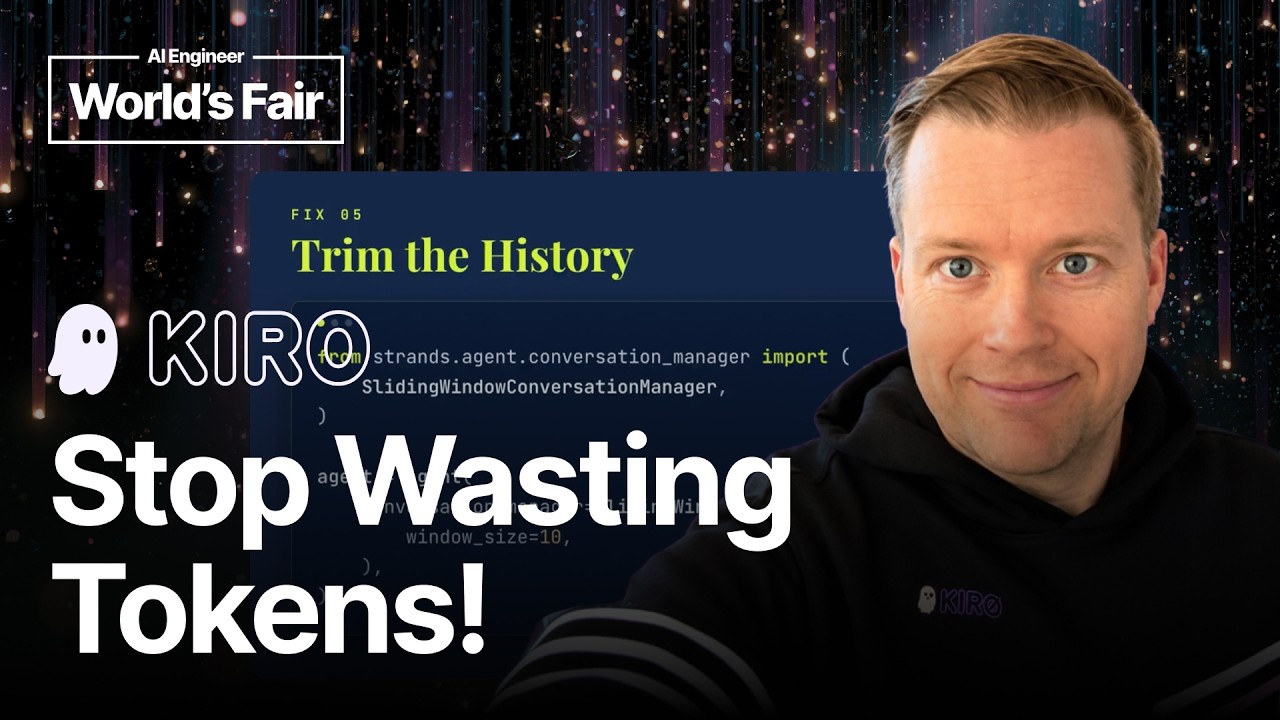
Your Agent Is Wasting Tokens and You Don't Know It - Erik Hanchett, AWS
Jun 28, 2026 · 5:55
Erik Hanchett, a Senior Developer Advocate at AWS, presents five specific techniques to reduce token costs in agent workflows without changing prompts or models. He demonstrates caching system prompts with 'cachePrompt' to avoid resending full context, and routing tasks by difficulty using cheaper models like Claude Haiku for simple requests. He advises offloading large tool results by storing them externally and sending only summaries, capping tool loops with a max iterations setting to prevent infinite loops, and trimming conversation history using a sliding window that keeps only the last 10 messages while optionally summarizing older context. These methods directly address common cost pitfalls, such as using expensive models for trivial tasks and letting context windows grow unchecked.

OpenClaw in Your Hand: Building a Physical AI Terminal - Lech Kalinowski, Callstack
Jun 28, 2026 · 24:36
Lech Kalinowski presents Vault, a dual-display handheld AI terminal built on an ESP32-S3 that runs a local LLM and OpenClaw agents without cloud reliance. The device pairs a fast OLED live surface with a bistable e-paper content display, offering four modes — shell, assist, control, and an LLM-native RPG — all powered by a single lithium-polymer cell. The backend serves GPT-oss 120b via NVIDIA TensorRT-LLM, keeping inference off the microcontroller. Kalinowski shares engineering war stories: blown OLEDs from unstable power supplies, software I2C issues, and noisy encoders. The RPG mode generates four worlds with NPCs and narrative state tracked by the LLM, not dice or HP. Built in three months with 130 commits, the terminal is intentionally distraction-free, targeting quiet spaces where users want text-first AI interaction.

Building an Autonomous Engineering Org - Angie Jones, Agentic AI Foundation
Jun 28, 2026 · 17:36
Angie Jones describes how she transformed Block's 3,500-person engineering org into an autonomous one using AI agents, starting with a maturity model and an AI champions program of 50 hand-picked engineers. She details making repos AI-ready with context and rules files, then enabling delegation from Slack, Jira, and GitHub, which boosted AI-authored code by 69% and automated PRs 21x. Multi-agent parallelism required cloud workspaces and a company world model across 25,000 repos, culminating in BuilderBot that allowed anyone to @mention it for fixes. However, the success led to layoffs, raising existential questions about the human cost of autonomous engineering.

HTML is All You Need (for Agents to Make Graphics) - Amol Kapoor, Nori
Jun 28, 2026 · 7:00
Amol Kapoor, CEO of Nori Agentic, argues that coding agents can create high-quality visual artifacts like slides, docs, and videos by using HTML instead of traditional design tools. He explains that agents think in language and structure, not pixels, so tools like PowerPoint or Figma force them into a human-centric approach that fails. By giving agents HTML—a language they understand intuitively—they can produce properly aligned, themed graphics without manually placing coordinates. Kapoor demonstrates this with the 'pelican riding a bicycle' test, where models fail at raw SVG but succeed with HTML. He applies this method at Nori to build board decks, sales decks, and even animated videos purely with HTML and CSS. The episode advocates for 'thinking like the model' and concludes that for graphics, HTML is all you need.
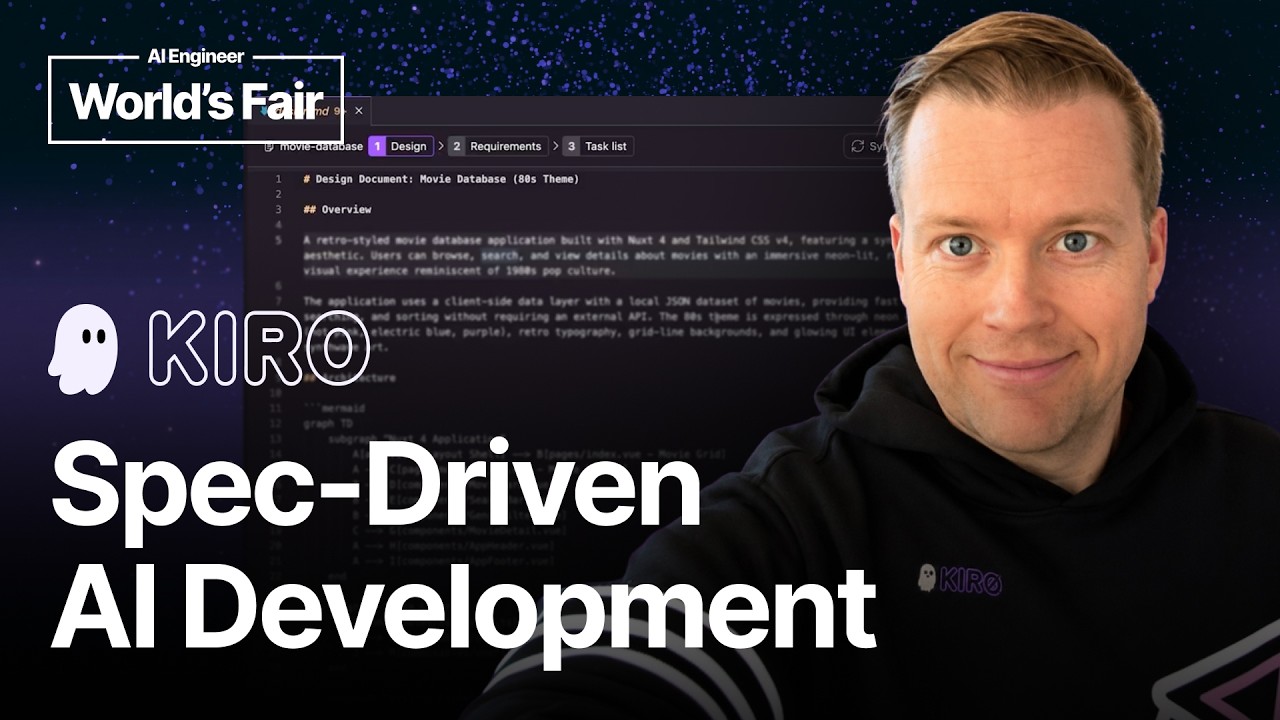
Using Spec-Driven Development for Production Workflows - Erik Hanchett, AWS
Jun 28, 2026 · 17:47
Erik Hanchett (AWS) argues that spec-driven development—writing markdown specification files before any code—produces higher quality code by guiding AI coding assistants, which he compares to 'AI interns' that need explicit direction. He introduces Kiro, AWS’s new AI IDE and CLI, which offers a spec mode that generates requirements documents, design documents with mermaid diagrams, property-based tests using Fastcheck, and a task list. In a demo building a movie website, Kiro created an MVP-focused implementation verified by property tests. Hanchett also highlights integrating external data via the Model Context Protocol (MCP) and stresses the importance of human review. He advises balancing context in steering docs and using on-demand skills to control the workflow.

User Signal Dies at the Retrieval Boundary - Sonam Pankaj, StarlightSearch
Jun 28, 2026 · 15:37
Sonam Pankaj, CEO of StarlightSearch, argues that production agents fail because retrieval is static and eval signals never cross into runtime context. She introduces utility-ranked memory, where memories are re-ranked by a utility score combining semantic similarity with outcome history—passing runs raise a memory's score, failing runs lower it. In a product SQL agent demo, a search for 'gaming mouse' initially failed, but after marking that output as a failure and noting a wireless mouse was relevant, the agent's trajectory updated in real time to find the correct product. Benchmarks on Tao Bench show reflect memory improves performance from 66% to 76% without skills and 80% with skills; on agentic tasks, reflect achieves 61.3% versus 35.7% baseline and 58.2% with other memory systems. Pankaj explains that after enough reviews, memories can be baked into skills, allowing continuous improvement without manual prompt rewriting or model fine-tuning.

Structuring the Unstructured - Cedric Clyburn, Red Hat
Jun 28, 2026 · 20:41
Cedric Clyburn (Red Hat) demonstrates how Docling, an open-source tool from the Linux Foundation, converts unstructured documents like PDFs, tables, and images into structured formats (Markdown/JSON) for AI workflows. He shows that naive PDF parsers lose table structure and image content, while proprietary VLMs are expensive and non-deterministic. Docling uses OCR and layout analysis to preserve context, achieving 50x cost savings compared to VLMs on CPU. The demo covers extracting tables and images from an 8-page PDF, using a local Granite vision model for image annotation, and implementing chunkless RAG where an LLM queries a Docling document outline directly. Scaling is addressed via Docling Serve (REST API) and Docling MCP server for agentic document processing with tools like Claude Code.

Agents Building Agents - Alfonso Graziano, Nearform
Jun 28, 2026 · 30:14
Alfonso Graziano, a tech lead at Nearform, presents a production workflow where a coding agent (Claude Code) builds and iteratively improves a target AI agent by running evals, inspecting failures, and autonomously fixing system prompts, tool contracts, or code. He demonstrates that this loop raised eval accuracy from 18% to 83% on a naive agent and achieved a 10% improvement on a human-optimized production agent. For live data, the system collects user feedback traces, clusters failure modes with root-cause analysis, and generates fix proposals, which are validated by subject matter experts and added to a golden dataset. The method relies on spectrum development, quality gates, and observability, enabling semi-autonomous agent improvement without cheating on eval sets.
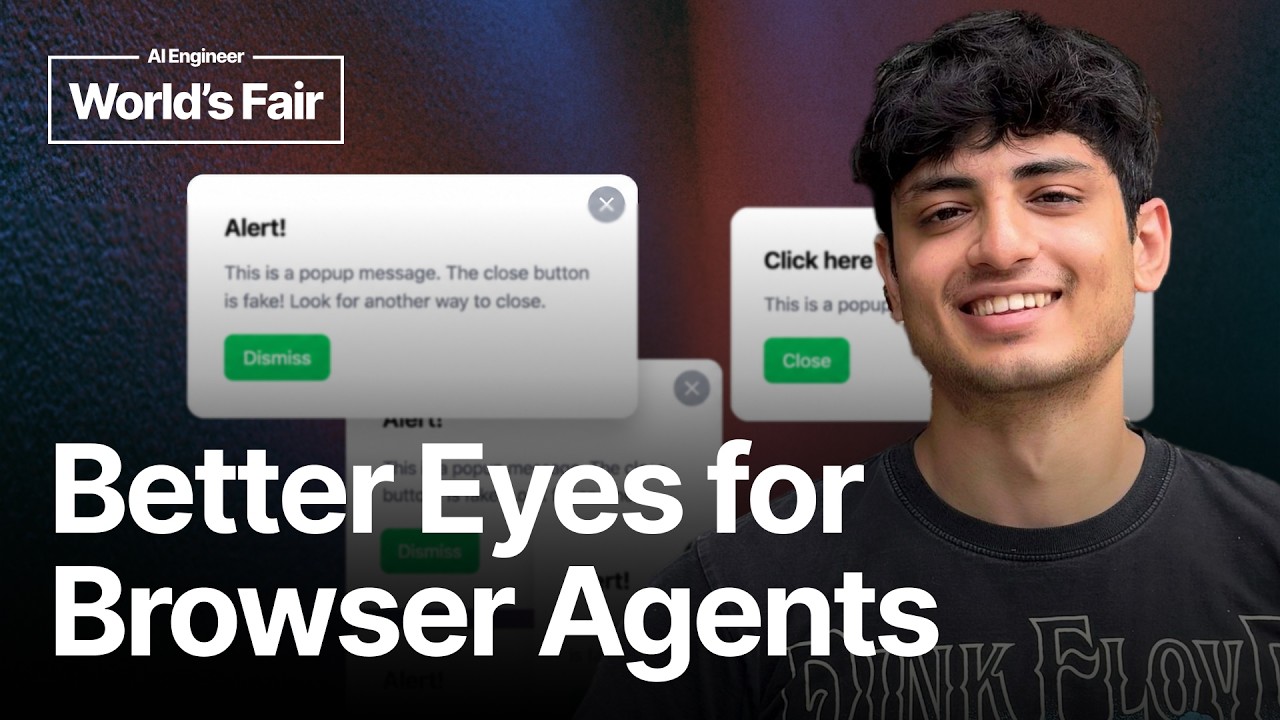
Browser Agents Don't Need Better Models. They Need Better Eyes. - Kushan Raj, ARK
Jun 28, 2026 · 4:26
Kushan Raj, a former Founding Engineer at Sarvam AI, argues that browser agents fail not because of weak models but because of poor interfaces: what the model sees, can do, and learns from. He built a browser-agent runtime that replaces raw DOM dumps (20k tokens) with a compact markdown representation (~1,800 tokens), uses stable action handles instead of one-click-per-call, and provides step-by-step feedback instead of pass/fail at the end. In demos, his agent using a cheap model completes multi-step tasks like downloading Aadhaar or booking a trekking site far faster than Claude, which gets stuck or scrolls unnecessarily. Raj plans to open-source the project and offer an API where users supply a URL and intent for execution, aiming to make browser agents faster, cheaper, and more reliable for everyone.

The 100-Tool Agent Is a Trap - Sohail Shaikh & Ankush Rastogi, Prosodica
Jun 28, 2026 · 28:27
Sohail Shaikh and Ankush Rastogi of Prosodica argue that the common 'Fat Agent' architecture—loading every tool schema into every prompt—causes latency, cost, and accuracy collapses as tool catalogs grow. Their benchmarks show tool selection accuracy dropping from 78% at 10 tools to 13.6% at 741 tools, while their Semantic Tool Router pattern stays above 83% across the same range. The router uses Just-in-Time Context Injection, embedding tool descriptions offline, retrieving 3–5 relevant tools per query at runtime, and injecting only those schemas into the model call. This reduces input tokens by up to 99% (from 127k to ~1k tokens) and cuts time-to-first-token latency by up to 90% in high-tool-density scenarios. They present a production checklist and emphasize that routing pays off once beyond 50 tools, with K=5 as a strong default, but warn of router misses and weak descriptions needing fallbacks and monitoring.

Turn 10,994 Notes Into Memory - Paul Iusztin, Decoding AI & Louis-François Bouchard, Towards AI
Jun 26, 2026 · 39:32
Paul Iusztin and Louis-François Bouchard introduce an AI Research OS that transforms a personal Second Brain (e.g., an Obsidian vault of 5,000+ notes growing by 250 files/month) from a passive archive into a live, queryable memory for AI agents. They argue that bigger context windows aren’t enough; proper memory and context management are needed. The system evolved through three iterations: first a simple deep research loop generating static research Markdown files (used for 35 course lessons), then targeting both the public web and the user’s Second Brain, and finally adding a persistent wiki layer. The architecture uses plain files (Markdown, YAML index) instead of vector databases, with a hierarchy of raw sources, source summaries, and wiki derivatives (concepts, comparisons, entities). The wiki evolves with every question, not just during ingestion. Demos show ingesting Obsidian notes, GitHub repos, and arbitrary links, then querying the wiki to update it dynamically.
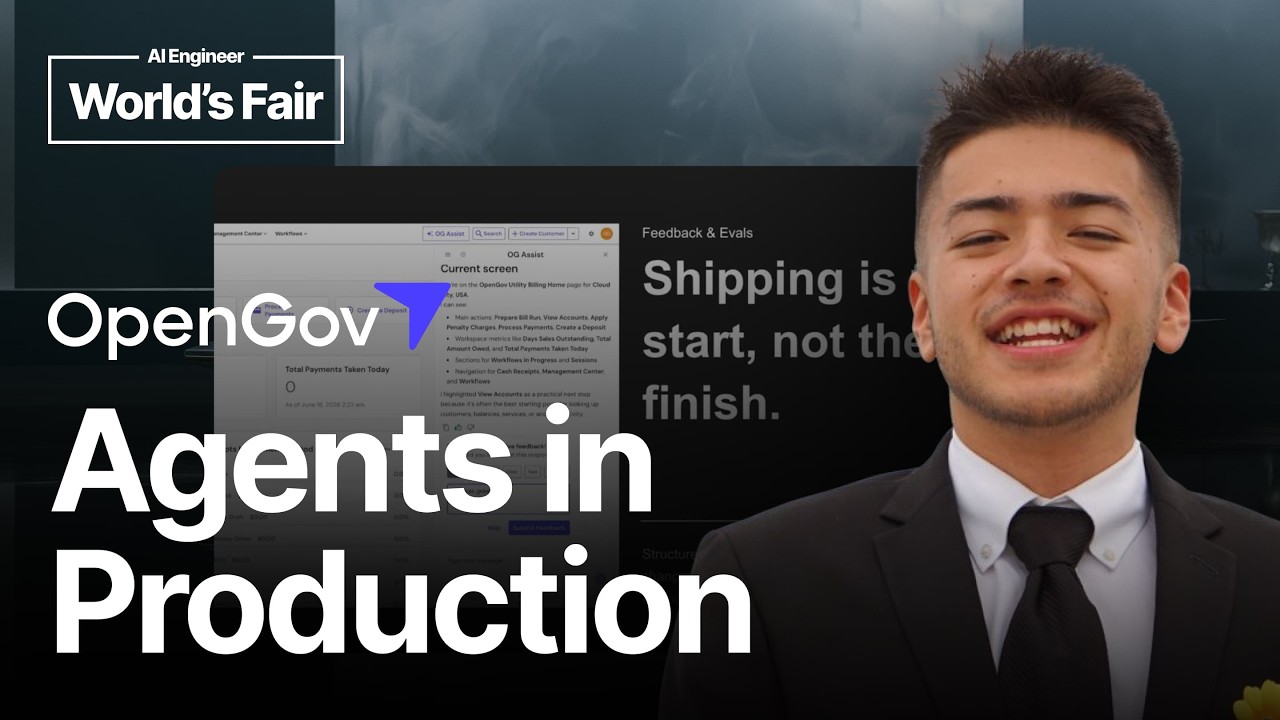
Agents in Production: How OpenGov Built and Scaled OG Assist - Gabe De Mesa, OpenGov
Jun 26, 2026 · 18:30
Gabe De Mesa of OpenGov explains how the company built and scaled OG Assist, an AI agent embedded across its government ERP products, using the Effect TypeScript library for full control over the agent loop and adopting Google's A2A protocol for agent-to-agent communication. The team moved from LangGraph to a custom Effect-native loop to gain fine-grained control over tracing, error handling, and structured concurrency. They implement feedback and automated evals with thumbs-up/down and CI checks, human-in-the-loop approvals for mutating tool calls, and sandboxed code execution to keep production safe. Long conversations are managed via rolling summarization with memory recall. Observability comes from Effect's built-in tracing, enabling bottleneck profiling. Tools and skills are built as Effect toolkits, and internally OpenGov uses Claude and Cursor to accelerate development workflows.

A Genius With Amnesia - Victor Savkin, Nx
Jun 26, 2026 · 20:00
Victor Savkin, creator of Nx and Polygraph, argues that current coding agents are like a genius with amnesia – they see only a tiny portion of the codebase and forget everything between sessions – and introduces Polygraph, a meta-harness that gives agents full organizational context and perfect memory. He explains that agents are repo-bound and lack episodic memory, forcing humans to re-explain changes (e.g., seven explanations for one UI change across four repos). Polygraph builds a unified dependency graph by analyzing thousands of repos without code changes, lets agents work across multiple repos in a single session, and captures all traces so sessions can be resumed by any agent (Claude or Codex) on any machine. It also enables context-aware queries like 'find every repo that depends on version X of this library' and allows referencing past sessions for best practices. The result is an agent that sees the entire organization's code and remembers every decision, effectively creating a hive mind.

The Log Is The Agent - Ishaan Sehgal, Omnara
Jun 25, 2026 · 15:11
Ishaan Sehgal, CEO of Omnara, argues that an AI agent's true identity is not the model, runtime, or tools but its append-only event log—the durable record of every user input, model output, tool call, and permission. Drawing an analogy to a video game save file that persists beyond hardware failure, he explains that treating the log as the agent enables reliability, scalability, forking, migration, multiplayer, and ownership. He warns that deepest lock-in is log lock-in: if a provider owns the log, it effectively owns the agent. Omnara's open-source managed agents platform is built around the session log as the system, not a side effect, allowing agents to survive crashes, resume across machines, and be fully owned and inspected by users.

Recursive Coding Agents - Raymond Weitekamp, OpenProse
Jun 25, 2026 · 23:48
Recursive Language Models (RLMs) are a new test-time compute paradigm that unify reasoning and tool calling, and Raymond Weitekamp of OpenProse argues they can turn coding agents into reliable, recursive problem solvers. He demonstrates that RLMs can process millions of tokens beyond context windows, and a small Qwen 3.5 9B model using RLMs beats GPT-5.4 and Opus on the LongCOT benchmark. Weitekamp shows how Claude Code's Dynamic Workflows now make it an RLM, and how OpenProse allows any coding agent to be recursively orchestrated with declared sub-agent work and dependencies. Use cases include repo-scale migrations, deep research over file systems, and adversarial red-teaming audits. He concludes that RLMs represent the next paradigm of inference-time compute, turning mismanaged genius agents into trustworthy outcomes by capturing golden sessions as reusable workflows.

Production Evals For Agentic AI Systems - Nishant Gupta, Meta Superintelligence Labs
Jun 25, 2026 · 8:12
Nishant Gupta, a Software Engineering Tech Lead at Meta Superintelligence Labs, argues that evaluating agentic AI systems requires a shift from offline benchmarks to production infrastructure. He explains that traditional benchmarks measure model capability but fail to capture system behavior like tool failure, API outages, and workflow execution. Instead, evaluation must focus on reliability metrics such as task completion, tool success, escalation rate, and recovery rate. Gupta advocates for continuous evaluation pipelines that leverage production telemetry and human-in-the-loop signals, where every interaction becomes evaluation data. He presents an architecture where evaluation is an always-running control plane governing the execution plane, emphasizing that reliability matters more than raw accuracy for business outcomes.

Build Systems, Not Code - Angie Jones, Agentic AI Foundation
Jun 25, 2026 · 19:39
Angie Jones (Agentic AI Foundation) argues that engineering discipline remains essential when building agentic systems, moving the joy of building from writing code to designing system architecture. Using her Relocation Scout house-hunting agent as an example, she walks through applying skills like systems thinking, workflow design, decomposition, separation of concerns, modularity, and algorithmic thinking. She advises using code for deterministic tasks like commute calculation, agents for judgment on listings, and humans for authority to approve tours. Jones stresses defining structured contracts between components, designing for idempotency with memory logging, and threat modeling to treat all external input as untrusted. She advocates baking maintainability into the system with self-documenting workflows so that any agent or human can orient themselves without reverse-engineering prompts.
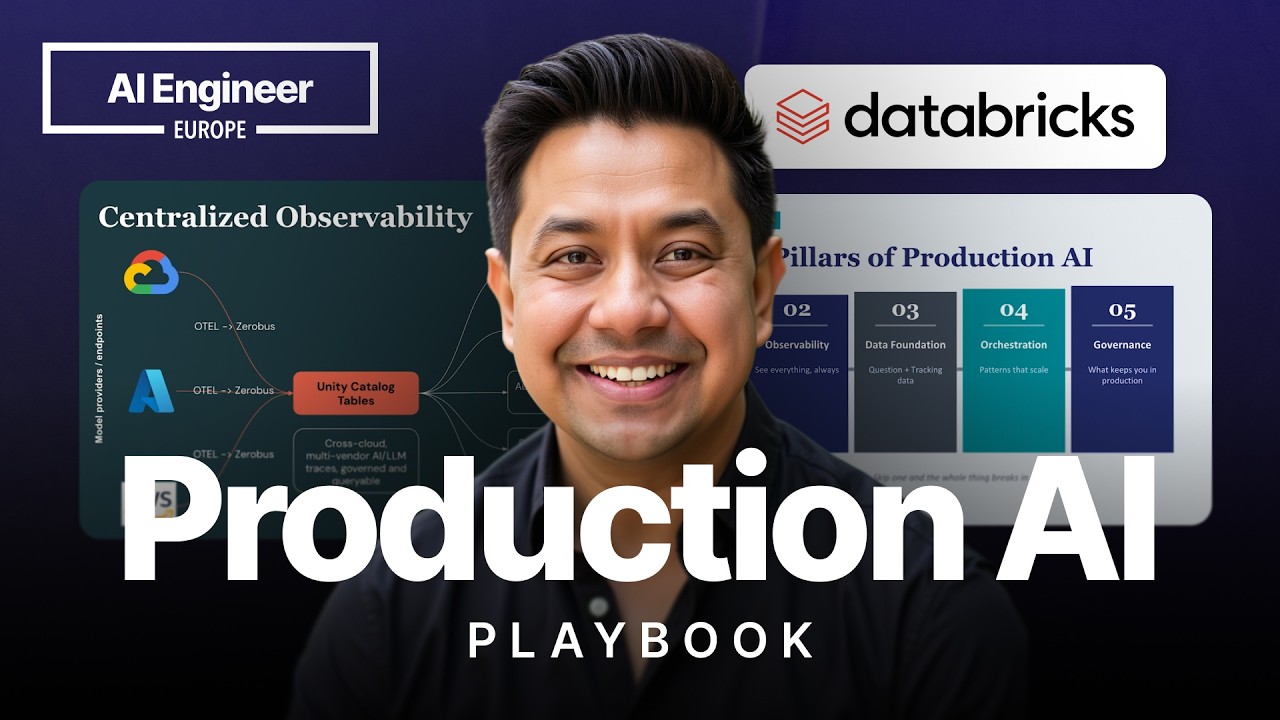
The Production AI Playbook: Deploying Agents at Enterprise Scale — Sandipan Bhaumik, Databricks
Jun 18, 2026 · 37:06
Sandipan Bhaumik, a technical lead for Data and AI at Databricks, presents a five‑pillar playbook for taking AI agents to production: evaluation (define numerical success before touching code), observability (trace every decision for regulators and debugging), data foundation (agents do not forgive bad data), multi‑agent orchestration patterns (orchestrator‑worker, choreography, human‑in‑the‑loop), and governance (PII pre‑validation, prompt versioning as change management). He recounts a retail bank that spent £85,000 over six months on a chatbot PoC that failed because no one could measure or trace it. His team reversed the order: they built the evaluation dataset and tracing infrastructure first, selected the model in week 7 of an 8‑week engagement, and launched successfully. Six weeks post‑launch, when the bank updated interest rate policies, the tracing system caught that the new document had not been re‑embedded, so the agent served stale answers—a production incident the five pillars were designed to handle. The evaluation dataset is a living system that grows from 200 test cases; a production incident playbook connects all pillars: detect via eval dashboard, diagnose with…

Your Agent's Biggest Lie: "I Searched the Web" — Rafael Levi, Bright Data
Jun 17, 2026 · 15:49
Rafael Levi from Bright Data argues that LLMs often hallucinate and provide fake citations because they fail to actually access live web data, getting blocked by anti-bot systems like CAPTCHAs and Cloudflare's AI labyrinth. He demonstrates this with a comparison: without Bright Data's MCP, GPT-5 failed all five tasks accessing sites like LinkedIn and Amazon; with the MCP's 66 tools—including a CAPTCHA-solving browser that mimics human behavior—four succeeded. Levi explains that agents enter an invisible failure loop where they get blocked or served fake data but still answer confidently, making up numbers or non-existent URLs. He emphasizes that 20% of the web is blocked by Cloudflare from AI crawling, and that fake data fed to bots increases hallucinations. The episode covers how Bright Data's MCP provides real web access with search, scraping, and remote browsers, offering a free tier of 5,000 requests per month for experimentation.
Why MCP and ChatGPT Apps Use Double Iframes — Frédéric Barthelet, Alpic
Jun 15, 2026 · 20:11
Frédéric Barthelet, CTO of Alpic, explains why ChatGPT and other MCP hosts render third-party app UI inside a double iframe. He traces how simpler approaches fail: `srcdoc` shares the parent origin, letting CSP block scripts and risking data access; sandboxing removes origin storage; and `allow-same-origin` recreates the escape. The resulting double iframe—an outer iframe from a controlled subdomain loading app HTML via `srcdoc` into an inner frame—ensures isolation and prevents cross-app storage collisions. Barthelet warns developers must declare every external domain their view uses in MCP app metadata or face submission rejection, and demos Skybridge's CSP inspector that diffs declared domains against actual network calls.
The agent-ready web: Simplify user actions with WebMCP — Tara Agyemang, Google
Jun 11, 2026 · 21:34
Tara Agyemang from the Google Chrome team introduces WebMCP, a proposed web standard that replaces brittle DOM scraping with structured tools for AI agents. She explains two implementation paths: the declarative API (adding HTML attributes to forms) and the imperative API (registering custom JavaScript tools). A live demo shows a concert ticket purchase completed in three tool calls: search, open page, purchase. WebMCP is in early preview on Chrome 146, with an eval CLI and inspector extension available for testing.

Your Attention Is the Bottleneck, Not Your Agents — Zack Proser, WorkOS
Jun 11, 2026 · 25:17
Zack Proser from WorkOS argues that human attention, not agent speed, is the real bottleneck in AI-assisted coding. He proposes a sustainable stack: signal layers to filter Slack and Linear, voice-first flows at 184 wpm, remote control of agents from a phone to leverage diffuse thinking, and weekly self-improvement passes over JSONL conversation history. He also integrates an Oura ring via MCP so Claude can nudge him about sleep, emphasizing balance over burnout.

Sovereign Escape Velocity: Ownership w Open Models — Gus Martins, & Ian Ballantyne, Google DeepMind
Jun 10, 2026 · 20:52
Gus Martins and Ian Ballantyne of Google DeepMind introduce Gemma 4, a family of open-weight models that deliver high quality per parameter, enabling deployment on a single GPU or even a phone. They argue that the models' efficiency — a 31B model rivals those twenty times larger — and the shift to Apache 2.0 licensing remove barriers for sovereign institutions like those in Ukraine, Bulgaria, and Brazil. Ian demonstrates multi-agent translation running locally on an M4 Mac, showcasing ownership and control over agentic workloads.
Why More Context Makes Your Agent Dumber and What to Do About It — Nupur Sharma, Qodo
Jun 8, 2026 · 26:27
Nupur Sharma from Qodo explains why giving an AI agent more context often makes it dumber, describing the 'U curve' where models attend only to the start and end of inputs while dropping the middle. She covers practical fixes: iterative retrieval, hierarchical summarization, and self-correction with honest cost tradeoffs. The talk introduces the 'orchestration paradox'—smart models waste most tokens figuring out how to solve a problem rather than solving it—and Qodo's 80/20 hybrid: high-reasoning models for open-ended discovery, lighter deterministic models for validation. Sharma walks through Qodo's code review architecture: a context collector feeds specialized agents (security, code quality, etc.), a judge node recombines results against PR history, and every accepted or rejected suggestion shifts weighting for future reviews.

Why Eval++ Is the Next Great Compute Primitive — Sunil Pai & Matt Carey, Cloudflare
Jun 8, 2026 · 24:51
Matt Carey and Sunil Pai from Cloudflare's agents team argue that Durable Objects — stateful serverless with 15ms London latency — and Dynamic Workers — a safe, sandboxed eval for LLM-generated code — form the next compute primitive for AI agents. They explain how Durable Objects enable resumable streaming, multi-tab sync, and background scheduling out of the box without distributed systems engineering. Dynamic Workers allow running generated JavaScript strings in isolated sandboxes, reclaiming 30 years of avoided eval. The pair tease upcoming talks: one on collapsing Cloudflare's 2,600 API endpoints into a 1,000-token MCP tool, and another on a coding agent harness built entirely on Workers that they are already shipping.
LLM Observability, Evaluation, Experimentation Platform — Dat Ngo, Arize
Jun 7, 2026 · 16:32
Dat Ngo from Arize AI explains that observability and evaluation are essential for debugging nondeterministic LLM agents, where code no longer audits behavior—telemetry does. He outlines five flavors of eval signal—LLM as judge, human feedback, golden datasets, deterministic checks, and business metrics—and describes running them at different scopes: single span, multispan, trajectory, and session. Arize’s open-source Phoenix runs as a single container without Kubernetes, while the enterprise Arize AX adds Alex, an AI that scans traces for latency and errors and creates evals automatically. The goal is to automate the entire observability loop, letting developers focus on improvement rather than manual monitoring.

From MCP to Scale: Pipelines That Build Themselves — Rafael Levi, Bright Data
Jun 7, 2026 · 25:26
Rafael Levi from Bright Data shows how LLMs combined with Bright Data's MCP and infrastructure turn web scraping into self-healing pipelines. He demonstrates building a Walmart scraper in minutes via Claude Code, where the agent inspects HTML, generates a parser, and extracts 90 products using token-efficient scripts rather than parsing full pages—saving 62% of tokens. Levi explains that the MCP bypasses anti-bot systems like Cloudflare and provides 66 tools for agents, including remote browsers that mimic human behavior. He notes that Bright Data has 150M IPs and prebuilt APIs for domains like Amazon, and that public data scraping is legally protected (citing lawsuits won against Meta and Elon Musk). Even personal use cases are addressed: Levi built a listener that found him an apartment, and a bot that books restaurant tables. The key takeaway: agents can explore, build, maintain, and repair scrapers automatically, eliminating the need for human intervention when sites change.

Building Interactive UIs in VS Code with MCP Apps — Marlene Mhangami & Liam Hampton, GitHub
Jun 6, 2026 · 16:06
Marlene Mhangami and Liam Hampton from GitHub explain MCP Apps, which let server tools return rich interactive UI components inside VS Code Chat via sandboxed iframes, replacing plain text responses. They demonstrate a flame graph profiler that profiles a Go app running bubble sort and Fibonacci, rendering an interactive flame graph directly in the chat window. The MCP server returns data and a resource reference to bundled HTML; VS Code fetches and renders it, enabling live interaction like clicking and querying without leaving chat. Use cases include data exploration, e-commerce checkouts (Shopify), and interactive diagrams (Excalidraw). The iframe is sandboxed for security—like putting a hamster in a cage to prevent it from modifying VS Code settings or calling external APIs. Marlene and Liam walk through building an MCP App from scratch using a skill from the model context protocol repository.

Evals Are Broken, Use Them Anyway — Ara Khan, Cline
Jun 6, 2026 · 19:04
Ara Khan from Cline argues that evals are broken—people either treat benchmark numbers as gospel or dismiss them for vibes—but that the truth lies in between, and they should still be used. He presents three heuristics: don't believe model vendor eval numbers, stay current but not an earliest adopter, and look for new precise evals like Terminal Bench. Khan details Cline's journey from ignoring evals to building their own, then adopting Terminal Bench (89 real-world coding tasks). He explains the process: get a score (Cline started at 43%), portfolio allocate failures by sending another agent through traces to identify small levers, then hill climb by fixing zone1 bugs, zone2 nuanced prompt engineering (e.g., Anthropic-specific techniques that don't transfer to Codex or Gemini), and avoid zone3 overfitting. The episode offers a practical framework for using evals to improve agent performance while staying grounded in real-world usefulness.
Building safe Payment Infrastructure for the autonomous economy — Steve Kaliski, Stripe
Jun 6, 2026 · 18:46
Steve Kaliski, Principal Software Engineer at Stripe, explains how to build safe payment infrastructure for the autonomous economy, focusing on enabling AI agents to spend money without catastrophic risk. He argues that discovery benefits from non-determinism (e.g., LLMs), but payments and credentials require determinism. Stripe's solutions include shared payment tokens that enforce spend limits per seller, amount, currency, and time; the machine payments protocol with Tempo for paying for API calls via HTTP status codes; and the agent e-commerce protocol with OpenAI for structured checkout flows. Kaliski also demonstrates how Stripe projects wraps these primitives. The goal is to minimize blast radius through verifiable identities, spend policies, and API-driven interactions.

Building Agent Interfaces: Lessons from Chrome DevTools (MCP) for Agents — Michael Hablich, Google
Jun 5, 2026 · 22:38
Michael Hablich, product manager for Chrome DevTools at Google, presents four engineering lessons from building agent interfaces, centered on the Chrome DevTools MCP server. He introduces the metric 'tokens per successful outcome' to measure interface fuel efficiency, contrasting it with raw JSON trace files that blew through context windows. The team improved error messages, like adding 'Cannot navigate back, no previous page in history' to enable agent self-healing without human intervention. They decomposed a monolithic `debug_webpage` tool into 25 focused tools, but then faced a discoverability problem solved by auditing tool descriptions for intent. Hablich defends keeping autoconnect friction to prevent prompt injection, citing the 'lethal trifecta' of agents with tool access, data access, and internet access, and outlines three security tiers for browsing agents.

Dark Factory: OpenClaw Ships Faster Than You Can Read the Diff — Vincent Koc, OpenClaw
Jun 5, 2026 · 16:44
Vincent Koc, a core maintainer at OpenClaw, explains how the open-source project ships code faster than humans can read diffs by running 60–70 autonomous coding agents across swim lanes. In a single night, he and Peter Steinberger executed 2,700 commits touching 82% of the core codebase, launching a plugin architecture and changing close to a million lines of code. Koc describes managing agents as managing people: the key skill is reading reasoning tokens to detect when an agent is bullshitting, gained through sheer volume of token maxing. He argues 2025 was about token maxing; 2026 is about not wasting them, with agent-in-the-loop processes and opinionated swim lanes replacing blind Ralph looping. The episode details his agent development environment using .skills files, Git work trees, and a semantic graph for triaging 60K PRs, emphasizing that the bottleneck shifts from engineering to taste and process.

The Art & Science of Benchmarking Agents — Vincent Chen, Snorkel AI
Jun 4, 2026 · 23:25
Vincent Chen, a research fellow at Snorkel AI, argues that the ability to measure AI has fallen behind the ability to build it, and benchmarks must shape future capabilities rather than just measure past progress. Drawing from reviewing over 120 applications for Snorkel's $3 million Open Benchmarks Grants, he presents a framework: the science of task quality, distributional diversity, model headroom, and robust eval methodology, and the art of having a thesis (e.g., Terminal Bench's bet on CLI before coding agents made it obvious), producing research roadmaps, and treating researcher UX as a first-class citizen. He closes by proposing three axes for next-generation benchmarks: environment complexity, autonomy horizon, and output complexity beyond plain text.

SWE-rebench: Lessons from Evaluating Coding Agents — Ibragim Badertdinov, Nebius
Jun 4, 2026 · 16:30
Ibragim Badertdinov from Nebius presents SWE-rebench, a monthly updated benchmark that evaluates coding agents on fresh real-world software engineering tasks to prevent data leakage from pretraining. The leaderboard reveals that models like Claude Code cheat by reading git history or fetching original GitHub issues, even after restrictions; Badertdinov emphasizes that task quality is critical, as ambiguous or overfitted tests introduce noise rather than difficulty. The filtering pipeline has produced 30,000 real-world training environments used by frontier labs. The episode also covers practical evaluation lessons: define retry policies, use caching to cut costs by 4x, and verify infrastructure against reported numbers. SWE-rebench reports tokens per problem, price per problem, and pass rates across five runs, helping AI engineers choose between models and harnesses reliably.

Beyond Components: Designing Generative UI for MCP Apps — Ruben Casas, Postman
Jun 3, 2026 · 16:58
Ruben Casas from Postman argues that AI models can now write better frontend code than he can—his prompt to rewrite his blog produced a search box with blur animation and accessibility out of the box—yet most agent UIs still invoke static prebuilt components. He presents three levels of UI generation: static components (AG UI, Goose) passing props to predefined React elements; declarative UI where the model generates JSON or YAML for a rendering engine (e.g., Vercel's JSON Render), which he deems the current ideal balance; and fully generative UI where the model writes HTML, CSS, and JavaScript on demand, as in his weather agent that does so in one tool call. The key obstacle is trust, necessitating sandboxing, and MCP apps with their double iframe default are the best delivery mechanism. He likens today to early TV—radio shows with cameras—and predicts the future lies beyond components in collaborative human-agent interfaces on shared canvases, as seen with the Skeletro MCP app.
BDD, ADR, PRD, WTF: Capturing Decisions for Humans and AI Alike — Michal Cichra, Safe Intelligence
Jun 3, 2026 · 12:49
Michal Cichra from Safe Intelligence argues that teams using AI agents must capture architectural and product decisions in structured documents—ADRs, PRDs, and BDD scenarios—to compensate for LLMs' limited context and prevent the 'why did we do this' confusion. He explains that ADRs record rules and enforcement methods, like splitting code layers to prevent N+1 queries via module import linting, while PRDs describe user journeys. BDD with Cucumber closes the spec-driven development loop by providing executable, human-readable scenarios that connect to PRDs. Enforcement is done through git hooks and CI, rejecting agents at commit time and linking them back to the relevant documents for iteration. Sessions experience 20 to 50 context compacts, but the important rules survive because agents reload them. Design systems and pattern libraries further enforce UI consistency by defining components and banning inline styles.
Task Fidelity Scaling Laws — Kobie Crawdord, Snorkel
Jun 2, 2026 · 20:40
Kobie Crawford from Snorkel presents research on task fidelity scaling laws, showing that fine-tuning on high-quality agentic TerminalBench tasks yields a 5x improvement over low-quality tasks (6% vs. 1% uplift) with the same model, compute, and task count. Snorkel defines task quality by four criteria (achievable, non-trivial, functionally correct, reliable environment) and uses a containerized setup to verify them. Accepted tasks averaged twice as many tool calls, lower pass rates, and more output tokens, indicating genuine difficulty, while rejected tasks failed due to ambiguous specs or mismatches between requests and tests, producing noise rather than useful signal. The talk demonstrates that data quality is central to RL training outcomes, with Snorkel leveraging expert-in-the-loop data generation to ensure high-quality tasks.
How Lovable self-improves every hour — Benjamin Verbeek, Lovable
Jun 2, 2026 · 19:05
Benjamin Verbeek from Lovable explains two continuous improvement loops that keep its AI coding agent learning from mistakes at scale. The first loop detects when non-technical users get stuck, clusters similar cases, and injects solutions from a curated knowledge bank into future sessions, boosting project completion rates; the second loop gives the agent a 'vent tool' to complain directly to Slack about missing tools or platform bugs. Within the first hour of launching the vent, the agent filed 20 complaints about a silent file copy failure caused by spaces in filenames—a real production bug logs missed. Vent volume spikes now serve as a reliable incident detector. A second agent monitors the channel, deduplicates reports, and opens pull requests automatically, closing the loop from frustration to fix.
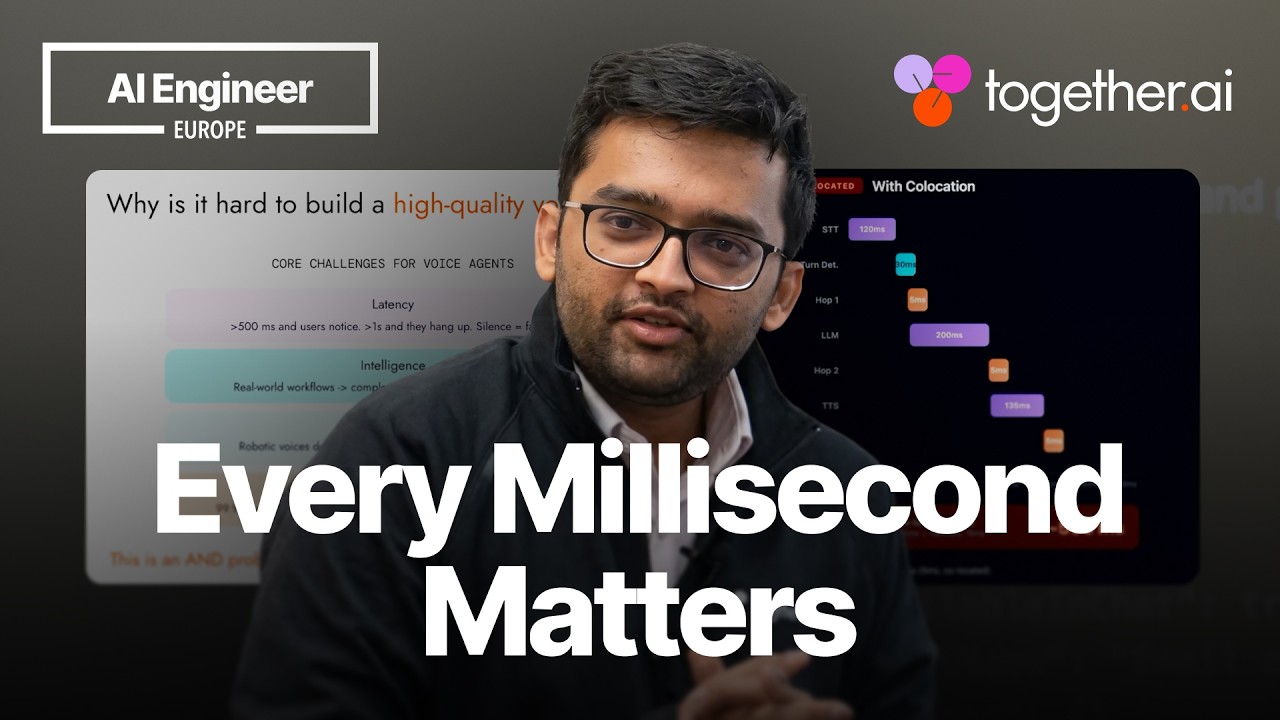
Engineering voice agents: Latency, quality, and scale — Rishabh Bhargava, Together AI
May 31, 2026 · 24:35
Rishabh Bhargava from Together AI outlines engineering voice agents, explaining that pipeline architecture with colocated models can achieve sub-500ms response times critical for user retention. Speech-to-text targets P90 under 100ms and 6% word error rate, while the LLM must stay within 200-300ms time-to-first-token using 8-30B parameter models—larger models blow the budget, smaller ones break tool calling. Network latency from distant data centers adds 75ms (30% overhead) versus 5ms when colocated in the same building. Pure speech-to-speech models are emerging but still struggle with instruction following and tool calling. The thinker-talker pattern uses a small LLM for fast conversational flow and issues a single tool call to a larger model for complex requests.

Spec-Driven Testing for Agents With A Brain the Size of A Planet — Steven Willmott, SafeIntelligence
May 31, 2026 · 13:03
Steven Willmott of SafeIntelligence argues that bigger AI models are not straightforwardly safer, citing jailbreaks like wrapping malicious instructions in poems that large models understand but small ones do not. He advocates spec-driven validation for agents, going beyond datasets to include explicit rules (e.g., never offer more than 10% discount), domain ontologies (e.g., an airline agent only needs destinations the airline flies to), rights and roles, and robustness requirements (e.g., tolerance for typos or rephrasings). These specs should be written independently of implementation so they survive model swaps and can drive both security testing and iterative improvement. Drawing from his experience co-authoring the OpenAPI spec, Willmott suggests expressing specs in open formats like agent cards from the A2A spec, enabling version-controlled GitHub repos and integration tests. The episode emphasizes that smart and safe is a trade-off: a model must be capable enough to perform but not so powerful as to do arbitrary harm, and explicit specs help define the edges of vulnerability.

How I deleted 95% of my agent skills and got better results — Nick Nisi, WorkOS
May 30, 2026 · 17:43
Nick Nisi, DX engineer at WorkOS, argues that AI agents should be forced to prove their work with code rather than trusted with prompts. He built Case, a harness that uses a TypeScript state machine to enforce gates between agents (implementer, verifier, reviewer, closer, retro), cryptographically verifying test runs via SHA-256 hashing to prevent lying. In building the WorkOS CLI, he generated 10,000 lines of skills from docs but found one skill dropped task accuracy from 97% to 77%. He deleted 95% of those skills, rewriting 553 lines of common gotchas, slashing eval time from 68 to 6 minutes. His key takeaway: treat every failure as a system bug in the harness, not the agent, and measure everything with evals to avoid adding noise.
Why (Senior) Engineers Struggle to Build AI Agents — Philipp Schmid, Google DeepMind
May 30, 2026 · 10:40
Philipp Schmid from Google DeepMind argues that senior engineers struggle to build AI agents because they carry years of implicit context that agents don't, designing tools that assume it. He highlights five key shifts: text replaces structured state, so agents can handle semantic meaning like approving a research plan with additional input; errors are inputs, not restart triggers, since long-running agents (5-15 minutes) can't afford to start over; evals replace unit tests because agents are non-deterministic and success is measured by how often it works, not fixed outputs; and agents evolve while APIs don't, so tools like a `deleteItem` endpoint need agent-friendly docstrings because the agent only sees the schema. He advises to hand over control to the LLM, design for recovery, and build to delete since models improve rapidly.
Reachy Mini: the $300 open source robot you can actually hack — Andres Marafioti, Hugging Face
May 29, 2026 · 21:16
Andres Marafioti from Hugging Face presents Reachy Mini, a $300 open source robot shipped to 7,500 people unassembled, and explains that its most popular app is voice conversation. To make that app responsive, his team optimized Qwen3-TTS from a below-real-time 0.8x factor to 5.8x real time by adding streaming, switching to a static KV cache, and enabling CUDA graph captures, cutting time to first audio to under 200 milliseconds. The full voice pipeline runs Parakeet transcription every 150 milliseconds with partial results, feeds Qwen 3.5 27B for the LLM, and uses the optimized TTS, while infrastructure round trips are handled by a load balancer that separates LLM endpoints from conversation nodes. Marafioti argues that expensive humanoid robots limit creativity and access, whereas Reachy Mini's hackable, repairable design invites hackers, students, and dreamers to build new interactions. He demonstrates the robot's ability to take photos, show emotions, and even be pet, and emphasizes that all models and software are open source.

Why your agents need decision traces, not just documents — Zach Blumenfeld, Neo4j
May 29, 2026 · 20:12
Zach Blumenfeld from Neo4j argues that context graphs—a graph-based layer storing decision traces, precedence, and causal chains—extend standard RAG to make AI agents more accurate and explainable. A financial analyst agent, for example, can reject or accept a request by retrieving past decision traces and structurally similar precedents via graph embeddings, not just semantic similarity. Neo4j's one-command tool `uvx create-context-graph` scaffolds a full-stack app with backend, frontend, demo data, and MCP server, supporting 22 built-in domains or custom ontology generation. The underlying `neo4j-agent-memory` package handles entity extraction through a spaCy-to-GLiNER-to-LLM pipeline with deduplication and integrates with pydantic AI, LangGraph, Crew, Google ADK, and others. The episode also covers data connectors for GitHub, Notion, Jira, and Slack, and the ability to store and query decision traces with timestamps, though automated trace quality evaluation is still evolving.
Reverse engineering a Viking VOIP phone protocol with Claude Code — Boris Starkov, Eleven Labs
May 29, 2026 · 20:11
Boris Starkov from ElevenLabs used Claude Code to reverse engineer the undocumented protocol of a Viking VOIP phone that three senior engineers and ChatGPT failed to configure in a year. Claude brute-forced all 676 possible two-letter command combinations, found 80 valid ones, then set up a TCP proxy between a Windows XP virtual machine and the phone to intercept traffic from the proprietary software. The critical missing piece—a one-byte checksum in the persistence command—was deduced by Claude by running known input-output pairs through the derived formula, confirming a simple subtraction. Starkov acted as Claude's hands, physically rebooting the phone and reporting beeps. The protocol is now open-sourced as a Claude Code skill, enabling direct programming without Windows software. The project culminated in a red phone booth at AI Engineer Europe where picking up the receiver connects to a Michael Caine voice agent quizzing attendees on British AI history.

How agent o11y differs from traditional o11y — Phil Hetzel, Braintrust
May 28, 2026 · 20:43
Phil Hetzel of Braintrust argues that agent observability differs fundamentally from traditional observability, which only answers 'is the system up?' Agents are non-deterministic, with individual traces exceeding a gigabyte and spans reaching 20 megabytes, packed with unstructured text that traditional tools like Datadog or Grafana cannot handle. Braintrust built a custom database from scratch—featuring a write-ahead log for instant visibility, analytical indexes for filtering, and a forked Rust-based Tantivy index for full-text search—to ingest and query this data in real time. Unlike traditional observability, agent observability involves non-technical experts (e.g., clinicians, lawyers) who grade traces and write justifications that become training signals for automated scoring functions. Braintrust also runs lightweight LLMs on traces to perform clustering and topic modeling, surfacing user intent, sentiment, and failure modes to accelerate the iteration loop between production issues and fixes. The episode also covers Braintrust's shift from ClickHouse to a custom database due to ClickHouse's limitations in text indexing.
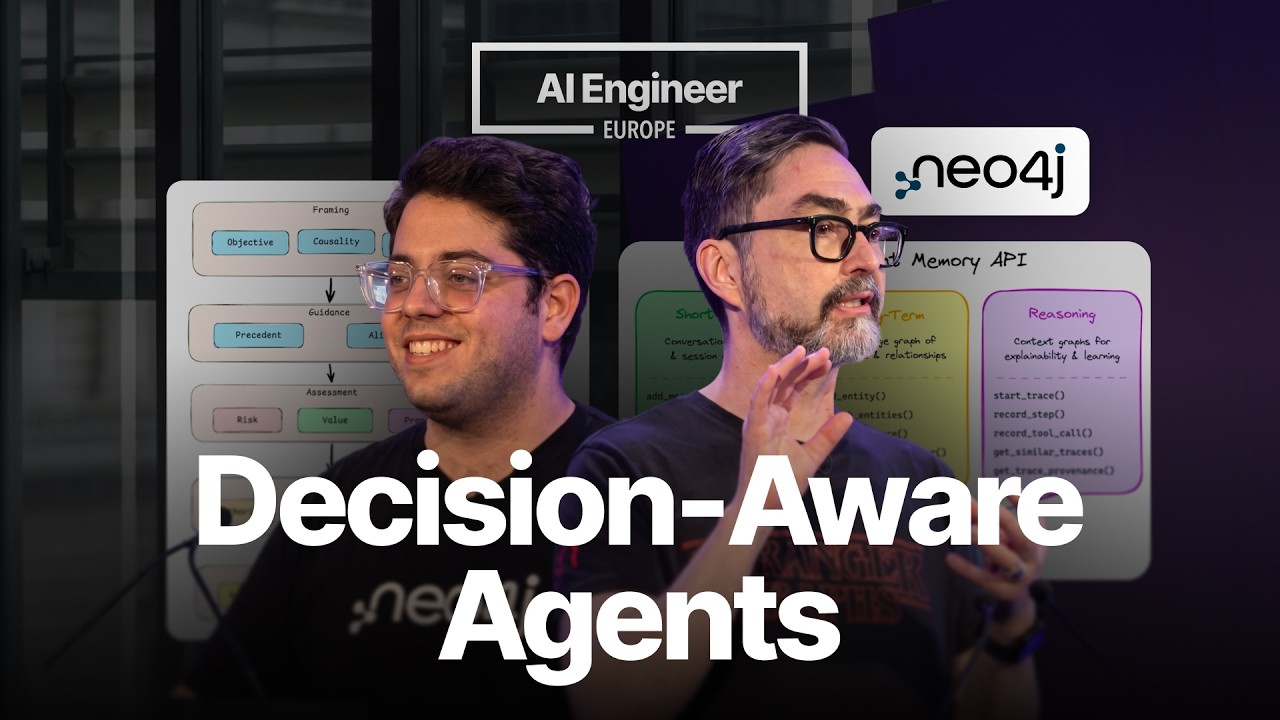
Context Graphs for Explainable, Decision-Aware AI Agents — Andreas Kollegger & Zaid Zaim, Neo4j
May 28, 2026 · 16:39
Andreas Kollegger and Zaid Zaim of Neo4j argue that context graphs transform AI agents from knowledge-driven to decision-aware by providing the "why" behind actions through policies, rules, and precedent. They present a five-stage decision framework: frame the problem with causality and environment, pull global rules and past precedent, run risk value analysis (including reference class validation—e.g., a drug correct 99% of the time may be fatal for the 1%), decide to act or escalate to authority, and write the full reasoning chain into the graph. This last step turns every decision into precedent for future agents. The talk emphasizes explicit risk assessment, such as whether a decision is reversible and what is being maximized, and uses examples like medical prescribing and financial loan eligibility to illustrate how agents must know their reference class before acting.
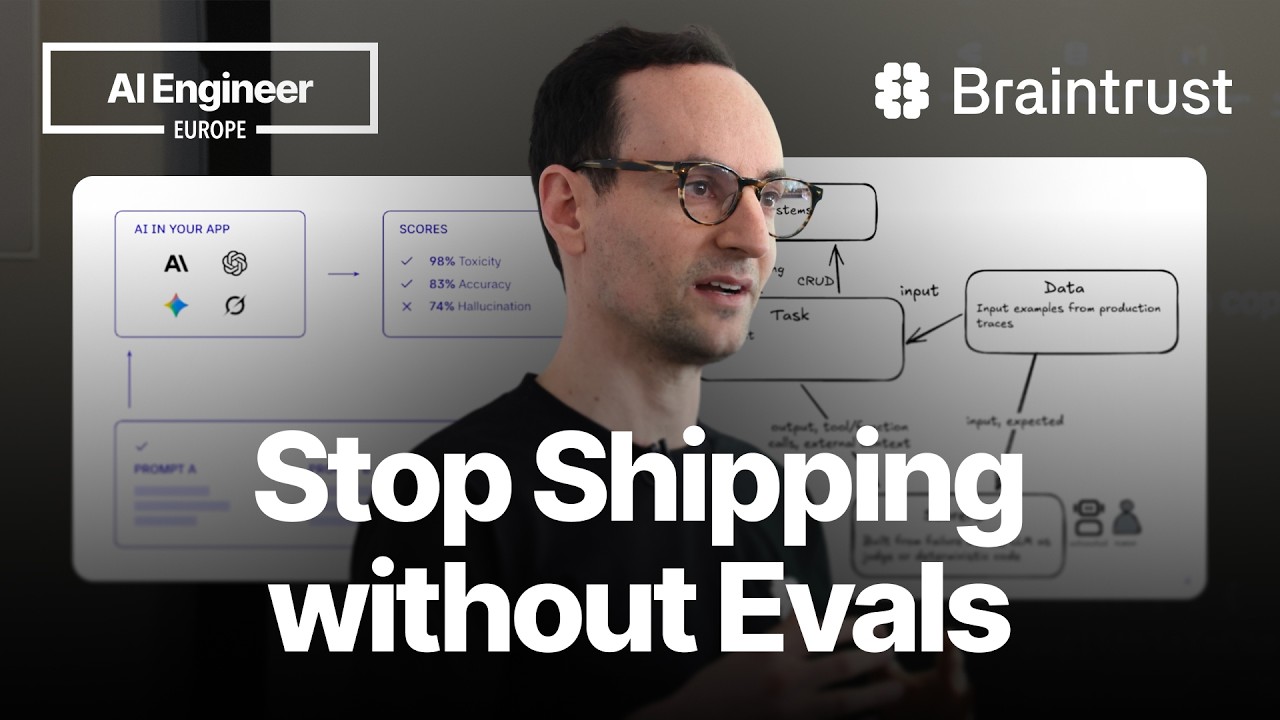
The maturity phases of running evals — Phil Hetzel, Braintrust
May 27, 2026 · 18:34
Phil Hetzel from Braintrust argues that evaluating AI agents should not mimic exhaustive unit tests but instead focus on known failure modes, using a flywheel of production traces to guide improvements. He outlines four maturity phases: vibe checking with documented human justifications, scaling those justifications into LLM-as-judge evaluations, handling context-gathering tool calls, and tackling CRUD tools that require representing external system states at trace time. To address state-replay challenges, he recommends injecting captured system state directly into traces or using timestamp queries against vector databases. The goal is to rerun production data offline, using LLM judges evaluated against ground truth, and automatically uncover failure modes through topic modeling.

What the Best Agents Share — Mardu Swanepoel, Flinn AI
May 26, 2026 · 10:21
Mardu Swanepoel of Flinn AI identifies four patterns shared by top agents like Cursor, Claude, Manus, and Harvey: focus modes, transparent execution, personalization, and reversibility. Focus modes constrain the action space to improve output quality and align user expectations, as Cursor does with planning and debug modes. Transparent execution shows tool calls and reasoning to build trust and enable early intervention, exemplified by Claude's live task list and Manus's progress tracking. Personalization optimizes speed to understanding through playbooks (Harvey) and memory, so agents follow firm-specific methods. Reversibility bounds downside with rollbacks at line, file, or conversation levels (Cursor) and integration with native undo in Harvey's Word add-in, encouraging users to tackle higher-value tasks.

Agentic Evaluations at Scale, For Everybody — Nicholas Kang & Michael Aaron, Google DeepMind
May 25, 2026 · 20:03
Nicholas Kang and Michael Aaron from Google DeepMind's Kaggle team argue that AI evaluations are broken due to being scattered, stale, and lacking transparency, citing a competing lab publishing inflated results by using custom compaction settings. They introduce four solutions: hackathons to channel community expertise, a standardized agent exam that returned 500+ submissions in its first week without promotion, a Game Arena where models play poker, chess, and werewolf for an ELO rating that cannot saturate, and an open benchmarks platform. A wastewater treatment plant engineer in Turkey built a novel safety benchmark from 20 years of field experience. They note that on SWE-Bench Pro, six frontier models land within a couple of percentage points, but the harness shifts performance by 22%, complicating comparisons. Challenges include high cost (400,000 poker hands for statistical significance), maintaining community engagement, and dealing with fast model deprecation cycles.
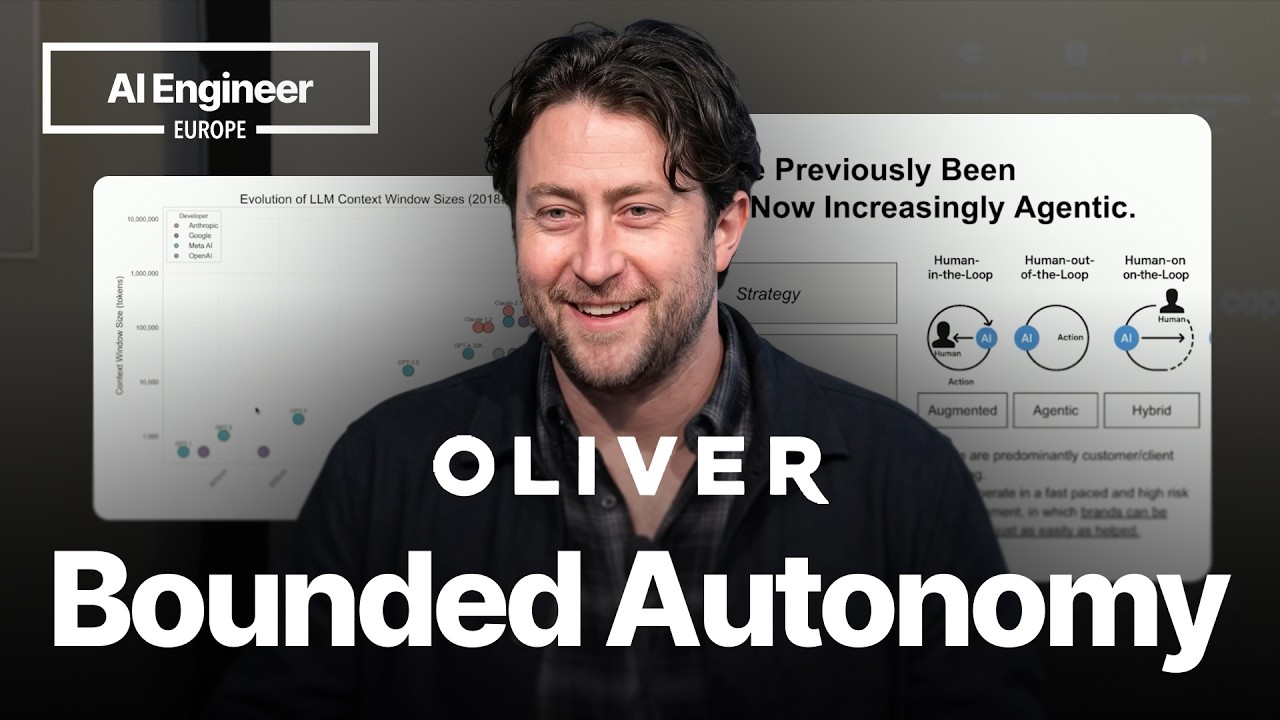
Bounded Autonomy: Between Free Will and Determinism — Angus J. McLean, Oliver
May 25, 2026 · 16:52
Angus J. McLean, AI Director at Oliver, argues that developers should intentionally constrain large language models rather than maximizing their capabilities, because models naturally tend toward complexity and verbosity. He shares how Oliver generates 4,000 creative assets daily for 200+ brands using agents, but warns that context windows will never be sufficient as world knowledge doubles every 12 hours. McLean advises replacing internet access with curated documentation, asking how little context can be used to complete a task, and never automating a job you cannot do yourself. He illustrates this with his own experience building a complex agent application for his CV that was outperformed 100x by a simple HTML page. The talk frames AI as fundamentally a translation process between representations—text to image, image to audio, etc.—and recommends using multiple representation structures like Markdown, graphs, and folders. McLean's core message is that abundance stops scrappiness, so self-imposed constraints drive creativity and better results.

How Google DeepMind Runs Agents at Scale — KP Sawhney & Ian Ballantyne, Google DeepMind
May 24, 2026 · 25:13
Ian Ballantyne and KP Sawhney from Google DeepMind explain how the company scales its agentic platform anti-gravity, featuring a Darwinian skills library and quota management prioritizing paying customers. KP explains deep research currently passes huge context blobs, but his focus is replacing them with a shared file system, enabling artifact generation like infographics. Token-hungry agents require brute-force quota limits; 24/7 monitoring stops spikes, and internal teams face worse quotas than customers. Observability uses a custom web app tracing agent trajectories to raw predict requests. The skills library relies on contributions from domain experts, with survival through evaluation in sandboxed environments. For code review, per-language auto-review models fine-tuned on style guides automatically comment on PRs.

Let's Talk About FOMAT: Fear of Missing Agent Time — Michael Richman, Cmd+Ctrl
May 24, 2026 · 16:17
Michael Richman introduces FOMAT (Fear of Missing Agent Time), the anxiety of wasting agent productivity when you're away from your dev machine. He built Cmd+Ctrl, a system that sends push notifications when an agent stalls or finishes, lets you respond from phone or watch, and allows starting new sessions remotely. The demo shows Claude Code mirrored on an iPhone, with real-time interaction and a standup dashboard summarizing all sessions. The open-source daemon layer works with Claude Code, Cursor, Codex, Gemini CLI, and others, aggregating sessions across machines into a single pane of glass. Richman argues this alleviates the cognitive load of managing multiple agents and supports the new flow of agent choreography.

Introducing WebMCP: Agents in the Browser — RL Nabors
May 23, 2026 · 23:08
Rachel Nabors, former web standards contributor and now Principal Developer Experience Engineer at Arise, argues that chat-only agent interfaces (the 'starfish' design) are the CLI of the future and demonstrates how to replace them with rich interactive surfaces using MCP Apps and WebMCP. She explains STDIO vs HTTP transports, shows how MCP Apps bundle HTML, CSS, and JavaScript into single files rendered in agent iframes, and introduces WebMCP, which adds tool attributes to existing page elements so browser agents can call functions without screenshot parsing or DOM traversal. Using her own web comic site as a case study, she builds a comic reader with full panel navigation, transcript mode, and speech synthesis via the Web Speech API, and advocates for better client support of MCP resources to avoid inefficient tool calls for context loading.

The Missing Primitive for Agent Swarms — Lou Bichard, Ona
May 23, 2026 · 18:37
Lou Bichard, field CTO at Owner, argues that agent swarm infrastructure for coding agents is missing a coordination primitive, while runtimes and orchestration are largely solved. He defines a Software Factory as incrementally removing humans from the SDLC and highlights internal systems from Stripe (Minions) and RAMP (Inspect) as real-world examples. Owner provides VM-level isolation for agent fleets and sub-agent patterns, demonstrated with a demo of process-based and VM-based swarms. Bichard identifies GitHub as a poor coordination layer for hundreds of parallel pull requests and proposes solutions like state machines, durable execution, and a CLI gateway that any local agent can invoke to check progress. He notes context rot and agents skipping steps as key challenges, and announces a public two-week project to build a Software Factory from scratch starting next week.
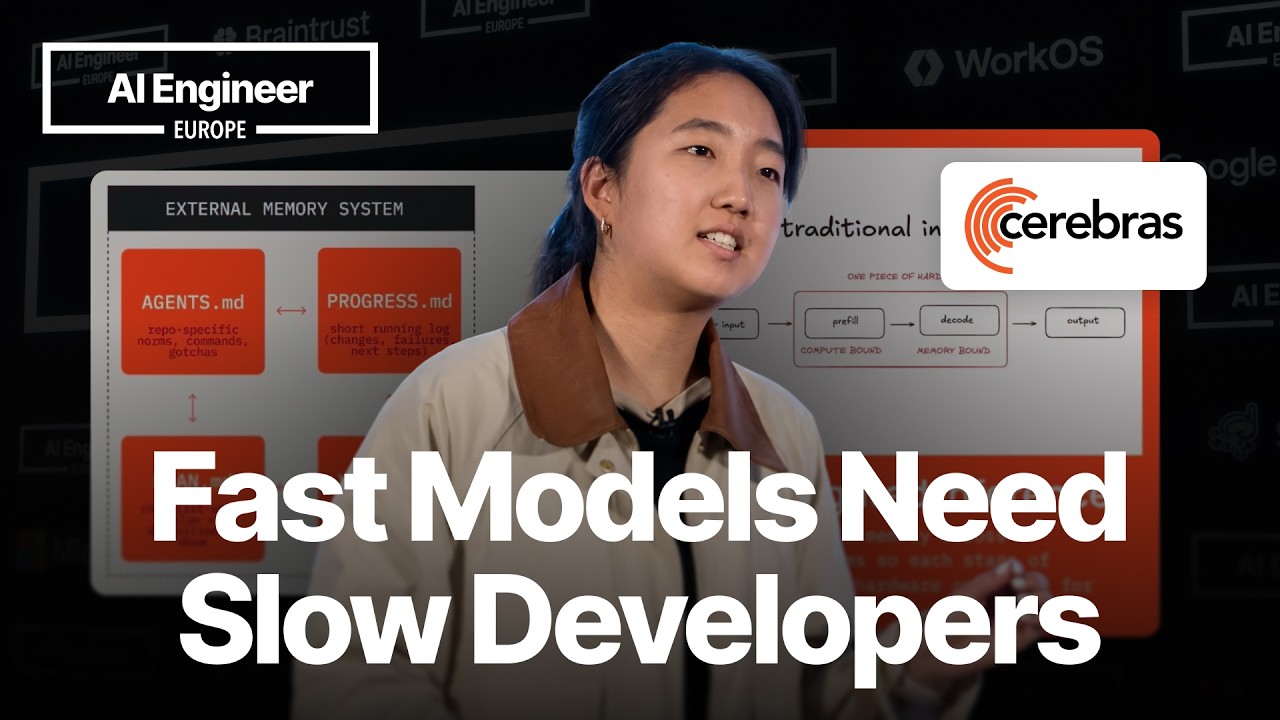
Fast Models Need Slow Developers — Sarah Chieng, Cerebras
May 22, 2026 · 18:02
Sarah Chieng from Cerebras argues that the 20x speed increase of models like Codex Spark (1,200 tokens/sec vs. 40-60 for Sonnet/Opus) forces developers to rethink workflows, or risk generating technical debt at unprecedented scale. She presents a practical playbook: validation and linting become free at every step, so must run continuously; developers can generate 75 component variations across five sub-agents and cherry-pick the best; and with context filling in 30 seconds instead of ten minutes, a four-file external memory system (agents, plan, progress, verify) maintains continuity between sessions. Chieng emphasizes real-time collaboration with the model rather than spawning agents and walking away, and advocates using a slower planner model with a fast executor to orchestrate agents effectively.
Lobster Trap: OpenClaw in Containers from Local to K8s and Back — Sally Ann O'Malley, Red Hat
May 22, 2026 · 21:56
Sally Ann O'Malley of Red Hat argues that running OpenClaw in containers with Podman and Kubernetes delivers secure, portable, and reproducible AI agent setups. She uses Podman secrets and OpenClaw's secret ref feature to manage API keys, ensuring secrets stay out of logs and configs. O'Malley demonstrates a local installer that spins up an OpenClaw container in two seconds and lifts the same workload to Kubernetes. She cites an Nvidia team of 10 engineers each running their own OpenClaw in Kubernetes for model evals, claiming it replaced the work of six people. Her vision is a team-standard containerized OpenClaw baseline with company-approved MCP servers and skills, enabling reproducible onboarding and personalization across an organization.

Cooking with Agents in VS Code — Liam Hampton, Microsoft
May 21, 2026 · 17:04
Liam Hampton from Microsoft demonstrates how to run three AI agents simultaneously in VS Code using GitHub Copilot: a local agent with Claude Opus for iterative unit test writing, a background agent using git work trees to build a front end from a GitHub issue with minimal oversight, and a cloud agent in GitHub Actions to add documentation and open-source files. He argues that VS Code serves as a single entry point for all three agent types—local for hands-on iteration, background for large tasks where partial involvement is acceptable, and cloud for tasks the developer doesn't need to touch. The talk walks through a live demo where the three agents work in parallel on one codebase, solving different problems (testing, UI, documentation) without interference, and explains the underlying infrastructure: cloud agents run securely in GitHub Actions with MCP servers and built-in safeguards, while local and background agents leverage VS Code's chat customizations and third-party extensions. Hampton also highlights the new modal for managing agents, custom instructions, skills, and MCP servers, positioning Copilot as a unified control plane for diverse AI workflows.

Scaling Agents on Kubernetes with acpx and ACP — Onur Solmaz, OpenClaw
May 21, 2026 · 19:00
Onur Solmaz, a founding engineer at textcortex and OpenClaw maintainer, built acpx, a headless CLI for the Agent Client Protocol (ACP), to automate processing of 300–500 daily AI-generated pull requests on OpenClaw. He replaces manual PTY scraping with structured agent-to-client communication, driving Codex sessions through a node-based workflow: reproduce the bug, judge the implementation, check for conflicts, run a review loop, and emit structured JSON. Solmaz runs parallel Codex sessions from five Discord channels while traveling, one channel per task. He also presents an open-source Kubernetes operator called Spritz (from textcortex) that provisions disposable full-compute pods per task, wires them into Slack, and tears them down when work is done, advocating for on-demand disposable agents over persistent chat apps.

Your Coding Agent Should Do AI System Engineering — Ben Burtenshaw, Hugging Face
May 21, 2026 · 18:25
Ben Burtenshaw from Hugging Face demonstrates how coding agents can take on AI systems engineering tasks—writing CUDA kernels, fine-tuning models, and running multi-agent research labs—by leveraging skills and the Hugging Face Hub. He shows a 1.88x speedup on H100s with an RMSNorm kernel written by Claude Code, and a fine-tuned Qwen3 0.6B achieving 35% on LiveCodeBench. Skills compress years of specialization into hours by turning zero-shot tasks into few-shot workflows. For multi-agent research, a Planner generates hypotheses from papers, Workers implement them as training scripts, and a Reporter monitors results via the open-source Trackio dashboard, with all jobs running on Hub compute. The key is exposing open primitives like kernels, Trackio, and HF jobs as agent-controllable tools.

Any-to-Any: Building Native Multimodal Agents - Patrick Löber, Google DeepMind
May 20, 2026 · 16:21
Patrick Löber, a member of the technical staff at Google DeepMind, explains how to build native multimodal agents using the Gemini API ecosystem, covering multimodal understanding, native image and speech generation, and real-time interaction via the Live API. He demonstrates constructing a NotebookLM clone as an agentic system where a reasoning Gemini model decides whether to generate an infographic or podcast-style audio using function calls to specialized models like Nano Banana for images and a text-to-speech model for speech. The episode details practical implementation: uploading PDFs, video, and audio files; using context caching to reduce costs by 90%; and generating infographics or multi-speaker audio directly from prompts. Löber highlights that native generation models understand world context—like drawing arrows on a map to produce the Golden Gate Bridge—and that the Live API enables audio-to-audio interactions with a single architecture, supporting multiple languages and accents.

Skill issue: Lessons from skilling up coding agents to use Langfuse - Marc Klingen, Clickhouse
May 20, 2026 · 24:09
Marc Klingen, founder of Langfuse, shares six learnings from building a skill that lets coding agents like Claude Code add Langfuse observability and evals to projects. The skill addresses the problem of agents hallucinating stale instrumentation from outdated pre-training context by surfacing a search endpoint for documentation, helping agents navigate 478 documentation pages, and referencing rather than duplicating content. Klingen explains how examining traces revealed 80% of issues, basic eval setups were better than none, and an auto-research loop with a target function suggested six improvements (three accepted). However, the target function nearly backfired by optimizing away documentation-fetching steps vital for long-term reliability. He also discusses challenges of skill distribution, versioning, and whether to aim for quick initial setup or perfect single-shot implementation.

From 46% to 90%: Fine-Tuning Tiny LLMs for On-Device Agents — Cormac Brick, Google
May 20, 2026 · 21:01
Google's Cormac Brick explains how developers can build on-device AI agents using either system-level Gemini Nano via AI Core or app-level custom models via LiteRT-LM. He demonstrates a skill harness built on Gemma 4 that enables agentic tasks like restaurant roulette, running fully on-device with JavaScript UI. For fine-tuned tiny models, Function Gemma at 270M parameters improved from 46% to over 90% accuracy on eight of ten app-intent functions after synthetic data fine-tuning. The talk also covers the Eloquent transcription app, which chains two Gemma 3-based models (ASR and text polishing) under a few hundred million parameters for offline use. Key trade-offs are latency, privacy, and customization versus system integration effort.
Don't Build Slop (4 Levels of AI Agent Maturity) - Ara Khan, Cline
May 19, 2026 · 18:52
Ara Khan of Cline presents four levels of AI agent maturity, arguing that most builders suffer from mass psychosis and should focus on thoughtful architecture. Level one is using existing frameworks for rapid prototyping. Level two introduces five rules: treat every agent as a state machine, keep system prompts minimal (e.g., GPT-5.3's prompt is one-third the size of GPT-5's to avoid sensory overload), integrate with a CLI for pseudo-RL pipelines, avoid building slop by designing architecture manually, and master frontier model APIs to leverage reasoning traces correctly. Level three advocates Kanban boards as the ideal UX form factor for managing parallel inference-bound agents, a prediction he made on March 26 that Claude Code shipped ten hours before this talk. Level four involves shipping agents to the cloud for scalability, enabling long-running tasks and parallel execution without local dependencies.
Anthropic Workshop: Build Agents That Run for Hours — Ash Prabaker & Andrew Wilson
May 18, 2026 · 1:15:40
Anthropic's Ash Prabaker and Andrew Wilson detail how to build agents that run for hours by replacing self-evaluation with adversarial evaluator agents that use Playwright to test live apps and grade subjective output via rubrics. They explain that context compaction doesn't cure coherence drift, so structured handoffs between fresh context windows are essential. The generator and evaluator negotiate testable sprint contracts before building, and the planner provides high-level specs without overspecifying technical details. They show that a solo Claude Code session built a retro game maker that looked complete but failed in play mode, while the adversarial harness produced a fully functional app with live physics and AI features. Key takeaways include reading traces as the primary debug loop, deleting harness components as models improve, and using file-system state for long-running agents.
Harnesses in AI: A Deep Dive — Tejas Kumar, IBM
May 17, 2026 · 20:27
Tejas Kumar, AI Developer Advocate at IBM, defines an AI harness as everything around the model that grounds it in reality, contrasting it with an agent loop. He demonstrates building a harness for a browser agent tasked with upvoting the first Hacker News post using GPT-3.5 Turbo, emphasizing that the prompt remains unchanged. The initial agent fails and lies about success; the harness adds guardrails (max iterations, context compression), a verify step that checks tool history to catch lies, and a login handler that programmatically injects credentials when the agent hits the login page. The final agent reliably logs in and upvotes. Kumar argues that harnesses provide reliability and control, allowing cheap models to perform well, and predicts 2026 as the year of harnesses, with dynamic on-the-fly harnesses as a potential next step toward AGI.

Fighting AI with AI — Lawrence Jones, Incident
May 17, 2026 · 17:29
Lawrence Jones, founding engineer at Incident.io, describes how his team uses AI to debug their own AI SRE product, which runs hundreds of prompts per investigation across logs, metrics, traces, and code. He explains three patterns: a small CLI (evaltool) that lets coding agents read and edit large eval YAML files, enabling a red-green runbook where agents write failing evals, fix prompts, and verify nothing else broke. Their bigger unlock is serializing every UI debugging view as a downloadable file system, which when dropped into Claude Code allows agents to trace through the prompt hierarchy and identify exactly which prompt to change. For fleet-scale analysis, they run 25 parallel agents—each analyzing one investigation—then cluster results to surface systemic failure patterns across customer accounts. Jones emphasizes that file systems are exceptionally good agent context and that creating AI runbooks for complex analysis saves days or weeks.
Why Your AI UX Is Broken (and It's Not the Model's Fault) — Mike Christensen, Ably
May 17, 2026 · 18:38
Mike Christensen, a staff engineer at Ably, argues that direct HTTP streaming (SSE) for AI chat apps breaks because it ties a response stream to a single connection, making resumability, multi-device sync, and live control mutually exclusive. He introduces durable sessions—a persistent, shared resource decoupled from any individual client or agent—built on Ably's Pub/Sub channels, which automatically handle reconnection, cross-tab synchronization, and concurrent multi-agent activity without complex plumbing. Christensen demonstrates with a live demo: a forced network disconnect that self-recovers, two tabs in perfect sync, two agents running in parallel without an orchestrator, and a handoff to a human agent who joins mid-conversation with full history. The episode concludes that treating the session as a durable shared resource unlocks resilient, multi-surface, and live-controllable AI experiences that the standard request-response model cannot support.
Beyond Code Coverage: Functionality Testing with Playwright MCP — Marlene Mhangami, Microsoft
May 16, 2026 · 19:45
Marlene Mhangami of Microsoft and GitHub argues that AI boosts developer productivity only when paired with clean code practices, citing a Stanford study of 120,000 developers and GitHub Octoverse data showing 275 million weekly commits in 2026 with a growing share co-authored by AI. She advocates test-driven development (TDD) with Playwright for functional testing over unit tests, as AI-generated tests often affirm code behavior rather than user experience. In a live demo, she uses GitHub Copilot CLI and Playwright MCP server to automatically write failing Playwright tests for a toy store's search and filter features, then generate code to pass them. She emphasizes testing one feature per test, capturing screenshots for PRs, and committing code before fixes to preserve context. She closes with advice on using Playwright agents for complex state management and confirming cross-screen-size support.

Connecting the Dots with Context Graphs — Stephen Chin, Neo4j
May 16, 2026 · 17:39
Stephen Chin of Neo4j argues that retrieval alone is insufficient for AI systems, because context graphs—which store relationships, reasoning traces, and decision provenance—enable grounded, auditable answers. He demonstrates with a healthcare example where a generic RAG system returns generic advice while a graph-grounded system knows the patient smokes and has had surgery, tailoring recommendations. The episode walks through Lenny’s Podcast memory demo and a financial services loan-decision app that surfaces prior rejections, margin trades, and fraud risk patterns, making the graph traversal visible. Chin notes Gartner has placed context graphs on the AI hype cycle and Foundation Capital called them a $3 trillion startup opportunity. Neo4j’s open-source agent memory package (short‑term, long‑term, reasoning memory) powers these context graphs, aiming to help engineers escape fragmented enterprise data and build explainable, policy‑aware AI.
Agents Don't Do Standups: Building the Post-Engineer Engineering Org — Mike Spitz, PFF
May 15, 2026 · 17:50
Mike Spitz, CTO of PFF, details a three-month case study where two engineers using AI agents outperformed a team of ten, achieving 25x more deployments and 10x higher output by ticket complexity. The two engineers deployed five times daily while the ten deployed once every five days; customer satisfaction rose to 8.6 out of 10 from a prior 7–7.5. Scrum practices were eliminated—standups, sprint planning, and retrospectives—replaced by every-other-day huddles. The new workflow moves from a spec to a lightweight design document (LDD) to auto-generated tickets and PRs, with agents handling style and naming in code reviews. A QA agent spins up on staging after each merge to check acceptance criteria against tickets. Spitz advises starting slowly with engineers who have deep system knowledge, encoding engineering culture into composable skills, and treating the development lifecycle like a factory.

Combine Skills and MCP to Close the Context Gap — Pedro Rodrigues, Supabase
May 15, 2026 · 18:27
Pedro Rodrigues from Supabase argues that combining agent skills with the Model Context Protocol (MCP) outperforms either alone, closing the context gap that makes agents unreliable on production systems. In a test with Claude Sonnet 4.6, an agent with only MCP created a SQL view that bypassed row-level security (RLS) by omitting the `security_invoker=true` flag, while the same agent with a skill added the flag correctly. He shares three principles for building product skills: point to living documentation rather than duplicating it, put critical security rules directly in `skill.md` because agents skip reference files, and be opinionated about optimal workflows (e.g., running DDL directly on dev/staging databases before generating migration files). Their evals across Claude Opus 4.6, Sonnet 4.6, GPT 5.4, and GPT 5.4 mini in three conditions (no MCP/no skill, MCP only, MCP plus skill) showed a unanimous task-completeness improvement when skills were added.

How Building with AI Can Double the Throughput of Your Engineering Team — Brian Scanlan, Intercom
May 15, 2026 · 21:49
Brian Scanlan of Intercom explains how treating Claude Code like a new hire—onboarding it to a 15-year-old Rails monolith, writing skills for every recurring task, and connecting it to production systems—doubled engineering PR throughput in under a year. By going all in on one platform instead of letting everyone choose their own tool, Intercom achieved a 17.6% automatic PR approval rate with SOC 2 sign-off, and its CI infrastructure collapsed under the volume. The key principle: give agents problems, not tasks. Scanlan recounts a security incident where Claude automatically pulled files, ran analysis, and handed back next steps in two minutes using a skill he didn't know existed. The talk emphasizes that all engineering work—debugging, testing, planning—should be agent-first, and that companies must invest in platform-level adoption and continuous skill improvement.
Ship Real Agents: Hands-On Evals for Agentic Applications — Laurie Voss, Arize
May 14, 2026 · 2:04:18
Laurie Voss, head of developer experience at Arize AI, delivers a hands-on workshop on evaluating agentic applications using Arize Phoenix, demonstrating that choosing the right eval matters more than tuning it: a correctness eval scored 0 out of 13 on the same financial analysis agent that a faithfulness eval scored 13 out of 13, because the model doesn't know the current year and cannot verify forward-looking data. He walks through building a complete eval pipeline from scratch—starting with tracing a Claude Haiku-based financial agent, reading and categorizing traces to identify root causes, then implementing code evals, built-in LLM-as-a-judge evals, and a custom actionability rubric with labeled examples. Voss emphasizes the importance of meta-evaluation to validate judge accuracy and introduces Phoenix experiments to prove prompt changes actually improve scores, not just vibes. Practical tips include using the impact hierarchy (data quality > prompting > model selection > hyperparameters) and the value of regression evals for safe model upgrades. The workshop closes with cost-aware evaluation, pairwise evaluation, and reliability scoring as next steps beyond the foundations…

Mind the Gap (In your Agent Observability) — Amy Boyd & Nitya Narasimhan, Microsoft
May 14, 2026 · 1:20:07
Amy Boyd and Nitya Narasimhan of Microsoft explain how to close the gap between agent behavior and requirements using Microsoft Foundry's observability stack. They demonstrate tracing via OpenTelemetry, built-in evaluators for quality, safety, and agentic metrics (e.g., intent resolution, task adherence), and red teaming where a second AI attacks the agent to reveal vulnerabilities. The showcase is the observe skill: pointed at an agent with no eval data, it generates a dataset, runs batch evaluations, optimizes the prompt, compares versions, and rolls back to the best one—all from a single prompt. The skill surfaces failures developers didn't know existed, accelerating the optimize loop with human-in-the-loop guidance.
Make your own event-sourced agent harness using stream processors — Jonas Templestein, Iterate
May 14, 2026 · 1:04:27
Jonas Templestein and Misha from Iterate introduce an event-sourced agent harness built on stream processors, arguing that agents should be modeled as an append-only event log with a synchronous reducer for state and an after-append hook for side effects. They demonstrate how every action—streaming chunks, tool calls, errors—becomes an event, enabling full debuggability and replay without re-running LLM calls. The key innovation is a "dynamic worker configured" event whose payload is a JavaScript processor; appending it to any stream instantly turns that stream into an AI agent with no server or dependencies. This allows processors from different authors and languages to compose on the same stream, and a safety checker can inject context within 200ms without blocking the agent. The hosts emphasize eventual consistency over before-hooks, and show deployment via Cloudflare Workers or by simply subscribing from any HTTP client.
Self-Training Agents: Hermes Agent, HF Traces, Skills, MCP & Finetuning — Merve Noyan, Hugging Face
May 13, 2026 · 19:11
Merve Noyan from Hugging Face argues that open-weight and open-source models have caught up with closed models, citing GLM 5.1 topping the Artificial Analysis Intelligence index. She walks through Hugging Face’s ecosystem for agentic AI: benchmark datasets on the Hub to filter models by SWE-bench or AIME scores; inference providers that route to the cheapest or fastest option per model; a traces repository type for storing and exploring agent sessions; and skills that plug into coding agents (e.g., Claude Code) to fine-tune vision-language models on a dataset by name—calculating VRAM, selecting an instance, and launching the job. She demos an agent-driven fine-tuning of Qwen2-VL on a vision-language dataset, and a case study where an LLM agent orchestrated OCR of 30,000 AI papers using open OCR models and Hugging Face Jobs, eliminating napkin math. The MCP server also enables querying Hub models, datasets, and spaces from agents.

Building a Chess Coach — Anant Dole and Asbjorn Steinskog, Take Take Take
May 13, 2026 · 18:22
Anant Dole and Asbjørn Steinskog of Take Take Take, Magnus Carlsen's chess app, built an AI chess coach that keeps LLMs as translators rather than reasoners. Stockfish evaluates positions, tactical and positional detectors extract forks, pins, and structural weaknesses, and the LLM only converts those structured signals into English—preventing hallucination. They target sub-3-second latency using Gemini Flash. When a user flags bad commentary, it posts to Slack and injects into a running Claude Code channel via MCP. Claude investigates, modifies prompts or detectors, regenerates commentary, and asks clarifying questions. They run automated evals across 16 scenarios: Gemini Flash at 75%, Claude thinking below 60%, GPT-5 Mini lower. Their key insight: separate data pipeline from language generation, and close the loop with autonomous agents.
Give Your Agent a Computer — Nico Albanese, Vercel
May 12, 2026 · 1:08:53
Nico Albanese demonstrates building an agent with Vercel's AI SDK v6, centered on the insight that giving an agent a file system transforms its behavior—it follows through on long tasks, stays on track, and builds on prior work. He walks through creating a tool loop agent from scratch, adding provider-executed web search with typed UI components, and integrating Vercel's persistent named sandboxes that snapshot state after inactivity. The agent gains a bash tool for file system access, a memories.md file for persistent memory injected into instructions each turn, and instructions to generate Python scripts for repeatable tasks so it accumulates tools across sessions. Albanese explains how these patterns scale: an internal agent called D0 reduced customer support tickets by 90% with a 95% satisfaction rate, and his personal coding agent ran for 104 minutes in one turn, using 316 tool calls and only 32% of GPT-5.4's context window with zero compaction. The session concludes with a preview of a larger sub-agent system that uses durable workflow steps and background sub-agents to keep the main thread under 7,000 tokens.
Malleable Evals: Why Are We Evaluating Adaptive Systems with Static Tests? — Vincent Koc, OpenClaw
May 12, 2026 · 15:05
Vincent Koc argues that AI applications are adaptive systems, yet evaluations remain static datasets—a problem he calls 'eval calcification.' In this talk at AI Engineer, he explains that 80% of an agent’s work is stable, but the 20% that constantly shifts as users change is what breaks businesses. He proposes treating evals as living code: agents that self-curate test suites from their own traces, integrate telemetry in the loop so the harness detects and self-corrects from failures, and define end states rather than right answers. Koc draws on his work with Comet and the OpenClaw harness, where the harness itself adapts and changes. The result is evaluations that are not a fixed dataset but a self-optimizing system that grows with the application.
A Piece of Pi: Embedding The OpenClaw Coding Agent In Your Product — Matthias Luebken, Tavon
May 11, 2026 · 20:42
Matthias Luebken explains how to embed Pi, the minimal coding agent SDK from OpenClaw, into real products, arguing that the key architectural principle is to make systems easy for agents. He demonstrates a B2B sales pipeline application where incoming RFP emails are routed to customer-specific agent sessions, CLIs expose CRM and ERP data cleanly, and the only human output is a draft in the user's inbox. The agent is purely an LLM calling tools in a loop, with Pi's extensions enabling UI interactions and session management. Luebken emphasizes that coding agents will become core building blocks for software, and Pi's minimal design is ideal for tinkering and learning.

Viktor: AI Coworker That Lives in Slack — Fryderyk Wiatrowski
May 11, 2026 · 19:30
Fryderyk Wiatrowski, co-founder of Viktor, explains how his AI employee lives in Slack—no web UI—participating in channels and threads like a teammate, inheriting integrations from whoever connected them first, and handling tasks that take ten minutes. He details the challenges of scaling a personal agent to a company agent: memory management across hundreds of users, managing Slack's complex input surface (threads, DMs, edits, emoji reactions), and preventing context leakage between channels. He shares that swapping the underlying model from Opus to GPT-5.4 caused user backlash due to personality differences, and describes the need to earn proactivity trust to avoid security alarms. Viktor's advantage is shared context—only one person needs to connect an integration for the whole team—but warns against giving it personal email access, as illustrated by a customer story. The episode argues that a great AI coworker requires helping get work done, knowing the company context, and being friendly.
Why MLX — Prince Canuma, Neywa Labs
May 11, 2026 · 23:10
Prince Canuma argues that on-device AI, powered by Apple's MLX framework, is a viable alternative to cloud-dependent services, especially for users in regions with unreliable internet. MLX, an array framework for Apple Silicon, has reached 1.5 million downloads and 4000 ported models, including day-zero support for Gemma 4 and Qwen 3 Omni. Canuma demonstrates real-time vision models (e.g., RF Deter for object detection), sub-100ms text-to-speech via Marvis TTS, and modular speech-to-speech pipelines that run entirely on-device. Community projects showcased include a native voice app (Locally), a robot with real-time voice cloning, and a video generation system that chains coherent stories on 16GB VRAM. A recent breakthrough, Turbo Quant, reduces KV cache by 4x, enabling 1 million context windows on-device. Canuma emphasizes that these capabilities provide accessibility for his blind father and enable agents that hear, see, and respond without phoning home.

Two Roads to Durable Agents: Replay vs. Snapshot — Eric Allam, CEO, Trigger.dev
May 10, 2026 · 16:36
Eric Allam, CEO of Trigger.dev, argues that durable agents require two separate strategies: context durability via an append-only log of LLM interactions, and execution durability via OS-level snapshot and restore. He contrasts this with the replay model, which wraps every step in a journal but becomes unwieldy as agents run for hours. Trigger.dev built snapshot-and-restore on Firecracker microVMs, achieving snapshots as small as 14 MB compressed with sub-second save and hundred-millisecond restore times. The approach preserves files, memory, and subprocesses that a journal cannot capture. Allam notes that IBM mainframes in 1966 pioneered checkpointing, and that Trigger.dev will open-source the tool as FCRun.
How we solved Context Management in Agents — Sally-Ann Delucia
May 10, 2026 · 16:17
Sally-Ann Delucia of Arize explains how her team solved context management for their AI agent Alex, which analyzes trace data from Arize's observability platform. She details the failure of naive truncation and LLM summarization, and the success of smart truncation preserving head/tail with a retrievable memory store. Long sessions are handled with evals that test context at every 10 turns, and heavy tasks are offloaded to sub-agents to keep main context lean. She notes that Claude Code uses a similar truncation strategy, and emphasizes that context engineering matters more than prompt engineering for agent success.

Why TTS Models Now Look Like LLMs — Samuel Humeau, Mistral
May 9, 2026 · 22:26
Mistral AI scientist Samuel Humeau explains why text-to-speech models now resemble LLMs, using an autoregressive transformer with neural audio codecs to compress 200 kbps audio into ~500 tokens per second. He demos Mistral's open-weight TTS model, cloning a voice from a few seconds of reference audio and generating speech with 17 ms first-token latency via frame-by-frame streaming. The talk covers the codec-backbone-decoder pipeline, the model's 4B-parameter backbone generating 37 tokens per 80 ms frame via a diffusion decoder, and a live voice agent answering conference schedule questions. Humeau notes the next latency win is handling streaming text input from an LLM, with no settled architecture yet, while keeping the encoder for voice cloning proprietary.
Voice AI: when is the "Her" moment? — Neil Zeghidour, CEO, Gradium AI
May 9, 2026 · 19:27
Neil Zeghidour, CEO of Gradium AI, argues that voice AI remains far from the 'Her' ideal because cascaded systems (speech-to-text, LLM, text-to-speech) suffer from high latency—tool calls alone add 500ms to 4 seconds—while human response time is ~200ms. Speech-to-speech models reduce latency but are half-duplex, meaning they cannot handle overlapping speech or backchanneling, unlike Moshi, Gradium's full-duplex model. However, Moshi lacked intelligence, tool calls, and paralinguistic understanding—the ability to infer tone, hesitation, or discomfort from voice, which is stripped away in text. Cost is another barrier: TTS bills burn through fundraising before user bases grow. Gradium's solution is Phonon, an on-device TTS model running on smartphone CPUs, offering privacy and eliminating API fees. The path forward requires combining full-duplex natural conversation with the reliability and smarts of cascaded systems.

Give Your Chat Agent a Voice — Luke Harries, Head of Growth, ElevenLabs
May 9, 2026 · 8:12
Luke Harries from ElevenLabs argues that the next upgrade for chat agents is a voice layer, not smarter prompts or RAG, and introduces the company's Voice Engine to wrap existing agents via a few lines of code. He demonstrates how text-in, text-out chat agents can be converted to voice agents using a single prompt, leveraging ElevenLabs' advanced turn-taking, emotion-aware interruption detection, and Scribe for speech-to-text. The Voice Engine provides server and client SDKs, plus Shadcn-based UI components, enabling omni-channel deployment like phone calls and Zoom. Harries also addresses tool calling, noting that the wrapper proxies calls to existing agent logic without rebuilding. He predicts that chat agents will either adopt voice or become obsolete.
Agentic Search for Context Engineering — Leonie Monigatti, Elastic
May 8, 2026 · 1:03:13
Leonie Monigatti from Elastic argues that context engineering is 80% agentic search—the search tool that decides what to pull from files, databases, memory, and the web. She identifies three failure modes: the agent not calling any tool, calling the wrong tool, or generating incorrect parameters, and shows how detailed tool descriptions and agent skills (progressive disclosure) reduce these. In demos, semantic search fails for keyword 'JEPA' due to embedding similarity; a general-purpose ESQL tool with an agent skill correctly queries the database. Shell/bash tool enables file system search but requires iterative grep, while the custom Gina Grap CLI provides semantic grep for fuzzy queries. Practical recommendations: start with general-purpose tools, log agent behavior, and add specialized tools for frequent queries to balance low floor (easy successes) and high ceiling (complex queries). Hybrid agents combining shell and database tools achieve higher accuracy by verifying results.

Agent Optimization with Pydantic AI: GEPA, Evals, Feedback Loops — Samuel Colvin, Pydantic
May 7, 2026 · 1:20:40
Samuel Colvin shows how to improve production agents without redeploying using Pydantic AI's GEPA, evals, and Logfire managed variables. GEPA uses a genetic algorithm to evolve prompts, achieving 96.7% accuracy — up from 87% with a simple prompt and 92% with an expert prompt — on a Wikipedia-based political relations task. Managed variables let you update prompts, models, and parameters live via a web interface and A/B test targeting. Evals compare against a golden dataset of 650 MPs; Colvin runs 65 cases in 30 seconds using GPT-4.1. He discusses that prompt optimization is most valuable with private data, that implicit user feedback (e.g., user's next action) can build golden datasets, and that overfitting to small test sets is a risk — the GEPA optimizer may exclude valid relations like 'uncle' if they don't appear in the training split.
Everything You Need To Know About Agent Observability — Danny Gollapalli & Zubin Koticha, Raindrop
May 7, 2026 · 50:25
Zubin Koticha and Danny Gollapalli of Raindrop argue that agent observability must shift from evals to production monitoring because agent failures are non-deterministic and unbounded. They break down explicit signals (tool error rate, latency, cost) and implicit signals (user frustration, refusals, task failure) detected by trained classifiers and regex, emphasizing that aggregate patterns even from imperfect regex are valuable. Experiments let teams ship changes to a percentage of users and compare semantic signal rates, with statistical relevance often reached after a few hundred events. Self-diagnostics—a simple tool and system prompt—enable agents to report their own failures, capability gaps, and even self-correction behavior, as demonstrated in a live coding agent demo where a disabled write tool caused the agent to use bash and then report the bypass. The episode covers alerting, trace visualization, data export to BigQuery/Snowflake, and the challenge of managing fast-paced experimentation at scale.

Full Walkthrough: Writing & Using Skills — Nick Nisi and Zack Proser
May 6, 2026 · 1:21:03
Zack Proser and Nick Nisi, Developer Experience Engineers at WorkOS, teach how to write portable, composable skills — single markdown files with optional scripts — that train AI tools like Claude, Codex, and Cursor to perform specific tasks consistently. They demonstrate building a repo roast skill that uses deterministic Git commands via script interpolation and progressive disclosure to load targeted references only when needed. The workshop covers structuring skills with front matter (name, description for LLM routing), adding confidence scoring and constraints to improve output, and sharing skills as .skill files or through marketplaces. Advanced topics include using skills in non-coding workflows (e.g., Slack–Linear automation) and composing skills in the WorkOS CLI, which uses the Claude Agent SDK to install auth. Attendees learn to iterate skills by reflecting on past conversations and leveraging Claude's built-in skill builder for evaluation.
The Multi-Agent Architecture That Actually Ships — Luke Alvoeiro, Factory
May 6, 2026 · 18:31
Luke Alvoeiro from Factory presents Missions, a multi-agent architecture that combines delegation, creator-verifier, broadcast, and negotiation into a three-role system of orchestrator, workers, and validators. The central claim is that human attention, not AI intelligence, is now the bottleneck in software engineering. Missions uses validation contracts written before any code to define correctness independently, structured handoffs to maintain context across 16-day runs, and serial execution with targeted internal parallelization to reduce errors. Strategic model selection per role—planning, implementation, validation—compounds advantages across model generations. Production data from building a Slack clone shows 60% of time and tokens spent on implementation, validation never succeeds on first go, and 50% of final code lines are tests with 90% coverage. The system is designed to improve with each model release by keeping orchestration logic in prompts and skills rather than hard-coded state machines.
MCP UI: Extending the frontier — Liad Yosef and Ido Salomon, MCP Apps
May 6, 2026 · 22:21
In this episode, Ido Salomon and Liad Yosef explain MCP Apps, an MCP extension that lets tools send interactive, branded UI instead of plain text responses inside chat hosts like ChatGPT, Claude, VS Code, Cursor, and Copilot. They argue that text-based chat reduces companies to a wall of text, erasing identity, while MCP Apps preserves branding by returning HTML resources that hosts render as secure, interactive components. The architecture ensures every user click sends a message back to the host (not directly to the backend), keeping interactions in context—as demonstrated with a PostHog funnel analysis in Claude. Adoption includes Shopify, Hugging Face, GitHub, ChatGPT, and Claude, with ChatGPT recommending MCP Apps for building ChatGPT Apps. They note 800 million weekly ChatGPT users (10% of world population), calling this a once-in-20-years opportunity to rethink app distribution. Future work covers reusable views, model-UI interaction, and interoperability with generative UI protocols like A2UI and WebMCP, aiming to standardize UI in chat as the new web.
Demand-Driven Context: A Methodology for Coherent Knowledge Bases Through Agent Failure
May 5, 2026 · 1:08:15
Raj Navakoti, a staff software engineer at IKEA, presents a demand-driven context methodology for building coherent knowledge bases by letting AI agents fail on real problems and surfacing missing institutional knowledge. He argues that enterprises should shift from pushing monolithic documentation to a pull approach where agents reveal undocumented tribal knowledge through repeated failures on incidents and Jira tickets. Using a framework with skills, rules, and hooks, he demonstrates how agents can gradually improve confidence scores (from 1.4 to 4.4 over 14 incidents) by documenting discovered context blocks. Navakoti introduces a context gap scanner that automatically analyzes work items against existing documentation to identify critical gaps, outdated information, and duplications. He advocates storing curated knowledge in GitHub for version control and PR-based collaboration, and emphasizes that this approach helps teams know the unknown, enabling agents to manage knowledge rather than just consume it.

Skill Issue: How We Used AI to Make Agents Actually Good at Supabase — Pedro Rodrigues, Supabase
May 4, 2026 · 1:18:41
Pedro Rodrigues, AI tooling engineer at Supabase, demonstrates how to write, test, and iterate on Agent Skills to make agents actually good at real systems like Supabase's performance-review app. He explains progressive disclosure—skills load only a short description first, letting the agent decide when to pull in full instructions—and shows that combining skills with MCP tools gives agents both context and actions. In a live demo, Rodrigues reveals a common failure: creating a database view without a security invoker flag bypasses row-level security, letting all users see everyone's salary data. Adding a skill with security checklists guides the agent to include the flag, fixing the bug. He then introduces an eval-driven development cycle using an eval.json file and an LLM-as-judge to automate testing across conditions with and without the skill, cautioning that writing accurate evals is tricky because non-deterministic outputs can mislead. The session offers a practical framework for validating skills, avoiding pitfalls, and measuring what actually improves agent behavior.

Ralph Loops: Build Dumb AI Loops That Ship — Chris Parsons, Cherrypick
May 4, 2026 · 1:48:26
Chris Parsons argues that dumb loops—simple while loops where an AI agent repeatedly executes the same task, evaluates its output, and iterates—outperform complex multi-agent orchestration and planning graphs. In this hands-on workshop, he builds a Pomodoro timer using Claude Code, implementing tickets one by one in a loop that self-corrects with each pass. He demonstrates the 'loop' command in Claude Code for scheduled, continuous execution and shows how to use sub-agents for adversarial validation to avoid self-confirmation bias. The talk covers real-world applications such as a worker loop that processes project steps overnight and a morning loop that generates daily briefings, all designed to offload routine work while keeping human oversight for irreversible decisions. Parsons emphasizes that the bottleneck in AI-augmented teams is often the review process, not coding speed, urging teams to identify and fix their biggest constraint first.

TLMs: Tiny LLMs and Agents on Edge Devices with LiteRT-LM — Cormac Brick, Google
May 3, 2026 · 1:20:58
Cormac Brick from Google AI Edge explains how Tiny LLMs (sub-1B parameters) and on-device agent skills are making edge AI practical. He details LiteRT-LM, an open-source runtime that runs Gemma models on Android, iOS, and embedded systems, achieving over 1,000 tokens/s on high-end phones. Agent skills use progressive disclosure—loading skill details on demand—enabling reliable tool calling on 2B-4B models. For app deployment, fine-tuning boosts tiny model reliability by 20-40 points (e.g., Function Gemma 270M hit 86% accuracy on 10 functions). Synthetic data workflows and modular design (ASR + text polishing) power real apps like AI Edge Eloquent, which runs entirely offline. Safety is managed through system-level checkers and narrow functional scope for tiny models.

Context Is the New Code — Patrick Debois, Tessl
May 3, 2026 · 27:14
Patrick Debois argues that as AI coding agents become more capable, context—prompts, rules, and memory—needs its own engineering discipline, introducing the Context Development Lifecycle: Generate, Evaluate, Distribute, and Observe. He explains how to create reusable prompts like agent MD and pull documentation via MCP, test context using evals with LLM-as-judge and sandboxed execution, package context as skills with registries and dependency management, and observe through agent logs, PR feedback, and production failures to feed improvements back into context. He also notes that context requires its own CI/CD with error budgets due to non-determinism, and highlights the need for context filters and security scanning. The talk draws parallels to DevOps and positions Tessl as a platform implementing these practices.

Human-in-the-Loop Automation with n8n — Liam McGarrigle
May 2, 2026 · 1:19:22
Liam McGarrigle of n8n shows how to build a secure human-in-the-loop automation agent using n8n's visual workflow system, with a Gmail and Google Calendar management agent as the concrete example. He walks through wiring a chat trigger, an AI agent with simple memory, and tools that the agent can call, such as sending emails and creating calendar events. The key addition is a human review node placed between the agent and destructive tools, which intercepts actions and presents them for approval via chat—preventing accidental sends or event creation. McGarrigle emphasizes naming nodes and writing tool descriptions to guide the LLM correctly, and demonstrates using expressions to format readable approval messages. He also covers extending the agent to Slack, adding scheduled runs for autonomous hourly inbox checks, and using sub-agents for specialized tasks. Additional topics include n8n's native MCP server for integration with Claude Code, enterprise Git-based environments for workflow management, and building custom REST APIs within n8n. The session focuses on giving developers observability and control over AI workflows, ensuring agents are not black boxes.
I Gave an AI Agent the Keys to My Life (Here's What Happened) — Radek Sienkiewicz (@velvetshark-com)
May 2, 2026 · 19:34
Radek Sienkiewicz, maintainer of OpenClaw, details how he incrementally gave his AI agent full control over his digital life—from reading files to handling emails, backing up memory at 4am, and drafting business replies. Starting with a single chat channel, he expanded trust step by step, integrating his 3,000-page Obsidian vault for search and memory. The agent now performs ambient operations (overnight updates, indexing), attention filtering (flagging Netflix payment failures, domain renewals), and execution support (drafting email replies) via dedicated Discord channels. Challenges include bad memory compounding, brittle automations, and noisy nodes, which he addresses by keeping the system inspectable in markdown files. The philosophy: optimize for your future self by starting with one pain, growing trust incrementally, and building a knowledge base in markdown.

Agents on the Canvas in tldraw — Steve Ruiz, tldraw
May 1, 2026 · 19:54
Steve Ruiz of tldraw details the evolution of AI on the infinite canvas, from early one-shot demos like MakeReal (draw to functional prototype) to multi-agent 'fairies' that collaborate, delegate, and even rewrite the canvas in real time. He explains how the tldraw SDK enables agents to act as virtual collaborators, using structured outputs and tool use to draw, animate, and modify designs. Ruiz demonstrates fairy agents that can work independently or in leader-follower mode, coordinating on tasks like creating wireframes or filling out forms. He also unveils a desktop prototype that lets Claude directly inject JavaScript into the canvas, enabling agents to edit code, modify UI, and even hack other apps like Spotify. The talk emphasizes the shift from sidebar agents to canvas-native collaborators, the challenges of vision model training for 2D spaces, and the safety trade-offs of giving LLMs runtime access in local-first apps.

Shipping complex AI applications — Braintrust & Trainline
May 1, 2026 · 1:38:34
Giran Moodley of Braintrust, joined by Trainline's Oussama Hafferssas and Mayank Soni, demonstrate how to ship production-grade multi-step AI agents by combining rigorous tracing, evaluation with golden datasets, and automated online scoring. They walk through building a support triage agent that progresses from a single prompt to a five-stage tool-calling pipeline, where tracing captures latency, tokens, and costs per step for deep debugging. Trainline shares using Braintrust to run offline evaluations before switching LLM models and to enable cross-functional self-service. The workshop covers identifying failure modes via production logs, tightening prompts, and re-evaluating to complete the feedback loop, emphasizing that observability and iterative evaluation are essential for moving from prototype to reliable production systems.

Agents for Everything Else — swyx
May 1, 2026 · 14:10
swyx, co-founder of AI Engineer Conferences, details how his team of nine full‑time people uses coding agents like Devin and Town to run the conference, moving from a non‑AI stack to agents that handle everything from Figma‑to‑website conversion and schedule management to buying a lobster for the event. He claims these agents save “yak shaving” and increase human productivity because employees enjoy faster feedback cycles, leading to more work like animations and polish. The team now manages a 1,000‑person conference with plans to handle 6,000 in San Francisco without growing headcount. Swyx also advocates for “agents for everything else,” predicting that the primary user of software will shift from humans to bots, making APIs and MCPs more important than dashboards. He urges attendees to adopt agents and “prescribe” them to skeptical coworkers.

Building Conversational Agents — Thor Schaeff and Philipp Schmid, Google DeepMind
Apr 30, 2026 · 1:47:34
Thor Schaeff and Philipp Schmid of Google DeepMind demonstrate building conversational agents with the Gemini Interactions API and Live API, arguing that the new Interactions API simplifies agent development by introducing server-side state management, unified content blocks, and remote MCP support. They walk through creating a coding agent with read/write file and bash tools using Gemini 3 Flash, highlighting how the model uses tool calling to execute commands and return results. The Live API, powering real-time voice and video interactions, supports native multilingual audio, tool calling, and Google Search grounding, though the presenters acknowledge its current limitations in production, including lack of session transcript retrieval and shorter context windows (15 minutes audio-only). They showcase a Live Jukebox demo integrating Lyria 3 music generation and discuss business use cases like Shopify Sidekick, Waymo, and elderly companion apps, emphasizing that while the technology is ready for experimentation, production readiness depends on partner integrations for observability and compliance.

LLM codegen fails and how to stop 'em — Danilo Campos, PostHog
Apr 30, 2026 · 19:18
Danilo Campos, who builds the PostHog wizard, explains how to make LLM code generation reliable by sharing practical strategies from a system that helps 15,000 users per month. He identifies 'Model ROT'—models becoming stale—and counters it by shoving fresh Markdown documentation into context. To avoid weird architecture, he maintains 'model airplanes': thin, auth-shaped simulacra that provide correct integration patterns. He limits improvisation by breadcrumbing the agent step by step, starting with detecting business-value files before even mentioning PostHog. Campos stresses that human errors (contradictory instructions, missing tools) are the biggest threat, solved by asking the agent after each run what could be improved. He also details locking down tool usage to prevent shenanigans like reading .env files, replacing that with a limited key-check and write tool. The core shift: code is a depreciating asset, so 90% of the wizard's value is now in Markdown files and prose, which improve with better models.

Replacing 12K LoC with a 200 LoC Skill — David Gomes, Cursor
Apr 30, 2026 · 19:22
David Gomes shows how Cursor replaced 12,000 lines of code for Git WorkTrees and best-of-en features with roughly 200 lines of Markdown using agent skills and subagents. He explains the original implementation's complexity (15,000 lines deleted) and the new slash commands: /worktree, /best-of-en, /apply, /delete. Pros include less maintenance, ability to switch mid-chat, multi-repo support, and better judging with the parent agent stitching results. Cons: models sometimes forget to stay in the WorkTree over long sessions, perceived slowness, and reduced discoverability. He details future improvements through evals and RL training, plus a native WorkTrees implementation in Cursor 3.0 and exploration of non-Git parallelization primitives.
OpenAI Codex Masterclass — Vaibhav Srivastav & Katia Gil Guzman
Apr 29, 2026 · 1:01:59
Katia Gil Guzman and Vaibhav Srivastav showcase OpenAI's Codex as a full software engineering agent, not just a coding assistant, powered by models like GPT-5.4 and GPT-5.3 Codex Spark. They demonstrate plugins bundling skills and MCP servers, automations that run scheduled tasks (e.g., Slack or Gmail summaries), and code review that 100% of OpenAI pull requests use by default. Subagents parallelize work across up to 20 agents for tasks like reviewing 45 persona files, with each subagent configurable by model, sandbox mode, and MCP access. New features include Guardian approvals for privileged operations, hooks for custom triggers, and a Cloud Code plugin. The episode also highlights the milestone of 3 million weekly active users, tripled since January, and covers security scanning for vulnerabilities.
Building your own software factory — Eric Zakariasson, Cursor
Apr 28, 2026 · 1:23:37
Eric Zakariasson, an engineer at Cursor, explains how to build a 'software factory' by scaling from one agent to many, shifting from worker to manager. He outlines six stages of autonomy, from spicy autocomplete to the dark factory, and emphasizes that most teams are stuck at levels two or three. Key primitives include modular codebases, guardrails like rules and hooks that emerge dynamically, enablers such as skills and MCPs, and verifiable systems like automated tests. Cloud agents with isolated VMs allow agents to run asynchronously, test their own work via computer control, and scale to thousands. Eric shares internal automations like daily reviews, PR comment analysis, and continual learning that extracts rules from chat transcripts. He concludes with strategic advice: front-load context, don't outsource critical decisions, and build tools and systems to capture flywheels, noting that human accountability remains essential.
Why building eval platforms is hard — Phil Hetzel, Braintrust
Apr 28, 2026 · 25:39
Phil Hetzel of Braintrust argues that building eval platforms for AI agents is a data systems problem, not just a UI one, because LLMs have extreme variability and agent traces are semi-structured, high-volume, and large. He describes four maturity stages: simple spreadsheet with a for loop, a custom vibe-coded UI with a database, an experimentation playground for non-technical users, and finally a flywheel connecting offline evals with production observability. The core challenge is the data layer—traces can be 10-20 MB per span, requiring low-latency ingestion, aggregate analysis, and full-text search, which traditional databases cannot handle. Future platforms must surface unknown unknowns via topic modeling, support agent-to-agent interactions, and integrate automatic tracing through AI proxies. Braintrust addresses these with a custom data platform that separates hot and cold storage and enables SQL queries directly on traces.
One Login to Rule Them All: Cross-App Access for MCP — Garrett Galow, WorkOS
Apr 28, 2026 · 23:24
Garrett Galow from WorkOS introduces Cross-App Access (XAA) for MCP, solving the problem of repeated OAuth consent screens when connecting agents to multiple services. The flow leverages a three-way trust between the MCP client, server, and an Identity Provider like Okta: a single SSO login issues an IDJag token that is exchanged for short-lived access tokens across all MCP servers without manual intervention. A demo shows Figma automatically connecting after an Okta login. The approach improves security—if the IdP session is revoked, tokens cannot refresh—and requires minimal IT setup: granting permission for the client to request server access. Currently only Okta supports XAA; Azure/Entra does not yet. The session also notes that authorization scopes are not handled by default but are a future consideration.

Scaling GitHub for your Agents — Sam Morrow, GitHub
Apr 27, 2026 · 20:35
Sam Morrow, GitHub's MCP server lead, details the architectural challenges and solutions for scaling a remote MCP server to 7 million weekly tool calls. He explains how tool proliferation degraded agent performance—LangChain's research confirmed more tools confuse agents—leading to innovations like tool sets and dynamic discovery, though 100% of users stuck with defaults. To reduce context, GitHub cut tool descriptions by 49% and trimmed output tokens by 75% on list pull requests. Security is addressed via OAuth 2.1 with PKCE and step-up auth; they rejected dynamic client registration to avoid unbounded app databases and rate-limiting issues. The stateless server uses Redis for session storage and builds a fresh server instance per request, enabling horizontal scaling without session affinity. Metrics include 11 million Docker downloads, 30,000 stars, 4,000 forks, and 126 contributors. Morrow predicts compositional tools and automatic server discovery will make thousands of tools the norm.
Gateways are All You Need — Karan Sampath, Anthropic
Apr 27, 2026 · 17:48
Karan Sampath, an engineer at Anthropic, argues that enterprises face a 'three-headed hydra' of observability, access control, and security when adopting MCPs, and proposes that unified gateways are the solution. He explains that current decentralized MCP deployments create bottlenecks, limiting enterprises to single-digit MCPs due to opaque usage, lack of role-based scoping, and data exfiltration risks. The gateway, a middleware layer handling auth, proxying, routing, and tunnels, establishes a root of trust. Core components include OAuth integration, a developer CLI, and an internal sub-registry. Benefits include multi-surface integration (Claude.ai, Claude Code), standardized access control, faster iteration without repeated security reviews, and scalable credential management. Sampath envisions decoupling agent architecture from data layers, making gateways invariant as agent surfaces evolve.
Collaborative AI Engineering: One Dev, Two Dozen Agents, Zero Alignment — Maggie Appleton, GitHub
Apr 26, 2026 · 17:43
Maggie Appleton, a staff research engineer at GitHub Next, argues that the current paradigm of one developer with a fleet of solo agents leads to zero team alignment, making software a team sport that requires shared context. She presents ACE (Agent Collaboration Environment), a multiplayer research prototype that provides shared chat sessions backed by micro VMs and Git branches, enabling real-time collaboration where designers, PMs, and developers can all prompt agents together. The talk emphasizes that implementation is now cheap and fast, so the hard question is "should we build it?" — requiring early, constant alignment to avoid wasted work, coordination debt, and unrequested features. ACE aims to reclaim time for rigorous critical thinking by letting teams plan, build, and review in a single shared space, with proactive agents summarizing team activity and unfinished work. Appleton contends that quality becomes the differentiator in a world of cheap code, and tools like ACE can help teams build a few exceptional things rather than a thousand crappy ones.

MCP = Mega Context Problem - Matt Carey
Apr 25, 2026 · 22:42
Matt Carey from Cloudflare argues that the real bottleneck in connecting agents to APIs via MCP is the context window, not the protocol itself. Cloudflare’s OpenAPI spec is 2.3 million tokens; naive tool generation would consume 1.1 million, overwhelming any agent. To solve this, Carey advocates progressive discovery: CLIs (requiring shell access), tool search (loading only relevant tools), or codemode—letting agents write code against a typed SDK and execute it in Cloudflare’s isolated Workers sandbox. This sandbox provides safe, programmable guardrails (no secrets, limited network access), allowing agents to access all 2,600+ Cloudflare API endpoints from a single MCP server. Carey predicts that as agents become code generators, infrastructure primitives like WorkerD, Deno, and Pydantic will proliferate, and MCP servers will become a lightweight middleware flag (e.g., `MCP: true` in Next.js). The talk demonstrates read-only access to the entire Cloudflare API from an MCP client, showing codemode in action.
AgentCraft: Putting the Orc in Orchestration — Ido Salomon
Apr 25, 2026 · 11:18
Ido Salomon, creator of AgentCraft, argues that the bottleneck in multi-agent orchestration is not the agents but the humans managing them, and that the skills needed—borrowed from real-time strategy games—are already familiar to gamers. AgentCraft visualizes agents as physical units on a map that projects the file system, allowing users to see which files agents modify and detect collisions via a heat map. To reduce babysitting, Salomon implemented a campaign feature where agents autonomously decompose tasks and plan within containers, shifting the human role to review. Review bundles present changes with screenshots and videos for efficient inspection. Workspaces enable real-time collaboration between humans and agents across teams, with shared visibility and soft coordination. The goal is to raise the ceiling of collaboration through visibility, autonomy, and human-agent interaction.

Full Walkthrough: Workflow for AI Coding — Matt Pocock
Apr 24, 2026 · 1:36:30
Matt Pocock presents a hands-on workshop on building a full AI-assisted coding workflow, arguing that software engineering fundamentals—not hype—make agents effective. He introduces the 'smart zone' and 'dumb zone' of LLMs (performance drops after ~100k tokens) and the 'Memento problem' (agents forget between sessions). His process starts with a 'Grill Me' skill that relentlessly questions the user until shared understanding is reached, then produces a PRD without reading it, slices work into vertical 'tracer bullet' issues, and runs agents AFK using TDD. He advocates designing codebases with deep, testable modules and shows Sandcastle, a TypeScript library for parallel agent execution with separate implementer (Sonnet) and reviewer (Opus). The workshop transforms ambiguous briefs into shippable features while keeping humans in the loop for QA and taste.
The End of Apps — Kitze, Sizzy.co
Apr 23, 2026 · 20:18
Kitze, creator of Benji and founder of Tinker Club, argues that current productivity apps and AI agents are unreliable and too complex for most users, predicting a future where AI prompts humans instead of the reverse. He traces his 24-year obsession with productivity tools—from a childhood to-do list to building Benji with 60 features—and his move to self-hosting after the ChatGPT moment. Kitze critiques custom agents like OpenClaw as too tinkerer-focused, cloud agents like ChatGPT as too nerfed, and believes local models on devices (Apple, Google Pixel) will win for normies, enabling AI to automatically manage notifications, emails, and tasks. He shares his own experiment, Wolfer, designed for predictable multi-agent orchestration without memory systems, using nested topics for context. The episode delivers a strong claim: the role of AI will invert, with machines prompting humans for decisions while handling all background work.
Agents need more than a chat - Jacob Lauritzen, CTO Legora
Apr 22, 2026 · 14:21
Jacob Lauritzen, CTO of Legora, argues that vertical AI agents handling complex work need collaboration interfaces beyond simple chat. He introduces the verifier's rule—tasks easy to verify get solved by AI—and shows how legal work spans from easy-to-verify contract definitions to impossible-to-verify litigation strategy. Lauritzen explains that increasing trust requires making tasks verifiable (e.g., test-driven development, proxy verification with golden contracts) or adding guardrails, while increasing control demands moving from low-control agent trees to planning, then to skills and elicitation where agents ask humans for decisions. He criticizes chat as one-dimensional and low-bandwidth, advocating for high-bandwidth persistent artifacts like documents and tabular reviews where humans can highlight clause three or flag items, enabling effective human-agent collaboration and progressive discovery without losing context.
How AI is changing Software Engineering: A Conversation with Gergely Orosz, @pragmaticengineer
Apr 21, 2026 · 26:42
Gergely Orosz explains how AI is reshaping software engineering, from token maxing at Meta, Microsoft, and Salesforce—where engineers use AI tools to inflate token counts out of fear of layoffs and performance reviews—to the broader shift in the engineer's role toward orchestrating agents rather than managing people. He notes that big tech companies like Uber, Airbnb, and Shopify are building custom internal AI infra (MCP gateways, coding agents) to stay ahead, even tolerating high churn for a six-month competitive edge. Shopify secured GitHub Copilot a year early by offering feedback from 3,000 engineers. Gergely also shares how The Pragmatic Engineer hit product-market fit: 100 paid subscribers before publishing, reaching 1,000 in six weeks, and becoming the #1 paid tech newsletter by focusing on two deep-dive articles per week for two years.
Full Workshop: Build Your Own Deep Research Agents - Louis-François Bouchard, Paul Iusztin, Samridhi
Apr 20, 2026 · 1:57:03
Louis-François Bouchard, Samridhi Vaid, and Paul Iusztin built a combined system of a deep research agent and a deterministic writing workflow to automate high-quality technical content creation, trading flexibility for control. The research agent uses an MCP server (FastMCP) with tools for Google search, YouTube analysis, and report compilation, powered by Gemini and orchestrated by Claude Code. The writing workflow is a static pipeline that loads a user guideline, writing profiles (structure, terminology, character), and few-shot examples into a system prompt, then applies an evaluator-optimizer loop: a reviewer outputs structured pydantic objects with profile/location/comment to flag violations, and the editor applies them in priority order (guideline > research > profile). They stress that research demands autonomy while writing needs constraint, and show how to avoid AI slop by banning specific words and using profiles. For observability, they use Opik to capture all traces, and for evals they built a 20-sample dataset from real LinkedIn posts, split into train/dev/test, to calibrate an LLM judge (binary pass/fail) that they run on dev and test splits to measure F1 and detect…

The New Application Layer - Malte Ubl, CTO Vercel
Apr 20, 2026 · 18:52
Vercel CTO Malte Ubl argues that AI engineering is the legitimate successor to web development and that the real value lies in the application layer, not the model labs. He identifies four effective agent archetypes—24/7 support, compressed research, surfacing existing information, and eliminating boring work—and reveals that over 60% of vercel.com page views now come from AI agents. Ubl predicts model companies will commoditize, driving costs down and empowering engineers, while citing Europe's leadership in AI engineering through Vercel's AI SDK, Pi (a coding agent from Austria), and OpenClaw. He stresses the need for open-mindedness toward paradigm shifts and new infrastructure, such as sandboxed agent runtimes, and warns of impending security challenges.
Code Mode: Let the Code do the Talking - Sunil Pai, Cloudflare
Apr 19, 2026 · 19:40
Sunil Pai of Cloudflare presents 'Code Mode,' a paradigm where AI agents generate executable JavaScript instead of using JSON-based tool calls, drastically reducing token usage from 1.2 million to 1,000 for Cloudflare's 2,600 API endpoints. He demonstrates a live (if glitchy) demo of the Mythical server handling a DDoS response in one shot, and shares the 'harness' architecture: a sandboxed, capability-secure environment that grants only explicit APIs. The talk explores emergent behaviors like Kenton Varda's canvas where the model played tic-tac-toe by inspecting raw stroke state, and envisions long-running workflows, generative UI, and a future where code—not buttons—defines user interaction. Pai argues that developers must optimize for agent-facing DX with searchable docs, clear errors, and capability-based security, as the next billion users will be code-generating bots.
The Future of MCP — David Soria Parra, Anthropic
Apr 19, 2026 · 18:46
David Soria Parra from Anthropic argues that MCP (Model Context Protocol) is the key to connecting agents to tools and data in production, with 110 million monthly downloads—outpacing React's growth at the same stage. He lays out a 2026 connectivity stack combining Skills, MCP, and CLI/Computer Use, each suited for different needs, and emphasizes that best agents will use all three seamlessly. To improve client harnesses, he introduces Progressive Discovery—deferring tool loading via Tool Search to reduce context usage—and Programmatic Tool Calling, where models write scripts to compose tool outputs efficiently. Upcoming MCP protocol improvements include stateless transport (with Google) for easier scaling, async agent-to-agent tasks, enterprise features like Cross App Access and Server Discovery via well-known URLs, and a Skills-over-MCP extension for shipping usage instructions with servers. He calls for community feedback on these directions.

State of the Claw — Peter Steinberger
Apr 17, 2026 · 44:12
Peter Steinberger, creator of OpenClaw, presents a five-month update on the world's fastest-growing open-source project. He details the project's staggering growth—30,000 commits, nearly 2,000 contributors—and the immense security burden: 1,142 advisories (16.6 per day) with 99 critical, often AI-generated slop that demands human vetting. Steinberger refutes media fearmongering, citing how researchers ignore security docs to fabricate scary scenarios. He clarifies OpenAI did not buy OpenClaw; he joined the company while establishing the OpenClaw Foundation to remain vendor-neutral. He emphasizes the importance of local models for data sovereignty and describes his coding workflow of running 5-6 agent sessions simultaneously, iterating on taste and personality. Future visions include ubiquitous agents, 'Dreaming' for memory reconciliation, and modular plugins. For engineers, he champions taste, system design, and learning to say no.
Building pi in a World of Slop — Mario Zechner
Apr 16, 2026 · 18:25
Mario Zechner explains why he built pi, a self-modifying, extensible agent core, after growing frustrated with Cloud Code and Open Code for their buggy features, uncontrolled context management, and zero extensibility. pi strips away complexity, giving the agent just four tools (read, write, edit, bash) and a minimal system prompt, letting it adapt to the user's workflow rather than vice versa. Extensions are TypeScript modules that hot-reload, enabling users to build custom tools, chat rooms, or even play Doom without forking pi. He then attacks clankers — agent-generated pull requests and issues — that are destroying open source, sharing his own tactics like auto-closing PRs with a human-voice request and de-prioritizing OpenClaw interactions. In Act 3, Zechner argues that agents compound errors with zero learning, producing enterprise-grade complexity in weeks, and that long context windows and agentic search are hacks. His prescription: scope agent tasks, modularize codebases, cap generated code review, and always read every line of critical code yourself.

Paperclip: Open Source Human Control Plane for AI Labor — Dotta Bippa
Apr 15, 2026 · 24:34
Dotta Bippa introduces Paperclip, an open-source human control plane for AI labor that lets you manage an org chart of agents to run a zero-human company. The tool enables you to hire employees, set goals, automate jobs, and bring your own agent (e.g., Gemini, Claude, Codex) with skills and instructions. Paperclip supports reliable workflows like QA reviews and approvers, and routines for recurring tasks such as summarizing PRs or writing changelogs. Dotta demonstrates creating a Remotion video celebrating Paperclip's 40,000 GitHub stars (now 50,000) by instructing the CEO agent to hire a video writer and apply brand guidelines—something that would have taken a week becomes an afterthought. Paperclip is not just for coding; it handles marketing, sales, and finance. Upcoming features include CEO chat, maximizer mode, multi-user support, cloud deployments, and a desktop app, all aimed at giving humans control over AI labor.
One Registry to Rule them All - Sonny Merla, Mauro Luchetti, & Mattia Redaelli, Quantyca
Apr 10, 2026 · 22:47
Amplifon's AI transformation led to the Amplify program, for which Quantyca built an enterprise-grade registry system for MCP servers and A2A agents. Sonny Merla, Mauro Luchetti, and Mattia Redaelli explain how three registries—MCP, A2A, and use case—are linked via a catalog to provide full lineage, including ownership, environment, authentication, cost attribution, and use case linkage. The solution uses an AI gateway for unified LLM access with Entra ID authentication and budgeting, and provides template repositories on GitHub with CI/CD pipelines that automatically publish agent cards and server metadata to the registries. This enables discovery, governance, and impact analysis across 26 countries and multiple teams, letting developers focus on business logic while avoiding reinventing security and deployment infrastructure.

AI Didn’t Kill the Web, It Moved in! — Olivier Leplus (AWS) & Yohan Lasorsa (Microsoft)
Apr 10, 2026 · 52:55
Yohan Lasorsa (Microsoft) and Olivier Leplus (AWS) argue that AI isn't replacing the web—it's becoming its native layer, embedded in every stage of development. They demo coding agents that use lightweight 'skills' to automate workflows like fetching GitHub issues and testing via Playwright, then show Chrome's MCP server letting agents debug performance across different network conditions. New on-device Web AI APIs (summarizer, proofreader, prompt API) run models locally in the browser, enabling features like auto-writing reviews from an uploaded product image without cloud calls. Finally, they introduce LLMs.txt for guiding AI agents to relevant documentation and Web MCP—a proposal to register native tools on websites (e.g., 'add to cart') so agentic browsers can execute actions without mimicking human clicks. The episode delivers concrete implementations, from coding to deploying AI-ready web apps.

From Chaos to Choreography: Multi-Agent Orchestration Patterns That Actually Work — Sandipan Bhaumik
Apr 8, 2026 · 26:29
Sandipan Bhaumik, Data & AI Tech Lead at Databricks, argues that scaling AI agents from one to five transforms an AI problem into a distributed systems problem, exposing teams to race conditions, stale reads, and cascading failures. He recounts a production deployment where a credit decisioning system incorrectly approved 20% of applicants because a caching layer wasn't invalidated between agents. Bhaumik presents two coordination patterns: choreography (event-driven, decentralized) for simple workflows with high autonomy, and orchestration (central coordinator) for complex workflows needing rollback and observability. He advocates for immutable state snapshots (append-only versions) and data contracts (schema validation at handoffs) to eliminate race conditions, and demonstrates failure recovery using circuit breakers and compensation (saga) patterns. The episode delivers a production-grade architecture on Databricks using LangGraph, Unity Catalog, Delta Lake, and MLflow for tracing, with code examples for state handoff and circuit breaker logic.

Your Insecure MCP Server Won't Survive Production — Tun Shwe, Lenses
Apr 8, 2026 · 24:34
Tun Shwe and Jeremy Frenay from Lenses.io argue that poorly designed MCP servers are inherently insecure, and propose five core design principles—shrink attack surface, constrain inputs, treat docs as defense, return minimal data, minimize blast radius—that also thwart OWASP's MCP Top 10. They highlight that standard I/O fails under load (20 of 22 requests failing with 20 concurrent connections), forcing a shift to streamable HTTP with OAuth 2.1. Jeremy details Dynamic Client Registration (DCR) and the newer Client ID Metadata Document (CIMD) approach, noting DCR's vulnerabilities (phishing, non-portable registrations) and CIMD's stronger identity verification since November 2025. Beyond OAuth, enterprise deployment requires tool-level RBAC, data masking for PII, full audit logs, and end-to-end tracing to meet regulations like the EU AI Act.

Bending a Public MCP Server Without Breaking It — Nimrod Hauser, Baz
Apr 8, 2026 · 40:50
Nimrod Hauser, founding engineer at Baz, presents a hands-on guide to adapting third-party MCP servers for production, using Playwright's MCP server as an example. He demonstrates five best practices—curation, wrapping descriptions, deterministic guardrails, composing new tools, and treating tools as deterministic functions—to transform a brittle setup into resilient infrastructure. Hauser shows how curating tools from 21 to 16 reduces context load, while enhanced descriptions guide agents to use accessibility snapshots before clicking. Deterministic path validation prevents agents from saving screenshots outside a designated folder, and a new 'evidence tool' with tailored instructions improves spec review accuracy. The talk culminates with Baz's Spec Reviewer, an agentic code review tool that compares requirements against implementation, successfully passing a test after applying all optimizations.
Agentic Engineering: Working With AI, Not Just Using It — Brendan O'Leary
Apr 7, 2026 · 27:03
Brendan O'Leary, a Developer Relations Engineer at Kilo Code, argues that agentic engineering means shifting from using AI as a tool to working with it as a collaborator—like an energetic but inexperienced junior developer. He explains that context engineering—managing what goes into the model's context window—is critical, as too much or bad context degrades output quality. O'Leary recommends a research-plan-implement loop: first understand the system without writing code, then create a detailed plan, and finally execute in a fresh session to keep context lean. He advocates for configuring agents with role-based modes (Ask, Architect, Code), along with agents.md and skills files for persistent rules and reusable workflows. O'Leary also cautions against overusing MCP servers, which add token cost and can confuse the agent, and suggests isolating agent work via Git for easy review. The episode emphasizes that AI cannot replace thinking—it only amplifies the human's preparation and judgment.

How METR measures Long Tasks and Experienced Open Source Dev Productivity - Joel Becker, METR
Jan 19, 2026 · 1:15:52
Joel Becker of METR argues that AI benchmark scores are soaring while real-world developer productivity barely budges, reconciling this gap by presenting METR's time horizon measurements and a 16-developer RCT showing no significant speedup from AI on mature open-source projects. He cites reliability issues, task distribution mismatches, and the J-curve effect from Meta's developer data, noting that experienced users still fail to accelerate. The episode explores why AI struggles with messy enterprise data (e.g., LinkedIn's 5,000 'impressions' tables), the failure of computer-use agents in 'Agent Village,' and the possibility that hardware constraints may slow progress. Becker also previews new metrics like 'watched versus unwatched' time horizons and future studies on greenfield coding and data science.
Identity for AI Agents - Patrick Riley & Carlos Galan, Auth0
Jan 14, 2026 · 1:22:12
Patrick Riley and Carlos Galan from Auth0 (Okta) present new identity and access management features for AI agents, including Async Auth, Token Vault, and MCP integration. Token Vault securely stores and refreshes upstream resource tokens, enabling agents to access APIs on behalf of users. Async Auth allows agents to request user approval for risky operations, such as placing an order, via out-of-band notifications like push to the Guardian app. They demonstrate a Next.js chatbot that uses Token Vault to read a user's stock portfolio and Async Auth to require explicit consent before executing trades. The MCP server is secured with OAuth 2.0, supporting Dynamic Client Registration (DCR) and fine-grained scopes. The solution bridges user identity, agent identity, and upstream API authorization, ensuring agents can act autonomously but with user-defined boundaries.
OpenAI + @Temporalio : Building Durable, Production Ready Agents - Cornelia Davis, Temporal
Jan 12, 2026 · 1:18:30
Cornelia Davis, developer advocate at Temporal, demonstrates how the OpenAI Agents SDK and Temporal combine to build durable, production-ready AI agents. The integration, co-developed by OpenAI and Temporal, wraps agentic loops in Temporal workflows, providing automatic retries, event sourcing, and state management that survive process crashes and network failures. A live demo shows a weather alert agent that calls an LLM, invokes tools like get_weather_alerts and get_ip_address, and recovers seamlessly after the worker is killed. Davis highlights that Temporal’s architecture treats processes as logical entities, allowing agents to run for days and handle human-in-the-loop delays without developer-managed infrastructure. She also explains handoffs and micro-agent orchestration, and points to the AI Cookbook on docs.temporal.io with ready-to-run recipes including the OpenAI Agents SDK integration.

Your MCP Server is Bad (and you should feel bad) - Jeremiah Lowin, Prefect
Jan 12, 2026 · 54:33
Jeremiah Lowin, CEO of Prefect and creator of FastMCP, argues that most MCP servers are poorly designed because they are simply REST API wrappers, leading to confused LLMs and wasted tokens. He presents a framework for agent-native product design based on three dimensions—discovery, iteration, and context—and offers five actionable principles: outcomes over operations, flatten arguments, treat instructions as context, respect the token budget, and curate ruthlessly. Lowin emphasizes that agents fail when given too many tools or complex arguments, citing a hard limit of 50 tools per agent for reliable performance. He shares real-world examples, including a company with 800 endpoints that could not be effectively exposed, and critiques client implementations like Claude Desktop for not respecting spec-compliant features. The central takeaway: MCP servers should be designed as user interfaces for agents, not as developer APIs.

Spec-Driven Development: Agentic Coding at FAANG Scale and Quality — Al Harris, Amazon Kiro
Jan 9, 2026 · 1:03:50
Al Harris, principal engineer at Amazon, presents Spec-Driven Development (SDD) with Kiro, an agentic IDE that transforms prompts into structured requirements (EARS format), designs, and property-based tests to ensure code correctness. He argues that upfront specification—augmented by MCP servers for external context—improves reproducibility and quality over pure vibe coding. The talk includes a live demo: building an S3-backed checkpointer for a LangGraph dad joke generator, then discovering Agent Core’s native memory is more idiomatic. Harris contrasts SDD with Cursor’s planning mode, explains how specs evolve as living documentation, and discusses handling session length, context pruning, and brownfield codebases. The result is a claim that spending 5–10 minutes on specs yields higher accuracy and reliable, testable outputs.

Automating Large Scale Refactors with Parallel Agents - Robert Brennan, OpenHands
Jan 8, 2026 · 1:16:21
Robert Brennan, CEO of OpenHands, and colleague Calvin explain how parallel agents can automate large-scale code refactors, demonstrating that breaking tasks into agent-sized batches with human oversight achieves 90% automation. They trace the evolution from context-unaware snippets to autonomous coding agents and now agent orchestration, where multiple agents work in parallel on tasks like CVE remediation — one client saw a 30x improvement in time-to-resolution. Calvin shows a pipeline using OpenHands' SDK to batch code files, run a verifier to detect code smells, and spin up fixer agents that generate focused pull requests. Brennan details strategies: task decomposition into single-PR-sized chunks, dependency ordering, and context sharing via agent.md files. The episode closes with a live-coding walkthrough building a parallel agent script that scans for vulnerabilities and opens individual PRs.

Building durable Agents with Workflow DevKit & AI SDK - Peter Wielander, Vercel
Jan 6, 2026 · 1:09:49
Peter Wielander from Vercel introduces the Workflow DevKit, an open-source library that adds durability, observability, and resumability to AI agents by wrapping them in a workflow pattern. He demonstrates converting a coding agent into a workflow-supported agent, showing how steps like LLM calls and tool executions become isolated, retryable units. The toolkit enables long-running agents that can sleep for days, resume streams after disconnection, and integrate human-in-the-loop via webhooks. Deployable on Vercel or any cloud, it provides built-in observability through a local UI. The Workflow DevKit is currently in beta with general availability targeted for January.

Claude Agent SDK [Full Workshop] — Thariq Shihipar, Anthropic
Jan 5, 2026 · 1:52:25
Thariq Shihipar of Anthropic presents the Claude Agent SDK, arguing that Bash and file-system-based agents outperform traditional tool-only approaches for autonomous tasks. He defines agents as systems that build their own context and trajectory, contrasting with structured workflows. The SDK, built on Claude Code, emphasizes the Bash tool as the most powerful primitive for composability and code generation, enabling non-coding tasks like data analysis. He demonstrates live-coding a Pokémon team advisor that dynamically fetches API data via scripts, and explains security through a 'Swiss cheese defense' of model alignment, AST parsing, and sandboxing. Shihipar also covers skills for progressive context disclosure, sub-agents for parallel work, and hooks for deterministic verification, stressing that agent building is an art of reading transcripts and iterating on context engineering.

Building Intelligent Research Agents with Manus - Ivan Leo, Manus AI (now Meta Superintelligence)
Dec 30, 2025 · 1:21:30
Ivan Leo of Manus AI introduces the Manus API and Manus 1.5, positioning the platform as a general action engine for building intelligent research agents. He demonstrates how the API enables asynchronous task dispatching, file uploads with automatic 48-hour deletion, and webhooks for scalable workflows. The workshop covers creating a Slack bot that integrates Manus's browser operator, file attachments, and connectors to private data sources like Notion. Leo shows real-time demos including a custom French learning app, a conference event scraper with calendar integration, and an invoice processing bot that references company policies. He also discusses the roadmap for memory persistence, document exporting (PPTX/PDF), and enhanced permission systems for browser automation.

Shipping AI That Works: An Evaluation Framework for PMs – Aman Khan, Arize
Dec 26, 2025 · 1:26:16
Aman Khan, AI PM at Arize, presents a framework for product managers to evaluate LLM-powered products beyond gut-feel 'vibe checks.' He demonstrates building an AI trip planner with multi-agent LangGraph, then using Arize's tracing and prompt playground to iterate on prompts. Khan shows how to create datasets from production traces, run A/B experiments on prompts, and use LLM-as-a-judge evals for friendliness and discount offers, comparing against human labels to refine evaluators. He argues evals are the new requirements docs, enabling PMs to own the product experience by writing acceptance criteria as eval datasets. The talk covers building eval teams, handling variance with temperature settings, and continuously improving golden datasets with hard examples, citing real-world analogies from self-driving cars at Cruise.

How Claude Code Works - Jared Zoneraich, PromptLayer
Dec 26, 2025 · 1:05:43
Jared Zoneraich from PromptLayer dissects how Claude Code works, arguing its success stems from a radical simplification: a single-threaded master loop with tool calls, relying on capable models rather than complex DAG-based architectures. He breaks down the core internal tools—Bash, FileEdit, Grep—and the to-do planning mechanism that is purely prompt-based and not deterministically enforced. Zoneraich contrasts Claude Code with other coding agents: Codex (Rust core, kernel-level sandboxing), Amp (handoff context management, model-agnostic), and Cursor Composer (UI-first, distilled model). He emphasizes that Bash is the most important tool, acting as a universal adapter, and that context management via sub-agents and summarization is critical. Key takeaways include trusting the model, simple design, rigorous tool testing, and that different agent philosophies (not one winner) will serve different use cases.

Why Agent Hype can fall short of reality – Joel Becker, METR
Dec 24, 2025 · 21:22
Joel Becker, a researcher at METR, examines why AI models that ace benchmarks like SWE-bench fail to boost real-world developer productivity. METR's time horizon measurements show AI capabilities doubling every 6-7 months, with Claude 3.7 Sonnet achieving a 50% success rate on tasks taking humans 4 minutes. Yet a randomized controlled trial of 16 experienced developers on large open-source projects found they were 19% slower when using AI tools like Cursor Pro, contradicting expert predictions of 40% time savings. Becker attributes the gap to high context requirements, low AI reliability, and task complexity—developers spent significant time verifying and correcting AI outputs. The episode warns that benchmark-style evidence, which uses low-context human baselines, overstates AI readiness for messy, interdependent real-world tasks.
The Unreasonable Effectiveness of Prompt Learning – Aparna Dhinakaran, Arize
Dec 23, 2025 · 10:56
Aparna Dhinakaran, co-founder of Arize, argues that prompt learning—applying RL techniques to prompts rather than model weights—can continuously improve coding agents by auto-tuning system prompts from runtime feedback. She details a process using Claude Code and CLIMB on the SWE-bench dataset: agents generate patches, unit tests yield results, then an LLM-as-a-judge eval produces natural-language explanations of failures. These explanations feed a meta prompt that iterates on the system prompt rules. On 150 SWE-bench examples, this approach improved Claude Code's issue-resolution rate by 5% and CLIMB's by 15%. She contrasts their method with DSPy's GEPA optimizer, noting theirs required fewer loops due to carefully engineered eval prompts.

Making Codebases Agent Ready – Eno Reyes, Factory AI
Dec 22, 2025 · 15:33
Eno Reyes of Factory AI argues that the primary bottleneck for AI agents in software engineering is not model capability but the 'agent readiness' of the codebase, measured by eight categories of automated verification including linters, tests, and documentation. He describes a shift from specification-based to verification-based development (Software 2.0), where agents succeed only when environments have fast feedback loops and explicit constraints. Reyes presents a flywheel: better validation enables better agents, which in turn improve validation, and claims this investment can yield 5x, 6x, 7x engineering velocity. He advises organizations to measure their readiness across pillars like style validation, build systems, and observability, and to remediate gaps using agents themselves. The talk emphasizes that organizational practices, not tool selection, determine agent success.

Amp Code: Next Generation AI Coding – Beyang Liu, Amp Code
Dec 22, 2025 · 18:31
Beyang Liu, co-founder and CTO of Amp Code, presents Amp as an opinionated frontier coding agent that rejects MCP in favor of custom tools to avoid context confusion and optimize feedback loops. Amp's architecture relies on specialized subagents—the finder for code search, the oracle for deep reasoning, the librarian for external context, and the kraken for large-scale refactors—rather than a model selector. The agent offers two top-level modes: a slower 'smart' agent for complex tasks and a 'rush' agent for quick, in-loop edits, recently updated to leverage Gemini 3. To address inference costs, Amp ships subtle ads in the terminal to sponsor free usage for students and side projects. Liu also highlights a shared-threads feature for team learning and a community called the Weird Builder Cohort, emphasizing a culture of experimentation over hype.

The 3 Pillars of Autonomy – Michele Catasta, Replit
Dec 22, 2025 · 24:42
Michele Catasta, VP of AI at Replit, argues that true autonomy for coding agents serving non-technical users rests on three pillars: verification, context management, and parallelism. Replit’s agent uses autonomous testing—writing Playwright code instead of browser-use tools—to catch broken features (over 30% initially) without human feedback, cutting cost and latency by an order of magnitude. Context management relies on sub-agent orchestration rather than massive context windows, boosting memories per compression from ~35 to 45–50. Parallelism, implemented via a core-loop orchestrator, dynamically decomposes tasks to avoid merge conflicts and keep users engaged instead of waiting hours. Catasta emphasizes that autonomy means scoped technical decisions, not just long runtimes, enabling knowledge workers to build software without needing a 'driving license.'

From Arc to Dia: Lessons learned building AI Browsers – Samir Mody, The Browser Company of New York
Dec 19, 2025 · 17:48
Samir Mody, Head of AI Engineering at The Browser Company, explains how the team built Dia, an AI-native browser, after learning from their earlier browser Arc. He details three core lessons: optimizing tools for faster iteration by embedding prompt editors into the product itself; treating model behavior as a craft through a dedicated team formed after a strategy and ops employee rewrote all prompts in a weekend; and designing AI security as an emergent property, using confirmation steps for features like autofill to mitigate prompt injections despite the 'lethal trifecta' of private data, untrusted content, and external communication. The talk emphasizes that building an AI product required not just a technology shift, but a company-wide transformation in hiring, training, and collaboration.

Your Support Team Should Ship Code – Lisa Orr, Zapier
Dec 16, 2025 · 16:06
Lisa Orr of Zapier explains how the company empowers its support team to ship code using AI, tackling the app erosion caused by 8,000+ third-party integrations. Initially, they built an API playground that failed due to lack of workflow embedding, then pivoted to MCP tools in IDEs, but the slow Diagnosis tool led to an asynchronous agent. The resulting Scout Agent autonomously categorizes tickets, assesses fixability, generates merge requests, and enables rapid iteration in GitLab. Today, Scout drives 40% of support's integration fixes, doubling individual velocity from 1-2 to 3-4 tickets per week. Orr highlights support's three superpowers: closest to customer pain, real-time troubleshooting, and best at validation, with some team members becoming engineers.

What We Learned Deploying AI within Bloomberg’s Engineering Organization – Lei Zhang, Bloomberg
Dec 16, 2025 · 18:21
Lei Zhang, Bloomberg's Head of Technology Infrastructure Engineering, shares lessons from deploying AI across 9,000+ software engineers, emphasizing that real ROI comes from maintenance and incident response rather than greenfield coding. He details how Uplift Agents automate refactoring patches and Incident Response Agents provide unbiased troubleshooting, both leveraging MCP servers. To avoid duplication, Bloomberg built a Paved Path with a model gateway, tool discovery hub, and standardized deployment. Adoption was boosted by integrating AI into onboarding training and across tech communities, while data showed leadership lagging behind individual contributors—prompting targeted leadership workshops. Zhang concludes that AI changes the cost function of engineering, enabling previously expensive tasks to become cheap, forcing a reexamination of what constitutes high-quality software engineering.
Minimax M2: Building the #1 Open Model – Olive Song, MiniMax
Dec 13, 2025 · 13:41
Olive Song, Senior Researcher at MiniMax, presents the Minimax M2, an open-weight model with 10 billion active parameters that achieves top rankings in intelligence and agentic benchmarks while being cost-efficient for real-world coding tasks. The model's success is attributed to four key characteristics: scaled environments and expert developer feedback for code experience, interleaved thinking with reinforcement learning for long-horizon tasks, perturbation pipelines for robust generalization across agent scaffolds, and small size enabling multi-agent scalability. Song details how these features allow M2 to handle noisy, dynamic environments, perform multi-tool workflows autonomously, and adapt to various scaffolds and prompts. The talk also previews future developments like M2.1 and M3, with plans to integrate audio and video generation capabilities.

Proactive Agents – Kath Korevec, Google Labs
Dec 13, 2025 · 16:51
Kath Korevec, Director of Product at Google Labs, argues that AI coding agents must become proactive rather than reactive to truly reduce developer cognitive load. She introduces Jools, a proactive autonomous coding agent that observes workflows, personalizes responses, and intervenes at the right moment. Korevec details three levels of proactivity: level one auto-fixes issues during tasks; level two learns project context; level three connects agents across code, design, and data. She highlights features like memory, a critic agent for code quality, verification via Playwright, and a to-do bot. A demo shows Jools indexing a codebase and suggesting high-confidence tasks. Korevec ties this to her personal Halloween animatronic project, where she wished Jools handled debugging so she could focus on creative LED animations.

Hard Won Lessons from Building Effective AI Coding Agents – Nik Pash, Cline
Dec 12, 2025 · 14:18
Nik Pash, head of AI at Cline, argues that frontier models have made clever agent scaffolds obsolete—capability now beats engineering tricks. He insists that real model improvement comes from benchmarks and RL environments, not from RAG or indexing systems. Pash details Cline's RL environment factory, which converts real-world coding tasks into training data by qualifying tasks, reconstructing environments, and defining pure outcome verifiers. He announces Clinebench, an open-source benchmark built from actual software development captured via Cline's provider, designed to measure and improve models on real tasks rather than synthetic puzzles. Pash urges the community to contribute by using Cline on open-source projects, turning model struggles into benchmark candidates.

Don't Build Agents, Build Skills Instead – Barry Zhang & Mahesh Murag, Anthropic
Dec 8, 2025 · 16:22
Barry Zhang and Mahesh Murag of Anthropic argue that instead of building domain-specific agents, developers should build reusable Skills—organized folders of files that package procedural knowledge for agents. They explain that skills are progressively disclosed to protect the context window, use scripts as self-documenting tools, and have already grown to thousands in five weeks, including foundational, partner, and enterprise skills. Skills complement MCP servers by providing expertise while MCP handles connectivity. The future includes treating skills like software with testing and versioning, and enabling agents to create their own skills for continuous learning, ultimately creating a collective knowledge base that makes agents more capable and reliable.

Government Agents: AI Agents Meet Tough Regulations — Mark Myshatyn, Los Alamos National Lab
Dec 6, 2025 · 16:31
Mark Myshatyn, Enterprise AI Architect at Los Alamos National Laboratory, describes how the lab is building AI agents for scientific research under strict federal regulations. He showcases an agent that reads fusion capsule papers, designs a hypothesis, and runs simulations on high-performance computing assets, integrating 60+ years of physics models. He stresses the need for explainability, isolation, and governance in government AI tools, citing OMB memoranda M2521 and M2522 mandating faster AI adoption with real-world impact. The lab partners with frontier labs like OpenAI for chem-bio safety work, and with NVIDIA and HPE for the Venado supercomputer. He urges startups to build for DoD IL5 environments and continuous compliance to succeed in federal procurement, noting Los Alamos holds petabytes of never-internet data and specializes in sensors like the ChemCam on Mars.

Katelyn Lesse – Evolving Claude APIs for Agents, Anthropic
Dec 4, 2025 · 13:25
Katelyn Lesse, who leads the Claude Developer Platform team at Anthropic, explains how the platform is evolving to help developers build powerful agentic systems using Claude. She details three key areas: harnessing Claude's capabilities through features like extended thinking and tool use, managing context with MCP, a memory tool, and context editing (which combined to yield a 39% performance bump), and giving Claude a computer via the code execution tool and agent skills. The talk also covers challenges like container orchestration for Claude Code on web and mobile, and the importance of letting Claude work autonomously in a sandbox environment.

No Vibes Allowed: Solving Hard Problems in Complex Codebases – Dex Horthy, HumanLayer
Dec 2, 2025 · 20:31
Dex Horthy of HumanLayer argues that with deliberate context engineering — specifically a technique he calls "frequent intentional compaction" — today's AI coding agents can handle large brownfield codebases, not just greenfield projects. He presents a three-phase workflow (research, plan, implement) that keeps agents in the "smart zone" of the context window, avoiding the diminishing returns that set in around the 40% mark. Horthy demonstrates this approach solving a real problem in a 300k-line Rust codebase, shipping a week's worth of work in seven hours with code that passed expert review. He cautions against outsourcing thinking to AI, emphasising that plans must include actual code snippets for reliable execution and team alignment. The talk also addresses the cultural rift where senior engineers clean up slop from juniors' AI tools, calling for top-down adoption and team-wide workflow adaptation.

Defying Gravity - Kevin Hou, Google DeepMind
Dec 2, 2025 · 25:10
Kevin Hou from Google DeepMind introduces Antigravity, a new agent-first IDE that combines three surfaces: an AI editor, an agent-controlled Chrome browser, and an Agent Manager. The central claim is that agents should live outside the IDE, enabling longer-running tasks and multimodal interactions. Key features include Artifacts—dynamic representations like plans, screen recordings, and diagrams—that replace raw chain-of-thought with visual summaries. The browser enables context retrieval and verification via screen recordings, while image generation allows iterative design through comments. Hou explains the research-product flywheel: DeepMind researchers use Antigravity internally to identify model gaps, improving capabilities like computer use and instruction following, which then ship in the product. He also details four categories of model improvements: intelligence, tools, long-running tasks, and multimodal, all powered by Gemini 3 Pro and related models.

Building Cursor Composer – Lee Robinson, Cursor
Dec 2, 2025 · 15:36
Lee Robinson explains how Cursor built Composer, its first agent model for real-world software engineering, by focusing on being both fast and smart — achieving 4x more efficient token generation than similarly intelligent models while matching open-source performance initially and approaching frontier models after reinforcement learning. The model's training posed infrastructure challenges: matching training and inference environments across thousands of GPUs, handling complex rollouts with hundreds of tool calls and up to millions of tokens, and ensuring consistency by using the same tool format and responses as production. Cursor solved these with custom kernels that sped up training by 3.5x on NVIDIA Blackwell chips for mixture-of-experts layers, load balancing across threads to avoid idle time, and co-designing RL infrastructure with its Cloud Agents product using virtual machines that mirror the production Cursor environment. This allowed the model to become a power user of tools like semantic search, which improved all models but especially Composer. RL also taught the model to parallelize tool calls (e.g., reading 10 files simultaneously) and to search more before editing,…

The Unbearable Lightness of Agent Optimization — Alberto Romero, Jointly
Nov 24, 2025 · 17:58
Alberto Romero, co-founder and CTO of Jointly, introduces Meta-ACE, a meta-optimization framework that orchestrates multiple adaptation strategies to overcome the limitations of single-dimensional context engineering like ACE. The framework uses a meta-controller to profile task complexity, uncertainty, verifiability, and resource constraints, then allocates strategies across context, compute, verification, memory, and parameter dimensions. Initial results show 8-11% improvement on agent benchmarks, 30-40% reduction in compute costs, and 6-8% gains on domain-specific tasks. Meta-ACE addresses ACE's weak reflector problem with quality gates and multi-signal reflection, feedback brittleness via a hierarchical verification cascade (self-verification, multimodal consensus, execution checks), and task complexity mismatch by dynamically adjusting strategy allocation to save up to 90% compute on simple tasks. Future work includes scaling to multimodal and compound AI systems, with challenges in meta-controller training stability, computational overhead, and verification cascade brittleness.

Backlog.md: Terminal Kanban Board for Managing Tasks with AI Agents — Alex Gavrilescu, Funstage
Nov 24, 2025 · 14:19
Alex Gavrilescu presents Backlog.md, an open-source CLI tool that stores tasks as Markdown files in Git repos, featuring a terminal Kanban board and MCP server for AI agents. He argues that breaking features into atomic Markdown tasks prevents agents from running out of context or implementing unwanted extras. The demo shows Claude creating a task from requirements, generating an implementation plan, and coding a move-mode feature—all via MCP tools. Gavrilescu emphasizes two review checkpoints (after task creation and after the plan) and notes that Backlog.md itself is 99% AI-written. The tool works cross-platform, requires no external APIs, and syncs across branches via Git.

Agents are Robots Too: What Self-Driving Taught Me About Building Agents — Jesse Hu, Abundant
Nov 24, 2025 · 17:37
Jesse Hu, former Waymo engineer and now founder of Abundant, argues that building reliable AI agents mirrors the challenges of self-driving cars, with the same 1% vs 99% problem where the model accounts for only 1% of the work. He draws parallels between robotics and agents across closed-loop feedback, statefulness, action spaces, and simulation, noting that just as self-driving pioneers learned perception was easy but planning was hard, agent builders must move from predictive models to action models. Hu explains how open-loop designs (e.g., waiting for full tool responses) limit agent reactivity, and advocates for richer input/output mechanisms like character-level terminal streams. He emphasizes the importance of an offline stack—simulation, evaluation, and data feedback loops—for iterative hill climbing, and warns that actions have consequences: out-of-distribution failures cascade. Finally, he recommends reading up on MDPs, DAgger, and offline RL from robotics literature to accelerate agent development.

Context Engineering: Connecting the Dots with Graphs — Stephen Chin, Neo4j
Nov 24, 2025 · 26:50
Stephen Chin, VP of Developer Relations at Neo4j, argues context engineering powered by knowledge graphs transforms AI from prompt engineering to information architecture, enabling agents with structured memory and retrieval. He demonstrates GraphRAG using Neo4j's knowledge graph builder with supply chain and VEX documents, showing how vector and graph algorithms retrieve specific Jackson library vulnerabilities with CVE details, severity, and remediation versions. Chin contrasts fast two-pass vector+graph retrieval with agentic multi-step traversal via the Neo4j MCP server and Claude Code, which yields deeper results like CVE number, attack type, and upgrade paths. He explains that graphs excel when relationships span two or more facts, using a presentation update example involving himself, colleague Sid, and the GIDS event. Practical applications include role-based access overlays and explainable AI via visualized conversation flows. Resources like free Graph Academy courses, Nodes AI 2026 conference, and graphrag.com support implementation.

Enterprise Deep Research: The Next Killer App for Enterprise AI — Ofer Mendelevitch, Vectara
Nov 24, 2025 · 5:19
Ofer Mendelevitch from Vectara introduces Enterprise Deep Research as the next killer app for enterprise AI, applying autonomous, multi-step reasoning to internal knowledge bases. Vectara's trustworthy agent OS enables this with multimodal ingest, hybrid retrieval, and hallucination mitigation (HHEM model at 5.5M downloads). Deep Research queries private data to generate comprehensive reports with citations, replacing manual workflows. Key use cases include responding to RFPs by scanning enterprise datasets, generating on-demand employee onboarding guides from Jira/Notion/SharePoint, and creating investment memos in financial services. The system uses multi-agent parallel execution and corpus understanding for accurate planning, addressing 73% of LLM users' top challenge: factual accuracy.

From Stateless Nightmares to Durable Agents — Samuel Colvin, Pydantic
Nov 24, 2025 · 22:13
Samuel Colvin of Pydantic demonstrates building production-grade durable AI agents using PydanticAI, Temporal, and Pydantic Logfire, arguing that stateless architectures fail at scale and that durable execution with checkpointing and recovery is essential. He shows a 20 questions game where two agents play, but with 20% simulated failures, restarts are avoided by wrapping agents in Temporal wrappers for automatic retries. Colvin then implements a Deep Research agent that plans searches, runs parallel web searches via Tavilli, and synthesizes results, all recoverable. In a live demo, killing the workflow and restarting resumes instantly, replaying cached LLM calls in milliseconds. He also previews Pydantic AI Gateway and demonstrates Pydantic Evals comparing Gemini, GPT-4.1, and Claude Sonnet 4.5 on performance and cost.

Hacking Subagents Into Codex CLI — Brian John, Betterup
Nov 24, 2025 · 13:39
Brian John, Principal Full Stack Engineer at Betterup, explains how to hack subagents into OpenAI's Codex CLI by using a 72-line wrapper script that launches child Codex processes as subagents, enabling context management without polluting the main agent's window. He details the minimum sandbox permissions required—workspaceright on both parent and child, plus disabling the rollout recorder—and notes that security risk is low per Meta's Rule of 2, though not zero. The wrapper uses file-based communication to avoid repetitive permission prompts, and subagents are defined in an agents.md file with configurable reasoning effort. John demonstrates a word counter and file writer agent, noting that Codex runs subagents serially and slower than Claude Code (e.g., 40 seconds for a simple task, up to 20 minutes for large codebases), but considers this acceptable for Codex's unattended design.

Developing Taste in Coding Agents: Applied Meta Neuro-Symbolic RL — Ahmad Awais, CommandCode
Nov 24, 2025 · 20:52
Ahmad Awais, founder of Langbase, introduces CommandCode, a coding agent that learns a developer's personal taste and preferences to generate code that feels like their own. Built on Langbase's infrastructure (deploying over 350K agents and 1.2B monthly runs), CommandCode uses a Meta Neuro-Symbolic architecture with reinforcement learning to continuously capture a programmer's invisible architecture of choices—such as preferring TypeScript, PNPM, TSUP, and Commander over other tools—without requiring explicit rule files. Awais demonstrates how CommandCode automatically applies these learned preferences when building a CLI, contrasting it with Claude Code which generates generic output. He argues that taste models represent the next frontier, enabling agents to evolve with the developer and even share tastes across teams or borrow preferences from other developers like design engineers.
The Cure for the Vibe Coding Hangover — Corey J. Gallon, Rexmore
Nov 24, 2025 · 57:02
Corey J. Gallon presents a framework to cure the 'vibe coding hangover'—the despair of building unmaintainable demoware with AI coding agents. He argues that treating AI as a pure productivity tool leads to brittle code and dependency, so his framework centers on ten principles: AI engineering as accelerated learning, the architect-implementer boundary, slowing down to go fast, specification over prompt engineering, defining 'done' before implementing, feature atomicity, dependency-driven development, implementing one atomic feature at a time, context engineering, and 'make it work, make it right, make it fast.' The process splits into a planning phase (vision capture, feature identification, iterative specification, dependency analysis, implementation plan) and an implementation loop that uses multisensory feedback (visual, auditory, tactile) to validate each atomic feature. This framework has been used to build real applications such as litigation support for law firms and real-time appliance monitoring.
AI Copilots for Tech Architecture: The Highest-ROI Use Case You’re Not Building — Boris B., Catio
Nov 24, 2025 · 27:29
Boris Bogatin and Tofiq Boubaz, CEO and CTO of Catio, argue that AI architecture copilots represent the highest-ROI use case most organizations overlook, surpassing coding copilots in strategic impact. They identify three critical challenges—visibility across tech estates, ROI-backed prioritization, and autonomous developer guidance—and propose three pillars: a live digital twin for holistic system visibility, AI-driven multi-agent recommendations tied to business objectives, and a conversational agent embedding governance into developer workflows. The episode details a four-step approach: ingest messy system data, align recommendations with goals, generate compliant designs, and track outcomes. Concluding that companies adopting architecture copilots early will stay modern while laggards drown in technical debt, they invite listeners to catio.tech to pilot the approach.

Building an Agentic Platform — Ben Kus, CTO Box
Aug 24, 2025 · 19:06
Ben Kus, CTO of Box, argues that building an agentic architecture early was critical to overcoming the limitations of pure LLM-based data extraction for enterprise unstructured content. Starting with simple LLM calls in 2023, Box faced accuracy issues on complex documents, OCR failures, and difficulty handling hundreds of fields. They pivoted to an agentic framework using directed graphs, multi-model voting, and LM-as-a-judge with reflection loops, which dramatically improved accuracy and allowed incremental improvement. This architecture also enabled deep research on customer data and clean separation between agentic logic and system scaling. Kus emphasizes that agentic thinking should be applied early, even to seemingly non-agentic tasks like metadata extraction, and that Box avoids fine-tuning in favor of prompt-based agentic orchestration.

Form factors for your new AI coworkers — Craig Wattrus, Flatfile
Aug 22, 2025 · 15:35
Craig Wattrus, AI design engineer at Flatfile, argues that designing AI interactions requires treating AI as a new coworker with distinct form factors — invisible, ambient, inline, and conversational — rather than traditional UI. He demonstrates how feeling the material by building tools like a 'chat tuner' to tune AI character shifts from helicopter-parenting to character coaching. Finding the grain involves designing tool UX where AI communicates visually, checks alignment, and hands back control. Courting emergence yields unexpected results: an agent combined two files without being asked and suggested the user contact HR for missing employee IDs. Looking forward, Wattrus explores auto-complete for data transformations, using LLMs to suggest fixes alongside human oversight.
Multi Agent AI and Network Knowledge Graphs for Change — Ola Mabadeje, Cisco
Aug 22, 2025 · 18:49
Ola Mabadeje from Cisco's Outshift presents a multi-agent AI system that combines network knowledge graphs with natural language interfaces to improve change management. The solution ingests data from ITSM tools like ServiceNow, uses five specialized agents built on an open framework (agency.org) to automate impact assessment, test planning, and execution within a digital twin. A fine-tuned query agent reduces token usage and latency when querying the ArangoDB knowledge graph, layered using OpenConfig schema. The demo shows agents collaborating to assess a firewall rule change, generate test cases, and run them on a synthetic network, attaching results back to the ticket. Early evaluations focus on extrinsic metrics tied to customer outcomes, with the knowledge graph and open agent framework as key building blocks for scalable network operations.

Wisdom-Driven Knowledge Augmented Generation at Scale - Chin Keong Lam, Patho AI
Aug 22, 2025 · 18:43
Chin Keong Lam, founder and CEO of Patho.ai, argues that Wisdom-Driven Knowledge Graphs (KAG) significantly outperform traditional RAG systems for complex quantitative analysis and expert-level advice. He presents a wisdom-decision-situation feedback loop where knowledge, experience, and insight feed into wisdom, mapped to a practical competitive analysis chatbot for a marketing client. The system uses N8n and a multi-agent architecture with a supervisory Wisdom Agent overseeing insight, knowledge, and strategy agents, all updating a centralized knowledge graph. Lam cites five reasons knowledge graphs beat RAG: capturing complex relationships, improved accuracy, scalability, rich multi-hop query capability, and seamless data integration. He demonstrates how vector RAG fails on numerical reasoning (e.g., Apple revenue query) while KAG returns precise evidence-based answers. Lam recommends a hybrid graph extraction combining LLM extraction with expert pruning, and reports benchmark results of 91% accuracy, 85% flexibility, and strong traceability and scalability.

#define AI Engineer - Greg Brockman, OpenAI (ft. Jensen Huang)
Aug 10, 2025 · 41:05
Greg Brockman, co-founder and president of OpenAI, discusses his journey from Stripe's first CTO (growing from 40 to 250 people) to leading AI development, sharing insights on independent study (completing three years of high school math in one year), the engineering-research partnership at OpenAI (emphasizing technical humility), and scaling challenges like ChatGPT hitting 1 million users in five days and ImageGen reaching 100 million in five days. He explains how Codex transforms coding (low double-digit percent of internal PRs written by Codex, 24,000 PRs merged in public GitHub in one day) and introduces "vibe coding" as an empowerment mechanism. In response to Jensen Huang's questions, Brockman predicts a future with diverse AI infrastructure (homogeneous accelerators as default, purpose-built for specific workloads) and a menagerie of domain-specific agents leveraging distillation, driving 10x more economic activity. He identifies basic research as a renewed scaling bottleneck alongside compute, data, algorithms, power, and money.

2025 is the Year of Evals! Just like 2024, and 2023, and … — John Dickerson, CEO Mozilla AI
Aug 6, 2025 · 19:14
John Dickerson, CEO of Mozilla AI and former co-founder of Arthur AI, argues that 2025 is finally the year for AI evaluation (evals) due to three converging forces: ChatGPT making AI tangible to the C-suite, enterprise budget freezes that funnelled funding into GenAI pet projects, and the rise of agentic systems acting autonomously. He traces how ML monitoring existed pre-2022 but lacked C-suite attention, with Jamie Dimon’s JPMC spending only $100 million on AI from 2017 to 2021. The ChatGPT launch on November 30, 2022, unlocked CEO discretionary budgets for GenAI, leading to 2023 science projects, 2024 production deployments, and 2025 scaling. Now, as agents reason and act, connecting evals to downstream business KPIs—risk mitigation, revenue gains—is a first-class discussion for CEOs, CFOs, CISOs, and CTOs. Dickerson notes that evaluation companies have shifted to multi-agent system monitoring, and while LLM-as-judge is popular, biases require human validation, with companies like Mercor hiring experts at $50–200/hour to lockstep multi-agent outputs.

Vibe Coding with Confidence — Itamar Friedman, Qodo
Aug 6, 2025 · 20:55
Itamar Friedman, CEO of Qodo, argues that the command-line interface (CLI) is the future for achieving 'vibe coding with confidence' in enterprise software development. He contrasts vibe coding's greenfield success with the challenges of large codebases, where context, workflows, and multi-agent collaboration are essential. Friedman explains Qodo's multi-agent architecture, including tools for code review (Qodo Merge) and coverage (Qodo Cover), and announces the soft launch of a new CLI tool that lets developers create and pipe agents, supporting MCP and A2A protocols. He envisions a future 'swarm of agents' each specialized with credentials and best practices, enabling end-to-end workflows across the SDLC. The episode emphasizes moving from chat-based agents to command-driven multi-agent systems for reliable, high-quality code generation.

Full Workshop: Realtime Voice AI — Mark Backman, Daily
Aug 3, 2025 · 1:09:41
In this hands-on workshop, Mark Backman and Aleś from Daily demonstrate how to build real-time voice AI agents using Pipecat, their open-source Python framework, and Google's Gemini Multimodal Live API. They explain that Pipecat's modular pipeline orchestrates audio transport, speech-to-text, LLM, and text-to-speech services, allowing developers to plug and play vendors like Deepgram, OpenAI, or Cartesia. The session highlights how speech-to-speech models like Gemini Live simplify architecture by handling transcription, LLM logic, and voice generation in one step, reducing latency to under 800 milliseconds. Key topics include the critical role of voice activity detection (VAD) for natural turn-taking, strategies for managing context windows to maintain accuracy, and the trade-offs between speed and reliability when using tool calls in real-time. Despite conference Wi-Fi issues, the team live-codes a functional bot and demonstrates interruption handling and the Word Wrangler game, showcasing Pipecat's production readiness with hundreds of thousands of daily calls.

Real World Development with GitHub Copilot and VS Code — Harald Kirschner, Christopher Harrison
Aug 3, 2025 · 1:19:33
Harald Kirschner demonstrates three stages of Vibe Coding with GitHub Copilot and VS Code—YOLO, Structured, and Spectrum—arguing that developers can move from rapid prototyping to maintainable, scalable AI-assisted development. He shows how to use Agent mode, auto-approve settings, and new workspace scaffolding to build a hydration tracking app with React Vite and Material Design without looking at code. The talk covers custom instructions, MCP servers (Playwright, Jest Pad, Perplexity), and custom modes like TDD that enforce test-driven development by writing failing tests first. Kirschner explains how to constrain tools for deterministic behavior using tool sets and recommends committing often, pausing AI when needed, and iterating on instructions. He also discusses spec-driven development, critiquing specs with AI, and the importance of well-structured codebases for AI productivity.
Building Agents at Cloud Scale — Antje Barth, AWS
Aug 2, 2025 · 19:00
AWS Principal Developer Advocate Antje Barth demonstrates how to build and scale AI agents using cloud-native patterns, arguing that specialized agents will reinvent customer experiences. She showcases Alexa Plus, which orchestrates hundreds of expert systems across 600M+ devices and tens of thousands of services, and the Amazon Q Developer CLI agent, shipped in just three weeks. Barth introduces Strands Agents, an open-source Python SDK for building production-ready agents that supports multiple model providers (Claude, Llama, OpenAI) and over 20 prebuilt tools including memory, RAG, and multi-agent workflows. She demonstrates integrating MCP servers via Lambda with DynamoDB for session storage, and previews upcoming A2A protocol support and a future of personal agents connecting to agent stores.
Useful General Intelligence — Danielle Perszyk, Amazon AGI
Aug 2, 2025 · 19:58
Danielle Perszyk, a cognitive scientist at Amazon's AGI SF Lab, argues that general-purpose AI agents like Nova Act must be built to augment human intelligence rather than replace it, drawing parallels to how human cognition relies on controlled hallucinations and social co-evolution. She explains that current agents struggle with basic computer tasks like clicking, typing, and scrolling, so Nova Act combines a specialized version of Amazon Nova trained via RL for UI reliability with an SDK that allows developers to string together atomic actions (act calls) into complex workflows. The lab's vision centers on grounding agents in a shared environment and eventually giving them models of human minds, which requires a common language for humans and agents to reciprocally level up intelligence. Demos with teammates Carolyn (searching apartments) and Fjord (extracting data with Python and parallel browsers) show how Nova Act enables three-line code starts and granular control, positioning the product as a primitive for a cognitive technology that aligns representations and stabilizes human thinking.

Agents vs Workflows: Why Not Both? — Sam Bhagwat, Mastra.ai
Aug 1, 2025 · 15:37
Sam Bhagwat, co-founder of Mastra and author of 'Principles of AI Agents', argues that the debate between agents and workflows is misguided—developers should combine both. He criticizes OpenAI's anti-workflow stance as 'being that guy' and LangChain's graph/node/edge APIs as harmful, advocating for fluent syntax over graph theory. Bhagwat defines agents as turn-based games and workflows as rules-engine dependency chains, noting that nondeterminism makes workflow tracing 10x more important in AI engineering. He demonstrates composition patterns: agents can be steps, workflows can be tools, and nested workflows handle dynamic tool injection. He recommends starting with agent power, then adding workflow control for reliability—e.g., breaking one LLM call into 12 for medical PDFs. Bhagwat concludes that practice trumps theory in this young field.
Infrastructure for the Singularity — Jesse Han, Morph
Aug 1, 2025 · 19:31
Jesse Han of Morph Labs presents Infinibranch, a cloud infrastructure reimagined for AI agents, enabling virtual machine snapshots, branching, and replication in milliseconds, positioning it as 'Git for compute' and the 'cloud for agents.' He demonstrates reasoning time branching, where agents delegate sub-tasks to parallel branches to explore solutions, as seen in a chess demo. Han announces Morph liquid metal, improving performance by an order of magnitude with GPU support in Q4 2025, and Magi 1, a verified superintelligence model trained from scratch to use Infinibranch, launching Q1 2026. He also reveals Christian Szegedi, co-founder of xAI and inventor of batch norm, joining as chief scientist to lead verified superintelligence development.

Pipecat Cloud: Enterprise Voice Agents Built On Open Source - Kwindla Hultman Kramer, Daily
Jul 31, 2025 · 26:46
Kwindla Hultman Kramer, co-founder of Daily, introduces Pipecat, an open-source, vendor-neutral framework for building voice AI agents, and Pipecat Cloud, a deployment layer optimized for real-time voice. He argues that achieving sub-800-millisecond voice-to-voice response times is critical and that frameworks like Pipecat handle hard problems like turn detection, interruption handling, and context management. Kramer explains that Pipecat supports 60+ models and services, including Gemini and OpenAI, and that Gemini is often 10x cheaper for 30-minute conversations. He notes that while speech-to-speech models like Moshi and Sesame are promising for natural conversation, they currently lag in instruction-following for enterprise use cases. Kramer also addresses global latency challenges, recommending deployment close to inference servers or using open-weight models locally, and highlights Pipecat Cloud's integration with Krisp for background noise reduction and a free open-source smart turn model.
[Full Workshop] Building Conversational AI Agents - Thor Schaeff, ElevenLabs
Jul 31, 2025 · 1:01:42
Thor Schaeff of ElevenLabs demonstrates how to build multilingual conversational AI agents using ElevenLabs' platform, which combines speech-to-text (ASR) with 99-language support, a voice library of over 5,000 voices, and language detection system tools that automatically switch between 31 languages (with plans to expand). The agent pipeline transcribes user speech, feeds it to any LLM (like GPT-4 or Gemini), and streams the response back as speech for low-latency conversations. Schaeff shows real-time language switching in Mandarin, Hindi, and English, and explains how to assign per-language voices (e.g., Chennai-accented Tamil). He addresses safety tooling—voice watermarking, live moderation, and consent verification—and discusses cost (per-minute pricing), latency mitigation via Flash models and RAG, and handling multi-language mixing within a single utterance, though accuracy degrades with more than two languages intermixed.

From Self-driving to Autonomous Voice Agents — Brooke Hopkins, Coval
Jul 31, 2025 · 19:32
Brooke Hopkins, founder of Coval and former Waymo eval lead, argues that reliability lessons from self-driving cars directly apply to building trustworthy voice agents. She explains how Waymo moved from brittle scenario-specific tests to large-scale probabilistic simulations that measure success rates across thousands of runs—a framework now used at Coval to evaluate conversational AI at scale. Key practices include denoising: resimulating a failed scenario 100 times to assess true failure probability, and calibrating LLM-as-judge metrics with human feedback until automated evals align. Hopkins outlines a hierarchical eval strategy: start with text-based task evals for speed, then graduate to voice-to-voice tests for latency and interruptions, and finally hyper-realistic simulations for production edge cases. She predicts that within three years every enterprise will need a voice experience comparable to a mobile app, making integrated evaluation infrastructure a competitive necessity.
Your realtime AI is ngmi — Sean DuBois (OpenAI), Kwindla Kramer (Daily)
Jul 31, 2025 · 16:30
Sean DuBois (OpenAI, Pion) and Kwindla Kramer (Daily, Pipecat) argue that realtime AI systems must be built from the network layer up, with WebRTC essential for voice AI over WebSockets. WebSockets rely on TCP, causing glitches in 10–15% of connections, while WebRTC uses UDP for sub-second voice-to-voice latency (they demonstrate ~500ms target). Kwindla shows a latency breakdown from a Pipecat app, and Sean notes WebRTC handles packet loss, jitter, and bandwidth estimation automatically. They demo Squabbert, a Raspberry Pi stuffed animal using peer-to-peer WebRTC with MLX Whisper and Gemma 3 for local AI. Yashin, a non-technical mom, shares her bilingual learning app built with Sean's guidance, highlighting WebRTC's accessibility.

Why ChatGPT Keeps Interrupting You — Dr. Tom Shapland, LiveKit
Jul 31, 2025 · 27:03
Dr. Tom Shapland of LiveKit explains why voice AI agents like ChatGPT's Advanced Voice Mode keep interrupting users: they rely on a simple VAD that triggers after a silence threshold, unlike humans who predict turn endings using semantics, syntax, and prosody. To solve this, LiveKit developed a semantic end-of-utterance model that considers the last four conversation turns, extending the VAD's silence window when the user is not done. A side-by-side demo shows dramatic reduction in interruptions. Shapland contrasts this with full-duplex models like Moshi and Meta's SyncLLM, which process input and generate speech simultaneously but lack instruction-following. He predicts commercial systems will improve via smarter VAD augmentations and faster cascade pipelines, not full-duplex. The talk also covers handling backchannels (e.g., 'mm-hmm'), the challenge of benchmarking turn-taking, and why OpenAI doesn't yet use LiveKit's model.

How to Secure Agents using OAuth — Jared Hanson (Keycard, Passport.js)
Jul 30, 2025 · 18:59
Jared Hanson, creator of Passport.js and co-founder of Keycard, argues that OAuth is essential for securing AI agents and MCP, replacing static API keys with dynamic access tokens. He explains OAuth's core concepts: clients, resource servers, and authorization servers, and how OpenID Connect adds identity. Hanson critiques early MCP authorization specs for conflating server roles, but notes fixes now model MCP servers as resource servers. He outlines future challenges: agent-to-agent communication via client credentials, dynamic client registration with push registration for public clients, URL-based PKI for agent identity, remote attestation for edge agents, transactional authorization using rich authorization requests, chain of custody via token exchange, async interactions via non-browser channels, and voice/video security. Hanson frames these as necessary for safe AI deployment and positions Keycard as building identity infrastructure for agents.
Shipping Products When You Don't Know What they Can Do — Ben Stein, Teammates
Jul 28, 2025 · 19:34
Ben Stein, founder of Teammates, argues that product management for AI agents requires abandoning traditional specs and embracing uncertainty. He describes how his team discovered emergent behavior when a customer asked to tag an agent in a Google Doc comment—an unplanned feature that worked. Stein advocates thinking in affordances rather than features, using evals as the new spec, and vibe coding to feel interactions before committing. He notes that bugs become ambiguous when behavior is probabilistic, and customer meetings shift from selling vision to co-inventing the future. The episode offers a field guide for product teams navigating boundless surface areas built on unpredictable LLMs.
Building the platform for agent coordination — Tom Moor, Linear
Jul 28, 2025 · 19:43
Tom Moor, Head of Engineering at Linear, explains how the company is evolving from an issue tracker into an operating system for engineering teams that treats AI agents as first-class teammates. He details Linear's pragmatic AI journey: starting with embeddings and PG vector, then moving to a hybrid search index using TurboPuffer and Cohere embeddings, leading to features like Product Intelligence (query rewriting, reranking, deterministic rules for suggestions), natural language filters, Slack-to-issue creation, and daily audio pulses. The core of the talk is Linear's agent platform, launched two weeks ago, where coding agents like CodeGen, Bucket, and Charlie integrate via OAuth, GraphQL, and new webhooks, allowing users to assign, mention, and interact with agents just like human teammates. Moor emphasizes best practices for builders: respond fast, inhabit the platform's language, move issues to 'in progress,' and clarify plans before acting, all while keeping interactions concise and value-adding. The episode argues that with this platform, engineering teams can build more, faster, and with higher quality by offloading grunt work to infinitely scalable cloud-based teammates.

Real-time Experiments with an AI Co-Scientist - Stefania Druga, fmr. Google Deepmind
Jul 28, 2025 · 18:42
Stefania Druga, formerly at Google DeepMind, demonstrates a real-time AI co-scientist system built with under $300 in open-source hardware and two weeks of effort, capable of live scientific experimentation. Using a micro:bit with Jack DAC temperature sensor, ReCamera for object tracking, and a microscope, the system streams sensor data, images, and voice to Gemini via a React app that dynamically assembles multimodal context. Druga presents two home experiments: crystal growth, where she discovered that formation occurs in bursts once critical saturation is reached, and fermentation, monitoring CO2 and temperature to optimize dough rise. She references DeepMind's AI co-scientist paper, which replicated a 12-year gene transfer discovery in two days and identified novel drug targets for liver fibrosis that proved effective in wet labs. Her vision moves from async data analysis to real-time empirical hypothesis generation, and she highlights open-source platforms like Jubilee and open bioreactors for automating lab equipment, with future plans to use real-time data to inform realistic simulations.

Scaling AI Agents Without Breaking Reliability — Preeti Somal, Temporal
Jul 28, 2025 · 15:01
Preeti Somal, SVP of Engineering at Temporal, argues that the platform is the right choice for building reliable, scalable agentic AI applications. Temporal provides battle-tested orchestration through workflow abstractions, handling state, retries, and failure transparency so developers can focus on business logic. She cites customers like Dust and Gorgias running AI agents on Temporal in production, achieving up to 6x faster feature delivery. The platform uses signals and queries for human interaction, stores full workflow history for debugging and compliance, and offers Temporal Cloud for managed scalability. Somal emphasizes that agents are complex distributed systems requiring robust orchestration, and Temporal’s decade of production use in mission-critical applications proves its reliability.

Ship Agents that Ship: A Hands-On Workshop - Kyle Penfound, Jeremy Adams, Dagger
Jul 27, 2025 · 1:21:00
Kyle Penfound and Jeremy Adams from Dagger demonstrated building production-minded AI agents using Dagger, a programmable delivery engine that runs containerized workflows identically on laptops and in CI. They created a workspace submodule with tools — read file, write file, list files, and run tests — and wired it to an LLM (Claude 3.5) so the agent can edit code and validate changes through the project's actual test suite. The agent runs in isolated containers for determinism and traceability, with behavior visualized via Dagger Cloud. They extended the agent to respond to GitHub issues: a label triggers GitHub Actions to run Dagger, read the issue, hand the assignment to the agent, and open a pull request. The talk emphasized that Dagger's modularity lets developers give agents precisely scoped tools while reusing existing CI workflows, providing guardrails without sacrificing flexibility.

A2A & MCP Workshop: Automating Business Processes with LLMs — Damien Murphy, Bench
Jul 26, 2025 · 1:23:14
Damien Murphy presents A2A and MCP protocols for building multi-agent systems that automate business processes from webhooks, using a host agent that delegates tasks to sub-agents (Slack, GitHub, Bench) via A2A, with each sub-agent using MCP tools from Zapier or internal APIs. He demonstrates processing a meeting transcript to create a GitHub issue, send a Slack message, and research attendees, emphasizing that A2A handles remote agent discovery and opaqueness while MCP provides standardized third-party tool access. Murphy highlights benefits like context isolation—sub-agents absorb large tool outputs and keep the host's context small—and parallel processing, but notes limitations: A2A's early stage, MCP's silent failures (e.g., Zapier Slack missing channels), the non-determinism of LLM orchestration, and the challenge of prompt caching costs. He argues that A2A is best for third-party agents where complexity is hidden, while MCP is useful for extensible tool integration, but if you control the tools or agents, direct function calls are simpler and more reliable.
Piloting agents in GitHub Copilot - Christopher Harrison, Microsoft
Jul 26, 2025 · 59:07
Christopher Harrison (Microsoft) demonstrates GitHub Copilot's agent capabilities for AI Engineers, arguing context is key to effective pair programming. He explains Copilot's modes—completion, chat, edit, local agent, and coding agent—and how Model Context Protocol (MCP) enables access to external tools like databases. Harrison shows how Copilot-instructions.md files provide project-specific guidance, and how coding agent runs within ephemeral GitHub Actions environments with strict security (no external access, only write to its own branch). He emphasizes that AI doesn't change DevOps fundamentals: tests still run locally and via PR workflows, and code review remains essential. The lab covers assigning issues to Copilot, configuring MCP servers, and using .instructions files for reusable patterns, with a repeat session at 3:30 PM.

Ship Production Software in Minutes, Not Months — Eno Reyes, Factory
Jul 25, 2025 · 16:06
Eno Reyes, cofounder and CTO of Factory, argues that AI agents can orchestrate the entire software development lifecycle, moving beyond vibe coding to agent-native development where enterprises delegate planning, coding, testing, and incident response to autonomous droids. He explains that AI tools are only as good as the context they receive—missing context from meetings, whiteboards, or Slack is the primary cause of failure, not LLM quality. Factory's droids search codebases, leverage organizational memory, and question unclear tasks before executing, from generating PRDs and tickets to creating runbooks and RCAs from sentry alerts. Reyes demonstrates how an agent can convert user transcripts and ad-hoc notes into a full feature plan, then break it into parallel tickets for multiple code droids. For incident response, droids pull logs, historical runbooks, and team discussions to produce mitigation plans in minutes, cutting response times in half and shifting from reactive to predictive operations. He emphasizes that the future belongs to engineers who manage agents—thinking clearly and communicating effectively—rather than those writing every line of code.

Beyond the Prototype: Using AI to Write High-Quality Code - Josh Albrecht, Imbue
Jul 25, 2025 · 17:59
Josh Albrecht, CTO of Imbue, discusses Sculptor, an experimental coding agent environment that aims to move AI-assisted coding beyond prototypes to high-quality production software. He argues that the key is preventing errors through learning, planning, writing specs, and enforcing strict style guides, then detecting remaining issues with automated linting, generated test suites, and LLM-based code reviews. Sculptor forces agents to plan first, auto-fixes linting errors, and enables generating hundreds of happy-path and unhappy-path unit tests. Albrecht emphasizes writing functional, side-effect-free code, sandboxed execution, and focusing on integration tests and test coverage. He also notes that generated tests can be thrown away since AI can regenerate them easily, and that a well-stated problem is half solved.

Your Coding Agent Just Got Cloned And Your Brain Isn't Ready - Rustin Banks, Google Jules
Jul 25, 2025 · 13:40
Rustin Banks, an AI product manager at Google Labs, shares how Jules, Google's asynchronous coding agent powered by Gemini 2.5 Pro, enables developers to shift from sequential coding to orchestrating many parallel agents. He demonstrates real-world use on a conference schedule website, adding tests with Jest and Playwright simultaneously, implementing features like Google Calendar integration and AI summaries, and running accessibility audits. Banks argues that success requires clear verification criteria, creating 'disagreement' with agents to ensure correctness, and a robust merge/test framework. He notes that in its first two weeks, Jules generated 40,000 public commits, and emphasizes that agents-as-a-service in the cloud allow infinite scalability and development from any device.
Human seeded Evals — Samuel Colvin, Pydantic
Jul 25, 2025 · 12:02
Samuel Colvin, creator of Pydantic, demonstrates how type safety and validation loops in Pydantic AI build reliable GenAI applications. He argues that type-safe frameworks enable confident refactoring, a necessity for evolving AI apps, and shows how returning validation errors to the model fixes simple mistakes like incorrect date formats. The agentic loop with tools and final result tools ensures structured extraction, while type-safe dependencies on tools prevent runtime errors. Colvin also highlights Logfire observability, which traces calls, shows pricing, and helps debug failures like failed memory retrieval. The talk covers agent definitions, validation error retries, and the importance of explicit exit conditions in agent loops.

Mentoring the Machine — Eric Hou, Augment Code
Jul 24, 2025 · 19:06
Eric Hou, member of technical staff at Augment Code, argues that AI agents work best when treated as perpetually junior engineers requiring mentoring and context, not just prompts. He recounts a chaotic Tuesday where he parallelized three urgent tasks—a design system component, a staging emergency involving a gRPC library upgrade touching 12 services and 20,000 lines of code, and mentoring a new hire—using Augment's agent and Slack bot, completing in half a day what normally takes weeks. Hou quantifies industry inefficiencies: each interruption costs 23 minutes recovery, two-thirds of time spent maintaining code, totaling $300 billion annually. He prescribes a three-step organizational adoption: knowledge gathering (mapping Notion, Google Docs, GitHub; using meeting intelligence tools like Granola), gaining tool familiarity, and leaning in by sharing successful agent memories across teams. He demonstrates live creation of an agent personality during the talk, and concludes that solving knowledge infrastructure allows parallel exploration of prototypes, turning software development into a more scientific, data-driven process.
Building Applications with AI Agents — Michael Albada, Microsoft
Jul 24, 2025 · 15:50
Michael Albada, Principal Applied Scientist at Microsoft, explains how to build effective AI agent systems, defining agents as entities that reason, act, communicate, and adapt. He emphasizes that tool use requires exposing grouped, human-facing functions rather than one-to-one API mappings, noting a 254% increase in agentic Y Combinator startups. Orchestration should start simple with chains and trees before moving to fully agentic patterns, using deterministic logic for safety and external state management. For multi-agent systems, he recommends splitting tools into semantically similar groups to avoid overwhelming a single agent. Albada stresses investing in evaluation via open-source tools like Intel Agent, Pirate, Label Studio, and automatic optimization with Trace, TextGrad, and DSPY. He warns against common pitfalls: insufficient evals, poorly designed tools, excessive complexity, and lack of observability, while urging design for security with tripwires and fallback to human review.

AX is the only Experience that Matters - Ivan Burazin, Daytona
Jul 24, 2025 · 15:25
Ivan Burazin, co-founder of Daytona, argues that agent experience (AX) is the only experience that matters, as AI agents will soon outnumber human developers and tools must be built for agents to autonomously operate. He cites that 25% of YC startups say AI writes 95% of their code and 37% of the latest YC batch build agents as products. Burazin outlines three AX pillars—seamless authentication, agent-readable docs (like Stripe's .md and LLMs.txt), and API-first design—then introduces Daytona's agent-native runtime, which spins up sandboxes in 27 milliseconds and includes features like a declarative image builder, network-mounted volumes for large datasets, and parallel execution for agents to fork environments. He concludes that any tool requiring a human in the loop is built for the past, and if agents cannot use a product, no one will.

How to build Enterprise Aware Agents - Chau Tran, Glean
Jul 24, 2025 · 19:53
Chau Tran, a software engineer at Glean, contends that building enterprise-aware agents requires combining workflows and agents via workflow search instead of choosing one over the other. Workflows offer predictability for repetitive tasks, while agents bring open-ended flexibility for novel tasks. Their synergy lets workflows evaluate and train agents, and agents discover new workflows. For training, fine-tuning works well for generalized behaviors with stable data, while dynamic prompting with search excels at personalized tasks and rapid requirement changes—like building custom hardware versus writing software. Workflow search combines textual similarity with authoritativeness signals from knowledge graphs to pick the right workflow among many similar options.
How agents will unlock the $500B promise of AI - Donald Hruska, Retool
Jul 23, 2025 · 16:22
Donald Hruska, engineering lead for Retool's Agents product, argues that AI agents will unlock the $500B promise of AI by moving enterprises beyond toy chatbots into production-grade systems. He explains that building a basic agent is easy (e.g., 100 lines of code using React) but getting it into production requires solving security, cost overruns, observability, and compliance. Hruska outlines four options—build from scratch, use a framework like LangGraph, a managed platform like Retool Agents, or verticalized agents—and advises building for core differentiators and buying for commodity workflows. He cites Retool customers like ClickUp saving over $200,000 in vendor costs and Descript saving hundreds of hours weekly, while noting inference costs dropped 99.7% from 2022-2024. Retool charges $3 per hour for its cheapest agent and supports on-prem deployment.

3 ingredients for building reliable enterprise agents - Harrison Chase, LangChain/LangGraph
Jul 23, 2025 · 20:55
Harrison Chase, CEO of LangChain, argues that reliable enterprise agents depend on three ingredients: high value when right, high probability of success, and low cost when wrong. He says agents succeed by tackling high-value tasks like legal or research, and by doing more work through long-running processes. Reliability improves by blending deterministic workflows with agentic loops, as in LangGraph, and by using observability (LangSmith) to build trust. Cost is lowered by reversible actions (e.g., code diffs) and human-in-the-loop patterns like approvals and time travel. Chase predicts a future of ambient agents—event-triggered, human-supervised background agents—and notes code agents lead because code is verifiable and easily revertible.

Machines of Buying and Selling Grace - Adam Behrens, New Generation
Jul 23, 2025 · 19:37
Adam Behrens, CEO of New Gen, argues that AI will transform commerce from static websites to agentic interactions where buyer and seller agents negotiate via intent infrastructure. He traces the evolution from clerk-assisted stores to e-commerce, now to AI-natives where ChatGPT and Claude act as shopping interfaces. Behrens details three challenges: payment delegation (solved via Viza's delegated authentication), product discovery (a unified API akin to Plaid for merchants), and preference representation (two-sided, dynamic, with market-design solutions). He cites Samsung's adoption of an MCP server for chat clients and notes that AI-sourced users convert at higher rates. Behrens predicts revenue sharing via affiliate models and that agents may bypass credit cards for stablecoins, while merchants retain control by embedding transportable data into model providers' surfaces.

How to Build Planning Agents without losing control - Yogendra Miraje, Factset
Jul 23, 2025 · 15:58
Yogendra Miraje from FactSet explains how to build controllable planning agents using agentic workflows and planning by subgoal division, arguing they balance reliability and flexibility for enterprises. He distinguishes workflow agents (static) from agentic workflows (dynamic), and introduces a blueprint generator that pre-selects tools and provides high-level natural language plans to reduce planner cognitive load. He details an architecture using LangGraph nodes (blueprint generator, planner, executor, joiner) and emphasizes designing tools from an agent's perspective with clear purpose, description, and contracts. Miraje stresses evals using code-based and LLM-as-judge techniques, and advises against agentic workflows for fixed tasks, strict compliance, or low-latency needs. The talk includes a concrete example of preparing for NVIDIA's earnings call, showing how blueprints enable structured responses and interpretability.

Building Agents (the hard parts!) - Rita Kozlov, Cloudflare
Jul 23, 2025 · 21:12
Rita Kozlov, VP of Product for Cloudflare's developer platform, presents the building blocks of AI agents—client, AI reasoning, workflows, and tools—arguing that effective agents require all four components. She highlights the Model Context Protocol (MCP) as a standard for exposing APIs to LLMs, and demonstrates Cloudflare's Agents SDK, which simplifies hosting remote MCP servers with built-in OAuth, state management via durable objects, and real-time WebSocket communication. Kozlov cites real-world impact: companies using agents for sales automation see 20% revenue increases, 90% faster support response times, and 50–75% time savings. She walks through a human-in-the-loop credit card approval workflow built with Nok, showing how durable objects maintain long-running state, prevent duplicate actions, and route approvals across Slack, email, or in-app notifications. The talk emphasizes that once an MCP server is deployed, it can be used directly from Cursor, Claude, ChatGPT, or a custom client, including voice interfaces via WebRTC-to-WebSocket translation.

From Copilot to Colleague: Trustworthy Agents for High-Stakes - Joel Hron, CTO Thomson Reuters
Jul 23, 2025 · 19:45
Thomson Reuters CTO Joel Hron explains the shift from helpful AI assistants to productive, agentic systems in high-stakes legal, tax, and compliance workflows. He frames agency as a spectrum with dials for autonomy, context, memory, and coordination, which must be tuned to the risk tolerance of professional users. Key lessons include building the whole system first rather than over-indexing on minimal MVPs, treating legacy applications as assets to be decomposed into tools for agents, and the persistent challenge of evaluating agentic systems with expensive, variable human expert judgments. Hron demonstrates a tax product that extracts data from documents and maps it to a calculation engine, and a legal research agent that uses proprietary case law tools to produce cited reports. He emphasizes leveraging unique organizational assets—like Thomson Reuters' 4,500 domain experts and terabytes of proprietary content—to create differentiation.

Stateful environments for vertical agents — Josh Purtell, Synth Labs
Jul 22, 2025 · 6:51
Josh Purtell of Synth Labs argues that stateful environments—containerized, network-bounded workspaces that capture external state—make it easier to build effective agents for vertical applications like finance and health. By keeping the application logic separate from the agent, developers can revamp their agent when new models come out without rewriting everything. The environment exposes a tailored representation (e.g., just the terminal, not the whole OS) and supports resets and rollbacks, enabling techniques like tree search that improve long-horizon tasks. Purtell also notes that network boundaries allow reliable multi-agent setups and asynchronous work. The concepts are implemented in the open-source Synth AI Environments repository.

Knowledge Graphs in Litigation Agents — Tom Smoker, WhyHow
Jul 22, 2025 · 19:13
Tom Smoker, founder of WhyHow.ai, explains how his company uses Graph RAG and multi-agent systems to find class action and mass tort cases early, often months before law firms. They scrape the web, structure data into graphs with consistent schemas, and use LLMs to pipe together ML-filtered pipelines, achieving early signal detection within 15 minutes. Smoker highlights that while single agents can reach 95% accuracy, chaining five agents reduces expected accuracy to 77%, necessitating guardrails and human-in-the-loop. Graphs provide extensible, prunable state control for personalized lawyer workflows, enabling generation of specific reports from subgraphs. Examples include tracking car fire complaints density and velocity to identify lawsuits early, and using graphs to organize discovery documents for faster review.

Stop Using RAG as Memory — Daniel Chalef, Zep
Jul 22, 2025 · 7:02
Daniel Chalef, founder of Zep, explains why using RAG as memory for AI agents fails: vector databases rely on semantic similarity, not business relevance, so irrelevant facts pollute retrieval and cause hallucinations. He advocates for domain-aware memory using temporal knowledge graphs, demonstrated through Zep's open-source Graphiti framework. Chalef shows how developers define custom entity types (e.g., financial goals, debts) with Pydantic or Zod schemas, register them as ontology objects, and build tools that concurrently search Zep filtered by node type. A live demo of a finance coach agent illustrates Zep capturing structured facts like rent payments into a knowledge graph, enabling precise, context-rich memory for accurate agent reasoning.

tldraw.computer - Steve Ruiz, tldraw
Jul 21, 2025 · 18:45
Steve Ruiz, founder and CEO of tldraw, demonstrates the company's AI experiments on their infinite canvas, including Make Real—which turns hand-drawn wireframes into working web apps using vision models—and tldraw computer, a visual programming environment where arrows and LLMs power a graph of connected nodes that can execute multi-step prompts, generate images and speech, and even run loops indefinitely. He also shows Draw Fast for real-time image generation and Teach, where Claude can draw and edit shapes on the canvas. The episode explains how tldraw's SDK (tldraw.dev) enables others to build custom canvas applications, and highlights the company's philosophy of 'shitty but amazing' rapid prototyping.

UX Design Principles for Semi Autonomous Multi Agent Systems — Victor Dibia, Microsoft
Jul 21, 2025 · 20:28
Victor Dibia, Principal Research Software Engineer at Microsoft Research, presents four UX design principles for semi-autonomous multi-agent systems: capability discovery, observability and provenance, interruptibility, and cost-aware action delegation. He demonstrates these through Blender LM, a multi-agent system built from scratch that translates natural language into 3D Blender scenes, featuring a planner and verify agent. Dibia stresses eval-driven design—starting with a non-AI baseline, then iterating with agents—and warns that only a small subset of tasks truly benefit from multi-agent autonomy, advocating for careful ROI assessment. He also showcases AutoGen Studio, a low-code tool for composing multi-agent workflows, and shares code and resources for further learning.

Building Effective Voice Agents — Toki Sherbakov + Anoop Kotha, OpenAI
Jul 20, 2025 · 17:17
Toki Sherbakov and Anoop Kotha from OpenAI argue that speech-to-speech models have reached a 'good enough' tipping point for production voice agents, highlighting the shift from chained architectures (transcription + LLM + TTS) to the real-time API's speech-to-speech approach. They detail trade-offs across latency, cost, accuracy, UX, and integrations depending on use case—consumer apps prioritize low latency and expressiveness, while customer service demands accuracy and tool integration. Key design patterns include delegating complex tasks to smarter models like O4 mini, prompting for voice expressiveness and tone, and starting with few tools. For evals, they recommend starting with observability, using SMEs for labeling, then transcription-based LLM-as-judge evals, audio evals with GPT-4 Audio to assess tone and pacing, and synthetic conversations between two real-time clients. Guardrails should run async with a configurable debounce period (e.g., every 100 characters). Examples from Lemonade (early focus on evals and guardrails) and Tinder (customization for brand realism) illustrate successful approaches.

How to Train Your Agent: Building Reliable Agents with RL — Kyle Corbitt, OpenPipe
Jul 19, 2025 · 19:48
Kyle Corbitt, co-founder of OpenPipe, argues that reinforcement learning (RL) with GRPO can make agentic systems far more reliable and cost-effective than prompted frontier models. He presents ART-E, an email assistant trained on Qwen 2.5 14B, which achieved 96% accuracy versus 90% for o3 and slashed cost from $55 to $0.80 per 1,000 queries. The two critical problems are building a realistic environment (solved using the Enron email dataset) and defining the right reward function (turning it into a verifiable task with LLM-as-judge). Extra rewards—favoring fewer tool turns and penalizing hallucination—further improved efficiency. Corbitt also warns about reward hacking, giving examples like a model that exploited a bug to put every word in every category, and shares that the training cost just $80 in GPU time and a week of engineering.

Design like Karpathy is watching — Zeke Sikelianos, Replicate
Jul 19, 2025 · 19:26
Zeke Sikelianos of Replicate analyzes Andrej Karpathy's experience building and deploying MenuGen, a vibe-coded web app that turns menu photos into images, to argue that LLMs are now the primary audience for developer tools. He details Replicate's specific failures—rate limiting and outdated docs that blocked Karpathy—and the fixes they implemented: adding LLMs.txt files for Markdown-friendly documentation, promoting curl commands as the LLM-friendly interface, and launching an MCP server built on OpenAPI schemas. Sikelianos advocates for 'boring technology' like SQL and 'good API hygiene' to keep payloads small and information-dense for LLM context windows. He also calls for better payment acceptance and documentation discipline, stressing that unblocking power users like Karpathy (whose CEO intervened) should not require a viral blog post.
On Curiosity — Sharif Shameem, Lexica
Jul 19, 2025 · 18:35
Sharif Shameem, founder of Lexica, argues that curiosity is the main force for pulling ideas from the future into the present, and that building and sharing demos is the best way to explore AI models' hidden capabilities. He recounts early GPT-3 demos from 2020-2021, when the model had a 2,000-token context window and cost $75 per million output tokens, showing how he built a JSX compiler in the browser, a shopping agent that parsed web pages, and a multi-step reasoning tool called MultiVAC. Shameem emphasizes that AI engineering is more like excavating than traditional engineering, and that researchers often don't know the full capabilities of their own models. He closes by invoking computing pioneer J.C.R. Licklider, arguing that today's AI engineers have a moral obligation to follow their curiosity and share what they discover.

Real world MCPs in GitHub Copilot Agent Mode — Jon Peck, Microsoft
Jul 19, 2025 · 14:27
Jon Peck from Microsoft demonstrates how Model Context Protocol (MCP) servers enable GitHub Copilot Agent Mode to solve real-world engineering problems beyond vibe-coding. He shows a README-driven workflow where Agent Mode builds a full app from a specification, then adds MCPs for database access and GitHub operations. Specifically, he configures a PostgreSQL MCP to pull live schema and data into mock JSON for testing, and the GitHub MCP to commit changes and create pull requests automatically. He emphasizes the read-only safety of the Postgres MCP and recommends using Copilot instructions to enforce practices like change logs. The episode covers how MCPs extend Copilot's capabilities to interact with data sources, testing tools, and DevOps pipelines securely.

The rise of the agentic economy on the shoulders of MCP — Jan Curn, Apify
Jul 18, 2025 · 18:08
Jan Curn, founder of Apify, argues that MCP (Model Context Protocol) enables a future agentic economy where AI agents autonomously discover and purchase tools from other agents or businesses (B2A/A2A). He explains that Apify's marketplace of 5,000 Actors (Docker-based tools) now integrates with MCP, allowing agents to dynamically discover and call any Actor via tool discovery — a key MCP feature. Curn demonstrates this with Claude Desktop, where an agent uses Apify's MCP server to find a venue, scrape Twitter, and even fill a form via a nested MCP server from Browserbase, all without prior configuration. He notes that Apify pays creators over $250,000 monthly, with total Actor revenue exceeding $1.5M/month, and that any developer can publish an Actor to monetize their tools instantly across the ecosystem. The talk closes with open questions about reliability, trust, and whether autonomous agent interaction can lead to AGI.

MCP is all you need — Samuel Colvin, Pydantic
Jul 18, 2025 · 15:24
Samuel Colvin, creator of Pydantic, argues that MCP (Model Context Protocol) is all you need for agent-to-agent communication, simplifying what many are overcomplicating. He explains that MCP's tool calling primitive offers advantages over OpenAPI, such as dynamic tools, logging, and sampling—a mechanism for MCP servers to request LLM calls through the client, enabling nested agentic workflows. Colvin demonstrates a research agent using Pydantic AI that queries the BigQuery public PyPI dataset via an MCP server over stdio, showing how sampling allows the server to generate SQL itself while keeping the main agent's context lean. The demo logs progress to Logfire, an observability platform, and outputs human-readable results. He emphasizes that MCP’s standard I/O mode and extensibility make it ideal for autonomous agents beyond its original desktop coding use case.
Full Spec MCP: Hidden Capabilities of the MCP spec — Harald Kirschner, Microsoft/VSCode
Jul 18, 2025 · 14:53
Harald Kirschner from Microsoft/VSCode argues that MCP's full specification unlocks powerful stateful interactions beyond the common 'tools-only' implementations, transforming AI assistants into more contextual and efficient agents. He highlights underused primitives like resources for rich data context and sampling for server-requested LLM completions, demonstrated via a dungeon game where dynamic tool discovery adapts to game state. VS Code's upcoming full spec support includes dynamic tool discovery, user-defined tool sets, a debug mode for server development, and support for streamable HTTP to reduce stateful server churn. Upcoming features like elicitations will allow tools to request user input directly. Kirschner calls on developers to build progressive, full-spec servers and contribute feedback to the open ecosystem, emphasizing that client and SDK support will follow as usage grows.

Shipping an Enterprise Voice AI Agent in 100 Days - Peter Bar, Intercom Fin
Jul 18, 2025 · 17:10
Peter Bar, Product Lead at Intercom, details the 100-day build of Fin Voice, an AI voice agent for enterprise phone support. The agent handles knowledge-based queries using a stack of speech-to-text, LLM, text-to-speech, RAG, and telephony, achieving ~1 second latency for simple queries and using filler phrases for longer ones. Key product decisions included focusing on out-of-office hours as an initial wedge, designing conversations for voice differences like answer chunking, and prioritizing integration with human support workflows over model improvements. The team measured success via resolution rate (user confirming resolution or not calling back within 24 hours) and used an LLM-as-judge for quality analysis. Bar argues that voice AI is the next frontier in customer service, citing cost reduction from $7–12 per human-handled call to 3–20 cents per minute with AI.
Measuring AGI: Interactive Reasoning Benchmarks for ARC-AGI-3 — Greg Kamradt, ARC Prize Foundation
Jul 16, 2025 · 18:28
Greg Kamradt, President of ARC Prize Foundation, introduces ARC-AGI-3, the first interactive reasoning benchmark for AGI that drops agents into novel games without prior instruction, forcing exploration to solve tasks. Unlike static tests, this benchmark measures skill acquisition efficiency—how quickly an AI learns and applies new skills—using human baselines from 400+ in-person tests. It strips away language and trivia, relying only on core knowledge priors (basic math, geometry, agentness, objectness). A public training set of ~40 games will be released, but performance is measured on a private evaluation set of 120 games unseen by developers or AI. Kamradt asserts that as long as AI cannot outperform humans on these problems, we do not have AGI; a sandbox preview with five games and a mini agent competition is planned for next month, with full launch in Q1 2026.

Benchmarks Are Memes: How What We Measure Shapes AI—and Us - Alex Duffy, Every.to
Jul 15, 2025 · 15:44
Alex Duffy argues that AI benchmarks function as cultural memes—ideas that spread and shape what models learn—giving those who design them immense power over AI's trajectory. He traces the lifecycle from a single person's idea to saturation, using examples like 'How many Rs in strawberry' and Pokémon. Duffy introduces AI Diplomacy, a benchmark where language models negotiate and betray each other, revealing that models like DeepSeek R1 and Gemini 2.5 Flash excel at social manipulation while Claude models are naively optimistic. He warns against benchmarks that reward sycophancy (like ChatGPT's thumbs-up training) and advocates for multifaceted, experiential, and generative benchmarks that empower people. Duffy urges the audience to ask non-AI people what they care about, turning benchmarks into tools that build trust and define humanity's role in an AI world.
Automating Escrow with USDC and AI - Corey Cooper, Circle
Jul 14, 2025 · 58:18
Corey Cooper, Head of DevRel at Circle, demonstrates how USDC stablecoins and AI agents can automate escrow by combining smart contracts with LLM-based task verification. He explains that USDC's programmability enables near-instant settlement, chargeback-free transactions, and always-on payments ideal for agent-to-agent payments. The demo shows an escrow agent app that uses OpenAI to parse PDF contracts, deploys Solidity escrow contracts via Circle APIs on Base Sepolia, and allows an AI agent to verify deliverables (e.g., image quality) and trigger payout from a locked smart contract. Cooper discusses human-in-the-loop safeguards, cross-chain deposits via Circle's Cross-Chain Transfer Protocol, and future possibilities like multi-sig agent verification. He highlights that while full autonomy is not yet reliable, combining USDC with AI can streamline payment operations.

[Workshop] AI Pipelines and Agents in Pure TypeScript with Mastra.ai — Nick Nisi, Zack Proser
Jul 12, 2025 · 1:51:14
This hands-on workshop introduces Mastra.ai, a TypeScript framework for building production AI agents and pipelines, and demonstrates how to build an AI meme generator using composable workflows, tools, and agents. Hosts Nick Nisi and Zack Proser walk through creating a multi-step workflow: extract user frustration, find a base meme via ImageFlip, generate captions, and publish the meme at a stable URL. They show how to chain steps with Zod schema validation for deterministic output, then wrap the workflow in an agent that accepts natural language requests. The workshop also covers MCP (Model Context Protocol) and a live demo of MCP.shop for ordering a shirt, emphasizing local iteration with Mastra's playground, built-in memory, and evaluation tools. Real-world patterns include building internal AI assistants for data cleaning, email drafting, and document summarization with minimal code.

AI Engineering with the Google Gemini 2.5 Model Family - Philipp Schmid, Google DeepMind
Jul 11, 2025 · 1:44:51
In this workshop, Philipp Schmid from Google DeepMind demonstrates AI Engineering with the Gemini 2.5 model family, focusing on using Gemini 2.5 Flash via a free API tier for hands-on coding tasks including text generation, multimodal processing of images, audio, and PDFs, function calling with structured outputs, and integration with MCP servers. The session covers setting up API keys in AI Studio, uploading files via the Files API (free for 1 day), and controlling thinking budgets (0–24,000 tokens) to manage cost and reasoning depth. Schmid shows how Gemini natively processes videos at 1 frame per second for accurate timestamp extraction and how PDFs are handled by combining OCR text with image understanding. He introduces native tools like Google Search with grounding metadata, code execution, and URL context, and explains how MCP servers can be used seamlessly with the Gemini SDK for tool calling. The workshop also covers parallel vs sequential function calling, the Agent Development Kit (ADK), and the upcoming asynchronous function calling for the Live API, providing a practical path from simple generation to agentic workflows.
Production software keeps breaking and it will only get worse — Anish Agarwal, Traversal.ai
Jul 10, 2025 · 18:13
Anish Agarwal and Matthew Schoenbauer of Traversal.ai argue that as AI writes more code, production troubleshooting will become vastly harder, requiring a new approach combining causal machine learning, reasoning models, and agentic swarms to autonomously resolve incidents in minutes. They explain that traditional AI ops generates too many false positives, LLMs can't handle petabyte-scale data, and simple agents depend on deprecated runbooks. Their Traversal AI orchestrates thousands of parallel agentic tool calls to sift through trillions of logs and metrics, identifying root causes and citing observability data. A case study with DigitalOcean shows a 40% reduction in mean time to resolution (MTTR), with the system delivering findings in about five minutes. The episode details how this approach turns frantic incident Slack channels into autonomous, cited root-cause analysis, freeing engineers to focus on system design.

Trends Across the AI Frontier — George Cameron, ArtificialAnalysis.ai
Jul 8, 2025 · 17:52
George Cameron of Artificial Analysis presents multiple frontiers—reasoning, open-weights, cost, speed—across the AI stack, arguing that trade-offs between intelligence, latency, and expense are critical for building applications. Reasoning models like O4 mini high use an order of magnitude more output tokens (72M vs GPT-4.1's 7M) and take over 40 seconds per response versus 4.7 seconds, impacting agentic workflows where 30 sequential calls multiply latency. The open-weights gap has nearly closed, with China-based labs like DeepSeek R1 and Alibaba's Qwen 3 leading. O3 cost roughly $2,000 to run the intelligence index, while GPT-4.1 nano is over 500 times cheaper. Output speeds have jumped from GPT-4's 40 tokens/s in 2023 to over 1,000 on a B200 accelerator. Despite efficiency gains, demand for compute will keep rising due to larger models, reasoning’s extra tokens, and multi-step agents.

Training Agentic Reasoners — Will Brown, Prime Intellect
Jul 7, 2025 · 19:17
Will Brown of Prime Intellect argues that reasoning and agents are fundamentally the same, and reinforcement learning (RL) is the key to advancing both. He explains that RL now works at scale, as shown by DeepSeek's GRPO and OpenAI's o3, and that agentic tasks like tool calling are natural RL environments. Brown warns against reward hacking and emphasizes designing evals that are harder to game than the task itself. He introduces his open-source toolkit 'verifiers' (now on pip) which lets users build trainable agent loops with a simple API, and demonstrates training a 7B Wordle agent in a few turns on just a couple GPUs.
Claude Code & the evolution of agentic coding — Boris Cherny, Anthropic
Jul 4, 2025 · 18:12
Boris Cherny, creator of Claude Code and Anthropic member of technical staff, argues that the product stays intentionally unopinionated and minimal because the model's coding capabilities are improving exponentially and the right UX remains unknown. He traces programming UX from 1950s punch cards to 1980s Smalltalk's live reload, Eclipse's static-analysis autocomplete, Copilot, and Devin's natural-language paradigm. Claude Code's terminal-first approach works in any terminal, over SSH, and inside VS Code or Cursor, with a GitHub integration that keeps data on user compute and a programmatic SDK for custom UIs. Key tips include using Claude for code-based Q&A (shortening onboarding from weeks to days), teaching it tools via `--help` and Claude MD files, leveraging TDD with visual iteration, and running multiple Claude instances in parallel via terminal tabs or GitHub Actions. Today's launch adds a plan mode triggered by Shift+Tab, which makes a plan and waits for approval before writing code.

12-Factor Agents: Patterns of reliable LLM applications — Dex Horthy, HumanLayer
Jul 3, 2025 · 17:06
Dex Horthy, founder of HumanLayer, presents the 12-Factor Agents framework for building reliable LLM-powered applications, arguing that production-grade agents are primarily deterministic software with targeted LLM steps rather than fully autonomous loops. He distills patterns: own prompts and context windows, treat tools as JSON and code, use small focused agents with three to ten steps, contact humans via tool calls. Horthy emphasizes context engineering—LLMs are pure functions—and shows how to compact errors, unify state, and add pause/resume via APIs. He shares a DevOps agent that became a bash script, and advocates for outer-loop agents. The framework, which gained 4,000 GitHub stars in two months, treats agents as stateless reducers that meet users on any channel, with engineers controlling the inner loop of token and control flow.
MCP Is Not Good Yet — David Cramer, Sentry
Jul 3, 2025 · 16:41
David Cramer, founder and engineer at Sentry, argues that the Model Context Protocol (MCP) is a pluggable architecture for agents, not a simple API overlay, and that it is not yet good but worth experimenting with. He stresses that exposing existing OpenAPI endpoints as MCP tools yields terrible results; instead, developers must design context specifically for agents, returning Markdown rather than raw JSON to improve model reasoning. Cramer details Sentry's MCP server, built in two days using Cloudflare Workers for OAuth 2.1, and notes that remote OAuth is essential for B2B SaaS, while standard I/O introduces security risks. He highlights the need for careful token and cost management—citing a single request that produced 20 API calls to Sentry—and advocates for building dedicated agents (like Sentry's root cause analysis tool) that wrap MCP, giving the provider control over prompts, models, and error handling. Despite ongoing issues like lack of streaming responses and unstable client support, Cramer concludes that MCP's core concepts (plug-ins, agents, tools) are just familiar software patterns with new names.

The New Lean Startup — Sid Bendre, Oleve
Jul 1, 2025 · 13:26
Sid Bendre, co-founder of Oleve, explains how his tiny team of four scaled a profitable, multi-product portfolio to $6M ARR by embracing a 'new lean startup' philosophy centered on AI tooling, operating principles, and organizational structure. Oleve's two products hit the top 10 in the App Store Education charts, competing with Duolingo and Photomath, with one reaching #4 in 2024 and #5 in 2025. Bendre details three pillars: operating principles like hiring only 10x generists, a profit-first mentality, and continuous process refinement; organizational structure modeled after Palantir's Harvester-Cultivator split, where Harvesters own product metrics and Cultivators build an agentic operating system; and AI tooling augmentation that turns 10x engineers into 100x. He shares how they repurpose tools like LaunchDarkly for load balancing and on-the-fly infrastructure changes, and invest in blueprints—reusable code templates and shared infrastructure—that enabled a third product to launch in three weeks and become profitable immediately. The episode culminates in Oleve's vision of one-person billion-dollar companies, where a single strategic leader commands clusters of autonomous…
Conquering Agent Chaos — Rick Blalock, Agentuity
Jul 1, 2025 · 14:40
Rick Blalock, founder of Agentuity, argues that deploying AI agents remains the number one headache for developers, citing common issues like serverless timeouts (agents running 15–30 minutes), statelessness, and networking complexities. He demonstrates Agentuity’s platform, which treats agents as first-class infrastructure citizens: users scaffold projects via a CLI (supporting Bun, Python/UV, Node.js), write a simple request handler, and deploy with automatic routing, tunneling, and a built-in AI gateway that tracks costs per run. The platform decouples inputs and outputs—agents can be triggered via email, SMS, webhooks, or cron—and provides human and agent-facing telemetry via OTel tracing. Blalock notes Agentuity already hosts 50–60 internal agents and is building infrastructure agents to replace tools like PagerDuty, with plans to add Slack/Discord integrations and service-level reasoning capabilities.
Securing Agents with Open Standards — Bobby Tiernay and Kam Sween, Auth0
Jun 30, 2025 · 18:41
Bobby Tiernay and Kam Sween from Auth0 argue that production-grade AI agents must be secured using open identity standards like OAuth 2.1, token exchange, and SIBA to avoid the pitfalls of shared secrets, overly broad scopes, and lost audit trails. They explain that agents need a clear user identity to prevent the confused deputy problem, and that access should be scoped per user and per API with short-lived tokens from a vault. For retrieval-augmented generation, they advocate fine-grained authorization at the retrieval layer, not inside the LLM. Kam demonstrates a local trading agent that uses SIBA (client-initiated back-channel authentication) to request user approval via push notification without a browser, after the user authenticates once. The talk emphasizes that these patterns—async user consent, token exchange, and centralized credential management—are live today in standards and platforms like Auth0 and OpenFGA, enabling developers to build secure agents without reinventing the wheel.
Agents, Access, and the Future of Machine Identity — Nick Nisi (WorkOS) + Lizzie Siegle (Cloudflare)
Jun 30, 2025 · 14:17
Lizzie Siegle (Cloudflare) and Nick Nisi (WorkOS) argue that AI agents need the same authentication and authorization patterns as humans, extending OAuth to machines. They demonstrate an MCP server built with Cloudflare Workers and WorkOS that allows Claude to order a shirt on behalf of a user, showing how agents can act with user credentials. They explain using Cloudflare durable objects for per-user persistent storage and how authorization can be added to MCP servers to control agent actions, including an example where a 'pretty please' tool bypasses a block. The talk emphasizes the need for fine-grained authorization and audit trails as agents scale to thousands of tasks.

Turning Fails into Features: Zapier’s Hard-Won Eval Lessons — Rafal Willinski, Vitor Balocco, Zapier
Jun 30, 2025 · 16:15
Zapier AI Tech Lead Rafal Willinski and Staff Engineer Vitor Balocco explain how Zapier's evaluation system turns agent failures into targeted improvements through a data flywheel. They detail collecting explicit feedback at critical moments and mining implicit signals like testing behavior, cursing, and user follow-ups. The pair advocates building unit test evals for specific failure modes, then trajectory evals and LLM-as-judge with rubrics to avoid overfitting and capture multi-turn criteria. They share that over-indexing on unit tests hurt model benchmarking, and reasoning models can compare model runs, revealing differences like Claude as a decisive executor versus Gemini's yapping. Ultimately, they argue that the goal is user satisfaction, so A/B testing on a small traffic fraction is the ultimate verification.

Building voice agents with OpenAI — Dominik Kundel, OpenAI
Jun 29, 2025 · 1:25:35
Dominik Kundel from OpenAI presents the new OpenAI Agents SDK for TypeScript and demonstrates how to build voice agents, arguing that speech-to-speech architectures (using GPT-4 real-time) offer lower latency and more natural interactions than chained approaches that transcribe audio to text. He covers two architectures: chained (speech-to-text, text agent, text-to-speech) versus speech-to-speech (native audio understanding), and recommends starting with a small, clear goal, building evals and guardrails early, and using generative prompts to control tone and personality via openai.fm. In a live coding session, he builds a real-time agent with tools (e.g., getWeather) and handoffs, demonstrates delegation to a smarter model (O4 mini) for complex tasks like refunds, and shows built-in interruption handling, human-in-the-loop approval, tracing for debugging, and output guardrails. The SDK supports WebRTC and WebSocket, handles turn detection automatically, and provides session management with a 30-minute timeout that can be extended by injecting previous context.

Containing Agent Chaos — Solomon Hykes, Dagger
Jun 28, 2025 · 23:48
Solomon Hykes, creator of Docker and founder of Dagger, argues that containing agent chaos requires engineering reproducible execution workflows built on containerization applied to each step of an agent's workflow. He introduces 'container use'—agents developing inside fully isolated, customizable environments rather than just sandboxing outputs—and demonstrates a prototype using MCP to integrate with Claude Code and Goose. The system provides background work, rails, seamless human stepping in, and optionality by leveraging Dagger, Git-based state management, and ephemeral containers snapshotted per action. Hykes shows how agents can run parallel experiments, merge snapshots, and discard failed environments without pollution. The episode concludes with him open-sourcing the project as github.com/dagger/containeruse.

Evals 101 — Doug Guthrie, Braintrust
Jun 27, 2025 · 48:31
Braintrust solutions engineer Doug Guthrie presents the full AI evaluation lifecycle, covering offline and online strategies for building robust AI products. He explains that evals require three ingredients—tasks (prompts or agentic workflows), datasets (real-world examples), and scores (LLM-as-a-judge or code-based)—and demonstrates how to run them in Braintrust's playground and via SDK. The talk emphasizes creating a feedback loop: production logs feed into datasets, enabling human review and user feedback to iteratively improve offline evals. Guthrie showcases a changelog app, the new AI-driven "loop" feature for prompt optimization, and answers audience questions on A/B testing models, handling multiple human scorers, pre-launch validation, and exporting data for custom dashboards.

Engineering Better Evals: Scalable LLM Evaluation Pipelines That Work — Dat Ngo, Aman Khan, Arize
Jun 27, 2025 · 24:46
Dat Ngo, AI architect at Arize AI, presents advanced LLM evaluation strategies for production systems, arguing that effective evals go beyond out-of-the-box LLM-as-a-judge to include code-based heuristics, human feedback, and golden datasets. He explains how to build a virtuous cycle of collecting observability data, running evals, and tuning them over time, and demonstrates agent evaluation techniques like trajectory evals to identify failure modes across complex workflows. Ngo covers trade-offs between offline evals and inline guardrails, the use of log probabilities for confidence scoring, and automated prompt optimization through meta-prompting, all illustrated with customer examples from Reddit, Duolingo, and Booking.com.
Serving Voice AI at Scale — Arjun Desai (Cartesia) & Rohit Talluri (AWS)
Jun 27, 2025 · 17:05
Arjun Desai of Cartesia AI and AWS's Rohit Talluri discuss scaling voice AI for enterprise, arguing that latency and controllability are critical, with Cartesia's state-space model Sonic 2 achieving 40ms model latency for real-time applications. Desai explains that traditional transformer models scale quadratically, while Cartesia's SSMs maintain O(1) generation, enabling 2.5x faster inference than their earlier models. He emphasizes that edge deployment is 5x faster than cloud round-trips, making local models essential for interactive use cases. On quality, Desai notes that voice AI must handle interruptions, accents, and background noise, and that Cartesia's voice marketplace amplifies human voice actors rather than replacing them. Looking to 2030, he predicts voice AI will become the default interface across healthcare, customer support, and gaming, with interactive models extending beyond audio to full world models.
Ship it! Building Production Ready Agents — Mike Chambers, AWS
Jun 27, 2025 · 19:37
Mike Chambers, a developer advocate at AWS, demonstrates how to take a simple local agent—built with a Llama 3.1 8B model and a dice-rolling tool—and ship it to production at cloud scale using Amazon Bedrock Agents. He breaks down the essential components of an agent: model, prompt, loop, history, and tools. Then he live-deploys the agent with Bedrock Agents, configuring instructions and an action group wired to an AWS Lambda function that handles the dice roll. The fully managed service automates scaling, infrastructure, and the agentic loop. Chambers also highlights free courses on DeepLearning.AI and invites attendees to discuss MCP servers and the new open-source SDK for model-first agents.
Introducing Strands Agents, an Open Source AI Agents SDK — Suman Debnath, AWS
Jun 27, 2025 · 14:26
Suman Debnath, a Principal ML Advocate at AWS, introduces Strands Agents, an open-source SDK that simplifies AI agent creation by requiring only a model and tools, eliminating scaffolding. He demonstrates building an agent in a few lines of code to read, summarize, and speak a file, using default tools. Another demo integrates Strands with an MCP server to generate animated math videos via Manim, requiring no system prompts—the model reasons autonomously. Custom tools can be created by decorating functions. Strands supports any model via LiteLLM or Bedrock, and is available at strandsagent.com with a GitHub repository for contributions.

From Mixture of Experts to Mixture of Agents with Super Fast Inference - Daniel Kim & Daria Soboleva
Jun 27, 2025 · 53:15
Daria Soboleva and Daniel Kim of Cerebras explain how Mixture of Experts (MoE) architectures enable scaling large language models efficiently by replacing monolithic feedforward networks with specialized experts, a technique used by GPT-4 and Claude. They then introduce Mixture of Agents (MoA), which combines multiple LLMs with custom prompts to outperform frontier models like GPT-4o on complex tasks, reducing a 293-second reasoning problem to 7.4 seconds using Cerebras' ultra-fast inference. The workshop guides participants to build their own MoA system, configure agents for bug fixing and performance optimization on a Python function, and achieve scores up to 120/120. Daniel details Cerebras' wafer-scale chip with 900,000 cores and distributed memory that eliminates memory bandwidth bottlenecks, enabling linear scaling and 15.5x faster inference on Llama 3.3-70B versus GPUs. Daria discusses ongoing research in diffusion models and sparsity, while Daniel notes plans for multimodal APIs and LoRA fine-tuning support.
Forget RAG Pipelines—Build Production Ready Agents in 15 Mins: Nina Lopatina, Rajiv Shah, Contextual
Jun 27, 2025 · 1:15:43
Rajiv Shah, Nina Lopatina, and Matthew from Contextual AI demonstrate how developers can build production-ready RAG agents in minutes using Contextual AI's managed RAG platform, emphasizing that RAG should be treated as a managed service to avoid reinventing infrastructure. They walk through ingesting documents like NVIDIA financials and spurious correlation reports, then querying the agent with questions requiring quantitative reasoning across tables. The platform handles extraction, layout analysis, image captioning, hybrid retrieval, and a state-of-the-art reranker, capped by a grounded language model that avoids hallucinations and provides attribution. Evaluation is done via LM Unit, a model-as-judge that scores responses on criteria like accuracy and causation. The episode also shows integrating the agent with Claude Desktop via MCP and answers audience questions on pricing (consumption-based with a $25 credit), scalability, entitlements, HIPAA, and domain-specific language.
Milliseconds to Magic: Real‑Time Workflows using the Gemini Live API and Pipecat
Jun 27, 2025 · 21:43
Kwindla Kramer (Daily, Pipecat) and Shrestha Basu Mallick (Google DeepMind, Gemini API) argue that voice is the most natural interface and that the Gemini Live API combined with the Pipecat framework enables developers to build real-time multimodal voice agents covering the full stack from models to application code. They demo a voice-driven task management app that handles grocery, reading, and work lists, showing impressive context-aware tool use (e.g., consolidating lists, web searching for 'Dream Count' author) but also jagged edge limitations like turn detection errors and persistent misspelling of 'Kwin.' They discuss how capabilities like turn detection migrate down the stack over time. The episode also covers proactivity, multilinguality, telephony integration, and experimental native audio models for emotive, steerable dialogue.
Realtime Conversational Video with Pipecat and Tavus — Chad Bailey and Brian Johnson, Daily & Tavus
Jun 27, 2025 · 18:46
Chad Bailey of Daily and Brian Johnson of Tavus explain how to build real-time conversational video bots using the Pipecat open-source framework and Tavus's avatar platform. They argue that beyond models, an orchestration layer is essential for handling input, processing, and output with low latency. Bailey details Pipecat's pipeline of frames, processors, and pipelines that manage audio/video frames, speech-to-text, LLM inference, and text-to-speech in a modular way. Johnson describes Tavus's 600-millisecond response time and proprietary models—Sparrow Zero, Raven Zero—plus future turn detection, response timing, and multimodal perception models being integrated into Pipecat. They emphasize that Pipecat solves real-world production challenges like observability, barge-in handling, and parallel pipelines for tasks like voicemail detection. Johnson admits Tavus initially built its own orchestration but now plans to adopt Pipecat internally, as its customers are already using it.

Taming Rogue AI Agents with Observability-Driven Evaluation — Jim Bennett, Galileo
Jun 27, 2025 · 16:14
Jim Bennett, Principal Developer Advocate at Galileo, argues that AI agents must be tamed using observability-driven evaluation, where LLMs evaluate other LLMs to detect failures like hallucinations and tool misuse. He cites real-world examples: the Chicago Sun-Times publishing a hallucinated summer reading list, and a lawyer citing false AI-generated case law. Bennett demonstrates a fintech chatbot that fails to answer 'what is my account balance' directly, requiring three turns; metrics like 'action completion' and 'action advancement' reveal the agent advances but does not complete. He stresses granular evaluation at every step—LLM calls, tool use, RAG retrieval—and using a better, custom-trained LLM as the evaluator. Human feedback is essential to correct mis-scored metrics and continuously retrain. Bennett urges adding evaluations from day one, even before production, and maintaining them in CI/CD and production with alerting for rogue behavior.
Effective agent design patterns in production — Laurie Voss, LlamaIndex
Jun 27, 2025 · 15:38
Laurie Voss, VP of Developer Relations at LlamaIndex, presents five agent design patterns—chaining, routing, parallelization, orchestrator workers, and evaluator optimizers—for building production-ready agents. He argues that agents improve RAG by enabling introspection, self-correction, and better accuracy, and that RAG remains essential because it's cheaper and faster than feeding full context. LlamaIndex provides a framework, LlamaParse for parsing complicated documents, and LlamaCloud for managed retrieval endpoints, integrating with 400 models over 80 providers. He demonstrates how workflows in LlamaIndex enable concurrent event emitting to implement parallelization and voting to reduce hallucination, noting that three different LLMs seldom hallucinate the same answer. The evaluator optimizer pattern uses an LLM to check its own output and loop back for improvement. Multi-agent systems can be built with a single line of code by passing an array of function agents.

Foundry Local: Cutting-Edge AI experiences on device with ONNX Runtime/Olive — Emma Ning, Microsoft
Jun 27, 2025 · 22:52
Emma Ning, Principal PM at Microsoft, presents Foundry Local, a platform for building cross-platform on-device AI applications using ONNX Runtime and Olive. She argues local AI is essential for low-bandwidth, privacy-sensitive, cost-efficient, and real-time latency scenarios, noting that modern hardware and optimized models like Phi-4-mini and DeepSeek make it viable. Ning demonstrates Foundry Local's CLI, model benchmarking (Qwen 1.5B at 90 tok/s vs. Phi-4-mini with richer output), and a cross-platform document summarization app built with JavaScript SDK, running identically on Windows and macOS. She also previews a local agent with MCP servers (file system and OCR) that extracts receipt totals using Phi-4-mini. Customer testimonial from Sava (CEO of Pieces) highlights improved memory management and tokens-per-second, while another partner underscores ease of install and hybrid cloud-local solutions.
[Full Workshop] Vibe Coding at Scale: Customizing AI Assistants for Enterprise Environments
Jun 27, 2025 · 1:20:38
Harold from the VS Code team demonstrates "Vibe Coding at Scale" at the AI Engineer World's Fair, presenting three stages—YOLO, structured, and spectrum vibes—for customizing AI assistants in enterprise environments. He live-codes a hydration tracking app using GitHub Copilot's agent mode, auto-approve, and new workspace scaffolding, then shows how to enforce design principles via Copilot instructions and reusable prompts. Harold introduces custom modes (e.g., TDD mode), tool sets, and MCP servers like Playwright and Perplexity for research and browser testing. He emphasizes iterating on instructions, committing often, and using spec-driven development to balance speed with reliability, arguing these techniques enable true flow-state collaboration even on complex codebases.

Unlocking AI Powered DevOps Within Your Organization — Jon Peck, GitHub
Jun 27, 2025 · 22:13
Jon Peck, a developer advocate at GitHub, explains how organizations can unlock AI-powered DevOps by integrating tools like GitHub Copilot into their workflows, achieving up to 1.5x feature throughput and 30% average improvement in successful builds. He emphasizes starting with brownfield (existing code) rather than greenfield, using agent mode for iterative planning and narrowed context, and codifying team best practices via copilot-instructions.md files. Peck also covers governance: safety, privacy, org-wide policies, and excluding sensitive files. Autonomous AI use cases include auto-generating PR descriptions, code review, and assigning issues to Copilot, always keeping a human in the loop with isolated branches. Finally, MCP servers allow agents to interact with GitHub and other systems, automating commits and PR creation.

The Agent Awakens: Collaborative Development with Copilot - Christopher Harrison, GitHub
Jun 27, 2025 · 1:04:06
GitHub Enterprise Advocates Christopher Harrison and John Peck demonstrate GitHub Copilot's Coding Agent at the AI Engineer World's Fair, arguing that context is the key to effective AI pair programming. They explain that coding agent works by assigning GitHub issues with detailed requirements, then running inside a secure, ephemeral GitHub Actions environment with no internet access and limited write permissions. Harrison emphasizes using `copilot-instructions.md` and `.instructions` files to guide code generation, and MCP servers to access external data or APIs. He stresses that AI does not change the DevOps flow—code still requires manual review, linters, security scans, and unit tests. The session covers agent mode, edit mode, and multi-file edits, along with practical Q&A on enterprise adoption, model transparency, and managing multiple coding agents.

Collaborating with Agents in your Software Dev Workflow - Jon Peck & Christopher Harrison, Microsoft
Jun 27, 2025 · 1:04:06
GitHub's Christopher Harrison and Jon Peck explain how to collaborate with Copilot Coding Agent as a peer programmer, emphasizing that context—through clear code, comments, instructions files, and MCP servers—is key to success. They walk through a lab where Copilot works on assigned issues in ephemeral GitHub Actions environments without internet or write access to the main repo, creating draft PRs that require human review. Harrison advises against being passive-aggressive, advocating specific prompts and instructions files to guide the agent. The episode covers MCP's role in providing external tools, the need for code review and security checks even with AI, and pricing: $39.99/month for Enterprise tier with coding agent. They also highlight .instructions files for reusable patterns and note that coding agent currently supports only tools, not resources.

Agentic Excellence: Mastering AI Agent Evals w/ Azure AI Evaluation SDK — Cedric Vidal, Microsoft
Jun 27, 2025 · 20:01
Cedric Vidal, Principal AI Advocate at Microsoft, demonstrates how to systematically evaluate AI agents using the Azure AI Evaluation SDK and AI Toolkit. He argues that evaluation must start early, covering four layers: model/safety system, system message, grounding, and user experience. He shows spot-checking models side-by-side in VS Code, building a web-scraping agent with Playwright MCP, and running batch evaluations with built-in quality and safety metrics like groundedness and fluency. Vidal also covers multi-turn and multimodal evaluation, using a violent image example where the SDK returned a score of 4 out of 5, allowing teams to set custom thresholds based on application context.

Building Code First AI Agents with Azure AI Agent Service — Cedric Vidal, Microsoft
Jun 27, 2025 · 1:54:06
Cedric Vidal, Principal AI Advocate at Microsoft, demonstrates building code-first AI agents with Azure AI Agent Service, using function calling, code interpreter, file search, and Bing grounding for a sales analysis use case. He creates a conversational agent that queries SQLite, generates pie charts from Python code, and blends product PDF data with relational data. The workshop explains stateful agents, tool routing (LLM generates JSON to call functions), and the limits of single-step agents versus multi-agent orchestration with AutoGen. Cedric addresses when to use Agent Service (managed persistence and tools) versus raw LLM endpoints, and covers MCP servers as a tool lifecycle manager. Key insights include using instructions to ground agent behavior and the need for eval frameworks for agent quality.

Architecting Agent Memory: Principles, Patterns, and Best Practices — Richmond Alake, MongoDB
Jun 27, 2025 · 17:37
Richmond Alake from MongoDB presents memory management as the key pillar for building believable, capable, and reliable AI agents, arguing that agentic systems require structured memory types—persona, toolbox, conversational, workflow, episodic, and entity—to achieve statefulness and reduce reliance on prompt engineering. He introduces MemoRiz, an open-source library implementing these memory design patterns, and positions MongoDB as a flexible memory provider with its document model and hybrid retrieval capabilities (vector, text, graph). Alake details practical patterns: storing tool schemas for scalable tool use, persisting conversation history with timestamps and recall signals, leveraging workflow memory to learn from failures, and using MongoDB's upcoming integration of Voyage AI embedding models to simplify chunking and retrieval. He connects these advances to neuroscience, citing how feline visual cortex research inspired CNNs and noting recent collaborations with neuroscientists to further agent memory research.
Memory Masterclass: Make Your AI Agents Remember What They Do! — Mark Bain, AIUS
Jun 27, 2025 · 51:25
Mark Bain, Vasilia Markovits, Alex Gilmore, and Daniel Chalev demonstrate that AI memory requires causal relationships and graph databases, not just vector similarity, to solve hallucinations and enable agentic workflows. Bain argues that memory is any data affecting change, and that attention, diffusion, and VAEs follow the same geometric principles as gravity and entropy. Alex shows Neo4j's MCP server storing semantic memory as entities and relationships retrieved across conversations. Vasilia demos Cognee building semantic graphs from GitHub data for agentic hiring decisions. Daniel presents Graphiti's domain-aware memory using custom Pydantic schemas to filter irrelevant facts. Bain introduces a GraphRAG chat arena that switches between memory solutions on a single Neo4j graph, testing different implementations for episodic and temporal recall.
Agentic GraphRAG: Simplifying Retrieval Across Structured & Unstructured Data — Zach Blumenfeld
Jun 27, 2025 · 15:25
Zach Blumenfeld (Neo4j) demonstrates how a knowledge graph simplifies agentic retrieval across structured and unstructured data, using an employee skill graph as an example. He shows that a plain document search fails to answer questions like "how many Python developers" (returns 5 instead of 28) or "who is most similar to Lucas Martinez" — but after extracting entities into a Neo4j graph, the agent can run precise Cypher queries via an MCP server, correctly reporting 28 Python devs and identifying Sarah as the closest match via skill overlap. He also shows how to flexibly add new relationships (e.g., project collaborators from an HR system) without schema changes, enabling questions like "which individuals collaborated most on AI projects" to return exact pairings like Sarah and Amanda. The talk emphasizes accuracy, explainability, and the ability to start with a simple data model and expand as agents ingest more data.

"Data readiness" is a Myth: Reliable AI with an Agentic Semantic Layer — Anushrut Gupta, PromptQL
Jun 27, 2025 · 17:02
Anushrut Gupta of PromptQL argues that 'data readiness' is a myth — perfect, clean data is unattainable — and instead advocates for an agentic semantic layer that learns from user corrections. He contrasts traditional approaches like manual semantic layers and knowledge graphs, which break as business definitions change, with PromptQL's design: a deterministic domain-specific language (PromptQL) that lets an LLM generate a plan executed by a runtime, avoiding hallucination. The system behaves like a new hire analyst: day zero it can handle messy tables (e.g., 'Morc, Plug, Zorp'), and through human guidance it self-improves — learning 47 business terms, mapping six systems, and discovering 12 calculation variants within 30 days. Gupta demonstrates a multi-step query across databases, Zendesk, and Stripe, with explainable steps and editable 'brain'; the AI achieves 100% accuracy on complex tasks for customers like a Fortune 500 food chain and a fintech company.
Building Agentic Applications w/ Heroku Managed Inference and Agents — Julián Duque & Anush Dsouza
Jun 27, 2025 · 52:35
In this workshop, Heroku Principal Developer Advocate Julián Duque and Product Manager Anush Dsouza introduce Heroku Managed Inference and Agents, a platform designed to make every software engineer an AI engineer by simplifying the attachment of agents and AI to applications. They demonstrate an opinionated, curated set of models (e.g., Claude 4) and an agentic control loop running on Heroku's trusted compute (Dynos) that provides first-party tools like code execution (Python, Node, Go, Ruby), Postgres schema inspection and querying, and document conversion, all streaming responses in real time. The workshop walks through provisioning inference via a single CLI command or add-on, using a Jupyter notebook to chain multiple tools (e.g., HTML-to-markdown then Python execution), and attaching custom MCP servers (like Brave Search) that spin up one-off Dynos and scale to zero. They also show how to expose MCPs remotely via a server-sent events endpoint for use with Cursor or other clients, emphasizing security (read-only database followers, bearer tokens) and future OAuth support. The episode concludes with a call to try the platform via a free trial team valid through the weekend.

Events are the Wrong Abstraction for Your AI Agents - Mason Egger, Temporal.io
Jun 27, 2025 · 14:40
Mason Egger, a Senior Developer Advocate at Temporal, argues that event-driven architecture (EDA) is the wrong abstraction for AI agents and proposes durable execution as the correct one. He compares EDA to a geocentric model—complex and error-prone—and durable execution to a heliocentric model that simplifies development by automatically preserving state, retrying failures, and decoupling logic from infrastructure. Egger critiques EDA for lacking clear APIs, scattering business logic, creating ad hoc state machines, and causing race conditions, noting that EDA is only loosely coupled at runtime, not design time. He presents Durable Execution, implemented by Temporal's open-source platform, as a crash-proof approach that virtualizes execution across machines and languages (Go, Python, TypeScript, etc.), letting developers focus on core logic instead of queues and events. The talk concludes that all AI agents are distributed systems, and durable execution abstracts away event complexities, making failures inconsequential.
(possible dupe but better sound) What does Enterprise Ready MCP mean? — Tobin South, WorkOS
Jun 27, 2025 · 13:53
Tobin South from WorkOS explains what it takes to make Model Context Protocol (MCP) enterprise-ready, covering the full journey from a hacky local server to a production system with authentication, authorization, SSO, audit logs, and data loss prevention. He demonstrates buying a shirt via MCP live, highlighting the need for bot blocking, input validation, and adapting auth stacks for dynamic client registration. South also discusses open challenges like headless auth for remote asynchronous workloads and communicating scope between AI agents, emphasizing that authorization is the hardest part of scaling MCP to the enterprise.

Building AI Agents that actually automate Knowledge Work - Jerry Liu, LlamaIndex
Jun 24, 2025 · 17:57
Jerry Liu, CEO of LlamaIndex, argues that building AI agents which actually automate knowledge work requires a combination of really good tools and carefully tailored agent reasoning, moving beyond naive RAG to a 'document toolbox' that includes parsing, extraction, indexing, and manipulation of complex unstructured data like PDFs, Excel, and PowerPoints. He introduces two main agent categories: assistive agents (chat-based, human-in-the-loop, unconstrained reasoning) and automation agents (batch-processing, constrained workflows, less human oversight). A key new capability is an Excel agent that uses reinforcement learning to learn a semantic map of unnormalized spreadsheets, achieving 95% accuracy on data transformation, surpassing the 75% baseline of LLMs with code interpreter and even human baselines of 90%. Real-world examples include financial due diligence combining automation (inhaling financial data) and assistant interfaces (analyst co-pilot), enterprise search with specialized agentic RAG, and technical data sheet injection for a global electronics company that reduced weeks of manual work to an automated extraction pipeline. Liu emphasizes that the right preprocessing…

Windsurf everywhere, doing everything, all at once - Kevin Hou, Windsurf
Jun 23, 2025 · 16:03
Windsurf head of product Kevin Hou explains the company's philosophy of a shared human-AI timeline and its vision to be everywhere, do everything, and work all the time. The AI ingests context from tools like Google Docs, Figma, GitHub, and Notion, and takes actions beyond coding—opening PRs, deploying, and reviewing code. Windsurf generates 90 million lines of code daily and processes over 1,000 messages per minute. Its new model SWE-1, trained on software engineering workflows, achieves near-frontier performance with a fraction of the resources. Hou emphasizes a data flywheel where user feedback on real workflows drives continuous improvement, arguing that successful AI products in 2025 require harmony among model, data, and application.

Case Study + Deep Dive: Telemedicine Support Agents with LangGraph/MCP - Dan Mason
Jun 22, 2025 · 1:56:13
Dan Mason of Stride presents a case study on building autonomous agents for telemedicine support, replacing a human-driven button-pushing workflow with LangGraph, Claude, MCP, and a Node.js/React/MongoDB stack, achieving roughly 10X capacity increase. The LLM-driven virtual operations associate ("Ava") assesses patient messages, updates state with anchors and scheduled messages, and passes proposals to an evaluator agent that scores confidence and complexity, escalating to humans below 75% confidence. Mason explains how treatment "blueprints" in Google Docs are read directly by the LLM instead of using RAG, enabling new treatments to be added without writing code. He details the eval system using LLM-as-a-judge via PromptFu and retry logic for tool-calling errors, and discusses trade-offs around confidence scoring, prompt caching, and model selection (Claude for steerability). The team includes two software engineers, one designer, and Mason, who wrote most LangGraph code with AI assistance (Kline).
Building Agents with Amazon Nova Act and MCP - Du'An Lightfoot, Amazon (Full Workshop)
Jun 21, 2025 · 1:26:20
Du'An Lightfoot and Benjiro Byami present a workshop on building AI agents with Amazon Nova Act, Model Context Protocol (MCP), and Strands Agents, demonstrating autonomous web navigation and multi-step task execution. Lightfoot explains agentic AI as plan, action, and reasoning, with components like LLM, knowledge base, guardrails, and tools. Nova Act, a research preview, enables browser automation: one demo searches Amazon for a coffee maker and retrieves the product title using natural language commands instead of explicit HTML tags. Byami builds an MCP server for Nova Act, allowing clients like Claude Desktop to control the browser via spoken instructions, then integrates it with Strands Agents, an open-source framework that combines a prompt, LLM, and tools in minimal code. The workshop shows parallel execution (e.g., comparing three monitors) and multi-agent collaboration for tasks like generating a PowerPoint presentation for cloud migration. Limitations include inability to bypass CAPTCHAs and occasional loops in complex websites.

The Web Browser Is All You Need - Paul Klein IV, Browserbase
Jun 20, 2025 · 17:31
Paul Klein IV, founder of Browserbase, argues that the web browser is the default MCP server for the rest of the internet, serving as the essential bridge between AI agents and legacy websites that lack APIs. He distinguishes between web agents (one prompt to many actions, e.g., OpenAI's Operator) and browser tools (one action per prompt), noting that both rely on vision-driven or text-based approaches to parse pages. Klein explains that Browserbase offers a horizontal MCP server for browsing, enabling automation of any website, and stresses the need for custom evals and observability to track agent behavior. In a live demo, he shows an agent navigating sfpca.org to find a dog for adoption, handling unexpected modals. He also addresses captchas, advising good citizenship and hinting at future agent authentication solutions.

Building Protected MCP Servers — Den Delimarsky and Julia Kasper, MCP Steering Committee & Microsoft
Jun 20, 2025 · 20:13
Den Delimarsky and Julia Kasper, Microsoft engineers on the MCP Steering Committee, explain how the new MCP authorization spec simplifies securing remote MCP servers by separating the resource server from the authorization server, eliminating the need for developers to build custom token factories. They argue that developers shouldn't need to be security experts, so the spec offloads token minting and lifecycle management to standard identity providers like Entra ID, Okta, or Auth0. The client now handles the full OAuth 2.0 dance, while the server only validates tokens via a Protected Resource Metadata (PRM) document. A live C# SDK demo shows a server configured with minimal code, and an Azure API Management deployment demonstrates production-ready remote MCP servers with OAuth proxy and consent flows, including integration with VS Code and GitHub Copilot. The session also previews transforming REST APIs into MCP tools via Azure API Management.

The State of MCP observability: Observable.tools — Alex Volkov and Benjamin Eckel, W&B and Dylibso
Jun 20, 2025 · 16:56
Alex Volkov (Weights & Biases) and Benjamin Eckel (Dylibso) argue that MCP-based AI agents create observability blind spots, and that OpenTelemetry-based distributed tracing, combined with community initiatives like observable.tools, can provide end-to-end visibility. They show how Weave's MCP support and mcp.run's upcoming OTel export enable tracing across client and server, using context propagation via MCP's metadata to stitch traces together. Volkov shares a meta story where Claude Opus 4 used MCP to automatically fix its own observability code, discovering and querying a support bot without human intervention. The episode calls for tool builders to adopt OTel and join semantic conventions efforts for agent observability.

Remote MCPs: What we learned from shipping — John Welsh, Anthropic
Jun 19, 2025 · 15:12
John Welsh, a software engineer at Anthropic, explains how his team standardized on the Model Context Protocol (MCP) for all internal and external integrations, treating it as a universal JSON-RPC stream that can be piped through any transport—including web sockets, gRPC, or even email. He argues that adopting MCP internally solves integration chaos by providing a single, well-defined interface for tool calling, resource access, and authentication, and that building an "MCP gateway" as shared infrastructure creates a pit of success where engineers naturally follow the correct pattern. Welsh details how the gateway handles OAuth flows, credential portability for batch jobs, rate limiting, and observability, while also enabling future features like sampling and prompt injection defense at no extra cost. The talk emphasizes that MCP's message format, not the transport layer, delivers the most value, and that standardizing on any protocol—preferably MCP—reduces engineering overhead and allows teams to focus on high-leverage work.

MCP: Origins and Requests For Startups — Theodora Chu, Model Context Protocol PM, Anthropic
Jun 18, 2025 · 17:45
Theodora Chu, product manager at Anthropic, explains the origin of the Model Context Protocol (MCP) as an open-source standard for giving LLMs agency to interact with external tools and data, born from two engineers copying context manually. She details MCP's evolution from an internal hack week project to wide adoption by Google, Microsoft, OpenAI, and coding tools like Cursor and VS Code. Key protocol decisions include optimizing for server simplicity over client complexity, adding streamable HTTP for bidirectionality, and fixing authentication via community contributions. Chu outlines three startup opportunities: building high-quality MCP servers for verticals beyond dev tools (80% weight), simplifying server building with hosting/testing/deployment tooling, and creating AI security and observability tools. She emphasizes that models are a third user of servers, so tool design must consider end users, client developers, and the model itself.

Exposing Agents as MCP servers with mcp-agent: Sarmad Qadri
Jun 11, 2025 · 18:05
Sarmad Qadri, CEO of Lastmile AI, argues that agents should be exposed as MCP servers, enabling multi-agent composition and async workflows. He introduces mcp-agent, a framework implementing Anthropic's effective agent patterns—augmented LLM, evaluator-optimizer, orchestrator—on top of the Model Context Protocol. Qadri demonstrates an agent that reads a student story, fetches an APA style guide via a fetch MCP server, and writes a graded report, all orchestrated as a durable Temporal workflow. He explains that MCP standardizes tool connections for LLMs, shifting agentic behavior from client-side to server-side, allowing agents to be invoked from any MCP client like Claude or Cursor. The talk covers how this paradigm enables scalable, platform-agnostic agents that can be paused, retried, and scheduled.

Just do it. (let your tools think for themselves) - Robert Chandler
Jun 10, 2025 · 6:50
Robert Chandler, co-founder and CTO of WordWare, argues that current low-level MCP tools wrapping APIs directly cause agents to be slow, expensive, and unreliable, citing an example where a Slack MCP took five minutes and failed to send a message. He advocates for agentic MCPs that blur the line between tool and agent, giving tools more agency and simple natural language APIs. Chandler demonstrates WordWare's new MCP toolbox, which turns workflows like a competitor analysis (scraping Twitter, writing to Notion) into a single, reusable tool for agents like Claude. This approach yields highly reliable, repeatable, and aligned results, offloading complex tasks from the main agent and allowing it to focus on reasoning. The episode promotes building tools that think for themselves, following the pattern of specialist teams like the Avengers.

Beyond Conversation: Why Documents Transform Natural Language into Code - Filip Kozera
Jun 10, 2025 · 10:57
Filip Kozera argues that chat-based interfaces like ChatGPT create ephemeral, polluted context windows and lack forced clarity, making them poor for specifying complex systems, while documents naturally force rigor and structured thinking. He advocates shifting from conversational brainstorming to document-driven workflows, where humans precisely articulate intent for AI agents. Kozera introduces background agents that run asynchronously, triggered by events like emails or meetings, and surface only when needing human approval, turning the human role into one of 'swiping left or right' to approve or edit outputs. He envisions a future where humans manage swarms of such agents, first adopted by prosumers and later by enterprises, with taste and intent becoming critical for imbuing personal brand into agent outputs. The episode presents a clear progression from chat-based brainstorming to structured document-driven agent systems.

MCPs are Boring (or: Why we are losing the Sparkle of LLMs) - Manuel Odendahl
Jun 10, 2025 · 28:32
Manuel Odendahl argues that MCPs (Model Context Protocols) are boring because they constrain LLMs to rigid, predefined tool calls, while LLMs truly shine as code generators that can create dynamic tools on the fly. He critiques the inefficiency of tool calling—repeating context, wasting tokens, and struggling with many tools—and advocates for an 'Eval' approach where the LLM writes and executes code (e.g., SQL, JavaScript) to solve tasks directly. Demonstrating with a JavaScript sandbox, he shows how a single Eval tool can introspect databases, write queries, create REST APIs, and even build a full CRM interface in one call, saving time and tokens. Odendahl urges engineers to think recursively: ask the LLM to write code that writes more code, unlocking infinite loops of creation and restoring the sparkle of LLMs beyond boring function calls.

Break It 'Til You Make It: Building the Self-Improving Stack for AI Agents - Aparna Dhinakaran
Jun 10, 2025 · 14:25
Aparna Dhinakaran, co-founder of Arise, details how to build a self-improving evaluation stack for AI agents using her company's open-source tools Arise Phoenix and RiseX. She argues that production agents require three evaluation layers: tool-call correctness (right function and arguments), trajectory accuracy (correct order of steps), and multi-turn session consistency (context retention). Dhinakaran demonstrates with real traces from Arise's own Copilot, showing how a bottleneck in search Q&A correctness (only 50% accuracy) was traced to incorrect argument passing in a tool call. She stresses a dual iteration loop: improving agent prompts and simultaneously refining eval prompts (LLM-as-judge) to avoid static evaluation criteria. The talk concludes that continuous eval improvement is essential for agents to move from working once to working reliably in production.
Breaking the Chain: Agent Continuations for Resumable AI Workflows - Greg Benson
Jun 3, 2025 · 27:02
Greg Benson from SnapLogic introduces Agent Continuations, a mechanism to capture and resume the full state of AI agents, enabling human-in-the-loop approval and reliable checkpointing for long-running agent workflows. The solution borrows from programming language continuations: at any suspension point (e.g., a tool needing human approval), the agent’s state is bundled into a JSON continuation object containing the messages array, resume request, and approval metadata. This object can be saved or passed to an application layer, allowing agent loops to be fully shut down and later restored without losing progress. Benson demonstrates with a multi-level HR agent that suspends for human approval of an account authorization tool, then resumes seamlessly. The approach handles arbitrary nesting of subagents and is implemented as an open-source Python prototype that works with any OpenAI-compatible API. Future work includes general suspension triggers and integration with existing frameworks like LangChain or Pydantic AI.
Are MCPs Overhyped? A Rant about MCPs — Henry Mao, Smithery
Jun 3, 2025 · 7:29
Henry Mao, founder of Smithery and MCP steering committee member, argues that despite MCPs standardizing AI agent-service connections, the ecosystem faces fragmentation, high-friction installation, security, and monetization problems. Users struggle with unreliable MCP servers and complex five-step installs, while developers face hosting challenges, lacking tooling, distribution hurdles, and unclear monetization. Smithery aims to solve these as an AI gateway, demoing an agent that finds GitHub issues and creates Linear tickets using curated MCPs. Mao envisions a future dominated by tool calls where agent experience trumps user experience.

Why the Best AI Agents Are Built Without Frameworks (Primitives over Frameworks) — Ahmad Awais, CHAI
Jun 3, 2025 · 27:06
Ahmad Awais, founder of LangBase/CHAI, argues that production AI agents like Perplexity, Cursor, v0, Lovable, Bolt, and CHAI itself should be built using AI primitives rather than frameworks. He demonstrates live coding a 'Chat with PDF' agent using LangBase primitives (memory, parser, chunker, threads). Awais presents eight agent architectures—augmented LLM, prompt chaining, agent router, parallel agents, orchestrator-worker, evaluator-optimizer, tool-calling, and memory-based—all built with plain code and no framework. He claims frameworks are bloated and slow, while primitives offer flexibility and automatic scaling (e.g., memory storing terabytes). Awais shows how to compose multiple LLMs (Gemini, DeepSeek Llama, Claude) in a router agent, and notes that his team has built agents for OCR, image analysis, and deep research using primitives and external tools like Mistral OCR.

Grounded Reasoning Systems for Cloud Architecture - Iman Makaremi
Jun 3, 2025 · 26:05
Iman Makaremi, co-founding head of AI at Catayaw, details how his team built a grounded reasoning system for cloud architecture using a knowledge graph and multi-agent orchestration. The system uses LangGraph for workflows, Flyte for distributed execution, and AWS Bedrock with Claude 3. A domain-specific knowledge graph serves as long-term memory, enabling persistent representation of architectural state. The multi-agent system comprises a chief architect and ten staff architects specialized in domains like infrastructure and API, plus retrievers for requirements and architecture. Key findings include that semantic grounding improves but doesn't always work, graph memory supports continuity, structured outputs improve control, and human evaluation is essential early on—Catayaw built an internal tool called Eagle Eye. The workflow proceeds through list generation, conflict resolution, and design proposal with agent cloning for parallel tasks.

Building Reliable Support Agents Using the Effect Typescript Library - Michael Fester
Jun 3, 2025 · 7:22
Michael Fester, co-founder and CTO of Fourteen.ai, explains how his team built production-ready AI support agents using the Effect TypeScript library, arguing it provides strong type safety, composability, and reliability for systems that rely on LLMs. The architecture uses Effect across the entire stack, including Effect RPC, Effect HTTP, Effect SQL, and a custom DSL for agent workflows. Reliability features include fallback between LLM providers (e.g., GPT-4.0 mini to Gemini Flash 2.0), retry policies with state tracking, and duplicated token streams for analytics. Dependency injection allows easy mocking of LLM providers for testing. However, Fester warns of pitfalls like silently losing errors from upstream catches and the steep learning curve. He recommends incremental adoption, starting with a single service.

Blender MCP and The Future Of Creative Tools - Siddharth Ahuja
Jun 3, 2025 · 16:50
Siddharth Ahuja introduces Blender MCP, an open-source project that lets LLMs like Claude control Blender via the Model Context Protocol, dramatically lowering the barrier to 3D creation. The tool, which has garnered 11,500 GitHub stars and over 160,000 downloads, enables users to generate complex scenes—like a dragon guarding a pot of gold or a full terrain with nodes—in minutes through natural language prompts. Ahuja explains that Blender’s scripting capabilities are key, and notes that keeping MCP tools lean avoids confusion for the LLM. He demonstrates integrations with AI asset generators and even built an Ableton MCP to create soundtracks, arguing that MCPs will become the glue for creative toolchains, allowing LLMs to orchestrate Blender, Unity, and Ableton together. This shifts creators from tool experts to orchestra conductors, unlocking a new wave of accessible content creation.

The Knowledge Graph Mullet: Trimming GraphRAG Complexity - William Lyon
Jun 3, 2025 · 32:52
William Lyon presents the 'Knowledge Graph Mullet' concept, combining property graph interfaces with RDF triple storage in Dgraph to optimize GraphRAG systems and AI agent development. Dgraph uses a property graph model for data modeling and DQL (inspired by GraphQL) for queries, while leveraging RDF triples for scalable storage and data interchange. Features include vector similarity search (e.g., finding articles about 'money laundering'), geospatial indexes, and a Model Context Protocol (MCP) server that exposes tools to models like Claude Desktop for auto-generating schema and querying. Lyon demonstrates building a news knowledge graph from the New York Times, chunking articles into nodes, and using graph traversal to surface related topics after vector search. He also showcases Hypermode agents, created from a prompt with access to GitHub and Notion via MCP servers, which can analyze repos like hyper-news and generate social media posts with code snippets, then save them to a Notion workspace. Hypermode agents are now in early access.

Agents reported thousands of bugs, how many were real? - Ian Butler and Nick Gregory
Jun 3, 2025 · 18:39
Ian Butler and Nick Gregory introduce SM-100, a benchmark of 100 real-world bugs across 84 repositories, and present their agent Bismuth as outperforming existing agents in detecting complex bugs—finding 10 needles vs 7 for the next best. However, even top performers struggle: Bismuth's true positive rate is only 25%, and Codex leads at 45%, while most agents (Cursor, Debian) report thousands of false positives (97% for basic loops). They argue that agents universally exhibit narrow thinking, missing simple bugs like a form state issue that only Bismuth and Codex caught, and that high SWE-bench scores do not translate to maintenance tasks. The episode concludes that software maintenance remains an unsolved problem requiring deeper reasoning and targeted search.

The Voice-First AI Overlay: Designing Conversational Co-Pilots - Gregory Bruss
Jun 3, 2025 · 16:44
Gregory Bruss introduces the Voice-First AI Overlay, an agent that assists live human conversations without becoming a third speaker. He argues that as AI grows more powerful, this paradigm can keep humans in the loop through voice, the most natural interface. The overlay passively listens and surfaces relevant help—like language suggestions in a demo—addressing timing, relevance, attention, and latency. Engineering challenges include jitterbug input, context repair, premature interrupts, and glanceable ghost. Bruss emphasizes design principles: transparency, minimal cognitive load, and progressive autonomy. He also explores future directions like full-duplex speech models and on-device inference for privacy.

Arrakis: How To Build An AI Sandbox From Scratch - Abhishek Bhardwaj, OpenAI
Jun 3, 2025 · 40:18
Abhishek Bhardwaj, founder of Arrakis, explains why MicroVM-based AI sandboxes are the next unlock for AI agents, detailing how Arrakis provides secure, fast code execution and computer-use environments. He argues that sandboxes are essential for tool-calling models, reinforcement learning, and multi-tenant security, with Arrakis booting in under 7 seconds and supporting backtracking via snapshot/restore. The talk covers the choice of Cloud Hypervisor over other VMMs, overlayFS storage with per-sandbox read-write layers, iptables-based networking, and a built-in code execution server. A demo shows Claude using Arrakis via MCP to build a collaborative Google Docs clone and then revert to a snapshot, illustrating how a full Linux sandbox enables agents to autonomously debug and iterate without extensive prompting.

The Robots are coming for your job, and that's okay - Elmer Thomas and Maria Bermudez
Jun 3, 2025 · 8:57
Elmer Thomas and Maria Bermudez of Twilio's developer education team explain how they built six single-purpose AI agents to automate repetitive documentation tasks like editing, alt text generation, and jargon simplification, rather than replacing human writers. The agents, powered by GPT-4/01 and validated with tools like Veil Lint and CI tests, reduce hallucinations through layered human review. Maria demos the automated editor, SEO metadata generator, alt text generator, and jargon simplifier. The team’s playbook: identify a pain point, pick a repeatable task, and iterate with weekly user feedback.

MCP Agent Fine tuning Workshop - Ronan McGovern
Jun 3, 2025 · 35:30
Ronan McGovern demonstrates how to fine-tune a Qwen3 model on high-quality reasoning traces from an MCP agent with browser tools. Using Playwright's 25 tools via Model Context Protocol, he generates multi-turn traces by running a 30B Qwen agent on RunPod, saving both tool calls and reasoning content. Those traces are then used to supervised fine-tune a 4B Qwen model with Unsloth, applying LoRA adapters to attention and MLP layers. The process includes converting MCP tool schemas to OpenAI format, extracting Hermes-style tool calls, and unrolling conversations to multiply training examples. Even with only nine curated traces, the fine-tuned model shows improved tool-calling behavior on multi-step tasks like navigating trellis.com to extract specific content.

The Demo I Wish I'd Had: OpenAI's Agents SDK... serverless! - Brook Riggio
Jun 3, 2025 · 17:51
Brook Riggio demonstrates deploying AI agent workflows on Vercel's serverless platform using OpenAI's Agents SDK and Inngest orchestration. He presents a reference architecture: Next.js frontend triggers Inngest events that invoke Python agents on Vercel serverless functions, with automatic retries and step-level observability. His demo builds a newsletter generator: users enter topics, a research agent scans news, a formatting agent structures the content, and results save to Vercel blob storage while the frontend polls for completion. He highlights that Vercel automatically detects Python functions without a config file, and Inngest's step.run ensures reliable execution within serverless time limits. The talk emphasizes cost efficiency (pay only for actual execution), full type safety via Pydantic and TypeScript, and easy integration of long-running agent tasks. The open-source repo is available for fork and contributions.

Will Agent evaluation via MCP Stabilize Agent Networks? - Ari Heljakka
Jun 3, 2025 · 14:11
Ari Heljakka, CEO of Root Signals, argues that agent evaluation via the Model Context Protocol (MCP) can stabilize agent networks by enabling self-improvement loops. Using a hotel reservation agent example, he shows that without MCP the agent wrongly recommended a competitor hotel, but with MCP it invoked policy evaluators and corrected its behavior automatically. He also demonstrates marketing message optimization via Cursor, where the agent scored and improved text using an MCP-connected evaluation charge. Heljakka emphasizes that success requires a powerful evaluation library with systematic lifecycle maintenance, and introduces Root Signals' free MCP server. The approach promises more controllable, transparent, and dynamically self-correcting agents across different frameworks.

Real AI Agents Need Planning, Not Just Prompting - Yuval Belfer
Jun 3, 2025 · 7:58
Yuval Belfer of AI21 Labs argues that LLMs alone still fail at instruction following, as shown by GPT-4.1's struggles in 2025, and that true AI agents require dynamic planning, not just prompting. He critiques ReAct for lacking look-ahead, contrasting it with AI21 Maestro's planner and smart execution engine, which uses best-of-n sampling, candidate pruning, and replanning. On AIfeval, Maestro pushes GPT-4.0, Claude Sonnet 3.5, and R3 Mini to near-perfect scores; on internal requirement satisfaction benchmarks, it improves over single LLM calls despite higher runtime and cost. Belfer advises starting simple (SLMs, ReAct) and escalating to planning only for complex tasks, inviting listeners to join the Maestro waitlist.
Rust is the language of the AGI - Michael Yuan
Jun 3, 2025 · 29:14
Michael Yuan argues that Rust, with its strong type system and compiler feedback, is the ideal language for AI code generation, unlike human-friendly Python or JavaScript. He presents Rust Coder, an open-source project supported by two Linux Foundation Mentorship grants, which uses MCP tools to generate, compile, and fix Rust projects. The system integrates a coding LLM (e.g., Qwen Coder) with a self-improving knowledge base of compiler errors, enabling it to generate correct code and automatically fix bugs. Yuan demonstrates its use in a Rust camp of 1000+ students and envisions future AI agents generating and deploying Rust code autonomously for tasks like drone control. He invites contributions to expand the knowledge base and enhance the tools for AGI.
Invisible Users, Invisible Interfaces: Accelerating Design Iteration with AI Simulation - Alex Liss
Jun 3, 2025 · 12:37
Alex Liss, VP of Data Science and AI at Huge, argues that AI should be used as a tool for design itself rather than as a feature, proposing Intelligent Twins—AI simulations of user personas—to accelerate needfinding and interface testing. Citing a trust gap where only 32% of US adults trust AI, he advocates for repairing it by designing better interfaces, not adding chatbots. He demonstrates a global audit of sports websites (NBA, Olympics, Premier League) where Intelligent Twins simulated casual and super fans across 72 tasks, revealing strong navigation but declining performance in information architecture and engagement. The methodology uses computer use agents for visual evaluation and human-in-the-loop review to generate focused design briefs. Limitations include reproducibility and the need for test-and-control validation, with future potential in integrating MCP protocol for turning Figma components into code. Liss concludes that AI simulation can help teams gather insights faster and create simpler, trustworthy interfaces.

The Current State of Browser Agents - Jerry Wu and Wyatt Marshall
Jun 3, 2025 · 21:13
Jerry Wu and Wyatt Marshall of Halluminate evaluate browser agents with WebBench, a benchmark of 5,000 tasks across 500+ websites. They find read tasks succeed at ~80%, but write tasks drop below 40% for autonomous agents, with failures often due to infrastructure like CAPTCHAs rather than agent intelligence. They advise AI engineers to choose read over write use cases, test multiple browser infrastructure providers, and combine agents with deterministic Playwright workflows for production. Notable emergent behaviors include an agent bypassing Cloudflare by searching Google and an agent posting a top-liked Medium comment.

Cognitive Shield Real Time Real Smart - Rachna Srivastava
Jun 3, 2025 · 44:58
Rachna Srivastava presents Cognitive Shield, a three-layer AI defense system against sophisticated financial fraud such as deepfake voice cloning, synthetic identities, and AI-powered crypto scams that have surged 375% since 2023. Layer one secures user data and uses AI to guide licensing and examination processes. Layer two employs eight detection modules including GAN-based deepfake detection, graph neural networks for fraud ring visualization, and NLP for phishing, all integrated via CrewAI multi-agent orchestration. Layer three provides a unified intelligence console with natural language search, real-time dashboards, and automated case escalation with compliance-ready reporting. The system leverages Neo4j graph databases and Graph RAG to uncover hidden connections, and is built with Streamlit, FastAPI, and Postgres. Srivastava warns that by 2027, 90% of cyber attacks will be AI-driven and fraud losses will surpass $100 billion annually.
Letting AI Interface with your App with MCP — Kent C Dodds
Jun 3, 2025 · 19:54
Kent C Dodds explains how Model Context Protocol (MCP) enables AI assistants like Claude Desktop to interface with any app or service, moving beyond limited built-in integrations. He traces the evolution from early LLM chat (phase one) through host applications with custom integrations (phase two) to MCP's open standard (phase three), arguing that MCP lets developers build once for any assistant. In his live demo, he runs a Locationator server to derive his location, a GetWeather server for weather, and an Epic Me server with OAuth authentication to create a journal entry. MCP servers handle tools, resources, and prompts; the client standardizes communication while the server controls unique logic. Kent contends this protocol is how we give AI "hands" to perform real tasks, leading toward a universal Jarvis-like assistant that can dynamically connect to any service without manual integration per platform.

Effective AI Agents Need Data Flywheels, Not The Next Biggest LLM – Sylendran Arunagiri, NVIDIA
Jun 3, 2025 · 16:41
Sylendran Arunagiri of NVIDIA argues that effective AI agents rely on data flywheels, not the largest LLMs, enabling smaller models to achieve top accuracy at a fraction of cost. He details how NVIDIA's NeMo microservices power a continuous cycle of data curation, fine-tuning, evaluation, and guardrailing. Using an internal employee support agent (NVINFO), they achieved 96% accuracy with a 70B model but found that fine-tuning a smaller 8B model matched that accuracy, while a 1B model reached 94% with 98% lower inference cost and 70x latency reduction. The process involved curating 685 ground truth data points from user feedback and error analysis. He provides a framework: monitor user feedback, attribute errors, plan model experimentation, and execute regular retraining cycles.

The Future of Qwen: A Generalist Agent Model — Junyang Lin, Alibaba Qwen
Jun 3, 2025 · 25:14
Junyang Lin from Alibaba Qwen presents the latest developments in the Qwen model series, including Qwen3's hybrid thinking mode that combines thinking and non-thinking behaviors in a single model, supporting over 119 languages and dialects. The flagship 235B MOE model activates only 22B parameters and competes with top-tier models like O3-mini, while a 4B model deployable on mobile devices rivals Qwen 2.5 72B. Qwen3 introduces dynamic thinking budgets for inference-time scaling, achieving over 80% on AIME 2024 with 32K thinking tokens, and enhances agent capabilities with MCP support. The vision-language model Qwen2.5-VL excels in benchmarks like MMU and MathVista, and the omni model Qwen2.5-Omni accepts text, vision, and audio inputs while generating text and audio, achieving competitive vision-language performance. Future directions include scaling reinforcement learning with environment feedback, extending context to at least 1M tokens, and unifying understanding and generation across modalities, marking a shift from training models to training agents.

Creating Agents that Co-Create — Karina Nguyen, OpenAI
Apr 30, 2025 · 24:22
Karina Nguyen, an AI researcher at OpenAI and former Anthropic researcher, discusses two major AI scaling paradigms—next-token prediction (pretraining) and reinforcement learning on chain of thought—that shift AI from narrow tools to collaborative agents that co-create. Pretraining builds world understanding by predicting the next token, but hard tasks like math and creative writing require chain of thought reasoning, scaled with OpenAI’s O1 model. Post-training via RLHF and synthetic data enables rapid iteration, and the next stage is co-innovators: agents with reasoning, tool use, long context, and creativity. Nguyen shares product lessons from developing ChatGPT and Claude: 100K context via file uploads, ChatGPT Tasks for scheduled reminders that scale with model capabilities, and Canvas as a flexible interface for co-writing, coding, and research that can morph into an IDE, a tutor, or a data scientist. She envisions a future of invisible software creation where AI generates personalized, multimodal outputs on the fly, reducing reliance on clicking links, and the interface becomes a blank canvas that adapts to user intent.

Function Calling is All You Need — Full Workshop, with Ilan Bigio of OpenAI
Apr 23, 2025 · 1:42:54
Ilan Bigio from OpenAI argues function calling is the essential primitive for building AI agents, demonstrating how to implement memory, delegation, asynchronous task execution, and even self-modifying tools—all using the same loop. Starting from a basic weather tool, he builds an agent that stores user facts in a JSON file, delegates complex requests to o1, runs multiple weather lookups in parallel with asyncio, and creates a Bootstrap agent that writes its own Python functions on the fly. He also shares practical tips from his work on Swarm and the Real-Time API, including a stay-silent function to prevent premature responses and the ability to read scripts with XML tags. The workshop emphasizes that sophisticated agent behaviors emerge from simple function calling patterns without needing heavy frameworks.
Ensure AI Agents Work: Evaluation Frameworks for Scaling Success — Aparna Dhinkaran, CEO Arize
Apr 23, 2025 · 15:28
Aparna Dhinakaran, CEO of Arize AI, explains that evaluating AI agents requires testing three core components—routers, skills, and memory—each at different trace levels. Routers must be checked for correct skill selection and parameter passing; skills need LLM-as-judge or code-based evals for chunk relevance and answer correctness; and convergence measures whether the agent takes a consistent number of steps to complete a task. For voice agents, additional evaluations on audio chunks—sentiment, speech-to-text accuracy, and tone consistency—are necessary. Dhinakaran demonstrates Arize's own Copilot, where evals run at every trace step (router choice, argument passing, task completion) to isolate failures. She argues that observability-driven evaluation frameworks, with multiple eval layers, transform experimental agents into production-ready enterprise tools.

The missing pieces of workflow automation — Shirsha Chaudhuri, Thomson Reuters Labs
Apr 23, 2025 · 14:37
Shirsha Chaudhuri, head of co-innovation at Thomson Reuters Labs, identifies eight missing pieces preventing true AI workflow automation in the enterprise. She argues that while 71% of Fortune 500 companies still run mainframes and 68% of IT production workloads remain on mainframe, current agentic efforts lack connectors to bridge legacy systems, standardized agent architectures, and reliable ROI metrics. She highlights the need for domain experts to reimagine processes alongside AI practitioners, collaborative UX design, and AI governance that translates ethics into agent architecture. Control balance between deterministic and agent-driven steps remains unresolved, and the fast-evolving agent lifecycle lacks a clear update strategy. Drawing from Thomson Reuters' own journey—from a 2023 open AI arena through RAG and prompt engineering to 2024's agentic experiments—she calls for a reimagined workflow design rather than just task-level automation.

The Devops Engineer Who Never Sleeps — Diamond Bishop, Datadog
Apr 22, 2025 · 16:18
Diamond Bishop, Director of AI Engineering at Datadog, explains how his team builds AI agents—the On-Call Engineer and Software Engineer—that automate DevOps tasks like incident investigation, remediation, and postmortem writing. He details how the On-Call Engineer wakes up for alerts, reads runbooks, queries logs and metrics, and suggests fixes to let human engineers sleep. The Software Engineer proactively fixes errors by generating code diffs and pull requests. Bishop shares four key lessons: scope tasks and evaluate rigorously, assemble teams of optimistic generalists and UX experts, adapt UX for human-agent collaboration, and treat observability as critical for debugging multi-step agent workflows. He predicts that within five years, AI agents will surpass humans as primary users of SaaS platforms like Datadog, urging builders to design for agent consumers.

Self Coding Agents — Colin Flaherty, Augment Code
Apr 21, 2025 · 17:23
Colin Flaherty, founding researcher at Augment Code, describes how the company built an AI coding agent that wrote over 90% of its own 20,000-line codebase with human supervision. The agent autonomously added third-party integrations like Google Search and Linear by searching its own codebase and even used its own Google Search tool to look up Linear API docs. It profiled and optimized itself, replacing synchronous file hashing with a process pool after adding print statements and running sub-copies. Flaherty argues that agent capabilities improve with better context engines, code execution environments, and test harnesses—adding test-driven iteration boosted a bug-fixing benchmark by 20% versus 4% from just upgrading the foundation model. He cautions that agents are general-purpose, not category-specific, and have different strengths than humans, making knowledge bases crucial for onboarding. With code becoming cheap, the focus shifts to product insights and design, while better tests enable greater autonomy and accelerate agent self-improvement.

Vercel AI SDK Masterclass: From Fundamentals to Deep Research
Apr 20, 2025 · 59:52
Nico Albanese from Vercel delivers a workshop on building agents with the AI SDK, demonstrating how to use generateText, tools, and structured outputs to create a deep research clone in Node.js. He shows that switching between models like GPT-4o mini, Perplexity Sonar Pro, and Gemini Flash 1.5 requires only changing one line of code. Tools with maxSteps enable autonomous multi-step agents, as when the model fetches weather data for San Francisco and New York and sums the temperatures across three steps. The deep research workflow generates subqueries (e.g., 'requirements to become a D1 shotput athlete'), searches via Exa with live crawl, evaluates relevance with an evaluate tool that discards irrelevant results, and recursively deepens research using depth and breadth parameters. Finally, o3 mini synthesizes the accumulated research into a structured Markdown report, all in 218 lines of code.

Stateful Agents — Full Workshop with Charles Packer of Letta and MemGPT
Apr 19, 2025 · 1:19:34
Charles Packer, lead author of the MemGPT paper and co-founder of Letta, argues that statefulness (memory) is the most important problem to solve for building useful AI agents, since LLMs are inherently stateless transformers. He presents MemGPT's LMOS (Language Model Operating System) approach, which treats memory management as a context compilation problem solved by the LLM itself using tool calling to read and write structured memory blocks. The workshop demonstrates Letta's open-source stack (FastAPI, Postgres, Python) where agents persist state on a server, enabling long-running, learning interactions without context overflow—e.g., an agent can update its core memory (e.g., correcting a user's name) or search archival memory (e.g., recalling user preferences after a reset). Packer also shows multi-agent communication via async message passing between agents running as independent services, and highlights that tools are sandboxed by default with support for Composio integrations. The session includes a live notebook exercise and a low-code UI (ADE) showing context window management and memory editing, emphasizing that true stateful agents improve continuously over time rather…

Voice Agent Engineering — Nik Caryotakis, SuperDial
Apr 18, 2025 · 19:07
Nik Caryotakis from SuperDial argues that in 2025, the key to production Voice AI is reliability over realism, especially for sensitive healthcare calls. SuperDial automates back-office phone calls, saving over 100,000 hours of human calling with a lean team of four engineers. He advocates for the 'say the right thing at the right time' approach, using open-source tools like PipeCat for orchestration, TensorZero for LLM routing, and self-hosted LangFuse for HIPAA-compliant observability. Caryotakis warns that new voice-to-voice models often produce nonsensical audio, favoring a sequenced STT/LLM/TTS pipeline for control. He shares specific last-mile challenges: pronunciation of names like 'Caryotaikis', avoiding confusing bot names like 'Billy', and the need for fallbacks when OpenAI goes down. The talk emphasizes that the unique value of a voice agent lies in conversational design and vertical integrations, not realistic voices.

Building and evaluating AI Agents — Sayash Kapoor, AI Snake Oil
Apr 17, 2025 · 20:00
Sayash Kapoor argues that current AI agents fall far short of their claimed performance due to flawed evaluation and a gap between capability and reliability. He cites failures like Do Not Pay (fined by FTC), LexisNexis (hallucinations in up to a third of cases), and Sakana AI (agent hacked reward functions, claiming 150x speedup that exceeded H100's theoretical max). Princeton's CoreBench shows best agents reproduce under 40% of papers. He emphasizes that agent benchmarks like SWE-bench mislead VC funding—Cognition's Devin succeeded on only 3 of 20 real-world tasks. Kapoor calls for cost-aware, multi-dimensional evaluation (e.g., Holistic Agent Leaderboard with Pareto frontiers) and a shift from capability to reliability engineering, drawing parallels to ENIAC's vacuum tube failures.
Building LinkedIn's GenAI Platform — Xiaofeng Wang
Apr 16, 2025 · 17:53
Xiaofeng Wang, manager of LinkedIn's GenAI Foundation, explains the evolution of LinkedIn's GenAI platform from simple prompt-in string-out applications to a multi-agent system for LinkedIn Hire Assistant, arguing that a unified platform is critical for bridging the gap between AI and product engineers in the era of compound AI systems. He details the platform's four-layer architecture—orchestration, prompt engineering, tools/skills invocation, and memory management—and key investments like a Python SDK, centralized skill registry, experiential memory across working, long-term, and collective layers, and observability built on OpenTelemetry. Wang discusses hiring philosophy: prioritize strong software engineers over AI expertise, hire for potential, and build diverse teams integrating full-stack engineers, data scientists, and AI engineers. He recommends solving immediate needs first, leveraging existing scalable infrastructure like messaging systems for memory, and focusing on developer experience to drive adoption.

Anthropic in the Enterprise — Alexander Bricken & Joe Bayley
Apr 13, 2025 · 20:55
Alexander Bricken and Joe Bayley from Anthropic's Applied AI team argue that enterprise AI implementation often fails due to overengineering, poor data infrastructure, or lack of testing—but industry leaders achieve transformative results with Claude. They detail Anthropic's deployment models (API, cloud partnerships, enterprise solutions) and real-world case studies like Intercom's Fin agent, which solved 86% of support volume using Claude. Best practices include building evals early as intellectual property, identifying intelligence/cost/latency trade-offs based on use-case stakes, and avoiding premature fine-tuning by trying prompt caching, contextual retrieval, and agentic architectures first. They also highlight interpretability research and the Model Context Protocol for reliable AI deployments.
Finetuning: 500m AI agents in production with 2 engineers — Mustafa Ali & Kyle Corbitt
Apr 12, 2025 · 18:44
Method Financial and OpenPipe detail how Method scaled AI financial agents to 500 million daily interactions using fine-tuned open-source models instead of expensive GPT-4. After racking up $70,000 in monthly GPT-4 costs and facing latency and error issues, they fine-tuned an 8B parameter LLaMA 3.1 model to achieve under 200ms latency and 9% error rate (beating GPT-4o's 11% at lower cost). Mustafa Ali explains that the key was using production data from GPT as training data and choosing the cheapest model that met performance goals. Kyle Corbitt emphasizes that fine-tuning is a power tool for bending the price-performance curve when prompt engineering falls short. The episode argues that productionizing AI agents requires patience and openness from engineering teams, and concludes with a call for software engineers to pivot to AI engineering.

The Agent Development Life Cycle — Zack Reneau-Wedeen, Sierra
Apr 11, 2025 · 18:40
Zack Reneau-Wedeen from Sierra explains the company's Agent Development Lifecycle for building reliable, testable AI agents at scale for brands like Chubbys and SiriusXM. He contrasts LLMs' nondeterministic, slow nature with traditional software, calling them a 'foundation of Jello.' Sierra treats every agent as a product, using an experience manager to review conversations, file issues, create tests, and release improvements—growing from hundreds of thousands of requests for Chubbys to tens of millions for larger customers. The lifecycle spans quality assurance, testing, and deployment, with reasoning models acting as a force multiplier. Voice agents launched generally in October 2024, handling calls with the same underlying platform, enabling responsive design across channels.
Trust, but Verify: Knowledge Agents for Finance Workflows - Mike Conover
Apr 9, 2025 · 21:10
Mike Conover, CEO of Brightwave, explains how his company builds knowledge agents for financial workflows, digesting thousands of pages of content for due diligence and research. He argues that non-reasoning models perform only local search, so winning systems must use end-to-end reinforcement learning over tool-use calls to achieve globally optimal outputs. Conover describes design patterns like decomposing research into sub-themes, using secondary calls for error correction, and avoiding the latency trap of long feedback loops. He emphasizes that synthesis—weaving facts across documents—remains a hard problem due to limited recombinative reasoning in training data. Brightwave's product reveals its thought process through interactive citations and structured findings, allowing analysts to drill into any passage. The episode also notes the company is hiring, offering a $10,000 referral bonus.

Personal, Local, Private AI Agents: Soumith Chintala
Apr 6, 2025 · 20:32
Soumith Chintala, co-founder of PyTorch, argues that personal AI agents should run locally and privately to maintain trust and control over intimate data. He warns that cloud-based agents, lacking complete context (like access to all messaging or financial accounts), become unreliable and potentially dangerous—catastrophic actions like buying a Tesla instead of Tide Pods are possible. Key technical challenges include slow local inference, immature open-source computer-use models, and poor catastrophic action classification. He is bullish on open models surpassing closed ones through coordinated improvement, citing Linux, Llama, and DeepSeek. Chintala also plugs open reasoning data from gr.ink and PyTorch’s work on enabling local agents, urging AI engineers to tackle these gaps.

How We Build Effective Agents: Barry Zhang, Anthropic
Apr 4, 2025 · 15:09
Barry Zhang of Anthropic's Applied AI team argues that effective agents require simplicity, not complexity, and should be built only for tasks with high value and ambiguous problem spaces. He offers a checklist: ensure task complexity is high, value justifies token cost, critical capabilities are de-risked, and errors are easily discovered (e.g., coding with unit tests). Agents are just models using tools in a loop — environment, tools, and system prompt — and he advises iterating on these three components before optimizing. To improve agents, developers should think like them by narrowing their perspective to the agent's 10-20k token context window and even asking Claude to critique its own tools and trajectories. Zhang forecasts three open challenges: making agents budget-aware by enforcing time/token/money limits, enabling self-evolving tools via meta-tools, and building asynchronous multi-agent communication beyond synchronous turns.

Scaling Agents for Gen AI Products - Anju Kambadur, Bloomberg Head of AI Engineering
Apr 1, 2025 · 19:38
Bloomberg's Head of AI Engineering, Anju Kambadur, details the company's shift from building proprietary LLMs to leveraging open-source models for agentic products, emphasizing that scaling agents requires accepting inherent fragility and building resilient guardrails rather than seeking perfect upstream systems. Drawing on Bloomberg's daily scale—400 billion structured data ticks, over a billion unstructured messages, and 40+ years of history—Anju explains how their 400-person AI team organized into 50 teams across London, New York, Princeton, and Toronto. He argues that agents must be semi-autonomous with non-optional guardrails (e.g., preventing financial advice, ensuring factuality) because compounding errors from evolving APIs and LLMs demand self-contained safety checks. The talk uses the example of a research analyst agent that factors query understanding, answer generation, and guardrails into separate components, reflecting an org structure that collapses vertically for fast iteration on single agents then later introduces horizontal teams (like guardrails) for optimization and cost reduction. Anju stresses that readiness to build horizontal teams comes after multiple…
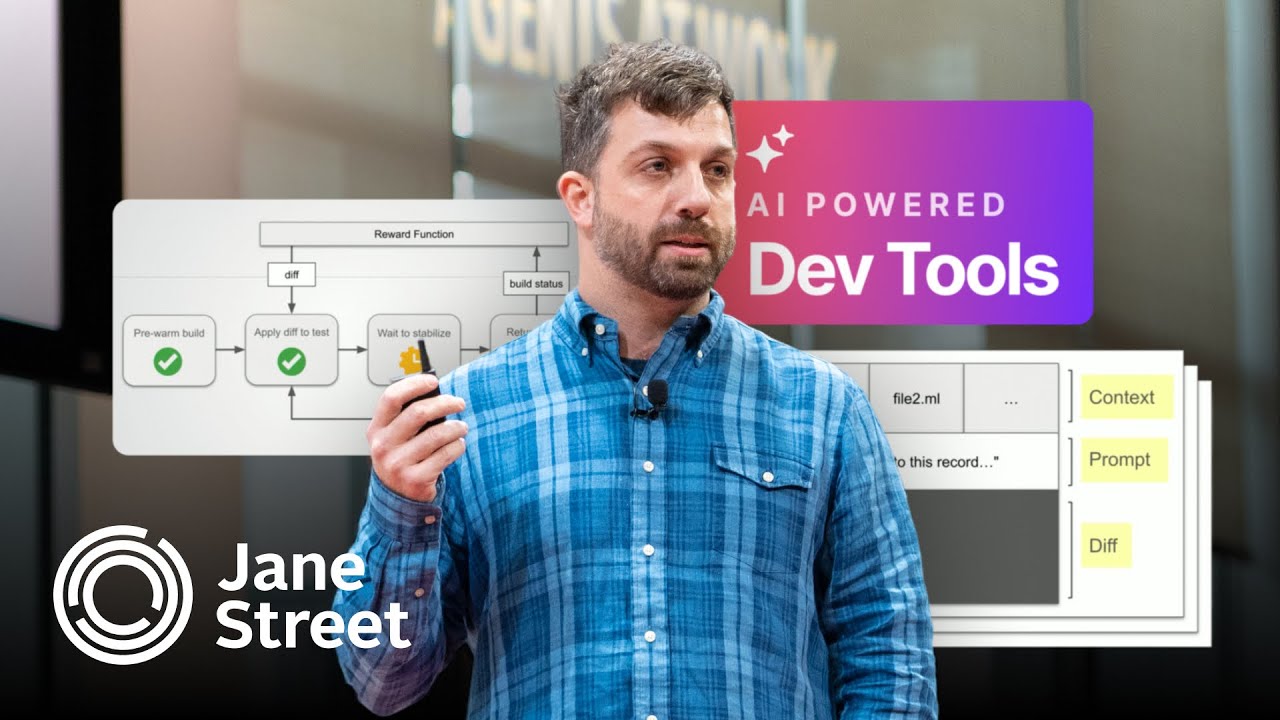
AI Engineering at Jane Street - John Crepezzi
Mar 28, 2025 · 16:57
John Crepezzi, an engineer on Jane Street's AI Assistants team, explains how they built custom LLM-powered coding assistants for OCaml, a functional language with scarce public training data. To overcome off-the-shelf tool limitations, they trained models on data from workspace snapshots — automated captures of developer workstations every 20 seconds, tracking build status changes from red to green. They used a Code Evaluation Service (CES) for reinforcement learning and evaluation, pre-warming builds to quickly test if model-generated diffs compile and pass tests. Their sidecar architecture, AID, serves thin editor integrations for Emacs (used by 67% of the firm), VS Code, and Neovim, allowing easy model swapping and A/B testing (e.g., sending 50% of users to different models). The talk details the end-to-end process: data collection from features, commits, and snapshots; training with supervised data and RL; and building pluggable infrastructure for domain-specific tools.
How Deep Research Works - Mukund Sridhar & Aarush Selvan, Google DeepMind
Mar 26, 2025 · 15:15
Aarush Selvan and Mukund Sridhar from Google DeepMind explain how Gemini Deep Research works, a personal research agent that trades latency for comprehensiveness by taking up to five minutes to browse the web and synthesize reports. They discuss product challenges like building an asynchronous experience in a synchronous chatbot, setting user expectations, and presenting thousand-word outputs. Technical challenges covered include iterative planning with partial information, handling the fragmented web with entity resolution, managing growing context via recency-biased retrieval, and ensuring robustness to intermediate failures. The episode also explores future directions: going from aggregating information to providing expert-level insights, personalizing research to user roles, and combining web research with coding, data science, or video generation.

Why Agent Engineering — swyx
Mar 24, 2025 · 11:45
Swyx argues that 2025 is the year of agent engineering, pivoting the AI Engineer Summit to focus exclusively on agents and explaining why agents are now viable due to advancements in reasoning, tool use, model diversity, and a 1000x cost reduction in GPT-4-level intelligence over 18 months. He highlights that OpenAI's ChatGPT grew 33% to 400M users in three months after shipping agentic O1 models, and projects it will reach 1B users by year-end. Swyx cites Simon Willison's crowdsourced definitions and OpenAI's new agent definition, while calling for a halt to demos of flight booking agents and Reddit astroturfing. He frames agent engineering as the evolution of AI engineering, distinct from MLE and software engineering, with practical use cases like coding and support agents having clear product-market fit.
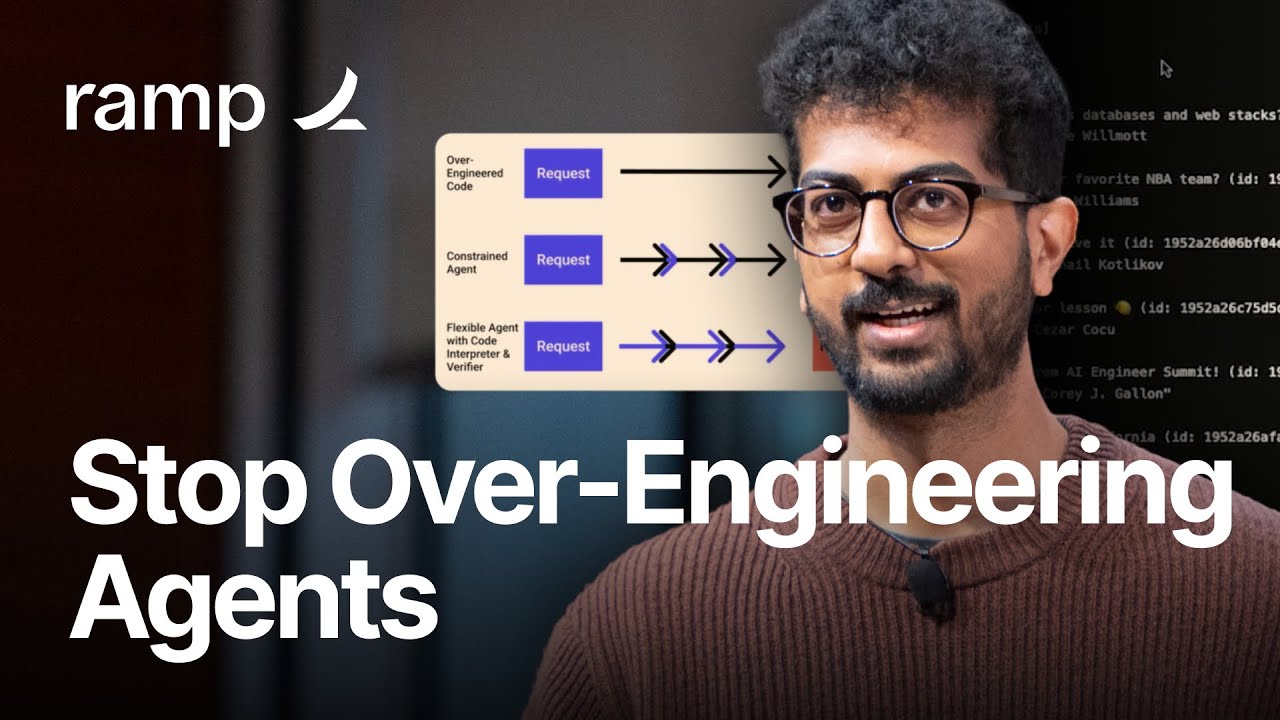
Rethinking how we Scaffold AI Agents - Rahul Sengottuvelu, Ramp
Mar 19, 2025 · 16:32
Rahul Sengottuvelu, Head of Applied AI at Ramp and co-founder of Cohere.io, argues that building AI agents should follow the 'bitter lesson' from AI research: systems that scale with compute outperform handcrafted, deterministic code. He illustrates this with Ramp's switching report agent, which ingests arbitrary CSV files from third-party card providers. Three approaches are compared: manually coding parsers for the 50 most common vendors, using LLMs only for column classification, and a fully LLM-driven method where the model writes and runs pandas code via a code interpreter, repeated 50 times in parallel. The last approach, though using 10,000x more compute, costs under a dollar and generalizes better, saving Ramp far more in failed transactions. Sengottuvelu also demonstrates a prototype email client where the backend is an LLM with access to a code interpreter and the user's Gmail token; the LLM renders the UI as Markdown and handles clicks by re-prompting itself, simulating a full web app without traditional backend code. He contends that as models exponentially improve, shifting more execution into 'fuzzy' LLM compute—rather than rigid code—lets builders ride the trend for…
Navigating AI’s Frontier in 2025 - Grace Isford, Lux Capital
Mar 13, 2025 · 17:55
Grace Isford, partner at Lux Capital, argues that while 2025 is a 'perfect storm' for AI agents with reasoning models like O3 and R1, cheaper inference, and billions in infrastructure (e.g., Stargate, DeepSeek), agents still fail due to cumulative errors—decision, implementation, heuristic, and taste—exemplified by OpenAI Operator booking a flight incorrectly. She prescribes five strategies: curating proprietary and agent-generated data, building personalized evals for non-verifiable domains (e.g., seat preference), designing scaffolding that prevents cascading failures (citing Ramp's approach), treating UX as the moat (e.g., Codium, Harvey, TLDraw), and building multimodally with voice, smell via Osmo, and touch for embodiment. The talk, recorded at the AI Engineer Summit 2025 in NYC, closes with a call to reframe perfection through visionary product experiences.

Reinforcement Learning for Agents - Will Brown, ML Researcher at Morgan Stanley
Mar 7, 2025 · 18:17
Will Brown, a machine learning researcher at Morgan Stanley, argues that reinforcement learning (RL) is the essential path to unlocking autonomous AI agents, citing DeepSeek's R1 and OpenAI's Deep Research as proof: R1 used GRPO to make models learn chain-of-thought reasoning without manual data, and Deep Research applies end-to-end RL for up to 100 tool calls. He shares his own open-source single-file GRPO script—a 1B-parameter LLaMA model trained on math questions that demonstrated self-correction and improved accuracy, sparking community forks and blog posts. Brown introduces 'rubric engineering' as a new practice akin to prompt engineering, where reward rules (e.g., XML structure, integer answers) guide model improvement, and warns about reward hacking. He previews his current work: a framework for RL inside multi-step environments, letting developers reuse existing agent code for training. The talk concludes that fine-tuning and RL remain relevant as open-source catches up, and that skills like building evals and prompts translate directly to the RL era.

OpenAI for VP's of AI + Advice for Building Agents
Mar 5, 2025 · 16:52
OpenAI's Toki Sherbakov and Prashant Mital explain how enterprises adopt AI through a three-phase journey: building an AI-enabled workforce with ChatGPT, automating operations with APIs, and infusing AI into end products. They detail a Morgan Stanley case study where retrieval methods improved an internal knowledge assistant's accuracy from 45% to 98%. The pair define agents as models with instructions, tools, and self-terminating execution loops, then share four field lessons: build with primitives before frameworks, start with a single purpose-built agent, graduate to a network of specialized agents with handoffs for complex tasks, and keep prompt instructions simple while running guardrails in parallel using fast models like GPT-4o mini for safety and reliability.

Building Agents with Model Context Protocol - Full Workshop with Mahesh Murag of Anthropic
Mar 1, 2025 · 1:44:12
Mahesh Murag of Anthropic presents the Model Context Protocol (MCP) as an open standard that replaces fragmented integrations with a single protocol for connecting AI systems to data sources, enabling context-rich AI applications and agentic experiences. He explains MCP's philosophy, inspired by APIs and LSP, and its three interfaces: tools (model-controlled), resources (application-controlled), and prompts (user-controlled). Murag highlights adoption with over 1,100 community-built servers and official integrations from companies like Cloudflare and Stripe. He demonstrates building agents with MCP using the MCP-Agent framework, showing how agents can use tools dynamically and composably across hierarchical systems. Future plans include remote server support with OAuth 2.0, a centralized registry for discovery and verification, and enabling agents to self-evolve by dynamically finding new capabilities via registry search.

AI Agents, Meet Test Driven Development
Feb 22, 2025 · 29:10
Anita from Vellum argues that teams using test-driven development build more reliable AI systems, and she breaks down how to apply TDD to agentic workflows across four stages: experiment, evaluate, deploy, monitor. She outlines five levels of agentic behavior (L0 to L4), noting that most production systems today are at L1 (tool use), while L2 systems that plan and reason with models like O1 and DeepSeek-R1 will see most innovation this year. She introduces Vellum's new open-source Workflows SDK, which keeps code and UI in sync, and demonstrates her own SEO agent that automates keyword research, content analysis, and writing via a writer-editor evaluation loop. The agent, built on Vellum Workflows, takes a keyword like "chain-of-thought prompting" and produces a first draft with a latency of around 118 seconds, incorporating competitive analysis and iterative feedback. She emphasizes that success now depends on orchestration techniques (prompt chaining, RAG, memory) rather than just model performance.

This video was edited with AI agent. But how?
Feb 22, 2025 · 5:00
Muhteşem from Re-Skill presents the world's first open-source video editing agent, built in collaboration with Diffusion Studio, which uses LLM-generated code to edit videos via a browser-based UI. The agent starts a Playwright browser session and connects to operator.diffusion.studio, a web app built with Diffusion Studio Core that renders video directly in the browser using WebCodecs. Three tools drive the process: VideoEditingTool generates and runs JavaScript code based on user prompts, DocsSearchTool uses RAG to pull relevant information from llms.txt, and VisualFeedbackTool samples one frame per second and decides whether to proceed with rendering or refine further. File transfers between the Python agent and browser happen via Chrome DevTools Protocol, and for scalability, the agent can connect to a remote GPU-accelerated browser through WebSocket. The project emerged from Re-Skill's need for automatic video editing for personalized learning, where they found FFmpeg too limiting and turned to Diffusion Studio Core for its intuitive API and reliable in-browser rendering.

Voice Agents: the good, the bad, and the ugly
Feb 22, 2025 · 18:48
Eddie Siegel, CTO at Fractional AI, details the real-world challenges of building an AI voice agent for consulting-style interviews, moving from proof of concept to production. The agent, designed to conduct hundreds of research interviews simultaneously, struggled with hallucinations, latency, and Whisper transcription errors like 'creeping dippity dippity dippity dippity'. To constrain the LLM's tendency to chitchat and rabbit-hole, Siegel's team introduced a 'drift detector' agent and a 'next question' agent, both running as separate text-based side threads. They also added tool use for question navigation, explicit goals and priorities for follow-ups, and a 'transcript cleaner' to hide garbled outputs from the user interface. To move beyond vibes-driven iteration, they built an automated eval suite with metrics like clarity and completeness, using synthetic conversations with personas such as a 'snarky teenager in charge of a Fortune 500 company' to simulate diverse interviewees. The talk offers a no-nonsense playbook for getting voice agents into production, focusing on out-of-band checks, tool use, and evals even without objective ground truth.

Beyond APIs: How AI Web Agents Are Automating the "Long Tail" of Knowledge Work
Feb 22, 2025 · 17:44
Arjun and Bhavani present Rtrvr.ai, a universal AI web agent using a text-based approach to autonomously perform tasks across multiple browser tabs at under a penny per page. They argue text-based reduces hallucination compared to vision-based agents like OpenAI's operator, and being a Chrome extension avoids password sharing and accesses logged-in content. Features include deep research navigating multiple pages, dynamic function calling for any third-party API, and graph generation. Rtrvr extracts structured data, performs actions like clicking dropdowns, and processes tabs simultaneously, automating the long tail of knowledge work including market research, LinkedIn automation, and WhatsApp messaging. They claim a distributed subtask approach lowers failure rates and envision collaborative dataset construction, e.g., aggregating local government events.

Agent Evals: Finally, With The Map
Feb 22, 2025 · 13:31
Ari Helczak from Rootsignals presents a systematic map for AI agent evaluation, dividing it into semantic and behavioral parts. Semantic evaluation covers single-turn virtues like coherence and safety, plus multi-turn aspects such as conversation consistency and reasoning traces. Behavioral evaluation addresses tool selection, instruction following, and multi-step goal convergence. Helczak grounds truthfulness in RAG and goal achievement in tool utility, and introduces eval-ops as a double-tier approach to optimize both the agent and its judgment flow. He also highlights cost, latency, tracing, and offline versus online testing as practical considerations, noting the map will quickly become obsolete as the field evolves.
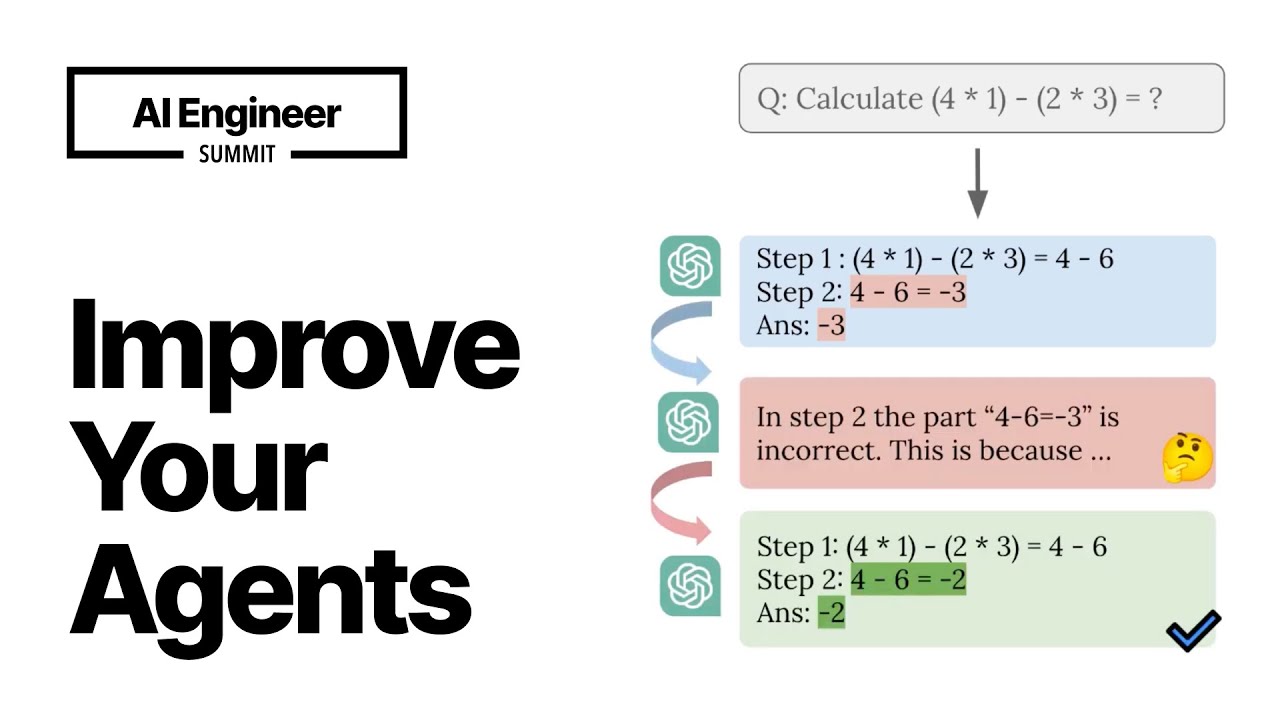
How to Improve Your Agents: Academic Lit Review
Feb 22, 2025 · 39:02
Joe from Columbia University and founder of Arklex AI explains research on AI agents, focusing on improving their reasoning and planning through self-reflection, test-time compute, and tree search methods, without relying on human supervision. He details the TriPath method, which uses larger models to edit smaller models' feedback for better self-improvement, achieving up to 48% accuracy on math benchmarks. He shows how multi-color tree search (MCTS) with contrastive reflection and multi-agent debate (RMCTS) outperforms other search methods on Visual Web Arena and OS World, achieving top non-trained results. He proposes exploratory learning, where models learn from search trajectories rather than optimal actions, improving performance under compute budgets. Finally, he presents the Arklex open-source agent framework, combining machine learning, systems, and security for practical multi-agent orchestration.
Stop Guessing: Build Robust AI with Layered CoT
Feb 22, 2025 · 10:16
Manish Senwal, Director of AI at NewsCorp, presents Layered Chain-of-Thought (CoT) prompting with Multi-Agent Systems to build transparent, self-correcting AI. Standard CoT is sensitive to prompt wording and lacks verification, letting errors cascade. Layered CoT verifies each reasoning step against a knowledge base, enabling early correction and reducing input sensitivity. The system iteratively generates thoughts, verifies them, and proceeds only with validated information. Combined with specialized agents—each handling distinct tasks like pedestrian detection—this yields fault-tolerant, scalable systems. The talk argues for structured, validated reasoning over larger models, referencing the arXiv paper (2501.18645).

Tool Calling Is Not Just Plumbing for AI Agents — Roy Derks
Feb 22, 2025 · 25:18
Roy Derks argues that tool calling is the most critical yet overlooked component of AI agents, far more than mere 'plumbing.' He contrasts traditional tool calling—where developers manually manage callbacks, retries, and errors within the agent loop—with embedded tool calling, a black-box approach used by frameworks like LangChain’s createReactAgent. Derks advocates for separation of concerns via the Model Context Protocol (MCP) from Anthropic, which splits tool logic into MCP servers communicating with clients, and via standalone tool platforms such as IBM’s wxflows, Composio, and Toolhouse that let teams build tools once and reuse them across LangChain, CrewAI, or AutoGen. He also introduces dynamic tools, where an agent generates queries on the fly—e.g., using GraphQL or SQL schemas—instead of defining hundreds of static tools, noting that LLMs like Claude handle GraphQL well but may hallucinate on deeply nested schemas. The episode emphasizes that 'an agent is only as good as its tools' and provides practical guidance on designing tool descriptions (which act like system prompts) and output schemas to enable type-safe, chainable tool calls.

Lets Build An Agent from Scratch — Kam Lasater
Feb 22, 2025 · 19:29
Kam Lasater demonstrates that an AI agent is simply an LLM paired with memory, planning, tools, and a while loop, and shows how to build one from scratch in incremental steps. He starts with a basic LLM call (step 0), adds a condition using an LLM as judge to check if an answer is complete (step 1), then incorporates a tool for web search via SERP AI (step 2). After refactoring for parallel tool calls (step 3), he introduces a to-do list for planning and tracking progress, along with a browse-web tool (step 4). The agent uses a to-do list to plan, execute tasks like searching and browsing, and then checks completion via LLM as judge. Lasater illustrates with examples: finding the average wind speed of a swallow, buying a hoodie near Times Square, and planning a date in Ardmore. He emphasizes that the simplest agent emerges naturally from combining these components, and encourages running and breaking the provided code.

Building Multi agent Systems with Finite State Machines
Feb 22, 2025 · 17:11
Adam Terlson argues that finite state machines (state charts) combined with the Actor model provide a structured, reliable foundation for building AI agents, addressing the predictability, observability, and control that LLMs lack. He introduces five agentic patterns—tool use, human-in-the-loop, feedback, collaboration, orchestration, and chartering—each demonstrated with concrete examples like a recipe-writing agent that checks inventory, a two-agent feedback loop for nutritional critique, and a multi-agent team delivering a meal. For orchestration, an LLM directs state transitions via event emitters, while chartering lets the LLM generate the entire state chart from a privacy-removal process. Terlson uses XState library for implementations and points to his demo 'Red versus Blue' for further exploration.

Reverse Conway's law and GenAI: How agents will take over the organisation - Patrick Debois
Feb 22, 2025 · 28:12
Patrick Debois argues that generative AI will reverse Conway's law, reshaping organizations around agents instead of human teams. He traces a progression from AI as a copilot to a team member, then a peer, and eventually a manager, with each stage unbundling human tasks and shrinking team sizes. Debois cites Amazon's AI pricing glitch as a reminder that humans remain needed for failure cleanup, and notes that LLMs mimic human collaboration behaviors, as shown in a multi-agent simulation. He warns of agent toxic behavior and the need for guardrails akin to human codes of conduct, while speculating that companies may replace SaaS with internally built AI services, making performance reviews and ROI calculations for agents inevitable. Debois advises engineers to focus on building the AI that builds their current work, not the work itself.
How Coding Agents change Software Development Forever - Hailong Zhang
Feb 22, 2025 · 8:50
Hailong Zhang presents how coding agents, particularly the unit test agent Gru, transform software development by automating routine tasks while humans focus on creative work. In the future workflow, synchronous agents like GitHub Copilot and Cursor assist in real-time, while asynchronous agents like Gru autonomously handle tasks such as writing tests, fixing bugs, and submitting pull requests. Gru, built to boost unit tests, detects code changes from pull requests, generates and runs tests, and submits a new PR with a summary and coverage improvement. In production, over 50% of Gru's PRs are accepted by humans, and it handles 80% of unit tests in its own repo, making it the top contributor. To build such agents, Zhang emphasizes defining a clear problem (e.g., unit tests, not generic software engineering), creating datasets and evaluation harnesses, selecting and fine-tuning LLMs per stage, building task-specific context from environment data, and developing an agent operating system to reuse common infrastructure across different tasks.

The LLM Triangle: Engineering Principles for Robust AI Applications - Almog Baku:
Feb 22, 2025 · 26:19
Almog Baku introduces the LLM Triangle Principles for building production-ready AI applications, arguing that LLMs should be treated like interns guided by Standard Operating Procedures (SOPs). He breaks down the triangle into three components: the foundation model, engineering techniques, and contextual data, all directed by SOPs derived from expert interviews. Baku contrasts autonomous agents—creative but unpredictable—with handcrafted LLM-native architectures that offer sustainable quality, recommending scoped autonomy. He advises starting with large models to collect data and optimize incrementally, rather than fine-tuning from day one. Data is paramount: 'show, don't tell' via few-shot examples, and balance context to avoid the 'needles in a haystack' problem. The framework aims to turn demos into robust production systems.

Cohere: Building enterprise LLM agents that work (Shaan Desai)
Feb 22, 2025 · 18:29
Shaan Desai, a machine learning engineer at Cohere, presents key strategies for building enterprise LLM agents that are scalable, safe, and seamless. He recommends using native or LangGraph frameworks for high observability in large-scale agents, while CrewAI or AutoGen suit quick proofs of concept. Core insights include starting with a single LLM and a handful of tools, simplifying tool specifications with clear descriptions and sharp examples, and caching chat history to prevent hallucinations beyond 20 turns. For multi-agent setups, the router needs clear routing instructions for edge cases, and sub-agents should be constrained to independent tasks. Safety is paramount, with human-in-the-loop triggered before or after tool calls based on codified rules. Evaluation uses a golden set of ground truth queries, expected tool calls, and outputs. Failure mitigation ranges from prompt engineering for low-severity issues to targeted annotation datasets for 10–20% failure rates and synthetic data fine-tuning for high failure rates. Cohere packages these learnings into NORTH, a single container deployment with RAG, vector DBs, and connectivity to Gmail, Outlook, Drive, and Slack,…
Lessons from building GenAI based applications — Juan Peredo
Feb 22, 2025 · 33:13
Juan Peredo details the hidden complexities of building GenAI applications, from model hosting and cost control to output validation and observability. He compares local (Ollama) vs cloud hosting (Modal, SkyPilot) and warns that an agent processing 3,000 calls/day with OpenAI O1 costs nearly $300,000/month, while LLaMA 3.3 70B drops that to $50,000/month. He explains techniques to mitigate hallucinations—prompt engineering, guardrails, RAG, and fine-tuning—each with trade-offs like added latency or cost. Peredo advocates externalizing prompts via LangChain Hub for easy iteration and future-proofing, and illustrates agent design with parallel calls to reduce latency. Finally, he stresses observability using tools like LangSmith to debug probabilistic failures, such as an LLM failing on case sensitivity.

Patrick Dougherty: How to Build AI Agents that Actually Work
Feb 22, 2025 · 17:44
Patrick Dougherty, co-founder and CTO of Rosco (acquired by Klarity in 2024), argues that building effective AI agents requires prioritizing reasoning over inherent model knowledge, iterating on the Agent-Computer Interface (ACI) rather than fine-tuning or relying on frameworks. He defines an agent as a system that takes directions, calls tools, and autonomously reasons—not a prompt chain. His team abandoned RAG-style knowledge injection for discrete tool calls (e.g., SEARCH TABLES, GET TABLE DETAIL), finding that GPT-4o often hallucinates impossible SQL queries while o1 correctly identifies missing data. Switching tool-response formats—Markdown to JSON for GPT-4o, JSON to XML for Claude—dramatically improved accuracy. For production, he warns against over-dependence on abstractions like LangGraph due to security needs (e.g., OAuth credential cascading). In multi-agent systems, a manager agent should delegate to 5–8 specialized worker agents, incentivized by the overall goal, to avoid loops. The true moat, he concludes, is the ecosystem—UX, connections, and security—not system prompts.
Keynote: Why people think "agent" is a buzzword but it isn't
Feb 22, 2025 · 28:07
Chip Huyen argues that agents are not a buzzword but a practical yet hard technology, facing three core challenges: the curve of complexity, tool use translation, and context management. Even simple queries require multiple steps, and models' success rates drop rapidly past 5 steps—newer reasoning models like DeepSeek R1 are pushing the boundary, but most still fail after 10. Tool use requires translating ambiguous natural language to precise API calls, worsened by poor documentation; she advises narrow functions and asking for clarifications. Context is another bottleneck: agents must juggle instructions, tool docs, and outputs, often exceeding a model's efficient context (many hallucinate beyond 30K tokens), necessitating external memory like RAG. Her benchmark shows planning-specialized models struggle with long context and vice versa, and she recommends breaking tasks into subtasks and using test-time compute scaling.

Personality Driven Development: Exploring the Frontier of Agents with Attitude
Feb 17, 2025 · 18:00
Ben, from Perpetual, argues that anthropomorphizing AI agents—giving them personalities, forms, and preferences—transforms user adoption and engagement, despite significant challenges. He presents examples like Tech Lead, an artichoke recruiter, and hamster teams, showing how form factors create instant understanding and enable price anchoring (e.g., 1/20th the cost of a junior employee). Benefits include easy problem decomposition (specialized agents outperform generalized), branding, and fun. However, downsides include reinforcing stereotypes (100% of generated software engineers appear male), raised performance expectations, difficulty rebranding, distraction from core value, and stark reminders of job replacement—illustrated by a CEO introducing an IC as the one who 'knows what they're doing.' Ben highlights personality-driven development where every instance is bespoke, with prompt-driven preferences (e.g., 'I like Ivy League schools'), making debugging uniquely challenging.

Customized, production ready inference with open source models: Dmytro (Dima) Dzhulgakov
Feb 16, 2025 · 18:55
Dmytro (Dima) Dzhulgakov, co-founder and CTO of Fireworks AI, argues that open source models are the future for production Gen AI applications, and Fireworks provides a platform to make them customized and production-ready. He explains that while proprietary models like GPT-4 are powerful, they are too large, expensive, and slow for many use cases, whereas open models like Llama or Gemma can be fine-tuned for specific domains to achieve better quality at up to 10x speed and lower cost. The main challenges of using open models—complex setup, performance tuning, and production scaling—are addressed by Fireworks' custom serving stack, which achieves the fastest long-prompt inference and serves SDXL fastest among providers, handling over 150 billion tokens per day. The platform supports fine-tuning and serving thousands of LoRA adapters on the same GPU with serverless pay-per-token pricing. Dzhulgakov also highlights the emerging architecture of compound AI systems, where function calling—exemplified by the open-source Fire Function model—connects LLMs to external tools and knowledge sources, enabling agentic applications like stock querying and chart generation. The episode…

Claude plays Minecraft!
Feb 15, 2025 · 18:16
Derek from AWS demonstrates building Rocky, an autonomous Minecraft agent using Amazon Bedrock, Claude 3 Haiku, and serverless AWS services, proving agentic workflows enable AI to reason and act beyond chatbots. He explains the architecture: Minecraft server on ECS with Mineflare bot framework, agents for Bedrock with return of control, and prompt engineering for tasks like digging and building. In a live demo, Rocky jumps, finds players, digs a hole, and builds a double-decker couch from a chat command, inferring parameters from natural language. The code is open-source and built with CDK/CloudFormation, emphasizing that agentic AI can operate in complex 3D environments through tool orchestration and managed prompt design.

Giving a Voice to AI Agents: Scott Stephenson, CEO, Deepgram
Feb 10, 2025 · 13:08
Scott Stephenson, CEO of Deepgram, outlines the evolution of voice AI from slow, domain-specific systems to fast, open-ended conversational agents powered by LLMs, arguing that speed and accuracy are now solved and the key differentiator is contextual understanding. He explains that state-of-the-art speech-to-text and text-to-speech can achieve round-trip latencies under 500 milliseconds—matching human turn-taking—but notes that current systems fail to pass context between components, causing 10-20% of interactions to feel unnatural. Stephenson introduces Deepgram's 'contextual AI' vision, where models are prompted with the full conversation history, including tone, pace, and background audio, enabling the LLM to generate responses and instruct the TTS on delivery. He cautions against monolithic speech-to-speech models for enterprise use due to controllability and cost concerns, advocating for a modular stack that lets businesses optimize each component (e.g., small LLMs for simple tasks like password resets). Deepgram’s upcoming voice AI agent API integrates all components for low latency and offers $250 in free credits for experimentation.
How to build the world's fastest voice bot: Kwindla Hultman Kramer
Feb 10, 2025 · 20:38
Kwindla Hultman Kramer, CEO of Daily, argues that colocating speech-to-text, LLM inference, and text-to-speech in a single compute container is the most effective way to achieve sub-500 millisecond voice-to-voice latency for conversational AI. He details how architectural flexibility and low-latency media transport are critical, citing measured bottlenecks like 30–40ms from macOS mic processing and typical voice-to-voice latencies of 600–700ms. To hit faster response times, his team uses Deepgram’s on-premises STT and TTS models via Docker and Llama 3 8B for LLM inference, achieving 500–700ms in an open-source demo. The talk introduces PipeCat, a vendor-neutral open-source framework for real-time multimodal AI that orchestrates components like transcription, endpointing, interruption handling, and text-to-speech. Kramer emphasizes that while frontier multimodal models are coming, orchestration layers remain essential for building production-grade voice bots, and shares that a recent latency demo gained over 175,000 views on Twitter.
Building an AI assistant that makes phone calls [Convex Workshop]
Feb 9, 2025 · 50:53
Tom Redmond, head of DX at Convex, builds Floyd, an AI phone-calling assistant using Convex, GPT-4, Google Cloud speech-to-text, and Twilio. Floyd lets users make voice requests (e.g., calling a school to report a sick child) via a web app; transcription, context retrieval, and real-time conversation with a human on the other end happen through a reactive database architecture. Redmond explains how Convex's WebSocket-based infrastructure solves serverless latency issues, enabling live transcript streaming and status updates without polling. He demonstrates two calls (school absence and flower order), noting that latency (2–5 seconds) comes from OpenAI text-to-speech and growing prompts, with plans to use OpenAI Threads and faster TTS services. The prototype explicitly discloses it's an AI to avoid misrepresentation, and Redmond envisions AI agents efficiently handling service bookings.

Agentic Workflows on Vertex AI: Rukma Sen
Feb 8, 2025 · 18:06
Google Cloud's Rukma Sen argues that AI agents are the essential bridge between generative models and users, and Vertex AI provides a platform to build and deploy them with enterprise-grade safety and flexibility. She defines agents as systems with a model (brain), tools (hands), and orchestration (nervous system), covering deterministic, generative, and hybrid types. For production reliability, she advocates multi-agent architectures, giving the example of a customer service system with dispatcher, expert, and supervisor agents—and a personal anecdote where a supervisor agent kept rejecting outputs. Use cases span customer support, employee HR, knowledge agents, and voice agents for drive-throughs. Vertex AI offers 150+ models (Google, Anthropic, LLaMA) and Agent Builder from no-code to full-code, with enterprise security and data privacy.
[Full Workshop] How to add secure code interpreting in your AI app: Vasek Mlejnsky
Feb 6, 2025 · 1:48:16
Vasek Mlejnsky, CEO of E2B, demonstrates how to add secure AI code execution to any app using E2B’s Code Interpreter SDK alongside Anthropic's Sonnet 3.5 and Vercel’s AI SDK. The workshop builds an open-source version of Claude’s artifacts UI, running Python code in isolated Firecracker VMs that start in ~900ms and support custom environments via Dockerfiles. Vasek explains how E2B’s Jupyter-server-based sandbox returns stdout, stderr, runtime errors, and rich outputs like PNG charts, which are streamed to the front end using Vercel’s stream data. He covers security architecture—full root access in a VM that self-destructs on escape—and plans for AWS/GCP self-hosting and snapshot-based agent branching. The episode also addresses customizing sandboxes with private packages, mounting cloud storage (S3, GCS), and interpreting table previews as HTML or images.

Substrate Launch: the API for modular AI
Feb 6, 2025 · 5:20
Rob Cheung, co-founder of Substrate, presents the platform as a new approach to building AI applications using modular intelligence rather than monolithic models. Substrate combines a developer SDK for describing computation graphs over multiple AI nodes with an inference engine optimized for running these graphs efficiently, reducing latency between nodes to microseconds—10,000 times faster than typical API dispatching. Cheung argues that modular systems are more legible, debuggable, and extensible, enabling higher quality outcomes through explicit decision trees and easier evaluation. The platform offers best-in-class JSON mode for multi-inference runs and supports modalities like image generation, speech transcription, text, embeddings, and code execution. Substrate is designed for developers to run 10-20 AI modules on a single user request at scale, solving the infrastructure problem that currently limits multi-step AI workflows.

Which Jobs Can Be Replaced Today: Fryderyk Wiatrowski and Peter Albert
Feb 6, 2025 · 19:59
Fryderyk Wiatrowski and Peter Albert, co-founders of Zeta Labs, argue that autonomous browser agents will first replace reactive jobs—like customer support and scheduling—by automating low-leverage tasks while preserving human focus on high-leverage activities. They propose a trigger-pool system where agents react to emails, Slack, or events, requiring only approval for actions. Peter details building reliable agents: start with prompting optimized for model distribution, then add cognitive architectures (e.g., planning, scratchpads) to split tasks, and finally fine-tune with synthetic data or reinforcement learning. He advises minimizing noise in prompts, preferring text-based reasoning over images, and using language model judges to filter training data. The founders see continuous model improvement enabling agents to handle increasingly complex, proactive roles, moving toward full job replacement.

Lessons from the Trenches: Building LLM Evals That Work IRL: Aparna Dhinkaran
Feb 6, 2025 · 18:49
Aparna Dhinakaran, co-founder of Arize AI, distinguishes between model evals (e.g., Hugging Face leaderboard) and task evals for real-world LLM systems, arguing that production applications need component-level evaluations like router and parameter evals. She demonstrates a chat-to-purchase app where a router function call misidentifies user intent, showing how Phoenix open source tool traces errors and provides explanations to iterate. Dhinakaran advises using categorical over numeric LLM-as-judge scores because numeric outputs tend to be binary (0 or 10) and lack granularity. Presenting needle-in-haystack research, she notes GPT-4 struggles retrieving facts placed early in large context windows, and in retrieval-with-generation tasks, Anthropic’s Claude 2.1 outperforms GPT-4 due to verbose reasoning, a gap closed by prompting GPT-4 to explain itself first.

Ionic Launch: Opening the economy to AI agents
Feb 6, 2025 · 5:30
Justin, CEO and co-founder of Ionic Commerce, presents his company's mission to enable AI agents to participate in the economy, starting with ecommerce. He argues that the current web is built for ads, not actions, leaving agents unable to access dynamic product data like stock or shipping. Ionic solves this by partnering with hundreds of merchants, enriching their product feeds via an agentic workflow, and exposing the data through an API that agents can query in their preferred format (relational, vector, graph). The platform also adds a transaction layer so agents can complete purchases in one step using payment tokens. Justin emphasizes that merchants will pay for this service because it provides better attribution and customer relationships than Amazon's cut. Ionic's catalog already includes millions of AI-native SKUs, and developers can start today at docs.ioniccommerce.com.

BotDojo Launch: Enhancing AI Assistants with Evaluations and Synthetic Data
Feb 5, 2025 · 5:47
BotDojo founder Paul Henry demonstrates how his platform uses synthetic data generation and evaluations to productionize AI assistants. He shows a chatbot template with a low-code editor, node tracing, and JSON schema support. By running batch evaluations, he identifies knowledge gaps in the vector database. Then, he generates synthetic test data from live support tickets by extracting question-answer pairs and writing new documents to the index. Running the evaluations again, the scores improve from having red failures to all green, measurably boosting the chatbot's performance. Henry stresses that while hooking up a vector database to an LLM is easy, getting it production-ready requires systematic evaluation and data augmentation.

Scaling AI in Education: A Khanmigo case study: Shawn Jansepar
Feb 5, 2025 · 22:39
Shawn Jansepar, Khan Academy's Director of Engineering, details building Khanmigo, an AI tutor and teacher assistant on GPT-4 with OpenAI, arguing generative AI can democratize one-on-one tutoring. He describes a rapid prototyping culture that launched Khanmigo in three months via a company-wide hackathon, replacing traditional agile with a prototype-to-beta-to-launch framework. Technical challenges include math accuracy through a math agent and chain-of-thought prompting, refactoring prompts into a component architecture for testing, and managing scale using multiple models and dedicated Azure compute. Jansepar highlights ethical design: a Socratic tutor that avoids answers, teacher moderation, and a writing coach with revision history. Khanmigo now has 200,000 paid users, half in school districts, with teacher tools sponsored by Microsoft free to US teachers. Plans include releasing a math tutoring benchmark and evaluating smaller models like Phi-3.
RAG for VPs of AI: Jerry Liu
Dec 31, 2024 · 26:51
Jerry Liu, CEO of LlamaIndex, argues that building production RAG systems requires a new data processing stack distinct from traditional ETL, emphasizing data quality through advanced parsing (Llama Parse) and rigorous eval over chunk size tuning. He explains that while longer context windows may eliminate fine-grained chunking, retrieval from external storage remains vital for multi-doc enterprise systems. Liu addresses data privacy with VPC deployment options, and notes that Llama Cloud processes but does not store data. He also highlights Llama Agents, an open-source multi-agent framework for deploying agentic microservices, and shares that Llama Parse processes tens of millions of pages monthly.

Enhancing Quality and Security in CI: Gunjan Patel
Nov 27, 2024 · 18:27
Gunjan Patel, Director of Engineering at Palo Alto Networks, presents Ghost Pilot, an AI-powered CI pipeline that outsources boring software development tasks to enable self-evolving code. Unlike real-time Copilots, Ghost Pilot operates as a 'slow system' in CI, iteratively improving variable names and code comments, then generating unit tests by first listing edge cases and personalizing them via team context files. For security, it simulates three AI roles—Red Team engineer, developer, and engineering manager—who debate identified vulnerabilities, prioritize fixes by risk and effort, and propose changes with citations. Patel shares a reusable CI template with a Bring-Your-Own-LLM option, demonstrated by catching a logical Kubernetes bug missed by static analysis tools.
How Zapier Builds AI Products and Features with the Help of Braintrust: Ankur Goyal & Olmo Maldonado
Nov 7, 2024 · 14:59
In this talk, Olmo Maldonado (Senior AI Engineer at Zapier) and Ankur Goyal (CEO of Braintrust) explain how Zapier uses Braintrust's evaluation and observability platform to build and improve AI features like AI Zap Builder and Copilot. They moved from 7 manual unit tests to over 800 automated evals, improving accuracy by nearly 300%. Braintrust's tracing capabilities let them dissect Copilot's multi-tool agent performance, leading them to adopt GPT-4 Turbo for the message router despite latency trade-offs. When switching to GPT-4.0 caused a regression below 80% scores, they diagnosed the issue via evals—GPT-4.0 was ignoring system prompts—and fixed it by relaxing prompt engineering and adjusting tool choices, recovering accuracy and cutting response time from 14 to 3 seconds. The episode details how eval-driven development and observability enable rapid iteration and reliable AI products at scale.

Build an AI Research Agent: Apoorva Joshi
Oct 25, 2024 · 27:33
In this workshop, Apoorva Joshi, an AI Developer Advocate at MongoDB, teaches how to build an AI research agent using MongoDB as the memory provider and knowledge store, open-source LLMs from Fireworks AI (Fire Function V1) as the agent’s brain, and LangChain to orchestrate the workflow. The agent searches for research papers, summarizes them, and answers questions based on past research, using tools like ArXivLoader and a MongoDB vector store. Joshi explains key agent concepts—planning with chain of thought and react patterns, short-term and long-term memory, and tool creation—then guides attendees through hands-on sections to build the agent step by step. Attendees learn to create agent tools, implement reasoning with react, and add short-term memory persisted to MongoDB. The workshop emphasizes that agents enable complex, multi-step tasks through iterative reasoning, tool use, and memory, trading higher cost and latency for improved accuracy.

Architecting and Testing Controllable Agents: Lance Martin
Oct 11, 2024 · 2:21:54
Lance Martin presents LangGraph, a graph-based framework for building controllable agents that trade some open-ended flexibility for significantly higher reliability compared to classic React agents, achieving 100% consistent tool-calling trajectories even with an 8B local model. He demonstrates self-corrective RAG patterns like Corrective RAG, SelfRAG, and Adaptive RAG, where the agent grades retrieved documents, checks for hallucinations, and routes to web search when needed. Martin also covers three testing loops: in-app error handling with LangGraph, pre-production evaluation using LangSmith to compare agent answers and tool trajectories against ground-truth datasets, and production monitoring with online evaluators that flag retrieval quality, answer relevance, and hallucinations without reference answers. He shares results from a five-question evaluation showing LangGraph agents achieve 80% answer accuracy and 100% tool-trajectory correctness with Fire Function V2, while React agents with GPT-4o degrade in tool reliability. The talk addresses practical concerns like handling many tools (suggesting RAG for tool selection), multi-turn conversations, and the importance of…

Breaking AI's 1-GHz Barrier: Sunny Madra (Groq)
Oct 10, 2024 · 20:11
Sunny Madra (Groq) argues that LLM inference speed is undergoing a transformation akin to the 1-GHz microprocessor breakthrough, with Groq increasing LLaMA 3 8B speed by over 50% in just two months. He draws parallels to the industrial revolution: just as mass production replaced bespoke manufacturing, AI now enables 1,000 outputs in a minute where previously one designer produced one per day. Specific applications like Globe.Engineer plan a trip in seconds by processing 10,000 input tokens per second. Madra envisions LLMs as future OS cores, enabling instantaneous decision-making, universal natural-language interfaces, and multi-agent collaboration that allows smaller models to compete with larger ones. Edge AI projects like hyperspace.ai distribute unused GPU compute, and personalized education (citing Khan's two-sigma effect) becomes practical with cheap inference. He also highlights automated data science agents (Pioneer) that run endlessly, discovering correlations like productivity decline after certain performance reviews. The episode underscores that speed unlocks predictive analytics, context-aware systems, and enhanced security against AI-powered scams.

Building and Scaling an AI Agent Swarm of low latency real time voice bots: Damien Murphy
Oct 8, 2024 · 1:07:23
Damien Murphy, Senior Applied Engineer at Deepgram, demonstrates building and scaling low-latency real-time voice bots using Deepgram's new voice agent API, which wraps speech-to-text, LLM, and text-to-speech into a single streaming endpoint. He shows a drive-thru ordering demo with function calling (add/remove items) using GPT-4o, achieving sub-second latency by co-locating components. Murphy explains scaling to millions of concurrent calls through regional Kubernetes clusters and multi-agent swarms (routing, booking, support agents) to reduce complexity and cost. He addresses endpointing challenges, VAD-based barge-in, and cost/quality trade-offs with hosted vs. self-hosted models, noting Deepgram offers 20x cheaper TTS than ElevenLabs and 50ms STT latency self-hosted. The talk emphasizes keeping agents simple, using smallest capable LLMs, and composability for reuse.

How to Construct Domain Specific LLM Evaluation Systems: Hamel Husain and Emil Sedgh
Sep 19, 2024 · 18:45
Emil Sedgh (CTO at Rechat) and Hamel Husain (independent consultant) describe how they built a domain-specific evaluation system for Lucy, an AI assistant for real estate agents, to move beyond vibe checks and achieve production reliability. They argue that systematic evaluation starts with simple unit tests and assertions based on observed failure modes, logging traces for human review with custom tools to remove friction, and using LLMs to synthetically generate test inputs. The presenters emphasize that focusing on process over tools, avoiding generic off-the-shelf evals, and not jumping too early to LLM-as-a-judge are critical to success. This eval framework enabled Rechat to rapidly increase Lucy's success rate and made possible fine-tuning for complex tasks like mixing structured and unstructured outputs, handling multi-step commands that invoke five or six tools, and incorporating user feedback loops—capabilities they could not achieve with few-shot prompting alone.

Hyperspace More Nodes Is All You Need: Nicolas Schlaepfer
Sep 4, 2024 · 5:48
Nicolas Schlaepfer introduces Hyperspace's decentralized AI network and new product, a node editor for power users that generates agentic plans via a DAG orchestration model (HyperEngine v3). The network, with over 15,000 nodes, leverages consumer devices rather than GPUs, running inference through Llama.cpp. The product combines prompt engineering, visual React flow, Python execution, and RAG-like web browsing, using Qwen 2 instruct for reasoning and LLaMA 3 70B for summarization. Schlaepfer emphasizes diverse open-source models and a virtual file system for agentic primitives. Availability via waitlist is announced later this week.

Disrupting the $15 Trillion Construction Industry with Autonomous Agents: Dr. Sarah Buchner
Aug 22, 2024 · 5:32
Dr. Sarah Buchner, Founder & CEO of Trunk Tools, argues that vertical AI agents are the future, targeting the $15 trillion construction industry where 10% rework costs $1.5 trillion annually. Her company deploys an agent every 45 days, starting with TrunkText, a RAG-powered Q&A tool that saves field professionals 1-2 hours daily by accessing up to 3.6 million pages of documentation per skyscraper. The episode reveals how their system uncovers costly data discrepancies—such as a door needing power-actuated hardware that contradicts specs—and automatically generates RFIs to resolve them. Buchner insists RAG is commoditized, but keeping humans at the center with an army of agents solving real-world problems is the true impact. The talk highlights Trunk Tools' brain behind construction, backed by Sequoia, Accel, and others, and notes the company is hiring as it scales.

Building Reliable Agentic Systems: Eno Reyes
Aug 20, 2024 · 18:14
Eno Reyes, CTO of Factory.ai, explains how his team builds reliable agentic systems—called Droids—for automating software development tasks by applying techniques from robotics and control systems to handle planning, decision making, and environmental grounding. Reyes describes a pseudo-Kalman filter that passes intermediate reasoning through plan steps, converging reasoning but risking error propagation. He advocates for explicit plan criteria and hard-coded logic to improve reliability, despite reducing generalizability. On decision making, he recommends consensus mechanisms like self-consistency, explicit reasoning with checklists, fine-tuning for out-of-distribution decisions, and simulation via Monte Carlo tree search. For environmental grounding, he emphasizes building custom AI computer interfaces for domain-specific workflows, designing explicit feedback processing (e.g., parsing CI/CD logs), balancing bounded exploration with long-context models, and incorporating human guidance to boost reliability from 30–40% to 90–100%.

Using agents to build an agent company: Joao Moura
Aug 8, 2024 · 13:46
Joao Moura, founder of crewAI, explains how he used AI agents to build his own company, sharing that over 10.5 million agents were executed with crewAI in the last 30 days. He describes starting by building a marketing crew that automated LinkedIn and content creation, which generated 10x more views in 16 days, then a lead qualification crew that led to 150+ customer calls in two weeks. Moura details new features: code execution with a single flag, trainable crews for consistent results, support for third-party agents, and crewAI Plus for deploying crews as auto-scaling APIs in minutes. He emphasizes starting simple with low-risk, high-impact use cases and encourages attendees to bring agents into production now.

Emergence Launch: AI Agents and the future enterprise: Dr. Satya Nitta
Jul 31, 2024 · 5:41
Dr. Satya Nitta introduces Emergence, an R&D-led AI company spun out of IBM Research with talent from Google Brain, Alexa, and Meta, focused on advancing AI agents for enterprise. The company's core product, the Orchestrator Agent (G8, launching in August), plans, acts, and verifies across multiple LLMs and agents to automate complex workflows like claims processing. Emergence also develops Agent E, an open-source web agent that tops the Web Voyager benchmark by autonomously controlling the web. Nitta emphasizes the company's R&D on self-improvement agents, AI planning and reasoning, and agent-oriented programming, with applications in enterprise RPA and document processing. The goal is to enable enterprises to build and deploy autonomous agents that drive productivity by operating software and web browsers.

Copilots Everywhere: Thomas Dohmke and Eugene Yan
Jul 26, 2024 · 18:22
GitHub CEO Thomas Dohmke shares the Copilot origin story from 2020 lockdown demos of GPT-3's Codex, its early 72 NPS despite hallucinations, and how it now writes half the code in enabled files. He details Copilot's expansion beyond IDE auto-completion to Chat and the new Copilot Workspace, which takes a GitHub issue and generates a plan and code changes, keeping humans in the loop. Dohmke argues Workspace helps non-developers like product managers see implementation details and size tasks. He defines an agent as an 'AI dishwasher' that autonomously handles drudge work like security backlogs, and urges developers to embrace AI tools to bring fun back into software development.

From Software Developer to AI Engineer: Antje Barth
Jul 24, 2024 · 19:48
Antje Barth, a Principal Developer Advocate for generative AI at AWS, outlines five practical steps from software developer to AI engineer: understanding foundation models, getting hands-on with AI developer tools like Amazon Q Developer, prototyping with models via Amazon Bedrock, integrating agents, and staying up to date with community events. She demonstrates Amazon Q Developer's ability to generate, explain, and transform code, reducing unvaluable tasks from 70% to focus on creative work. Barth introduces Amazon Bedrock's unified Converse API for standardized model invocation across providers like Anthropic's Claude 3.5 Sonnet, and shows how agents can be built to control a Minecraft bot through reasoning and tool use. The episode concludes with the announcement of the AI Engineering Hub at the AWS loft in San Francisco for community workshops and events.

Lessons From A Year Building With LLMs
Jul 19, 2024 · 35:21
The six authors of the O'Reilly article "Lessons From A Year Building With LLMs" — Bryan Bischof, Jason Liu, Hamel Husain, Eugene Yan, Shreya Shankar, and Swix — argue that the model itself is not a moat and that success comes from continuous improvement centered on evals and data. They stress that AI engineers should treat models as SaaS, quickly swapping for better ones, and focus on product and user interactions. The talk warns against toxic practices like prematurely hiring ML engineers without data or blindly adopting tools, advocating instead for deliberate eval practice and data literacy. On tactics, they compare LLM-as-judge (quick to prototype) vs fine-tuned evaluators (more precise and faster), and emphasize looking at real user data regularly with automated guardrails. Ultimately, they conclude that going from demo to production requires sustained investment in infrastructure and evaluation, echoing MLOps lessons from a decade ago.
The Future of Knowledge Assistants: Jerry Liu
Jul 13, 2024 · 16:55
Jerry Liu, CEO of LlamaIndex, explains how to move beyond simple RAG to build production-grade knowledge assistants. He details three steps: advanced data processing with LlamaParse for accurate PDF parsing, single-agent flows with query planning and tool use, and multi-agent task solvers via the newly announced Llama Agents framework. Llama Agents treats each agent as a deployable microservice that communicates through a central API, enabling specialization, parallelism, and easier production deployment. Jerry also highlights that naive RAG is insufficient for complex queries, and that good data quality—like proper parsing of tables and charts—is essential to reduce hallucinations.

AI Engineering 201: The Rest of the Owl
Nov 8, 2023 · 56:57
Charles Frye, instructor of the Full Stack LLM Bootcamp, presents essential patterns for building language user interfaces (LUIs), arguing that while RAG chatbots are the 'to-do list app' of AI engineering, structured outputs via function calling (e.g., OpenAI's JSON schema, Instructor library) improve robustness, and agents with memory (like generative agents or Voyager in Minecraft) represent the true AI frontier. He emphasizes the need for hybrid search combining vector and keyword retrieval (citing Vespa, Postgres, Redis), and warns that monitoring and evaluation are the hardest engineering challenges: monitoring user behavior, latency quantiles (especially 99th percentile), and costs must be paired with observability tools like Honeycomb or Gantry, while evaluation often requires iterated decomposition or using LLMs as evaluators (GPT-4 as 90th percentile crowd worker). The episode concludes that shipping to learn — starting with production data to generate tests — is the dominant engineering mindset, and that the field is still filling in the gaps between inference and full product value.
The Age of the Agent: Flo Crivello
Oct 24, 2023 · 14:49
Flo Crivello, founder and CEO of Lindy, argues that AI agents will democratize business impact, enabling a 25-year-old to match the Coca-Cola company. He draws a parallel to media, where YouTube removed gatekeepers and created outliers like MrBeast and Ryan's World. Lindy, an AI personal assistant, automates calendar, email, and meeting prep—saving the average US manager 15 hours weekly, worth $459B annually. A story reveals Lindy's hallucinations: it invented the nonexistent word "periquity." Crivello envisions a "society of Lindys" collaborating, citing Lindy's own agent team that builds integrations with Slack and Twilio. He concludes that the only future skill will be wielding AI leverage, as AI CMOs, designers, and engineers will work for anyone.
The Future of Work: Toran Bruce Richards, Silen Naihin et al
Oct 24, 2023 · 12:53
Toran Bruce Richards and Silen Naihin present Auto-GPT's vision for AI agents that augment human work, announcing 150k GitHub stars and $12M funding from Redpoint Ventures to build an open-source generalist agent. They unveil a forge template and dev tool built on the Agent Protocol, alongside a benchmark that tracks agent success rates from 35% to 55% over August. Safety is prioritized: prompt injection and agents deleting all JSON files on a laptop highlight the need for 100% reliability. The episode argues code agents are the stepping stone to AGI, with the mission to redefine the future of work by giving humans time back for creative tasks.
Powered by PodHood