

The Gap0:00
Hello everybody, I'm Armanas. I work at Alithea Bio, where we focus on life sciences topics; more specifically, we work on immuno-oncology and immunopeptidomics. While we work on science topics, we use ourselves and write our clients agentic automation, or agentic AI solutions.
However, we found a certain gap, which we would like to discuss today, and we have a solution which we're working on, which we would like to share. It's called Froglet.
But to start with, I would like to ask: what do you think is most valuable work that agentic automation can do?
My guess: scientific research automation would be quite high up that list. However, from my experience, adding more tools to agents will not suffice. Because science, and especially life sciences, is an inherently collaborative process. And in order to enable agents to collaborate, we need a way to have a verifiable chain of receipts.
What do I mean? We need a solution which can provide these receipts, proving every step, ensuring that every result can be trusted, and enabling repeatability as well as collaboration at scale.
Having these features in mind, let's go to the next step. So, stepping back, we imagine agents as cooks in the kitchen. Giving them more tools, or better tools, improves kitchen's efficiency. Better knives, more pans, more ovens definitely boost the speed and quality, but it only enhances the local work.
Kitchen Analogy1:42
On the other hand, scientific work is not cooking alone in your own kitchen. It is closer to running a Michelin-star restaurant. To overcome this, the outcome depends on providers and quality of their produce, high-level services, as well as an ability to consistently deliver the same quality dish, again and again and again.
You cannot bring everything into one kitchen. The challenge isn't local. It's not local tools. The challenge is aligning the entire supply chain so that it's repeatable and consistent.
Today, we have already agents with plenty of tools, and it is increasing in volume, number, and quality. And we also have, on the other hand, data and specialized analytics algorithms and compute, which are distributed across different organizations and siloed.
Vision3:03
So our vision is that whenever AI agent workflow automation matures, organizations will give to the agents not only tools, they will give them budgets. We're already kind of doing this in a primitive form, by allocating tokens for token budgets for a specific task.
But what I'm talking about is a bit broader. It's allowing agents to manage their own budgets to achieve their own goals, whether it's to discover services, request data, negotiate execution terms, or pay for work across organizational boundaries. At that point, an agent is no longer just a cook with a better knife.
Froglet4:19
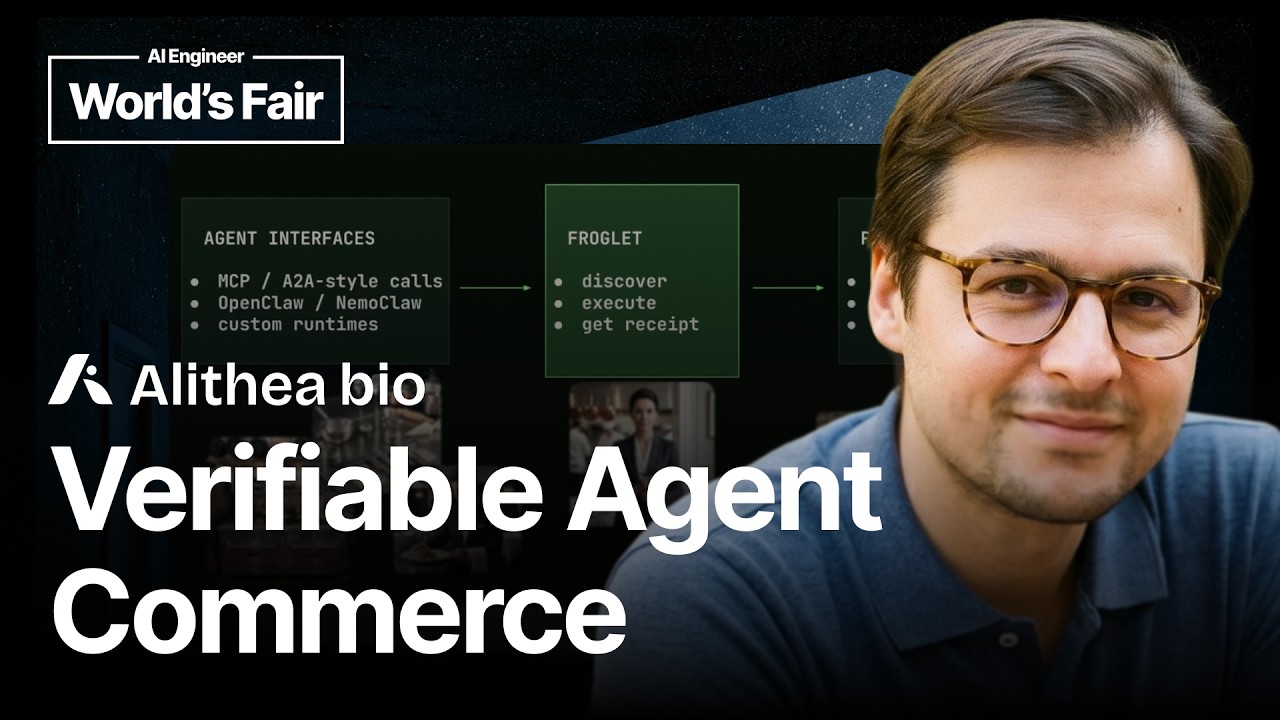
It starts to act like a chef, like an executive chef: finding suppliers, ordering ingredients, coordinating work at the kitchen, and finally keeping the record of what has happened. That is why we're building Froglet, an open-source protocol for agents to discover, transact with, and receive verifiable receipts from external data and service providers.
For more detailed information, obviously, go to our page froglet.dev, where you will find
general descriptions on how it works, what it integrates with. Froglet is designed to be in between the moving parts. It's not designed to replace; it's designed to integrate. It integrates with different payment rails, it integrates with different agent harnesses, execution environments, and even transport protocols.
And it doesn't require that every node in the network uses the same software stack. That's the beauty: we are not forcing everyone to use the same, to work the same way. We're just asking everybody to use the same interface.
In the web page, you will find how to run Froglet with just how to install it locally, just with one command. Or even how to run it remotely, just with one prompt.
So in essence, what we're saying is: closed-source scientific collaboration often turns into a bespoke project, enterprise project, that can take years and cost millions before any reusable workflow exists.
On the other hand, Froglet's mission is to make the transaction layer much lighter. Once an organization decides that the data or resource or service is deemed shareable
and it's exposed on Froglet, an agent can discover it, understand the terms, request the work, and receive a verifiable receipt.
That setup costs 2,000 tokens and takes minutes.
Now, if I may, let me open our website for a quick second. So if you land our—if you go and land our homepage, you will see a couple of things. First, a lot of helper information, which allows you or your agent to read through and understand how it works.
Website Tour6:56
And most of the web page is focused on agentic use. But also, we have some helpful documentation for you. Let me go through a couple of steps in the demo.
So, first of all, we define that a Froglet node by itself is not different implementations at each site. It is actually exactly the same node. It just plays different roles, whether it's a provider, requester, or marketplace. Marketplace itself is just a Froglet node which is providing certain services.
And what does it help to do? It helps to find, to trust, to pay, and to prove that work has happened. That is it. We're not trying to replace any of the functionalities of other tools or protocols.
Whenever you are generating a or creating a new node, it generates a key pair for identity and signing the artifacts. And during the execution, everything is being signed with that signature, meaning everything is being signed in a chain, and the chain is only valid if all data points are not tampered with.
And in terms of discovery requests, providers are publishing what services they are providing to the marketplace using the same protocol. And requests are requests in known marketplaces just to provide lists of services that are available in that marketplace.
From that moment on, once a requester identifies the service that they want to work with, the communication is direct. There is no third party. And everything from quote to deal to execution and receipt happens in one interaction.
Let me jump forward a bit.
So, so far, what I showed you is just a node talking to a node. Where agent comes in are the plugins that we placed inside the Froglet core. It integrates with different execution environments and different harnesses, whether it's OpenClaw, NemoClaw, it acts as an MCP server or plugin.
Agent Plugins9:35
And it's primarily designed that it is used by an agent.
The primary interface for humans should be an LLM. And LLM should drive usage of Froglet, whether you are a provider or a requester.
Terminal Demo10:39
So now, maybe let's jump to a terminal and I will show you a couple of things. First of all, I will show you how to—how you can use Froglet remotely, meaning that there is a Froglet node running in a remote server where you can access and get a 15-minute trial identity which you can play with.
Second, how to run a Froglet locally on my machine here on a Docker. And third, how I will ask my Claude to interact with local installation and actually configure a service and try it out. So, first of all, what we—what I would like to do is to run a command to check whether Froglet try.froglet.com.dev actually exists and it works.
That's fine. So now what I can do is to create myself a token. And this creates a temporary token for 15 minutes. And you can see it here, created.
And then what I can do also, in exactly the same manner, I can have access to the specific provider token. And this is a specific provider which adds two numbers. It's a very simple example service provider. As you see, the tokens are different.
That means the Froglet nodes are different. Now, in order to execute this service, what I need, I need to create a payload.
So I create a payload which includes many things, including schema, what kind of service I'm targeting, also which provider, and finally what input I'm providing it to. So I'm providing it 7 and 5, 7 plus 5. Now what I need is to provide this payload to my remote
Froglet.
And this executes. I need to get a deal ID. And this is where I have a receipt of actually a deal happening. Now, deal has an ID already, but it might have happened that it takes some time to execute.
So I take a for command, for loop to actually wait for it. But it depends on the load on that temporary small node that runs on a cloud. And here we have an answer. It's 12. Fantastic. We have a correct answer.
So we have an entire loop finalized. Now, in order to run it locally,
what I need is to install it here. So first of all, I will clear everything. As you see, the
directory is empty. And what I do is, I—what I run is HTTPS Froglet dev agent. And what it will do, it will download and install agent on a Docker. Let's wait a second. It's actually already there. So it just confirms that it doesn't need to download anything.
And it's working. And it's running.
And now I can see that there are two Froglets running. But if I look at
the actually not IP addresses and ports, but I actually look at the node ID, I see that this is one and the same ID. And that means that each Froglet can assume different roles and at the same time can assume multiple roles.
And we have here two roles as a provider and consumer at the same time. And just to prove that I'm running it on a Docker, here it is, running on the same port, same IP addresses, my local installations.
So now, Claude.
If I open my Claude, first of all, what I need to do
is to see whether Froglet MCP is enabled. And it is. That's fantastic. And what I will ask it to do is, first of all, I will change the permissions that it doesn't bug me. And what I will ask it is, use
from Froglet MCP only. Do not install anything.
And
just let's be very specific. And let's see if it understands the constraints. And I have here prepared a couple of steps. I won't do them one by one. I'll actually ask it to do it all at once,
in steps, and provide a specific output.
Great. And it even goes ahead and checks what is running. And what I'm asking it to do is, first of all, to see whether the status is live, which already did above. Then if provider and runtime is healthy, then I want it to publish an artifact from a template, which is exactly the same template, add two numbers.
Then what I want is that it actually finds and calls that service and invokes it locally. I'm asking it to add again 5 and 7. And it can wait a bit because it's asking for a new call. And then show the output of what it got.
So if
we go down here, here is what we see, that it actually executes all commands.
And what we see, that it actually done exactly as we asked. It has a result, sum 12. And it can create anything that you want. It can connect to—you can ask Claude to connect to your database and provide row-by-row access
for a payment. Or you can have just your GPU running in the background and welcome the request for any kind of computation. In essence, it's a very simple way how to use it, but it packages a lot of underlying protocols and underlying tools where now you are not shoving everything into an LLM context.
It just has services that it needs to interact. And underneath, there is a receipt, there is a payment, there is an execution environment, and there is a negotiation and marketplace hidden. And it doesn't stuff your LLM with context.
Conclusion18:26
So going back to the slides.
For some reason, it scrolled down. Going back to the slides.
So what we have on our hands, we have an open protocol called Froglet, which has multiple things. First of all, it provides a way to
find resources outside the organizational boundaries. Then it allows your agents to actually execute remote commands. And third, what it allows, it allows to have a verifiable chain of receipts of what has happened. And I think that actually enables a collaborative science.
That enables a progress of perpetual science automation. So please join us, either via Froglet or Alithea Bio. And please join us on GitHub. And thank you for listening.