

Scientific Research0:00
What is the most valuable agentic automation work?
I think scientific research is quite high on that list.
Verifiable Receipts0:17
After a decade working in life sciences collaboration projects, I think that more tools alone will not enable automation of scientific research, because science work relies on collaboration. For agents to collaborate autonomously, we need a chain of verifiable receipts.
We need a solution which can provide these receipts, proving every step, ensuring that every result can be trusted, and enabling collaboration at scale.
Let's step back. Imagine
Kitchen Analogy0:59
agents as cooks in the kitchen.
Giving them more tools improves kitchen sufficiency. Better knives, more pans, more ovens boost speed and quality, but it only enhances local work.
Scientific work is not cooking alone in your own kitchen. It is closer to running a Michelin-star restaurant. The outcomes depend on suppliers and their produce, the level of service that you can provide, and an ability to consistently deliver the same quality dish, again and again and again.
You cannot bring everything into one kitchen. The challenge isn't local tools. It is aligning the entire supply chain.
Today we already have plenty of tools for agents and agent automation. On the other hand, we also have data and specialized analytics algorithms, which are distributed across organizations and live in silos.
Froglet Vision2:08
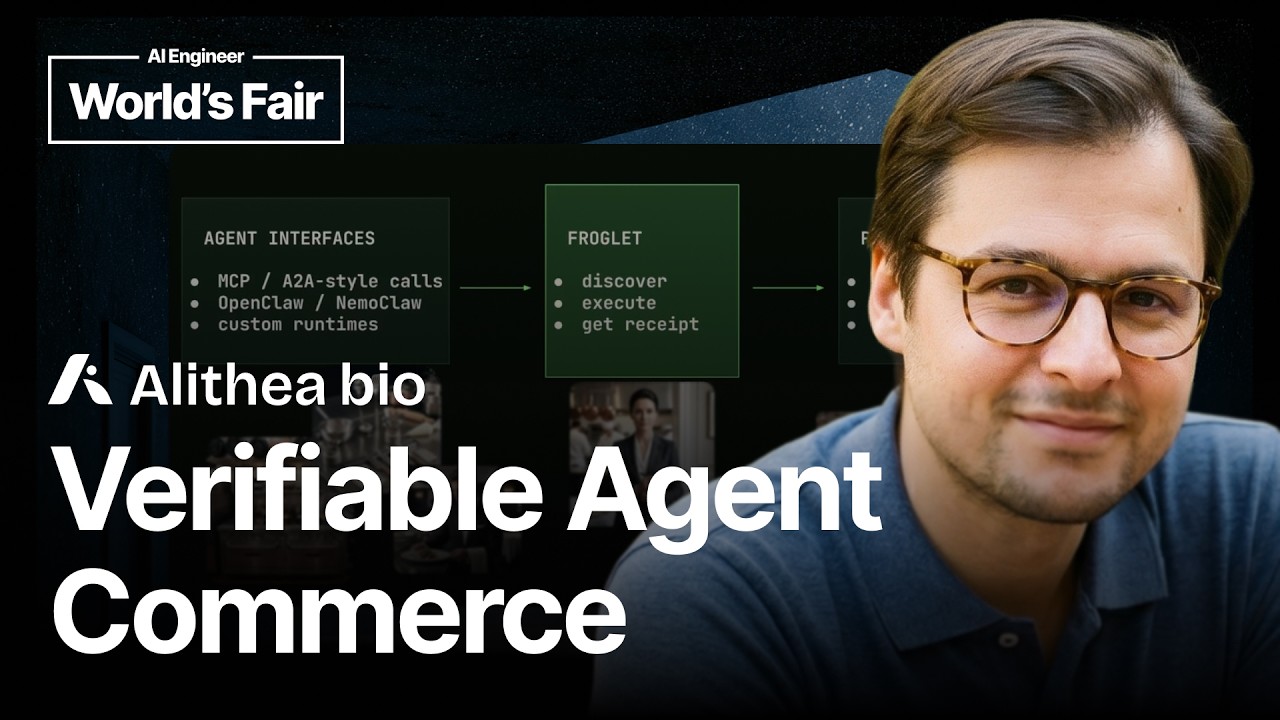
At Alithea, our vision for Froglet is very simple.
Agent Budgets2:37
As agentic workflow automation matures, organizations will not just give agents more tools; they will allocate them budgets. We already kind of doing it in a primitive way, allocating them token budgets per task. The next step is a bit broader.
It's allowing agents to manage their own budget for anything that they might need: discovering services, requesting data, negotiating execution, paying for work in cross-organizational boundary setting.
At that point, the agent is no longer just a cook with a better knife. It starts acting like an executive chef: finding suppliers, ordering ingredients, coordinating kitchen work, and keeping a record of everything that's happening. That is why we're building Froglet: the protocol for agents to discover, transact with, and receive verifiable receipts for external data and
service providers.
Froglet is designed to sit in between of many moving parts. That's why we are not replacing existing tools and protocols. We integrate with different payment rails, with different agentic harnesses, execution environments, and even network transport protocols. It does not require that everyone has the same software stack.
Froglet Design4:08
It just requires that everyone has the same interface.
For more details, please visit froglet.dev,
where you will be able to see how to run Froglet locally with just one command,
or you can even try Froglet remotely with just one prompt.
So, in essence, closed scientific collaboration often turns into a bespoke enterprise project.
Simplifying Collaboration5:06
That can take years and cost millions before even first reusable workflow exists.
On another hand, the Froglet's mission is to simplify that much more.
Once an organization has deemed that the resource is shareable, a provider should be able to expose it through Froglet. An agent can discover it, understand its terms, request the work, and receive a verifiable receipt. That costs a few thousand tokens and takes minutes.
Let's deep dive a bit deeper. So here is our froglet.dev website, and here you can see
Deep Dive6:05
a walkthrough button. If you click on it, you will have a much more detailed review of what's happening, and you can read documentation in even more detail. So first of all, the Froglet network consists of homogeneous nodes. Every single actor in the environment runs the same core
node. It just plays a different role. There are requesters, there are providers, and there is a marketplace which is just a Froglet running the specialized service.
What it solves is how to find, how for a quester to find the providers, how to trust them, how to pay or settle, and how to prove that execution has happened.
Whenever you're creating a new node, you are generating a key pair for identity and signing.
And every time you execute anything with Froglet, it uses your keys to sign on the chain. And the chain consists of everything what you do, from descriptors to offer to quote to deal for invoice and finally receipt. Therefore, you cannot tamper with any part of this chain.
Otherwise, the chain will be broken.
Service Discovery7:57
And to discover services, providers of services just register and describe their services to the marketplace. Marketplace itself provides services for providing descriptions and for indexing what is exist what service is existing on a marketplace. Once a requester requests an index of available services, from there on it continues direct communication with that requester.
It doesn't need a middleman. So the requester and provider communicates with each other directly, and it all happens in one interaction: requests, signing, execution, and receipt.
Payment System8:48
On a payment side, we have a system where all payments, if it's not free, has two parts. One is a base payment and another is success fee. So base payment protects the providers that they wouldn't be attacked by multiple requests, and success fee is providing the requesters from malicious providers.
In essence, the Froglet itself is not an AI agent, but it is created specifically for agents as an interface to find each other, as an interface to find the data and services cross borders, and execute these deals directly with each other.
Recap9:48
So coming back to recap. A Froglet lets agent to discover external scientific resources, execute work across organizational boundaries, and it gives every transaction a verifiable receipt.
Together, this opens the door to autonomous scientific progress.
Closing10:16
We hope you will join us and enjoyed this talk.
Thank you.