
Agent Commerce
Episodes from AI Engineer about Agent Commerce.
7 episodes
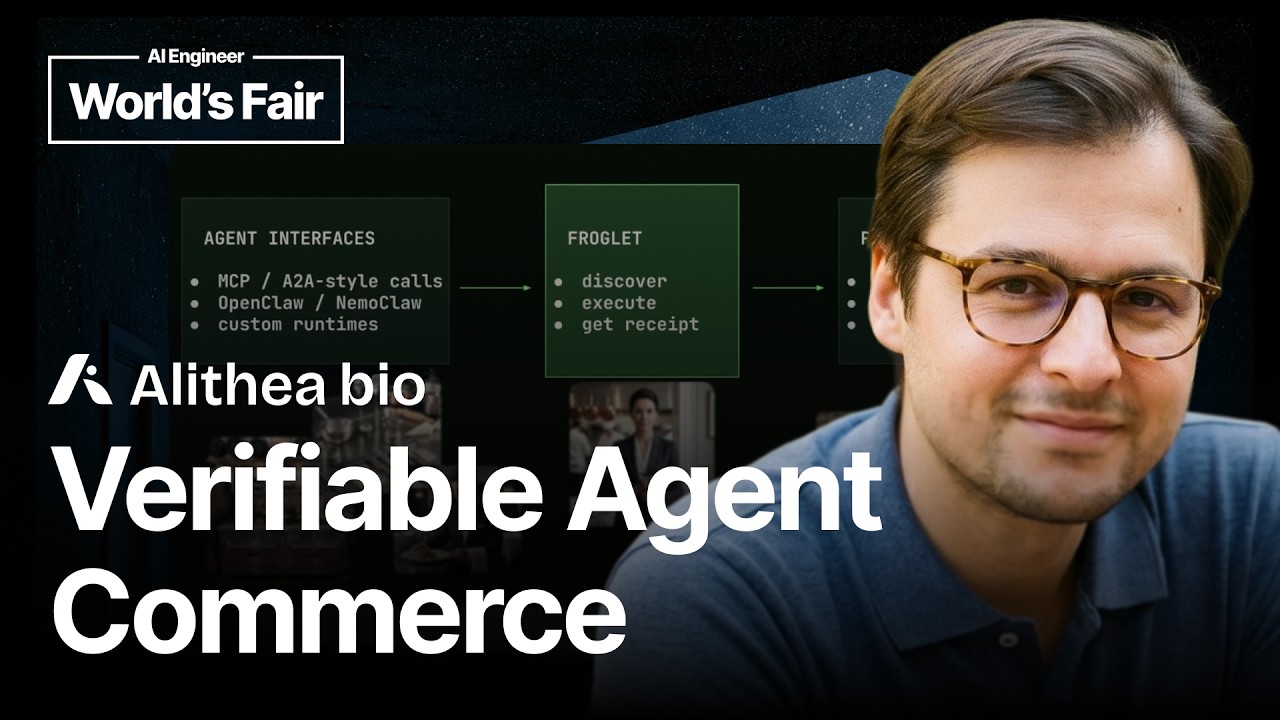
Agents Need Receipts, Not More Tool Calls - Armanas Povilionis, Alithea Bio
Jul 20, 2026 · 10:23
Armanas Povilionis presents Froglet, an open-source protocol for agent-to-agent compute that enables agents to discover, transact, and receive verifiable receipts for external data and services. He argues that autonomous scientific collaboration requires a chain of verifiable receipts, not just more tools, because science relies on aligning an entire supply chain. Froglet integrates with existing payment rails and agentic harnesses, using signed chains of descriptors, offers, quotes, deals, invoices, and receipts. Povilionis compares agents to cooks: more tools improve local work, but scientific collaboration is like running a Michelin-star restaurant where outcomes depend on suppliers and consistent delivery. Froglet lets agents act as executive chefs—finding suppliers, ordering ingredients, coordinating, and keeping records. This turns bespoke enterprise projects that take years and millions into a process costing a few thousand tokens and minutes.
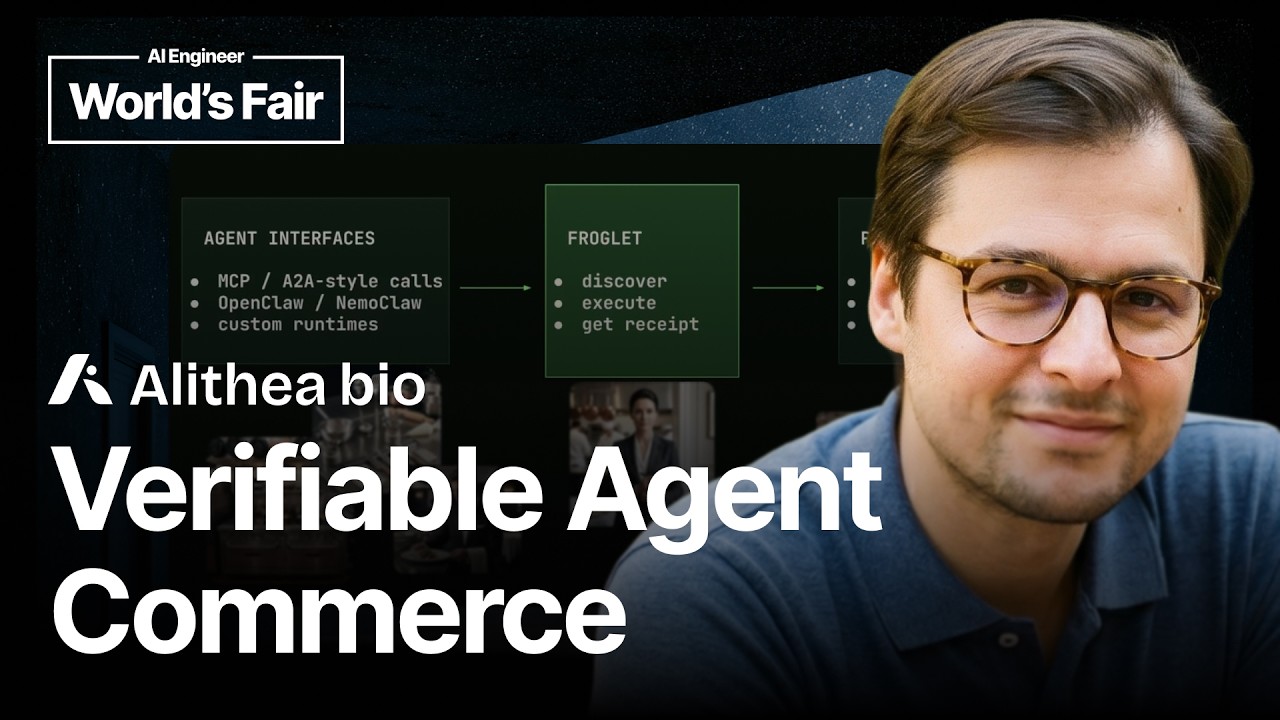
Agents Need Receipts, Not More Tool Calls - Armanas Povilionis, Alithea Bio
Jul 18, 2026 · 19:36
Armanas Povilionis of Alithea Bio argues that agents need verifiable receipts, not more tool calls, and introduces Froglet, an open-source protocol for agent-to-agent compute. Froglet enables agents to discover, negotiate, execute, and receive signed, tamper-proof receipts for external services, reducing setup to 2,000 tokens and minutes. The protocol integrates with MCP, OpenClaw, and NemoClaw, and supports payment rails, identity, and workload hashes. In a live demo, he shows Claude using Froglet to publish an 'add two numbers' service locally and remotely, then invoke it to get result 12, with a signed deal ID. Froglet aims to make scientific collaboration repeatable and consistent across organizational boundaries without requiring uniform software stacks.
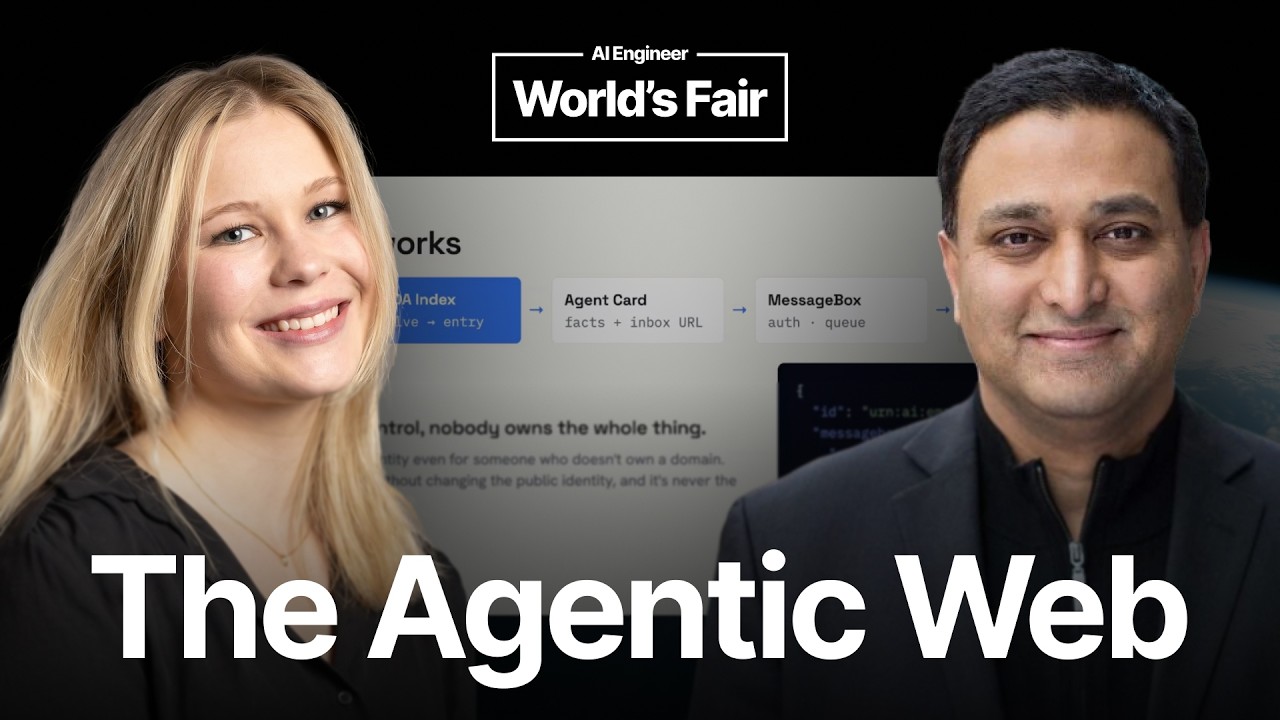
The Agentic Web and the Bazaar Era of AI - Ramesh Raskar, MIT Media Lab
Jul 12, 2026 · 12:11
Ramesh Raskar and Maria from MIT's Project Nanda argue that the emerging web of AI agents requires an open infrastructure for discovery, commerce, and coordination, moving beyond today's walled-garden platforms. They outline three layers: the Discovery Layer (Nanda index for agent identity, trust, and adaptive resolution), the Commerce Layer (knowledge pricing markets for intelligence), and the Bazaar Layer (machine co-learning). The Nanda index enables agents to find each other across vendors via signed agent facts and adaptive routing, while Nanda town simulates the entire agent economy to test protocols at scale. The goal is a permissionless web where any agent can discover, transact, and learn across organizational boundaries, analogous to the transition from AOL to the open web.

The Factory That Dreams: 39 AI Agents, No Framework - Rushabh Doshi, Machinecraft
Jul 11, 2026 · 9:58
Rushabh Doshi, CEO of Machinecraft, explains how his 100-person factory built Ira, a 36-agent AI OS running its go-to-market and memory without a framework. The system uses 36 specialist agents, each with one job, orchestrated by Athena, handling outbound emails, quoting, leads, and replies from one Cursor tab. Built for $30,000 versus $230,000 agency quote, it runs on a few thousand monthly with no training. Doshi says the secret is well-organized memory, vectors, graphs, and biological-inspired architecture including senses, digestion, memory layers, a nightly dream cycle, and immune system for fact-checking. The system is grounded in a SOUL.md constitution based on Jain philosophy, and ForkMyBrain.org helps others build their own forkable brain by mapping their business from the inside.
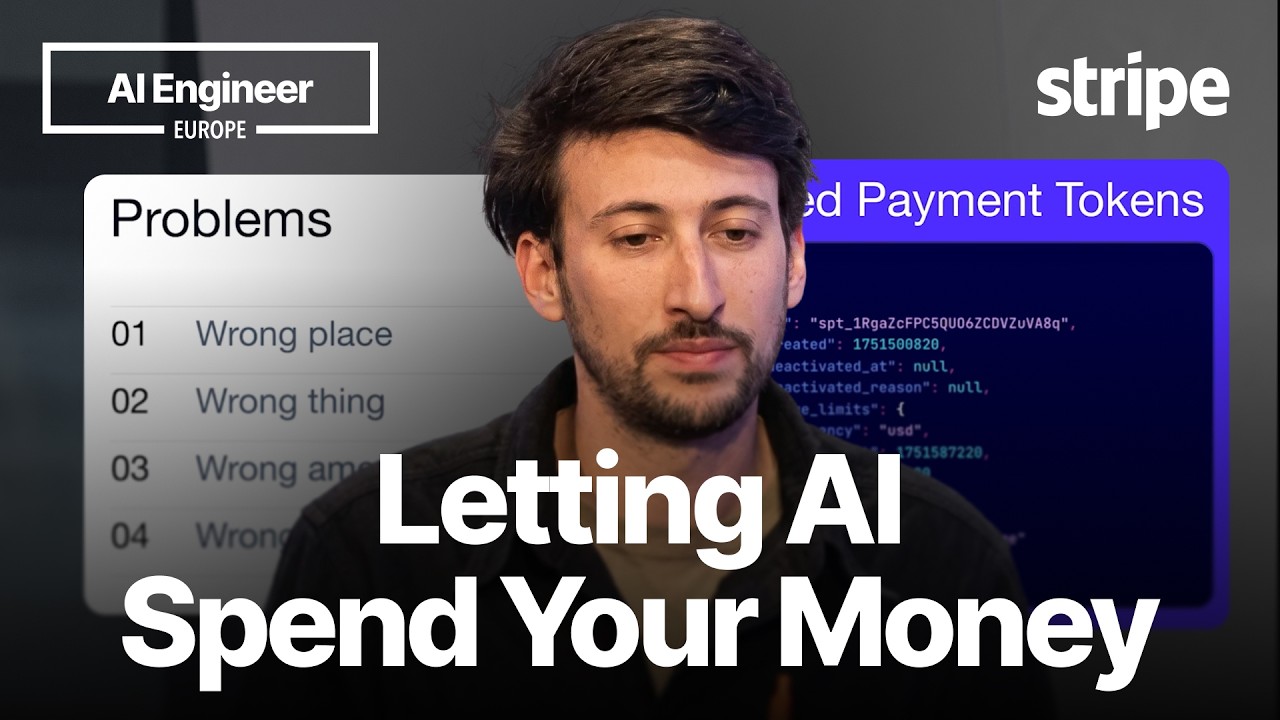
Building safe Payment Infrastructure for the autonomous economy — Steve Kaliski, Stripe
Jun 6, 2026 · 18:46
Steve Kaliski, Principal Software Engineer at Stripe, explains how to build safe payment infrastructure for the autonomous economy, focusing on enabling AI agents to spend money without catastrophic risk. He argues that discovery benefits from non-determinism (e.g., LLMs), but payments and credentials require determinism. Stripe's solutions include shared payment tokens that enforce spend limits per seller, amount, currency, and time; the machine payments protocol with Tempo for paying for API calls via HTTP status codes; and the agent e-commerce protocol with OpenAI for structured checkout flows. Kaliski also demonstrates how Stripe projects wraps these primitives. The goal is to minimize blast radius through verifiable identities, spend policies, and API-driven interactions.
Automating Escrow with USDC and AI - Corey Cooper, Circle
Jul 14, 2025 · 58:18
Corey Cooper, Head of DevRel at Circle, demonstrates how USDC stablecoins and AI agents can automate escrow by combining smart contracts with LLM-based task verification. He explains that USDC's programmability enables near-instant settlement, chargeback-free transactions, and always-on payments ideal for agent-to-agent payments. The demo shows an escrow agent app that uses OpenAI to parse PDF contracts, deploys Solidity escrow contracts via Circle APIs on Base Sepolia, and allows an AI agent to verify deliverables (e.g., image quality) and trigger payout from a locked smart contract. Cooper discusses human-in-the-loop safeguards, cross-chain deposits via Circle's Cross-Chain Transfer Protocol, and future possibilities like multi-sig agent verification. He highlights that while full autonomy is not yet reliable, combining USDC with AI can streamline payment operations.

Ionic Launch: Opening the economy to AI agents
Feb 6, 2025 · 5:30
Justin, CEO and co-founder of Ionic Commerce, presents his company's mission to enable AI agents to participate in the economy, starting with ecommerce. He argues that the current web is built for ads, not actions, leaving agents unable to access dynamic product data like stock or shipping. Ionic solves this by partnering with hundreds of merchants, enriching their product feeds via an agentic workflow, and exposing the data through an API that agents can query in their preferred format (relational, vector, graph). The platform also adds a transaction layer so agents can complete purchases in one step using payment tokens. Justin emphasizes that merchants will pay for this service because it provides better attribution and customer relationships than Amazon's cut. Ionic's catalog already includes millions of AI-native SKUs, and developers can start today at docs.ioniccommerce.com.
Powered by PodHood