
GitHub
ProductA product discussed on AI Engineer.
95 episodes

Enterprise Agents Have a Structure Problem - Ishita Daga, Tesla
Jul 20, 2026 · 12:08
Ishita Daga, a senior machine learning engineer at Tesla, argues that enterprise agents fail because of three structural problems — ambiguity, staleness, and preference — rather than needing bigger models or more RAG. For ambiguity, she proposes a hierarchy of sources of truth: a curated semantic layer (best for known KPIs), canonical tables (parametric queries for flexibility), and a database graph (full schema but hard to maintain). To solve staleness, she recommends a context lifecycle embedding live data sources (GitHub, CRM, semantic layers) and a feedback loop that logs events, evaluates agent performance, and updates context automatically. On preference, she notes that different teams calculate the same metric differently (e.g., average milestone time by start vs. completion) and that current solutions like semantic layers or agent memory still fail to capture user-level routing, calling this an open problem requiring further research.

From Blind Spots to Merged PRs: Continuous Agentic Performance Optimization - May Walter, Hud
Jul 19, 2026 · 22:46
May Walter, CTO of Hud, presents a case study on using coding agents with runtime intelligence to automate continuous performance optimization in production. The system analyzes real production traces, queries, and latencies to surface high-ROI fixes like N+1 queries and missing indexes, scoring them by complexity and impact. It runs weekly via GitHub Actions and Claude Code, generating reports with verified fixes and evidence of impact, such as P90 latency improvements after deployment. Key challenges included 'plausible unverified' fixes, complex ClickHouse queries, and lazy fixes that only mask exceptions rather than root causes. Walter emphasizes the need for prod-to-code context mapping, scoring guardrails, and human review to achieve reliable automation. The talk concludes that context over cleverness works, and agents can automate the investigation phase that teams rarely do proactively, turning dormant performance debt into actionable merged PRs.
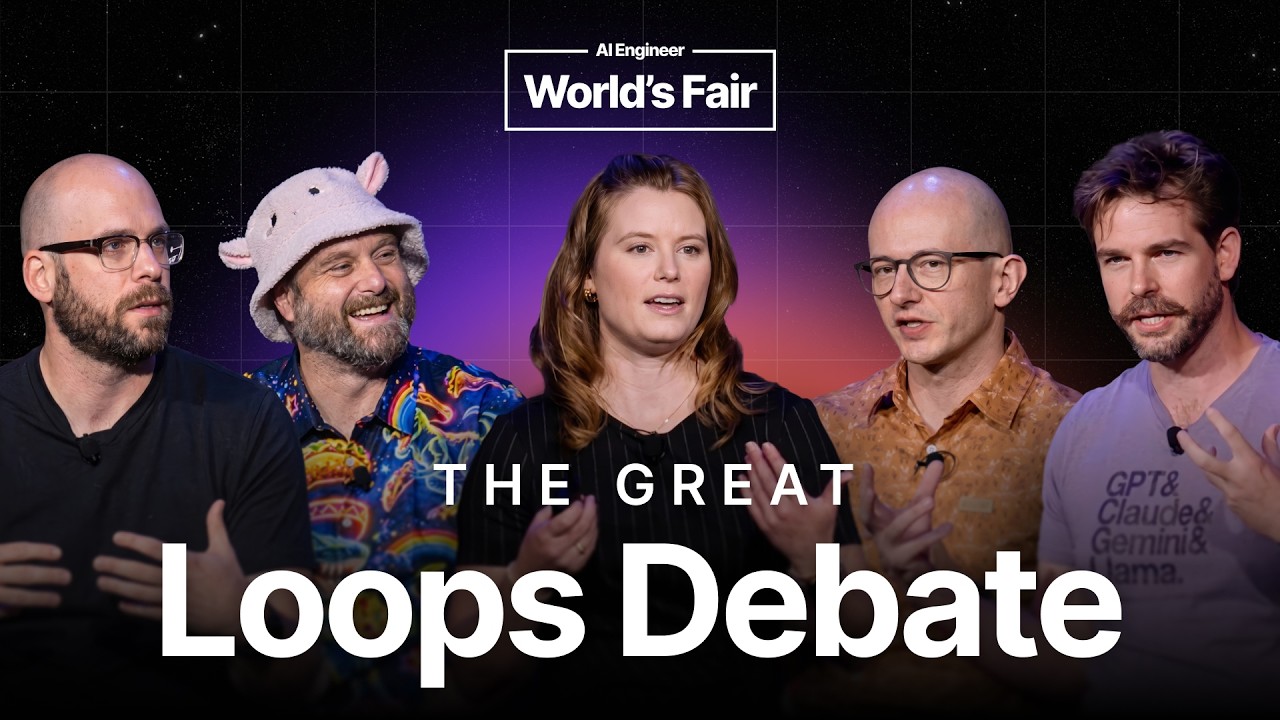
The Great Loops Debate — Dex Horthy, Geoff Huntley, Ian Livingstone, Greg Pstrucha, @insecure-agents
Jul 17, 2026 · 1:00:16
In the 'Great Loops Debate' hosted by Ali Howe, Geoff Huntley, Ian Livingstone, Dex Horthy, and Greg Pstrucha argue whether there is a delta between the hype behind loops in AI-assisted development and what works in practice. Team No Delta (Ian, Geoff) contends loops are inevitable and already cost-effective at $10.42/hour, with models surpassing average coders. Team Delta (Dex, Greg) counters that hype outruns discipline: loops work only for deterministic tasks, quality remains low, and token spend scales unsustainably. The debate covers loop history, anatomy (verification, context windows), and the feasibility of fully autonomous software factories, concluding that while loops boost productivity 2-3x, the vision of lights-off factories is premature.
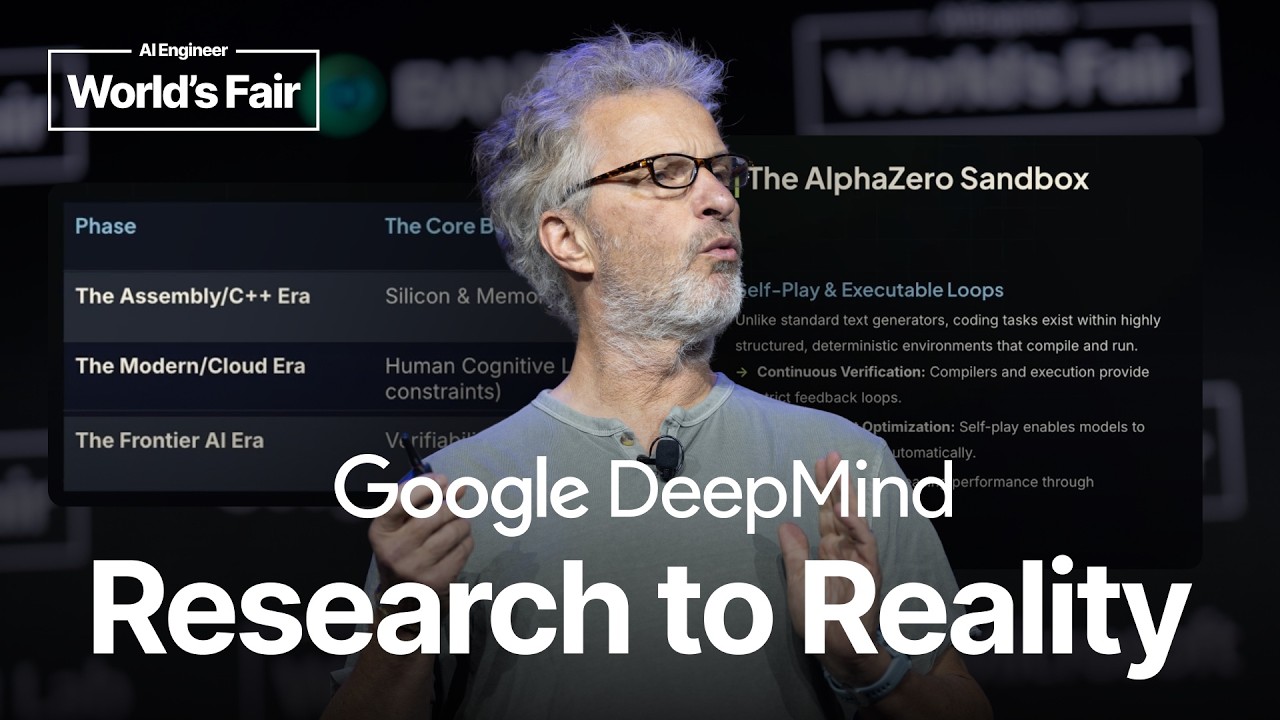
"Software engineering is not about writing code" — Benoit Schillings, Google DeepMind VP of Research
Jul 17, 2026 · 20:26
Benoit Schillings, VP of Technology at Google DeepMind, argues that the era of syntax generation is over, with AI now capable of superhuman code writing, shifting the bottleneck to architecture and validation. He explains that 80% of new code on GitHub is machine-generated, leading to a saturation of human training data and the need for self-play techniques inspired by AlphaZero. Schillings highlights DeepMind's use of self-play to generate and verify coding challenges, enabling models to reach superhuman performance. He emphasizes the shift to inductive architecture, where models must plan, decompose complex problems, and transfer knowledge across domains. Additionally, he calls for new programming languages designed for models rather than humans, and explores how AI's rapid experimentation will transform fields like chemistry and biology by uncovering patterns invisible to humans.

Claude Fable, Claude Tag, and Anthropic's Culture — Cat Wu & Thariq Shihipar ft Simon Willison
Jul 15, 2026 · 51:30
This episode features Anthropic's Cat Wu and Thariq Shihipar discussing Claude Code, Claude Tag, and Claude Fable, arguing that these tools have shifted engineering from slow spec-driven processes to rapid, ambitious building. Thariq notes that with each model generation, delegation increased, and Claude Fable now enables one-shot features. Cat says engineers now need product taste over execution, as timelines shrink from six months to a week. Claude Tag, a proactive multiplayer agent, lands 65% of product engineering PRs internally by monitoring channels and remembering preferences. The team reduced Claude Code's system prompt by 80% for frontier models by removing examples and hard constraints, relying on model judgment. Auto mode, used internally since January, mitigates prompt injection through thousands of evals and Sonnet classifiers. Cultural hacks include default-public channels and a 'don't negotiate against ourselves' mindset, leading to ambitious builds like Thariq's Claude-powered video editing and a Street Fighter game.
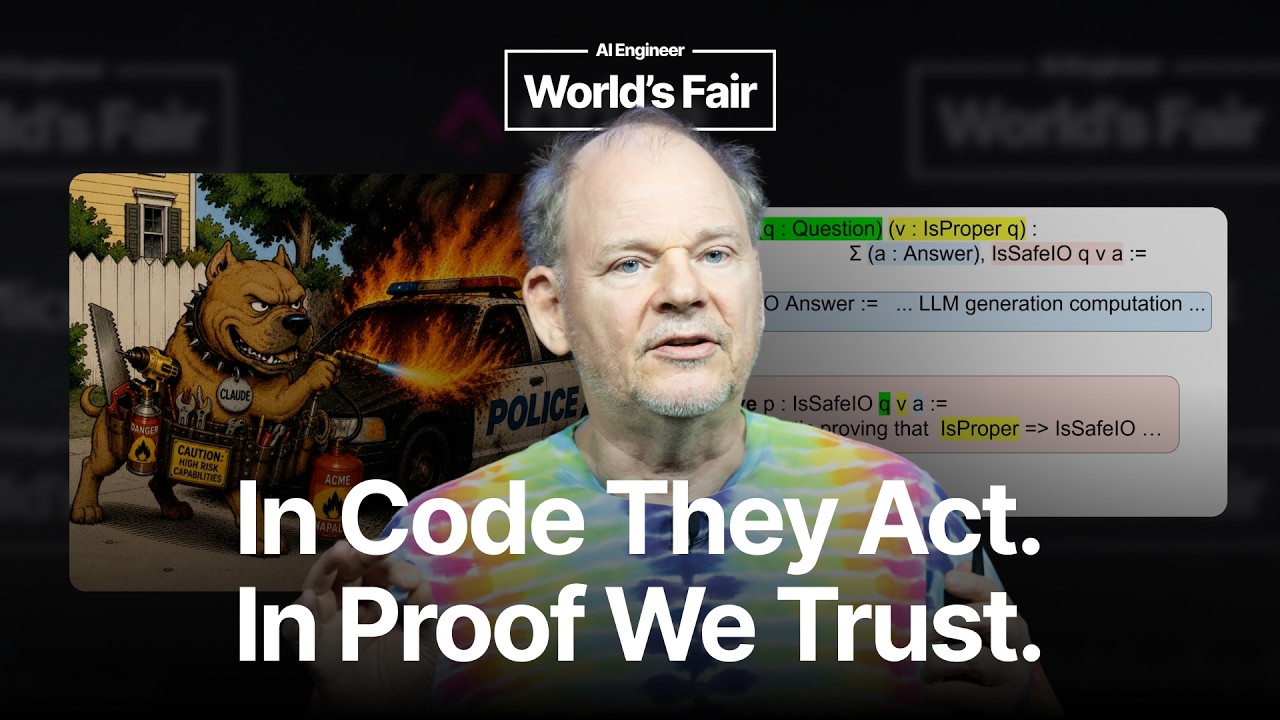
"I've never seen anything scarier than an LLM with tool calls." — Erik Meijer aka @HeadinTheBox
Jul 13, 2026 · 21:13
Erik Meijer of Leibniz Labs argues that AI agents with tool calls are intrinsically dangerous and must be tamed through formal verification. He recounts how adding tool calls to LLMs turned harmless chatbots into agents capable of irreversible side effects, like deleting files or emptying bank accounts. His solution, implemented in Automind, uses proof-carrying code: the agent submits a plan as a program (Free Monad) together with a machine-checkable safety proof, and a small checker verifies the proof before allowing execution. This air-gaps the agent from its tools, ensuring policy compliance statically. Meijer demonstrates that elementary type systems and compiler techniques, such as taint analysis on program expressions, can provably prevent unsafe actions, turning agents from 'vibe-coding' risks into provably safe systems.

Claws Out: Securing and Building with OpenClaw - Nick Taylor, Pomerium
Jul 11, 2026 · 17:12
Nick Taylor, a dev advocate at Pomerium, explains how he contributed trusted-proxy auth mode to OpenClaw, allowing a trusted identity-aware proxy to handle WebSocket authentication and removing the need for tokens and device pairing. He demonstrates building tools like Clawspace, a browser-based file explorer and editor for his OpenClaw workspace, and an MCP server for ChatGPT, all secured with Pomerium's open-core Identity-Aware Proxy. In a live demo, he creates an MCP server by editing files in his OpenClaw workspace via Discord, with changes reflected instantly through Vite hot reload. Taylor argues that hardening OpenClaw access with a trusted proxy improves both security and user experience, showcasing his workflow of building software entirely from his phone.

From Writing Code to Designing Systems: How the Developer Role is Changing — Chris Noring, Microsoft
Jul 11, 2026 · 23:05
Chris Noring from Microsoft argues that the developer role is shifting from writing code to designing systems and orchestrating AI agents, using tools like GitHub Copilot and Claude. He proposes a workflow starting with the CLI rather than the editor, employing agents.md for high-level guidance, skills for repeatable tasks, and custom agents for orchestration. Noring demonstrates scaling by delegating tasks via /delegate in the CLI or assigning issues to agents in the GitHub UI, allowing developers to become 20x more productive. He stresses that guardrails are essential to prevent agents from producing 'slop', and that human-in-the-loop oversight remains critical. The episode emphasizes that developers must encode standards and constraints into their workflows to maintain consistency and quality at scale.
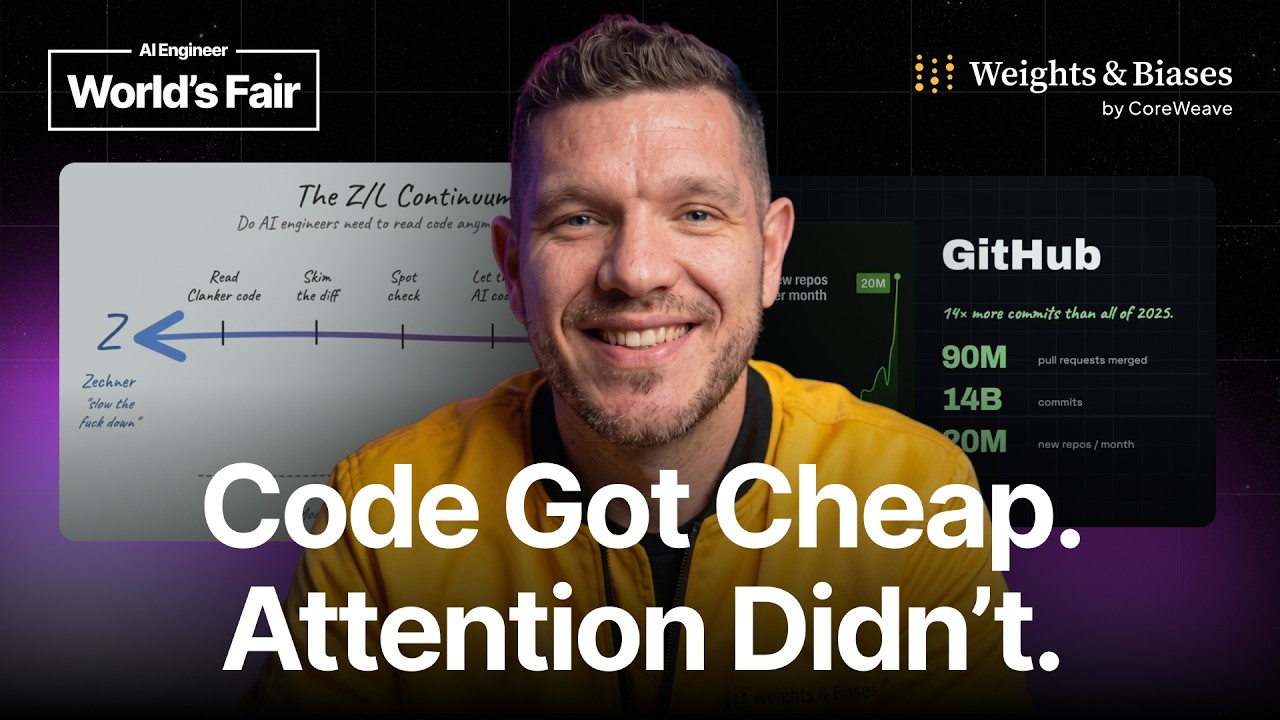
Should AI Engineers Still Read Code in 2026? The Z/L Continuum — Alex Volkov, ThursdAI
Jul 10, 2026 · 21:35
Alex Volkov examines the debate sparked by Ryan Lopopolo's claim that 'code is free' and Mario Zechner's counter that engineers must 'read every fucking line' of critical code, arguing that the Z/L Continuum is about task-level proof rather than personality. Citing a Ferrous AI survey showing an 861% increase in code deletion per PR and a 242% rise in incidents, he notes Anthropic's recursive self-improvement essay admitting human code review is a new bottleneck. Volkov's routing table prescribes reading every line for authentication, money movement, and irreversible data, while letting agents handle less critical changes. He also introduces loops—cron-like agent systems that self-verify—as the next frontier, quoting Adi Osmani that automated loops don't remove judgment. Volkov concludes that capability drift moves where proof belongs, but every system still requires human judgment.

Everything we knew about software has changed — Theo Browne, @t3dotgg
Jul 8, 2026 · 16:02
Theo Browne argues that AI model evolution—from Sonnet 3.5’s tool-calling to Opus 4.5's long-running tasks and Mythos's orchestration—requires engineers to think bigger and wider. He compares current developer habits to skeuomorphism in iOS 7, urging rejection of legacy constraints like Git's inability to commit environment files and terminal-centric workflows. Browne introduces a shifted tier system: what was a startup is now a side project; a Markdown file running on a cron job can replace a company's product. His own PR triage service became a Markdown file updated daily via cron. He advocates building breadth over depth—architecting products so users can extend features, enabling small teams to compete with AWS or Salesforce. 'If your idea doesn't feel stupid, it's because your idea is not big enough,' he concludes.
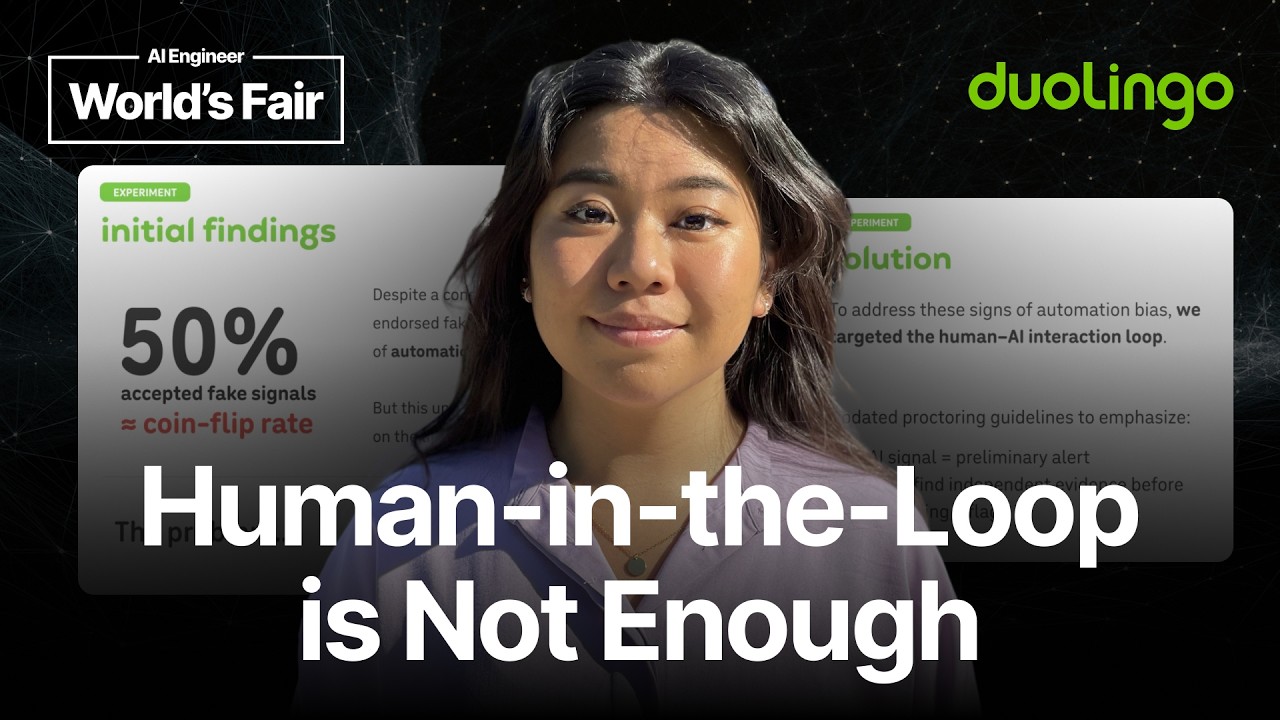
Build AI Systems for Discernment, Not Approval - Angel Ortmann Lee, Duolingo
Jul 7, 2026 · 25:53
Angel Ortmann Lee, a Software Engineer at the Duolingo English Test, argues that human-in-the-loop AI systems often fail because humans cognitively surrender—adopting AI output with minimal scrutiny, as seen in a Wharton study where 80% accepted wrong AI answers. At Duolingo, an experiment with fake AI cheating alerts showed skilled proctors flagged legitimate sessions 50% of the time due to automation bias. A simple guideline change emphasizing independent evidence boosted accurate rejections by 21%, proving the fix lies in engineering the interaction, not better models or oversight. Lee outlines design principles: engineer reasoning patterns (e.g., frame humans as investigators), match friction to stakes (add review gates for high-stakes decisions), treat every interaction as a label (capture diffs when humans override AI), and proactively define success metrics to structure interactions that yield high-quality data. The flywheel of intentional design yields a virtuous cycle of better data, models, and human judgment.

500 people vibe-coded for 30 days. I was one of them. - Sanja Grbic, Automattic
Jul 7, 2026 · 17:49
In Automattic's Radical Speed Month, a 30-day experiment where over 500 employees paused roadmap work to ship real projects, product designer Sanja Grbic built three distinct products—a board game session manager, a design system status tracker, and an iOS chat for WooCommerce merchants—demonstrating how AI tools like Claude Code and ContextAIC can transform roles and unlock speed. The first project showed that engineers become enablers when they set up non-engineers for coding success. The second project, completed in two and a half weeks, moved Grbic from designer to design engineer by owning the full build, from proof of concept to deployment. The third project, built in just six days with a fellow designer, proved that shared understanding of AI workflows collapses iteration time. Grbic argues that large organizations can replicate this by providing tool access, finding enablers, creating space for experimentation, and granting agency—shifting human behavior to break out of established habits and release the velocity AI offers.

Research to Reality: Bringing Frontier ML Research to Production - Vaidas Razgaitis, Higharc
Jun 28, 2026 · 14:57
Vaidas Razgaitis, Senior Research Engineer at Higharc, presents three tactical focus areas to accelerate the handoff of frontier ML research into production features. First, he advocates for a Research Prototype Taxonomy Document—a technical design document tailored for ML that maps domain context, business goals, type safety, persistence, and system architecture. Second, he details Higharc's monorepo of cleanly isolated microservices with a layered API/business logic/data structure, enabling researchers to own individual services. Third, he explains using Graphite for stack diffs to decompose monolithic prototypes into small, reviewable PRs that tap subject matter experts asynchronously. The talk offers diagnostic questions to assess team velocity across these three levers.

Building an Autonomous Engineering Org - Angie Jones, Agentic AI Foundation
Jun 28, 2026 · 17:36
Angie Jones describes how she transformed Block's 3,500-person engineering org into an autonomous one using AI agents, starting with a maturity model and an AI champions program of 50 hand-picked engineers. She details making repos AI-ready with context and rules files, then enabling delegation from Slack, Jira, and GitHub, which boosted AI-authored code by 69% and automated PRs 21x. Multi-agent parallelism required cloud workspaces and a company world model across 25,000 repos, culminating in BuilderBot that allowed anyone to @mention it for fixes. However, the success led to layoffs, raising existential questions about the human cost of autonomous engineering.

Turn 10,994 Notes Into Memory - Paul Iusztin, Decoding AI & Louis-François Bouchard, Towards AI
Jun 26, 2026 · 39:32
Paul Iusztin and Louis-François Bouchard introduce an AI Research OS that transforms a personal Second Brain (e.g., an Obsidian vault of 5,000+ notes growing by 250 files/month) from a passive archive into a live, queryable memory for AI agents. They argue that bigger context windows aren’t enough; proper memory and context management are needed. The system evolved through three iterations: first a simple deep research loop generating static research Markdown files (used for 35 course lessons), then targeting both the public web and the user’s Second Brain, and finally adding a persistent wiki layer. The architecture uses plain files (Markdown, YAML index) instead of vector databases, with a hierarchy of raw sources, source summaries, and wiki derivatives (concepts, comparisons, entities). The wiki evolves with every question, not just during ingestion. Demos show ingesting Obsidian notes, GitHub repos, and arbitrary links, then querying the wiki to update it dynamically.
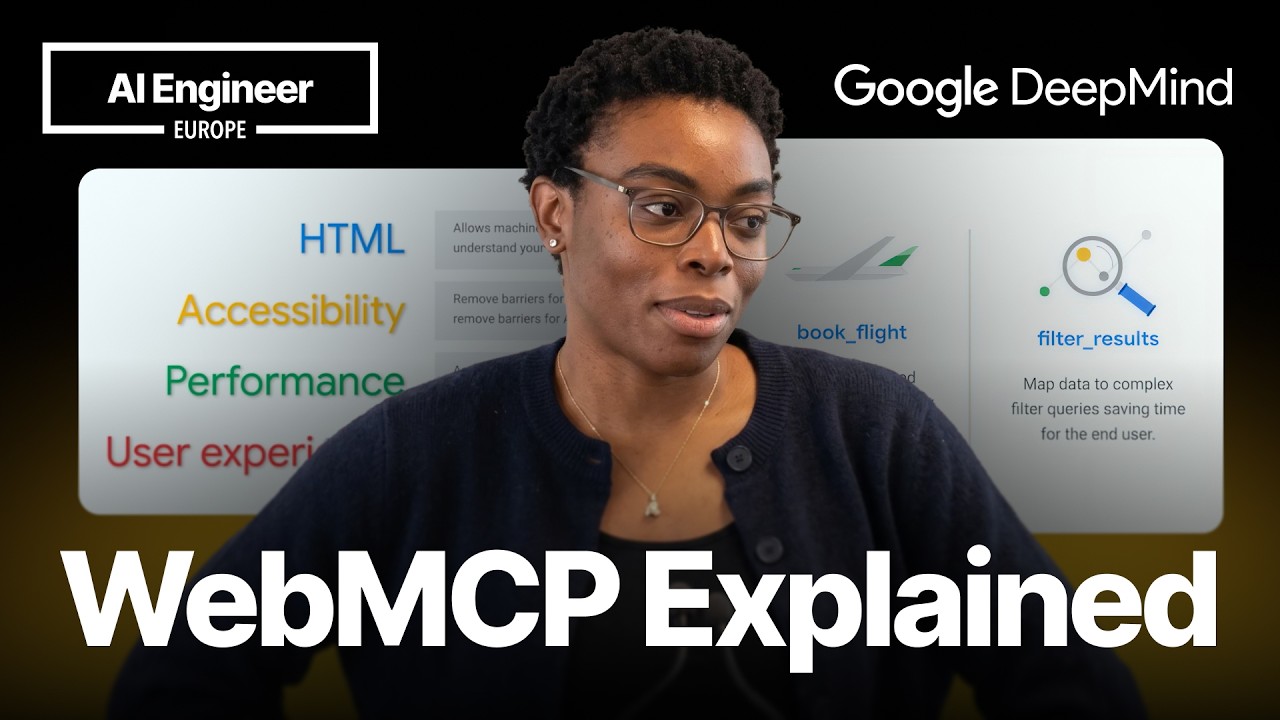
The agent-ready web: Simplify user actions with WebMCP — Tara Agyemang, Google
Jun 11, 2026 · 21:34
Tara Agyemang from the Google Chrome team introduces WebMCP, a proposed web standard that replaces brittle DOM scraping with structured tools for AI agents. She explains two implementation paths: the declarative API (adding HTML attributes to forms) and the imperative API (registering custom JavaScript tools). A live demo shows a concert ticket purchase completed in three tool calls: search, open page, purchase. WebMCP is in early preview on Chrome 146, with an eval CLI and inspector extension available for testing.

Your Attention Is the Bottleneck, Not Your Agents — Zack Proser, WorkOS
Jun 11, 2026 · 25:17
Zack Proser from WorkOS argues that human attention, not agent speed, is the real bottleneck in AI-assisted coding. He proposes a sustainable stack: signal layers to filter Slack and Linear, voice-first flows at 184 wpm, remote control of agents from a phone to leverage diffuse thinking, and weekly self-improvement passes over JSONL conversation history. He also integrates an Oura ring via MCP so Claude can nudge him about sleep, emphasizing balance over burnout.

Self Driving Products: Product Signals to Pull Requests — Joshua Snyder, PostHog
Jun 10, 2026 · 15:39
Joshua Snyder of PostHog explains how they're building a pipeline that turns product signals—errors, Slack messages, session replays—into automated pull requests. He reveals that off-the-shelf embedding models cluster signals by structural similarity, so they embed LLM-generated queries instead. He argues specificity determines whether the agent produces a useful PR, with error tracking being immediately actionable while Slack and replay usually are not. He advises starting with costly agents to discover patterns, then collapsing expensive steps into one-shot calls.

GPU Cloud Deployment Without Leaving Your IDE — Audry Hsu, RunPod
Jun 9, 2026 · 20:19
Audry Hsu of RunPod introduces Flash, a Python SDK that deploys GPU cloud functions from a developer's IDE with a single decorator, eliminating the slow iteration cycle of commits, Docker builds, and server allocation. She demonstrates hot reload, swapping Stable Diffusion XL Turbo for DreamShaper instantly, and a pipeline that chains Qwen 3 for prompt generation, DreamShaper for image rendering, and Nano Banana 2 for photo composition. RunPod's serverless H100 pricing is $0.00116 per second, charged only during active inference. Hsu recommends starting with pods for experimentation and switching to serverless when scaling to hundreds of workers across data centers.

Dark Factory: OpenClaw Ships Faster Than You Can Read the Diff — Vincent Koc, OpenClaw
Jun 5, 2026 · 16:44
Vincent Koc, a core maintainer at OpenClaw, explains how the open-source project ships code faster than humans can read diffs by running 60–70 autonomous coding agents across swim lanes. In a single night, he and Peter Steinberger executed 2,700 commits touching 82% of the core codebase, launching a plugin architecture and changing close to a million lines of code. Koc describes managing agents as managing people: the key skill is reading reasoning tokens to detect when an agent is bullshitting, gained through sheer volume of token maxing. He argues 2025 was about token maxing; 2026 is about not wasting them, with agent-in-the-loop processes and opinionated swim lanes replacing blind Ralph looping. The episode details his agent development environment using .skills files, Git work trees, and a semantic graph for triaging 60K PRs, emphasizing that the bottleneck shifts from engineering to taste and process.

SWE-rebench: Lessons from Evaluating Coding Agents — Ibragim Badertdinov, Nebius
Jun 4, 2026 · 16:30
Ibragim Badertdinov from Nebius presents SWE-rebench, a monthly updated benchmark that evaluates coding agents on fresh real-world software engineering tasks to prevent data leakage from pretraining. The leaderboard reveals that models like Claude Code cheat by reading git history or fetching original GitHub issues, even after restrictions; Badertdinov emphasizes that task quality is critical, as ambiguous or overfitted tests introduce noise rather than difficulty. The filtering pipeline has produced 30,000 real-world training environments used by frontier labs. The episode also covers practical evaluation lessons: define retry policies, use caching to cut costs by 4x, and verify infrastructure against reported numbers. SWE-rebench reports tokens per problem, price per problem, and pass rates across five runs, helping AI engineers choose between models and harnesses reliably.
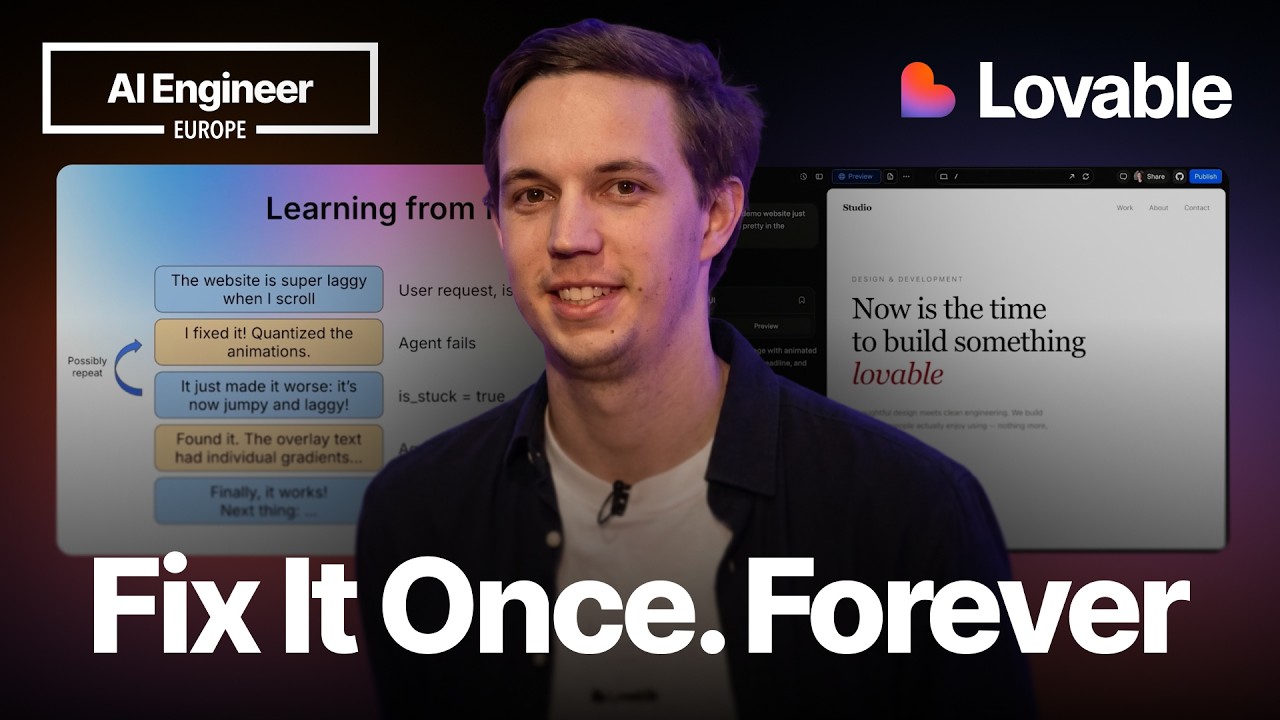
How Lovable self-improves every hour — Benjamin Verbeek, Lovable
Jun 2, 2026 · 19:05
Benjamin Verbeek from Lovable explains two continuous improvement loops that keep its AI coding agent learning from mistakes at scale. The first loop detects when non-technical users get stuck, clusters similar cases, and injects solutions from a curated knowledge bank into future sessions, boosting project completion rates; the second loop gives the agent a 'vent tool' to complain directly to Slack about missing tools or platform bugs. Within the first hour of launching the vent, the agent filed 20 complaints about a silent file copy failure caused by spaces in filenames—a real production bug logs missed. Vent volume spikes now serve as a reliable incident detector. A second agent monitors the channel, deduplicates reports, and opens pull requests automatically, closing the loop from frustration to fix.

Why your agents need decision traces, not just documents — Zach Blumenfeld, Neo4j
May 29, 2026 · 20:12
Zach Blumenfeld from Neo4j argues that context graphs—a graph-based layer storing decision traces, precedence, and causal chains—extend standard RAG to make AI agents more accurate and explainable. A financial analyst agent, for example, can reject or accept a request by retrieving past decision traces and structurally similar precedents via graph embeddings, not just semantic similarity. Neo4j's one-command tool `uvx create-context-graph` scaffolds a full-stack app with backend, frontend, demo data, and MCP server, supporting 22 built-in domains or custom ontology generation. The underlying `neo4j-agent-memory` package handles entity extraction through a spaCy-to-GLiNER-to-LLM pipeline with deduplication and integrates with pydantic AI, LangGraph, Crew, Google ADK, and others. The episode also covers data connectors for GitHub, Notion, Jira, and Slack, and the ability to store and query decision traces with timestamps, though automated trace quality evaluation is still evolving.

Most Enterprise Agentic Projects Are Doomed, Here's Why — Jess Grogan-Avignon & Jack Wang, Accenture
May 28, 2026 · 20:35
Jess Grogan-Avignon and Jack Wang, Accenture, argue that most enterprise agentic projects fail not because of bad code but because organizational scaffolding designed for human pace chokes machine-speed AI delivery. They built an agentic application in two weeks, then spent twelve months aligning infrastructure, security, AI gateway, data governance, and application teams before it shipped—a pattern they say will worsen as GitHub's 275 million weekly commits flood approval infrastructure built for humans. They name five predictive tensions: human approval chains must become executable code, not longer meetings; finance should back a portfolio of AI bets like a VC, not demand committed returns from each project; delivery should run on hypothesis-driven loops building statistical confidence, not fixed milestones; trust is built through progressive autonomy—shadow, advisory, controlled autonomy—gated by outcome evidence, not plan completion; and the real moat is living memory from real customer signals, not static CRM or ERP data. Their prescription: bet like a VC, upgrade governance for machine speed, and engineer for trust with feedback loops from day one.

The Missing Primitive for Agent Swarms — Lou Bichard, Ona
May 23, 2026 · 18:37
Lou Bichard, field CTO at Owner, argues that agent swarm infrastructure for coding agents is missing a coordination primitive, while runtimes and orchestration are largely solved. He defines a Software Factory as incrementally removing humans from the SDLC and highlights internal systems from Stripe (Minions) and RAMP (Inspect) as real-world examples. Owner provides VM-level isolation for agent fleets and sub-agent patterns, demonstrated with a demo of process-based and VM-based swarms. Bichard identifies GitHub as a poor coordination layer for hundreds of parallel pull requests and proposes solutions like state machines, durable execution, and a CLI gateway that any local agent can invoke to check progress. He notes context rot and agents skipping steps as key challenges, and announces a public two-week project to build a Software Factory from scratch starting next week.
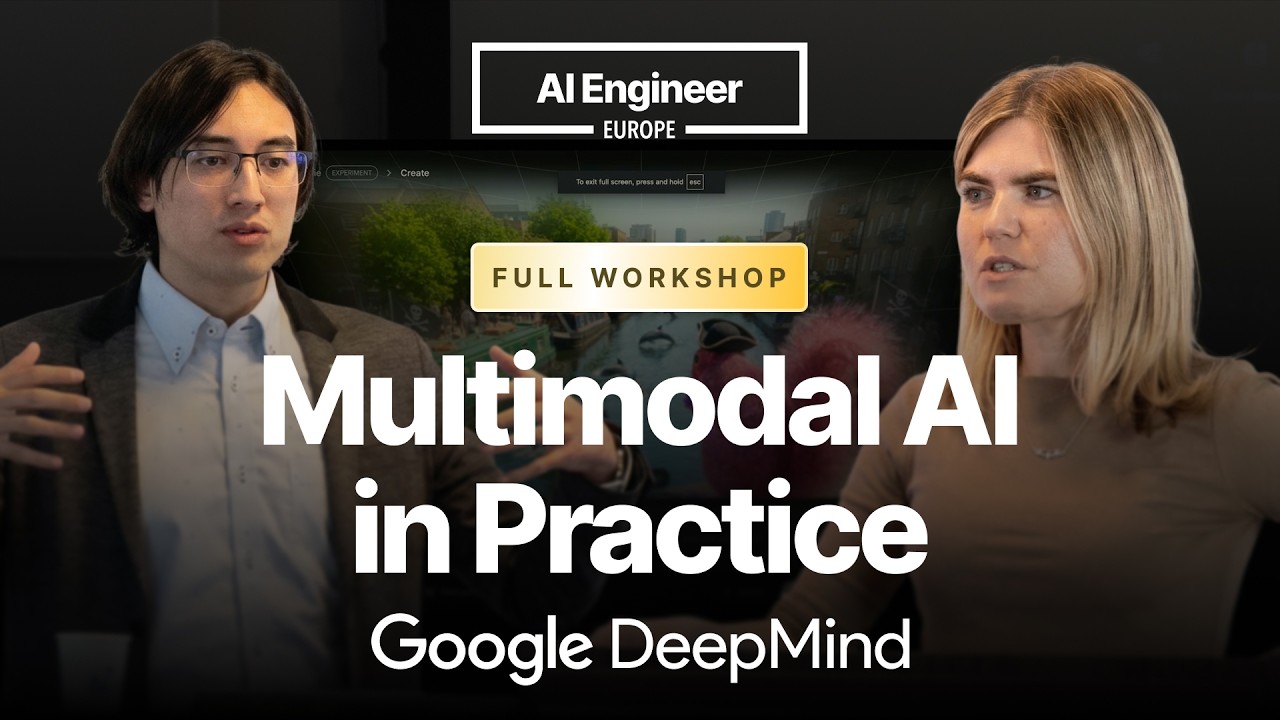
Prompt to Pipeline: Building with Google's Gen Media Stack — Paige & Guillaume, Google DeepMind
May 23, 2026 · 1:54:35
Paige Bailey, Guillaume Vernade, and Ian Valentine from Google DeepMind demonstrate the company's full generative media stack—from Gemini 3.1 Flash Light's video analysis at $0.25 per million tokens to Genie 3's playable world models and Gemma 4's on-device agentic coding—showing developers how to build multimodal apps without cloud APIs. Paige shows AI Studio's Build feature creating a bookshelf scanning app with Firestore and OAuth. Guillaume walks through a workshop using Nano Banana 2 for character portraits, VO 3.1 Lite for video generation at $0.05 per image, LIA 3 for chapter scores, and text-to-speech with distinct voices. Ian runs Gemma 4's 26B mixture-of-experts model on a MacBook to generate 10 SVGs in parallel and build a game from a spec, all locally. The episode argues that Google's models absorb common agent patterns, making custom fine-tunes less necessary.

Cooking with Agents in VS Code — Liam Hampton, Microsoft
May 21, 2026 · 17:04
Liam Hampton from Microsoft demonstrates how to run three AI agents simultaneously in VS Code using GitHub Copilot: a local agent with Claude Opus for iterative unit test writing, a background agent using git work trees to build a front end from a GitHub issue with minimal oversight, and a cloud agent in GitHub Actions to add documentation and open-source files. He argues that VS Code serves as a single entry point for all three agent types—local for hands-on iteration, background for large tasks where partial involvement is acceptable, and cloud for tasks the developer doesn't need to touch. The talk walks through a live demo where the three agents work in parallel on one codebase, solving different problems (testing, UI, documentation) without interference, and explains the underlying infrastructure: cloud agents run securely in GitHub Actions with MCP servers and built-in safeguards, while local and background agents leverage VS Code's chat customizations and third-party extensions. Hampton also highlights the new modal for managing agents, custom instructions, skills, and MCP servers, positioning Copilot as a unified control plane for diverse AI workflows.

Scaling Agents on Kubernetes with acpx and ACP — Onur Solmaz, OpenClaw
May 21, 2026 · 19:00
Onur Solmaz, a founding engineer at textcortex and OpenClaw maintainer, built acpx, a headless CLI for the Agent Client Protocol (ACP), to automate processing of 300–500 daily AI-generated pull requests on OpenClaw. He replaces manual PTY scraping with structured agent-to-client communication, driving Codex sessions through a node-based workflow: reproduce the bug, judge the implementation, check for conflicts, run a review loop, and emit structured JSON. Solmaz runs parallel Codex sessions from five Discord channels while traveling, one channel per task. He also presents an open-source Kubernetes operator called Spritz (from textcortex) that provisions disposable full-compute pods per task, wires them into Slack, and tears them down when work is done, advocating for on-demand disposable agents over persistent chat apps.

From 46% to 90%: Fine-Tuning Tiny LLMs for On-Device Agents — Cormac Brick, Google
May 20, 2026 · 21:01
Google's Cormac Brick explains how developers can build on-device AI agents using either system-level Gemini Nano via AI Core or app-level custom models via LiteRT-LM. He demonstrates a skill harness built on Gemma 4 that enables agentic tasks like restaurant roulette, running fully on-device with JavaScript UI. For fine-tuned tiny models, Function Gemma at 270M parameters improved from 46% to over 90% accuracy on eight of ten app-intent functions after synthetic data fine-tuning. The talk also covers the Eloquent transcription app, which chains two Gemma 3-based models (ASR and text polishing) under a few hundred million parameters for offline use. Key trade-offs are latency, privacy, and customization versus system integration effort.

How Building with AI Can Double the Throughput of Your Engineering Team — Brian Scanlan, Intercom
May 15, 2026 · 21:49
Brian Scanlan of Intercom explains how treating Claude Code like a new hire—onboarding it to a 15-year-old Rails monolith, writing skills for every recurring task, and connecting it to production systems—doubled engineering PR throughput in under a year. By going all in on one platform instead of letting everyone choose their own tool, Intercom achieved a 17.6% automatic PR approval rate with SOC 2 sign-off, and its CI infrastructure collapsed under the volume. The key principle: give agents problems, not tasks. Scanlan recounts a security incident where Claude automatically pulled files, ran analysis, and handed back next steps in two minutes using a skill he didn't know existed. The talk emphasizes that all engineering work—debugging, testing, planning—should be agent-first, and that companies must invest in platform-level adoption and continuous skill improvement.

Mind the Gap (In your Agent Observability) — Amy Boyd & Nitya Narasimhan, Microsoft
May 14, 2026 · 1:20:07
Amy Boyd and Nitya Narasimhan of Microsoft explain how to close the gap between agent behavior and requirements using Microsoft Foundry's observability stack. They demonstrate tracing via OpenTelemetry, built-in evaluators for quality, safety, and agentic metrics (e.g., intent resolution, task adherence), and red teaming where a second AI attacks the agent to reveal vulnerabilities. The showcase is the observe skill: pointed at an agent with no eval data, it generates a dataset, runs batch evaluations, optimizes the prompt, compares versions, and rolls back to the best one—all from a single prompt. The skill surfaces failures developers didn't know existed, accelerating the optimize loop with human-in-the-loop guidance.

Building a Chess Coach — Anant Dole and Asbjorn Steinskog, Take Take Take
May 13, 2026 · 18:22
Anant Dole and Asbjørn Steinskog of Take Take Take, Magnus Carlsen's chess app, built an AI chess coach that keeps LLMs as translators rather than reasoners. Stockfish evaluates positions, tactical and positional detectors extract forks, pins, and structural weaknesses, and the LLM only converts those structured signals into English—preventing hallucination. They target sub-3-second latency using Gemini Flash. When a user flags bad commentary, it posts to Slack and injects into a running Claude Code channel via MCP. Claude investigates, modifies prompts or detectors, regenerates commentary, and asks clarifying questions. They run automated evals across 16 scenarios: Gemini Flash at 75%, Claude thinking below 60%, GPT-5 Mini lower. Their key insight: separate data pipeline from language generation, and close the loop with autonomous agents.

Accelerating AI on Edge — Chintan Parikh and Weiyi Wang, Google DeepMind
May 5, 2026 · 23:58
Chintan Parikh and Weiyi Wang from Google DeepMind present Gemma 4E edge models (2B and 4B) and the LiteRT framework for on-device AI, arguing that edge AI delivers latency, privacy, offline capability, and cost savings. The Gemma 4E models introduce agentic capabilities including built-in function calling, structured JSON output, and chain-of-thought reasoning, all optimized for hardware-native support across CPUs, GPUs, and NPUs. LiteRT supports cross-platform deployment on Android, iOS, macOS, Linux, Windows, and IoT devices like Raspberry Pi, with a CLI tool and AI Edge portal for benchmarking. Performance benchmarks show up to 56 tokens per second on iOS, 30x speedups with NPU acceleration, and 35x faster than Llama on mobile. The Gallery app demonstrates on-device skills such as Wikipedia querying, mood tracking, photo-to-music generation, and voice agents, with open-source code and a Hugging Face repository. Q&A addresses use cases like local security camera face recognition, LiteRT vs TensorRT on Orin, multi-agent architectures, and audio model support.
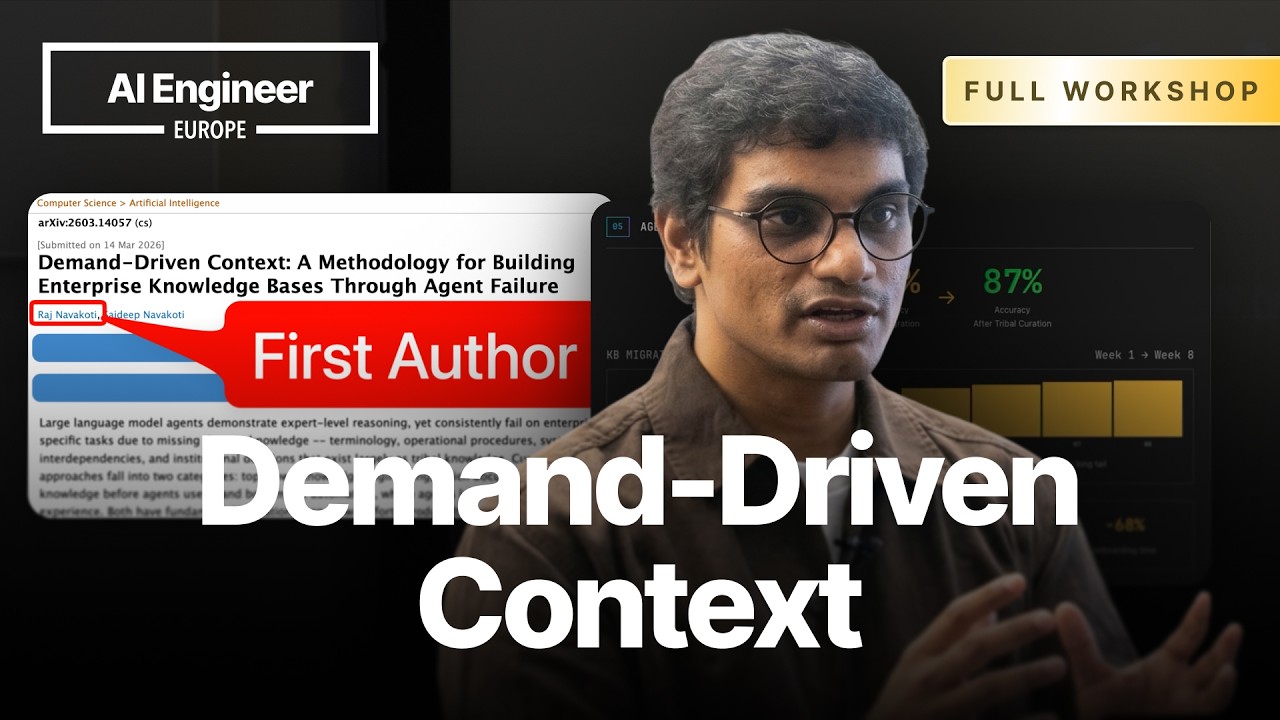
Demand-Driven Context: A Methodology for Coherent Knowledge Bases Through Agent Failure
May 5, 2026 · 1:08:15
Raj Navakoti, a staff software engineer at IKEA, presents a demand-driven context methodology for building coherent knowledge bases by letting AI agents fail on real problems and surfacing missing institutional knowledge. He argues that enterprises should shift from pushing monolithic documentation to a pull approach where agents reveal undocumented tribal knowledge through repeated failures on incidents and Jira tickets. Using a framework with skills, rules, and hooks, he demonstrates how agents can gradually improve confidence scores (from 1.4 to 4.4 over 14 incidents) by documenting discovered context blocks. Navakoti introduces a context gap scanner that automatically analyzes work items against existing documentation to identify critical gaps, outdated information, and duplications. He advocates storing curated knowledge in GitHub for version control and PR-based collaboration, and emphasizes that this approach helps teams know the unknown, enabling agents to manage knowledge rather than just consume it.

Ralph Loops: Build Dumb AI Loops That Ship — Chris Parsons, Cherrypick
May 4, 2026 · 1:48:26
Chris Parsons argues that dumb loops—simple while loops where an AI agent repeatedly executes the same task, evaluates its output, and iterates—outperform complex multi-agent orchestration and planning graphs. In this hands-on workshop, he builds a Pomodoro timer using Claude Code, implementing tickets one by one in a loop that self-corrects with each pass. He demonstrates the 'loop' command in Claude Code for scheduled, continuous execution and shows how to use sub-agents for adversarial validation to avoid self-confirmation bias. The talk covers real-world applications such as a worker loop that processes project steps overnight and a morning loop that generates daily briefings, all designed to offload routine work while keeping human oversight for irreversible decisions. Parsons emphasizes that the bottleneck in AI-augmented teams is often the review process, not coding speed, urging teams to identify and fix their biggest constraint first.
Mergeable by default: Building the context engine to save time and tokens — Peter Werry, Unblocked
May 3, 2026 · 1:41:25
Peter Werry of Unblocked argues that context engines—systems that supply AI agents with only the relevant organizational context—are critical to avoid agent doom loops and wasted tokens. He debunks three myths: naive RAG, connecting MCP servers, and bigger context windows do not solve the context problem. Werry describes building a social engineering graph to identify experts and distill team best practices, and shares hard lessons including hiding conflicts and caching answers. In a benchmark task, Unblocked's context engine reduced a 2.5-hour, 21-million-token task to 25 minutes and 10 million tokens. The talk offers a practitioner's guide to building context engines with conflict resolution, personalization, and access control.
OpenAI Codex Masterclass — Vaibhav Srivastav & Katia Gil Guzman
Apr 29, 2026 · 1:01:59
Katia Gil Guzman and Vaibhav Srivastav showcase OpenAI's Codex as a full software engineering agent, not just a coding assistant, powered by models like GPT-5.4 and GPT-5.3 Codex Spark. They demonstrate plugins bundling skills and MCP servers, automations that run scheduled tasks (e.g., Slack or Gmail summaries), and code review that 100% of OpenAI pull requests use by default. Subagents parallelize work across up to 20 agents for tasks like reviewing 45 persona files, with each subagent configurable by model, sandbox mode, and MCP access. New features include Guardian approvals for privileged operations, hooks for custom triggers, and a Cloud Code plugin. The episode also highlights the milestone of 3 million weekly active users, tripled since January, and covers security scanning for vulnerabilities.
Building your own software factory — Eric Zakariasson, Cursor
Apr 28, 2026 · 1:23:37
Eric Zakariasson, an engineer at Cursor, explains how to build a 'software factory' by scaling from one agent to many, shifting from worker to manager. He outlines six stages of autonomy, from spicy autocomplete to the dark factory, and emphasizes that most teams are stuck at levels two or three. Key primitives include modular codebases, guardrails like rules and hooks that emerge dynamically, enablers such as skills and MCPs, and verifiable systems like automated tests. Cloud agents with isolated VMs allow agents to run asynchronously, test their own work via computer control, and scale to thousands. Eric shares internal automations like daily reviews, PR comment analysis, and continual learning that extracts rules from chat transcripts. He concludes with strategic advice: front-load context, don't outsource critical decisions, and build tools and systems to capture flywheels, noting that human accountability remains essential.

Full Walkthrough: Workflow for AI Coding — Matt Pocock
Apr 24, 2026 · 1:36:30
Matt Pocock presents a hands-on workshop on building a full AI-assisted coding workflow, arguing that software engineering fundamentals—not hype—make agents effective. He introduces the 'smart zone' and 'dumb zone' of LLMs (performance drops after ~100k tokens) and the 'Memento problem' (agents forget between sessions). His process starts with a 'Grill Me' skill that relentlessly questions the user until shared understanding is reached, then produces a PRD without reading it, slices work into vertical 'tracer bullet' issues, and runs agents AFK using TDD. He advocates designing codebases with deep, testable modules and shows Sandcastle, a TypeScript library for parallel agent execution with separate implementer (Sonnet) and reviewer (Opus). The workshop transforms ambiguous briefs into shippable features while keeping humans in the loop for QA and taste.
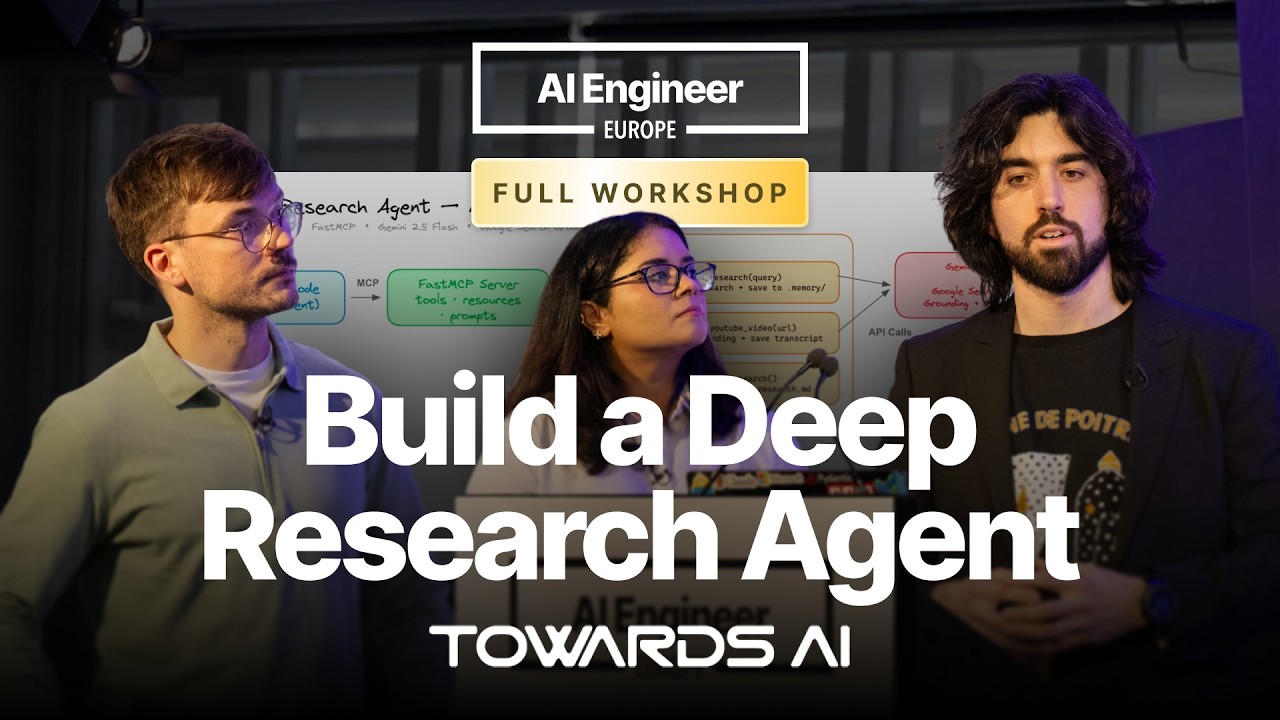
Full Workshop: Build Your Own Deep Research Agents - Louis-François Bouchard, Paul Iusztin, Samridhi
Apr 20, 2026 · 1:57:03
Louis-François Bouchard, Samridhi Vaid, and Paul Iusztin built a combined system of a deep research agent and a deterministic writing workflow to automate high-quality technical content creation, trading flexibility for control. The research agent uses an MCP server (FastMCP) with tools for Google search, YouTube analysis, and report compilation, powered by Gemini and orchestrated by Claude Code. The writing workflow is a static pipeline that loads a user guideline, writing profiles (structure, terminology, character), and few-shot examples into a system prompt, then applies an evaluator-optimizer loop: a reviewer outputs structured pydantic objects with profile/location/comment to flag violations, and the editor applies them in priority order (guideline > research > profile). They stress that research demands autonomy while writing needs constraint, and show how to avoid AI slop by banning specific words and using profiles. For observability, they use Opik to capture all traces, and for evals they built a 20-sample dataset from real LinkedIn posts, split into train/dev/test, to calibrate an LLM judge (binary pass/fail) that they run on dev and test splits to measure F1 and detect…

Harness Engineering: How to Build Software When Humans Steer, Agents Execute — Ryan Lopopolo, OpenAI
Apr 17, 2026 · 46:21
Ryan Lopopolo, a member of technical staff at OpenAI, argues that software engineers must shift to 'harness engineering' where agents produce all code and humans focus on delegation, system design, and guardrails. He describes how his team banned editors, using Codex with skills to manipulate apps, and reduced review friction by automating lint rules and review agents. Lopopolo explains that code is free but human time and model context are scarce, so teams should structure repositories for consistency and use 'garbage collection days' to eliminate recurring slop. He shares practical techniques like writing tests about source code (e.g., file length limits) and using review agents that inject prompts. His future vision involves agents autonomously executing long-horizon work based on token budgets and success metrics, freeing humans for higher-level activities.

$1 AI Guardrails: The Unreasonable Effectiveness of Finetuned ModernBERTs – Diego Carpentero
Apr 16, 2026 · 43:53
Diego Carpentero argues that LLM-based attacks—Prompt Injection, Indirect Injection, Model Internals (gibberish suffix), RAG Poisoning, MCP Exploits, and Agentic Escalation—are now the baseline, not the exception, and that model alignment and human review alone are insufficient. He identifies the core problem as a Zero Trust Gap: LLMs natively lack separation between system controls and data, allowing adversaries to override decisions via malicious instructions in inputs or external content. To build a protective layer, Carpentero fine-tunes ModernBERT—a state-of-the-art encoder with Alternating Attention, Unpadding & Sequence Packing, RoPE, and FlashAttention—into a safety discriminator that classifies prompts as safe or unsafe in ~35 milliseconds with 85% accuracy, all for under a dollar. He walks through the fine-tuning pipeline using the IngetGuard dataset and demonstrates live detection of real attack examples from each vector.

Paperclip: Open Source Human Control Plane for AI Labor — Dotta Bippa
Apr 15, 2026 · 24:34
Dotta Bippa introduces Paperclip, an open-source human control plane for AI labor that lets you manage an org chart of agents to run a zero-human company. The tool enables you to hire employees, set goals, automate jobs, and bring your own agent (e.g., Gemini, Claude, Codex) with skills and instructions. Paperclip supports reliable workflows like QA reviews and approvers, and routines for recurring tasks such as summarizing PRs or writing changelogs. Dotta demonstrates creating a Remotion video celebrating Paperclip's 40,000 GitHub stars (now 50,000) by instructing the CEO agent to hire a video writer and apply brand guidelines—something that would have taken a week becomes an afterthought. Paperclip is not just for coding; it handles marketing, sales, and finance. Upcoming features include CEO chat, maximizer mode, multi-user support, cloud deployments, and a desktop app, all aimed at giving humans control over AI labor.
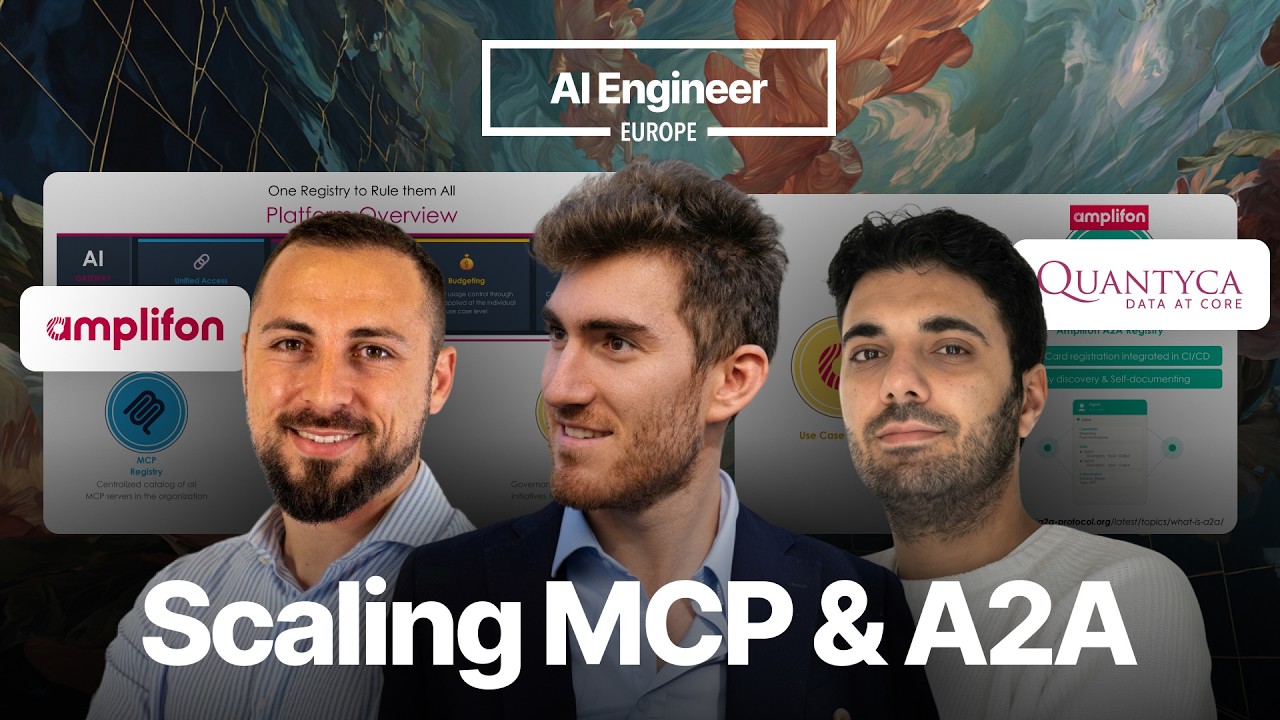
One Registry to Rule them All - Sonny Merla, Mauro Luchetti, & Mattia Redaelli, Quantyca
Apr 10, 2026 · 22:47
Amplifon's AI transformation led to the Amplify program, for which Quantyca built an enterprise-grade registry system for MCP servers and A2A agents. Sonny Merla, Mauro Luchetti, and Mattia Redaelli explain how three registries—MCP, A2A, and use case—are linked via a catalog to provide full lineage, including ownership, environment, authentication, cost attribution, and use case linkage. The solution uses an AI gateway for unified LLM access with Entra ID authentication and budgeting, and provides template repositories on GitHub with CI/CD pipelines that automatically publish agent cards and server metadata to the registries. This enables discovery, governance, and impact analysis across 26 countries and multiple teams, letting developers focus on business logic while avoiding reinventing security and deployment infrastructure.

AI Didn’t Kill the Web, It Moved in! — Olivier Leplus (AWS) & Yohan Lasorsa (Microsoft)
Apr 10, 2026 · 52:55
Yohan Lasorsa (Microsoft) and Olivier Leplus (AWS) argue that AI isn't replacing the web—it's becoming its native layer, embedded in every stage of development. They demo coding agents that use lightweight 'skills' to automate workflows like fetching GitHub issues and testing via Playwright, then show Chrome's MCP server letting agents debug performance across different network conditions. New on-device Web AI APIs (summarizer, proofreader, prompt API) run models locally in the browser, enabling features like auto-writing reviews from an uploaded product image without cloud calls. Finally, they introduce LLMs.txt for guiding AI agents to relevant documentation and Web MCP—a proposal to register native tools on websites (e.g., 'add to cart') so agentic browsers can execute actions without mimicking human clicks. The episode delivers concrete implementations, from coding to deploying AI-ready web apps.

Your MCP Server is Bad (and you should feel bad) - Jeremiah Lowin, Prefect
Jan 12, 2026 · 54:33
Jeremiah Lowin, CEO of Prefect and creator of FastMCP, argues that most MCP servers are poorly designed because they are simply REST API wrappers, leading to confused LLMs and wasted tokens. He presents a framework for agent-native product design based on three dimensions—discovery, iteration, and context—and offers five actionable principles: outcomes over operations, flatten arguments, treat instructions as context, respect the token budget, and curate ruthlessly. Lowin emphasizes that agents fail when given too many tools or complex arguments, citing a hard limit of 50 tools per agent for reliable performance. He shares real-world examples, including a company with 800 endpoints that could not be effectively exposed, and critiques client implementations like Claude Desktop for not respecting spec-compliant features. The central takeaway: MCP servers should be designed as user interfaces for agents, not as developer APIs.

Spec-Driven Development: Agentic Coding at FAANG Scale and Quality — Al Harris, Amazon Kiro
Jan 9, 2026 · 1:03:50
Al Harris, principal engineer at Amazon, presents Spec-Driven Development (SDD) with Kiro, an agentic IDE that transforms prompts into structured requirements (EARS format), designs, and property-based tests to ensure code correctness. He argues that upfront specification—augmented by MCP servers for external context—improves reproducibility and quality over pure vibe coding. The talk includes a live demo: building an S3-backed checkpointer for a LangGraph dad joke generator, then discovering Agent Core’s native memory is more idiomatic. Harris contrasts SDD with Cursor’s planning mode, explains how specs evolve as living documentation, and discusses handling session length, context pruning, and brownfield codebases. The result is a claim that spending 5–10 minutes on specs yields higher accuracy and reliable, testable outputs.

Claude Agent SDK [Full Workshop] — Thariq Shihipar, Anthropic
Jan 5, 2026 · 1:52:25
Thariq Shihipar of Anthropic presents the Claude Agent SDK, arguing that Bash and file-system-based agents outperform traditional tool-only approaches for autonomous tasks. He defines agents as systems that build their own context and trajectory, contrasting with structured workflows. The SDK, built on Claude Code, emphasizes the Bash tool as the most powerful primitive for composability and code generation, enabling non-coding tasks like data analysis. He demonstrates live-coding a Pokémon team advisor that dynamically fetches API data via scripts, and explains security through a 'Swiss cheese defense' of model alignment, AST parsing, and sandboxing. Shihipar also covers skills for progressive context disclosure, sub-agents for parallel work, and hooks for deterministic verification, stressing that agent building is an art of reading transcripts and iterating on context engineering.

Developer Experience in the Age of AI Coding Agents – Max Kanat-Alexander, Capital One
Dec 23, 2025 · 18:20
Max Kanat-Alexander, Capital One executive distinguished engineer, argues that developer experience teams should invest in a 'No Regrets' framework to prepare for an agentic future, regardless of unpredictable AI advancements. He identifies six key inputs that benefit both humans and AI agents: standardized development environments using industry-standard tools, native CLIs and APIs instead of browser automation, deterministic validation with clear error messages, refactoring legacy codebases for testability and reasoning, documenting external context and intentions, and improving code review velocity and quality through assignment and apprenticeship. Without these, bad codebases lead to rubber-stamped PRs and a vicious cycle of decreasing agent productivity; with them, a virtuous cycle accelerates software engineering velocity. Kanat-Alexander emphasizes that what's good for humans is good for AI, and these investments will help developers no matter what the future holds.
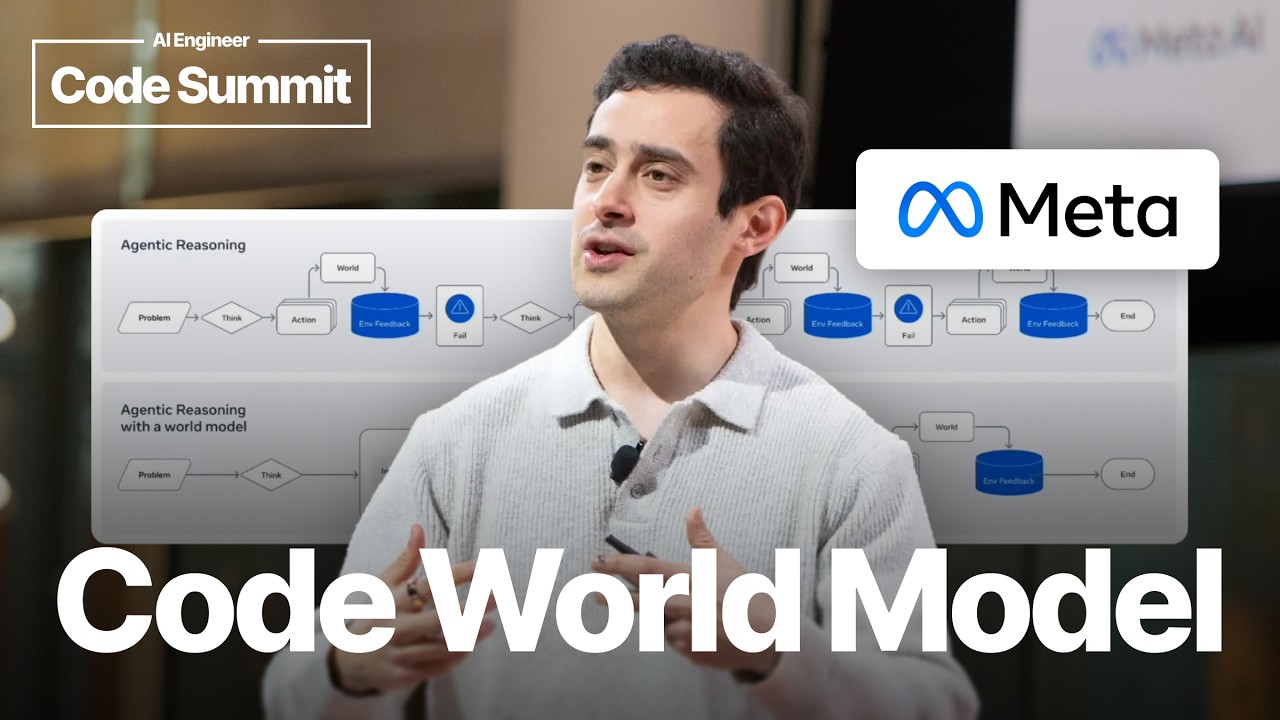
Code World Model: Building World Models for Computation – Jacob Kahn, FAIR Meta
Dec 17, 2025 · 16:41
Jacob Kahn, a research scientist at FAIR Meta, presents the Code World Model (CWM), a 32 billion parameter dense transformer that models program execution rather than just syntax. CWM predicts execution traces line by line, enabling neural debugging and approximation of the halting problem. Trained on GitHub data and refined with synchronous RL and long-context mid-training, CWM uses bash-oriented tool use and achieves strong throughput through asynchronous model updates. The model is open-source on Hugging Face, with code and a technical report available, and aims to build foundations for reasoning and planning in AI-driven software systems.

Future-Proof Coding Agents – Bill Chen & Brian Fioca, OpenAI
Dec 5, 2025 · 17:48
Bill Chen and Brian Fioca from OpenAI argue that coding agents are booming but fragile, with teams rebuilding harnesses every time models change. They present Codex, OpenAI's combined model and harness, as a stable abstraction layer that handles complexity like context compaction, parallel tool calls, and MCP integration. Key lessons include avoiding overprompting—letting the model use its trained habits rather than forcing foreign instructions—as demonstrated when GPT-5 ran slowly because users told it to examine every file. They describe patterns for using Codex as an SDK, enabling products like GitHub and Cursor to integrate without maintaining their own harness, and highlight future improvements in longer-horizon tasks and self-healing software. The episode concludes that building where models are going, with Codex's SDK, lets teams focus on differentiation rather than infrastructure rewrites.

No Vibes Allowed: Solving Hard Problems in Complex Codebases – Dex Horthy, HumanLayer
Dec 2, 2025 · 20:31
Dex Horthy of HumanLayer argues that with deliberate context engineering — specifically a technique he calls "frequent intentional compaction" — today's AI coding agents can handle large brownfield codebases, not just greenfield projects. He presents a three-phase workflow (research, plan, implement) that keeps agents in the "smart zone" of the context window, avoiding the diminishing returns that set in around the 40% mark. Horthy demonstrates this approach solving a real problem in a 300k-line Rust codebase, shipping a week's worth of work in seven hours with code that passed expert review. He cautions against outsourcing thinking to AI, emphasising that plans must include actual code snippets for reliable execution and team alignment. The talk also addresses the cultural rift where senior engineers clean up slop from juniors' AI tools, calling for top-down adoption and team-wide workflow adaptation.

Defying Gravity - Kevin Hou, Google DeepMind
Dec 2, 2025 · 25:10
Kevin Hou from Google DeepMind introduces Antigravity, a new agent-first IDE that combines three surfaces: an AI editor, an agent-controlled Chrome browser, and an Agent Manager. The central claim is that agents should live outside the IDE, enabling longer-running tasks and multimodal interactions. Key features include Artifacts—dynamic representations like plans, screen recordings, and diagrams—that replace raw chain-of-thought with visual summaries. The browser enables context retrieval and verification via screen recordings, while image generation allows iterative design through comments. Hou explains the research-product flywheel: DeepMind researchers use Antigravity internally to identify model gaps, improving capabilities like computer use and instruction following, which then ship in the product. He also details four categories of model improvements: intelligence, tools, long-running tasks, and multimodal, all powered by Gemini 3 Pro and related models.

What Data from 20m Pull Requests Reveal About AI Transformation — Nick Arcolano, Jellyfish
Nov 24, 2025 · 17:57
Nick Arcolano, head of research at Jellyfish, presents data from 20 million pull requests across 200,000 engineers at 1,000 companies to reveal what AI transformation actually looks like. Median AI adoption of interactive coding tools (Copilot, Cursor, Claude Code) jumped from 22% in June 2024 to nearly 90% today, driving a 2x increase in PR throughput and 24% faster cycle times on average. Autonomous agents like Devin and Codex remain negligible—only 44% of companies have tried them, contributing less than 0.2% of PRs. PRs grow 18% larger with AI, but bug rates and reverts show no significant quality impact. Crucially, code architecture determines success: centralized and balanced repos see 4x throughput gains, while highly distributed architectures (many repos per engineer) show no correlation with AI adoption, likely due to cross-repo context limitations. Arcolano advises focusing on adoption first, then addressing architectural barriers to unlock productivity.

Z.ai GLM 4.6: What We Learned From 100 Million Open Source Downloads — Yuxuan Zhang, Z.ai
Nov 22, 2025 · 19:39
Yuxuan Zhang from zAI details the technical roadmap behind the GLM 4.6 open-source model series, which has surpassed 100 million downloads and tied for number one on the LMSYS Chatbot Arena alongside GPT-4o and Claude 3.5 Sonnet. The training pipeline uses 15 trillion tokens of pre-training data, followed by 7 trillion tokens of code and reasoning data, repo-level contexts at 32,000 tokens, and 100 billion tokens of long-context agent trajectories up to 128,000 tokens. Zhang introduces SLIME, a hybrid synchronous/asynchronous RL framework that decouples agent-environment interaction from GPU training to avoid bottlenecks. He explains why single-stage RL at 64,000 tokens outperforms multi-stage approaches for preserving long-context abilities, and shows that token-weighted loss converges faster than sequence-average loss for code RL. The multimodal GLM 4.5V model handles native resolution images and video with temporal index tokens, enabling GUI agent capabilities. Deployment is supported via vLLM and SGLang, with an API at z.ai and an open-source coding assistant.
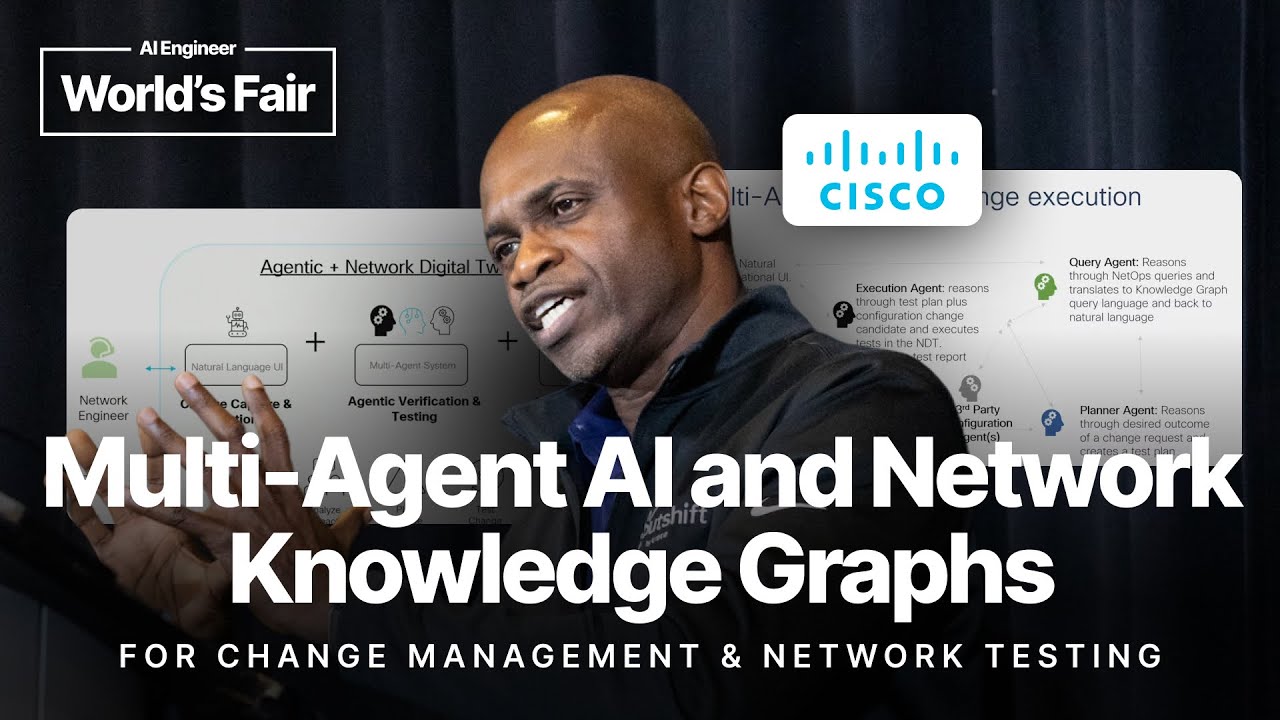
Multi Agent AI and Network Knowledge Graphs for Change — Ola Mabadeje, Cisco
Aug 22, 2025 · 18:49
Ola Mabadeje from Cisco's Outshift presents a multi-agent AI system that combines network knowledge graphs with natural language interfaces to improve change management. The solution ingests data from ITSM tools like ServiceNow, uses five specialized agents built on an open framework (agency.org) to automate impact assessment, test planning, and execution within a digital twin. A fine-tuned query agent reduces token usage and latency when querying the ArangoDB knowledge graph, layered using OpenConfig schema. The demo shows agents collaborating to assess a firewall rule change, generate test cases, and run them on a synthetic network, attaching results back to the ticket. Early evaluations focus on extrinsic metrics tied to customer outcomes, with the knowledge graph and open agent framework as key building blocks for scalable network operations.

A2A & MCP Workshop: Automating Business Processes with LLMs — Damien Murphy, Bench
Jul 26, 2025 · 1:23:14
Damien Murphy presents A2A and MCP protocols for building multi-agent systems that automate business processes from webhooks, using a host agent that delegates tasks to sub-agents (Slack, GitHub, Bench) via A2A, with each sub-agent using MCP tools from Zapier or internal APIs. He demonstrates processing a meeting transcript to create a GitHub issue, send a Slack message, and research attendees, emphasizing that A2A handles remote agent discovery and opaqueness while MCP provides standardized third-party tool access. Murphy highlights benefits like context isolation—sub-agents absorb large tool outputs and keep the host's context small—and parallel processing, but notes limitations: A2A's early stage, MCP's silent failures (e.g., Zapier Slack missing channels), the non-determinism of LLM orchestration, and the challenge of prompt caching costs. He argues that A2A is best for third-party agents where complexity is hidden, while MCP is useful for extensible tool integration, but if you control the tools or agents, direct function calls are simpler and more reliable.

Your Coding Agent Just Got Cloned And Your Brain Isn't Ready - Rustin Banks, Google Jules
Jul 25, 2025 · 13:40
Rustin Banks, an AI product manager at Google Labs, shares how Jules, Google's asynchronous coding agent powered by Gemini 2.5 Pro, enables developers to shift from sequential coding to orchestrating many parallel agents. He demonstrates real-world use on a conference schedule website, adding tests with Jest and Playwright simultaneously, implementing features like Google Calendar integration and AI summaries, and running accessibility audits. Banks argues that success requires clear verification criteria, creating 'disagreement' with agents to ensure correctness, and a robust merge/test framework. He notes that in its first two weeks, Jules generated 40,000 public commits, and emphasizes that agents-as-a-service in the cloud allow infinite scalability and development from any device.

AI powered entomology: Lessons from millions of AI code reviews — Tomas Reimers, Graphite
Jul 22, 2025 · 10:21
Tomas Reimers, co-founder of Graphite, discusses the company's AI-powered code reviewer Diamond, arguing that while LLMs can effectively find bugs, they must be carefully prompted to avoid frustrating developers. After analyzing 10,000 comments from codebases, Graphite classified bugs into a quadrant based on what LLMs can catch versus what humans want to receive, identifying bugs, accidentally committed code, performance and security concerns, and documentation mismatches as high-value targets. Code cleanliness and best practice comments, though technically correct, are often unwelcome from AI. Graphite measures success via emoji reactions (less than 4% downvote rate) and the percentage of comments that lead to code changes, reaching 52% actionability in March—matching human-level effectiveness. The talk emphasizes continuous monitoring to ensure LLM comments stay within the desirable quadrant.

Practical GraphRAG: Making LLMs smarter with Knowledge Graphs — Michael, Jesus, and Stephen, Neo4j
Jul 22, 2025 · 19:46
Michael Hunger and Stephen Chin of Neo4j present GraphRAG as a method to enhance LLMs by integrating knowledge graphs, achieving more accurate, contextual, and explainable answers than standard RAG. They highlight limitations of vector search, showing GraphRAG improves relevance and reduces hallucinations. They detail a three-step construction process: lexical graphs, entity extraction, graph enrichment with algorithms. They demonstrate open-source tools like Neo4j Knowledge Graph Builder and GraphRAG Python package, and show an agentic approach using domain-specific retrievals. They cite studies showing three times improvement in accuracy.

HybridRAG: A Fusion of Graph and Vector Retrieval - Mitesh Patel, NVIDIA
Jul 22, 2025 · 20:24
Mitesh Patel, Developer Advocate Manager at NVIDIA, presents HybridRAG, a fusion of knowledge graph-based GraphRAG and vector-based VectorRAG for improved question-answering from complex texts. He emphasizes that ontology engineering consumes 80% of development time and is critical for accurate triplet extraction, where fine-tuning LLaMA 3.1 with LoRA boosted triplet accuracy from 71% to 87% on 100 documents. Patel also highlights retrieval strategies like multi-hop graph traversal, which provides richer context but increases latency, and recommends QGraph acceleration via Networx to reduce latency. For evaluation, he suggests RAGAS for end-to-end pipeline metrics and the LLaMA-Nimotron reward model for response quality. Ultimately, he advises using GraphRAG when data has inherent structure or complex relationships, but notes it is compute-heavy, so the choice between GraphRAG, semantic RAG, or hybrid depends on the use case.
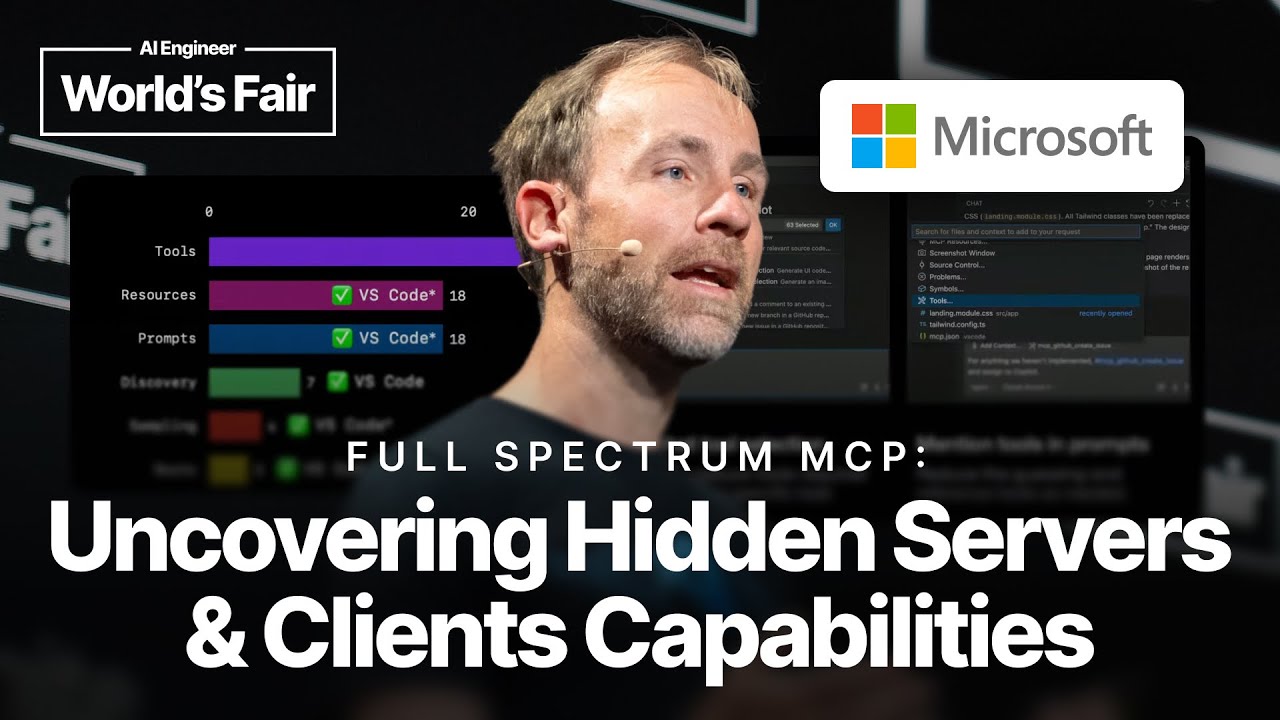
Full Spec MCP: Hidden Capabilities of the MCP spec — Harald Kirschner, Microsoft/VSCode
Jul 18, 2025 · 14:53
Harald Kirschner from Microsoft/VSCode argues that MCP's full specification unlocks powerful stateful interactions beyond the common 'tools-only' implementations, transforming AI assistants into more contextual and efficient agents. He highlights underused primitives like resources for rich data context and sampling for server-requested LLM completions, demonstrated via a dungeon game where dynamic tool discovery adapts to game state. VS Code's upcoming full spec support includes dynamic tool discovery, user-defined tool sets, a debug mode for server development, and support for streamable HTTP to reduce stateful server churn. Upcoming features like elicitations will allow tools to request user input directly. Kirschner calls on developers to build progressive, full-spec servers and contribute feedback to the open ecosystem, emphasizing that client and SDK support will follow as usage grows.

How LLMs work for Web Devs: GPT in 600 lines of Vanilla JS - Ishan Anand
Jul 13, 2025 · 1:41:34
Ishan Anand shows that GPT-2 small implemented in 600 lines of vanilla JavaScript makes LLMs understandable for web developers without ML backgrounds. He explains tokenization via byte-pair encoding, 768-dimensional embeddings representing semantic meaning via co-occurrence, and the Transformer's attention mechanism that lets tokens share context. The multi-layer perceptron learns next-token prediction through backpropagation, while the language head converts embeddings to token probabilities using softmax. Anand demonstrates each step—tokenization, embedding lookup, positional encoding, attention, MLP, and output—in a browser debugger, and notes that GPT-2's architecture underpins ChatGPT, with innovations like scale, supervised fine-tuning, and RLHF. The workshop provides an intuitive mental model of Transformers, turning perceived AI magic into understandable machinery.

AI Engineering with the Google Gemini 2.5 Model Family - Philipp Schmid, Google DeepMind
Jul 11, 2025 · 1:44:51
In this workshop, Philipp Schmid from Google DeepMind demonstrates AI Engineering with the Gemini 2.5 model family, focusing on using Gemini 2.5 Flash via a free API tier for hands-on coding tasks including text generation, multimodal processing of images, audio, and PDFs, function calling with structured outputs, and integration with MCP servers. The session covers setting up API keys in AI Studio, uploading files via the Files API (free for 1 day), and controlling thinking budgets (0–24,000 tokens) to manage cost and reasoning depth. Schmid shows how Gemini natively processes videos at 1 frame per second for accurate timestamp extraction and how PDFs are handled by combining OCR text with image understanding. He introduces native tools like Google Search with grounding metadata, code execution, and URL context, and explains how MCP servers can be used seamlessly with the Gemini SDK for tool calling. The workshop also covers parallel vs sequential function calling, the Agent Development Kit (ADK), and the upcoming asynchronous function calling for the Live API, providing a practical path from simple generation to agentic workflows.

12-Factor Agents: Patterns of reliable LLM applications — Dex Horthy, HumanLayer
Jul 3, 2025 · 17:06
Dex Horthy, founder of HumanLayer, presents the 12-Factor Agents framework for building reliable LLM-powered applications, arguing that production-grade agents are primarily deterministic software with targeted LLM steps rather than fully autonomous loops. He distills patterns: own prompts and context windows, treat tools as JSON and code, use small focused agents with three to ten steps, contact humans via tool calls. Horthy emphasizes context engineering—LLMs are pure functions—and shows how to compact errors, unify state, and add pause/resume via APIs. He shares a DevOps agent that became a bash script, and advocates for outer-loop agents. The framework, which gained 4,000 GitHub stars in two months, treats agents as stateless reducers that meet users on any channel, with engineers controlling the inner loop of token and control flow.
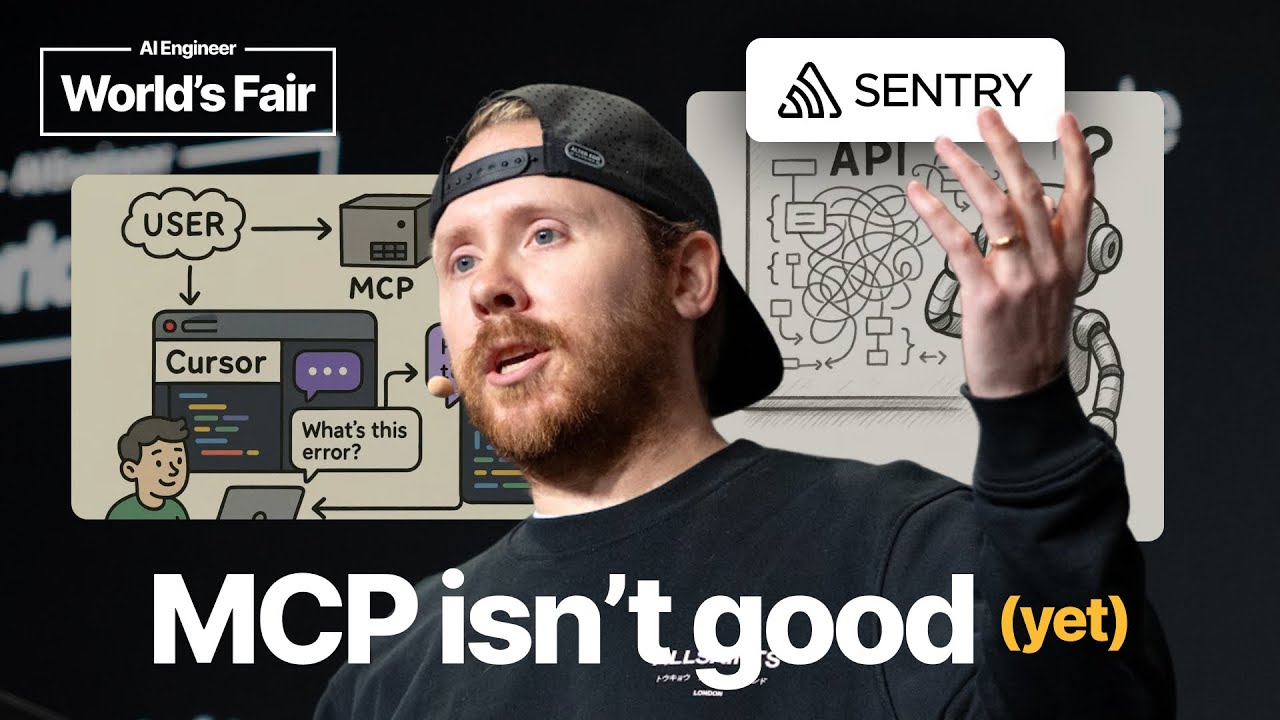
MCP Is Not Good Yet — David Cramer, Sentry
Jul 3, 2025 · 16:41
David Cramer, founder and engineer at Sentry, argues that the Model Context Protocol (MCP) is a pluggable architecture for agents, not a simple API overlay, and that it is not yet good but worth experimenting with. He stresses that exposing existing OpenAPI endpoints as MCP tools yields terrible results; instead, developers must design context specifically for agents, returning Markdown rather than raw JSON to improve model reasoning. Cramer details Sentry's MCP server, built in two days using Cloudflare Workers for OAuth 2.1, and notes that remote OAuth is essential for B2B SaaS, while standard I/O introduces security risks. He highlights the need for careful token and cost management—citing a single request that produced 20 API calls to Sentry—and advocates for building dedicated agents (like Sentry's root cause analysis tool) that wrap MCP, giving the provider control over prompts, models, and error handling. Despite ongoing issues like lack of streaming responses and unstable client support, Cramer concludes that MCP's core concepts (plug-ins, agents, tools) are just familiar software patterns with new names.

[Evals Workshop] Mastering AI Evaluation: From Playground to Production
Jul 1, 2025 · 1:25:08
In this workshop, Braintrust Solutions Engineers Carlos Esteban and Doug guide participants through the complete AI evaluation lifecycle, from offline testing in the playground to production monitoring. They explain the three core ingredients of an eval—task, data set, and score—and demonstrate how to run evals both via the Braintrust UI and the SDK. The session covers LLM-as-judge vs. deterministic code scores, the importance of starting small with synthetic data, and how to use online scoring and logging to capture real user feedback. Human-in-the-loop review is highlighted as a way to establish ground truth and close the feedback loop. The presenters also address audience questions on bootstrapping data sets, non-determinism in LLM judges, and integrating evals into existing projects.

Intro to GraphRAG — Zach Blumenfeld
Jun 30, 2025 · 1:18:35
Zach Blumenfeld introduces GraphRAG using Neo4j, showing how to build knowledge graphs from employee and skill data, combine structured and unstructured data, and use graph traversal with vector search for retrieval. The workshop covers Cypher query patterns for multi-hop similarity, entity extraction from resumes via LLMs, and creating semantic similarity relationships. It demonstrates Leiden community detection for skill clustering and builds a LangGraph agent with four custom tools that balance exact skill matches with vector similarity. Blumenfeld argues that knowledge graphs provide controlled, explainable retrieval logic for agentic workflows, enabling developers to decompose data into graph models that expose domain logic for more accurate retrieval than pure vector search.
How to build world-class AI products — Sarah Sachs (AI lead @ Notion) & Carlos Esteban (Braintrust)
Jun 27, 2025 · 1:43:46
Sarah Sachs (AI lead at Notion) and Carlos Esteban (Braintrust) explain that building great AI products requires 10% prompting and 90% evals and observability, with Notion AI using Braintrust to iterate on prompts and models. Sachs details their cycle: curate small datasets, tie them to scoring functions (LLM-as-a-judge with per-sample prompts and heuristic checks), run evals before shipping, and use production logs to catch regressions. She notes Notion AI supports 100M+ users, switches models in under a day, and 60% of enterprise users are non-English—requiring multilingual eval rigor. Carlos and Doug then walk through Braintrust's framework: tasks (prompts, tools, agents), datasets, and scores (0-1). They demonstrate offline evals via playground and SDK, online scoring in production, user feedback capture, human review setup, and remote evals to bridge complex code with the playground. The workshop covers moving from pre-prod evals to production monitoring, closing the feedback loop by adding underperforming spans to datasets.

Vibe Coding at Scale: Customizing AI Assistants for Enterprise Environments - Harald Kirshner,
Jun 27, 2025 · 15:26
Harald Kirshner, a Principal Product Manager at Microsoft working on VS Code and GitHub Copilot, argues that 'vibe coding' must evolve from ad-hoc experimentation to structured, spec-driven approaches for enterprise environments. He breaks vibe coding into three stages: YOLO (rapid prototyping with auto-accept and voice dictation), structured (using templates, custom instructions, and tools like MCP for consistency), and spec-driven (iterating from a plan for scale and reliability). Kirshner demonstrates VS Code Insiders' agent mode, new workspace flow, and auto-approve features, emphasizing that developers should commit often, review agent pauses, and leverage workspace instructions to maintain quality. He advocates for standardizing AI usage through team-defined prompts and modes, preserving developer autonomy while ensuring maintainable code even in complex, polyglot codebases.

Building Code First AI Agents with Azure AI Agent Service — Cedric Vidal, Microsoft
Jun 27, 2025 · 1:54:06
Cedric Vidal, Principal AI Advocate at Microsoft, demonstrates building code-first AI agents with Azure AI Agent Service, using function calling, code interpreter, file search, and Bing grounding for a sales analysis use case. He creates a conversational agent that queries SQLite, generates pie charts from Python code, and blends product PDF data with relational data. The workshop explains stateful agents, tool routing (LLM generates JSON to call functions), and the limits of single-step agents versus multi-agent orchestration with AutoGen. Cedric addresses when to use Agent Service (managed persistence and tools) versus raw LLM endpoints, and covers MCP servers as a tool lifecycle manager. Key insights include using instructions to ground agent behavior and the need for eval frameworks for agent quality.
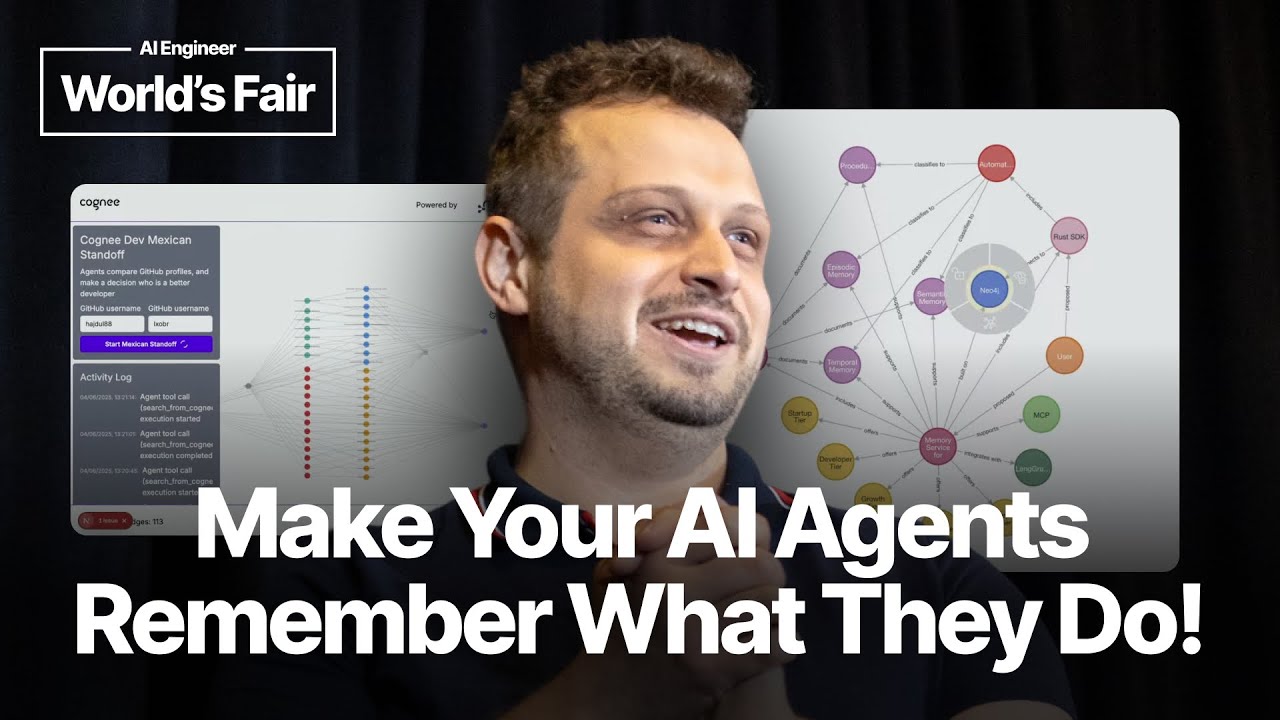
Memory Masterclass: Make Your AI Agents Remember What They Do! — Mark Bain, AIUS
Jun 27, 2025 · 51:25
Mark Bain, Vasilia Markovits, Alex Gilmore, and Daniel Chalev demonstrate that AI memory requires causal relationships and graph databases, not just vector similarity, to solve hallucinations and enable agentic workflows. Bain argues that memory is any data affecting change, and that attention, diffusion, and VAEs follow the same geometric principles as gravity and entropy. Alex shows Neo4j's MCP server storing semantic memory as entities and relationships retrieved across conversations. Vasilia demos Cognee building semantic graphs from GitHub data for agentic hiring decisions. Daniel presents Graphiti's domain-aware memory using custom Pydantic schemas to filter irrelevant facts. Bain introduces a GraphRAG chat arena that switches between memory solutions on a single Neo4j graph, testing different implementations for episodic and temporal recall.

Windsurf everywhere, doing everything, all at once - Kevin Hou, Windsurf
Jun 23, 2025 · 16:03
Windsurf head of product Kevin Hou explains the company's philosophy of a shared human-AI timeline and its vision to be everywhere, do everything, and work all the time. The AI ingests context from tools like Google Docs, Figma, GitHub, and Notion, and takes actions beyond coding—opening PRs, deploying, and reviewing code. Windsurf generates 90 million lines of code daily and processes over 1,000 messages per minute. Its new model SWE-1, trained on software engineering workflows, achieves near-frontier performance with a fraction of the resources. Hou emphasizes a data flywheel where user feedback on real workflows drives continuous improvement, arguing that successful AI products in 2025 require harmony among model, data, and application.

Supercharging developer workflow with Amazon Q Developer - Vikash Agrawal
Jun 10, 2025 · 13:22
Vikash Agrawal and Linda show how Amazon Q Developer can drive every stage of the software development lifecycle. They build a 2048 game with FastAPI and Poetry using Q's /dev command in the CLI, then add unit tests with /test, generate documentation with /doc, and integrate with GitHub for automated pull requests. After deploying to AWS, they use Q in CloudWatch to debug a runtime import error by analyzing logs and resource topology. The episode emphasizes that planning infrastructure and prompts upfront, along with security scans, are critical for production-ready AI-assisted development.

The 4 Patterns of AI Native Development — Patrick Debois
Jun 4, 2025 · 14:11
Patrick Debois presents four patterns of AI-native development that redefine software engineering roles: from producer to manager (reviewing AI-generated code, managing agents), from implementation to intent (specifying requirements in markdown files), from delivery to discovery (rapid prototyping with tools like Lovable and Bolt), and from content creation to knowledge (capturing learnings for reuse). He argues these shifts mirror senior developer activities and are supported by new tools, such as the AI Native Dev landscape featuring roughly 300 tools. The talk emphasizes that AI changes not just coding speed but the entire workflow, reducing cognitive load through smarter reviews and intent-based coding.
Are MCPs Overhyped? A Rant about MCPs — Henry Mao, Smithery
Jun 3, 2025 · 7:29
Henry Mao, founder of Smithery and MCP steering committee member, argues that despite MCPs standardizing AI agent-service connections, the ecosystem faces fragmentation, high-friction installation, security, and monetization problems. Users struggle with unreliable MCP servers and complex five-step installs, while developers face hosting challenges, lacking tooling, distribution hurdles, and unclear monetization. Smithery aims to solve these as an AI gateway, demoing an agent that finds GitHub issues and creates Linear tickets using curated MCPs. Mao envisions a future dominated by tool calls where agent experience trumps user experience.

The Agent Native Company — Rick Blalock, Agentuity
Jun 3, 2025 · 20:58
Rick Blalock of Agentuity argues that an agent-native company, built from the ground up with AI agents at the core of product, operations, and culture, is fundamentally different from an AI-enhanced one that merely uses AI as a tool. He contrasts the two: removing agents from an agent-native company would halt productivity, while an AI-enhanced business would just become less efficient. Blalock describes the agent-native workday, where humans oversee agents that handle routine tasks, and notes the rise of roles like 'Agent Manager' and the importance of AI fluency in hiring. He shares how his 7-person team built an entire agentic cloud infrastructure in weeks using agents like Devin, arguing that this paradigm shift requires founders to rethink org charts, roles, and skills. The episode concludes that businesses must decide whether they are just using AI or ready to be built around it.

The Knowledge Graph Mullet: Trimming GraphRAG Complexity - William Lyon
Jun 3, 2025 · 32:52
William Lyon presents the 'Knowledge Graph Mullet' concept, combining property graph interfaces with RDF triple storage in Dgraph to optimize GraphRAG systems and AI agent development. Dgraph uses a property graph model for data modeling and DQL (inspired by GraphQL) for queries, while leveraging RDF triples for scalable storage and data interchange. Features include vector similarity search (e.g., finding articles about 'money laundering'), geospatial indexes, and a Model Context Protocol (MCP) server that exposes tools to models like Claude Desktop for auto-generating schema and querying. Lyon demonstrates building a news knowledge graph from the New York Times, chunking articles into nodes, and using graph traversal to surface related topics after vector search. He also showcases Hypermode agents, created from a prompt with access to GitHub and Notion via MCP servers, which can analyze repos like hyper-news and generate social media posts with code snippets, then save them to a Notion workspace. Hypermode agents are now in early access.

The Robots are coming for your job, and that's okay - Elmer Thomas and Maria Bermudez
Jun 3, 2025 · 8:57
Elmer Thomas and Maria Bermudez of Twilio's developer education team explain how they built six single-purpose AI agents to automate repetitive documentation tasks like editing, alt text generation, and jargon simplification, rather than replacing human writers. The agents, powered by GPT-4/01 and validated with tools like Veil Lint and CI tests, reduce hallucinations through layered human review. Maria demos the automated editor, SEO metadata generator, alt text generator, and jargon simplifier. The team’s playbook: identify a pain point, pick a repeatable task, and iterate with weekly user feedback.

The Devops Engineer Who Never Sleeps — Diamond Bishop, Datadog
Apr 22, 2025 · 16:18
Diamond Bishop, Director of AI Engineering at Datadog, explains how his team builds AI agents—the On-Call Engineer and Software Engineer—that automate DevOps tasks like incident investigation, remediation, and postmortem writing. He details how the On-Call Engineer wakes up for alerts, reads runbooks, queries logs and metrics, and suggests fixes to let human engineers sleep. The Software Engineer proactively fixes errors by generating code diffs and pull requests. Bishop shares four key lessons: scope tasks and evaluate rigorously, assemble teams of optimistic generalists and UX experts, adapt UX for human-agent collaboration, and treat observability as critical for debugging multi-step agent workflows. He predicts that within five years, AI agents will surpass humans as primary users of SaaS platforms like Datadog, urging builders to design for agent consumers.

Evaluating Domain Specific LLMs for Real World Finance — Waseem Alshikh, Writer
Apr 22, 2025 · 12:01
Writer CTO Waseem Alshikh presents FailSafe, a benchmark for evaluating LLMs in real-world finance, challenging the notion that general-purpose models suffice. Tests on query failures (misspelling, incomplete, out-of-domain) and context failures (missing context, OCR errors, irrelevant context) reveal that reasoning models like o1 and o3 perform 50% to 60% worse on context grounding than smaller domain-specific models, despite higher answerability. Even the best model achieves only 81% combined robustness and grounding, meaning roughly 20% of responses are wrong. Alshikh argues that domain-specific models remain essential, and that full-stack systems—RAG, guardrails, and grounding—are necessary for reliable deployment in high-stakes finance.

How to Fail at AI Strategy: Hamel Husain & Greg Ceccarelli
Apr 13, 2025 · 17:03
Greg Ceccarelli and Hamel Husain argue that the most reliable path to AI failure is to follow a set of inverted worst practices, including cultivating disconnect between executives and builders, promising unrealistic AI capabilities, drowning communication in jargon, and avoiding data analysis. They describe how to divide your company by incentivizing secrecy and using jargon like 'agents' to exclude domain experts, ensuring that AI projects are disconnected from real needs. The speakers advocate faking strategy by highlighting random paragraphs from last year's report, announcing vague goals like 'become the global AI leader in everything,' and creating a massive backlog with no timeline. They recommend throwing tools at problems—buying expensive vector databases or switching frameworks—without understanding root causes, and blindly trusting off-the-shelf evaluation metrics like BLEU and ROUGE. Crucially, they insist on never looking at data, using complex systems inaccessible to domain experts, and trusting gut feelings over evidence. This inverted guide guarantees wasted resources, alienated teams, and spectacular failure.

Building Agents with Model Context Protocol - Full Workshop with Mahesh Murag of Anthropic
Mar 1, 2025 · 1:44:12
Mahesh Murag of Anthropic presents the Model Context Protocol (MCP) as an open standard that replaces fragmented integrations with a single protocol for connecting AI systems to data sources, enabling context-rich AI applications and agentic experiences. He explains MCP's philosophy, inspired by APIs and LSP, and its three interfaces: tools (model-controlled), resources (application-controlled), and prompts (user-controlled). Murag highlights adoption with over 1,100 community-built servers and official integrations from companies like Cloudflare and Stripe. He demonstrates building agents with MCP using the MCP-Agent framework, showing how agents can use tools dynamically and composably across hierarchical systems. Future plans include remote server support with OAuth 2.0, a centralized registry for discovery and verification, and enabling agents to self-evolve by dynamically finding new capabilities via registry search.
How Coding Agents change Software Development Forever - Hailong Zhang
Feb 22, 2025 · 8:50
Hailong Zhang presents how coding agents, particularly the unit test agent Gru, transform software development by automating routine tasks while humans focus on creative work. In the future workflow, synchronous agents like GitHub Copilot and Cursor assist in real-time, while asynchronous agents like Gru autonomously handle tasks such as writing tests, fixing bugs, and submitting pull requests. Gru, built to boost unit tests, detects code changes from pull requests, generates and runs tests, and submits a new PR with a summary and coverage improvement. In production, over 50% of Gru's PRs are accepted by humans, and it handles 80% of unit tests in its own repo, making it the top contributor. To build such agents, Zhang emphasizes defining a clear problem (e.g., unit tests, not generic software engineering), creating datasets and evaluation harnesses, selecting and fine-tuning LLMs per stage, building task-specific context from environment data, and developing an agent operating system to reuse common infrastructure across different tasks.

GitHub's AI Powered Security Platform: Sarah Khalife
Feb 8, 2025 · 23:45
Sarah Khalife, Principal Solutions Engineer at GitHub, details how the company is weaving generative AI into GitHub Advanced Security (GHAS), focusing on code scanning auto fix (in public beta, with a 70% success rate on vulnerability fixes within pull requests), secret scanning enhancements such as AI-generated custom regex patterns and unstructured password detection (reducing false positives), and supply chain security via Dependabot. She demonstrates how AI enables faster remediation—detecting cross-site scripting and suggesting fixes before merge—and shows the security dashboard’s coverage view, which reveals that secret scanning covers 99% of repositories while code scanning only 57%. The talk emphasizes that AI shifts security from reactive to proactive, bridging the gap between AppSec teams and developers through shared responsibility and community driven improvements.

AI Templates: Gabriela and Aishwarya
Feb 6, 2025 · 1:03:20
Gabriela de Queiroz, Aishwarya, and Pamela from Microsoft present AI templates for rapidly prototyping and deploying generative AI applications, demonstrating how startups can leverage Microsoft for Startups Founders Hub, including up to $150,000 in Azure credits and expert guidance. The workshop covers three templates: a simple chat app using GPT-3.5 Turbo, a Retrieval Augmented Generation (RAG) app on Postgres with hybrid vector and text search, and a RAG app on unstructured documents using Azure AI Search and Document Intelligence. Key insights include the importance of query rewriting, hybrid search over pure vector search, and streaming responses for better user experience. The templates are open source on GitHub and can be deployed via Codespaces, with a proxy provided to bypass Azure OpenAI approval delays.

Everything you need to know about Fine-tuning and Merging LLMs: Maxime Labonne
Sep 25, 2024 · 17:52
Maxime Labonne from Liquid AI explains the LLM training lifecycle—pre-training, supervised fine-tuning (SFT), and preference alignment—and when to use fine-tuning over prompt engineering. He details SFT dataset creation (accuracy, diversity, complexity) and techniques like full fine-tuning, LoRA, and QLoRA, with key hyperparameters. The core of the talk is model merging: combining weights of fine-tuned models without GPU, using methods like SLERP (spherical linear interpolation for two models), TIES (pruning redundant parameters to merge many models), pass-through (concatenating layers, e.g., Meta LLaMA 3 120B Instruct by repeating layers gives strong creative writing), and Franken-MoE (extracting FFN layers from domain-specific models with a router). Labonne demonstrates these with his NeuralBeagle and Beyonder models, noting merged models dominate the OpenLLM leaderboard and that TIES merging often outperforms more experimental Mixture of Experts approaches.

Going beyond RAG: Extended Mind Transformers - Phoebe Klett
Sep 11, 2024 · 16:04
Phoebe Klett presents Extended Mind Transformers (EMT), a modification to transformer attention that lets models retrieve relevant memory tokens during generation without fine-tuning. EMT uses relative position embeddings (RoPE in LLaMA, ALiBi in MPT) to enable zero-shot generalization. On a counterfactual retrieval benchmark up to 16K tokens, EMT outperforms fine-tuned models and, combined with RAG, surpasses GPT-4. It provides granular citations by showing exactly which memory tokens were attended to, and reduces hallucinations via active learning: when token-level entropy signals uncertainty, the model retrieves more memories. EMT is open-sourced on Hugging Face and GitHub with configurable parameters like stride length, top K, similarity masking, and unknown token elimination.

10x Development: LLMs For the working Programmer - Manuel Odendahl
Aug 21, 2024 · 1:14:46
Manuel Odendahl presents a workshop on using LLMs as a translation engine to achieve 10x development productivity, arguing that treating models as cultural rather than purely technological artifacts enables novel techniques like world simulation for code reviews and domain-specific language creation. He demonstrates concrete methods: regenerating responses, editing model outputs, clearing context frequently, and summarizing transcripts into actionable formats. Odendahl introduces his tool Prompto for managing code fragments and emphasizes that fundamental programming knowledge remains essential while API-specific details become less critical. The episode focuses on decomposing problems into language translation steps, using examples such as transforming meeting transcripts into GitHub issues and building applications by instructing the LLM to simulate itself as the app. Odendahl advocates for divergent thinking and human-centered output, noting that all generated artifacts should ultimately serve human understanding.

The Making of Devin by Cognition AI: Scott Wu
Jul 11, 2024 · 20:04
Scott Wu, co-founder and CEO of Cognition AI, demonstrates Devin, a fully autonomous AI software engineer that builds and deploys working applications from plain English instructions, sharing the early lessons and vision behind the product. Devin built a name game website for the AI Engineer World's Fair in minutes, iterating on feedback to hide names, add a streak counter, and deploy the final version. Cognition uses Devin internally for features like a search bar and dashboards; Wu notes that engineers typically spend 80–90% of time on implementation, but Devin frees them to focus on architecture and problem-solving, making them 5–10x more productive while increasing overall demand for software. He also highlights the UX challenges of agents, which require new interactions beyond text completion, and notes that access to Devin is expanding via a waitlist.
How to Become an AI Engineer from a Fullstack Background - Reid Mayo
Feb 2, 2024 · 10:19
Reid Mayo presents a step-by-step syllabus to transition from fullstack engineer to AI engineer, covering generative AI foundations, prompt engineering, LangChain, fine-tuning, and cost-effective open-source model deployment. The syllabus starts with Cohere's LLM overview, then dives into prompt engineering via Elvis Seravia's guide and Learn Prompting org docs. It emphasizes LangChain as the glue layer for modular AI systems, with tutorials from Mayo Ocean. Evals are treated as software tests using OpenAI's cookbook. Fine-tuning is taught via OpenAI's cookbook and then open-source LLaMA 2, with a specific case study showing a $19 fine-tuned LLaMA 2 matching OpenAI's $24,000 model on a target task. The boot camp ends with advanced deep learning courses from FastAI and Hugging Face for further mastery.

Move Fast Break Nothing: Dedy Kredo
Nov 8, 2023 · 13:01
Dedy Kredo, co-founder and CPO of CodiumAI, argues that code generation needs a GAN-like architecture with a separate code integrity critic, and that behavior coverage is a more useful metric than code coverage. He demonstrates CodiumAI's IDE extensions (200,000 installs) on the open-source AutoScraper project (5,000 GitHub stars with no tests), automatically mapping behaviors, generating tests for happy paths and edge cases, and using reflection to auto-fix failures. The tool then enhances code with deep improvements (performance, security) and, via a PR assistant, catches a forgotten API key vulnerability. Kredo closes with a personal note about the Hamas attack on Israel, showing his co-founder on reserve duty while CodiumAI usage continues to rise.
[Workshop] AI Engineering 101
Nov 6, 2023 · 3:02:24
In this hands-on workshop, AI engineer Noah Hein teaches the basics of AI engineering by building five projects with OpenAI's GPT-3, GPT-4, Dall-E, Whisper, and Telegram. Participants create a Telegram bot that uses GPT-3 for chat, implements retrieval-augmented generation (RAG) with embeddings and cosine similarity on MDN docs, generates code with GPT-4 using few-shot prompting, creates images via Dall-E 2, and transcribes voice with Whisper. The session explains core concepts like tokens, chunking, context windows, temperature, and top-p, emphasizing that embeddings and prompt engineering are key to performance. Hein demonstrates that these tools are cheap and accessible—the entire workshop costs about $0.05 in API fees—and shows how AI engineers can integrate multiple models into a single application.
The Future of Work: Toran Bruce Richards, Silen Naihin et al
Oct 24, 2023 · 12:53
Toran Bruce Richards and Silen Naihin present Auto-GPT's vision for AI agents that augment human work, announcing 150k GitHub stars and $12M funding from Redpoint Ventures to build an open-source generalist agent. They unveil a forge template and dev tool built on the Agent Protocol, alongside a benchmark that tracks agent success rates from 35% to 55% over August. Safety is prioritized: prompt injection and agents deleting all JSON files on a laptop highlight the need for 100% reliability. The episode argues code agents are the stepping stone to AGI, with the mission to redefine the future of work by giving humans time back for creative tasks.

Announcing the AI Engineer Network: Benjamin Dunphy
Oct 23, 2023 · 7:44
Benjamin Dunphy launches the AI Engineer Summit 2023 by welcoming attendees and recognizing sponsors Auto-GPT, Supabase, Fixie, Microsoft, and Cloudflare, as well as VC Alessio Finelli. He then unveils two major updates for the conference's mobile app, Network: AI-Enhanced Matching, a generative algorithm using LLMs to connect attendees based on stated problems, and the open-sourcing of both the event app and matching algorithm on GitHub, enabling any event to use them. Dunphy credits lead engineer Simon Sturmer for the mobile app, 'Sweezett's teller' for the matching algorithm, and infrastructure partners Dscope (auth) and Supabase (database and PG vector). The announcements aim to improve high-signal networking among the 500 selected engineers, founders, and sponsors at the summit.
Powered by PodHood