

Enterprise Reality0:00
Allright, uh, hi everyone. I'm Jess, this is Jack, and we're very excited to be here today. Um, so, let us tell you about our world. Um, so we work in the world of enormous enterprises, so telecoms, utilities, serving entire nations, government, uh, healthcare that you just heard a little bit about, uh, consumer products in your homeright now.
And, um, when you operate at that scale, uh, actions have consequences. Um, so a bad deployment, for example, can take down critical national infrastructure. And so over time, these organizations have built structures for this reality: control, process, repeatability, governance, layers and layers of it.
And this has worked really well,right? Like, for years, these companies have seen massive successes and growth, but always at human pace.
Human pace. That is what's shifting. We're entering a world at a machine speed and transforming everything we know: our work, our clients, and ultimately the societies these enterprises underpin. Our re-research showed that 12% of companies reached what we called "AI achiever."
It means that most of the company are still stuck, piloting and spending millions, and perhaps not getting too much in their return. 88%. The tragedy is not just a waste of spend; it's about falling behind in a world that's accelerating beyond what they can compute.
Many of you here may ship your own Fridays and then roll back on Saturdays. A decision you take an afternoon could easily take an enterprise six months or more. Octopus, Klarna, Shein, they think that's insane, and then they go on and redefine the games themselves.
Others studied the games, crafted the playbooks, and ran the workshop, but they went home. We stayed. We shipped through the reality, and that is our moat.
When you stay, you learn things that the slide decks don't warn you about. Um, so, for example, it's not just about data availability or API availability that impacts AI success. It's the entire enterprise scaffold itself, the very thing that has made these companies so successful, which is increasingly becoming the drag, the thing that is holding them back from capturing AI value at scale.
Speed2:28
So we're going to share with you today five enterprise tensions, um, learning from our experience deploying AI at large enterprises over the last couple of years. And if you understand these five, we think you can probably predict the success of your next AI project before you get started.
Cool. Let's get into it. Um, 18 months ago, you probably still need to explain why AI mattered, why speed mattered, but that battle's gone. The C-levels are convinced, you know, CEOs are terrified of being left behind now, but yet the enterprise speed has not really shifted.
It's not because AI cannot write good code. It is not because our engineers can't solve the context problem. I think it's something a lot more deeper. It is the actual enterprise scaffolding itself. A human operating system that's designed for human and running at a human speed.
The automation behind every delivery, uh, that Jess mentioned about, um, thinking about data access, security reviews, you know, deployment process. Most of the enterprises never needed to invest like a tech company. Corporate process balanced with minimal engineering investment, with the complementary of stakeholder meetings.
And that is how enterprise runs today. Fit for enterprise, fit for human. We had the pleasure of delivering agentic solutions in a large corp and integrating their centralized AI gateway. You know, we've been given the essentially testing configuration templated to us.
Every single configuration change required a manual review before you can actually hit the test to run. And we eventually have to automate that, and the whole application we built took about two weeks. It then takes another 12 months to get that into production.
Um, because their infrastructure team, their security team, their AI gateway team, their data governance team, their application teams, they all needed to align. Um, the best way I can describe this is think about Google Search. Before you see the results come out, there are going to be three teams review the results first.
Need to be a legal sign-off for the results, and then they say, "Wait for two weeks because we're quarter end, it's change freeze." That is how AI in enterprise delivery today.
So how do you go faster? I guess you hand an A-AI coding agent to your developers, and the next thing that you find is a massive bottleneck at the code review and the deployment stage,right? And this is going to get worse because these coding agents are turning everyone into a builder: PMs, designers, domain experts.
And so the de the supply of deployable code is exploding. Um, some of you might have seen the GitHub stats. In 2025, uh, they reported 1 billion commits. So far this year, we're averaging 275 million per week, which means we're on track for 14 billion by the end of the year.
And this is super exciting, but approval infrastructure, deployment infrastructure hasn't changed because these processes were ultimately designed for human speed. The real tech debt here goes beyond the legacy code that exists within applications. Um, and it's the years of underinvestment in the engineering, automation, CI/CD, etc., that allows companies to move faster while maintaining control.
So what's the pathway? Every single human process needs to become adaptable, executable code. Not another meeting, not a sign-off chain, code. And the good news here is that AI can help you build this faster and cheaper,right? Like, these aren't new capabilities, but it does represent a fundamental mindset shift for a lot of the organizations that we work with.
Value6:52
Okay, next up. Um, who here has had to start a project with a business case to unlock internal funding? Cool. Welcome to our world. Um, now, business cases aren't wrong, per se. Um, they, you know, they raise a lot of theright questions, they create oversight, they ensure that someone has thought about ROI.
All of these are really good things. But they assume that three things are knowable upfront: the scope and the solution, the expected value, and the cost and time to deliver. Now, with AI, this is often backwards,right? You learn the solution and the business case by doing the work.
And more importantly, when the execution cost for prototyping, experimentation, building, etc., drops down to near zero, this is no longer just about efficiency. This is now unlocking capabilities, uh, entire new categories of things that weren't possible previously. It means you can now attempt things that were previously economically impossible for the organization.
And that means things like new products, new services, customer experiences that are just waiting to be reinvented. Um, and we see this borne out in the stats. So in terms of the AI achievers that we mentioned earlier, we see them achieving about 50% higher revenue growth than their peers.
And that's not from cost cutting; that's from doing entirely new things. If you think about, as well, recent AI product successes, often they've been emergent. So you think about cursors, user base, or vibe coders. They didn't exist when they started building the product or when they released it.
Claude code wasn't something that was planned out on a product roadmap months and months in advance. And on the enterprise side, you have examples like Walmart, for example, who, um, built out a social media trend scanner, um, and generative designer that's now allowing them to compete in entire new entirely new ways with the likes of Shein and Temu, um, or JP Morgan, who started building something as an internal productivity tool that they've now been able to productize and generate an entirely new revenue stream.
Now, currently, enterprise finance is wired for certainty, which means that generally your project starts life justifying itself in terms of committed benefits and predictable cost phasing. And that framing can kill projects before you even begin because it's asking a question based on, "Can we justify this specific thing based on predictability?"
rather than asking about what now becomes possible. And so theright question to be asking is, "What is the impact of not doing this? What is the cost of not doing this?"
So your CFO needs to think like a VC, at least when it comes to agentic transformation. Um, a VC doesn't bet on one project and demand, like, three years fixed, guaranteed payback because they know the certainty from a business case is a fantasy.
Rather, they back a portfolio. They're knowing most of the bets may not pay off, but they will basically looking for those ones that compound. They knows that where the true value really lies is in that beyond the certainty and that power of exponential growth.
Enterprise investment works the same way for AI. The question is not, "Can we justify this project?" but, "Are we placing enough bets across the portfolio that we're going to hit theright ones that's going to change everything for us?"
So if your finance function cannot think like that, that is where your transformation should start, um, because everything else is downstream.
Delivery10:32
Cool. Next one. Um, do we have any data scientists or machine, uh, learning engineers here? Brilliant. Uh, I think hopefully you guys are going to like this part. Um, you guys have been doing something different to everyone else, I hope.
Um, hypothesize and experiment, statistical confidence. Um, most of enterprises probably treated you guys like the modern IT crowd. Brilliant, quietlyright, and just very kindly ignored. Uh, capture you guys in the basement while the upstairs doing the real work through the Jira board and PI planning.
However, I think this is your opportunity. Agentic delivery is your world, not theirs. Models are non-deterministic. Agent behavior is emergent, and you should not scope it like just a feature build like software traditionally. And you cannot milestone it like a fixed program.
And yet that's what entire enterprises are trying to do. When you are in that delivery trench, what we see is that the more enormous effort we have to spend to really not about building the things, but to really try to bridge that gap between how any system actually work versus what our stakeholders actually expect.
You know, the, um, the never-ending utopian design upfront and the constant conversation you have to talk about guarantee the performance and those kind of endless, uh, status updates to for those decisions that never gets made. And those are the things that is currently consume the energy when it become to delivery the, this, um, the agentic systems.
The IT crowd is never the problem,right? The organization just need to learn your language. And it's the only language we think is matter for agentic delivery. Um, the team need to upskill themselves to learn hypothesis-driven delivery. You need to reshape your program around one goal, which is building that statistical confidence.
Small loops of build, evaluate, iterate, fast evidence. And then, and, and actually your delivery team needs to look quite different too. People who are comfortable with ambiguity, who can articulate what they have learned, not just what they have delivered.
And mo and most importantly, they can translate those statistical number into stakeholder confidence. And those are different kind of skill set. You need hire for it, you need train for it, and you probably need to value that as well.
Allright. Next one.
Trust13:11
Now, as a society, we are collectively learning to trust AI. I mean, no one cross-checks a Google result anymore,right? And we in this room are probably quite comfortable with using AI tools. Um, probably all of us don't review every single code output that we generate.
Um, now, AI is on that same trajectory,right? But it's not there yet. And it's our job as AI engineers to bridge that gap. And for large enterprises, that trust gap is not small. Um, and what we have learned is that the completion of individual features is not necessarily the most valuable thing that you ship.
Um, the trust in the outputs and the AI that you build over time is the more valuable thing. And, and when I say trust, I mean in the broader sense, you know, in the content, in the accuracy, responsible use, privacy, all of those things that collectively allow end users to trust an AI system.
You can think about agentic delivery in some ways as a deposit or a withdrawal into a trust account with your stakeholders, your leadership, with your end customers. And what survives over time isn't necessarily a specific feature. It's that trust that you've built as things evolve and things change.
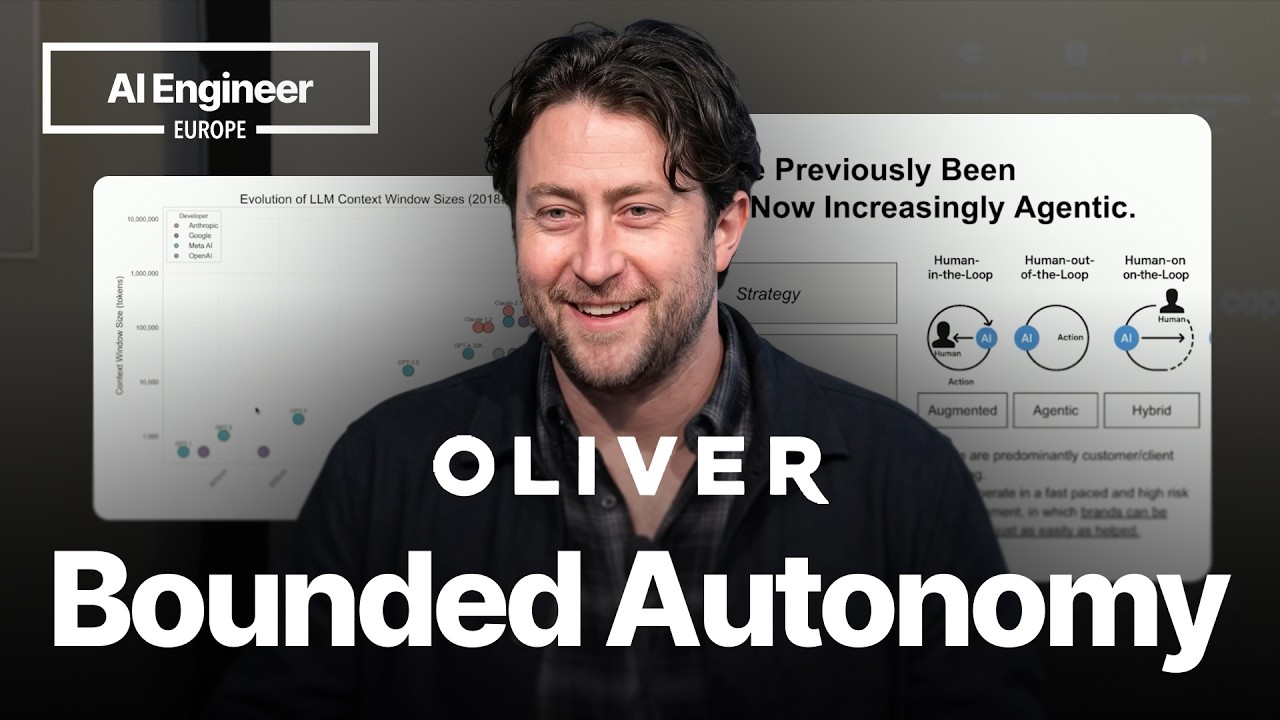
And so the question we ask is, how do you build trust at speed, deliberately, and with evidence? So we spend a lot of time talking to companies about, uh, progressive autonomy. Um, many companies still see agents as basically the same as traditional automation, where you complete some tests, you run them, you deploy them, and they run, and that's that.
But agents aren't just built and then turned on,right? Like, you can't foresee every single response or behavior upfront and test for it. Um, their behavior is emergent. And this is particularly relevant in the context of autonomous processes, which is something we do with quite a lot of our clients.
Um, and so the eval suite, we've heard a lot about it over the last few days. That's super important. Um, and you have to evaluate theright things. But we also talk about how you actually deploy into production and, uh, increase autonomy over time.
So you follow this exposure ladder. So you start with a shadow mode where an agent might run alongside human processes, but it can't actually affect outcomes. Um, you compare the human decisions that are made to what the agent is saying, and you use that as a signal to iterate, um, and build up confidence in the specific behaviors that you're, you're trying to achieve.
Um, you keep iterating. You then move up to more of an advisory mode where the agent runs live, um, but it only recommends. So the humans are still playing an active role in the workflow. They can approve or reject the outcome.
And again, this provides you with another signal that you can incorporate and you iterate again. Then you shift up to controlled autonomy where the agent is able to run and trigger actions, but in a narrow, low-risk, uh, scenarios.
Um, and it has clear limits, kill switches. And over time, you can extend that up to, um, to, to wider autonomy based on achieving theright level of confidence in the target behaviors that you're trying to drive. And the key here is that each step is gated by evidence in outcomes.
It's not based on completion of activities and a project plan or pass-fail testing. It's entirely about the confidence, the trust in those outcomes. So engineer for trust, not just for completion.
Moat16:48
Right. Last one. Um, we mentioned our mode earlier. Now, what is yours? In a recursive world where AI codes AI, anything you ship can be cloned the minute it goes viral. So ask this, what is unique only to you?
I think your existing enterprise knowledge, the CRM, the ERP, the SOPs, they got you to the table. We call it your transaction, uh, your transactional memory. However, every competitor has what version of that. It's a flaw, not a fortress.
The real mode is in the moment when your customer touches your product. Edge cases, corrections, emotional intent, and actual behavior at your specific scale in your specific context. Those signals belong to you. And we call it your living memory.
The day you the day you ship is not the finish line. Far from it. It is when the race actually begins. How quickly you can compound and iterate. How fast you can turn a signal into value. It is a race against yourself to engineering your own competitive edge recursively and constantly.
The pathway requires a fundamental shift in your engineering vision. Every feature you ship should either generate that feedback signal or deliver on what the signal has already taught you. Um, because if it doesn't either, you're building something anyone can copy.
Feedback is not the option. Feedback is the only mode.
So five enterprise tensions: speed, value, delivery, trust, moat. How do you then apply what we've learned here to make sure that your next agentic project is a success? So first, we say start now. Deliver differently. Measure in terms of confidence.
Prescription18:28
Uh, shape the project around hypotheses rather than requirements or specific features. And run delivery in small loops of experimentation, iteration, and evaluation. Second, make finance a transformation partner, not just a gatekeeper. Um, create a portfolio of different AI bets across the organization rather than justifying each project in isolation.
And see value beyond the certainty of cost out.
And third, um, make the governance speed your CTO's top engineering problem. The ultimate technical debt you want to rectify. And the last one, um, that's for CEOs. Your moat is not in what you hold from yesterday. It is what uh, it is in what you are learning and compounding every day.
The technology we are accelerating, those who will thrive won't be the ones that has to be the earliest adopter, but they will be the ones that learn to learn. They'll be the ones that live and building the living memories through the feedback loops.
They will be the ones to cultivate the trust for their people and their customer. And you cannot buy that and you can you cannot copy that. You can only start building that by now and by never treating the journey as finished.
So prescription is simple. Bet like a VC, upgrade for machine speed, and engineer for trust with the feedback loop from day one. Thank you.
Thank you.