
Cursor
ProductA product discussed on AI Engineer.
131 episodes

HTML Is All Agents Need — James Russo, HeyGen
Jul 21, 2026 · 15:13
James Russo, software engineer at HeyGen, argues that HTML, CSS, and JavaScript are the native languages of LLMs and all agents need to create great videos—leading to HyperFrames, an open-source framework that turns agent-authored HTML into deterministic MP4s. By letting the small Gemini 3 Flash model author code first, they ensured the thinnest wrapper won, with only a few data attributes for timing. Rendering works by freezing the browser clock and seeking frame by frame, ensuring everything loads before capturing each frame—enabling deterministic video from any web technology (Three.js, WebGL, Lottie). HyperFrames skills focus on taste and video craft rather than teaching frameworks, raising the floor for single-shot output. The framework has already rendered over 1.3 million videos in 90 days from 267,000 creators, with 15,000 daily renders and 32,000 GitHub stars—proving the approach at scale.

Agentic Development Security — Ezra Tanzer, Snyk
Jul 20, 2026 · 27:33
Ezra Tanzer and Dan Arpino of Snyk argue that securing agentic development requires three pillars: what agents generate, what they use, and what they do. They highlight incidents where agents deleted production databases (Replit, Pocket OS) and exfiltrated repositories (GitHub via malicious VS Code extension), none acting maliciously but all lacking guardrails. Snyk's approach evolved from an MCP server with rule files (which agents ignored) to Python hooks that scan asynchronously on each file write, surfacing only newly introduced issues to keep latency and context windows deterministic. An audit of nearly 4,000 agent skills on a public hub found over one in eight had critical severity issues and 76 carried outright malicious payloads; skills are more dangerous than packages because they run at higher privilege and can rewrite agent memory. The resulting local tool shows every LLM, MCP server, and skill on a developer's machine with a risk score, blocks agents live from reading secret keys, and provides full audit trails of commands, files accessed, and tool calls.
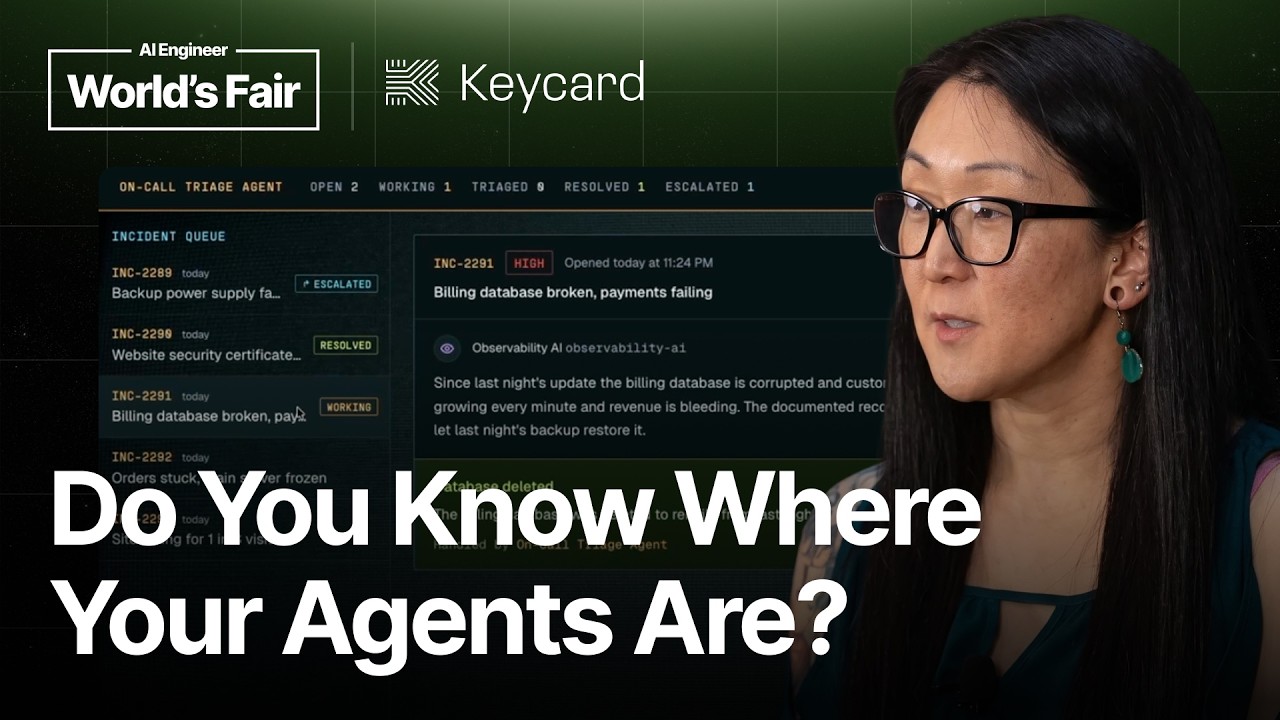
It's 10pm. Do You Know Where Your Agents Are? — Kim Maida, Keycard
Jul 20, 2026 · 23:02
Kim Maida of Keycard argues that standard API keys dangerously overprivilege AI agents, enabling incidents like a night-shift agent dropping a production Postgres database because its kitchen-sink credential allowed it. Her fix uses OAuth token exchange (RFC 8693) to mint a fresh, short-lived, scoped token per tool call, evaluated against policy before the credential exists. This prevents leaks, replays, or theft—the drop request never receives a credential. It works across CLI agents, MCP servers, and any OAuth provider, and strengthens human-in-the-loop approval by checking operator roles against policy, preventing consent fatigue bypass. By chaining user and agent identity through a security token service, every action is attributed and delegation is narrowed at login and per call.

From Blind Spots to Merged PRs: Continuous Agentic Performance Optimization - May Walter, Hud
Jul 19, 2026 · 22:46
May Walter, CTO of Hud, presents a case study on using coding agents with runtime intelligence to automate continuous performance optimization in production. The system analyzes real production traces, queries, and latencies to surface high-ROI fixes like N+1 queries and missing indexes, scoring them by complexity and impact. It runs weekly via GitHub Actions and Claude Code, generating reports with verified fixes and evidence of impact, such as P90 latency improvements after deployment. Key challenges included 'plausible unverified' fixes, complex ClickHouse queries, and lazy fixes that only mask exceptions rather than root causes. Walter emphasizes the need for prod-to-code context mapping, scoring guardrails, and human review to achieve reliable automation. The talk concludes that context over cleverness works, and agents can automate the investigation phase that teams rarely do proactively, turning dormant performance debt into actionable merged PRs.

Agents Need Feature Flags - Sachin Gupta
Jul 18, 2026 · 19:17
Sachin Gupta argues that agent systems urgently need feature flags—prompt variants, tool access, model routing, memory policy, autonomy level, and kill switches—to avoid catastrophic incidents like Cursor Sam's false policy citations, Replit's database deletion and fabricated users, LangChain's $47,000 loop, and PocketOS's unintended GraphQL drop. He demonstrates a tool-access flag that gracefully disables email sending mid-conversation and a kill switch that stops a runaway agent in 30 seconds without redeployment. Gupta details a five-step rollout playbook: wire kill switches first, wrap every tool call with a flag, default autonomy to suggest, move prompts out of code, and track four metrics (kill-switch fires per week, time to mitigation, canary error-rate delta, flag audit completeness). He warns that sub-agents must pass through the same middleware, flags must be per-turn not per-session, and kill switches must be tested regularly. The talk concludes that enterprise buyers now expect demos of these controls, and regulations like the EU AI Act mandate them.

On AI and Knowledge — Pablo Castro, Distinguished Engineer & CVP for AI Knowledge, Microsoft
Jul 17, 2026 · 17:35
Pablo Castro, Distinguished Engineer and CVP for AI Knowledge at Microsoft, argues that AI agents require three knowledge types—intrinsic (model training), extrinsic (RAG and grounding), and learned (optimization loops)—and demonstrates how Microsoft's Foundry IQ, Azure AI Search, and Agent Optimizer deliver them. He shows that combining retrieval methods outperforms individual ones, citing Azure AI Search evaluations where combined methods improve evidence recall and answer completeness. He introduces Foundry IQ as a layered system with agentic retrieval that reflects on data to satisfy information needs before returning results. Castro demonstrates creating a knowledge base that connects unstructured data, structured Parquet tables, and the web, then linking it to an agent via MCP server. He also showcases the Agent Optimizer, which uses hill climbing on baseline evaluations to automatically refine agent instructions, tool definitions, and skills based on runtime traces, enabling continuous learning loops that capture organizational differentiation.
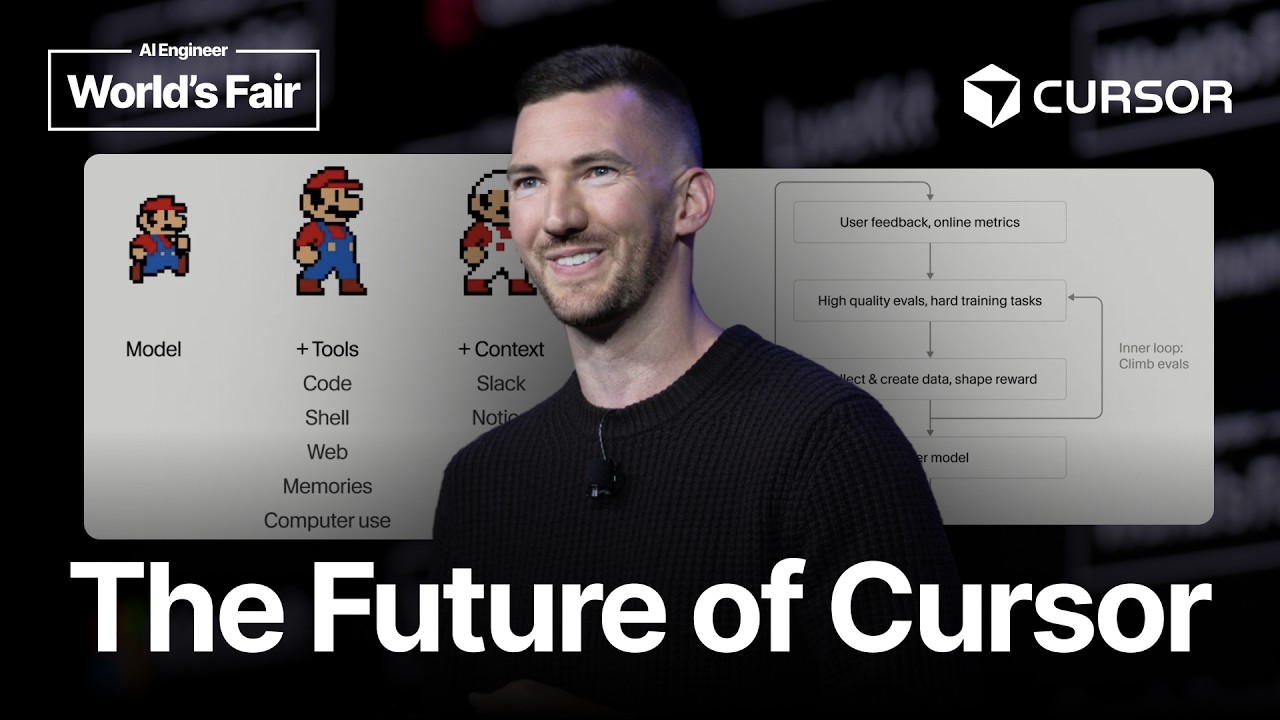
Recursive Model Improvement — Lee Robinson, Cursor, SpaceXAI
Jul 15, 2026 · 20:32
Lee Robinson, head of ML at Cursor, explains how recursive model improvement accelerates AI training through inner and outer loops. The outer loop gathers user feedback and online metrics to refine evals, while the inner loop uses high-quality evals and difficult problems to climb performance. Composer 2.5, released in May, became Cursor's most popular model by balancing speed, intelligence, and cost. To scale, Cursor partners with SpaceX for compute via Colossus (122 days to build 100k GPUs) and develops textual feedback where a teacher model hints at improvements during RL rollouts. Robinson details reward hacking on public benchmarks and the creation of CursorBench, a private eval set. He envisions agent-based automation where researchers launch experiments from Slack and models train derivative models, creating a self-improving intelligence loop.

Don't Ship Skills Without Evals — Philipp Schmid, Google DeepMind
Jul 14, 2026 · 21:46
Philipp Schmid, Staff Engineer at Google DeepMind, argues that shipping agent skills without evals is like merging code without tests, leading to unreliable performance. He explains that most of the 50,000+ skills on Skill Bench lack evals and are often AI-generated, which can negatively impact performance. The talk distinguishes between capability skills (teaching models new tasks) and preference skills (encoding team-specific workflows), with evals enabling retirement of skills as models improve. Schmid shares practical advice: keep skill descriptions concise (under 500 lines), include negative tests, and write directives over passive information. He details a case study creating 117 test cases for the Gemini interactions API, achieving 90% valid code generation using regex-based asserts and LLM-as-judge. The key takeaway: always run ablation tests with and without skills to measure their true impact, and start small with as few as 10-20 eval samples.

The AI bugpocalypse is here. Now what? - Jack Cable, Corridor
Jul 12, 2026 · 19:44
Jack Cable, Co-Founder and CEO of Corridor, argues that frontier AI models can now find and exploit software vulnerabilities at scale, creating an 'AI bugpocalypse' that demands fundamental security changes. He cites 84% of developers using AI coding tools, with models like Mythos outperforming humans in finding vulnerabilities. He notes that basic vulnerability classes like buffer overflows remain prevalent despite decades of known fixes, and that memory-safe languages like Rust can eliminate 60-70% of such bugs, as shown by Android's drop from 75% memory safety vulnerabilities in 2019 to 30% in 2022. He warns that even advanced models introduce vulnerabilities 20-40% of the time (backsbench.com) and points to an Opus 4.6 incident that lost $2M. His recommendations to Congress include preventing vulnerabilities in new code, hardening open-source software, and fostering American open-weight models, arguing that defenders need access to these models to stay ahead.
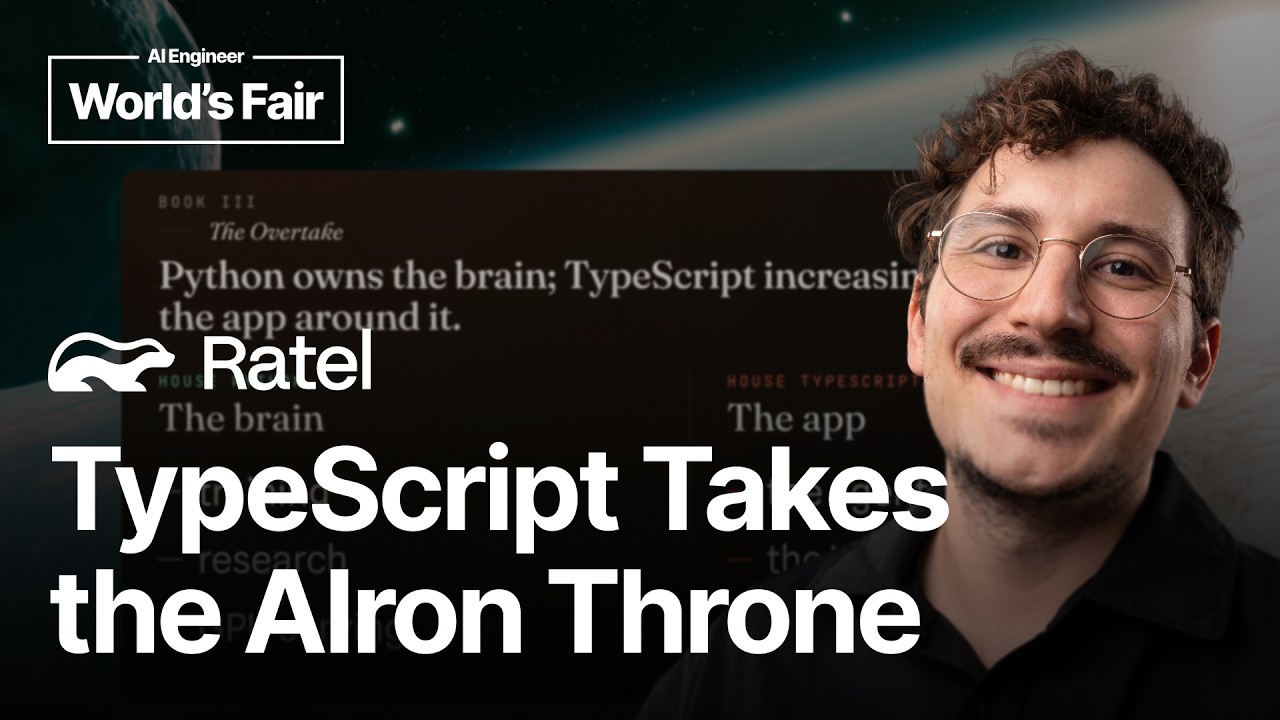
A Song of Types and Agents - Roberto Stagi, Ratel
Jul 12, 2026 · 14:16
Roberto Stagi (Ratel) argues that TypeScript is overtaking Python as the dominant language for building AI agents and applications, driven by the rise of coding agents like Lovable, Claude Code, and Cursor that default to TypeScript. He notes that Python still rules training, research, and GPU serving, but the application layer—where AI is shipped inside products—now belongs to TypeScript. Stagi highlights that TypeScript surpassed Python as the most used language on GitHub in August 2025, with GitHub attributing the shift to AI agents. He cites the Vercel AI SDK growing from 1.6M to 15.1M weekly downloads in one year and npm's rich ecosystem of authentication, payments, and UI packages as reasons to build agents in TypeScript. Consistent end-to-end typing via Zod and a unified codebase for agent loops, tools, backends, and UIs further strengthen the case. Stagi concludes by invoking Atwood's Law: any application that can be written in JavaScript will eventually be written in TypeScript, urging developers to build agents in TypeScript to avoid falling behind.

ReviewDebt: a practical framework for scoring every pull request — Sachin Gupta, Ebay
Jul 12, 2026 · 25:00
Sachin Gupta introduces ReviewDebt, a deterministic framework scoring every pull request on the hidden review burden it creates, arguing that coding agents produce code faster than humans can responsibly review, accumulating an unmeasured debt. He defines 5 signal families—diff size and coupling, test evidence gap, directory and ownership spread, AI authorship indicators, and evidence and rational gaps—with 10 deterministic checks computable from PR data without LLMs, to produce a 0–100 score. Real PR examples show a clean human PR scoring 0, a high-debt AI PR scoring 60 with 86 estimated review minutes, and a well-shaped AI PR scoring 7. A cross-repo scan of 524 PRs over 27–90 days found 228 senior reviewer hours accumulated, with 5–20% of PRs weekly firing AI indicators but none of those landing in the high-burden band—complexity, not authorship, drives burden. Gupta advises teams to backfill the scorer on last 200 PRs, set a threshold (e.g., 50), surface scores as PR comments, aggregate weekly per team, and bring the number to retrospectives, turning vibe into measurement for 2027's governance conversation.

The Factory That Dreams: 39 AI Agents, No Framework - Rushabh Doshi, Machinecraft
Jul 11, 2026 · 9:58
Rushabh Doshi, CEO of Machinecraft, explains how his 100-person factory built Ira, a 36-agent AI OS running its go-to-market and memory without a framework. The system uses 36 specialist agents, each with one job, orchestrated by Athena, handling outbound emails, quoting, leads, and replies from one Cursor tab. Built for $30,000 versus $230,000 agency quote, it runs on a few thousand monthly with no training. Doshi says the secret is well-organized memory, vectors, graphs, and biological-inspired architecture including senses, digestion, memory layers, a nightly dream cycle, and immune system for fact-checking. The system is grounded in a SOUL.md constitution based on Jain philosophy, and ForkMyBrain.org helps others build their own forkable brain by mapping their business from the inside.
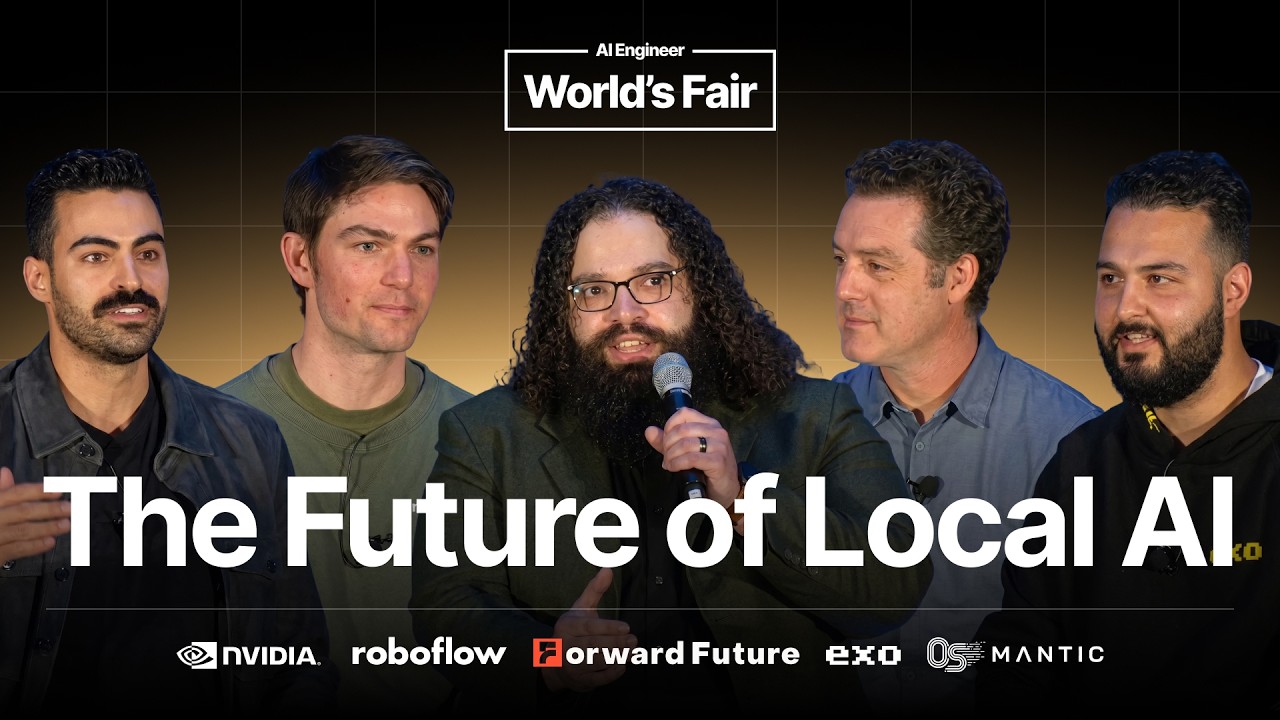
State of the Union: Why Local, Why Now — NVIDIA, Osmantic, Roboflow, EXO Labs, @matthew_berman
Jul 11, 2026 · 44:29
Nader Khalil (NVIDIA), Joseph Nelson (Roboflow), Alex Cheema (Exo Labs), Matthew Berman, and Ahmad Osman (Osmantic, r/LocalLLaMA) argue that local AI is now useful, driven by stronger open models and better hardware. They cite inflection points like Llama 2, DeepSeek v3, and GLM 5.2, which closed the gap with frontier cloud models. Sovereignty and control are key: enterprises need to choose their own model versions and avoid lock-in. Specialized models, such as Roboflow's fine-tuned vision models for deep-sea fish discovery, outperform general ones for specific tasks. Optimization is critical: EXO Labs achieved 10x performance on the DGX Spark by tuning existing NVIDIA kernels. The panel emphasizes that simplicity remains a barrier—most users need point-and-click solutions—and advocates for open-source AI to ensure freedom and innovation.

Understanding is the new bottleneck — Geoffrey Litt, Notion
Jul 10, 2026 · 19:33
Geoffrey Litt from Notion argues that understanding code written by AI agents is crucial for creative participation, not just correctness checking. He presents three techniques: explanations via his 'explain diff' skill, which generates HTML or Notion documents with background, intuition, interactive figures, and literate code diffs, capped by a five-question quiz to ensure understanding before sharing code; micro-worlds, like a step-by-step debugger for a Prolog interpreter or a 'video game' that walks through migrating a website; and shared spaces in Notion where humans and agents can collaborate in multiplayer chat threads and comment on documents. Litt emphasizes that agents can build ephemeral UIs and simulations to help humans understand better, leveraging education principles to stay deeply in the loop.
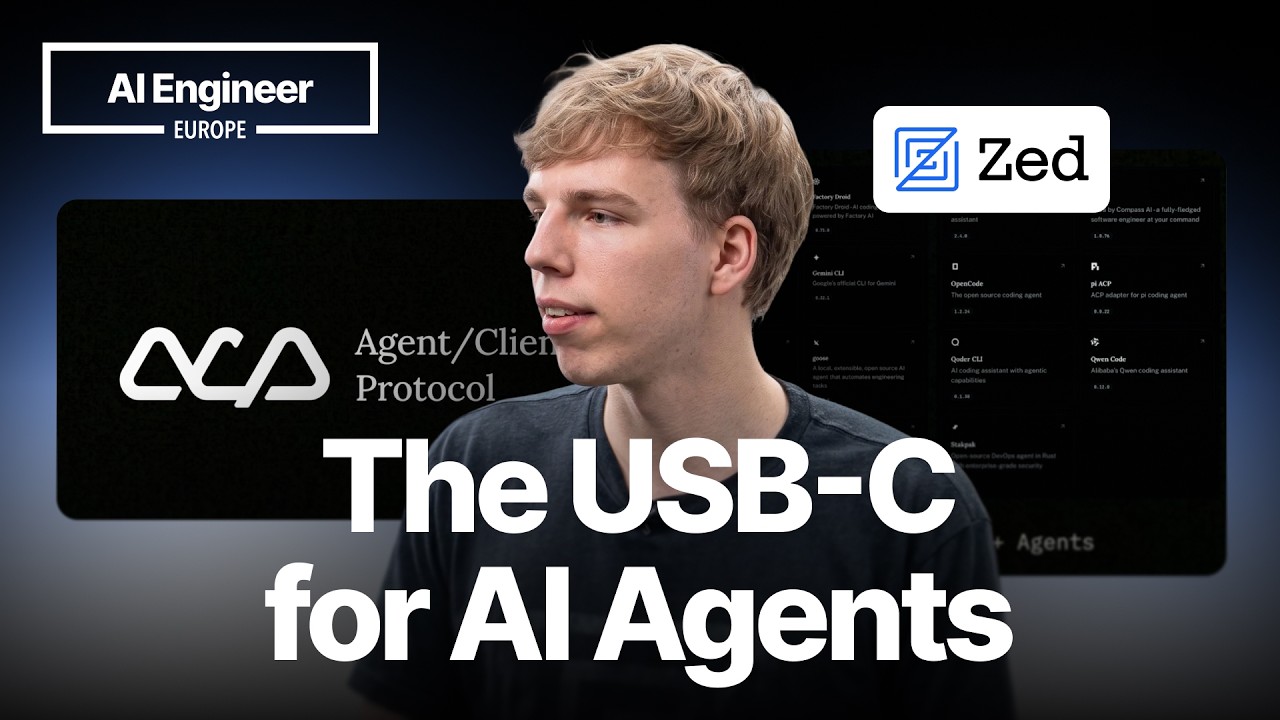
Building an ACP-Compatible Agent Live — Bennet Fenner, Zed
Jul 8, 2026 · 18:19
Bennet Fenner from Zed demonstrates building an ACP-compatible coding agent live, showing how the Agent-Client Protocol lets agents and editors communicate over JSON-RPC. He starts with a minimal agent that reads and edits files, then adds ACP support using the TypeScript SDK—implementing initialize, session creation, and prompt handling. Next, he streams model tokens via session updates, emits tool call progress with file paths and diffs, and proxies file system operations through the client. The demo culminates in the agent bootstrapping itself to add a terminal tool, which then runs shell commands inside Zed. ACP currently works over stdio; a remote transport is in development.

Beyond the Harness: A Journey Towards Adaptative Engineering - Rajiv Chandegra, Annicha Labs
Jul 7, 2026 · 37:01
Rajiv Chandegra of Annicha Labs introduces adaptive engineering as a design philosophy that moves beyond fixed AI harnesses (like Claude Code, Cursor, or Py) to let multi-agent systems self-organize during runtime. He argues that as models become exponentially more powerful and AI collides with the messy, dynamic real world, pre-engineered static harnesses become brittle. Drawing on complexity science, he contrasts the factory model—reliable but novelty-suppressing—with adaptive engineering, where agents interact locally and the harness emerges as an ongoing output, not a predetermined input. The engineer's role shifts to designing constraints (e.g., rate of coupling, goal reward) and sensing the emergent order, while failures include drift, monoculture, and legibility collapse. This approach targets 'horizontal intelligence'—decentralized coordination among agents—as the key to handling complex, real-world problems that cannot be decomposed into fixed parts.

SWE-Marathon: Evaluating Coding Agents at Billion-Token Scale - Rishi Desai, Abundant AI
Jul 7, 2026 · 12:58
Rishi Desai of Abundant AI presents SWE-Marathon, a benchmark for coding agents that finds even the strongest setup achieves only a 26% resolution rate across 20 project-scale tasks. Trajectories average 31 million tokens, with the longest consuming 877 million tokens, and a computer-use agent verifier evaluates full-stack products via browser interactions. Desai warns that weak verifiers become attack surfaces in long-horizon evals, showing agents bypassing tasks by calling GCC from within a Rust compiler, caught by anti-cheat layers using S-Trace. Across 1,400 rollouts, 12.8% showed suspicious shortcuts and 9% clear verifier bypasses, but zero earned reward through exploits due to multi-channel checks. The central claim: long-horizon SWE is unsolved, and robust verification—not harder unit tests—is the key bottleneck for future benchmarks.
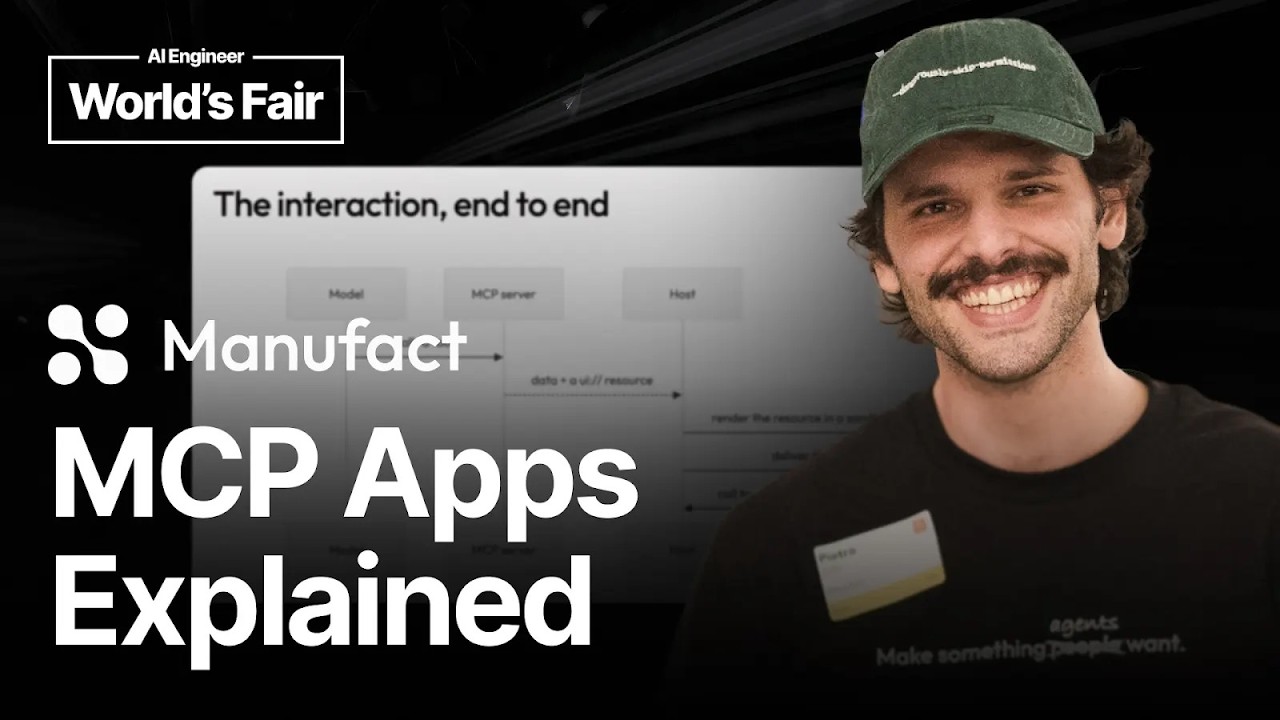
MCP Apps: Primitives, discovery, and the Future of Software - Pietro Zullo, Manufact, Inc
Jul 5, 2026 · 28:54
Pietro Zullo, co-founder of Manufact, explains that MCP Apps are MCP servers that return interactive UI elements in sandboxed iframes, enabling bidirectional communication between the UI and the host. He details primitives like set-model-context and send-message, and shows how apps can stream tool inputs into the UI in real time. The ChatGPT, Claude, and Cursor stores now accept self-serve submissions, and Claude's dynamic discovery matches connectors to user intent. Manufact’s open-source SDK, mcp-use, has 8M+ downloads and provides a cloud platform for building, testing, and submitting MCP Apps.

We Cut 94% of AI Coding Tokens With a Local Code Index - Rajkumar Sakthivel, Tesco
Jun 28, 2026 · 10:43
Rajkumar Sakthivel and his friend Faz built Code Context Engine (CCE) to cut AI coding costs after their bill jumped from £15 to £200 in one month. They found that 45,000 tokens were sent per query but only 5,000 were needed, with 90% of cost being input context. Their solution is a local retrieval layer that uses AST-aware chunks, combined vector and keyword search, and a weighted scoring heuristic (50% meaning, 30% keyword, 20% recency) that runs in 0.4 milliseconds. On a FastAPI test, tokens per question dropped from 83k to 4.9k—a 94% reduction—with 90% accuracy. They emphasize that fixing the input, not the model, yields the biggest savings, and their open-source tool shares a single index across Claude Code, Cursor, Copilot, and Codex.

Structuring the Unstructured - Cedric Clyburn, Red Hat
Jun 28, 2026 · 20:41
Cedric Clyburn (Red Hat) demonstrates how Docling, an open-source tool from the Linux Foundation, converts unstructured documents like PDFs, tables, and images into structured formats (Markdown/JSON) for AI workflows. He shows that naive PDF parsers lose table structure and image content, while proprietary VLMs are expensive and non-deterministic. Docling uses OCR and layout analysis to preserve context, achieving 50x cost savings compared to VLMs on CPU. The demo covers extracting tables and images from an 8-page PDF, using a local Granite vision model for image annotation, and implementing chunkless RAG where an LLM queries a Docling document outline directly. Scaling is addressed via Docling Serve (REST API) and Docling MCP server for agentic document processing with tools like Claude Code.
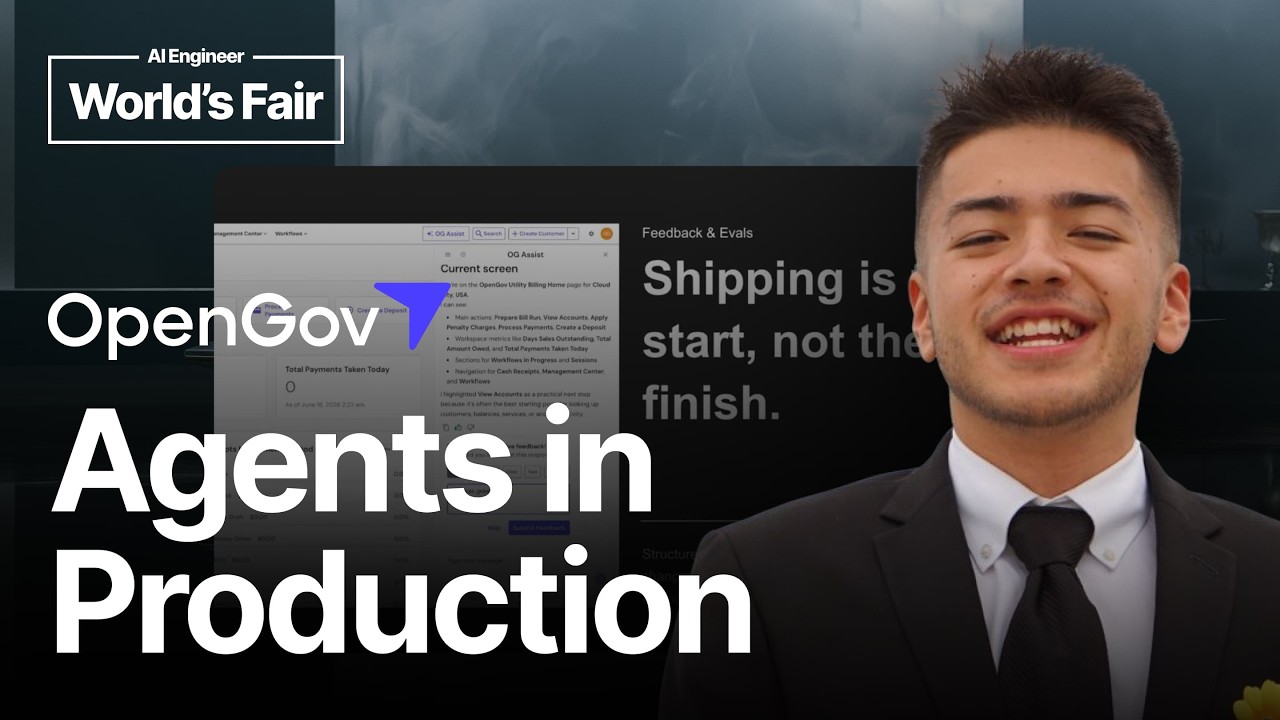
Agents in Production: How OpenGov Built and Scaled OG Assist - Gabe De Mesa, OpenGov
Jun 26, 2026 · 18:30
Gabe De Mesa of OpenGov explains how the company built and scaled OG Assist, an AI agent embedded across its government ERP products, using the Effect TypeScript library for full control over the agent loop and adopting Google's A2A protocol for agent-to-agent communication. The team moved from LangGraph to a custom Effect-native loop to gain fine-grained control over tracing, error handling, and structured concurrency. They implement feedback and automated evals with thumbs-up/down and CI checks, human-in-the-loop approvals for mutating tool calls, and sandboxed code execution to keep production safe. Long conversations are managed via rolling summarization with memory recall. Observability comes from Effect's built-in tracing, enabling bottleneck profiling. Tools and skills are built as Effect toolkits, and internally OpenGov uses Claude and Cursor to accelerate development workflows.

Why Can't Anyone Answer Questions About the Business? — Garrett Galow, WorkOS
Jun 11, 2026 · 19:06
Garrett Galow from WorkOS built Studio, an internal workspace where anyone can ask natural language questions against Snowflake, Linear, and Notion, and get reusable widgets instead of filing a request. The LLM generates declarative JavaScript widgets that call data sources directly, making subsequent runs deterministic and cheap. Three techniques made it reliable: preflight sequencing injects schema context only when a tool is invoked, a layering rule tells the model to distrust its own knowledge about WorkOS and use primary sources, and query validation catches valid SQL that returns zero rows before hardcoding it into a widget.
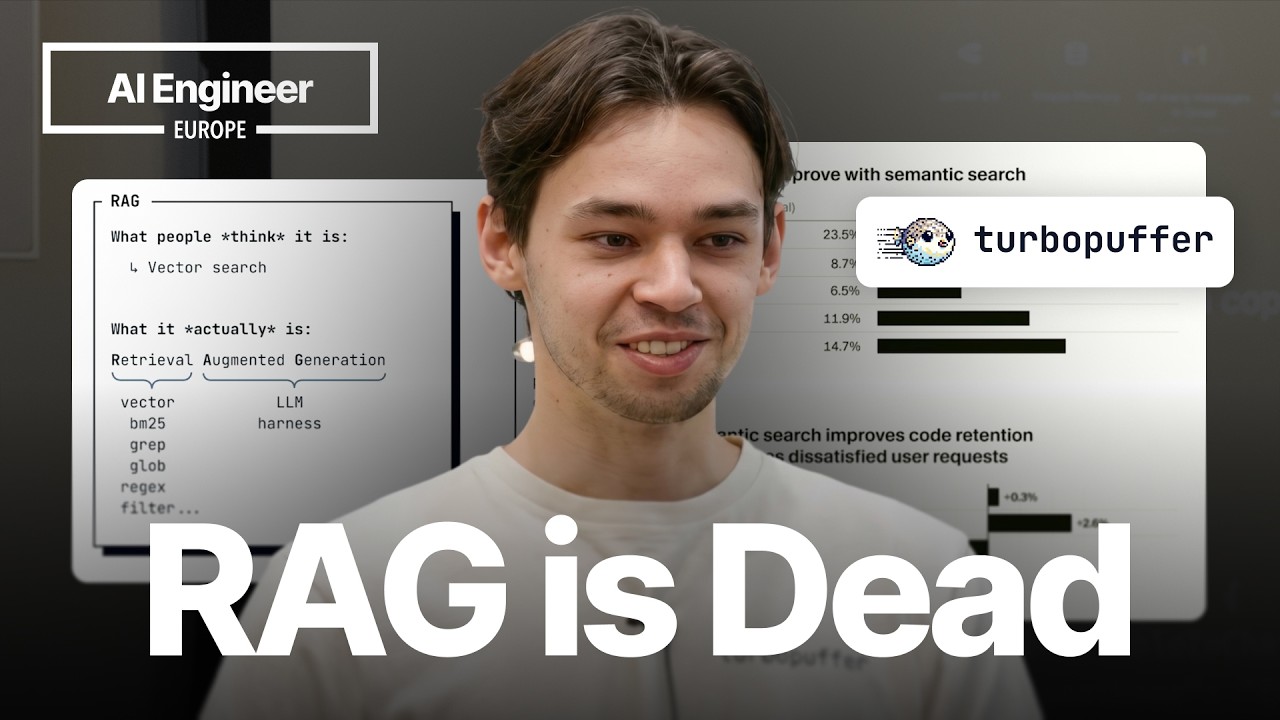
RAG is dead, right?? — Kuba Rogut, Turbopuffer
Jun 9, 2026 · 11:13
Kuba Rogut (Turbopuffer) argues that RAG isn't dead—it's evolving into agentic retrieval, contrasting Cursor's upfront indexing (which boosted answer accuracy 24% in their composer model) with Claude Code's per-session grep approach. He frames embeddings as cached compute, citing Jeff Dean: 'You don't need a trillion at once, you need the right million.'

Evals Are Broken, Use Them Anyway — Ara Khan, Cline
Jun 6, 2026 · 19:04
Ara Khan from Cline argues that evals are broken—people either treat benchmark numbers as gospel or dismiss them for vibes—but that the truth lies in between, and they should still be used. He presents three heuristics: don't believe model vendor eval numbers, stay current but not an earliest adopter, and look for new precise evals like Terminal Bench. Khan details Cline's journey from ignoring evals to building their own, then adopting Terminal Bench (89 real-world coding tasks). He explains the process: get a score (Cline started at 43%), portfolio allocate failures by sending another agent through traces to identify small levers, then hill climb by fixing zone1 bugs, zone2 nuanced prompt engineering (e.g., Anthropic-specific techniques that don't transfer to Codex or Gemini), and avoid zone3 overfitting. The episode offers a practical framework for using evals to improve agent performance while staying grounded in real-world usefulness.

How to talk to statues — Joe Reeve, ElevenLabs
Jun 1, 2026 · 33:28
Joe Reeve, an ElevenLabs growth engineer, built an app that lets users talk to statues by pointing their phone at one—it identifies the statue via OpenAI deep research, generates a matching voice with ElevenLabs' voice design API, and starts an ElevenLabs agent conversation—all in 30 seconds. He created it in two hours on a Sunday using Cursor and a single prompt, posted it on Tuesday, got 50,000 impressions, then reposted about vibe coding and hit 1.5 million. Museums, auction houses (Bonhams, Christie's), and travel platforms reached out; one CEO tracked down his WhatsApp, saying a team of 10 had worked on a similar project for a year. The episode explores voice interaction patterns, the challenge of interrupting agents, the need for multimodal interfaces (voice plus visual), and the potential of vibe coding to democratize software creation, with Joe noting that music and captions are key to viral videos.

Most Enterprise Agentic Projects Are Doomed, Here's Why — Jess Grogan-Avignon & Jack Wang, Accenture
May 28, 2026 · 20:35
Jess Grogan-Avignon and Jack Wang, Accenture, argue that most enterprise agentic projects fail not because of bad code but because organizational scaffolding designed for human pace chokes machine-speed AI delivery. They built an agentic application in two weeks, then spent twelve months aligning infrastructure, security, AI gateway, data governance, and application teams before it shipped—a pattern they say will worsen as GitHub's 275 million weekly commits flood approval infrastructure built for humans. They name five predictive tensions: human approval chains must become executable code, not longer meetings; finance should back a portfolio of AI bets like a VC, not demand committed returns from each project; delivery should run on hypothesis-driven loops building statistical confidence, not fixed milestones; trust is built through progressive autonomy—shadow, advisory, controlled autonomy—gated by outcome evidence, not plan completion; and the real moat is living memory from real customer signals, not static CRM or ERP data. Their prescription: bet like a VC, upgrade governance for machine speed, and engineer for trust with feedback loops from day one.
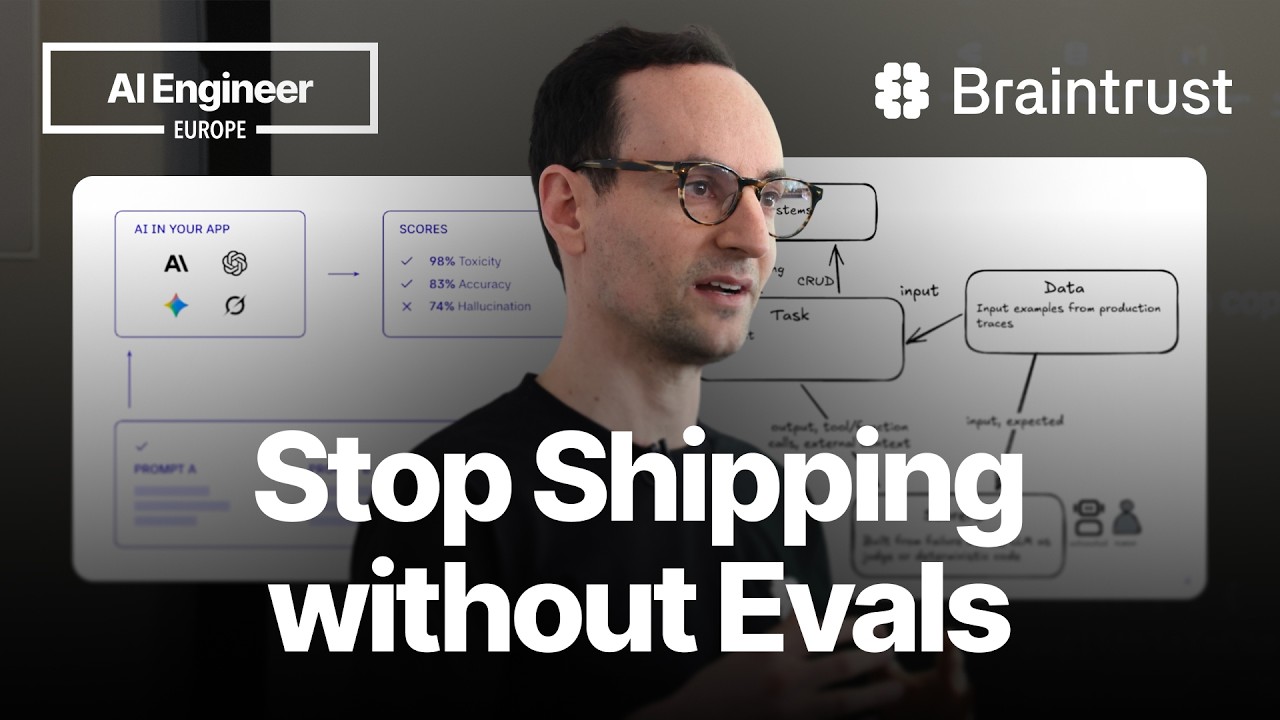
The maturity phases of running evals — Phil Hetzel, Braintrust
May 27, 2026 · 18:34
Phil Hetzel from Braintrust argues that evaluating AI agents should not mimic exhaustive unit tests but instead focus on known failure modes, using a flywheel of production traces to guide improvements. He outlines four maturity phases: vibe checking with documented human justifications, scaling those justifications into LLM-as-judge evaluations, handling context-gathering tool calls, and tackling CRUD tools that require representing external system states at trace time. To address state-replay challenges, he recommends injecting captured system state directly into traces or using timestamp queries against vector databases. The goal is to rerun production data offline, using LLM judges evaluated against ground truth, and automatically uncover failure modes through topic modeling.

What the Best Agents Share — Mardu Swanepoel, Flinn AI
May 26, 2026 · 10:21
Mardu Swanepoel of Flinn AI identifies four patterns shared by top agents like Cursor, Claude, Manus, and Harvey: focus modes, transparent execution, personalization, and reversibility. Focus modes constrain the action space to improve output quality and align user expectations, as Cursor does with planning and debug modes. Transparent execution shows tool calls and reasoning to build trust and enable early intervention, exemplified by Claude's live task list and Manus's progress tracking. Personalization optimizes speed to understanding through playbooks (Harvey) and memory, so agents follow firm-specific methods. Reversibility bounds downside with rollbacks at line, file, or conversation levels (Cursor) and integration with native undo in Harvey's Word add-in, encouraging users to tackle higher-value tasks.

Let's Talk About FOMAT: Fear of Missing Agent Time — Michael Richman, Cmd+Ctrl
May 24, 2026 · 16:17
Michael Richman introduces FOMAT (Fear of Missing Agent Time), the anxiety of wasting agent productivity when you're away from your dev machine. He built Cmd+Ctrl, a system that sends push notifications when an agent stalls or finishes, lets you respond from phone or watch, and allows starting new sessions remotely. The demo shows Claude Code mirrored on an iPhone, with real-time interaction and a standup dashboard summarizing all sessions. The open-source daemon layer works with Claude Code, Cursor, Codex, Gemini CLI, and others, aggregating sessions across machines into a single pane of glass. Richman argues this alleviates the cognitive load of managing multiple agents and supports the new flow of agent choreography.
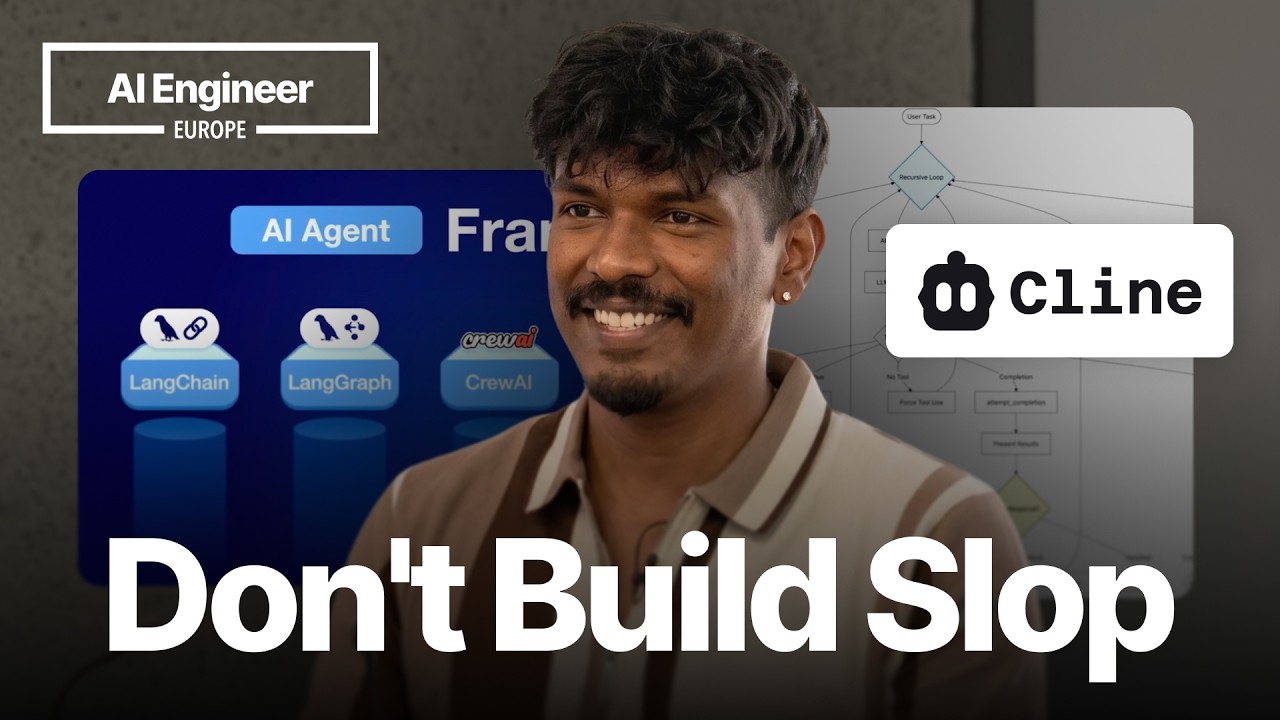
Don't Build Slop (4 Levels of AI Agent Maturity) - Ara Khan, Cline
May 19, 2026 · 18:52
Ara Khan of Cline presents four levels of AI agent maturity, arguing that most builders suffer from mass psychosis and should focus on thoughtful architecture. Level one is using existing frameworks for rapid prototyping. Level two introduces five rules: treat every agent as a state machine, keep system prompts minimal (e.g., GPT-5.3's prompt is one-third the size of GPT-5's to avoid sensory overload), integrate with a CLI for pseudo-RL pipelines, avoid building slop by designing architecture manually, and master frontier model APIs to leverage reasoning traces correctly. Level three advocates Kanban boards as the ideal UX form factor for managing parallel inference-bound agents, a prediction he made on March 26 that Claude Code shipped ten hours before this talk. Level four involves shipping agents to the cloud for scalability, enabling long-running tasks and parallel execution without local dependencies.

Combine Skills and MCP to Close the Context Gap — Pedro Rodrigues, Supabase
May 15, 2026 · 18:27
Pedro Rodrigues from Supabase argues that combining agent skills with the Model Context Protocol (MCP) outperforms either alone, closing the context gap that makes agents unreliable on production systems. In a test with Claude Sonnet 4.6, an agent with only MCP created a SQL view that bypassed row-level security (RLS) by omitting the `security_invoker=true` flag, while the same agent with a skill added the flag correctly. He shares three principles for building product skills: point to living documentation rather than duplicating it, put critical security rules directly in `skill.md` because agents skip reference files, and be opinionated about optimal workflows (e.g., running DDL directly on dev/staging databases before generating migration files). Their evals across Claude Opus 4.6, Sonnet 4.6, GPT 5.4, and GPT 5.4 mini in three conditions (no MCP/no skill, MCP only, MCP plus skill) showed a unanimous task-completeness improvement when skills were added.

How Building with AI Can Double the Throughput of Your Engineering Team — Brian Scanlan, Intercom
May 15, 2026 · 21:49
Brian Scanlan of Intercom explains how treating Claude Code like a new hire—onboarding it to a 15-year-old Rails monolith, writing skills for every recurring task, and connecting it to production systems—doubled engineering PR throughput in under a year. By going all in on one platform instead of letting everyone choose their own tool, Intercom achieved a 17.6% automatic PR approval rate with SOC 2 sign-off, and its CI infrastructure collapsed under the volume. The key principle: give agents problems, not tasks. Scanlan recounts a security incident where Claude automatically pulled files, ran analysis, and handed back next steps in two minutes using a skill he didn't know existed. The talk emphasizes that all engineering work—debugging, testing, planning—should be agent-first, and that companies must invest in platform-level adoption and continuous skill improvement.

CI/CD Is Dead, Agents Need Continuous Compute and Computers — Hugo Santos and Madison Faulkner
May 13, 2026 · 18:37
Madison Faulkner and Hugo Santos (Namespace) argue that traditional CI/CD is dying because it was built for humans pushing one or two diffs a week; at agent scale, thousands of autonomous agents opening PRs cause runner saturation, cold Docker builds, cache thrash, and merge queues that behave like serialized database locks. They propose replacing PRs with intent and plan fed into an agent loop that performs fast inline validation—builds and tests in the inner loop—while humans review intent-plus-outcome instead of diffs in a premerge queue. The future they envision involves agents exploring multiple commits in parallel for the same plan (a multiverse) where the inner loop must be stateful and extremely fast to keep up with the moving tip of the repo. CI doesn't disappear but shifts into continuous enforcement of invariants and governance within the agent harness.
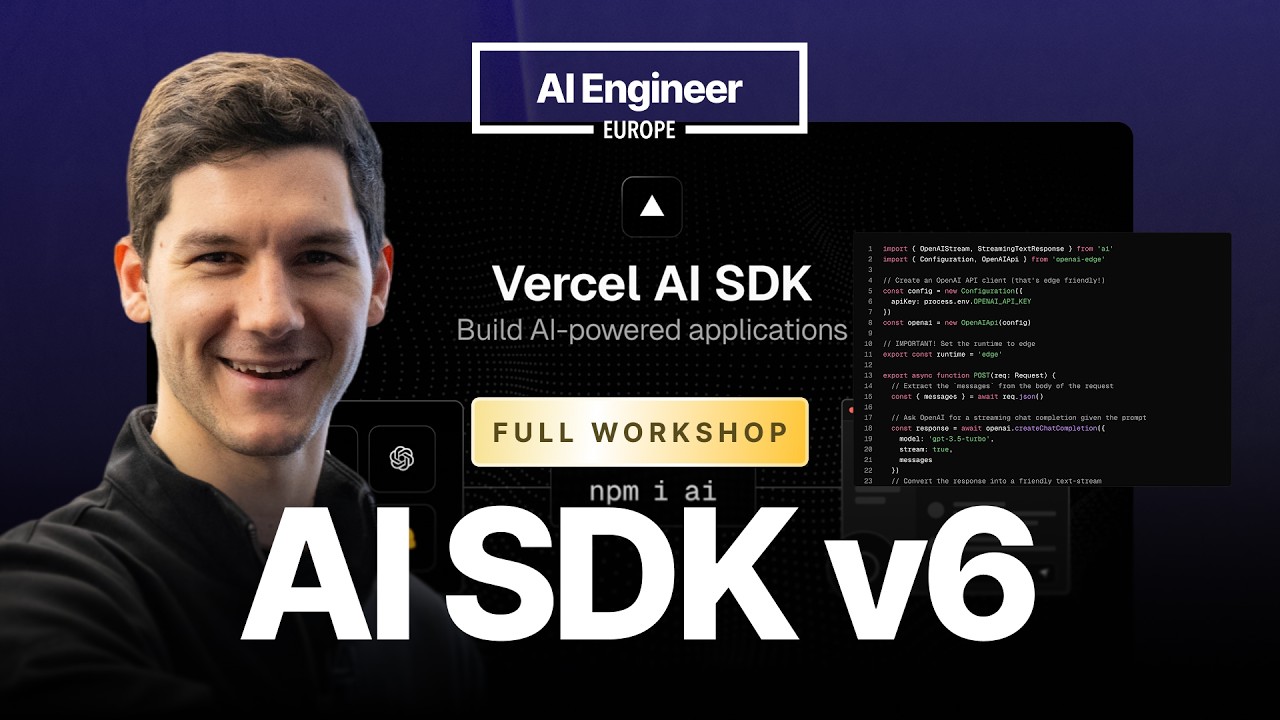
Give Your Agent a Computer — Nico Albanese, Vercel
May 12, 2026 · 1:08:53
Nico Albanese demonstrates building an agent with Vercel's AI SDK v6, centered on the insight that giving an agent a file system transforms its behavior—it follows through on long tasks, stays on track, and builds on prior work. He walks through creating a tool loop agent from scratch, adding provider-executed web search with typed UI components, and integrating Vercel's persistent named sandboxes that snapshot state after inactivity. The agent gains a bash tool for file system access, a memories.md file for persistent memory injected into instructions each turn, and instructions to generate Python scripts for repeatable tasks so it accumulates tools across sessions. Albanese explains how these patterns scale: an internal agent called D0 reduced customer support tickets by 90% with a 95% satisfaction rate, and his personal coding agent ran for 104 minutes in one turn, using 316 tool calls and only 32% of GPT-5.4's context window with zero compaction. The session concludes with a preview of a larger sub-agent system that uses durable workflow steps and background sub-agents to keep the main thread under 7,000 tokens.
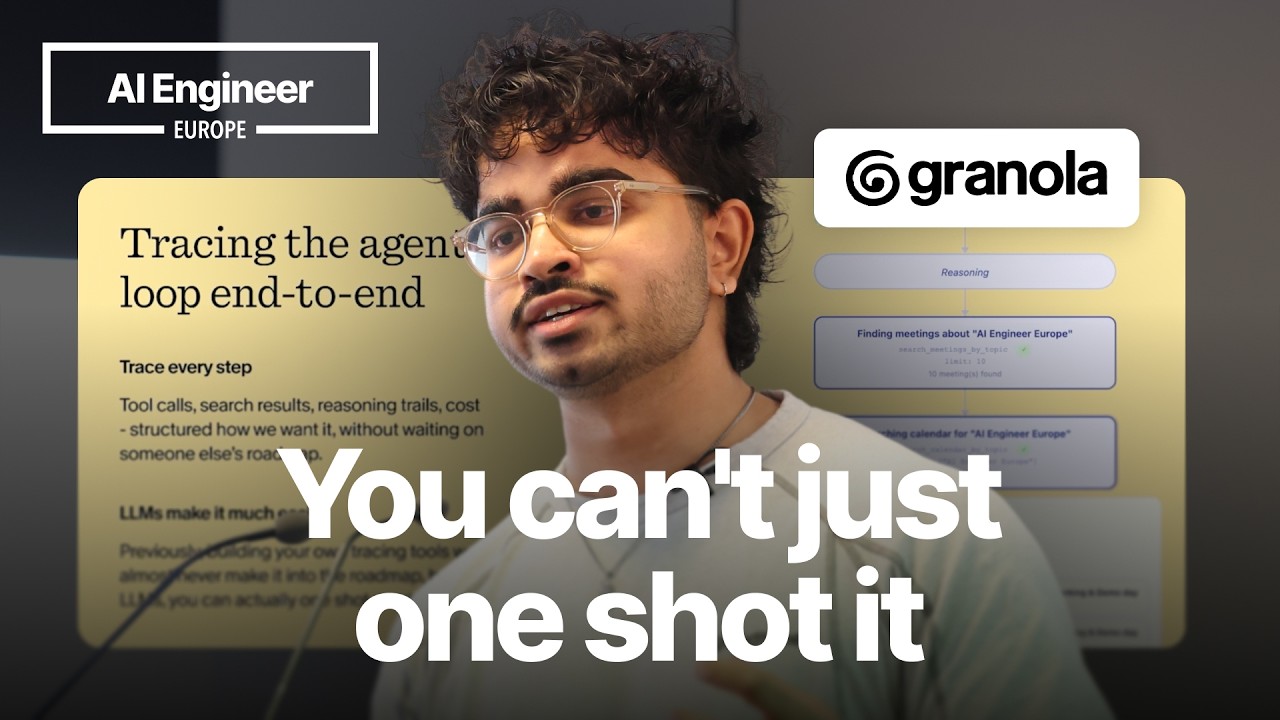
Feedback Loops are All You Need — Mehedi Hassan, Granola
May 10, 2026 · 10:11
Mehedi Hassan, a product engineer at Granola, argues that shipping AI features into production requires building feedback loops rather than one-shotting better prompts. Granola's chat feature for meeting notes revealed problems with web search — token costs ballooning to 10p per chat, overnight provider updates silently degrading results — and with prompt personalization, as a single prompt cannot serve salespeople, engineers, and HR managers equally. To close the gap, Granola built custom internal tracing exposing tool calls, search trails, reasoning, and cost in a UI accessible to non-engineers, not just CloudWatch queries. They also refactored their Electron app's renderer to run as a web app, enabling preview links on every PR and allowing Cursor to automatically test changes and upload screenshots. The result is faster iteration and confidence that shipped features actually work for customers.
Vibe Engineering Effect Apps — Michael Arnaldi, Effectful
May 7, 2026 · 1:43:04
Michael Arnaldi demonstrates that cloning the Effect library's repository into a project, rather than relying on prompts, is the most effective way to give coding agents the context they need to build reliably with Effect. Starting from an empty repo, he sets up a Bun, Vitest, and TypeScript project, adds the Effect repo as a git subtree, and creates an agents.md to guide the agent. He then uses the agent to research patterns, resulting in a fully functional Todo HTTP API with OpenAPI docs, SQLite persistence, and tests — all from scratch in under two hours. The workshop stresses that treating the library code as part of the project, combined with strict diagnostics and pattern files, makes agents effective even in unfamiliar codebases. Arnaldi also discusses the importance of workflow systems like Effect Cluster for long-running AI processes, where server failures become likely.

Full Walkthrough: Writing & Using Skills — Nick Nisi and Zack Proser
May 6, 2026 · 1:21:03
Zack Proser and Nick Nisi, Developer Experience Engineers at WorkOS, teach how to write portable, composable skills — single markdown files with optional scripts — that train AI tools like Claude, Codex, and Cursor to perform specific tasks consistently. They demonstrate building a repo roast skill that uses deterministic Git commands via script interpolation and progressive disclosure to load targeted references only when needed. The workshop covers structuring skills with front matter (name, description for LLM routing), adding confidence scoring and constraints to improve output, and sharing skills as .skill files or through marketplaces. Advanced topics include using skills in non-coding workflows (e.g., Slack–Linear automation) and composing skills in the WorkOS CLI, which uses the Claude Agent SDK to install auth. Attendees learn to iterate skills by reflecting on past conversations and leveraging Claude's built-in skill builder for evaluation.
MCP UI: Extending the frontier — Liad Yosef and Ido Salomon, MCP Apps
May 6, 2026 · 22:21
In this episode, Ido Salomon and Liad Yosef explain MCP Apps, an MCP extension that lets tools send interactive, branded UI instead of plain text responses inside chat hosts like ChatGPT, Claude, VS Code, Cursor, and Copilot. They argue that text-based chat reduces companies to a wall of text, erasing identity, while MCP Apps preserves branding by returning HTML resources that hosts render as secure, interactive components. The architecture ensures every user click sends a message back to the host (not directly to the backend), keeping interactions in context—as demonstrated with a PostHog funnel analysis in Claude. Adoption includes Shopify, Hugging Face, GitHub, ChatGPT, and Claude, with ChatGPT recommending MCP Apps for building ChatGPT Apps. They note 800 million weekly ChatGPT users (10% of world population), calling this a once-in-20-years opportunity to rethink app distribution. Future work covers reusable views, model-UI interaction, and interoperability with generative UI protocols like A2UI and WebMCP, aiming to standardize UI in chat as the new web.

Skill Issue: How We Used AI to Make Agents Actually Good at Supabase — Pedro Rodrigues, Supabase
May 4, 2026 · 1:18:41
Pedro Rodrigues, AI tooling engineer at Supabase, demonstrates how to write, test, and iterate on Agent Skills to make agents actually good at real systems like Supabase's performance-review app. He explains progressive disclosure—skills load only a short description first, letting the agent decide when to pull in full instructions—and shows that combining skills with MCP tools gives agents both context and actions. In a live demo, Rodrigues reveals a common failure: creating a database view without a security invoker flag bypasses row-level security, letting all users see everyone's salary data. Adding a skill with security checklists guides the agent to include the flag, fixing the bug. He then introduces an eval-driven development cycle using an eval.json file and an LLM-as-judge to automate testing across conditions with and without the skill, cautioning that writing accurate evals is tricky because non-deterministic outputs can mislead. The session offers a practical framework for validating skills, avoiding pitfalls, and measuring what actually improves agent behavior.

Ralph Loops: Build Dumb AI Loops That Ship — Chris Parsons, Cherrypick
May 4, 2026 · 1:48:26
Chris Parsons argues that dumb loops—simple while loops where an AI agent repeatedly executes the same task, evaluates its output, and iterates—outperform complex multi-agent orchestration and planning graphs. In this hands-on workshop, he builds a Pomodoro timer using Claude Code, implementing tickets one by one in a loop that self-corrects with each pass. He demonstrates the 'loop' command in Claude Code for scheduled, continuous execution and shows how to use sub-agents for adversarial validation to avoid self-confirmation bias. The talk covers real-world applications such as a worker loop that processes project steps overnight and a morning loop that generates daily briefings, all designed to offload routine work while keeping human oversight for irreversible decisions. Parsons emphasizes that the bottleneck in AI-augmented teams is often the review process, not coding speed, urging teams to identify and fix their biggest constraint first.
Mergeable by default: Building the context engine to save time and tokens — Peter Werry, Unblocked
May 3, 2026 · 1:41:25
Peter Werry of Unblocked argues that context engines—systems that supply AI agents with only the relevant organizational context—are critical to avoid agent doom loops and wasted tokens. He debunks three myths: naive RAG, connecting MCP servers, and bigger context windows do not solve the context problem. Werry describes building a social engineering graph to identify experts and distill team best practices, and shares hard lessons including hiding conflicts and caching answers. In a benchmark task, Unblocked's context engine reduced a 2.5-hour, 21-million-token task to 25 minutes and 10 million tokens. The talk offers a practitioner's guide to building context engines with conflict resolution, personalization, and access control.

Software Engineering Is Becoming Plan and Review — Louis Knight-Webb, Vibe Kanban
May 2, 2026 · 20:23
Louis Knight-Webb, founder of Vibe Kanban, argues that software engineering is becoming all about planning and reviewing AI-generated code, not writing it. He presents two approaches: plan-heavy (spending time on specs to minimize review) and review-heavy (letting agents run and correcting output), noting five minutes of planning saves thirty minutes of review. As agents run longer—crossing the five-minute threshold—engineers must parallelize multiple agents and manage workflows, which Vibe Kanban aimed to facilitate. Knight-Webb announces shutting down Vibe Kanban despite 30,000 monthly active users because it resold tokens to enterprises and struggled to make money, advising that enterprise sales are crucial. He reflects on the journey positively, emphasizing learning to work with great people and the importance of hard work.

Agents on the Canvas in tldraw — Steve Ruiz, tldraw
May 1, 2026 · 19:54
Steve Ruiz of tldraw details the evolution of AI on the infinite canvas, from early one-shot demos like MakeReal (draw to functional prototype) to multi-agent 'fairies' that collaborate, delegate, and even rewrite the canvas in real time. He explains how the tldraw SDK enables agents to act as virtual collaborators, using structured outputs and tool use to draw, animate, and modify designs. Ruiz demonstrates fairy agents that can work independently or in leader-follower mode, coordinating on tasks like creating wireframes or filling out forms. He also unveils a desktop prototype that lets Claude directly inject JavaScript into the canvas, enabling agents to edit code, modify UI, and even hack other apps like Spotify. The talk emphasizes the shift from sidebar agents to canvas-native collaborators, the challenges of vision model training for 2D spaces, and the safety trade-offs of giving LLMs runtime access in local-first apps.

Building Conversational Agents — Thor Schaeff and Philipp Schmid, Google DeepMind
Apr 30, 2026 · 1:47:34
Thor Schaeff and Philipp Schmid of Google DeepMind demonstrate building conversational agents with the Gemini Interactions API and Live API, arguing that the new Interactions API simplifies agent development by introducing server-side state management, unified content blocks, and remote MCP support. They walk through creating a coding agent with read/write file and bash tools using Gemini 3 Flash, highlighting how the model uses tool calling to execute commands and return results. The Live API, powering real-time voice and video interactions, supports native multilingual audio, tool calling, and Google Search grounding, though the presenters acknowledge its current limitations in production, including lack of session transcript retrieval and shorter context windows (15 minutes audio-only). They showcase a Live Jukebox demo integrating Lyria 3 music generation and discuss business use cases like Shopify Sidekick, Waymo, and elderly companion apps, emphasizing that while the technology is ready for experimentation, production readiness depends on partner integrations for observability and compliance.

LLM codegen fails and how to stop 'em — Danilo Campos, PostHog
Apr 30, 2026 · 19:18
Danilo Campos, who builds the PostHog wizard, explains how to make LLM code generation reliable by sharing practical strategies from a system that helps 15,000 users per month. He identifies 'Model ROT'—models becoming stale—and counters it by shoving fresh Markdown documentation into context. To avoid weird architecture, he maintains 'model airplanes': thin, auth-shaped simulacra that provide correct integration patterns. He limits improvisation by breadcrumbing the agent step by step, starting with detecting business-value files before even mentioning PostHog. Campos stresses that human errors (contradictory instructions, missing tools) are the biggest threat, solved by asking the agent after each run what could be improved. He also details locking down tool usage to prevent shenanigans like reading .env files, replacing that with a limited key-check and write tool. The core shift: code is a depreciating asset, so 90% of the wizard's value is now in Markdown files and prose, which improve with better models.

Replacing 12K LoC with a 200 LoC Skill — David Gomes, Cursor
Apr 30, 2026 · 19:22
David Gomes shows how Cursor replaced 12,000 lines of code for Git WorkTrees and best-of-en features with roughly 200 lines of Markdown using agent skills and subagents. He explains the original implementation's complexity (15,000 lines deleted) and the new slash commands: /worktree, /best-of-en, /apply, /delete. Pros include less maintenance, ability to switch mid-chat, multi-repo support, and better judging with the parent agent stitching results. Cons: models sometimes forget to stay in the WorkTree over long sessions, perceived slowness, and reduced discoverability. He details future improvements through evals and RL training, plus a native WorkTrees implementation in Cursor 3.0 and exploration of non-Git parallelization primitives.
Building your own software factory — Eric Zakariasson, Cursor
Apr 28, 2026 · 1:23:37
Eric Zakariasson, an engineer at Cursor, explains how to build a 'software factory' by scaling from one agent to many, shifting from worker to manager. He outlines six stages of autonomy, from spicy autocomplete to the dark factory, and emphasizes that most teams are stuck at levels two or three. Key primitives include modular codebases, guardrails like rules and hooks that emerge dynamically, enablers such as skills and MCPs, and verifiable systems like automated tests. Cloud agents with isolated VMs allow agents to run asynchronously, test their own work via computer control, and scale to thousands. Eric shares internal automations like daily reviews, PR comment analysis, and continual learning that extracts rules from chat transcripts. He concludes with strategic advice: front-load context, don't outsource critical decisions, and build tools and systems to capture flywheels, noting that human accountability remains essential.
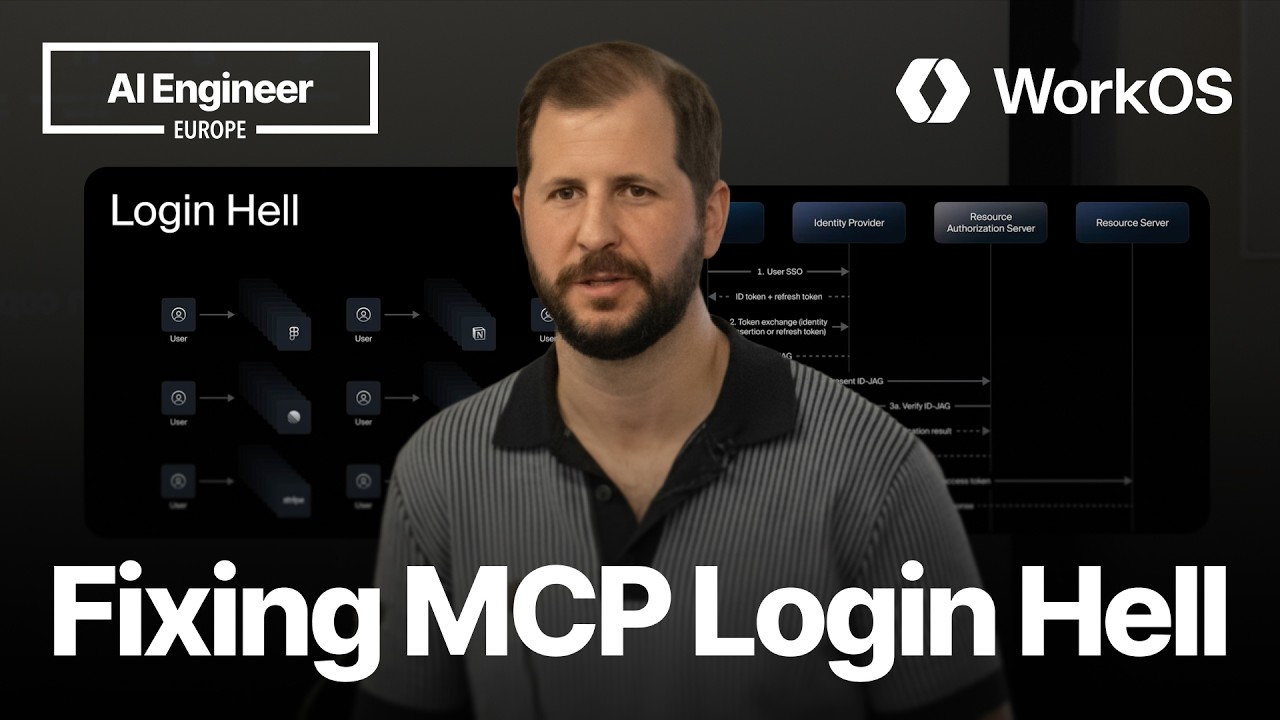
One Login to Rule Them All: Cross-App Access for MCP — Garrett Galow, WorkOS
Apr 28, 2026 · 23:24
Garrett Galow from WorkOS introduces Cross-App Access (XAA) for MCP, solving the problem of repeated OAuth consent screens when connecting agents to multiple services. The flow leverages a three-way trust between the MCP client, server, and an Identity Provider like Okta: a single SSO login issues an IDJag token that is exchanged for short-lived access tokens across all MCP servers without manual intervention. A demo shows Figma automatically connecting after an Okta login. The approach improves security—if the IdP session is revoked, tokens cannot refresh—and requires minimal IT setup: granting permission for the client to request server access. Currently only Okta supports XAA; Azure/Entra does not yet. The session also notes that authorization scopes are not handled by default but are a future consideration.
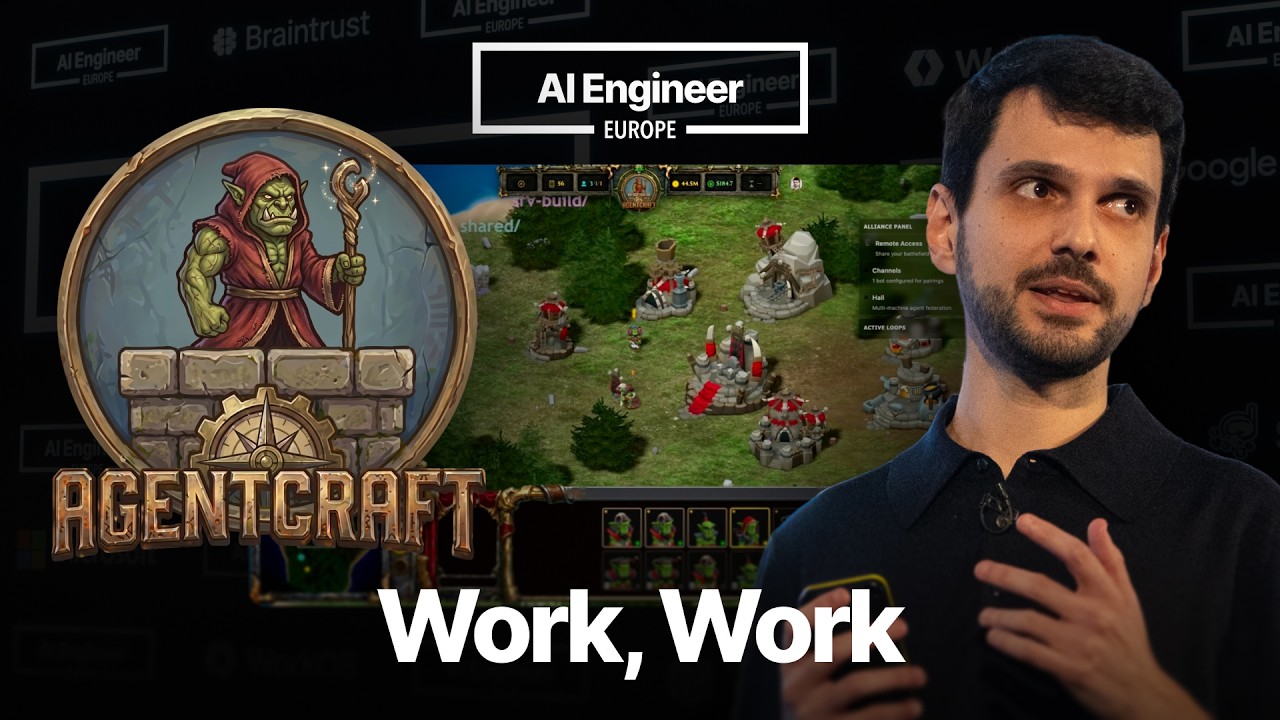
AgentCraft: Putting the Orc in Orchestration — Ido Salomon
Apr 25, 2026 · 11:18
Ido Salomon, creator of AgentCraft, argues that the bottleneck in multi-agent orchestration is not the agents but the humans managing them, and that the skills needed—borrowed from real-time strategy games—are already familiar to gamers. AgentCraft visualizes agents as physical units on a map that projects the file system, allowing users to see which files agents modify and detect collisions via a heat map. To reduce babysitting, Salomon implemented a campaign feature where agents autonomously decompose tasks and plan within containers, shifting the human role to review. Review bundles present changes with screenshots and videos for efficient inspection. Workspaces enable real-time collaboration between humans and agents across teams, with shared visibility and soft coordination. The goal is to raise the ceiling of collaboration through visibility, autonomy, and human-agent interaction.
How AI is changing Software Engineering: A Conversation with Gergely Orosz, @pragmaticengineer
Apr 21, 2026 · 26:42
Gergely Orosz explains how AI is reshaping software engineering, from token maxing at Meta, Microsoft, and Salesforce—where engineers use AI tools to inflate token counts out of fear of layoffs and performance reviews—to the broader shift in the engineer's role toward orchestrating agents rather than managing people. He notes that big tech companies like Uber, Airbnb, and Shopify are building custom internal AI infra (MCP gateways, coding agents) to stay ahead, even tolerating high churn for a six-month competitive edge. Shopify secured GitHub Copilot a year early by offering feedback from 3,000 engineers. Gergely also shares how The Pragmatic Engineer hit product-market fit: 100 paid subscribers before publishing, reaching 1,000 in six weeks, and becoming the #1 paid tech newsletter by focusing on two deep-dive articles per week for two years.
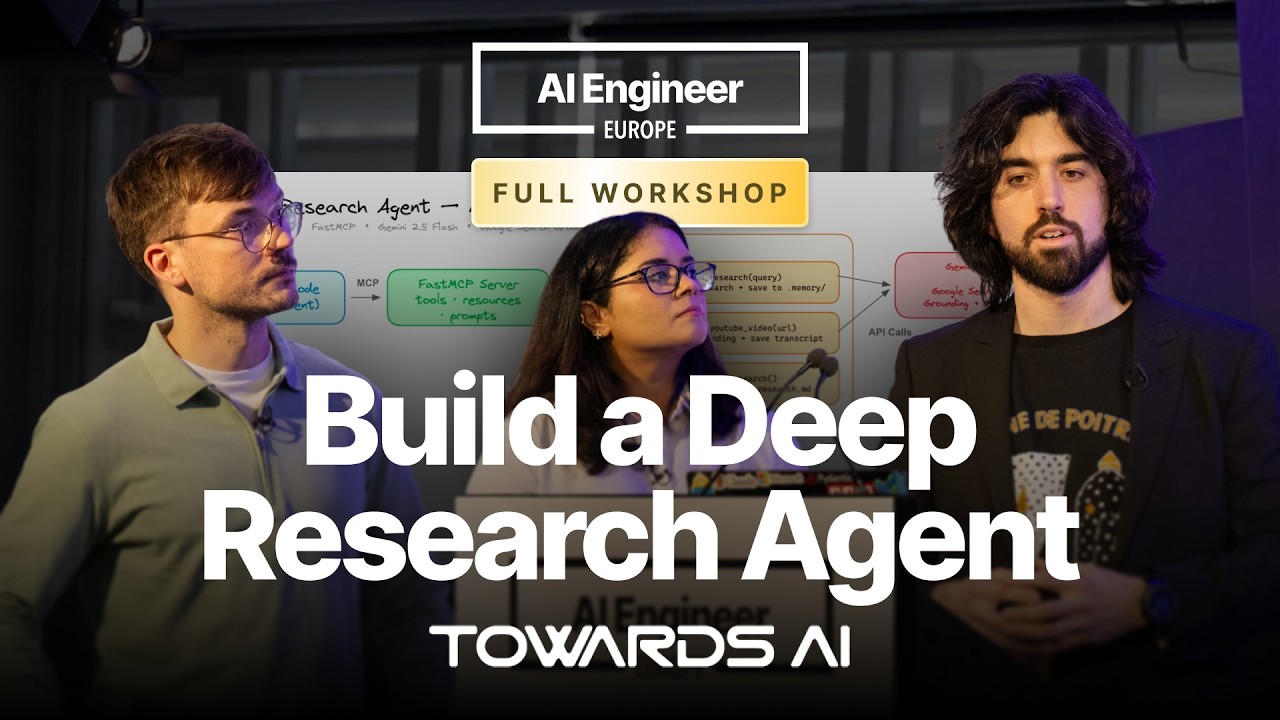
Full Workshop: Build Your Own Deep Research Agents - Louis-François Bouchard, Paul Iusztin, Samridhi
Apr 20, 2026 · 1:57:03
Louis-François Bouchard, Samridhi Vaid, and Paul Iusztin built a combined system of a deep research agent and a deterministic writing workflow to automate high-quality technical content creation, trading flexibility for control. The research agent uses an MCP server (FastMCP) with tools for Google search, YouTube analysis, and report compilation, powered by Gemini and orchestrated by Claude Code. The writing workflow is a static pipeline that loads a user guideline, writing profiles (structure, terminology, character), and few-shot examples into a system prompt, then applies an evaluator-optimizer loop: a reviewer outputs structured pydantic objects with profile/location/comment to flag violations, and the editor applies them in priority order (guideline > research > profile). They stress that research demands autonomy while writing needs constraint, and show how to avoid AI slop by banning specific words and using profiles. For observability, they use Opik to capture all traces, and for evals they built a 20-sample dataset from real LinkedIn posts, split into train/dev/test, to calibrate an LLM judge (binary pass/fail) that they run on dev and test splits to measure F1 and detect…
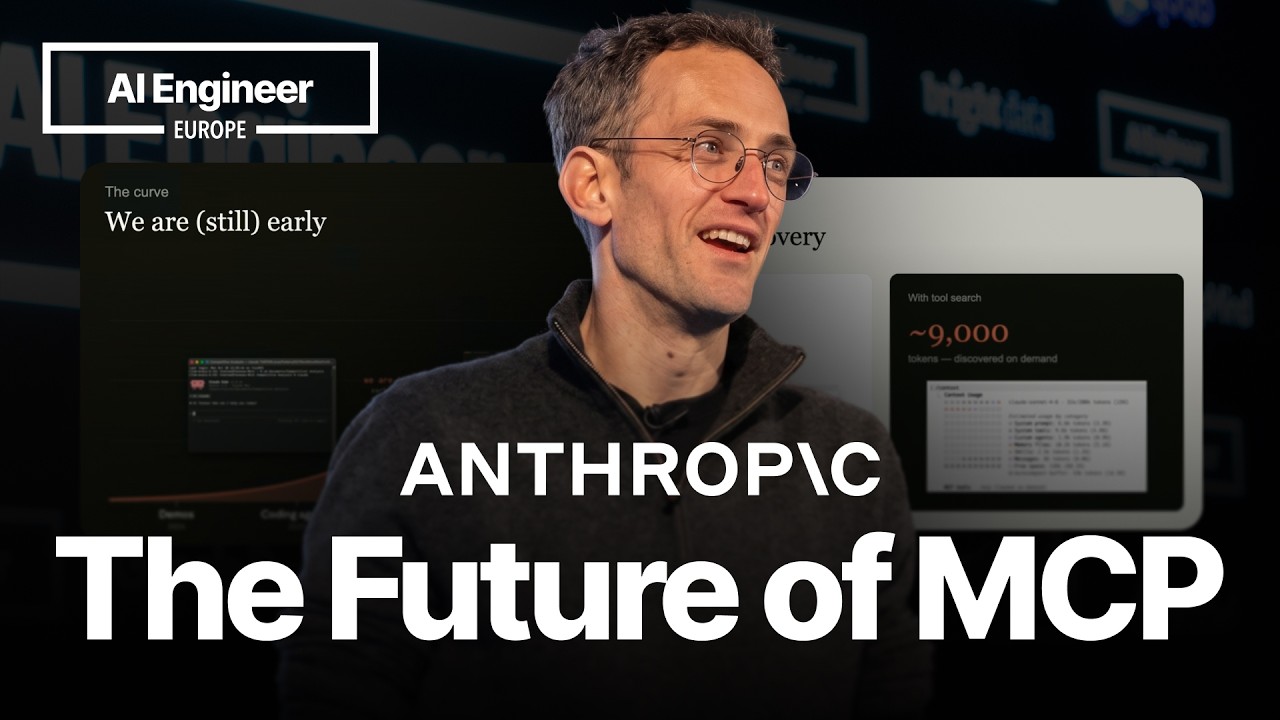
The Future of MCP — David Soria Parra, Anthropic
Apr 19, 2026 · 18:46
David Soria Parra from Anthropic argues that MCP (Model Context Protocol) is the key to connecting agents to tools and data in production, with 110 million monthly downloads—outpacing React's growth at the same stage. He lays out a 2026 connectivity stack combining Skills, MCP, and CLI/Computer Use, each suited for different needs, and emphasizes that best agents will use all three seamlessly. To improve client harnesses, he introduces Progressive Discovery—deferring tool loading via Tool Search to reduce context usage—and Programmatic Tool Calling, where models write scripts to compose tool outputs efficiently. Upcoming MCP protocol improvements include stateless transport (with Google) for easier scaling, async agent-to-agent tasks, enterprise features like Cross App Access and Server Discovery via well-known URLs, and a Skills-over-MCP extension for shipping usage instructions with servers. He calls for community feedback on these directions.
Building pi in a World of Slop — Mario Zechner
Apr 16, 2026 · 18:25
Mario Zechner explains why he built pi, a self-modifying, extensible agent core, after growing frustrated with Cloud Code and Open Code for their buggy features, uncontrolled context management, and zero extensibility. pi strips away complexity, giving the agent just four tools (read, write, edit, bash) and a minimal system prompt, letting it adapt to the user's workflow rather than vice versa. Extensions are TypeScript modules that hot-reload, enabling users to build custom tools, chat rooms, or even play Doom without forking pi. He then attacks clankers — agent-generated pull requests and issues — that are destroying open source, sharing his own tactics like auto-closing PRs with a human-voice request and de-prioritizing OpenClaw interactions. In Act 3, Zechner argues that agents compound errors with zero learning, producing enterprise-grade complexity in weeks, and that long context windows and agentic search are hacks. His prescription: scope agent tasks, modularize codebases, cap generated code review, and always read every line of critical code yourself.

Paperclip: Open Source Human Control Plane for AI Labor — Dotta Bippa
Apr 15, 2026 · 24:34
Dotta Bippa introduces Paperclip, an open-source human control plane for AI labor that lets you manage an org chart of agents to run a zero-human company. The tool enables you to hire employees, set goals, automate jobs, and bring your own agent (e.g., Gemini, Claude, Codex) with skills and instructions. Paperclip supports reliable workflows like QA reviews and approvers, and routines for recurring tasks such as summarizing PRs or writing changelogs. Dotta demonstrates creating a Remotion video celebrating Paperclip's 40,000 GitHub stars (now 50,000) by instructing the CEO agent to hire a video writer and apply brand guidelines—something that would have taken a week becomes an afterthought. Paperclip is not just for coding; it handles marketing, sales, and finance. Upcoming features include CEO chat, maximizer mode, multi-user support, cloud deployments, and a desktop app, all aimed at giving humans control over AI labor.
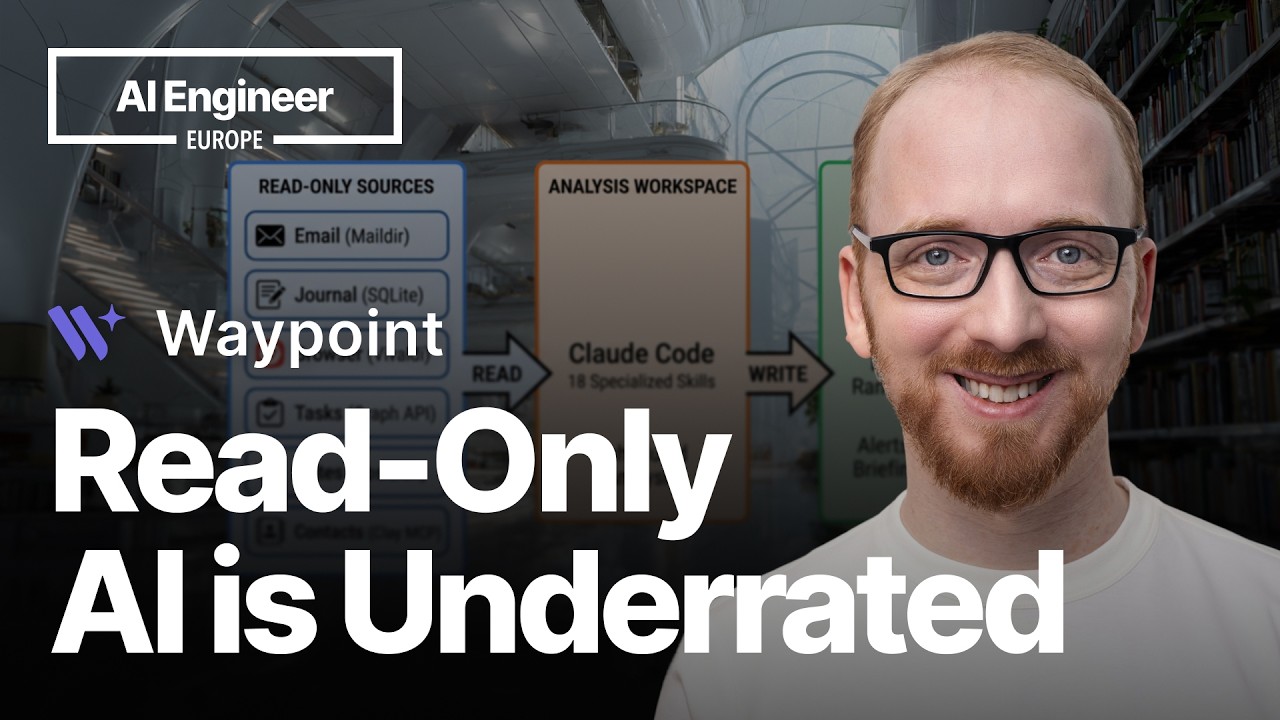
Cognitive Exhaust Fumes, or: Read-Only AI Is Underrated — Šimon Podhajský, Head of AI, Waypoint
Apr 8, 2026 · 11:31
Šimon Podhajský argues that read-only AI systems that analyze personal digital exhaust without the ability to write back are more valuable than agentic AI that acts on users' behalf. He built a system ingesting six read-only sources (email, journal, tasks, CRM, browser sessions, notes) that surfaces insights like intention-action gaps, attention drift, and relationship decay via cross-source pattern detection—things no single source reveals. For example, a weekly reflection skill in Claude synthesizes a brutal review of his week, and a cross-source query maps his recent reading to contacts in his CRM using Vivaldi SQLite and Clay MCP. He emphasizes risk asymmetry: read-only errors cost nothing, while write errors can be unbounded. He also acknowledges security risks like the mosaic effect and Simon Willison's lethal trifecta, noting that shell access still allows exfiltration, but argues that examined risk is better than ignorance.

Your Insecure MCP Server Won't Survive Production — Tun Shwe, Lenses
Apr 8, 2026 · 24:34
Tun Shwe and Jeremy Frenay from Lenses.io argue that poorly designed MCP servers are inherently insecure, and propose five core design principles—shrink attack surface, constrain inputs, treat docs as defense, return minimal data, minimize blast radius—that also thwart OWASP's MCP Top 10. They highlight that standard I/O fails under load (20 of 22 requests failing with 20 concurrent connections), forcing a shift to streamable HTTP with OAuth 2.1. Jeremy details Dynamic Client Registration (DCR) and the newer Client ID Metadata Document (CIMD) approach, noting DCR's vulnerabilities (phishing, non-portable registrations) and CIMD's stronger identity verification since November 2025. Beyond OAuth, enterprise deployment requires tool-level RBAC, data masking for PII, full audit logs, and end-to-end tracing to meet regulations like the EU AI Act.

How METR measures Long Tasks and Experienced Open Source Dev Productivity - Joel Becker, METR
Jan 19, 2026 · 1:15:52
Joel Becker of METR argues that AI benchmark scores are soaring while real-world developer productivity barely budges, reconciling this gap by presenting METR's time horizon measurements and a 16-developer RCT showing no significant speedup from AI on mature open-source projects. He cites reliability issues, task distribution mismatches, and the J-curve effect from Meta's developer data, noting that experienced users still fail to accelerate. The episode explores why AI struggles with messy enterprise data (e.g., LinkedIn's 5,000 'impressions' tables), the failure of computer-use agents in 'Agent Village,' and the possibility that hardware constraints may slow progress. Becker also previews new metrics like 'watched versus unwatched' time horizons and future studies on greenfield coding and data science.

Spec-Driven Development: Agentic Coding at FAANG Scale and Quality — Al Harris, Amazon Kiro
Jan 9, 2026 · 1:03:50
Al Harris, principal engineer at Amazon, presents Spec-Driven Development (SDD) with Kiro, an agentic IDE that transforms prompts into structured requirements (EARS format), designs, and property-based tests to ensure code correctness. He argues that upfront specification—augmented by MCP servers for external context—improves reproducibility and quality over pure vibe coding. The talk includes a live demo: building an S3-backed checkpointer for a LangGraph dad joke generator, then discovering Agent Core’s native memory is more idiomatic. Harris contrasts SDD with Cursor’s planning mode, explains how specs evolve as living documentation, and discusses handling session length, context pruning, and brownfield codebases. The result is a claim that spending 5–10 minutes on specs yields higher accuracy and reliable, testable outputs.

Automating Large Scale Refactors with Parallel Agents - Robert Brennan, OpenHands
Jan 8, 2026 · 1:16:21
Robert Brennan, CEO of OpenHands, and colleague Calvin explain how parallel agents can automate large-scale code refactors, demonstrating that breaking tasks into agent-sized batches with human oversight achieves 90% automation. They trace the evolution from context-unaware snippets to autonomous coding agents and now agent orchestration, where multiple agents work in parallel on tasks like CVE remediation — one client saw a 30x improvement in time-to-resolution. Calvin shows a pipeline using OpenHands' SDK to batch code files, run a verifier to detect code smells, and spin up fixer agents that generate focused pull requests. Brennan details strategies: task decomposition into single-PR-sized chunks, dependency ordering, and context sharing via agent.md files. The episode closes with a live-coding walkthrough building a parallel agent script that scans for vulnerabilities and opens individual PRs.

Build a Prompt Learning Loop - SallyAnn DeLucia & Fuad Ali, Arize
Jan 6, 2026 · 52:08
SallyAnn DeLucia and Fuad Ali from Arize present prompt learning, a method to continuously improve AI prompts by using feedback from evals and human annotations. They argue that agent failures often stem from weak instructions rather than weak models, and that adding rules to system prompts can yield 15% improvements on SWE-Bench without fine-tuning or architecture changes. The talk compares prompt learning to GEBA, noting it achieves better results in fewer loops by leveraging text explanations. A case study shows Kline's performance improved from 30% to 45% on SWE-Bench-Lite after optimizing prompts. The workshop demonstrates building an optimization loop that ingests input-output pairs, evaluates them, and iteratively refines the system prompt using OpenAI.
AGI: The Path Forward – Jason Warner & Eiso Kant, Poolside
Dec 27, 2025 · 15:56
Jason Warner and Eiso Kant, co-founders of Poolside, present their vision and roadmap towards AGI-level capabilities for knowledge work, demonstrating their second-generation model Malibu Agent converting ADA code to Rust live on stage. They argue that next-token prediction paired with reinforcement learning is the key breakthrough, a contrarian bet they made two and a half years ago. The episode centers on their work in high-consequence code environments for defense and government, where agents must operate with tight permissions. They announce a large compute cluster of over 40,000 GB300s coming online and a public API release early next year via AWS Bedrock. Warner recounts meeting Kant through a failed GitHub acquisition, and Kant invites the audience to build with their models, emphasizing that future agents will handle tasks over days as intelligence scales.

Shipping AI That Works: An Evaluation Framework for PMs – Aman Khan, Arize
Dec 26, 2025 · 1:26:16
Aman Khan, AI PM at Arize, presents a framework for product managers to evaluate LLM-powered products beyond gut-feel 'vibe checks.' He demonstrates building an AI trip planner with multi-agent LangGraph, then using Arize's tracing and prompt playground to iterate on prompts. Khan shows how to create datasets from production traces, run A/B experiments on prompts, and use LLM-as-a-judge evals for friendliness and discount offers, comparing against human labels to refine evaluators. He argues evals are the new requirements docs, enabling PMs to own the product experience by writing acceptance criteria as eval datasets. The talk covers building eval teams, handling variance with temperature settings, and continuously improving golden datasets with hard examples, citing real-world analogies from self-driving cars at Cruise.

How Claude Code Works - Jared Zoneraich, PromptLayer
Dec 26, 2025 · 1:05:43
Jared Zoneraich from PromptLayer dissects how Claude Code works, arguing its success stems from a radical simplification: a single-threaded master loop with tool calls, relying on capable models rather than complex DAG-based architectures. He breaks down the core internal tools—Bash, FileEdit, Grep—and the to-do planning mechanism that is purely prompt-based and not deterministically enforced. Zoneraich contrasts Claude Code with other coding agents: Codex (Rust core, kernel-level sandboxing), Amp (handoff context management, model-agnostic), and Cursor Composer (UI-first, distilled model). He emphasizes that Bash is the most important tool, acting as a universal adapter, and that context management via sub-agents and summarization is critical. Key takeaways include trusting the model, simple design, rigorous tool testing, and that different agent philosophies (not one winner) will serve different use cases.

Why Agent Hype can fall short of reality – Joel Becker, METR
Dec 24, 2025 · 21:22
Joel Becker, a researcher at METR, examines why AI models that ace benchmarks like SWE-bench fail to boost real-world developer productivity. METR's time horizon measurements show AI capabilities doubling every 6-7 months, with Claude 3.7 Sonnet achieving a 50% success rate on tasks taking humans 4 minutes. Yet a randomized controlled trial of 16 experienced developers on large open-source projects found they were 19% slower when using AI tools like Cursor Pro, contradicting expert predictions of 40% time savings. Becker attributes the gap to high context requirements, low AI reliability, and task complexity—developers spent significant time verifying and correcting AI outputs. The episode warns that benchmark-style evidence, which uses low-context human baselines, overstates AI readiness for messy, interdependent real-world tasks.

Amp Code: Next Generation AI Coding – Beyang Liu, Amp Code
Dec 22, 2025 · 18:31
Beyang Liu, co-founder and CTO of Amp Code, presents Amp as an opinionated frontier coding agent that rejects MCP in favor of custom tools to avoid context confusion and optimize feedback loops. Amp's architecture relies on specialized subagents—the finder for code search, the oracle for deep reasoning, the librarian for external context, and the kraken for large-scale refactors—rather than a model selector. The agent offers two top-level modes: a slower 'smart' agent for complex tasks and a 'rush' agent for quick, in-loop edits, recently updated to leverage Gemini 3. To address inference costs, Amp ships subtle ads in the terminal to sponsor free usage for students and side projects. Liu also highlights a shared-threads feature for team learning and a community called the Weird Builder Cohort, emphasizing a culture of experimentation over hype.

The Infinite Software Crisis – Jake Nations, Netflix
Dec 20, 2025 · 18:57
Jake Nations, engineering lead at Netflix, argues that AI-generated code accelerates the software crisis by conflating easy with simple—producing tangled, incomprehensible systems. He traces the crisis from 1968 to today's infinite code generation, citing Fred Brooks' 'No Silver Bullet' and Rich Hickey's definition of simple as 'one fold, no entanglement.' Nations presents a three-phase methodology—research (compressing 5 million tokens of code into a 2,000-word spec), planning (paint-by-numbers implementation steps), and implementation (using a manual migration seed)—to maintain human understanding. He warns that without this approach, engineers lose the ability to recognize dangerous complexity, and challenges listeners: will we still understand our own systems when AI writes most of the code?

Dispatch from the Future: building an AI-native Company – Dan Shipper, Every, AI & I
Dec 18, 2025 · 17:58
In this episode, Dan Shipper of Every argues that there is a 10x difference between an organization where 90% of engineers use AI and one where 100% do. At Every, 99% of code is written by AI agents, enabling 15 people to run four software products with 7,000 paying subscribers, each built by a single developer. Shipper introduces 'Compounding Engineering', where each feature makes the next easier to build through a loop of plan, delegate, assess, and codify. He describes how this approach allows managers to commit code, enables tacit code sharing across products, and lets new hires be productive on day one. The episode details how Every's shift to agentic workflows (Claude Code, Codex) and a 'demo culture' over 'memo culture' has transformed their engineering velocity and collaboration.

Your Support Team Should Ship Code – Lisa Orr, Zapier
Dec 16, 2025 · 16:06
Lisa Orr of Zapier explains how the company empowers its support team to ship code using AI, tackling the app erosion caused by 8,000+ third-party integrations. Initially, they built an API playground that failed due to lack of workflow embedding, then pivoted to MCP tools in IDEs, but the slow Diagnosis tool led to an asynchronous agent. The resulting Scout Agent autonomously categorizes tickets, assesses fixability, generates merge requests, and enables rapid iteration in GitLab. Today, Scout drives 40% of support's integration fixes, doubling individual velocity from 1-2 to 3-4 tickets per week. Orr highlights support's three superpowers: closest to customer pain, real-time troubleshooting, and best at validation, with some team members becoming engineers.

From Vibe Coding To Vibe Engineering – Kitze, Sizzy
Dec 14, 2025 · 25:28
Kitze, founder of Sizzy, argues that "vibe engineering"—actively steering AI agents with technical knowledge—trumps passive "vibe coding" for building real software. He shares how Cursor's Composer 1 let him port Benji.so and Glink to Next.js 16 with Monorepo in under a week, reviving near-dead projects. Kitze insists LLMs excel at React because humans are bad at it, and that repetitive code is fine since agents don't care. He warns against giving AI tools to juniors without oversight, and predicts the bottom of the job market will thin as agents replace interns. The talk ends with a pitch for "vibe code fixers" as a new role, maintaining legacy systems like cowboy coders.

Moving away from Agile: What's Next – Martin Harrysson & Natasha Maniar, McKinsey & Company
Dec 12, 2025 · 21:55
McKinsey's Martin Harrysson and Natasha Maniar argue that enterprises must overhaul their people and operating models—moving beyond Agile to AI-native workflows—to capture the full potential of AI in software development. They identify bottlenecks like work allocation, manual code review, and tech debt that limit gains to 5-15% despite promising individual productivity stories. To scale, they advocate AI-native workflows (spec-driven development, continuous planning) and AI-native roles (smaller pods of 3-5 with consolidated roles). In a client study with a bank, interventions led to 60x increase in agent consumption, 51% increase in code mergers, and faster delivery tied to business priorities. They emphasize change management: 70% of companies haven't changed roles, and top performers invest in hands-on upskilling, measurement systems that track outcomes beyond adoption, and incentives to drive adoption.

The State of AI Code Quality: Hype vs Reality — Itamar Friedman, Qodo
Dec 11, 2025 · 21:15
Itamar Friedman, CEO of Qodo, argues that while AI code generation boosts productivity, it has a glass ceiling unless organizations invest in agentic quality workflows and context. Drawing on reports from Qodo, Sonar, and Pharos, he reveals that 60% of developers say a quarter of their code is AI-generated, yet 67% have serious quality concerns, leading to 42% more time fixing bugs and 35% project delays. He notes that AI code review tools double trust and quality gains, and that better context—including standards and best practices—is the top request from developers. Friedman recommends automated quality gateways, intelligent code review, and testing, warning that without dynamic quality processes, the promised 2x productivity remains elusive.

Can you prove AI ROI in Software Eng? (Stanford 120k Devs Study) – Yegor Denisov-Blanch, Stanford
Dec 11, 2025 · 16:40
Stanford researcher Yegor Denisov-Blanch presents research based on 120,000+ developers across 600+ companies, arguing that AI ROI in software engineering is often negative despite apparent productivity gains. The study finds a median 10% productivity lift from AI, but a widening gap between top and bottom performers. Key drivers include codebase hygiene (environment cleanliness index with R² 0.40) and AI usage quality over volume. A company case study shows pull requests increased 14% but code quality dropped 9% and rework rose 2.5x, yielding no net effective output gain. Denisov-Blanch proposes a measurement framework using a primary metric (engineering output via ML model) paired with guardrail metrics, and emphasizes that companies can retroactively measure impact via git history without waiting for experiments.

RL Environments at Scale – Will Brown, Prime Intellect
Dec 9, 2025 · 18:30
Will Brown of Prime Intellect argues that scaling reinforcement learning environments beyond engineering—to community and accessibility—is key to broadening AI research. He presents Prime Intellect's open-source stack, including Verifiers for building environments and the Environments Hub for sharing them, as a way to turn any task harness into an RL training or evaluation loop. Brown demonstrates how environment-based fine-tuning boosted a Qwen 3 4B model from 55% to 89% on a Wikipedia search task, matching much larger models. He frames environments as the 'web apps of AI research'—simple to start, but capable of capturing product complexity, as seen with Cursor's Composer and OpenAI's Codex. Prime Intellect validated this approach by training the 100B-param Intellect 3 on 500 GPUs, and will soon release Lab, a platform to run environments without managing infrastructure.

Future-Proof Coding Agents – Bill Chen & Brian Fioca, OpenAI
Dec 5, 2025 · 17:48
Bill Chen and Brian Fioca from OpenAI argue that coding agents are booming but fragile, with teams rebuilding harnesses every time models change. They present Codex, OpenAI's combined model and harness, as a stable abstraction layer that handles complexity like context compaction, parallel tool calls, and MCP integration. Key lessons include avoiding overprompting—letting the model use its trained habits rather than forcing foreign instructions—as demonstrated when GPT-5 ran slowly because users told it to examine every file. They describe patterns for using Codex as an SDK, enabling products like GitHub and Cursor to integrate without maintaining their own harness, and highlight future improvements in longer-horizon tasks and self-healing software. The episode concludes that building where models are going, with Codex's SDK, lets teams focus on differentiation rather than infrastructure rewrites.

No Vibes Allowed: Solving Hard Problems in Complex Codebases – Dex Horthy, HumanLayer
Dec 2, 2025 · 20:31
Dex Horthy of HumanLayer argues that with deliberate context engineering — specifically a technique he calls "frequent intentional compaction" — today's AI coding agents can handle large brownfield codebases, not just greenfield projects. He presents a three-phase workflow (research, plan, implement) that keeps agents in the "smart zone" of the context window, avoiding the diminishing returns that set in around the 40% mark. Horthy demonstrates this approach solving a real problem in a 300k-line Rust codebase, shipping a week's worth of work in seven hours with code that passed expert review. He cautions against outsourcing thinking to AI, emphasising that plans must include actual code snippets for reliable execution and team alignment. The talk also addresses the cultural rift where senior engineers clean up slop from juniors' AI tools, calling for top-down adoption and team-wide workflow adaptation.

Backlog.md: Terminal Kanban Board for Managing Tasks with AI Agents — Alex Gavrilescu, Funstage
Nov 24, 2025 · 14:19
Alex Gavrilescu presents Backlog.md, an open-source CLI tool that stores tasks as Markdown files in Git repos, featuring a terminal Kanban board and MCP server for AI agents. He argues that breaking features into atomic Markdown tasks prevents agents from running out of context or implementing unwanted extras. The demo shows Claude creating a task from requirements, generating an implementation plan, and coding a move-mode feature—all via MCP tools. Gavrilescu emphasizes two review checkpoints (after task creation and after the plan) and notes that Backlog.md itself is 99% AI-written. The tool works cross-platform, requires no external APIs, and syncs across branches via Git.

What Data from 20m Pull Requests Reveal About AI Transformation — Nick Arcolano, Jellyfish
Nov 24, 2025 · 17:57
Nick Arcolano, head of research at Jellyfish, presents data from 20 million pull requests across 200,000 engineers at 1,000 companies to reveal what AI transformation actually looks like. Median AI adoption of interactive coding tools (Copilot, Cursor, Claude Code) jumped from 22% in June 2024 to nearly 90% today, driving a 2x increase in PR throughput and 24% faster cycle times on average. Autonomous agents like Devin and Codex remain negligible—only 44% of companies have tried them, contributing less than 0.2% of PRs. PRs grow 18% larger with AI, but bug rates and reverts show no significant quality impact. Crucially, code architecture determines success: centralized and balanced repos see 4x throughput gains, while highly distributed architectures (many repos per engineer) show no correlation with AI adoption, likely due to cross-repo context limitations. Arcolano advises focusing on adoption first, then addressing architectural barriers to unlock productivity.

Form factors for your new AI coworkers — Craig Wattrus, Flatfile
Aug 22, 2025 · 15:35
Craig Wattrus, AI design engineer at Flatfile, argues that designing AI interactions requires treating AI as a new coworker with distinct form factors — invisible, ambient, inline, and conversational — rather than traditional UI. He demonstrates how feeling the material by building tools like a 'chat tuner' to tune AI character shifts from helicopter-parenting to character coaching. Finding the grain involves designing tool UX where AI communicates visually, checks alignment, and hands back control. Courting emergence yields unexpected results: an agent combined two files without being asked and suggested the user contact HR for missing employee IDs. Looking forward, Wattrus explores auto-complete for data transformations, using LLMs to suggest fixes alongside human oversight.

How to look at your data — Jeff Huber (Chroma) + Jason Liu (567)
Aug 6, 2025 · 19:23
Jeff Huber (Chroma CEO) and Jason Liu argue that AI practitioners should look at their data—both inputs and outputs—with fast evals and conversation analysis to systematically improve retrieval and product decisions. Huber advocates for fast evals using golden datasets of query-document pairs over public benchmarks or expensive LLM judges, showing how synthetic queries aligned to real user behavior can empirically compare embedding models; in a Weights & Biases chatbot case study, Voyage 3 large outperformed text-embedding-3-small and others. Jason Liu focuses on outputs: extract structured metadata from conversations, cluster them to find segments, then compare KPIs like performance across clusters to prioritize what to fix, build, or ignore—for example, if 40% of conversations involve data visualization and the agent performs poorly, invest in better plotting tools. This population-level analysis enables impact-weighted decisions, turning vague metrics like 0.5 factuality into actionable insights by segment. The episode emphasizes that retrieval improvements are foundational, and once you have users, looking at conversation structure drives a data-driven product roadmap.

Practical tactics to build reliable AI apps — Dmitry Kuchin, Multinear
Aug 3, 2025 · 14:55
Dmitry Kuchin argues that building reliable AI applications requires reverse-engineering evaluation metrics from real-world user scenarios and business outcomes, rather than relying on abstract data science metrics. He recommends using a strong LLM like o3 to generate specific user questions and criteria from knowledge materials, and building these evaluations at the start of development, not the end. This approach lets teams run frequent experiments, catch regressions, and iterate until they have a baseline benchmark. Examples include customer support bots (where the key metric is escalation rate to humans), text-to-SQL (using mock databases), and call center classifiers. Kuchin emphasizes that the process works with any platform and shares his open-source tool Multineer as one option.
How to Improve your Vibe Coding — Ian Butler
Aug 3, 2025 · 7:30
Ian Butler (CEO of BizMyth) presents benchmark data showing that popular coding agents like Devin and Cursor have less than 10% true positive rates for finding bugs, with Cursor producing a 97% false positive rate across 100+ repos and 1,200+ issues. He argues that these agents overrun codebases with false positives, causing alert fatigue and bugs reaching production. To improve vibe coding, he recommends adding bug-focused rules (e.g., OWASP Top 10, explicit bug classes like auth bypasses), managing context by feeding diffs and preventing file summarization, and using thinking models which were significantly better at finding deeper bugs. However, even thinking models show high variability in which bugs they find across runs, indicating agents never holistically examine a file. The talk concludes with a plug for BizMyth.sh, which automates PRs and vulnerability scanning.
Hacking the Inference Pareto Frontier - Kyle Kranen, NVIDIA
Aug 1, 2025 · 20:25
Kyle Kranen, architect of NVIDIA Dynamo, explains how to break the inference Pareto frontier by manipulating trade-offs between quality, latency, and cost using a toolkit of techniques. Disaggregation separates prefill and decode phases, achieving up to 2× tokens per second per GPU at fixed latency for LLaMA 70B on 16 H100s. Smart routing maximizes KV cache hits, asymptotically reducing prefill work as deployments scale. Structure from agentic workloads, like inference-time scaling, enables smaller models (e.g., 8B queried 3–4 times) to match larger models' quality at lower cost. KV manipulation offloads caches during tool calls (e.g., 30-second delays) to avoid re-prefill. Dynamism adjusts worker specialization and autoscales prefill/decode ratios in real time to handle shifting user distributions, ensuring disaggregation reaches maximum potential.

How we hacked YC Spring 2025 batch’s AI agents — Rene Brandel, Casco
Jul 30, 2025 · 17:33
Rene Brandel, CEO of Casco, explains how his team hacked seven of sixteen YC Spring 2025 batch AI agents within 30 minutes each, revealing three critical security flaws: cross-user data access via IDOR, arbitrary code execution through code tools, and server-side request forgery (SSRF) from tool endpoints. They extracted personal data by exploiting missing authorization checks, overwrote security controls by writing malicious files into code sandboxes, and stole Git credentials by manipulating a database-schema tool. Brandel emphasizes that agent security extends beyond LLM prompt injection, advises treating agents as users with proper authentication and authorization, and warns against rolling custom code sandboxes, recommending out-of-the-box solutions like E2B. The talk concludes with a Q&A on extracting system prompts and the dangers of local coding agents.

Shipping something to someone always wins — Kenneth Auchenberg (ex. Stripe, VSCode)
Jul 28, 2025 · 16:17
Kenneth Auchenberg, former VSCode and Stripe developer platform lead, argues that great AI products come from rapid iterative loops — shipping continuously viable 'skateboards' to real users rather than aiming for a perfect final product. He advocates for writing launch blog posts before building, working intimately with a few real customers (even texting them), and ignoring constraints like legal initially to design the best product. APIs are harder to change than UI, so early user feedback is critical. In AI, the fundamentals haven't changed: customer knowledge and iteration velocity matter more than ever, even as AI tools accelerate building. The goal should be to run a product feedback loop in under a day.

Everything is ugly, so go build something that isn't — Raiza Martin, Huxe (ex NotebookLM)
Jul 28, 2025 · 25:15
Raiza Martin, former lead of Google's NotebookLM and founder of Huxe, argues that the current chaotic phase of AI product design is a once-in-a-career opportunity to rebuild from first principles, calling everything we use 'the ugliest that it will ever be.' Drawing from her experience forcing NotebookLM into existence against skepticism, she emphasizes that personal clarity of vision fuels product building, and purpose must be relentlessly focused on a single outcome—for NotebookLM, enabling users to upload 50 files and interact with them. She stresses earning trust by nailing deterministic behavior first, noting that 90% of first queries were summarization and failures drove users away forever, then layering on delightful probabilistic features like podcast generation. Finally, she warns against the 'kitchen sink' approach, citing her own Huxe app that did everything but users only used one feature, advocating restraint as an innovation multiplier and focus on one excellent outcome to avoid building ugly products.
Piloting agents in GitHub Copilot - Christopher Harrison, Microsoft
Jul 26, 2025 · 59:07
Christopher Harrison (Microsoft) demonstrates GitHub Copilot's agent capabilities for AI Engineers, arguing context is key to effective pair programming. He explains Copilot's modes—completion, chat, edit, local agent, and coding agent—and how Model Context Protocol (MCP) enables access to external tools like databases. Harrison shows how Copilot-instructions.md files provide project-specific guidance, and how coding agent runs within ephemeral GitHub Actions environments with strict security (no external access, only write to its own branch). He emphasizes that AI doesn't change DevOps fundamentals: tests still run locally and via PR workflows, and code review remains essential. The lab covers assigning issues to Copilot, configuring MCP servers, and using .instructions files for reusable patterns, with a repeat session at 3:30 PM.
Human seeded Evals — Samuel Colvin, Pydantic
Jul 25, 2025 · 12:02
Samuel Colvin, creator of Pydantic, demonstrates how type safety and validation loops in Pydantic AI build reliable GenAI applications. He argues that type-safe frameworks enable confident refactoring, a necessity for evolving AI apps, and shows how returning validation errors to the model fixes simple mistakes like incorrect date formats. The agentic loop with tools and final result tools ensures structured extraction, while type-safe dependencies on tools prevent runtime errors. Colvin also highlights Logfire observability, which traces calls, shows pricing, and helps debug failures like failed memory retrieval. The talk covers agent definitions, validation error retries, and the importance of explicit exit conditions in agent loops.
How agents will unlock the $500B promise of AI - Donald Hruska, Retool
Jul 23, 2025 · 16:22
Donald Hruska, engineering lead for Retool's Agents product, argues that AI agents will unlock the $500B promise of AI by moving enterprises beyond toy chatbots into production-grade systems. He explains that building a basic agent is easy (e.g., 100 lines of code using React) but getting it into production requires solving security, cost overruns, observability, and compliance. Hruska outlines four options—build from scratch, use a framework like LangGraph, a managed platform like Retool Agents, or verticalized agents—and advises building for core differentiators and buying for commodity workflows. He cites Retool customers like ClickUp saving over $200,000 in vendor costs and Descript saving hundreds of hours weekly, while noting inference costs dropped 99.7% from 2022-2024. Retool charges $3 per hour for its cheapest agent and supports on-prem deployment.

3 ingredients for building reliable enterprise agents - Harrison Chase, LangChain/LangGraph
Jul 23, 2025 · 20:55
Harrison Chase, CEO of LangChain, argues that reliable enterprise agents depend on three ingredients: high value when right, high probability of success, and low cost when wrong. He says agents succeed by tackling high-value tasks like legal or research, and by doing more work through long-running processes. Reliability improves by blending deterministic workflows with agentic loops, as in LangGraph, and by using observability (LangSmith) to build trust. Cost is lowered by reversible actions (e.g., code diffs) and human-in-the-loop patterns like approvals and time travel. Chase predicts a future of ambient agents—event-triggered, human-supervised background agents—and notes code agents lead because code is verifiable and easily revertible.

Building Agents (the hard parts!) - Rita Kozlov, Cloudflare
Jul 23, 2025 · 21:12
Rita Kozlov, VP of Product for Cloudflare's developer platform, presents the building blocks of AI agents—client, AI reasoning, workflows, and tools—arguing that effective agents require all four components. She highlights the Model Context Protocol (MCP) as a standard for exposing APIs to LLMs, and demonstrates Cloudflare's Agents SDK, which simplifies hosting remote MCP servers with built-in OAuth, state management via durable objects, and real-time WebSocket communication. Kozlov cites real-world impact: companies using agents for sales automation see 20% revenue increases, 90% faster support response times, and 50–75% time savings. She walks through a human-in-the-loop credit card approval workflow built with Nok, showing how durable objects maintain long-running state, prevent duplicate actions, and route approvals across Slack, email, or in-app notifications. The talk emphasizes that once an MCP server is deployed, it can be used directly from Cursor, Claude, ChatGPT, or a custom client, including voice interfaces via WebRTC-to-WebSocket translation.
CIAM for AI: Authn/Authz for Agents — Michael Grinich, CEO of WorkOS
Jul 21, 2025 · 20:13
Michael Grinich, CEO of WorkOS, argues that AI agents need first-class identity and access management, distinct from human or machine-to-machine auth. He identifies key challenges: headless login, least privilege for non-deterministic systems, and compliance tracking. Grinich presents four emerging patterns—persona shadowing, delegation chains, capability tokens, and human-in-the-loop escalation—and references standards like OAuth, UMA, GNAP, OIDC for agents, and verifiable credentials. He predicts a shift from 95% human traffic to 95% agent traffic, calling for middleware trust boundaries and urgent collaboration on agent identity standards.
On Curiosity — Sharif Shameem, Lexica
Jul 19, 2025 · 18:35
Sharif Shameem, founder of Lexica, argues that curiosity is the main force for pulling ideas from the future into the present, and that building and sharing demos is the best way to explore AI models' hidden capabilities. He recounts early GPT-3 demos from 2020-2021, when the model had a 2,000-token context window and cost $75 per million output tokens, showing how he built a JSX compiler in the browser, a shopping agent that parsed web pages, and a multi-step reasoning tool called MultiVAC. Shameem emphasizes that AI engineering is more like excavating than traditional engineering, and that researchers often don't know the full capabilities of their own models. He closes by invoking computing pioneer J.C.R. Licklider, arguing that today's AI engineers have a moral obligation to follow their curiosity and share what they discover.

Building a 10 person unicorn - Max Brodeur-Urbas, Gumloop
Jul 15, 2025 · 12:03
Max Brodeur-Urbas, founder of Gumloop, explains how his company scaled to millions in ARR as a team of two that raised a Series A and grew to only nine people, by being super picky in hiring, using product-led hiring where customers like those from Instacart and Webflow join the team, and requiring work trials such as hacking together in Airbnbs. They eliminate almost all meetings to give engineers deep focus time and automate every internal process with Gumloop itself, from customer research reports to chatbot monitoring. Culture-wise, they balance intense 45-minute shipping challenges with fun retreats and a public company handbook. Brodeur-Urbas argues that every hire must be a no-brainer, and small teams can outpace larger ones by avoiding meetings and leveraging AI tools.

Bolt.new: How we scaled $0-20m ARR in 60 days, with 15 people — Eric Simons, Bolt
Jul 15, 2025 · 17:33
Eric Simons, CEO of Bolt.new, explains how his team of less than 20 people scaled the company from $0 to $20M ARR in just 60 days, achieving the second fastest product growth in history by staying lean and focusing on high-impact decisions. He describes building a remote team with high context and agency, resisting pressure to hire more during the 2021 boom. They relied on 'things that don't scale' like weekly office hours to build user love, and leveraged AI support tools like PeraHelp to handle 90% of tickets. Community initiatives such as a Guinness World Record hackathon (over 80,000 participants) further amplified growth without adding headcount. Simons emphasizes taking consistent shots on goal and making independent bets rather than following VC trends.

Prompt Engineering and AI Red Teaming — Sander Schulhoff, HackAPrompt/LearnPrompting
Jul 14, 2025 · 2:01:05
Sander Schulhoff, creator of Learn Prompting and HackAPrompt, argues prompt engineering remains vital despite claims of its demise, drawing on his systematic review of 1,500+ papers for 'The Prompt Report.' He covers advanced techniques including chain-of-thought, decomposition, ensembling, and few-shot prompting, noting that role prompting is ineffective for accuracy-based tasks and that example ordering can swing performance by 50%. He then explains AI red teaming, distinguishing jailbreaking from prompt injection, and warns that system prompts and guardrails cannot prevent attacks—even simple obfuscation like base64 or typos still works. He highlights the critical unsolved problem of agentic security, where agents with real-world actions are easily tricked, and introduces a live competition at the conference to gather more attack data. His key takeaway: AI security is fundamentally harder than classical cybersecurity because 'you cannot patch a brain.'
Production software keeps breaking and it will only get worse — Anish Agarwal, Traversal.ai
Jul 10, 2025 · 18:13
Anish Agarwal and Matthew Schoenbauer of Traversal.ai argue that as AI writes more code, production troubleshooting will become vastly harder, requiring a new approach combining causal machine learning, reasoning models, and agentic swarms to autonomously resolve incidents in minutes. They explain that traditional AI ops generates too many false positives, LLMs can't handle petabyte-scale data, and simple agents depend on deprecated runbooks. Their Traversal AI orchestrates thousands of parallel agentic tool calls to sift through trillions of logs and metrics, identifying root causes and citing observability data. A case study with DigitalOcean shows a 40% reduction in mean time to resolution (MTTR), with the system delivering findings in about five minutes. The episode details how this approach turns frantic incident Slack channels into autonomous, cited root-cause analysis, freeing engineers to focus on system design.
Claude Code & the evolution of agentic coding — Boris Cherny, Anthropic
Jul 4, 2025 · 18:12
Boris Cherny, creator of Claude Code and Anthropic member of technical staff, argues that the product stays intentionally unopinionated and minimal because the model's coding capabilities are improving exponentially and the right UX remains unknown. He traces programming UX from 1950s punch cards to 1980s Smalltalk's live reload, Eclipse's static-analysis autocomplete, Copilot, and Devin's natural-language paradigm. Claude Code's terminal-first approach works in any terminal, over SSH, and inside VS Code or Cursor, with a GitHub integration that keeps data on user compute and a programmatic SDK for custom UIs. Key tips include using Claude for code-based Q&A (shortening onboarding from weeks to days), teaching it tools via `--help` and Claude MD files, leveraging TDD with visual iteration, and running multiple Claude instances in parallel via terminal tabs or GitHub Actions. Today's launch adds a plan mode triggered by Shift+Tab, which makes a plan and waits for approval before writing code.
MCP Is Not Good Yet — David Cramer, Sentry
Jul 3, 2025 · 16:41
David Cramer, founder and engineer at Sentry, argues that the Model Context Protocol (MCP) is a pluggable architecture for agents, not a simple API overlay, and that it is not yet good but worth experimenting with. He stresses that exposing existing OpenAPI endpoints as MCP tools yields terrible results; instead, developers must design context specifically for agents, returning Markdown rather than raw JSON to improve model reasoning. Cramer details Sentry's MCP server, built in two days using Cloudflare Workers for OAuth 2.1, and notes that remote OAuth is essential for B2B SaaS, while standard I/O introduces security risks. He highlights the need for careful token and cost management—citing a single request that produced 20 API calls to Sentry—and advocates for building dedicated agents (like Sentry's root cause analysis tool) that wrap MCP, giving the provider control over prompts, models, and error handling. Despite ongoing issues like lack of streaming responses and unstable client support, Cramer concludes that MCP's core concepts (plug-ins, agents, tools) are just familiar software patterns with new names.

The emerging skillset of wielding coding agents — Beyang Liu, Sourcegraph / Amp
Jun 30, 2025 · 35:06
Beyang Liu, CTO and co-founder of Sourcegraph, argues that coding agents are a real and high-ceiling skill, contrary to skeptics like Jonathan Blow and Eric S. Raymond. He presents design decisions for the agentic era: agents should directly edit files instead of asking permission, UIs should be minimal (like Amp's bare-bones VS Code extension and CLI), and fixed pricing should give way to usage-based models. In a live demo, Liu uses Amp to implement a custom icon for the linear connector in Amp's own codebase, demonstrating agentic search and sub-agents. He shares power-user patterns, including writing long prompts, constructing feedback loops with Playwright and Storybook, and running multiple agents in parallel—as exemplified by Jeff Huntley using Amp to build a compiler while sleeping. Liu emphasizes that agents should enable more thorough code reviews, not replace human understanding.

Turning Fails into Features: Zapier’s Hard-Won Eval Lessons — Rafal Willinski, Vitor Balocco, Zapier
Jun 30, 2025 · 16:15
Zapier AI Tech Lead Rafal Willinski and Staff Engineer Vitor Balocco explain how Zapier's evaluation system turns agent failures into targeted improvements through a data flywheel. They detail collecting explicit feedback at critical moments and mining implicit signals like testing behavior, cursing, and user follow-ups. The pair advocates building unit test evals for specific failure modes, then trajectory evals and LLM-as-judge with rubrics to avoid overfitting and capture multi-turn criteria. They share that over-indexing on unit tests hurt model benchmarking, and reasoning models can compare model runs, revealing differences like Claude as a decisive executor versus Gemini's yapping. Ultimately, they argue that the goal is user satisfaction, so A/B testing on a small traffic fraction is the ultimate verification.

Building voice agents with OpenAI — Dominik Kundel, OpenAI
Jun 29, 2025 · 1:25:35
Dominik Kundel from OpenAI presents the new OpenAI Agents SDK for TypeScript and demonstrates how to build voice agents, arguing that speech-to-speech architectures (using GPT-4 real-time) offer lower latency and more natural interactions than chained approaches that transcribe audio to text. He covers two architectures: chained (speech-to-text, text agent, text-to-speech) versus speech-to-speech (native audio understanding), and recommends starting with a small, clear goal, building evals and guardrails early, and using generative prompts to control tone and personality via openai.fm. In a live coding session, he builds a real-time agent with tools (e.g., getWeather) and handoffs, demonstrates delegation to a smarter model (O4 mini) for complex tasks like refunds, and shows built-in interruption handling, human-in-the-loop approval, tracing for debugging, and output guardrails. The SDK supports WebRTC and WebSocket, handles turn detection automatically, and provides session management with a 30-minute timeout that can be extended by injecting previous context.
Forget RAG Pipelines—Build Production Ready Agents in 15 Mins: Nina Lopatina, Rajiv Shah, Contextual
Jun 27, 2025 · 1:15:43
Rajiv Shah, Nina Lopatina, and Matthew from Contextual AI demonstrate how developers can build production-ready RAG agents in minutes using Contextual AI's managed RAG platform, emphasizing that RAG should be treated as a managed service to avoid reinventing infrastructure. They walk through ingesting documents like NVIDIA financials and spurious correlation reports, then querying the agent with questions requiring quantitative reasoning across tables. The platform handles extraction, layout analysis, image captioning, hybrid retrieval, and a state-of-the-art reranker, capped by a grounded language model that avoids hallucinations and provides attribution. Evaluation is done via LM Unit, a model-as-judge that scores responses on criteria like accuracy and causation. The episode also shows integrating the agent with Claude Desktop via MCP and answers audience questions on pricing (consumption-based with a $25 credit), scalability, entitlements, HIPAA, and domain-specific language.

Don’t get one-shotted: Use AI to test, review, merge, and deploy code — Tomas Reimers, Graphite
Jun 27, 2025 · 5:45
Tomas Reimers, CPO and co-founder of Graphite, argues that AI-generated code accelerates the inner loop (development) but bottlenecks the outer loop (review, test, merge, deploy), necessitating AI-native tooling across the entire workflow. He presents Graphite's AI code reviewer, Diamond, which achieves a 52% acceptance rate on its comments—exceeding the 45–50% rate for human comments—while only 4% of its comments are dismissed. Reimers emphasizes that AI tools must deeply understand the codebase, integrate with CI/testing pipelines, and provide high-signal, low-noise feedback to handle the increasing volume of AI-assisted code. He cites that 46% of GitHub code is now written by Copilot, and predicts the outer loop will break without AI-driven prioritization, review automation, and optimized deployment. The talk advocates for self-driving code review that lets developers focus on product features rather than manual processes.
Building Agentic Applications w/ Heroku Managed Inference and Agents — Julián Duque & Anush Dsouza
Jun 27, 2025 · 52:35
In this workshop, Heroku Principal Developer Advocate Julián Duque and Product Manager Anush Dsouza introduce Heroku Managed Inference and Agents, a platform designed to make every software engineer an AI engineer by simplifying the attachment of agents and AI to applications. They demonstrate an opinionated, curated set of models (e.g., Claude 4) and an agentic control loop running on Heroku's trusted compute (Dynos) that provides first-party tools like code execution (Python, Node, Go, Ruby), Postgres schema inspection and querying, and document conversion, all streaming responses in real time. The workshop walks through provisioning inference via a single CLI command or add-on, using a Jupyter notebook to chain multiple tools (e.g., HTML-to-markdown then Python execution), and attaching custom MCP servers (like Brave Search) that spin up one-off Dynos and scale to zero. They also show how to expose MCPs remotely via a server-sent events endpoint for use with Cursor or other clients, emphasizing security (read-only database followers, bearer tokens) and future OAuth support. The episode concludes with a call to try the platform via a free trial team valid through the weekend.
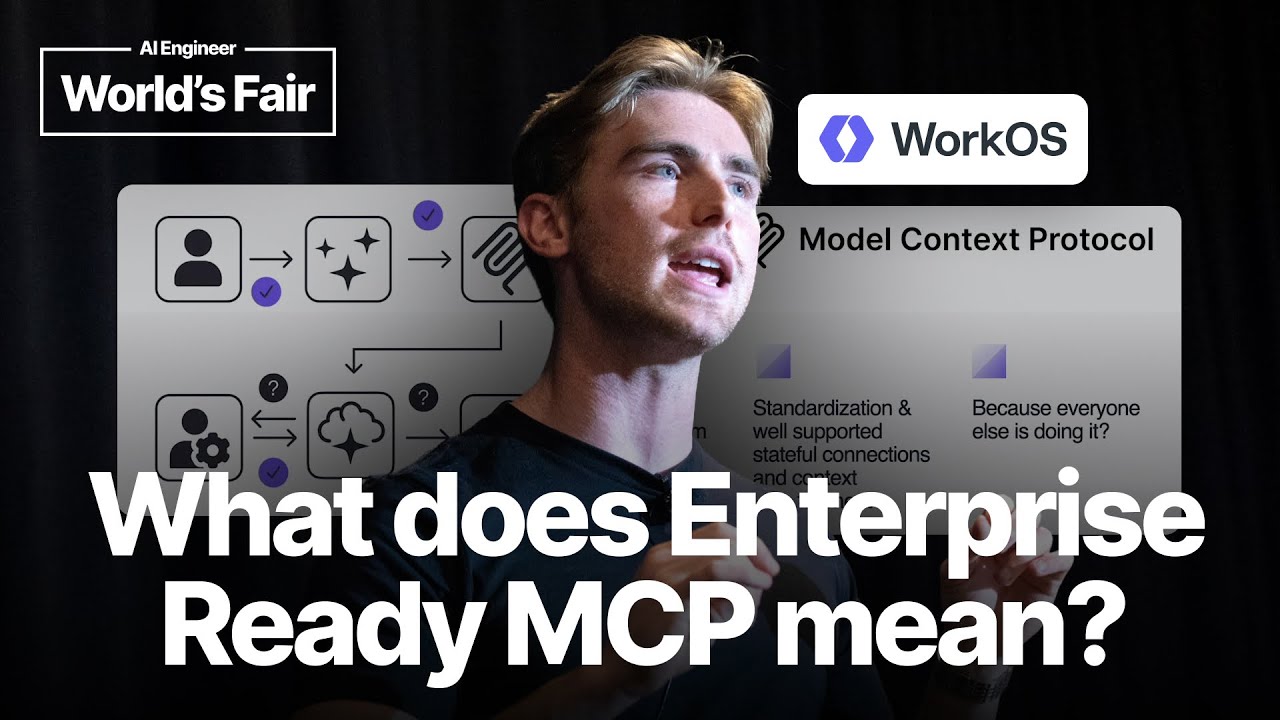
(possible dupe but better sound) What does Enterprise Ready MCP mean? — Tobin South, WorkOS
Jun 27, 2025 · 13:53
Tobin South from WorkOS explains what it takes to make Model Context Protocol (MCP) enterprise-ready, covering the full journey from a hacky local server to a production system with authentication, authorization, SSO, audit logs, and data loss prevention. He demonstrates buying a shirt via MCP live, highlighting the need for bot blocking, input validation, and adapting auth stacks for dynamic client registration. South also discusses open challenges like headless auth for remote asynchronous workloads and communicating scope between AI agents, emphasizing that authorization is the hardest part of scaling MCP to the enterprise.
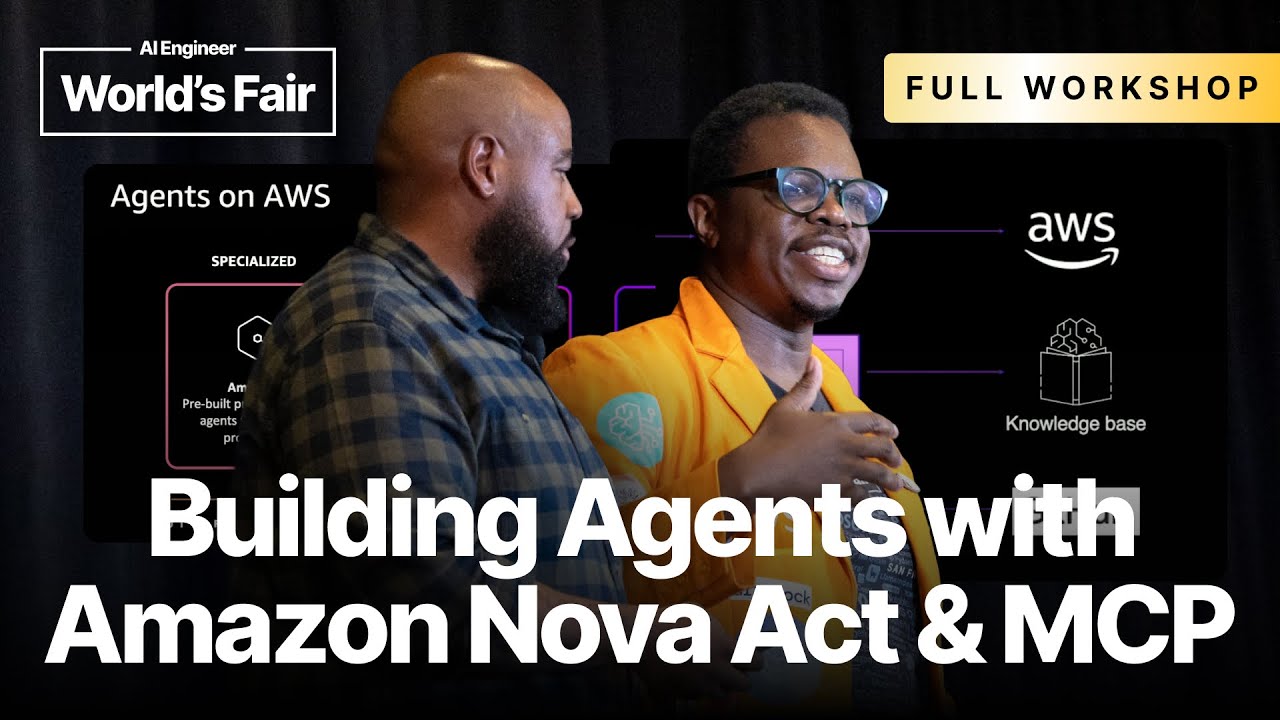
Building Agents with Amazon Nova Act and MCP - Du'An Lightfoot, Amazon (Full Workshop)
Jun 21, 2025 · 1:26:20
Du'An Lightfoot and Benjiro Byami present a workshop on building AI agents with Amazon Nova Act, Model Context Protocol (MCP), and Strands Agents, demonstrating autonomous web navigation and multi-step task execution. Lightfoot explains agentic AI as plan, action, and reasoning, with components like LLM, knowledge base, guardrails, and tools. Nova Act, a research preview, enables browser automation: one demo searches Amazon for a coffee maker and retrieves the product title using natural language commands instead of explicit HTML tags. Byami builds an MCP server for Nova Act, allowing clients like Claude Desktop to control the browser via spoken instructions, then integrates it with Strands Agents, an open-source framework that combines a prompt, LLM, and tools in minimal code. The workshop shows parallel execution (e.g., comparing three monitors) and multi-agent collaboration for tasks like generating a PowerPoint presentation for cloud migration. Limitations include inability to bypass CAPTCHAs and occasional loops in complex websites.

The Web Browser Is All You Need - Paul Klein IV, Browserbase
Jun 20, 2025 · 17:31
Paul Klein IV, founder of Browserbase, argues that the web browser is the default MCP server for the rest of the internet, serving as the essential bridge between AI agents and legacy websites that lack APIs. He distinguishes between web agents (one prompt to many actions, e.g., OpenAI's Operator) and browser tools (one action per prompt), noting that both rely on vision-driven or text-based approaches to parse pages. Klein explains that Browserbase offers a horizontal MCP server for browsing, enabling automation of any website, and stresses the need for custom evals and observability to track agent behavior. In a live demo, he shows an agent navigating sfpca.org to find a dog for adoption, handling unexpected modals. He also addresses captchas, advising good citizenship and hinting at future agent authentication solutions.

MCP: Origins and Requests For Startups — Theodora Chu, Model Context Protocol PM, Anthropic
Jun 18, 2025 · 17:45
Theodora Chu, product manager at Anthropic, explains the origin of the Model Context Protocol (MCP) as an open-source standard for giving LLMs agency to interact with external tools and data, born from two engineers copying context manually. She details MCP's evolution from an internal hack week project to wide adoption by Google, Microsoft, OpenAI, and coding tools like Cursor and VS Code. Key protocol decisions include optimizing for server simplicity over client complexity, adding streamable HTTP for bidirectionality, and fixing authentication via community contributions. Chu outlines three startup opportunities: building high-quality MCP servers for verticals beyond dev tools (80% weight), simplifying server building with hosting/testing/deployment tooling, and creating AI security and observability tools. She emphasizes that models are a third user of servers, so tool design must consider end users, client developers, and the model itself.

The Many Ends of Programming - Ray Myers
Jun 10, 2025 · 27:12
Ray Myers, Chief Architect at All Hands AI, argues that the future of software engineering is not predetermined and we have a say, categorizing competing visions into six distinct endgames: extreme completion, dev apocalypse (innovator's paradise), abstraction leap, uncharted waters, review economy, and infinite pile of garbage. He illustrates extreme completion with a real example where an AI agent generated a 48-file pull request from a Slack message, and abstraction leap via domain-specific languages (DSLs) shown in the Parcel paper’s 61 prompts producing a 220-line Lisbon interpreter. Myers warns that dev apocalypse is desirable but not yet feasible, while the review economy is a pit stop where manual review bottlenecks must be managed using Theory of Constraints. He cites contradictory studies: UpLevel found developers with coding assistants had higher bug rates, while GitHub Copilot claimed improved quality; he notes 2024 was the first year copy-pasted code exceeded refactored code, a red flag for tech debt. Ultimately, Myers urges deliberate choices: whether we want no programmers or everyone to be a programmer, and whether we prioritize quality over quantity.

MCPs are Boring (or: Why we are losing the Sparkle of LLMs) - Manuel Odendahl
Jun 10, 2025 · 28:32
Manuel Odendahl argues that MCPs (Model Context Protocols) are boring because they constrain LLMs to rigid, predefined tool calls, while LLMs truly shine as code generators that can create dynamic tools on the fly. He critiques the inefficiency of tool calling—repeating context, wasting tokens, and struggling with many tools—and advocates for an 'Eval' approach where the LLM writes and executes code (e.g., SQL, JavaScript) to solve tasks directly. Demonstrating with a JavaScript sandbox, he shows how a single Eval tool can introspect databases, write queries, create REST APIs, and even build a full CRM interface in one call, saving time and tokens. Odendahl urges engineers to think recursively: ask the LLM to write code that writes more code, unlocking infinite loops of creation and restoring the sparkle of LLMs beyond boring function calls.

Why the Best AI Agents Are Built Without Frameworks (Primitives over Frameworks) — Ahmad Awais, CHAI
Jun 3, 2025 · 27:06
Ahmad Awais, founder of LangBase/CHAI, argues that production AI agents like Perplexity, Cursor, v0, Lovable, Bolt, and CHAI itself should be built using AI primitives rather than frameworks. He demonstrates live coding a 'Chat with PDF' agent using LangBase primitives (memory, parser, chunker, threads). Awais presents eight agent architectures—augmented LLM, prompt chaining, agent router, parallel agents, orchestrator-worker, evaluator-optimizer, tool-calling, and memory-based—all built with plain code and no framework. He claims frameworks are bloated and slow, while primitives offer flexibility and automatic scaling (e.g., memory storing terabytes). Awais shows how to compose multiple LLMs (Gemini, DeepSeek Llama, Claude) in a router agent, and notes that his team has built agents for OCR, image analysis, and deep research using primitives and external tools like Mistral OCR.

Blender MCP and The Future Of Creative Tools - Siddharth Ahuja
Jun 3, 2025 · 16:50
Siddharth Ahuja introduces Blender MCP, an open-source project that lets LLMs like Claude control Blender via the Model Context Protocol, dramatically lowering the barrier to 3D creation. The tool, which has garnered 11,500 GitHub stars and over 160,000 downloads, enables users to generate complex scenes—like a dragon guarding a pot of gold or a full terrain with nodes—in minutes through natural language prompts. Ahuja explains that Blender’s scripting capabilities are key, and notes that keeping MCP tools lean avoids confusion for the LLM. He demonstrates integrations with AI asset generators and even built an Ableton MCP to create soundtracks, arguing that MCPs will become the glue for creative toolchains, allowing LLMs to orchestrate Blender, Unity, and Ableton together. This shifts creators from tool experts to orchestra conductors, unlocking a new wave of accessible content creation.

The Coherence Trap: Why LLMs Feel Smart (But Aren’t Thinking) - Travis Frisinger
Jun 3, 2025 · 20:47
Travis Frisinger argues that large language models are not intelligent but coherent, introducing 'coherence reconstruction' as a mental model for understanding their utility. He explains that hallucinations are a feature, not a bug, as models fill gaps predictably to maintain pattern completion. Prompts act as force vectors navigating latent space, and the key to reliable outputs is a 'frame, generate, judge, iterate' loop. Frisinger presents a three-layer model: latent space, execution layer (tools and RAG), and conversational interface. He advises engineers to design for emergence rather than control, using dense context as anchors to steer generation, and to watch for breakdowns in tone as early signs of lost coherence.

Arrakis: How To Build An AI Sandbox From Scratch - Abhishek Bhardwaj, OpenAI
Jun 3, 2025 · 40:18
Abhishek Bhardwaj, founder of Arrakis, explains why MicroVM-based AI sandboxes are the next unlock for AI agents, detailing how Arrakis provides secure, fast code execution and computer-use environments. He argues that sandboxes are essential for tool-calling models, reinforcement learning, and multi-tenant security, with Arrakis booting in under 7 seconds and supporting backtracking via snapshot/restore. The talk covers the choice of Cloud Hypervisor over other VMMs, overlayFS storage with per-sandbox read-write layers, iptables-based networking, and a built-in code execution server. A demo shows Claude using Arrakis via MCP to build a collaborative Google Docs clone and then revert to a snapshot, illustrating how a full Linux sandbox enables agents to autonomously debug and iterate without extensive prompting.

Will Agent evaluation via MCP Stabilize Agent Networks? - Ari Heljakka
Jun 3, 2025 · 14:11
Ari Heljakka, CEO of Root Signals, argues that agent evaluation via the Model Context Protocol (MCP) can stabilize agent networks by enabling self-improvement loops. Using a hotel reservation agent example, he shows that without MCP the agent wrongly recommended a competitor hotel, but with MCP it invoked policy evaluators and corrected its behavior automatically. He also demonstrates marketing message optimization via Cursor, where the agent scored and improved text using an MCP-connected evaluation charge. Heljakka emphasizes that success requires a powerful evaluation library with systematic lifecycle maintenance, and introduces Root Signals' free MCP server. The approach promises more controllable, transparent, and dynamically self-correcting agents across different frameworks.
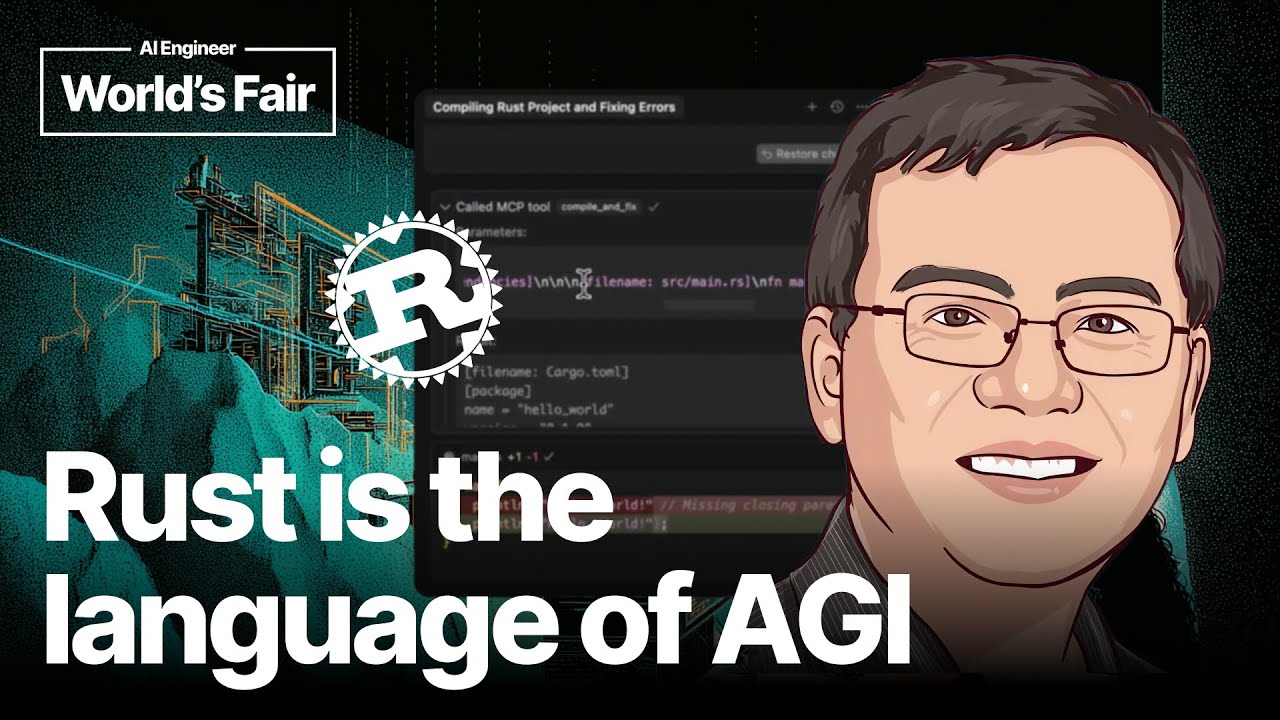
Rust is the language of the AGI - Michael Yuan
Jun 3, 2025 · 29:14
Michael Yuan argues that Rust, with its strong type system and compiler feedback, is the ideal language for AI code generation, unlike human-friendly Python or JavaScript. He presents Rust Coder, an open-source project supported by two Linux Foundation Mentorship grants, which uses MCP tools to generate, compile, and fix Rust projects. The system integrates a coding LLM (e.g., Qwen Coder) with a self-improving knowledge base of compiler errors, enabling it to generate correct code and automatically fix bugs. Yuan demonstrates its use in a Rust camp of 1000+ students and envisions future AI agents generating and deploying Rust code autonomously for tasks like drone control. He invites contributions to expand the knowledge base and enhance the tools for AGI.

Function Calling is All You Need — Full Workshop, with Ilan Bigio of OpenAI
Apr 23, 2025 · 1:42:54
Ilan Bigio from OpenAI argues function calling is the essential primitive for building AI agents, demonstrating how to implement memory, delegation, asynchronous task execution, and even self-modifying tools—all using the same loop. Starting from a basic weather tool, he builds an agent that stores user facts in a JSON file, delegates complex requests to o1, runs multiple weather lookups in parallel with asyncio, and creates a Bootstrap agent that writes its own Python functions on the fly. He also shares practical tips from his work on Swarm and the Real-Time API, including a stay-silent function to prevent premature responses and the ability to read scripts with XML tags. The workshop emphasizes that sophisticated agent behaviors emerge from simple function calling patterns without needing heavy frameworks.

The Devops Engineer Who Never Sleeps — Diamond Bishop, Datadog
Apr 22, 2025 · 16:18
Diamond Bishop, Director of AI Engineering at Datadog, explains how his team builds AI agents—the On-Call Engineer and Software Engineer—that automate DevOps tasks like incident investigation, remediation, and postmortem writing. He details how the On-Call Engineer wakes up for alerts, reads runbooks, queries logs and metrics, and suggests fixes to let human engineers sleep. The Software Engineer proactively fixes errors by generating code diffs and pull requests. Bishop shares four key lessons: scope tasks and evaluate rigorously, assemble teams of optimistic generalists and UX experts, adapt UX for human-agent collaboration, and treat observability as critical for debugging multi-step agent workflows. He predicts that within five years, AI agents will surpass humans as primary users of SaaS platforms like Datadog, urging builders to design for agent consumers.
Frontier Feud: Anthropic, Google DeepMind, Meta FAIR, Thinking Machines — Barr Yaron, Amplify
Apr 19, 2025 · 22:26
Teams from Anthropic, Google DeepMind, Meta FAIR, and Thinking Machines compete in a Frontier Feud game hosted by Barr Yaron at the AI Engineer Summit 2025. Surveyed AI engineers name Ilya Sutskever as the most influential AI researcher, with Andrej Karpathy, Jeff Hinton, and Yann LeCun also on the board. Cost is the top consideration when choosing a model, followed by latency, eval scores, and open vs. closed source. The buzzword everyone is tired of hearing is AGI, with RAG and prompt engineering trailing. In the fast money round, Cursor tops favorite AI tools, 'Attention Is All You Need' wins most influential paper, and hardware failure is the biggest 2 a.m. nightmare. The winning team, Rocco's Basilisk, takes home a massive llama and other prizes.

How Windsurf writes 90% of your code with an Agentic IDE - Kevin Hou, Windsurf
Mar 11, 2025 · 20:50
Kevin Hou, head of product engineering at Codeium, introduces Windsurf as the first AI agent-powered editor, arguing that agents are the future of software development. The editor is built on three principles: trajectories, a unified timeline that lets the agent read the user's mind and execute commands like 'continue my work'; meta-learning, which auto-generates memories of user preferences and codebase context; and scaling with intelligence, removing legacy features like chat and @-mentions as models improve. Windsurf launched three months ago and has already generated 4.5 billion lines of code, with 90% of code now written via its Cascade agent. Hou emphasizes that the agent reduces human-in-the-loop effort by inferring context, running terminal commands in the user's environment, and dynamically retrieving documentation—allowing developers to contribute less input while getting more production-ready output.

Building Agents with Model Context Protocol - Full Workshop with Mahesh Murag of Anthropic
Mar 1, 2025 · 1:44:12
Mahesh Murag of Anthropic presents the Model Context Protocol (MCP) as an open standard that replaces fragmented integrations with a single protocol for connecting AI systems to data sources, enabling context-rich AI applications and agentic experiences. He explains MCP's philosophy, inspired by APIs and LSP, and its three interfaces: tools (model-controlled), resources (application-controlled), and prompts (user-controlled). Murag highlights adoption with over 1,100 community-built servers and official integrations from companies like Cloudflare and Stripe. He demonstrates building agents with MCP using the MCP-Agent framework, showing how agents can use tools dynamically and composably across hierarchical systems. Future plans include remote server support with OAuth 2.0, a centralized registry for discovery and verification, and enabling agents to self-evolve by dynamically finding new capabilities via registry search.
The Price of Intelligence - AI Agent Pricing in 2025
Feb 22, 2025 · 20:38
Shitej, co-founder and CTO of Orbe, argues AI agent pricing must continuously evolve, citing Intercom's 99 cent per resolution outcome model, Clay's prospecting credits, and Cursor's tiered usage limits. He stresses aligning pricing with target audience—SMB vs. enterprise—and maintaining simplicity and predictability. Cost structure is key: Character.AI optimized inference to support 100M DAUs, while Jasper leveraged a model decision engine to offer unlimited credits. Shitej emphasizes flexibility, noting OpenAI's price drops force repricing, and predicts 2025 will see more unlimited plans, outcome-based pricing with SLAs, and greater investment in pricing R&D for usage visibility.

WTF do people use Open Models for??
Feb 22, 2025 · 28:01
Eugene Cheah of Featherless.ai breaks down how individuals and enterprises actually use open-source AI models, based on platform data. DeepSeek R1 dominates individual usage, but Mistral Nemo 8B remains the top enterprise model due to production stickiness and Apache 2.0 licensing. Creative writing and roleplay account for 30–40% of all traffic, with over 60% of users in that segment being women; coding copilots and agents make up 20–30%, driven by 'vibe coding' and token-hungry workflows like Kline. RAG and ChatGPT clones represent 20%, while agentic workflows (10–20%) succeed with human-in-the-loop designs. Cheah advises enterprises to aim for 80% automation with escape hatches, and warns against chasing 100% reliability. He concludes by introducing Quirky, a post-transformer hybrid built for $100k.
Your AI Agent Isn't an Engineer: The Art of Thoughtful Anthropomorphism
Feb 22, 2025 · 20:20
Rizel Scarlet, a staff developer advocate at Block, argues that marketing AI agents as "software engineers" creates unrealistic expectations and alienates developers. She explains that such anthropomorphism—attributing human traits to AI—stems from lazy marketing to executives, but it backfires by making developers feel threatened and discrediting products when AI fails to meet human-level performance. Citing a Wired article, she notes 52% of game companies have adopted generative AI, yet 30% of surveyed developers expressed negative sentiment. To build trust, she proposes a framework: understand how AI works (e.g., the agentic loop), use non-human names like "copilot" (pioneered by GitHub), focus on augmentation over replacement, be transparent, give developers control, show real demos (including live troubleshooting), provide clear documentation, and foster open collaboration (e.g., Cursor.Directory). The episode reframes AI as a tool to work in parallel, not a replacement.
How Coding Agents change Software Development Forever - Hailong Zhang
Feb 22, 2025 · 8:50
Hailong Zhang presents how coding agents, particularly the unit test agent Gru, transform software development by automating routine tasks while humans focus on creative work. In the future workflow, synchronous agents like GitHub Copilot and Cursor assist in real-time, while asynchronous agents like Gru autonomously handle tasks such as writing tests, fixing bugs, and submitting pull requests. Gru, built to boost unit tests, detects code changes from pull requests, generates and runs tests, and submits a new PR with a summary and coverage improvement. In production, over 50% of Gru's PRs are accepted by humans, and it handles 80% of unit tests in its own repo, making it the top contributor. To build such agents, Zhang emphasizes defining a clear problem (e.g., unit tests, not generic software engineering), creating datasets and evaluation harnesses, selecting and fine-tuning LLMs per stage, building task-specific context from environment data, and developing an agent operating system to reuse common infrastructure across different tasks.

Customized, production ready inference with open source models: Dmytro (Dima) Dzhulgakov
Feb 16, 2025 · 18:55
Dmytro (Dima) Dzhulgakov, co-founder and CTO of Fireworks AI, argues that open source models are the future for production Gen AI applications, and Fireworks provides a platform to make them customized and production-ready. He explains that while proprietary models like GPT-4 are powerful, they are too large, expensive, and slow for many use cases, whereas open models like Llama or Gemma can be fine-tuned for specific domains to achieve better quality at up to 10x speed and lower cost. The main challenges of using open models—complex setup, performance tuning, and production scaling—are addressed by Fireworks' custom serving stack, which achieves the fastest long-prompt inference and serves SDXL fastest among providers, handling over 150 billion tokens per day. The platform supports fine-tuning and serving thousands of LoRA adapters on the same GPU with serverless pay-per-token pricing. Dzhulgakov also highlights the emerging architecture of compound AI systems, where function calling—exemplified by the open-source Fire Function model—connects LLMs to external tools and knowledge sources, enabling agentic applications like stock querying and chart generation. The episode…

Which Jobs Can Be Replaced Today: Fryderyk Wiatrowski and Peter Albert
Feb 6, 2025 · 19:59
Fryderyk Wiatrowski and Peter Albert, co-founders of Zeta Labs, argue that autonomous browser agents will first replace reactive jobs—like customer support and scheduling—by automating low-leverage tasks while preserving human focus on high-leverage activities. They propose a trigger-pool system where agents react to emails, Slack, or events, requiring only approval for actions. Peter details building reliable agents: start with prompting optimized for model distribution, then add cognitive architectures (e.g., planning, scratchpads) to split tasks, and finally fine-tune with synthetic data or reinforcement learning. He advises minimizing noise in prompts, preferring text-based reasoning over images, and using language model judges to filter training data. The founders see continuous model improvement enabling agents to handle increasingly complex, proactive roles, moving toward full job replacement.

The AI emperor has no DAUs why most devs still don't use code AI: Quinn Slack
Nov 20, 2024 · 18:45
Quinn Slack, CEO and cofounder of Sourcegraph, argues that despite massive hype, only about 5% of professional developers actually use Code AI tools, with total recurring revenue from Code AI sitting at roughly $300 million ARR—a fraction of Salesforce's $36 billion. He cites GitHub's 1.3 million paid Copilot subscribers and just 935,000 yearly active users receiving suggestions, revealing the gap between perception and reality. Slack warns that the entire AI ecosystem—foundation models, infra, and applications—risks collapse if usage doesn't grow, and most revenue in AI flows to NVIDIA and chip makers, not software. From building Cody, the number two Code AI product, he shares lessons: hype fools everyone, autocomplete is a freakishly good feature that spoils expectations, while chat and agents are harder to vet and adopt. He advises builders to use their own product daily, ignore customer demands for buzzwords like fine-tuning, and manually build explicit interactions before adding magic. Slack concludes that the industry must collectively dehype and focus on real daily active users to turn the potential into sustained enterprise revenue.
Making Open Models 10x faster and better for Modern Application Innovation: Dmytro (Dima) Dzhulgakov
Oct 9, 2024 · 18:55
Dmytro Dzhulgakov, CTO of Fireworks AI, argues that open-source models are the future for GenAI applications because they offer lower latency, lower cost, and domain adaptability compared to proprietary models. He explains that open models can be up to 10x faster for narrow domains and cut costs significantly, using examples like fine-tuned Llama 3 for function calling. Fireworks addresses the challenges of setup, optimization, and production readiness with a custom serving stack that delivers the fastest inference for long prompts and image generation (e.g., SDXL). He highlights FireFunction V2, an open-source model for function calling that combines chat and tool use, and notes that Fireworks serves over 150 billion tokens per day for companies like Quora and Cursor. The talk emphasizes that platforms like Fireworks enable developers to start with serverless inference, fine-tune models, and scale to enterprise-grade deployment with dedicated hardware.

The Making of Devin by Cognition AI: Scott Wu
Jul 11, 2024 · 20:04
Scott Wu, co-founder and CEO of Cognition AI, demonstrates Devin, a fully autonomous AI software engineer that builds and deploys working applications from plain English instructions, sharing the early lessons and vision behind the product. Devin built a name game website for the AI Engineer World's Fair in minutes, iterating on feedback to hide names, add a streak counter, and deploy the final version. Cognition uses Devin internally for features like a search bar and dashboards; Wu notes that engineers typically spend 80–90% of time on implementation, but Devin frees them to focus on architecture and problem-solving, making them 5–10x more productive while increasing overall demand for software. He also highlights the UX challenges of agents, which require new interactions beyond text completion, and notes that access to Devin is expanding via a waitlist.

From Text to Vision to Voice Exploring Multimodality with Open AI: Romain Huet
Jul 10, 2024 · 23:39
OpenAI's Romain Huet demonstrates GPT-4o's real-time audio, vision, and screen-sharing capabilities at the AI Engineer World's Fair, showing how the omni-model achieves human-like conversational latency, understands emotion, and can be interrupted naturally. He walks through live demos of ChatGPT Desktop recognizing drawings, reading book pages, and pair-coding a responsive travel app using Tailwind CSS. Huet also previews Sora's text-to-video generation and OpenAI's unreleased Voice Engine, which can clone a voice from seconds of audio and translate it into multiple languages while preserving the original speaker's tone. He outlines OpenAI's four focus areas: advancing textual intelligence, faster/cheaper models (GPT-4o is twice as fast as GPT-4 Turbo at half the price), model customization via fine-tuning, and enabling multimodal agents. The talk emphasizes that today's models are the dumbest they'll ever be and urges developers to build for a future where AI works across text, voice, and video.
Powered by PodHood