
Vibe Coding
Episodes from AI Engineer about Vibe Coding.
40 episodes
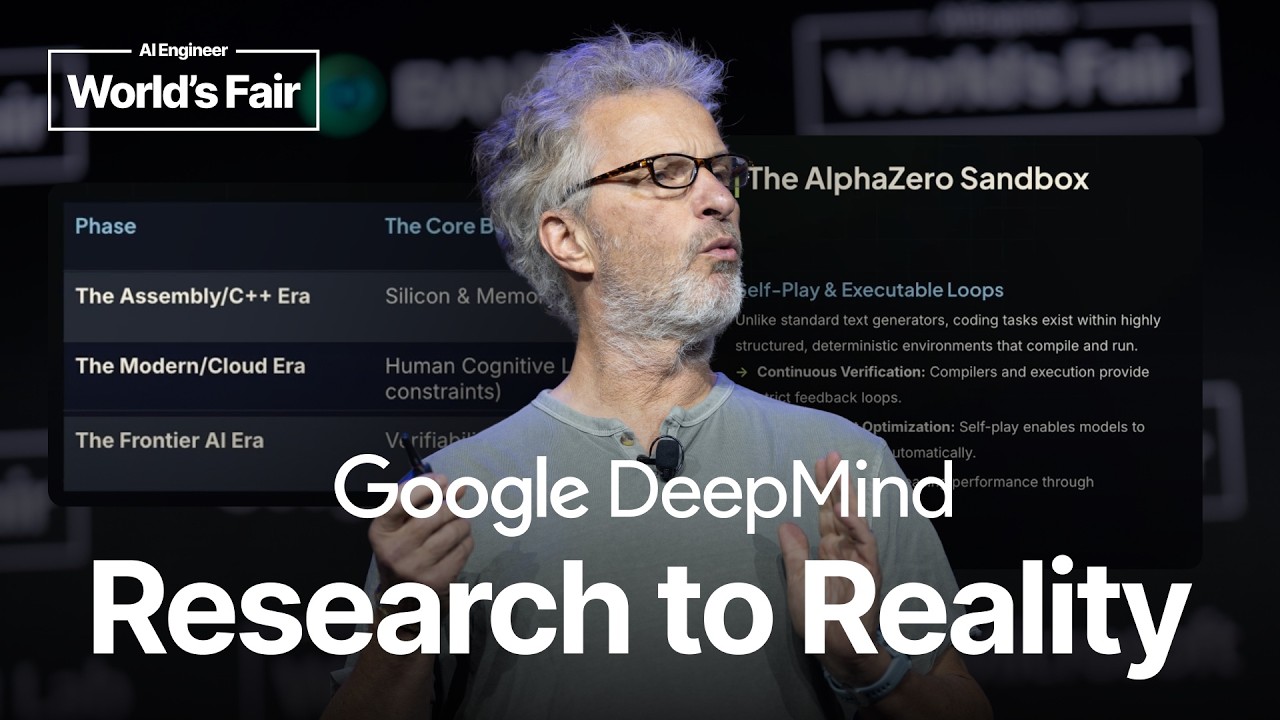
"Software engineering is not about writing code" — Benoit Schillings, Google DeepMind VP of Research
Jul 17, 2026 · 20:26
Benoit Schillings, VP of Technology at Google DeepMind, argues that the era of syntax generation is over, with AI now capable of superhuman code writing, shifting the bottleneck to architecture and validation. He explains that 80% of new code on GitHub is machine-generated, leading to a saturation of human training data and the need for self-play techniques inspired by AlphaZero. Schillings highlights DeepMind's use of self-play to generate and verify coding challenges, enabling models to reach superhuman performance. He emphasizes the shift to inductive architecture, where models must plan, decompose complex problems, and transfer knowledge across domains. Additionally, he calls for new programming languages designed for models rather than humans, and explores how AI's rapid experimentation will transform fields like chemistry and biology by uncovering patterns invisible to humans.
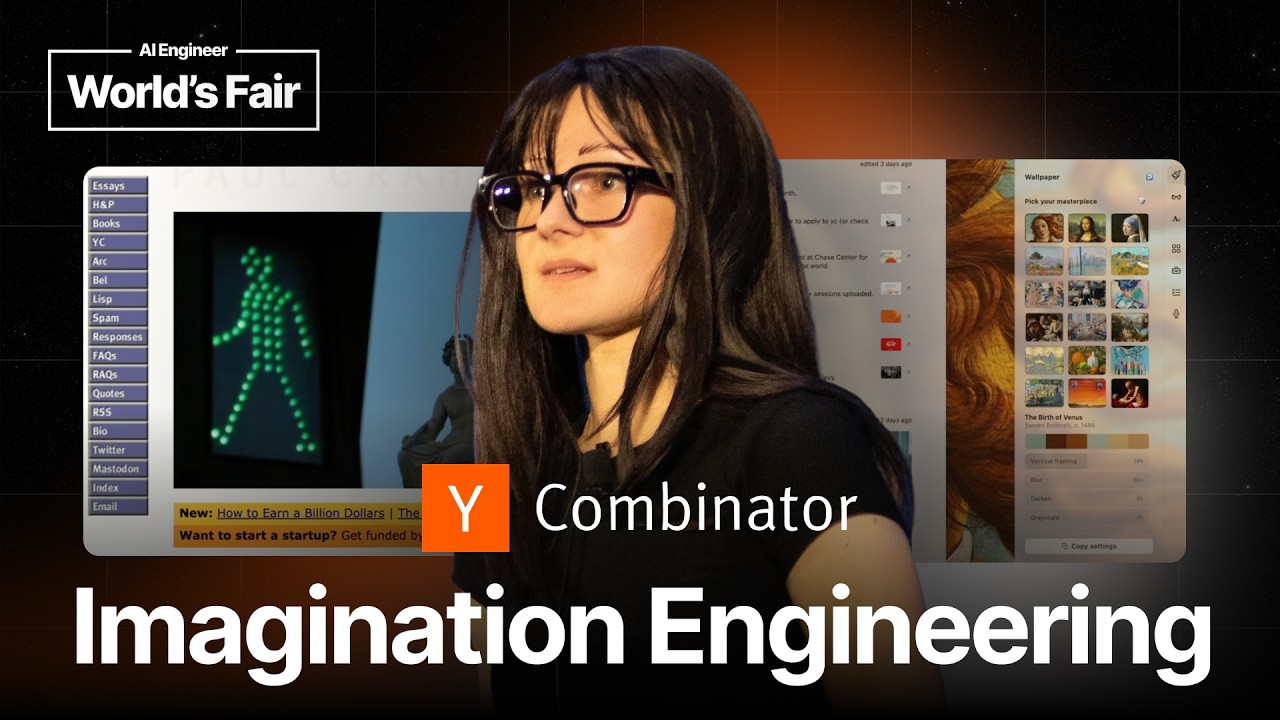
Imagination Engineering — Eve Bouffard, Head of Design, Y Combinator
Jul 16, 2026 · 16:04
Eve Bouffard, Head of Design at Y Combinator, introduces 'Imagination Engineering' as the art of stretching the mind to invent what seems impossible, arguing that idea generation is the new bottleneck as AI models become incredibly capable. She shares her experiment in 'thinking in public' with a Slack channel called 'Eve Thoughts,' where she dumps her stream of consciousness, and then used Opus 4.8 to build a personalized website (EveBouffard.com) that aggregates and visualizes those thoughts. The site dynamically surfaces her projects, quotes, tools, and books, and even applies shaders and translations. She also built 'Shape of Minds'—a tool that analyzes commonalities across history's greatest minds, revealing patterns like taking naps and barely eating. Bouffard demonstrates how to spin up agents on demand for learning and productivity, emphasizing that anyone can now create software on the fly from their stream of consciousness.
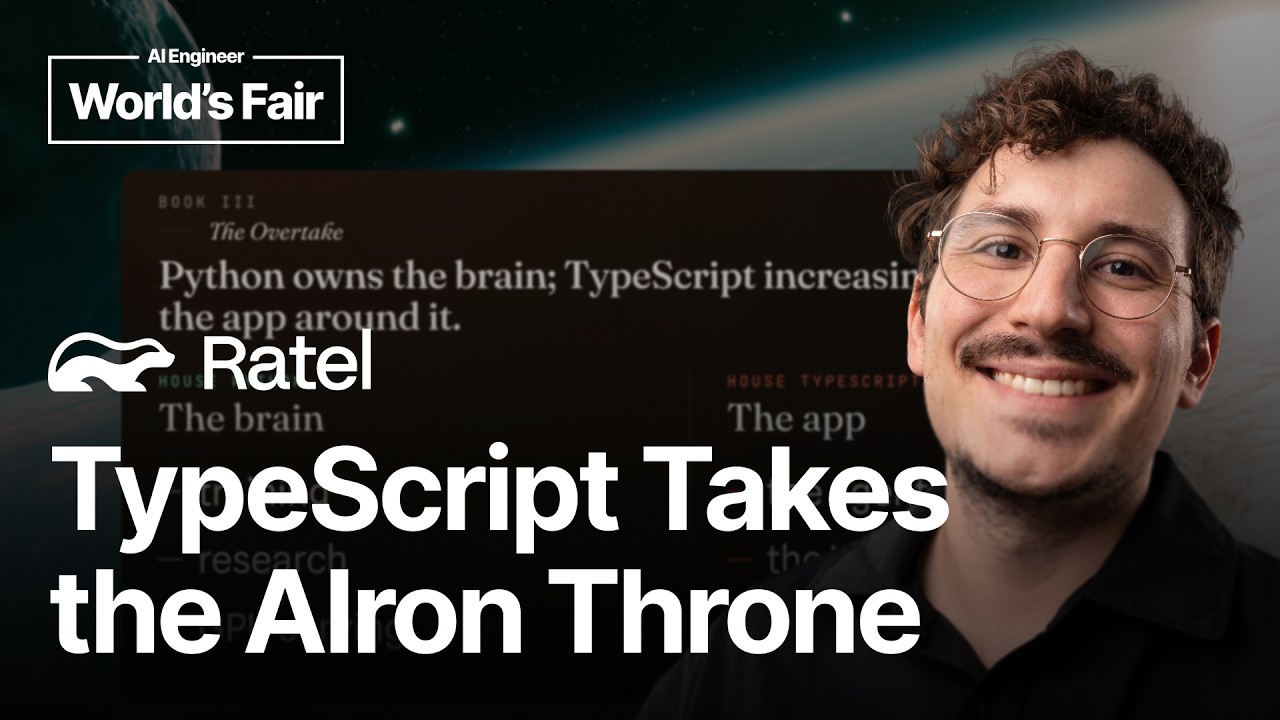
A Song of Types and Agents - Roberto Stagi, Ratel
Jul 12, 2026 · 14:16
Roberto Stagi (Ratel) argues that TypeScript is overtaking Python as the dominant language for building AI agents and applications, driven by the rise of coding agents like Lovable, Claude Code, and Cursor that default to TypeScript. He notes that Python still rules training, research, and GPU serving, but the application layer—where AI is shipped inside products—now belongs to TypeScript. Stagi highlights that TypeScript surpassed Python as the most used language on GitHub in August 2025, with GitHub attributing the shift to AI agents. He cites the Vercel AI SDK growing from 1.6M to 15.1M weekly downloads in one year and npm's rich ecosystem of authentication, payments, and UI packages as reasons to build agents in TypeScript. Consistent end-to-end typing via Zod and a unified codebase for agent loops, tools, backends, and UIs further strengthen the case. Stagi concludes by invoking Atwood's Law: any application that can be written in JavaScript will eventually be written in TypeScript, urging developers to build agents in TypeScript to avoid falling behind.

500 people vibe-coded for 30 days. I was one of them. - Sanja Grbic, Automattic
Jul 7, 2026 · 17:49
In Automattic's Radical Speed Month, a 30-day experiment where over 500 employees paused roadmap work to ship real projects, product designer Sanja Grbic built three distinct products—a board game session manager, a design system status tracker, and an iOS chat for WooCommerce merchants—demonstrating how AI tools like Claude Code and ContextAIC can transform roles and unlock speed. The first project showed that engineers become enablers when they set up non-engineers for coding success. The second project, completed in two and a half weeks, moved Grbic from designer to design engineer by owning the full build, from proof of concept to deployment. The third project, built in just six days with a fellow designer, proved that shared understanding of AI workflows collapses iteration time. Grbic argues that large organizations can replicate this by providing tool access, finding enablers, creating space for experimentation, and granting agency—shifting human behavior to break out of established habits and release the velocity AI offers.

How to talk to statues — Joe Reeve, ElevenLabs
Jun 1, 2026 · 33:28
Joe Reeve, an ElevenLabs growth engineer, built an app that lets users talk to statues by pointing their phone at one—it identifies the statue via OpenAI deep research, generates a matching voice with ElevenLabs' voice design API, and starts an ElevenLabs agent conversation—all in 30 seconds. He created it in two hours on a Sunday using Cursor and a single prompt, posted it on Tuesday, got 50,000 impressions, then reposted about vibe coding and hit 1.5 million. Museums, auction houses (Bonhams, Christie's), and travel platforms reached out; one CEO tracked down his WhatsApp, saying a team of 10 had worked on a similar project for a year. The episode explores voice interaction patterns, the challenge of interrupting agents, the need for multimodal interfaces (voice plus visual), and the potential of vibe coding to democratize software creation, with Joe noting that music and captions are key to viral videos.

Why Rust is the Ideal Language for Vibe-Coding — Daniel Szoke, Sentry
May 27, 2026 · 16:25
Daniel Szoke, Sentry's Rust SDK maintainer, argues Rust is ideal for vibe-coding: its compiler enforces correctness, catching bugs that Python and TypeScript allow to compile and run. He challenges the preference for easy-to-write languages, warning that dynamic typing and null values invite subtle bugs. Szoke highlights Rust's type safety, null safety, and fearless concurrency, demonstrating with a 100-thread counter where TypeScript's data race compiles and fails intermittently while Rust rejects it with an error naming the non-Send type. He argues every compile error an agent fixes is a production bug avoided, and the Rust compiler is faster and more reliable than a review agent.
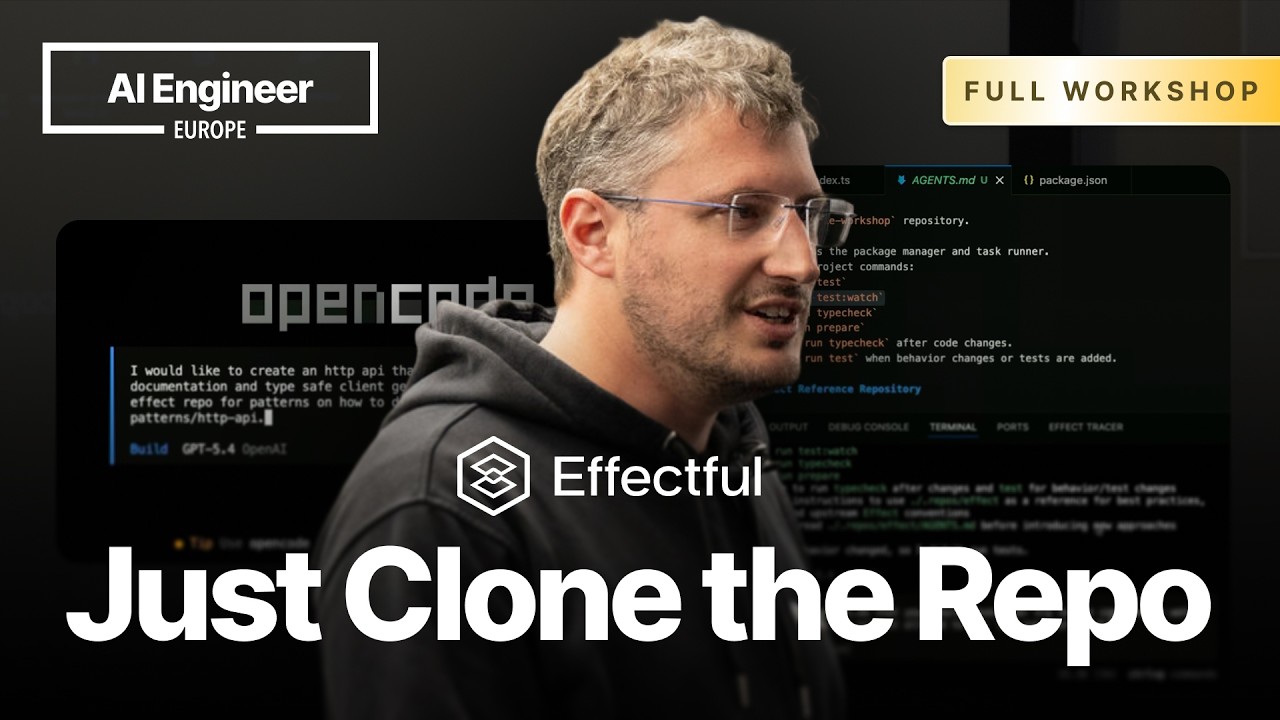
Vibe Engineering Effect Apps — Michael Arnaldi, Effectful
May 7, 2026 · 1:43:04
Michael Arnaldi demonstrates that cloning the Effect library's repository into a project, rather than relying on prompts, is the most effective way to give coding agents the context they need to build reliably with Effect. Starting from an empty repo, he sets up a Bun, Vitest, and TypeScript project, adds the Effect repo as a git subtree, and creates an agents.md to guide the agent. He then uses the agent to research patterns, resulting in a fully functional Todo HTTP API with OpenAPI docs, SQLite persistence, and tests — all from scratch in under two hours. The workshop stresses that treating the library code as part of the project, combined with strict diagnostics and pattern files, makes agents effective even in unfamiliar codebases. Arnaldi also discusses the importance of workflow systems like Effect Cluster for long-running AI processes, where server failures become likely.

Software Engineering Is Becoming Plan and Review — Louis Knight-Webb, Vibe Kanban
May 2, 2026 · 20:23
Louis Knight-Webb, founder of Vibe Kanban, argues that software engineering is becoming all about planning and reviewing AI-generated code, not writing it. He presents two approaches: plan-heavy (spending time on specs to minimize review) and review-heavy (letting agents run and correcting output), noting five minutes of planning saves thirty minutes of review. As agents run longer—crossing the five-minute threshold—engineers must parallelize multiple agents and manage workflows, which Vibe Kanban aimed to facilitate. Knight-Webb announces shutting down Vibe Kanban despite 30,000 monthly active users because it resold tokens to enterprises and struggled to make money, advising that enterprise sales are crucial. He reflects on the journey positively, emphasizing learning to work with great people and the importance of hard work.
Taste & Craft: A Conversation with Tuomas Artman, CTO Linear & Gergely Orosz, @pragmaticengineer
Apr 21, 2026 · 29:17
Tuomas Artman, CTO of Linear, warns that AI's ability to instantly ship features risks creating convoluted, low-quality software, arguing that taste and design must guide development. He explains Linear's culture of deliberate product decisions, including a 'zero bug policy' where bugs are fixed within hours, and 'Quality Wednesdays' where engineers find and fix one minute detail each week—resulting in over 2,500 quality fixes. Artman notes that AI lacks human 'taste' and cannot feel user experience nuances like animation timing. He predicts all software engineers will become product engineers, needing to focus on customer needs and UX, and advises aspiring product engineers to build for themselves, talk to customers, and study Apple's Human Interface Guidelines.

The Friction is Your Judgment — Armin Ronacher & Cristina Poncela Cubeiro, Earendil
Apr 18, 2026 · 18:38
Armin Ronacher (creator of Flask) and Cristina Poncela Cubeiro argue that while AI coding agents promise frictionless shipping, the resulting loss of human judgment introduces dangerous technical debt and brittleness. They describe the psychological trap of addictive speed and the engineering challenge of agents producing slop that creates hidden failure conditions. To counter this, they advocate for agent-legible codebases that modularize both code components and flow, enforce strict linting rules such as no bare catch-alls and unique function names, and deliberately reintroduce friction in high-stakes decisions like database migrations and permission changes. They note that agents excel at libraries with simple cores but struggle with products built on intertwined concerns, and that human responsibility must remain central as code production outpaces review capacity.

State of the Claw — Peter Steinberger
Apr 17, 2026 · 44:12
Peter Steinberger, creator of OpenClaw, presents a five-month update on the world's fastest-growing open-source project. He details the project's staggering growth—30,000 commits, nearly 2,000 contributors—and the immense security burden: 1,142 advisories (16.6 per day) with 99 critical, often AI-generated slop that demands human vetting. Steinberger refutes media fearmongering, citing how researchers ignore security docs to fabricate scary scenarios. He clarifies OpenAI did not buy OpenClaw; he joined the company while establishing the OpenClaw Foundation to remain vendor-neutral. He emphasizes the importance of local models for data sovereignty and describes his coding workflow of running 5-6 agent sessions simultaneously, iterating on taste and personality. Future visions include ubiquitous agents, 'Dreaming' for memory reconciliation, and modular plugins. For engineers, he champions taste, system design, and learning to say no.

Spec-Driven Development: Agentic Coding at FAANG Scale and Quality — Al Harris, Amazon Kiro
Jan 9, 2026 · 1:03:50
Al Harris, principal engineer at Amazon, presents Spec-Driven Development (SDD) with Kiro, an agentic IDE that transforms prompts into structured requirements (EARS format), designs, and property-based tests to ensure code correctness. He argues that upfront specification—augmented by MCP servers for external context—improves reproducibility and quality over pure vibe coding. The talk includes a live demo: building an S3-backed checkpointer for a LangGraph dad joke generator, then discovering Agent Core’s native memory is more idiomatic. Harris contrasts SDD with Cursor’s planning mode, explains how specs evolve as living documentation, and discusses handling session length, context pruning, and brownfield codebases. The result is a claim that spending 5–10 minutes on specs yields higher accuracy and reliable, testable outputs.

The Infinite Software Crisis – Jake Nations, Netflix
Dec 20, 2025 · 18:57
Jake Nations, engineering lead at Netflix, argues that AI-generated code accelerates the software crisis by conflating easy with simple—producing tangled, incomprehensible systems. He traces the crisis from 1968 to today's infinite code generation, citing Fred Brooks' 'No Silver Bullet' and Rich Hickey's definition of simple as 'one fold, no entanglement.' Nations presents a three-phase methodology—research (compressing 5 million tokens of code into a 2,000-word spec), planning (paint-by-numbers implementation steps), and implementation (using a manual migration seed)—to maintain human understanding. He warns that without this approach, engineers lose the ability to recognize dangerous complexity, and challenges listeners: will we still understand our own systems when AI writes most of the code?

Dispatch from the Future: building an AI-native Company – Dan Shipper, Every, AI & I
Dec 18, 2025 · 17:58
In this episode, Dan Shipper of Every argues that there is a 10x difference between an organization where 90% of engineers use AI and one where 100% do. At Every, 99% of code is written by AI agents, enabling 15 people to run four software products with 7,000 paying subscribers, each built by a single developer. Shipper introduces 'Compounding Engineering', where each feature makes the next easier to build through a loop of plan, delegate, assess, and codify. He describes how this approach allows managers to commit code, enables tacit code sharing across products, and lets new hires be productive on day one. The episode details how Every's shift to agentic workflows (Claude Code, Codex) and a 'demo culture' over 'memo culture' has transformed their engineering velocity and collaboration.

Building in the Gemini Era – Kat Kampf & Ammaar Reshi, Google DeepMind
Dec 15, 2025 · 17:57
Kat Kampf and Ammaar Reshi from Google DeepMind present Gemini 3 and Nano Banana Pro, arguing that these models enable anyone to build complex, aesthetic applications through natural language alone. Gemini 3 achieves state-of-the-art results in one-shot UI design and agentic tool calling, with SweBench outperformance. Nano Banana Pro integrates Google Search for world knowledge and renders text accurately, handling up to 14 consistent people per image. They demonstrate vibe coding in AI Studio, building a personalized comic book with precise text, laptop stickers grounded in search, and a 3D racing game that scaled to 23 players live. Upcoming full-stack runtime adds backend support and automatic database integration, further democratizing software creation.

From Vibe Coding To Vibe Engineering – Kitze, Sizzy
Dec 14, 2025 · 25:28
Kitze, founder of Sizzy, argues that "vibe engineering"—actively steering AI agents with technical knowledge—trumps passive "vibe coding" for building real software. He shares how Cursor's Composer 1 let him port Benji.so and Glink to Next.js 16 with Monorepo in under a week, reviving near-dead projects. Kitze insists LLMs excel at React because humans are bad at it, and that repetitive code is fine since agents don't care. He warns against giving AI tools to juniors without oversight, and predicts the bottom of the job market will thin as agents replace interns. The talk ends with a pitch for "vibe code fixers" as a new role, maintaining legacy systems like cowboy coders.
2026: The Year The IDE Died — Steve Yegge & Gene Kim, Authors, Vibe Coding
Dec 6, 2025 · 24:59
Steve Yegge and Gene Kim argue that by 2026, traditional IDEs will be obsolete, replaced by AI-driven coding agents. Yegge claims current tools like Claude Code are too hard for most developers, with high cognitive overhead and a single-agent bottleneck akin to a solo diver running out of oxygen. He predicts next year will bring multi-agent systems, comparing the shift from manual tools to CNC machines, and provocatively states that engineers using an IDE after January 1st are bad engineers. Gene Kim introduces their 'Vibe Coding' book and shares case studies: Booking.com saw double-digit productivity gains, Travelopia replaced a legacy app in six weeks with a small team, and a Fidelity leader Vibe Coded an app in five days that previously was estimated to take five months. They present the FAFO framework (Faster, Ambitious, alone/autonomous, Fun, Optionality) and cite DORA research showing trust in AI grows with usage. The episode concludes that Vibe Coding will reshape organizations, enabling non-developers to ship features and potentially compressing team sizes.

Backlog.md: Terminal Kanban Board for Managing Tasks with AI Agents — Alex Gavrilescu, Funstage
Nov 24, 2025 · 14:19
Alex Gavrilescu presents Backlog.md, an open-source CLI tool that stores tasks as Markdown files in Git repos, featuring a terminal Kanban board and MCP server for AI agents. He argues that breaking features into atomic Markdown tasks prevents agents from running out of context or implementing unwanted extras. The demo shows Claude creating a task from requirements, generating an implementation plan, and coding a move-mode feature—all via MCP tools. Gavrilescu emphasizes two review checkpoints (after task creation and after the plan) and notes that Backlog.md itself is 99% AI-written. The tool works cross-platform, requires no external APIs, and syncs across branches via Git.
The Cure for the Vibe Coding Hangover — Corey J. Gallon, Rexmore
Nov 24, 2025 · 57:02
Corey J. Gallon presents a framework to cure the 'vibe coding hangover'—the despair of building unmaintainable demoware with AI coding agents. He argues that treating AI as a pure productivity tool leads to brittle code and dependency, so his framework centers on ten principles: AI engineering as accelerated learning, the architect-implementer boundary, slowing down to go fast, specification over prompt engineering, defining 'done' before implementing, feature atomicity, dependency-driven development, implementing one atomic feature at a time, context engineering, and 'make it work, make it right, make it fast.' The process splits into a planning phase (vision capture, feature identification, iterative specification, dependency analysis, implementation plan) and an implementation loop that uses multisensory feedback (visual, auditory, tactile) to validate each atomic feature. This framework has been used to build real applications such as litigation support for law firms and real-time appliance monitoring.

#define AI Engineer - Greg Brockman, OpenAI (ft. Jensen Huang)
Aug 10, 2025 · 41:05
Greg Brockman, co-founder and president of OpenAI, discusses his journey from Stripe's first CTO (growing from 40 to 250 people) to leading AI development, sharing insights on independent study (completing three years of high school math in one year), the engineering-research partnership at OpenAI (emphasizing technical humility), and scaling challenges like ChatGPT hitting 1 million users in five days and ImageGen reaching 100 million in five days. He explains how Codex transforms coding (low double-digit percent of internal PRs written by Codex, 24,000 PRs merged in public GitHub in one day) and introduces "vibe coding" as an empowerment mechanism. In response to Jensen Huang's questions, Brockman predicts a future with diverse AI infrastructure (homogeneous accelerators as default, purpose-built for specific workloads) and a menagerie of domain-specific agents leveraging distillation, driving 10x more economic activity. He identifies basic research as a renewed scaling bottleneck alongside compute, data, algorithms, power, and money.

Vibe Coding with Confidence — Itamar Friedman, Qodo
Aug 6, 2025 · 20:55
Itamar Friedman, CEO of Qodo, argues that the command-line interface (CLI) is the future for achieving 'vibe coding with confidence' in enterprise software development. He contrasts vibe coding's greenfield success with the challenges of large codebases, where context, workflows, and multi-agent collaboration are essential. Friedman explains Qodo's multi-agent architecture, including tools for code review (Qodo Merge) and coverage (Qodo Cover), and announces the soft launch of a new CLI tool that lets developers create and pipe agents, supporting MCP and A2A protocols. He envisions a future 'swarm of agents' each specialized with credentials and best practices, enabling end-to-end workflows across the SDLC. The episode emphasizes moving from chat-based agents to command-driven multi-agent systems for reliable, high-quality code generation.
How to Improve your Vibe Coding — Ian Butler
Aug 3, 2025 · 7:30
Ian Butler (CEO of BizMyth) presents benchmark data showing that popular coding agents like Devin and Cursor have less than 10% true positive rates for finding bugs, with Cursor producing a 97% false positive rate across 100+ repos and 1,200+ issues. He argues that these agents overrun codebases with false positives, causing alert fatigue and bugs reaching production. To improve vibe coding, he recommends adding bug-focused rules (e.g., OWASP Top 10, explicit bug classes like auth bypasses), managing context by feeding diffs and preventing file summarization, and using thinking models which were significantly better at finding deeper bugs. However, even thinking models show high variability in which bugs they find across runs, indicating agents never holistically examine a file. The talk concludes with a plug for BizMyth.sh, which automates PRs and vulnerability scanning.

Vibes won't cut it — Chris Kelly, Augment Code
Aug 3, 2025 · 15:34
Chris Kelly of Augment Code argues that vibe coding—letting AI write code without review—fails for production systems, where every line of code carries maintenance burden and decisions about architecture, packages, and trade-offs. He contends that code generation is not the job; software engineering is changing code safely, requiring context that LLMs lack despite their human-like output. Claims that generating 30% of code against millions of existing lines leaves little wiggle room, and that complex systems have emergent failures that pattern matching can't fix. He advises documented standards, reproducible environments, easy testing, clear boundaries, and defined tasks—tools every engineer needs. Cites Jeff Atwood: 'The best code is no code at all.' Notes professional engineers are slowest to adopt AI, and suggests code review is the most important skill for an AI-assisted future.

Real World Development with GitHub Copilot and VS Code — Harald Kirschner, Christopher Harrison
Aug 3, 2025 · 1:19:33
Harald Kirschner demonstrates three stages of Vibe Coding with GitHub Copilot and VS Code—YOLO, Structured, and Spectrum—arguing that developers can move from rapid prototyping to maintainable, scalable AI-assisted development. He shows how to use Agent mode, auto-approve settings, and new workspace scaffolding to build a hydration tracking app with React Vite and Material Design without looking at code. The talk covers custom instructions, MCP servers (Playwright, Jest Pad, Perplexity), and custom modes like TDD that enforce test-driven development by writing failing tests first. Kirschner explains how to constrain tools for deterministic behavior using tool sets and recommends committing often, pausing AI when needed, and iterating on instructions. He also discusses spec-driven development, critiquing specs with AI, and the importance of well-structured codebases for AI productivity.
Shipping Products When You Don't Know What they Can Do — Ben Stein, Teammates
Jul 28, 2025 · 19:34
Ben Stein, founder of Teammates, argues that product management for AI agents requires abandoning traditional specs and embracing uncertainty. He describes how his team discovered emergent behavior when a customer asked to tag an agent in a Google Doc comment—an unplanned feature that worked. Stein advocates thinking in affordances rather than features, using evals as the new spec, and vibe coding to feel interactions before committing. He notes that bugs become ambiguous when behavior is probabilistic, and customer meetings shift from selling vision to co-inventing the future. The episode offers a field guide for product teams navigating boundless surface areas built on unpredictable LLMs.

Books reimagined: AI to create new experiences for things you know — Lukasz Gandecki, TheBrain.pro
Jul 22, 2025 · 9:44
Łukasz Gandecki of TheBrain.pro presents Books Reimagined, an AI-powered reading companion that adds music, graphics, and conversational AI to books like '1984' and 'The Snow Queen', arguing that AI can create magical experiences by hiding itself behind a polished user interface. He started by vibe-coding a companion for a Trump reelection book to track characters, then iterated into a full multimedia reader. He demonstrates features including 100-millisecond voice response, natural language search via embeddings, and deep research that scans the entire book. Gandecki emphasizes that human curation of AI-generated music and graphics is essential for quality, and he is open-sourcing the player at bookgenius.net.

tldraw.computer - Steve Ruiz, tldraw
Jul 21, 2025 · 18:45
Steve Ruiz, founder and CEO of tldraw, demonstrates the company's AI experiments on their infinite canvas, including Make Real—which turns hand-drawn wireframes into working web apps using vision models—and tldraw computer, a visual programming environment where arrows and LLMs power a graph of connected nodes that can execute multi-step prompts, generate images and speech, and even run loops indefinitely. He also shows Draw Fast for real-time image generation and Teach, where Claude can draw and edit shapes on the canvas. The episode explains how tldraw's SDK (tldraw.dev) enables others to build custom canvas applications, and highlights the company's philosophy of 'shitty but amazing' rapid prototyping.

Design like Karpathy is watching — Zeke Sikelianos, Replicate
Jul 19, 2025 · 19:26
Zeke Sikelianos of Replicate analyzes Andrej Karpathy's experience building and deploying MenuGen, a vibe-coded web app that turns menu photos into images, to argue that LLMs are now the primary audience for developer tools. He details Replicate's specific failures—rate limiting and outdated docs that blocked Karpathy—and the fixes they implemented: adding LLMs.txt files for Markdown-friendly documentation, promoting curl commands as the LLM-friendly interface, and launching an MCP server built on OpenAPI schemas. Sikelianos advocates for 'boring technology' like SQL and 'good API hygiene' to keep payloads small and information-dense for LLM context windows. He also calls for better payment acceptance and documentation discipline, stressing that unblocking power users like Karpathy (whose CEO intervened) should not require a viral blog post.
On Curiosity — Sharif Shameem, Lexica
Jul 19, 2025 · 18:35
Sharif Shameem, founder of Lexica, argues that curiosity is the main force for pulling ideas from the future into the present, and that building and sharing demos is the best way to explore AI models' hidden capabilities. He recounts early GPT-3 demos from 2020-2021, when the model had a 2,000-token context window and cost $75 per million output tokens, showing how he built a JSX compiler in the browser, a shopping agent that parsed web pages, and a multi-step reasoning tool called MultiVAC. Shameem emphasizes that AI engineering is more like excavating than traditional engineering, and that researchers often don't know the full capabilities of their own models. He closes by invoking computing pioneer J.C.R. Licklider, arguing that today's AI engineers have a moral obligation to follow their curiosity and share what they discover.

Using OSS models to build AI apps with millions of users — Hassan El Mghari
Jul 15, 2025 · 18:47
Hassan El Mghari, a software engineer at Together.ai, explains how he builds open source AI apps that attract millions of users, including roomGPT.io (2.9 million users), restorePhotos.io (1.1 million), Blinkshot.io (1 million visitors), and LlamaCoder.io (1.4 million visitors). He details his simple four-step tech stack: user input, a single API call to an open source model on Together.ai, storing results in a database, and displaying output. His process emphasizes keeping ideas simple enough to describe in five words, spending 80% of time on UI, launching early, and incorporating the latest models like Fluxionel for virality. He advises naming apps with short, memorable names, making them free and open source to encourage sharing, and iterating rapidly—most apps fail, but the key is to keep building. He funds compute through sponsorships from Together.ai and partners like Neon and Clerk, which provide free services for his open source projects.

The emerging skillset of wielding coding agents — Beyang Liu, Sourcegraph / Amp
Jun 30, 2025 · 35:06
Beyang Liu, CTO and co-founder of Sourcegraph, argues that coding agents are a real and high-ceiling skill, contrary to skeptics like Jonathan Blow and Eric S. Raymond. He presents design decisions for the agentic era: agents should directly edit files instead of asking permission, UIs should be minimal (like Amp's bare-bones VS Code extension and CLI), and fixed pricing should give way to usage-based models. In a live demo, Liu uses Amp to implement a custom icon for the linear connector in Amp's own codebase, demonstrating agentic search and sub-agents. He shares power-user patterns, including writing long prompts, constructing feedback loops with Playwright and Storybook, and running multiple agents in parallel—as exemplified by Jeff Huntley using Amp to build a compiler while sleeping. Liu emphasizes that agents should enable more thorough code reviews, not replace human understanding.
[Full Workshop] Vibe Coding at Scale: Customizing AI Assistants for Enterprise Environments
Jun 27, 2025 · 1:20:38
Harold from the VS Code team demonstrates "Vibe Coding at Scale" at the AI Engineer World's Fair, presenting three stages—YOLO, structured, and spectrum vibes—for customizing AI assistants in enterprise environments. He live-codes a hydration tracking app using GitHub Copilot's agent mode, auto-approve, and new workspace scaffolding, then shows how to enforce design principles via Copilot instructions and reusable prompts. Harold introduces custom modes (e.g., TDD mode), tool sets, and MCP servers like Playwright and Perplexity for research and browser testing. He emphasizes iterating on instructions, committing often, and using spec-driven development to balance speed with reliability, arguing these techniques enable true flow-state collaboration even on complex codebases.

Vibe Coding at Scale: Customizing AI Assistants for Enterprise Environments - Harald Kirshner,
Jun 27, 2025 · 15:26
Harald Kirshner, a Principal Product Manager at Microsoft working on VS Code and GitHub Copilot, argues that 'vibe coding' must evolve from ad-hoc experimentation to structured, spec-driven approaches for enterprise environments. He breaks vibe coding into three stages: YOLO (rapid prototyping with auto-accept and voice dictation), structured (using templates, custom instructions, and tools like MCP for consistency), and spec-driven (iterating from a plan for scale and reliability). Kirshner demonstrates VS Code Insiders' agent mode, new workspace flow, and auto-approve features, emphasizing that developers should commit often, review agent pauses, and leverage workspace instructions to maintain quality. He advocates for standardizing AI usage through team-defined prompts and modes, preserving developer autonomy while ensuring maintainable code even in complex, polyglot codebases.
The Eyes Are The (Context) Window to The Soul: How Windsurf Gets to Know You — Sam Fertig, Windsurf
Jun 27, 2025 · 13:37
Sam Fertig, Deployed Engineer at Windsurf, explains how the AI coding IDE achieves its uncanny ability to predict developer intent by focusing on relevant context rather than merely expanding context windows. He breaks context into two pillars: heuristics (user behavior like cursor position, open files, clipboard) and hard evidence (codebase, rules, memories). The core challenge is generating code that fits existing codebases, adheres to personal and organizational standards, and remains future-proof. Windsurf optimizes retrieval quality over quantity, using techniques like embedding search, reranking, and AST parsing to balance latency and scale. Fertig also addresses privacy, stating that while code is sent to servers, data is not stored or used for training.

Why Bolt.new Won and Most DevTools AI Pivots Failed - Victoria Melnikova
Jun 10, 2025 · 5:45
Victoria Melnikova explains how StackBlitz's Bolt.new achieved explosive growth from near-death to over 100M ARR by avoiding common AI pivot traps. She outlines three mistakes: adding a chatbot UI, competing broadly against big AI labs, and waiting for perfect AI instead of building tactically. StackBlitz succeeded by identifying its unfair advantage—running full dev environments in the browser without containers or servers—and amplifying it with AI to let users describe apps and see them live instantly. This created a new category of vibe coding, not just an AI feature. Melnikova urges devtools founders to find their unique moat and reinvent workflows rather than bolt AI onto existing ones.

The 4 Patterns of AI Native Development — Patrick Debois
Jun 4, 2025 · 14:11
Patrick Debois presents four patterns of AI-native development that redefine software engineering roles: from producer to manager (reviewing AI-generated code, managing agents), from implementation to intent (specifying requirements in markdown files), from delivery to discovery (rapid prototyping with tools like Lovable and Bolt), and from content creation to knowledge (capturing learnings for reuse). He argues these shifts mirror senior developer activities and are supported by new tools, such as the AI Native Dev landscape featuring roughly 300 tools. The talk emphasizes that AI changes not just coding speed but the entire workflow, reducing cognitive load through smarter reviews and intent-based coding.

WTF do people use Open Models for??
Feb 22, 2025 · 28:01
Eugene Cheah of Featherless.ai breaks down how individuals and enterprises actually use open-source AI models, based on platform data. DeepSeek R1 dominates individual usage, but Mistral Nemo 8B remains the top enterprise model due to production stickiness and Apache 2.0 licensing. Creative writing and roleplay account for 30–40% of all traffic, with over 60% of users in that segment being women; coding copilots and agents make up 20–30%, driven by 'vibe coding' and token-hungry workflows like Kline. RAG and ChatGPT clones represent 20%, while agentic workflows (10–20%) succeed with human-in-the-loop designs. Cheah advises enterprises to aim for 80% automation with escape hatches, and warns against chasing 100% reliability. He concludes by introducing Quirky, a post-transformer hybrid built for $100k.
GPT Web App Generator - 10,000 apps created in a month: Matija Sosic
Jan 26, 2024 · 9:23
Matija Sosic, CEO and co-founder of Wasp, demonstrates how his team built mage, a GPT-powered full-stack web app generator that produced over 10,000 applications in one month. Mage specializes in generating React, Node.js, Prisma, and Wasp apps from plain English descriptions, thanks to three key factors: specialization in full-stack web apps, leveraging Wasp's high-level declarative configuration to reduce boilerplate and errors, and an automated error-fixing phase. A typical app uses 25,000 to 60,000 tokens and costs 10 to 20 cents by combining GPT-3.5 for implementation and GPT-4 for planning, versus $1–$2 with GPT-4 alone. Mage serves as a highly customized cross-starter, with current limitations around lack of interactive debugging, which is planned next. Future directions include live debugging and potentially fine-tuning an LLM for Wasp.

The Weekend AI Engineer: Hassan El Mghari
Nov 22, 2023 · 21:49
Hassan El Mghari shares how he built viral AI apps like RoomGPT and AI Commit, arguing that simple off-the-shelf APIs and focused weekend sprints can attract millions. He describes building 11 side projects in a year, which grew from 20,000 visitors to over 8.5 million unique visitors and 2.8 million sign-ups. Key projects include RoomGPT, which used ControlNet for room redesign and reached 6 million visitors, and AI Commit, an open-source CLI tool adopted by 30,000 developers. He emphasizes using tools like the Vercel AI SDK and v0.dev to accelerate development, making apps free and open source to drive growth, spending 80% of time on UI, and launching quickly with minimal fine-tuning.

Building AI For All: Amjad Masad & Michele Catasta
Oct 23, 2023 · 25:13
Amjad Masad and Michele Catasta announce Replit's AI for all, giving free AI-powered coding to millions of users. They detail the training of Replit Code v1.5, a 3.3B parameter model trained on 1 trillion tokens of code, which outperforms StarCoder 3B and approaches Code LLaMA 7B in Human Eval despite being half the size. The model is optimized for low-latency inference, generating over 200 tokens per second per GPU. Catasta explains the data pipeline using permissively licensed code from The Stack and Replit public repos, with five epochs of repeated high-quality data. The model is released open-source with a commercially permissive license. Partnerships with Glaive AI for instruction fine-tuning, Morph Labs for a novel fill-in-syntax-tree format, and Perplexity for fast model serving are also unveiled.
Powered by PodHood