
React
ProductA product discussed on AI Engineer.
42 episodes

Content Is Code - Matt Palmer, Conductor
Jul 18, 2026 · 10:53
Matt Palmer, head of developer experience at Conductor, argues that code is now the fastest way to produce technical content, shifting left to code as the source of truth. He outlines three eras of content creation—handcrafted, expensive code, and cheap code with AI—and claims that the scarce resource today is not code but structure and conscientiousness, meaning meticulous care in maintaining design tokens, brand guidelines, and clean codebases. AI rewards organizational excellence over raw technical skill, making the best communicating teams those that instill discipline and rigor into their software creation. Palmer predicts 2026 as the year of the creative technologist and 2027 as the year of the content engineer, with declarative pipelines that automatically generate documentation, walkthroughs, product tours, and updates from structured code.
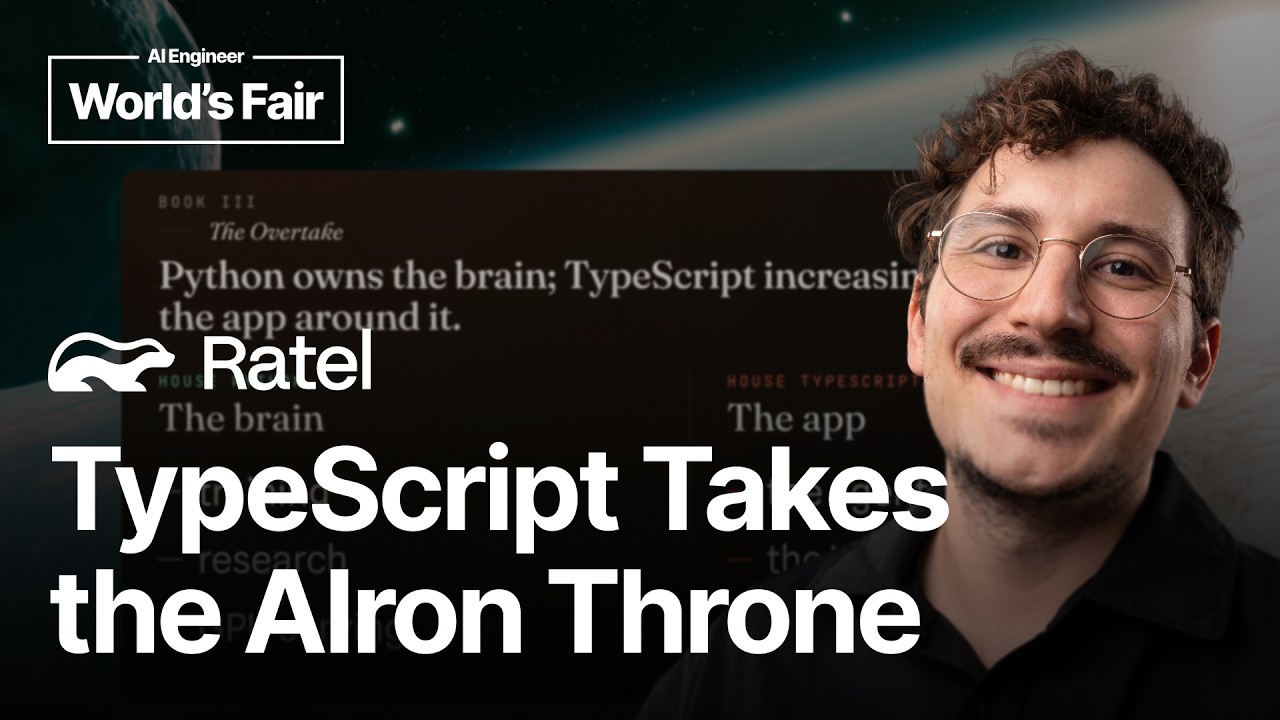
A Song of Types and Agents - Roberto Stagi, Ratel
Jul 12, 2026 · 14:16
Roberto Stagi (Ratel) argues that TypeScript is overtaking Python as the dominant language for building AI agents and applications, driven by the rise of coding agents like Lovable, Claude Code, and Cursor that default to TypeScript. He notes that Python still rules training, research, and GPU serving, but the application layer—where AI is shipped inside products—now belongs to TypeScript. Stagi highlights that TypeScript surpassed Python as the most used language on GitHub in August 2025, with GitHub attributing the shift to AI agents. He cites the Vercel AI SDK growing from 1.6M to 15.1M weekly downloads in one year and npm's rich ecosystem of authentication, payments, and UI packages as reasons to build agents in TypeScript. Consistent end-to-end typing via Zod and a unified codebase for agent loops, tools, backends, and UIs further strengthen the case. Stagi concludes by invoking Atwood's Law: any application that can be written in JavaScript will eventually be written in TypeScript, urging developers to build agents in TypeScript to avoid falling behind.

Claws Out: Securing and Building with OpenClaw - Nick Taylor, Pomerium
Jul 11, 2026 · 17:12
Nick Taylor, a dev advocate at Pomerium, explains how he contributed trusted-proxy auth mode to OpenClaw, allowing a trusted identity-aware proxy to handle WebSocket authentication and removing the need for tokens and device pairing. He demonstrates building tools like Clawspace, a browser-based file explorer and editor for his OpenClaw workspace, and an MCP server for ChatGPT, all secured with Pomerium's open-core Identity-Aware Proxy. In a live demo, he creates an MCP server by editing files in his OpenClaw workspace via Discord, with changes reflected instantly through Vite hot reload. Taylor argues that hardening OpenClaw access with a trusted proxy improves both security and user experience, showcasing his workflow of building software entirely from his phone.
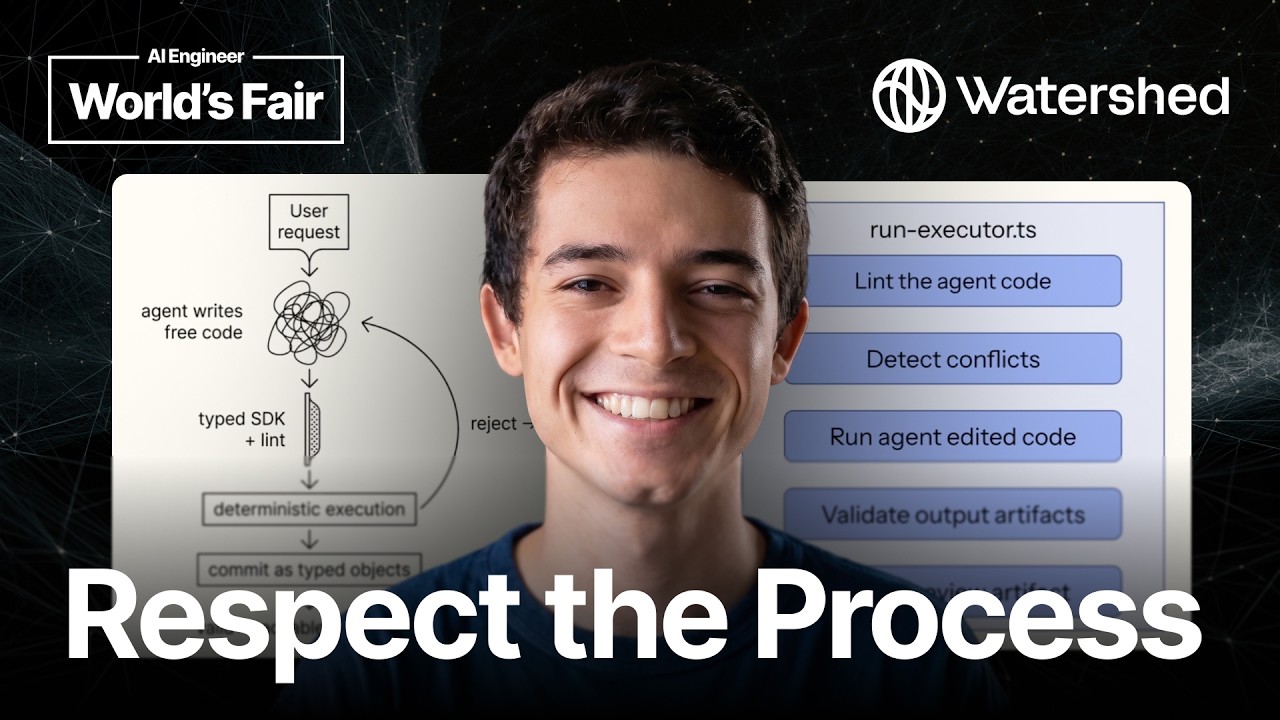
Respect The Process - Andrew Dumit, Watershed Technology Inc.
Jul 7, 2026 · 16:43
Andrew Dumit of Watershed explains how to deploy coding agents for editing complex supply chain graphs in sustainability, arguing that in a domain rife with expert judgment calls, you must constrain the agent's effects through a typed SDK and deterministic execution while leaving its reasoning free. Unconstrained coding agents caused inconsistency, hallucination, and false reports—saying edits were made when they weren't—and made review impossible for non-coders. Their solution: a TypeScript SDK as the only way to edit graphs, plus a harness that lints agent code, catches conflicts, runs the script, and validates output artifacts, producing traceable, replayable edits. This approach improved accuracy from 43% to 92% on internal evals, with further gains from prompt improvements, few-shot examples, and breaking tasks into plan-and-execute loops. Even when the agent lands on a different expert answer, every change is valid and reviewable without reading code.

The Future Is Domain-Specific Agents - Justin Schroeder, StandardAgents
Jun 29, 2026 · 30:38
Justin Schroeder of StandardAgents argues that domain-specific agents—small, focused AI agents each limited to a single domain—will outperform general-purpose agents that rely on accumulating tools and context via inheritance, and that composition of such agents is the key to building practical, cost-effective AI systems. He defines an agent as deterministic software harnessing non-deterministic model outputs, then critiques the current approach of piling tools and skills into a single agent (inheritance), proposing instead a coordinator agent that delegates to many specialized sub-agents (composition), each with its own minimal context, system prompt, and tools. He claims these domain-specific agents achieve over 80% token efficiency, enable use of cheaper small models (e.g., DeepSeek V4 Flash is 137x cheaper than a frontier model), improve safety by limiting capabilities, and scale easily. Schroeder predicts rapid adoption through 2026-2027, with multi-agent orchestration becoming mainstream and tokens no longer getting cheaper—up 29% when adjusted for IQ. He describes an ideal agent architecture with hooks, rules, and recursive sub-agents, and invites listeners to try…

Bypassing the Multimodal Tax: Hybrid RAG, SQL RRF & UI Telemetry - Abed Matini, Ogilvy
Jun 28, 2026 · 45:48
Abed Matini from Ogilvy demonstrates bypassing the multimodal tax by building a local-first hybrid RAG system that converts documents to clean Markdown via Docling, eliminating cloud vision token overhead. Using Ollama (Qwen 2.5 0.5B), PostgreSQL with pgvector, and raw SQL with Reciprocal Rank Fusion, he implements a FAQ assistant for an employee handbook with four chunking strategies—heading-based, paragraph, fixed 512-char with 64% overlap, and sentence-based. The system combines dense embedding vectors and sparse keyword indices (BM25) in a single query, retrieves top 2 chunks, and uses Python functions for speed and testability. Guardrails block prompt injections and out-of-scope questions before reaching the LLM, and LangFuse tracks token usage and latency. Matini argues that a small, local model and code-controlled pipelines reduce hallucination and cost while maintaining full observability.

Why Eval++ Is the Next Great Compute Primitive — Sunil Pai & Matt Carey, Cloudflare
Jun 8, 2026 · 24:51
Matt Carey and Sunil Pai from Cloudflare's agents team argue that Durable Objects — stateful serverless with 15ms London latency — and Dynamic Workers — a safe, sandboxed eval for LLM-generated code — form the next compute primitive for AI agents. They explain how Durable Objects enable resumable streaming, multi-tab sync, and background scheduling out of the box without distributed systems engineering. Dynamic Workers allow running generated JavaScript strings in isolated sandboxes, reclaiming 30 years of avoided eval. The pair tease upcoming talks: one on collapsing Cloudflare's 2,600 API endpoints into a 1,000-token MCP tool, and another on a coding agent harness built entirely on Workers that they are already shipping.

How Building with AI Can Double the Throughput of Your Engineering Team — Brian Scanlan, Intercom
May 15, 2026 · 21:49
Brian Scanlan of Intercom explains how treating Claude Code like a new hire—onboarding it to a 15-year-old Rails monolith, writing skills for every recurring task, and connecting it to production systems—doubled engineering PR throughput in under a year. By going all in on one platform instead of letting everyone choose their own tool, Intercom achieved a 17.6% automatic PR approval rate with SOC 2 sign-off, and its CI infrastructure collapsed under the volume. The key principle: give agents problems, not tasks. Scanlan recounts a security incident where Claude automatically pulled files, ran analysis, and handed back next steps in two minutes using a skill he didn't know existed. The talk emphasizes that all engineering work—debugging, testing, planning—should be agent-first, and that companies must invest in platform-level adoption and continuous skill improvement.
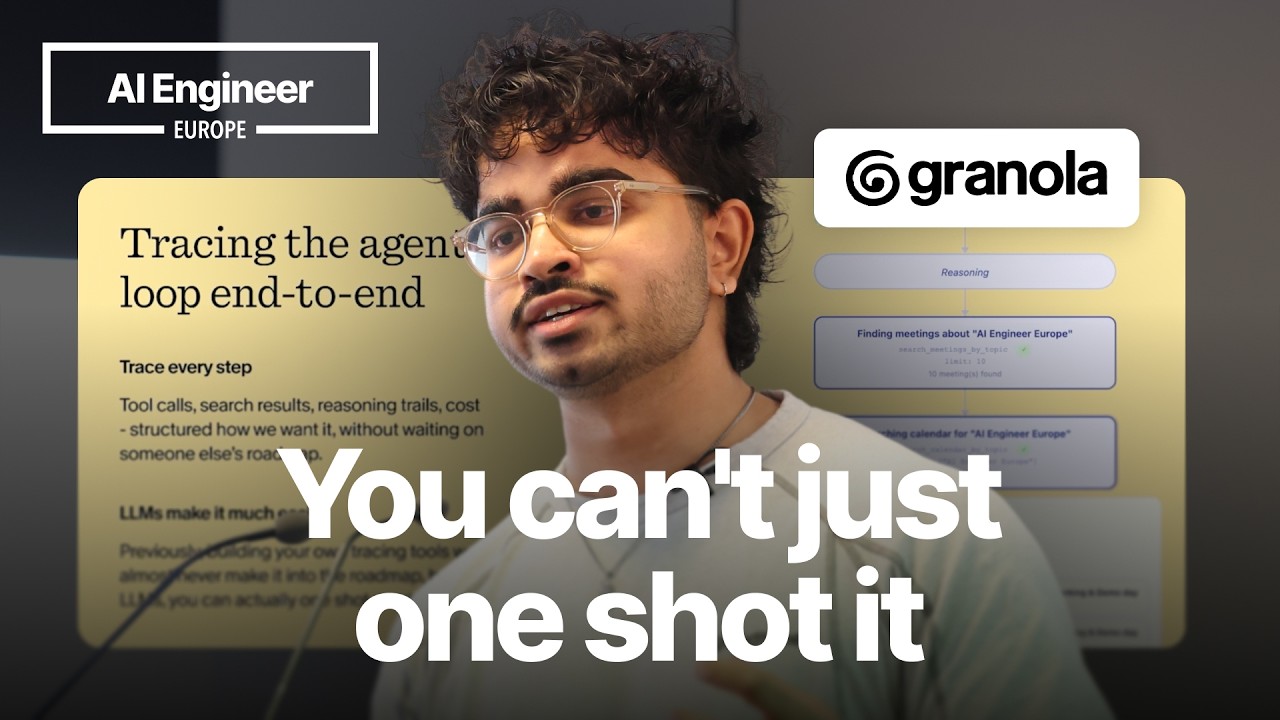
Feedback Loops are All You Need — Mehedi Hassan, Granola
May 10, 2026 · 10:11
Mehedi Hassan, a product engineer at Granola, argues that shipping AI features into production requires building feedback loops rather than one-shotting better prompts. Granola's chat feature for meeting notes revealed problems with web search — token costs ballooning to 10p per chat, overnight provider updates silently degrading results — and with prompt personalization, as a single prompt cannot serve salespeople, engineers, and HR managers equally. To close the gap, Granola built custom internal tracing exposing tool calls, search trails, reasoning, and cost in a UI accessible to non-engineers, not just CloudWatch queries. They also refactored their Electron app's renderer to run as a web app, enabling preview links on every PR and allowing Cursor to automatically test changes and upload screenshots. The result is faster iteration and confidence that shipped features actually work for customers.

Agents on the Canvas in tldraw — Steve Ruiz, tldraw
May 1, 2026 · 19:54
Steve Ruiz of tldraw details the evolution of AI on the infinite canvas, from early one-shot demos like MakeReal (draw to functional prototype) to multi-agent 'fairies' that collaborate, delegate, and even rewrite the canvas in real time. He explains how the tldraw SDK enables agents to act as virtual collaborators, using structured outputs and tool use to draw, animate, and modify designs. Ruiz demonstrates fairy agents that can work independently or in leader-follower mode, coordinating on tasks like creating wireframes or filling out forms. He also unveils a desktop prototype that lets Claude directly inject JavaScript into the canvas, enabling agents to edit code, modify UI, and even hack other apps like Spotify. The talk emphasizes the shift from sidebar agents to canvas-native collaborators, the challenges of vision model training for 2D spaces, and the safety trade-offs of giving LLMs runtime access in local-first apps.

Agents for Everything Else — swyx
May 1, 2026 · 14:10
swyx, co-founder of AI Engineer Conferences, details how his team of nine full‑time people uses coding agents like Devin and Town to run the conference, moving from a non‑AI stack to agents that handle everything from Figma‑to‑website conversion and schedule management to buying a lobster for the event. He claims these agents save “yak shaving” and increase human productivity because employees enjoy faster feedback cycles, leading to more work like animations and polish. The team now manages a 1,000‑person conference with plans to handle 6,000 in San Francisco without growing headcount. Swyx also advocates for “agents for everything else,” predicting that the primary user of software will shift from humans to bots, making APIs and MCPs more important than dashboards. He urges attendees to adopt agents and “prescribe” them to skeptical coworkers.
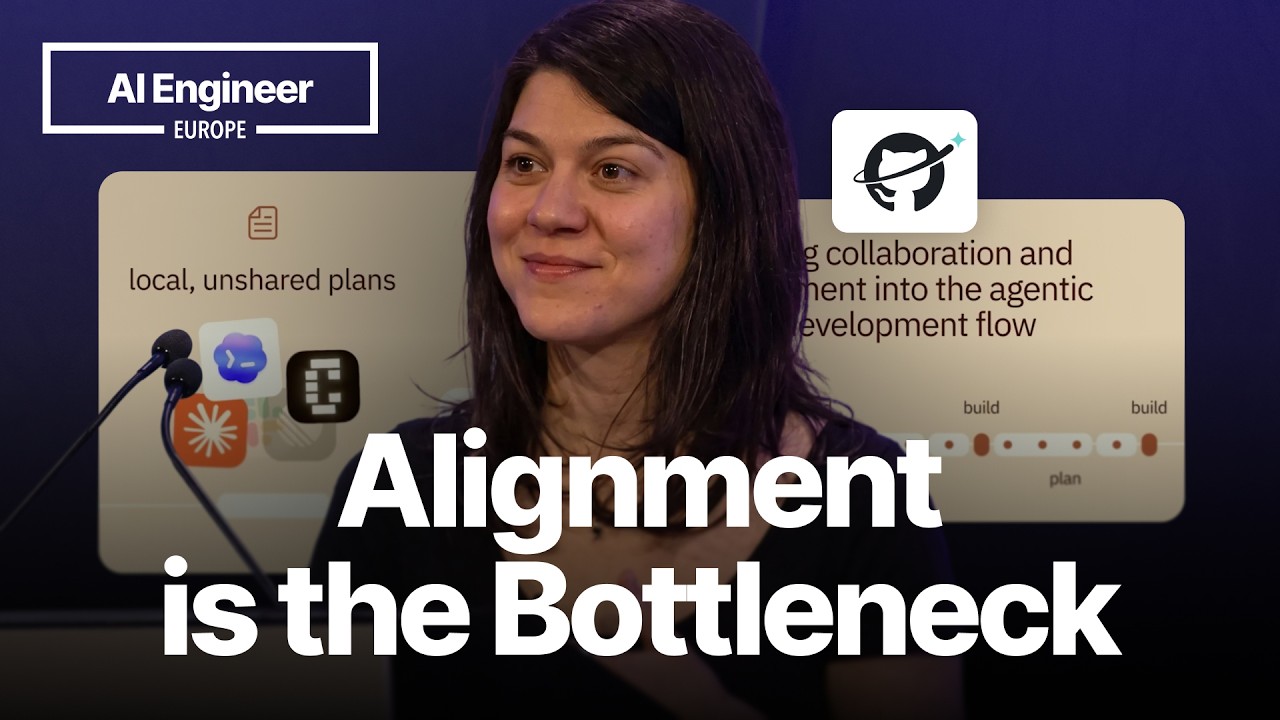
Collaborative AI Engineering: One Dev, Two Dozen Agents, Zero Alignment — Maggie Appleton, GitHub
Apr 26, 2026 · 17:43
Maggie Appleton, a staff research engineer at GitHub Next, argues that the current paradigm of one developer with a fleet of solo agents leads to zero team alignment, making software a team sport that requires shared context. She presents ACE (Agent Collaboration Environment), a multiplayer research prototype that provides shared chat sessions backed by micro VMs and Git branches, enabling real-time collaboration where designers, PMs, and developers can all prompt agents together. The talk emphasizes that implementation is now cheap and fast, so the hard question is "should we build it?" — requiring early, constant alignment to avoid wasted work, coordination debt, and unrequested features. ACE aims to reclaim time for rigorous critical thinking by letting teams plan, build, and review in a single shared space, with proactive agents summarizing team activity and unfinished work. Appleton contends that quality becomes the differentiator in a world of cheap code, and tools like ACE can help teams build a few exceptional things rather than a thousand crappy ones.

Automating Large Scale Refactors with Parallel Agents - Robert Brennan, OpenHands
Jan 8, 2026 · 1:16:21
Robert Brennan, CEO of OpenHands, and colleague Calvin explain how parallel agents can automate large-scale code refactors, demonstrating that breaking tasks into agent-sized batches with human oversight achieves 90% automation. They trace the evolution from context-unaware snippets to autonomous coding agents and now agent orchestration, where multiple agents work in parallel on tasks like CVE remediation — one client saw a 30x improvement in time-to-resolution. Calvin shows a pipeline using OpenHands' SDK to batch code files, run a verifier to detect code smells, and spin up fixer agents that generate focused pull requests. Brennan details strategies: task decomposition into single-PR-sized chunks, dependency ordering, and context sharing via agent.md files. The episode closes with a live-coding walkthrough building a parallel agent script that scans for vulnerabilities and opens individual PRs.

Claude Agent SDK [Full Workshop] — Thariq Shihipar, Anthropic
Jan 5, 2026 · 1:52:25
Thariq Shihipar of Anthropic presents the Claude Agent SDK, arguing that Bash and file-system-based agents outperform traditional tool-only approaches for autonomous tasks. He defines agents as systems that build their own context and trajectory, contrasting with structured workflows. The SDK, built on Claude Code, emphasizes the Bash tool as the most powerful primitive for composability and code generation, enabling non-coding tasks like data analysis. He demonstrates live-coding a Pokémon team advisor that dynamically fetches API data via scripts, and explains security through a 'Swiss cheese defense' of model alignment, AST parsing, and sandboxing. Shihipar also covers skills for progressive context disclosure, sub-agents for parallel work, and hooks for deterministic verification, stressing that agent building is an art of reading transcripts and iterating on context engineering.

Building in the Gemini Era – Kat Kampf & Ammaar Reshi, Google DeepMind
Dec 15, 2025 · 17:57
Kat Kampf and Ammaar Reshi from Google DeepMind present Gemini 3 and Nano Banana Pro, arguing that these models enable anyone to build complex, aesthetic applications through natural language alone. Gemini 3 achieves state-of-the-art results in one-shot UI design and agentic tool calling, with SweBench outperformance. Nano Banana Pro integrates Google Search for world knowledge and renders text accurately, handling up to 14 consistent people per image. They demonstrate vibe coding in AI Studio, building a personalized comic book with precise text, laptop stickers grounded in search, and a 3D racing game that scaled to 23 players live. Upcoming full-stack runtime adds backend support and automatic database integration, further democratizing software creation.

From Vibe Coding To Vibe Engineering – Kitze, Sizzy
Dec 14, 2025 · 25:28
Kitze, founder of Sizzy, argues that "vibe engineering"—actively steering AI agents with technical knowledge—trumps passive "vibe coding" for building real software. He shares how Cursor's Composer 1 let him port Benji.so and Glink to Next.js 16 with Monorepo in under a week, reviving near-dead projects. Kitze insists LLMs excel at React because humans are bad at it, and that repetitive code is fine since agents don't care. He warns against giving AI tools to juniors without oversight, and predicts the bottom of the job market will thin as agents replace interns. The talk ends with a pitch for "vibe code fixers" as a new role, maintaining legacy systems like cowboy coders.

Developing Taste in Coding Agents: Applied Meta Neuro-Symbolic RL — Ahmad Awais, CommandCode
Nov 24, 2025 · 20:52
Ahmad Awais, founder of Langbase, introduces CommandCode, a coding agent that learns a developer's personal taste and preferences to generate code that feels like their own. Built on Langbase's infrastructure (deploying over 350K agents and 1.2B monthly runs), CommandCode uses a Meta Neuro-Symbolic architecture with reinforcement learning to continuously capture a programmer's invisible architecture of choices—such as preferring TypeScript, PNPM, TSUP, and Commander over other tools—without requiring explicit rule files. Awais demonstrates how CommandCode automatically applies these learned preferences when building a CLI, contrasting it with Claude Code which generates generic output. He argues that taste models represent the next frontier, enabling agents to evolve with the developer and even share tastes across teams or borrow preferences from other developers like design engineers.

Real World Development with GitHub Copilot and VS Code — Harald Kirschner, Christopher Harrison
Aug 3, 2025 · 1:19:33
Harald Kirschner demonstrates three stages of Vibe Coding with GitHub Copilot and VS Code—YOLO, Structured, and Spectrum—arguing that developers can move from rapid prototyping to maintainable, scalable AI-assisted development. He shows how to use Agent mode, auto-approve settings, and new workspace scaffolding to build a hydration tracking app with React Vite and Material Design without looking at code. The talk covers custom instructions, MCP servers (Playwright, Jest Pad, Perplexity), and custom modes like TDD that enforce test-driven development by writing failing tests first. Kirschner explains how to constrain tools for deterministic behavior using tool sets and recommends committing often, pausing AI when needed, and iterating on instructions. He also discusses spec-driven development, critiquing specs with AI, and the importance of well-structured codebases for AI productivity.

Agents vs Workflows: Why Not Both? — Sam Bhagwat, Mastra.ai
Aug 1, 2025 · 15:37
Sam Bhagwat, co-founder of Mastra and author of 'Principles of AI Agents', argues that the debate between agents and workflows is misguided—developers should combine both. He criticizes OpenAI's anti-workflow stance as 'being that guy' and LangChain's graph/node/edge APIs as harmful, advocating for fluent syntax over graph theory. Bhagwat defines agents as turn-based games and workflows as rules-engine dependency chains, noting that nondeterminism makes workflow tracing 10x more important in AI engineering. He demonstrates composition patterns: agents can be steps, workflows can be tools, and nested workflows handle dynamic tool injection. He recommends starting with agent power, then adding workflow control for reliability—e.g., breaking one LLM call into 12 for medical PDFs. Bhagwat concludes that practice trumps theory in this young field.

Real-time Experiments with an AI Co-Scientist - Stefania Druga, fmr. Google Deepmind
Jul 28, 2025 · 18:42
Stefania Druga, formerly at Google DeepMind, demonstrates a real-time AI co-scientist system built with under $300 in open-source hardware and two weeks of effort, capable of live scientific experimentation. Using a micro:bit with Jack DAC temperature sensor, ReCamera for object tracking, and a microscope, the system streams sensor data, images, and voice to Gemini via a React app that dynamically assembles multimodal context. Druga presents two home experiments: crystal growth, where she discovered that formation occurs in bursts once critical saturation is reached, and fermentation, monitoring CO2 and temperature to optimize dough rise. She references DeepMind's AI co-scientist paper, which replicated a 12-year gene transfer discovery in two days and identified novel drug targets for liver fibrosis that proved effective in wet labs. Her vision moves from async data analysis to real-time empirical hypothesis generation, and she highlights open-source platforms like Jubilee and open bioreactors for automating lab equipment, with future plans to use real-time data to inform realistic simulations.

Software Development Agents: What Works and What Doesn't - Robert Brennan, OpenHands
Jul 25, 2025 · 16:46
Robert Brennan, creator of the open-source coding agent OpenHands (formerly OpenDevin), argues that while coding is going away, software engineering remains about critical thinking, not typing. He explains that agents like OpenHands operate via a loop between an LLM and tools like a diff-based editor, terminal, and web browser, all sandboxed in Docker. Brennan advises starting small with rote tasks like merge conflicts (99% success) or PR feedback, being specific about frameworks and files, and always reviewing AI-generated code to avoid tech debt. He shares that 90% of his code now goes through the agent, with 10% requiring manual intervention, and warns against auto-merging without human accountability—OpenHands now assigns PRs to the human who triggered them. Key use cases include fixing failing tests, infrastructure changes, database migrations, and greenfield internal apps where vibecoding is acceptable.
How agents will unlock the $500B promise of AI - Donald Hruska, Retool
Jul 23, 2025 · 16:22
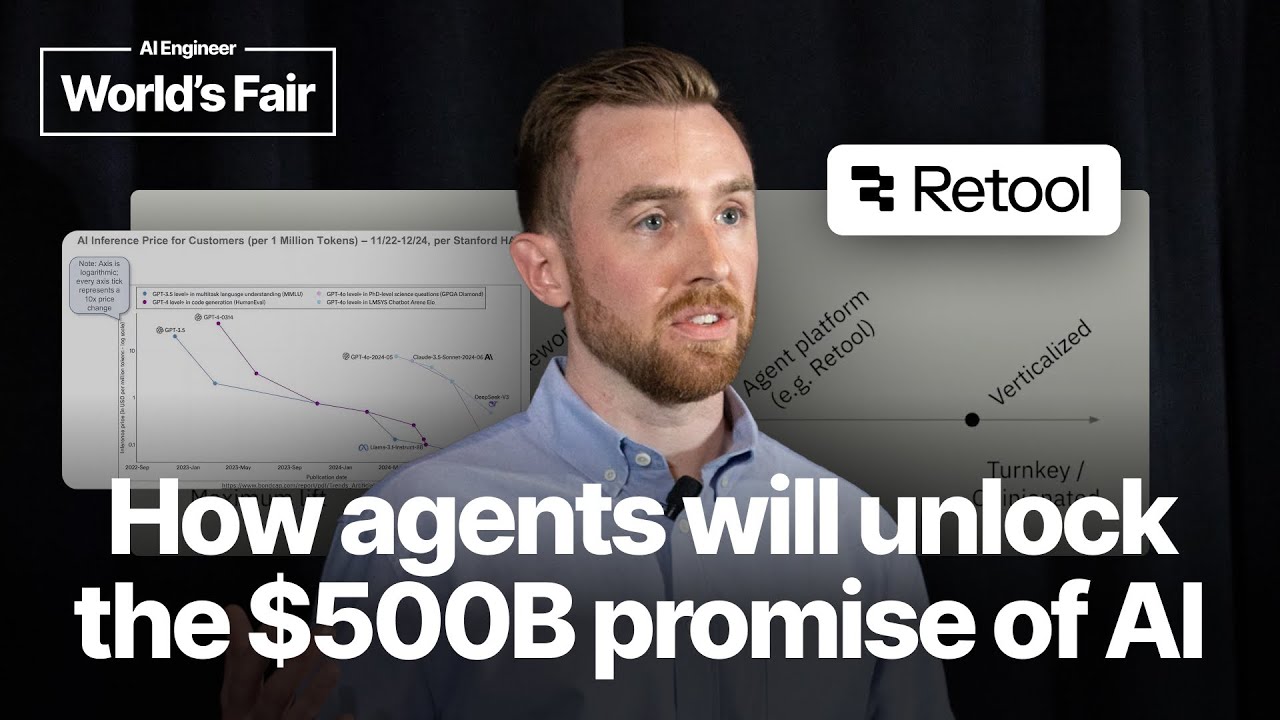
Donald Hruska, engineering lead for Retool's Agents product, argues that AI agents will unlock the $500B promise of AI by moving enterprises beyond toy chatbots into production-grade systems. He explains that building a basic agent is easy (e.g., 100 lines of code using React) but getting it into production requires solving security, cost overruns, observability, and compliance. Hruska outlines four options—build from scratch, use a framework like LangGraph, a managed platform like Retool Agents, or verticalized agents—and advises building for core differentiators and buying for commodity workflows. He cites Retool customers like ClickUp saving over $200,000 in vendor costs and Descript saving hundreds of hours weekly, while noting inference costs dropped 99.7% from 2022-2024. Retool charges $3 per hour for its cheapest agent and supports on-prem deployment.

Building Agents (the hard parts!) - Rita Kozlov, Cloudflare
Jul 23, 2025 · 21:12
Rita Kozlov, VP of Product for Cloudflare's developer platform, presents the building blocks of AI agents—client, AI reasoning, workflows, and tools—arguing that effective agents require all four components. She highlights the Model Context Protocol (MCP) as a standard for exposing APIs to LLMs, and demonstrates Cloudflare's Agents SDK, which simplifies hosting remote MCP servers with built-in OAuth, state management via durable objects, and real-time WebSocket communication. Kozlov cites real-world impact: companies using agents for sales automation see 20% revenue increases, 90% faster support response times, and 50–75% time savings. She walks through a human-in-the-loop credit card approval workflow built with Nok, showing how durable objects maintain long-running state, prevent duplicate actions, and route approvals across Slack, email, or in-app notifications. The talk emphasizes that once an MCP server is deployed, it can be used directly from Cursor, Claude, ChatGPT, or a custom client, including voice interfaces via WebRTC-to-WebSocket translation.
The Billable Hour is Dead; Long Live the Billable Hour — Kevin Madura + Mo Bhasin, Alix Partners
Jul 23, 2025 · 17:04
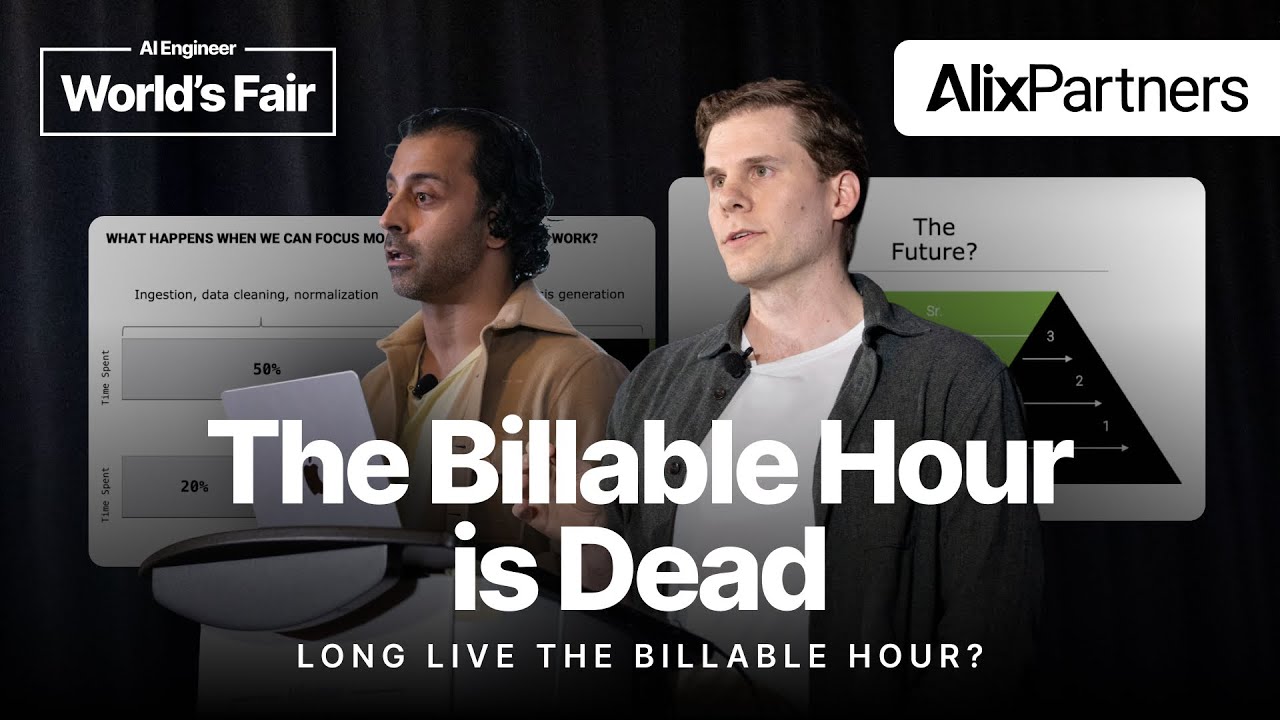
Kevin Madura and Mo Bhasin from AlixPartners argue that AI is reshaping knowledge work by compressing upfront data ingestion from 50% to 10-20% human effort, enabling analysis of 100% of data rather than the top 20%. They detail three use cases: categorization via structured outputs achieving 95% accuracy on 10,000 vendors in minutes; enterprise-scale RAG that democratizes access to siloed data by teaching LLMs to call APIs; and structured extraction from documents using schemas and log-prob-based confidence scoring. They caution that AI investments face a paradox—89% of CEOs plan agentic AI but NBER finds no earnings impact—and stress that success requires people skills, demos, and a focus on NPS and ROI over chasing shiny new tools. The episode concludes that once Excel-powered LLMs work reliably, AGI will be here.
Full Spec MCP: Hidden Capabilities of the MCP spec — Harald Kirschner, Microsoft/VSCode
Jul 18, 2025 · 14:53
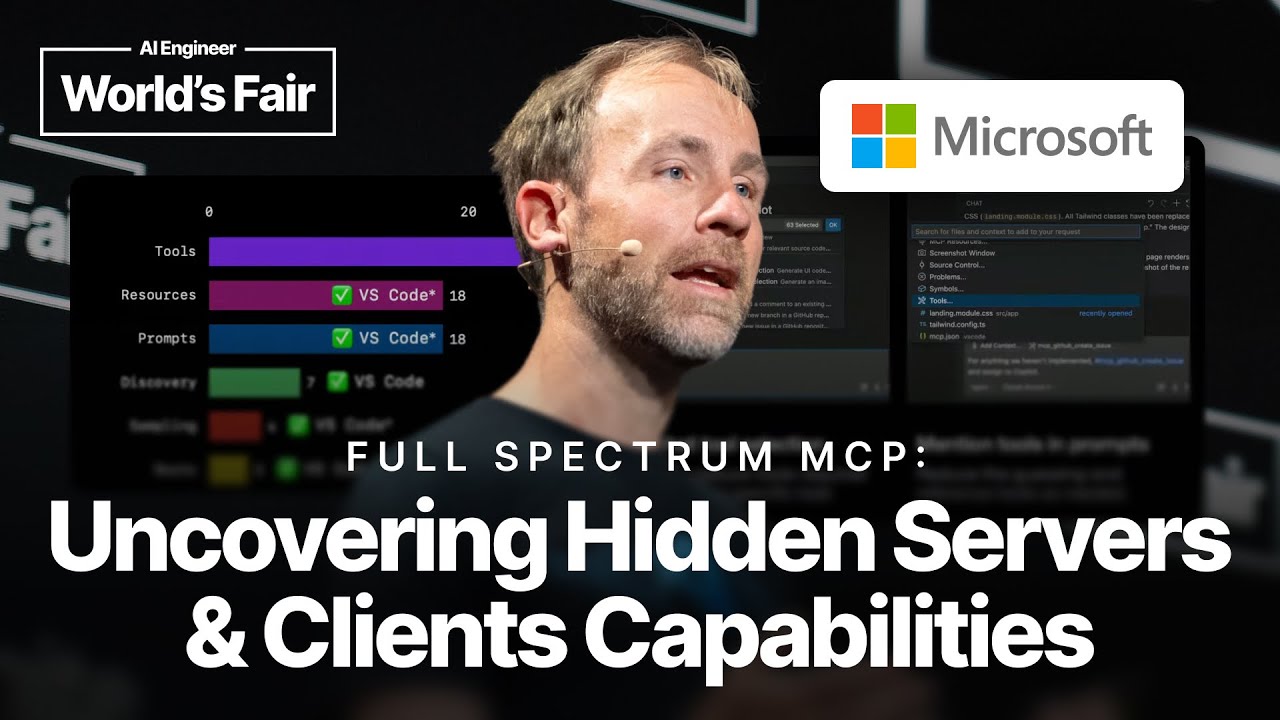
Harald Kirschner from Microsoft/VSCode argues that MCP's full specification unlocks powerful stateful interactions beyond the common 'tools-only' implementations, transforming AI assistants into more contextual and efficient agents. He highlights underused primitives like resources for rich data context and sampling for server-requested LLM completions, demonstrated via a dungeon game where dynamic tool discovery adapts to game state. VS Code's upcoming full spec support includes dynamic tool discovery, user-defined tool sets, a debug mode for server development, and support for streamable HTTP to reduce stateful server churn. Upcoming features like elicitations will allow tools to request user input directly. Kirschner calls on developers to build progressive, full-spec servers and contribute feedback to the open ecosystem, emphasizing that client and SDK support will follow as usage grows.

Building voice agents with OpenAI — Dominik Kundel, OpenAI
Jun 29, 2025 · 1:25:35
Dominik Kundel from OpenAI presents the new OpenAI Agents SDK for TypeScript and demonstrates how to build voice agents, arguing that speech-to-speech architectures (using GPT-4 real-time) offer lower latency and more natural interactions than chained approaches that transcribe audio to text. He covers two architectures: chained (speech-to-text, text agent, text-to-speech) versus speech-to-speech (native audio understanding), and recommends starting with a small, clear goal, building evals and guardrails early, and using generative prompts to control tone and personality via openai.fm. In a live coding session, he builds a real-time agent with tools (e.g., getWeather) and handoffs, demonstrates delegation to a smarter model (O4 mini) for complex tasks like refunds, and shows built-in interruption handling, human-in-the-loop approval, tracing for debugging, and output guardrails. The SDK supports WebRTC and WebSocket, handles turn detection automatically, and provides session management with a 30-minute timeout that can be extended by injecting previous context.
[Full Workshop] Vibe Coding at Scale: Customizing AI Assistants for Enterprise Environments
Jun 27, 2025 · 1:20:38
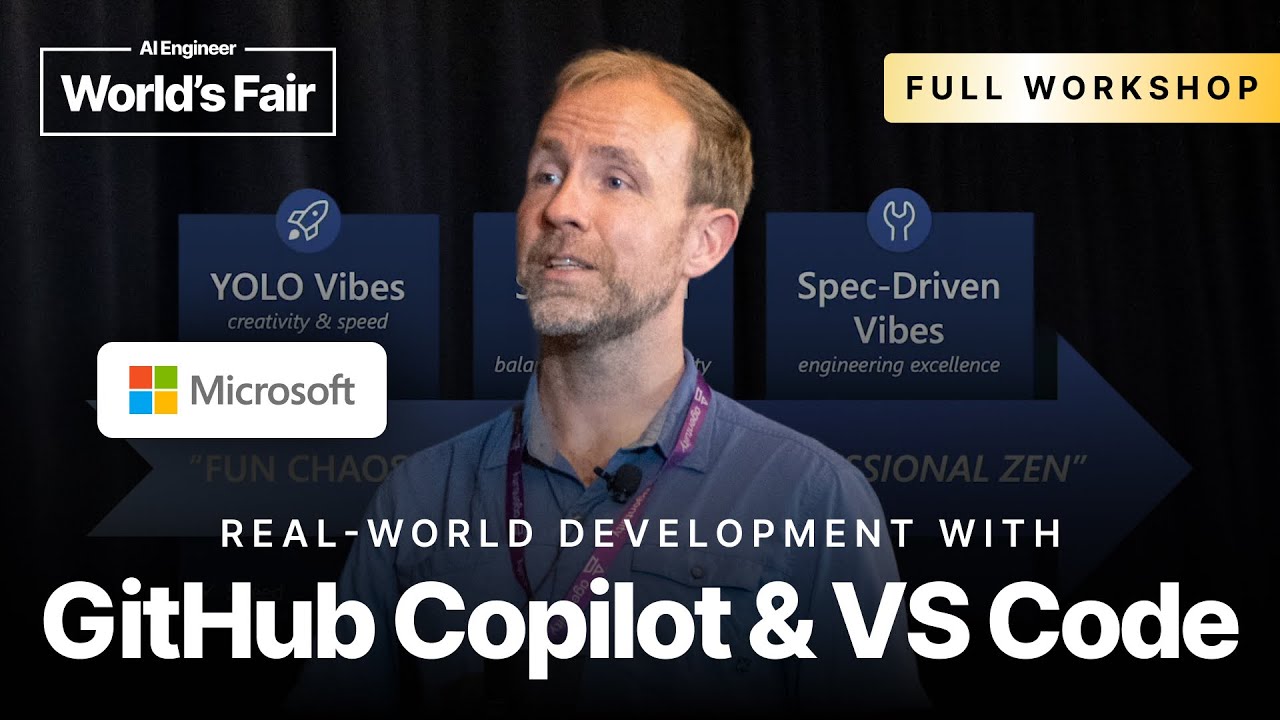
Harold from the VS Code team demonstrates "Vibe Coding at Scale" at the AI Engineer World's Fair, presenting three stages—YOLO, structured, and spectrum vibes—for customizing AI assistants in enterprise environments. He live-codes a hydration tracking app using GitHub Copilot's agent mode, auto-approve, and new workspace scaffolding, then shows how to enforce design principles via Copilot instructions and reusable prompts. Harold introduces custom modes (e.g., TDD mode), tool sets, and MCP servers like Playwright and Perplexity for research and browser testing. He emphasizes iterating on instructions, committing often, and using spec-driven development to balance speed with reliability, arguing these techniques enable true flow-state collaboration even on complex codebases.

Vibe Coding at Scale: Customizing AI Assistants for Enterprise Environments - Harald Kirshner,
Jun 27, 2025 · 15:26
Harald Kirshner, a Principal Product Manager at Microsoft working on VS Code and GitHub Copilot, argues that 'vibe coding' must evolve from ad-hoc experimentation to structured, spec-driven approaches for enterprise environments. He breaks vibe coding into three stages: YOLO (rapid prototyping with auto-accept and voice dictation), structured (using templates, custom instructions, and tools like MCP for consistency), and spec-driven (iterating from a plan for scale and reliability). Kirshner demonstrates VS Code Insiders' agent mode, new workspace flow, and auto-approve features, emphasizing that developers should commit often, review agent pauses, and leverage workspace instructions to maintain quality. He advocates for standardizing AI usage through team-defined prompts and modes, preserving developer autonomy while ensuring maintainable code even in complex, polyglot codebases.

Case Study + Deep Dive: Telemedicine Support Agents with LangGraph/MCP - Dan Mason
Jun 22, 2025 · 1:56:13
Dan Mason of Stride presents a case study on building autonomous agents for telemedicine support, replacing a human-driven button-pushing workflow with LangGraph, Claude, MCP, and a Node.js/React/MongoDB stack, achieving roughly 10X capacity increase. The LLM-driven virtual operations associate ("Ava") assesses patient messages, updates state with anchors and scheduled messages, and passes proposals to an evaluator agent that scores confidence and complexity, escalating to humans below 75% confidence. Mason explains how treatment "blueprints" in Google Docs are read directly by the LLM instead of using RAG, enabling new treatments to be added without writing code. He details the eval system using LLM-as-a-judge via PromptFu and retry logic for tool-calling errors, and discusses trade-offs around confidence scoring, prompt caching, and model selection (Claude for steerability). The team includes two software engineers, one designer, and Mason, who wrote most LangGraph code with AI assistance (Kline).

Building Reliable Support Agents Using the Effect Typescript Library - Michael Fester
Jun 3, 2025 · 7:22
Michael Fester, co-founder and CTO of Fourteen.ai, explains how his team built production-ready AI support agents using the Effect TypeScript library, arguing it provides strong type safety, composability, and reliability for systems that rely on LLMs. The architecture uses Effect across the entire stack, including Effect RPC, Effect HTTP, Effect SQL, and a custom DSL for agent workflows. Reliability features include fallback between LLM providers (e.g., GPT-4.0 mini to Gemini Flash 2.0), retry policies with state tracking, and duplicated token streams for analytics. Dependency injection allows easy mocking of LLM providers for testing. However, Fester warns of pitfalls like silently losing errors from upstream catches and the steep learning curve. He recommends incremental adoption, starting with a single service.

Real AI Agents Need Planning, Not Just Prompting - Yuval Belfer
Jun 3, 2025 · 7:58
Yuval Belfer of AI21 Labs argues that LLMs alone still fail at instruction following, as shown by GPT-4.1's struggles in 2025, and that true AI agents require dynamic planning, not just prompting. He critiques ReAct for lacking look-ahead, contrasting it with AI21 Maestro's planner and smart execution engine, which uses best-of-n sampling, candidate pruning, and replanning. On AIfeval, Maestro pushes GPT-4.0, Claude Sonnet 3.5, and R3 Mini to near-perfect scores; on internal requirement satisfaction benchmarks, it improves over single LLM calls despite higher runtime and cost. Belfer advises starting simple (SLMs, ReAct) and escalating to planning only for complex tasks, inviting listeners to join the Maestro waitlist.
Invisible Users, Invisible Interfaces: Accelerating Design Iteration with AI Simulation - Alex Liss
Jun 3, 2025 · 12:37
Alex Liss, VP of Data Science and AI at Huge, argues that AI should be used as a tool for design itself rather than as a feature, proposing Intelligent Twins—AI simulations of user personas—to accelerate needfinding and interface testing. Citing a trust gap where only 32% of US adults trust AI, he advocates for repairing it by designing better interfaces, not adding chatbots. He demonstrates a global audit of sports websites (NBA, Olympics, Premier League) where Intelligent Twins simulated casual and super fans across 72 tasks, revealing strong navigation but declining performance in information architecture and engagement. The methodology uses computer use agents for visual evaluation and human-in-the-loop review to generate focused design briefs. Limitations include reproducibility and the need for test-and-control validation, with future potential in integrating MCP protocol for turning Figma components into code. Liss concludes that AI simulation can help teams gather insights faster and create simpler, trustworthy interfaces.
Building an AI assistant that makes phone calls [Convex Workshop]
Feb 9, 2025 · 50:53
Tom Redmond, head of DX at Convex, builds Floyd, an AI phone-calling assistant using Convex, GPT-4, Google Cloud speech-to-text, and Twilio. Floyd lets users make voice requests (e.g., calling a school to report a sick child) via a web app; transcription, context retrieval, and real-time conversation with a human on the other end happen through a reactive database architecture. Redmond explains how Convex's WebSocket-based infrastructure solves serverless latency issues, enabling live transcript streaming and status updates without polling. He demonstrates two calls (school absence and flower order), noting that latency (2–5 seconds) comes from OpenAI text-to-speech and growing prompts, with plans to use OpenAI Threads and faster TTS services. The prototype explicitly discloses it's an AI to avoid misrepresentation, and Redmond envisions AI agents efficiently handling service bookings.

Hiring & Building an AI Engineering Team: Dr. Bryan Bischof
Dec 31, 2024 · 29:07
Dr. Bryan Bischof, Head of AI at Hex, argues that building an AI engineering team requires hiring based on product stage—starting with full-stack engineers and data profiles, then adding designers and later MLEs—while avoiding the 'mythical man month' trap in early AI products. He advocates for data intuition over LeetCode in interviews, using a take-home data exercise to assess candidates' ability to extract meaning from data and give feedback. Key attributes he looks for are curiosity, urgency, and product-mindedness, noting that enthusiasm alone is insufficient. Bischof also recommends working directly with domain experts to model AI behavior and suggests a centralized AI platform team to support multiple product teams, rather than having each team build AI infrastructure independently.
We accidentally made an AI platform: Jamie Turner
Oct 8, 2024 · 5:36
Jamie Turner, co-founder of Convex, explains how his company's backend platform accidentally became an AI platform because its reactive data flow paradigm—extending React's state reactivity to the server with subscribable queries and mutations—perfectly suits generative AI workflows. He describes Convex's architecture as seamlessly syncing state between backend steps and the application, enabling concurrent chains of tasks like automatic speech recognition, summarization, embedding generation, and finding related notes. Turner notes that post-ChatGPT, over 90% of Convex projects are generative AI. To support this shift, Convex added native vector indexes for schema fields and launched a startups program with discounts and exclusive forums. Upcoming high-level components will encapsulate state machines for sophisticated workflows. Turner presents Convex as a way for generative AI engineers to ship quickly and confidently.

How to Construct Domain Specific LLM Evaluation Systems: Hamel Husain and Emil Sedgh
Sep 19, 2024 · 18:45
Emil Sedgh (CTO at Rechat) and Hamel Husain (independent consultant) describe how they built a domain-specific evaluation system for Lucy, an AI assistant for real estate agents, to move beyond vibe checks and achieve production reliability. They argue that systematic evaluation starts with simple unit tests and assertions based on observed failure modes, logging traces for human review with custom tools to remove friction, and using LLMs to synthetically generate test inputs. The presenters emphasize that focusing on process over tools, avoiding generic off-the-shelf evals, and not jumping too early to LLM-as-a-judge are critical to success. This eval framework enabled Rechat to rapidly increase Lucy's success rate and made possible fine-tuning for complex tasks like mixing structured and unstructured outputs, handling multi-step commands that invoke five or six tools, and incorporating user feedback loops—capabilities they could not achieve with few-shot prompting alone.

Hyperspace More Nodes Is All You Need: Nicolas Schlaepfer
Sep 4, 2024 · 5:48
Nicolas Schlaepfer introduces Hyperspace's decentralized AI network and new product, a node editor for power users that generates agentic plans via a DAG orchestration model (HyperEngine v3). The network, with over 15,000 nodes, leverages consumer devices rather than GPUs, running inference through Llama.cpp. The product combines prompt engineering, visual React flow, Python execution, and RAG-like web browsing, using Qwen 2 instruct for reasoning and LLaMA 3 70B for summarization. Schlaepfer emphasizes diverse open-source models and a virtual file system for agentic primitives. Availability via waitlist is announced later this week.

What's new from Anthropic and what's next: Alex Albert
Aug 5, 2024 · 13:38
Alex Albert, Head of Developer Relations at Anthropic, argues the industry is in a 'magic star icon phase'—tacking AI onto existing products—and urges rebuilding from the ground up. He announces Claude 3.5 Sonnet, which scores 64% on pull request evals (vs 38% for 3 Opus), with 200k context, vision improvements, and pricing at $3/M input and $15/M output tokens. New features include Artifacts for collaborative creation of code and React components from screenshots, Projects for team knowledge grounding, and an enhanced ToolUse API supporting hundreds of tools and structured JSON output. Future models (3.5 Haiku/Opus) will be smarter, cheaper, and faster; a steering API for interpretability allows clamping feature values to control outputs.

The Making of Devin by Cognition AI: Scott Wu
Jul 11, 2024 · 20:04
Scott Wu, co-founder and CEO of Cognition AI, demonstrates Devin, a fully autonomous AI software engineer that builds and deploys working applications from plain English instructions, sharing the early lessons and vision behind the product. Devin built a name game website for the AI Engineer World's Fair in minutes, iterating on feedback to hide names, add a streak counter, and deploy the final version. Cognition uses Devin internally for features like a search bar and dashboards; Wu notes that engineers typically spend 80–90% of time on implementation, but Devin frees them to focus on architecture and problem-solving, making them 5–10x more productive while increasing overall demand for software. He also highlights the UX challenges of agents, which require new interactions beyond text completion, and notes that access to Devin is expanding via a waitlist.

GPT Web App Generator - 10,000 apps created in a month: Matija Sosic
Jan 26, 2024 · 9:23
Matija Sosic, CEO and co-founder of Wasp, demonstrates how his team built mage, a GPT-powered full-stack web app generator that produced over 10,000 applications in one month. Mage specializes in generating React, Node.js, Prisma, and Wasp apps from plain English descriptions, thanks to three key factors: specialization in full-stack web apps, leveraging Wasp's high-level declarative configuration to reduce boilerplate and errors, and an automated error-fixing phase. A typical app uses 25,000 to 60,000 tokens and costs 10 to 20 cents by combining GPT-3.5 for implementation and GPT-4 for planning, versus $1–$2 with GPT-4 alone. Mage serves as a highly customized cross-starter, with current limitations around lack of interactive debugging, which is planned next. Future directions include live debugging and potentially fine-tuning an LLM for Wasp.

Storyteller: Building Multi-modal Apps with TS & ModelFusion - Lars Grammel, PhD
Jan 23, 2024 · 7:30
Lars Grammel presents Storyteller, a kid's story generator built with TypeScript and his ModelFusion library, which orchestrates multiple AI models to turn voice input into narrated audio stories with images. The app transcribes speech via OpenAI Whisper in 1.5 seconds, generates a story outline with GPT-3 TurboInstruct in 4 seconds, and then runs title, image, and audio generation in parallel. For consistency, it uses GPT-4 with a low temperature to produce structured story passages, and streams partial results so narration can begin before the full story is ready—addressing the 1.5-minute full generation time. Voices are selected by embedding speaker descriptions and retrieving matching ElevenLabs voices filtered by gender. Image prompts are extracted from the story via GPT-4 and rendered with Stability AI's Stable Diffusion XL. The result is a responsive, multi-modal app that lets users listen while the server continues processing.

Building Reactive AI Apps: Matt Welsh
Nov 9, 2023 · 17:02
Matt Welsh announces AI.JSX, an open-source TypeScript framework he describes as 'React for LLMs,' which lets developers build reactive AI applications by composing JSX components that render to an LLM rather than the DOM. He argues AI.JSX makes LLM app development accessible to JavaScript developers, not just Python back-end engineers, by handling RAG, tool invocation, and real-time voice interaction out of the box. Welsh demonstrates parallel streaming of multiple LLM calls for story generation, a kid-safe wrapper component that rewrites content, and a 10-line RAG implementation. He showcases a live voice demo where an AI takes a donut order with sub-second latency, powered by Fixie's cloud platform for hosting, managed RAG pipelines, and conversational state. He emphasizes the framework's full React integration and ability to generate UI from AI, positioning AI.JSX as a simplification for building sophisticated LLM-powered apps.
Powered by PodHood