
Perplexity
ProductA product discussed on AI Engineer.
12 episodes
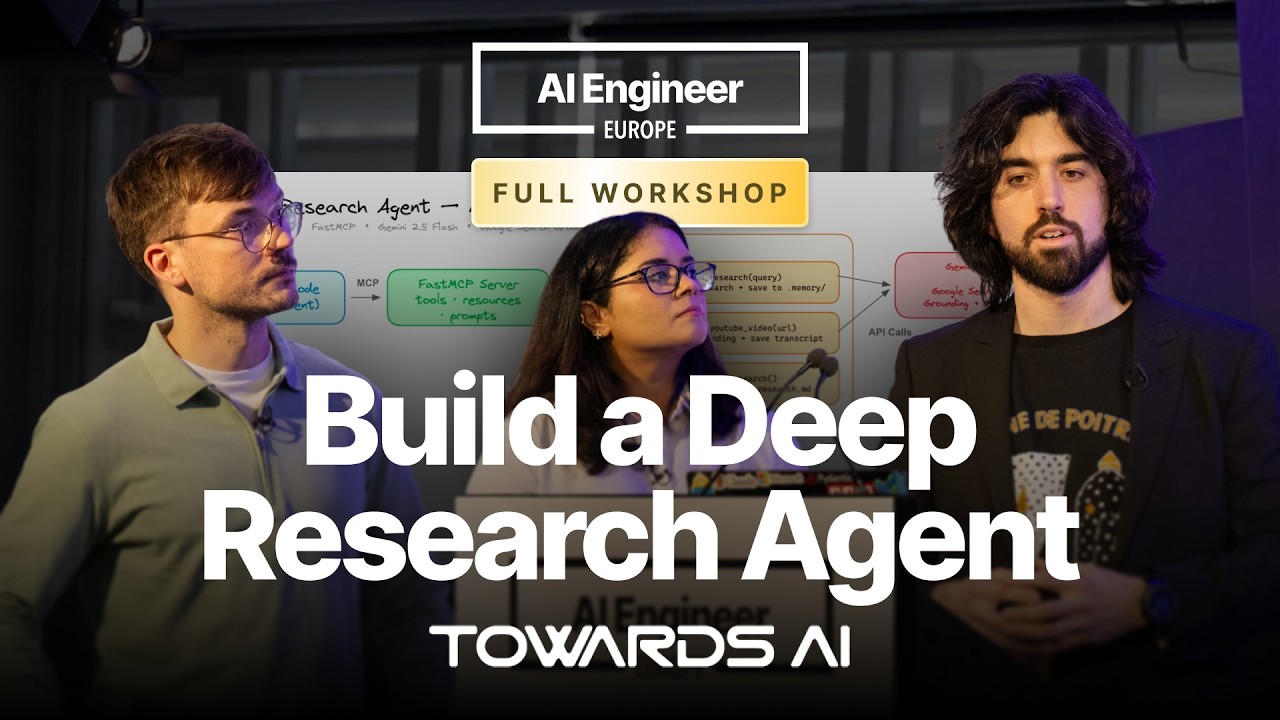
Full Workshop: Build Your Own Deep Research Agents - Louis-François Bouchard, Paul Iusztin, Samridhi
Apr 20, 2026 · 1:57:03
Louis-François Bouchard, Samridhi Vaid, and Paul Iusztin built a combined system of a deep research agent and a deterministic writing workflow to automate high-quality technical content creation, trading flexibility for control. The research agent uses an MCP server (FastMCP) with tools for Google search, YouTube analysis, and report compilation, powered by Gemini and orchestrated by Claude Code. The writing workflow is a static pipeline that loads a user guideline, writing profiles (structure, terminology, character), and few-shot examples into a system prompt, then applies an evaluator-optimizer loop: a reviewer outputs structured pydantic objects with profile/location/comment to flag violations, and the editor applies them in priority order (guideline > research > profile). They stress that research demands autonomy while writing needs constraint, and show how to avoid AI slop by banning specific words and using profiles. For observability, they use Opik to capture all traces, and for evals they built a 20-sample dataset from real LinkedIn posts, split into train/dev/test, to calibrate an LLM judge (binary pass/fail) that they run on dev and test splits to measure F1 and detect…

Enterprise Deep Research: The Next Killer App for Enterprise AI — Ofer Mendelevitch, Vectara
Nov 24, 2025 · 5:19
Ofer Mendelevitch from Vectara introduces Enterprise Deep Research as the next killer app for enterprise AI, applying autonomous, multi-step reasoning to internal knowledge bases. Vectara's trustworthy agent OS enables this with multimodal ingest, hybrid retrieval, and hallucination mitigation (HHEM model at 5.5M downloads). Deep Research queries private data to generate comprehensive reports with citations, replacing manual workflows. Key use cases include responding to RFPs by scanning enterprise datasets, generating on-demand employee onboarding guides from Jira/Notion/SharePoint, and creating investment memos in financial services. The system uses multi-agent parallel execution and corpus understanding for accurate planning, addressing 73% of LLM users' top challenge: factual accuracy.

Real World Development with GitHub Copilot and VS Code — Harald Kirschner, Christopher Harrison
Aug 3, 2025 · 1:19:33
Harald Kirschner demonstrates three stages of Vibe Coding with GitHub Copilot and VS Code—YOLO, Structured, and Spectrum—arguing that developers can move from rapid prototyping to maintainable, scalable AI-assisted development. He shows how to use Agent mode, auto-approve settings, and new workspace scaffolding to build a hydration tracking app with React Vite and Material Design without looking at code. The talk covers custom instructions, MCP servers (Playwright, Jest Pad, Perplexity), and custom modes like TDD that enforce test-driven development by writing failing tests first. Kirschner explains how to constrain tools for deterministic behavior using tool sets and recommends committing often, pausing AI when needed, and iterating on instructions. He also discusses spec-driven development, critiquing specs with AI, and the importance of well-structured codebases for AI productivity.

Layering every technique in RAG, one query at a time - David Karam, Pi Labs (fmr. Google Search)
Jul 29, 2025 · 20:22
David Karam of Pi Labs (formerly Google Search) walks through layering every technique in RAG, from in-memory retrieval to planet-scale search with 70+ corpus mix of token, embeddings, and knowledge graphs, jointly retrieved and re-ranked at 160,000 queries per second in under 200msec. He advocates a Quality Engineering Loop: baseline with simplest methods, analyze losses, then apply incremental techniques based on complexity-adjusted impact. Karam explains why queries like "falafel" are notoriously hard due to ambiguous intent, highlights failures of chunking documents, and shows when BM25 suffices, when relevance embeddings are needed, and when custom embeddings or domain-specific signals (price, popularity, user clicks) become essential. He covers query orchestration via fan-out, supplementary retrieval across back ends, and distillation for cost optimization, concluding that at sufficient complexity, problems must be punted to LLM or UX for graceful degradation.

Teaching Gemini to Speak YouTube: Adapting LLMs for Video Recommendations to 2B+DAU - Devansh Tandon
Jul 16, 2025 · 22:51
Devansh Tandon, a Product Manager at Google leading YouTube's discovery system, details how YouTube adapted Gemini LLMs to power its recommendation engine for billions of daily active users. The team built SemanticID, a tokenization system that compresses video features into semantically meaningful tokens, creating a new language for YouTube content. They then continued pre-training Gemini on sequences of user watches to make the model bilingual in English and this video language. For generative retrieval, they prompt the adapted model with user demographics and watch history to output video recommendations as SemanticIDs, achieving 95%+ cost savings to serve at scale. Challenges include serving billions of users with low latency and handling video freshness—Taylor Swift's new music video must be recommendable within minutes. Tandon argues LLM-led recommendations are a bigger consumer application than search and hints at future interactive, steerable recommendations and even personalized content creation.

Prompt Engineering and AI Red Teaming — Sander Schulhoff, HackAPrompt/LearnPrompting
Jul 14, 2025 · 2:01:05
Sander Schulhoff, creator of Learn Prompting and HackAPrompt, argues prompt engineering remains vital despite claims of its demise, drawing on his systematic review of 1,500+ papers for 'The Prompt Report.' He covers advanced techniques including chain-of-thought, decomposition, ensembling, and few-shot prompting, noting that role prompting is ineffective for accuracy-based tasks and that example ordering can swing performance by 50%. He then explains AI red teaming, distinguishing jailbreaking from prompt injection, and warns that system prompts and guardrails cannot prevent attacks—even simple obfuscation like base64 or typos still works. He highlights the critical unsolved problem of agentic security, where agents with real-world actions are easily tricked, and introduces a live competition at the conference to gather more attack data. His key takeaway: AI security is fundamentally harder than classical cybersecurity because 'you cannot patch a brain.'
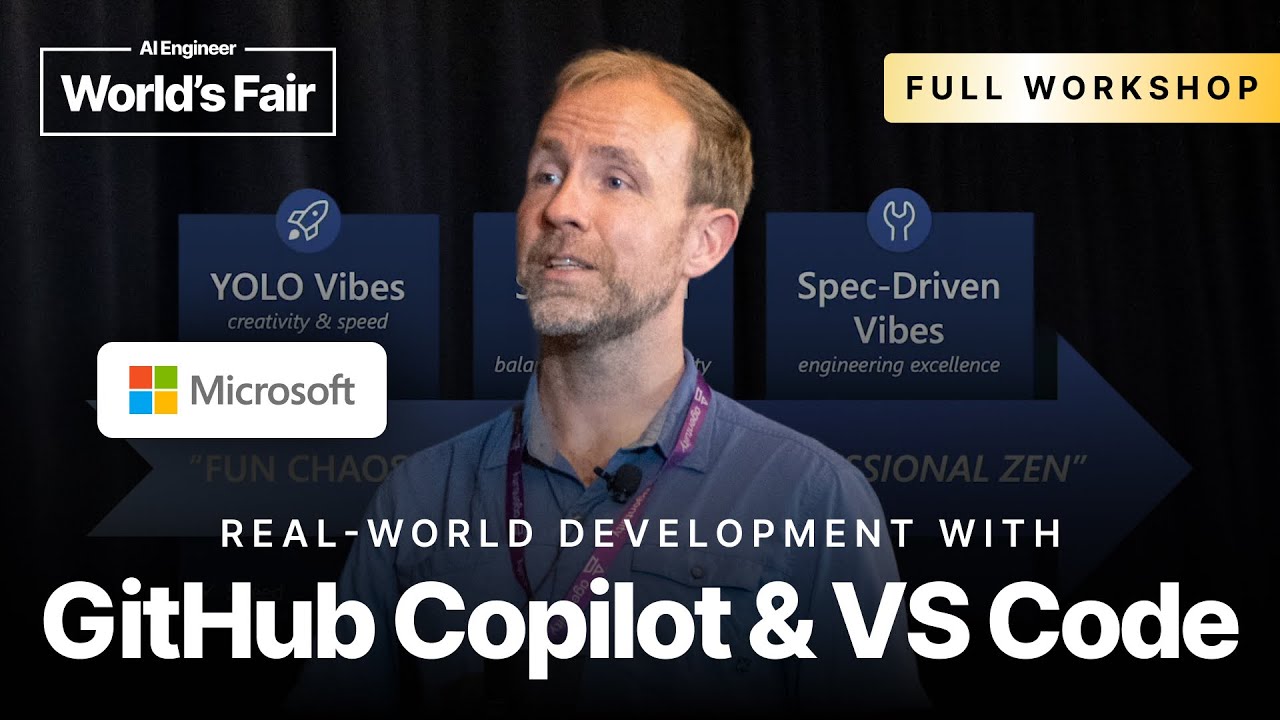
[Full Workshop] Vibe Coding at Scale: Customizing AI Assistants for Enterprise Environments
Jun 27, 2025 · 1:20:38
Harold from the VS Code team demonstrates "Vibe Coding at Scale" at the AI Engineer World's Fair, presenting three stages—YOLO, structured, and spectrum vibes—for customizing AI assistants in enterprise environments. He live-codes a hydration tracking app using GitHub Copilot's agent mode, auto-approve, and new workspace scaffolding, then shows how to enforce design principles via Copilot instructions and reusable prompts. Harold introduces custom modes (e.g., TDD mode), tool sets, and MCP servers like Playwright and Perplexity for research and browser testing. He emphasizes iterating on instructions, committing often, and using spec-driven development to balance speed with reliability, arguing these techniques enable true flow-state collaboration even on complex codebases.

Why the Best AI Agents Are Built Without Frameworks (Primitives over Frameworks) — Ahmad Awais, CHAI
Jun 3, 2025 · 27:06
Ahmad Awais, founder of LangBase/CHAI, argues that production AI agents like Perplexity, Cursor, v0, Lovable, Bolt, and CHAI itself should be built using AI primitives rather than frameworks. He demonstrates live coding a 'Chat with PDF' agent using LangBase primitives (memory, parser, chunker, threads). Awais presents eight agent architectures—augmented LLM, prompt chaining, agent router, parallel agents, orchestrator-worker, evaluator-optimizer, tool-calling, and memory-based—all built with plain code and no framework. He claims frameworks are bloated and slow, while primitives offer flexibility and automatic scaling (e.g., memory storing terabytes). Awais shows how to compose multiple LLMs (Gemini, DeepSeek Llama, Claude) in a router agent, and notes that his team has built agents for OCR, image analysis, and deep research using primitives and external tools like Mistral OCR.
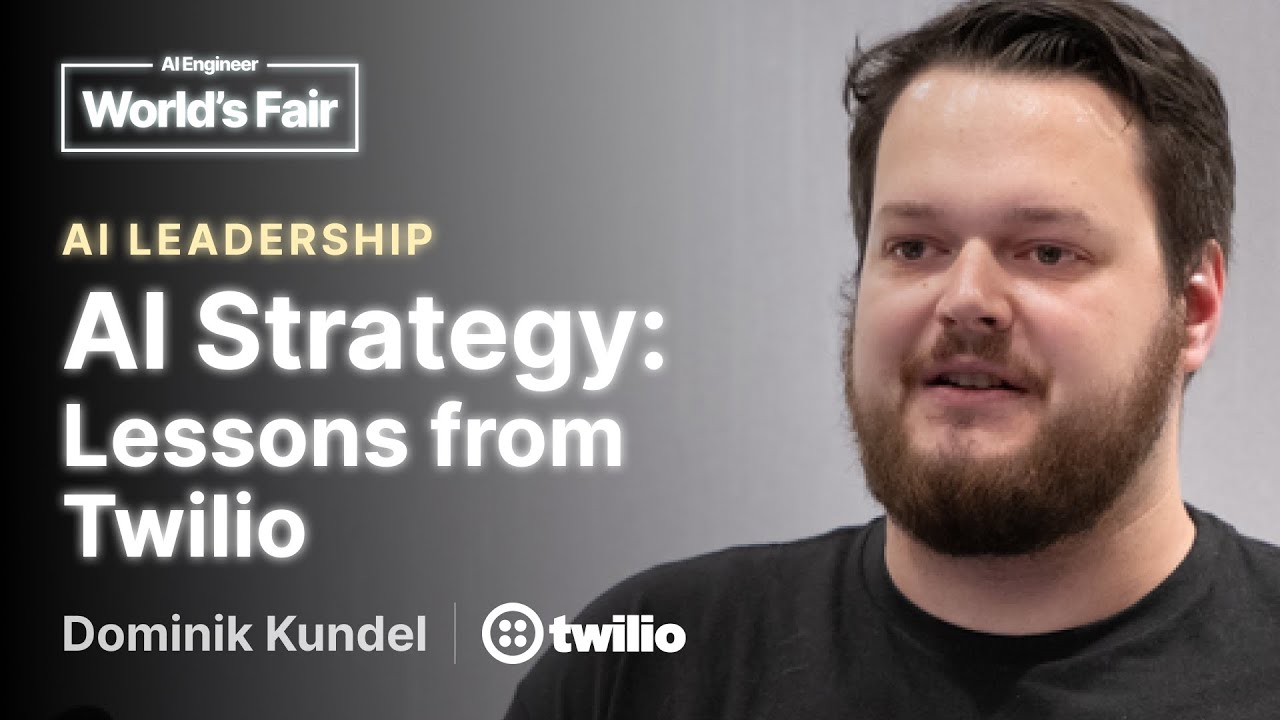
Cooking with fire without burning down the kitchen: Dominik Kundel
Dec 31, 2024 · 20:35
Dominik Kundel, who leads product and design for Twilio's Emerging Tech & Innovation team, explains how the company balances disruptive AI innovation with its existing communications and customer data platform businesses. He distinguishes sustaining innovation (e.g., Apple's AI features) from disruptive innovation (e.g., agents not yet enterprise-ready due to quality and cost), arguing that ignoring disruptive AI is increasingly dangerous because quality improves daily. Kundel shares three key lessons from Twilio's AI journey: first, ship early and often—even rough prototypes—to gather real feedback, which led to the Twilio Alpha sub-brand for setting expectations; second, build a curious, problem-owning team rather than requiring existing AI expertise; third, share learnings internally and externally to avoid operating in a silo and to help customers be thought leaders. He recounts how an initial AI personalization engine was too disruptive for mainstream R&D, so the team iterated on an AI Assistance agent builder, using internal hackathons and dogfooding with low-risk use cases like IT helpdesk to improve quality before broader release.

The ROI of AI: Why you need Eval Framework - Beyang Liu
Dec 31, 2024 · 25:28
Beyang Liu, CTO of Sourcegraph, presents six evaluation frameworks for measuring the ROI of AI coding tools, arguing that no single metric suffices because AI ROI reduces to the intractable problem of developer productivity. He dismisses the 'roles eliminated' framework as irrelevant for engineering, noting that backlogs are never fully addressed. Instead, he highlights customer examples: A/B testing velocity at Palo Alto Networks showed 20-30% acceleration with Cody; time saved as a function of engagement lower-bounds gains (e.g., each code search saves ~2 minutes); and LITOS tracked value-add zones (building features, writing tests, reviewing code) instead of lines of code. For key initiatives like code migrations, ROI is measured by how many months the migration is pulled forward. Liu also advocates developer surveys bounded by a 5-25% productivity tool budget, and warns against the Mythical Man Month fallacy: preferring one 100x human developer over 100 mediocre AI agents.

Enhancing Quality and Security in CI: Gunjan Patel
Nov 27, 2024 · 18:27
Gunjan Patel, Director of Engineering at Palo Alto Networks, presents Ghost Pilot, an AI-powered CI pipeline that outsources boring software development tasks to enable self-evolving code. Unlike real-time Copilots, Ghost Pilot operates as a 'slow system' in CI, iteratively improving variable names and code comments, then generating unit tests by first listing edge cases and personalizing them via team context files. For security, it simulates three AI roles—Red Team engineer, developer, and engineering manager—who debate identified vulnerabilities, prioritize fixes by risk and effort, and propose changes with citations. Patel shares a reusable CI template with a Bring-Your-Own-LLM option, demonstrated by catching a logical Kubernetes bug missed by static analysis tools.

The era of unbounded products: Designing for Multimodal IO: Ben Hylak
Sep 25, 2024 · 20:32
Ben Hylak, founder of Dawn and former Apple Vision Pro designer, argues that the key to building intuitive AI products in the era of unbounded interfaces is adding structure—highlighting what matters, establishing hierarchy, and leveraging familiarity—lessons from designing VisionOS. He shows how successful AI apps like Dot, Perplexity, and Claude use structure (e.g., Claude pulling code into artifacts) while the Vercel chatbot's inline dynamic UI is an anti-pattern because it disrupts conversation flow. For agents, spreadsheets (like Clay) make unfamiliar multi-step tasks familiar. Looking ahead, Hylak predicts less prompt engineering via sparse autoencoders for millions of ranked, personalized presets, shifting product evaluation from evals to user analytics as apps become increasingly personalized.
Powered by PodHood