
Figma
ProductA product discussed on AI Engineer.
18 episodes

500 people vibe-coded for 30 days. I was one of them. - Sanja Grbic, Automattic
Jul 7, 2026 · 17:49
In Automattic's Radical Speed Month, a 30-day experiment where over 500 employees paused roadmap work to ship real projects, product designer Sanja Grbic built three distinct products—a board game session manager, a design system status tracker, and an iOS chat for WooCommerce merchants—demonstrating how AI tools like Claude Code and ContextAIC can transform roles and unlock speed. The first project showed that engineers become enablers when they set up non-engineers for coding success. The second project, completed in two and a half weeks, moved Grbic from designer to design engineer by owning the full build, from proof of concept to deployment. The third project, built in just six days with a fellow designer, proved that shared understanding of AI workflows collapses iteration time. Grbic argues that large organizations can replicate this by providing tool access, finding enablers, creating space for experimentation, and granting agency—shifting human behavior to break out of established habits and release the velocity AI offers.

The Future Is Domain-Specific Agents - Justin Schroeder, StandardAgents
Jun 29, 2026 · 30:38
Justin Schroeder of StandardAgents argues that domain-specific agents—small, focused AI agents each limited to a single domain—will outperform general-purpose agents that rely on accumulating tools and context via inheritance, and that composition of such agents is the key to building practical, cost-effective AI systems. He defines an agent as deterministic software harnessing non-deterministic model outputs, then critiques the current approach of piling tools and skills into a single agent (inheritance), proposing instead a coordinator agent that delegates to many specialized sub-agents (composition), each with its own minimal context, system prompt, and tools. He claims these domain-specific agents achieve over 80% token efficiency, enable use of cheaper small models (e.g., DeepSeek V4 Flash is 137x cheaper than a frontier model), improve safety by limiting capabilities, and scale easily. Schroeder predicts rapid adoption through 2026-2027, with multi-agent orchestration becoming mainstream and tokens no longer getting cheaper—up 29% when adjusted for IQ. He describes an ideal agent architecture with hooks, rules, and recursive sub-agents, and invites listeners to try…
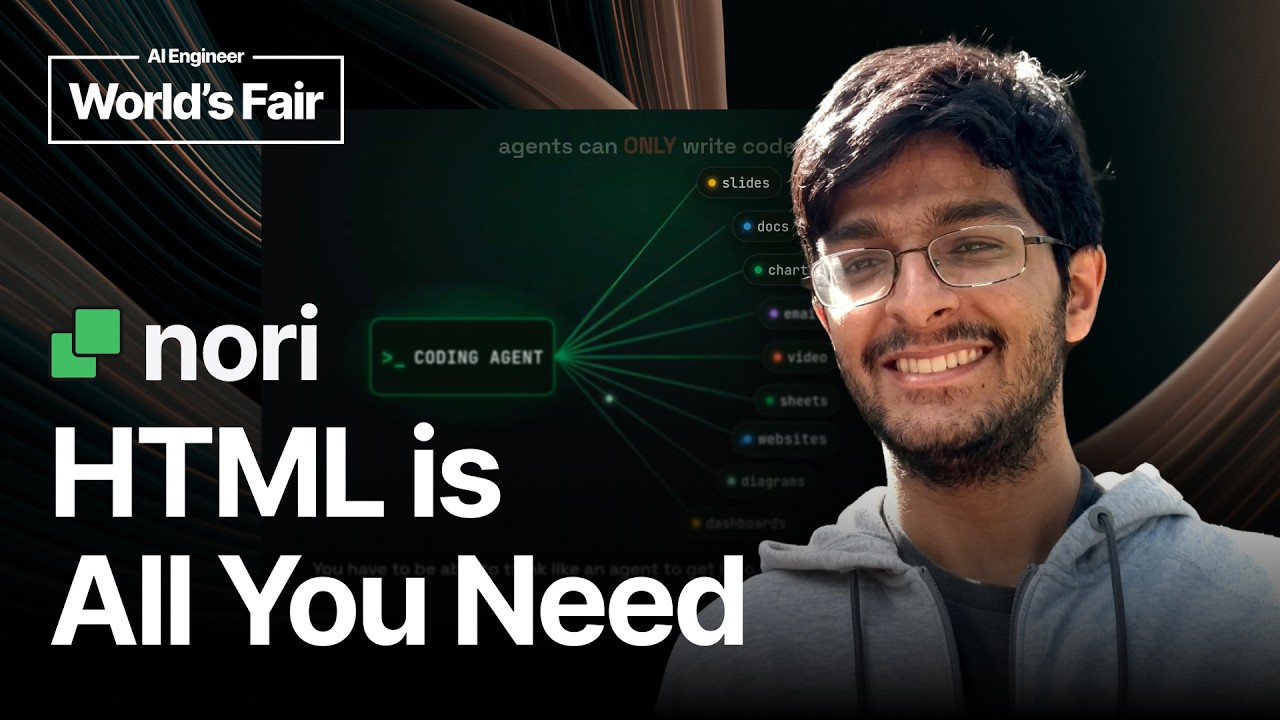
HTML is All You Need (for Agents to Make Graphics) - Amol Kapoor, Nori
Jun 28, 2026 · 7:00
Amol Kapoor, CEO of Nori Agentic, argues that coding agents can create high-quality visual artifacts like slides, docs, and videos by using HTML instead of traditional design tools. He explains that agents think in language and structure, not pixels, so tools like PowerPoint or Figma force them into a human-centric approach that fails. By giving agents HTML—a language they understand intuitively—they can produce properly aligned, themed graphics without manually placing coordinates. Kapoor demonstrates this with the 'pelican riding a bicycle' test, where models fail at raw SVG but succeed with HTML. He applies this method at Nori to build board decks, sales decks, and even animated videos purely with HTML and CSS. The episode advocates for 'thinking like the model' and concludes that for graphics, HTML is all you need.

Building Interactive UIs in VS Code with MCP Apps — Marlene Mhangami & Liam Hampton, GitHub
Jun 6, 2026 · 16:06
Marlene Mhangami and Liam Hampton from GitHub explain MCP Apps, which let server tools return rich interactive UI components inside VS Code Chat via sandboxed iframes, replacing plain text responses. They demonstrate a flame graph profiler that profiles a Go app running bubble sort and Fibonacci, rendering an interactive flame graph directly in the chat window. The MCP server returns data and a resource reference to bundled HTML; VS Code fetches and renders it, enabling live interaction like clicking and querying without leaving chat. Use cases include data exploration, e-commerce checkouts (Shopify), and interactive diagrams (Excalidraw). The iframe is sandboxed for security—like putting a hamster in a cage to prevent it from modifying VS Code settings or calling external APIs. Marlene and Liam walk through building an MCP App from scratch using a skill from the model context protocol repository.
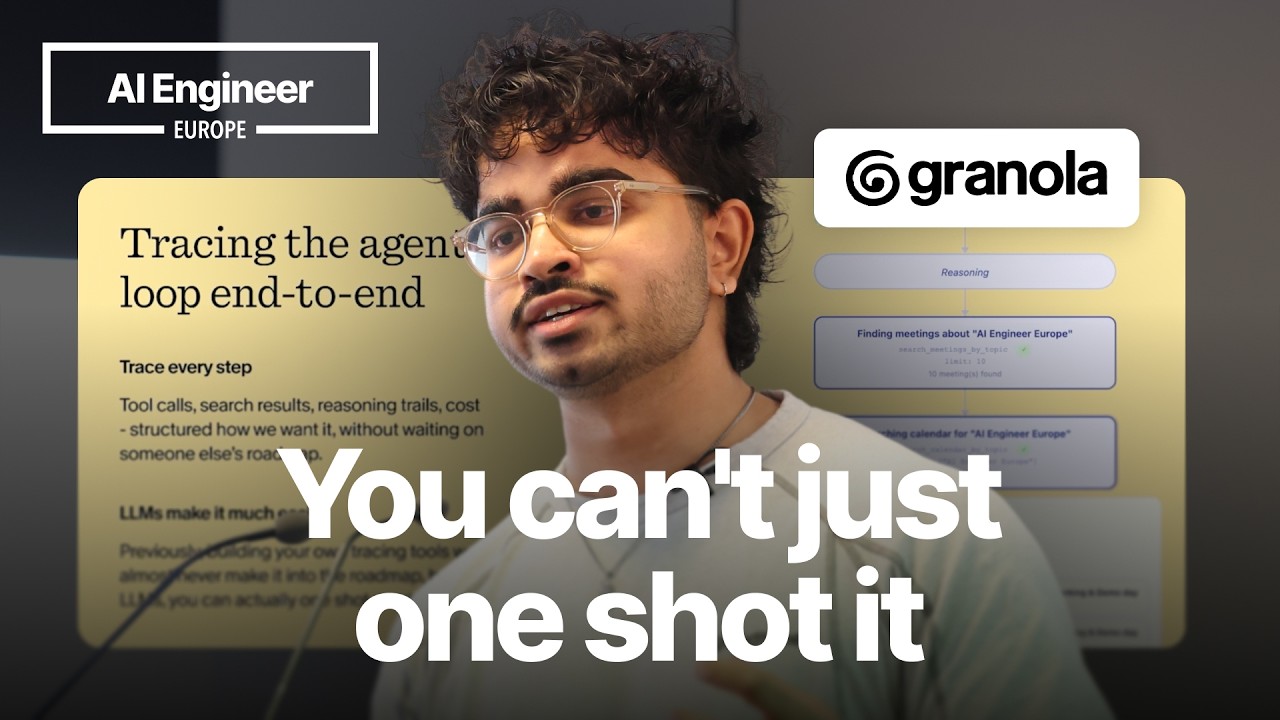
Feedback Loops are All You Need — Mehedi Hassan, Granola
May 10, 2026 · 10:11
Mehedi Hassan, a product engineer at Granola, argues that shipping AI features into production requires building feedback loops rather than one-shotting better prompts. Granola's chat feature for meeting notes revealed problems with web search — token costs ballooning to 10p per chat, overnight provider updates silently degrading results — and with prompt personalization, as a single prompt cannot serve salespeople, engineers, and HR managers equally. To close the gap, Granola built custom internal tracing exposing tool calls, search trails, reasoning, and cost in a UI accessible to non-engineers, not just CloudWatch queries. They also refactored their Electron app's renderer to run as a web app, enabling preview links on every PR and allowing Cursor to automatically test changes and upload screenshots. The result is faster iteration and confidence that shipped features actually work for customers.

Agents for Everything Else — swyx
May 1, 2026 · 14:10
swyx, co-founder of AI Engineer Conferences, details how his team of nine full‑time people uses coding agents like Devin and Town to run the conference, moving from a non‑AI stack to agents that handle everything from Figma‑to‑website conversion and schedule management to buying a lobster for the event. He claims these agents save “yak shaving” and increase human productivity because employees enjoy faster feedback cycles, leading to more work like animations and polish. The team now manages a 1,000‑person conference with plans to handle 6,000 in San Francisco without growing headcount. Swyx also advocates for “agents for everything else,” predicting that the primary user of software will shift from humans to bots, making APIs and MCPs more important than dashboards. He urges attendees to adopt agents and “prescribe” them to skeptical coworkers.
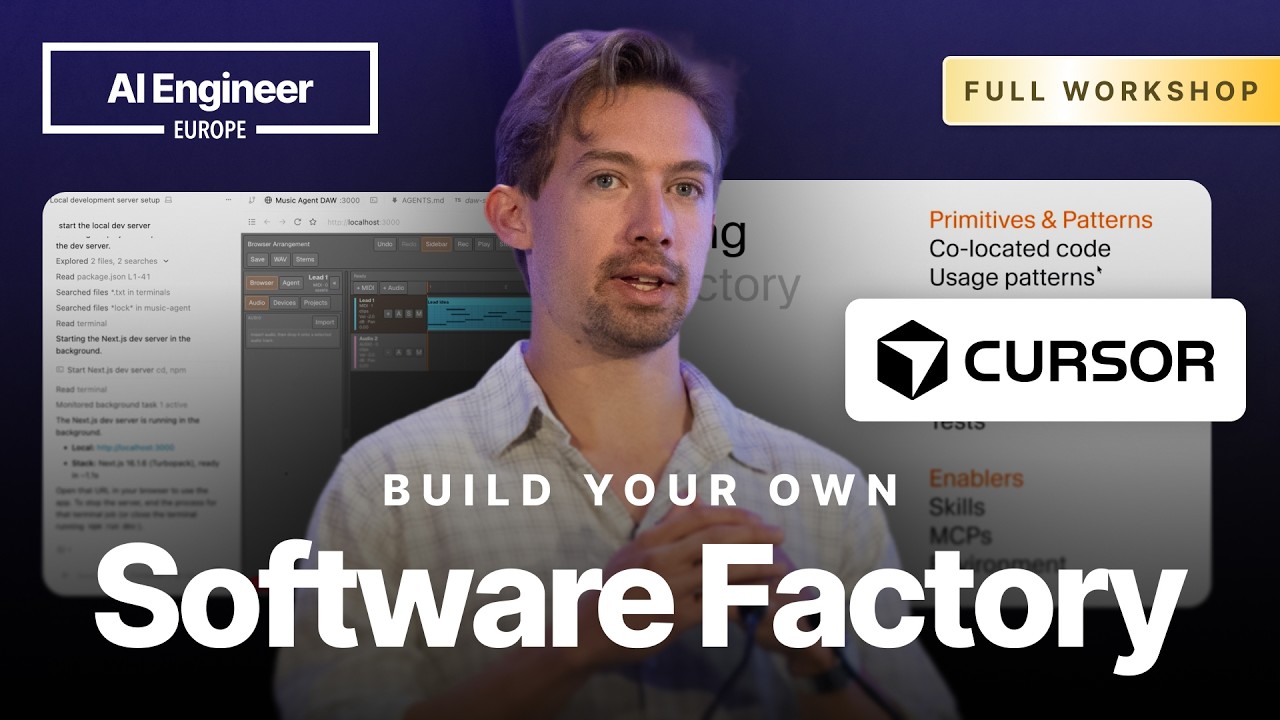
Building your own software factory — Eric Zakariasson, Cursor
Apr 28, 2026 · 1:23:37
Eric Zakariasson, an engineer at Cursor, explains how to build a 'software factory' by scaling from one agent to many, shifting from worker to manager. He outlines six stages of autonomy, from spicy autocomplete to the dark factory, and emphasizes that most teams are stuck at levels two or three. Key primitives include modular codebases, guardrails like rules and hooks that emerge dynamically, enablers such as skills and MCPs, and verifiable systems like automated tests. Cloud agents with isolated VMs allow agents to run asynchronously, test their own work via computer control, and scale to thousands. Eric shares internal automations like daily reviews, PR comment analysis, and continual learning that extracts rules from chat transcripts. He concludes with strategic advice: front-load context, don't outsource critical decisions, and build tools and systems to capture flywheels, noting that human accountability remains essential.
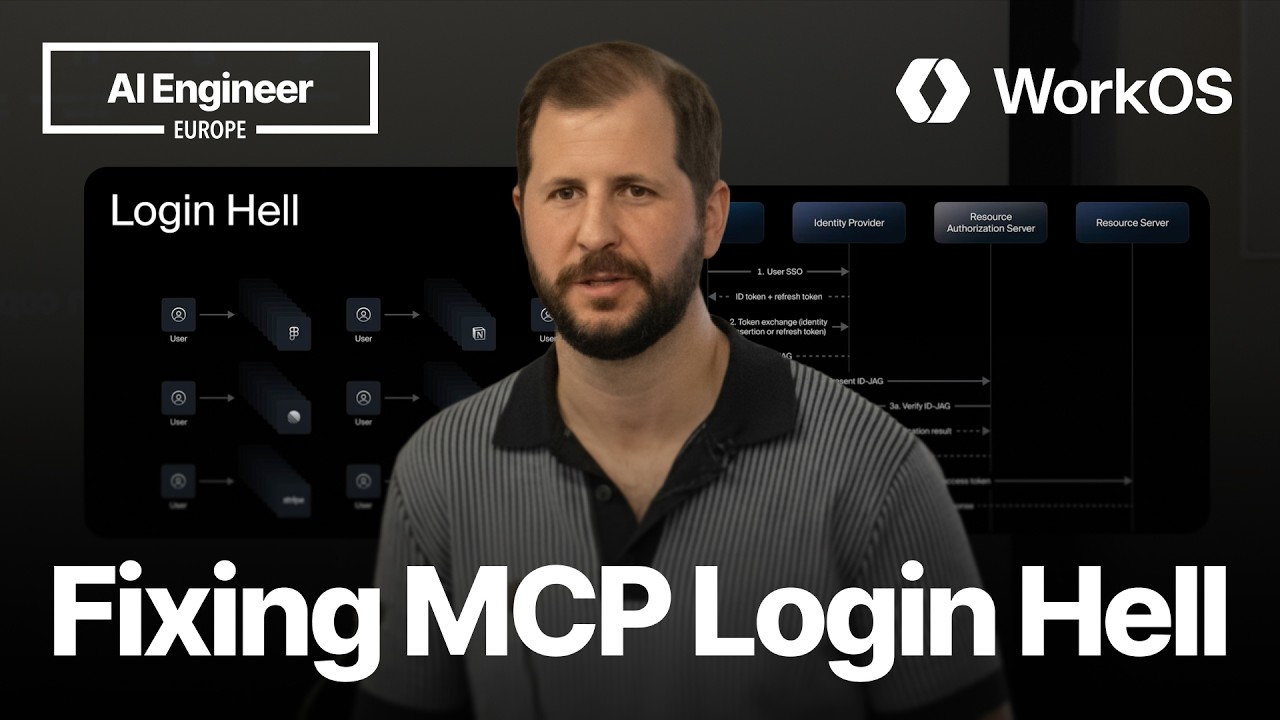
One Login to Rule Them All: Cross-App Access for MCP — Garrett Galow, WorkOS
Apr 28, 2026 · 23:24
Garrett Galow from WorkOS introduces Cross-App Access (XAA) for MCP, solving the problem of repeated OAuth consent screens when connecting agents to multiple services. The flow leverages a three-way trust between the MCP client, server, and an Identity Provider like Okta: a single SSO login issues an IDJag token that is exchanged for short-lived access tokens across all MCP servers without manual intervention. A demo shows Figma automatically connecting after an Okta login. The approach improves security—if the IdP session is revoked, tokens cannot refresh—and requires minimal IT setup: granting permission for the client to request server access. Currently only Okta supports XAA; Azure/Entra does not yet. The session also notes that authorization scopes are not handled by default but are a future consideration.

Bending a Public MCP Server Without Breaking It — Nimrod Hauser, Baz
Apr 8, 2026 · 40:50
Nimrod Hauser, founding engineer at Baz, presents a hands-on guide to adapting third-party MCP servers for production, using Playwright's MCP server as an example. He demonstrates five best practices—curation, wrapping descriptions, deterministic guardrails, composing new tools, and treating tools as deterministic functions—to transform a brittle setup into resilient infrastructure. Hauser shows how curating tools from 21 to 16 reduces context load, while enhanced descriptions guide agents to use accessibility snapshots before clicking. Deterministic path validation prevents agents from saving screenshots outside a designated folder, and a new 'evidence tool' with tailored instructions improves spec review accuracy. The talk culminates with Baz's Spec Reviewer, an agentic code review tool that compares requirements against implementation, successfully passing a test after applying all optimizations.

Building in the Gemini Era – Kat Kampf & Ammaar Reshi, Google DeepMind
Dec 15, 2025 · 17:57
Kat Kampf and Ammaar Reshi from Google DeepMind present Gemini 3 and Nano Banana Pro, arguing that these models enable anyone to build complex, aesthetic applications through natural language alone. Gemini 3 achieves state-of-the-art results in one-shot UI design and agentic tool calling, with SweBench outperformance. Nano Banana Pro integrates Google Search for world knowledge and renders text accurately, handling up to 14 consistent people per image. They demonstrate vibe coding in AI Studio, building a personalized comic book with precise text, laptop stickers grounded in search, and a 3D racing game that scaled to 23 players live. Upcoming full-stack runtime adds backend support and automatic database integration, further democratizing software creation.

Defying Gravity - Kevin Hou, Google DeepMind
Dec 2, 2025 · 25:10
Kevin Hou from Google DeepMind introduces Antigravity, a new agent-first IDE that combines three surfaces: an AI editor, an agent-controlled Chrome browser, and an Agent Manager. The central claim is that agents should live outside the IDE, enabling longer-running tasks and multimodal interactions. Key features include Artifacts—dynamic representations like plans, screen recordings, and diagrams—that replace raw chain-of-thought with visual summaries. The browser enables context retrieval and verification via screen recordings, while image generation allows iterative design through comments. Hou explains the research-product flywheel: DeepMind researchers use Antigravity internally to identify model gaps, improving capabilities like computer use and instruction following, which then ship in the product. He also details four categories of model improvements: intelligence, tools, long-running tasks, and multimodal, all powered by Gemini 3 Pro and related models.
Shipping Products When You Don't Know What they Can Do — Ben Stein, Teammates
Jul 28, 2025 · 19:34
Ben Stein, founder of Teammates, argues that product management for AI agents requires abandoning traditional specs and embracing uncertainty. He describes how his team discovered emergent behavior when a customer asked to tag an agent in a Google Doc comment—an unplanned feature that worked. Stein advocates thinking in affordances rather than features, using evals as the new spec, and vibe coding to feel interactions before committing. He notes that bugs become ambiguous when behavior is probabilistic, and customer meetings shift from selling vision to co-inventing the future. The episode offers a field guide for product teams navigating boundless surface areas built on unpredictable LLMs.

Shipping something to someone always wins — Kenneth Auchenberg (ex. Stripe, VSCode)
Jul 28, 2025 · 16:17
Kenneth Auchenberg, former VSCode and Stripe developer platform lead, argues that great AI products come from rapid iterative loops — shipping continuously viable 'skateboards' to real users rather than aiming for a perfect final product. He advocates for writing launch blog posts before building, working intimately with a few real customers (even texting them), and ignoring constraints like legal initially to design the best product. APIs are harder to change than UI, so early user feedback is critical. In AI, the fundamentals haven't changed: customer knowledge and iteration velocity matter more than ever, even as AI tools accelerate building. The goal should be to run a product feedback loop in under a day.

tldraw.computer - Steve Ruiz, tldraw
Jul 21, 2025 · 18:45
Steve Ruiz, founder and CEO of tldraw, demonstrates the company's AI experiments on their infinite canvas, including Make Real—which turns hand-drawn wireframes into working web apps using vision models—and tldraw computer, a visual programming environment where arrows and LLMs power a graph of connected nodes that can execute multi-step prompts, generate images and speech, and even run loops indefinitely. He also shows Draw Fast for real-time image generation and Teach, where Claude can draw and edit shapes on the canvas. The episode explains how tldraw's SDK (tldraw.dev) enables others to build custom canvas applications, and highlights the company's philosophy of 'shitty but amazing' rapid prototyping.

Windsurf everywhere, doing everything, all at once - Kevin Hou, Windsurf
Jun 23, 2025 · 16:03
Windsurf head of product Kevin Hou explains the company's philosophy of a shared human-AI timeline and its vision to be everywhere, do everything, and work all the time. The AI ingests context from tools like Google Docs, Figma, GitHub, and Notion, and takes actions beyond coding—opening PRs, deploying, and reviewing code. Windsurf generates 90 million lines of code daily and processes over 1,000 messages per minute. Its new model SWE-1, trained on software engineering workflows, achieves near-frontier performance with a fraction of the resources. Hou emphasizes a data flywheel where user feedback on real workflows drives continuous improvement, arguing that successful AI products in 2025 require harmony among model, data, and application.
Invisible Users, Invisible Interfaces: Accelerating Design Iteration with AI Simulation - Alex Liss
Jun 3, 2025 · 12:37
Alex Liss, VP of Data Science and AI at Huge, argues that AI should be used as a tool for design itself rather than as a feature, proposing Intelligent Twins—AI simulations of user personas—to accelerate needfinding and interface testing. Citing a trust gap where only 32% of US adults trust AI, he advocates for repairing it by designing better interfaces, not adding chatbots. He demonstrates a global audit of sports websites (NBA, Olympics, Premier League) where Intelligent Twins simulated casual and super fans across 72 tasks, revealing strong navigation but declining performance in information architecture and engagement. The methodology uses computer use agents for visual evaluation and human-in-the-loop review to generate focused design briefs. Limitations include reproducibility and the need for test-and-control validation, with future potential in integrating MCP protocol for turning Figma components into code. Liss concludes that AI simulation can help teams gather insights faster and create simpler, trustworthy interfaces.

The era of unbounded products: Designing for Multimodal IO: Ben Hylak
Sep 25, 2024 · 20:32
Ben Hylak, founder of Dawn and former Apple Vision Pro designer, argues that the key to building intuitive AI products in the era of unbounded interfaces is adding structure—highlighting what matters, establishing hierarchy, and leveraging familiarity—lessons from designing VisionOS. He shows how successful AI apps like Dot, Perplexity, and Claude use structure (e.g., Claude pulling code into artifacts) while the Vercel chatbot's inline dynamic UI is an anti-pattern because it disrupts conversation flow. For agents, spreadsheets (like Clay) make unfamiliar multi-step tasks familiar. Looking ahead, Hylak predicts less prompt engineering via sparse autoencoders for millions of ranked, personalized presets, shifting product evaluation from evals to user analytics as apps become increasingly personalized.

What's new from Anthropic and what's next: Alex Albert
Aug 5, 2024 · 13:38
Alex Albert, Head of Developer Relations at Anthropic, argues the industry is in a 'magic star icon phase'—tacking AI onto existing products—and urges rebuilding from the ground up. He announces Claude 3.5 Sonnet, which scores 64% on pull request evals (vs 38% for 3 Opus), with 200k context, vision improvements, and pricing at $3/M input and $15/M output tokens. New features include Artifacts for collaborative creation of code and React components from screenshots, Projects for team knowledge grounding, and an enhanced ToolUse API supporting hundreds of tools and structured JSON output. Future models (3.5 Haiku/Opus) will be smarter, cheaper, and faster; a steering API for interpretability allows clamping feature values to control outputs.
Powered by PodHood