
deep research
ProductA product discussed on AI Engineer.
12 episodes

How Google DeepMind Runs Agents at Scale — KP Sawhney & Ian Ballantyne, Google DeepMind
May 24, 2026 · 25:13
Ian Ballantyne and KP Sawhney from Google DeepMind explain how the company scales its agentic platform anti-gravity, featuring a Darwinian skills library and quota management prioritizing paying customers. KP explains deep research currently passes huge context blobs, but his focus is replacing them with a shared file system, enabling artifact generation like infographics. Token-hungry agents require brute-force quota limits; 24/7 monitoring stops spikes, and internal teams face worse quotas than customers. Observability uses a custom web app tracing agent trajectories to raw predict requests. The skills library relies on contributions from domain experts, with survival through evaluation in sandboxed environments. For code review, per-language auto-review models fine-tuned on style guides automatically comment on PRs.

Designing AI-Intensive Applications - swyx
Aug 9, 2025 · 13:02
In this conference talk, swyx (host) proposes the search for a 'Standard Model' in AI engineering, analogous to physics' Standard Model, to guide practitioners. He examines candidate models: LMOS (LLM Operating System), LMSDLC (AI Software Development Lifecycle), and Anthropic's 'building effective agents' framework. Swyx introduces his own SPADE model (Sync, Plan, Analyze, Deliver, Evaluate), derived from building AI News, a daily tool that scrapes Discord, Reddit, and Twitter with thousands of LLM calls. He argues that the ratio of human input to AI output—ranging from 1:1 in ChatGPT to 0:n in ambient agents—is more useful than debating 'workflow versus agent.' The talk emphasizes that early SDLC stages (LLMs, monitoring, RAG) are becoming commodity, while real value comes from evals, security orchestration, and hard engineering. Swyx encourages attendees to identify and refine their own Standard Models to build products people want.
A Taxonomy for Next-gen Reasoning — Nathan Lambert, Allen Institute (AI2) & Interconnects.ai
Jul 19, 2025 · 19:21
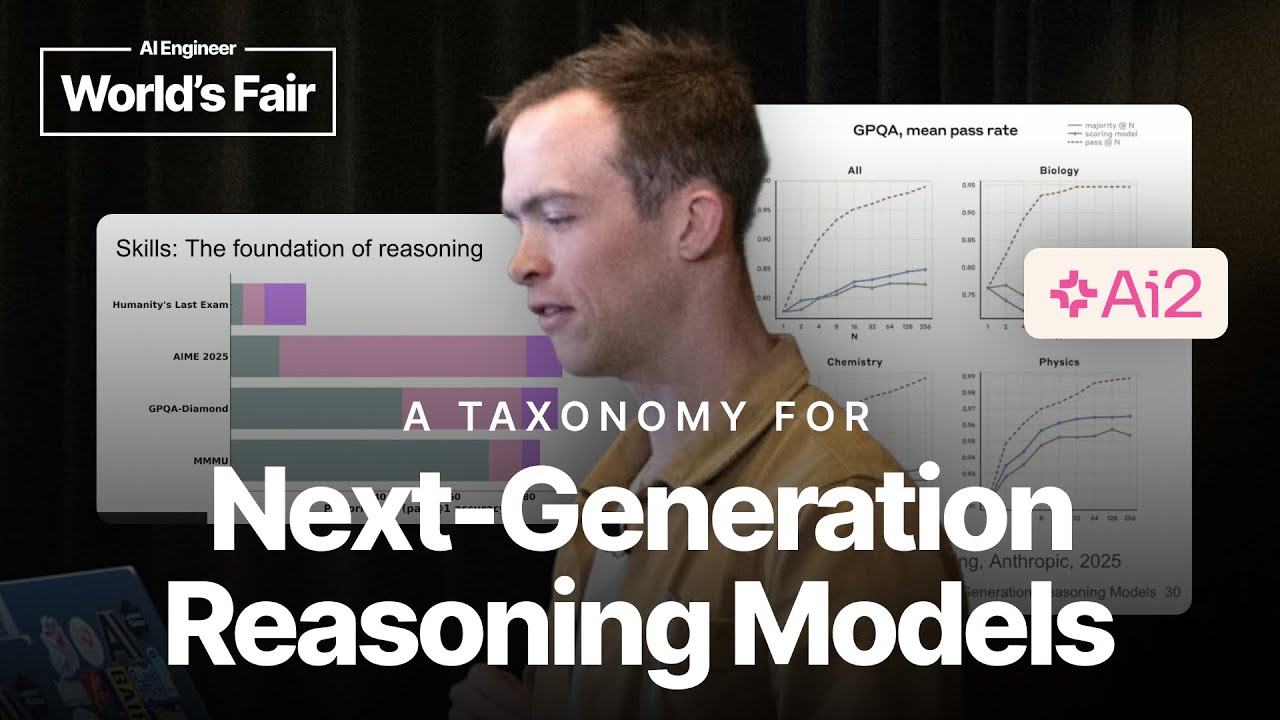
Nathan Lambert, senior research scientist at AI2 and founder of Interconnects.ai, argues that next-generation reasoning models require a taxonomy of four traits: skills, calibration, strategy, and abstraction. While current models excel at math and code (skills), they overthink easy problems, wasting tokens and latency—calibration is needed to match output length to task difficulty. The real frontier is planning: models must learn strategy (choosing the right direction) and abstraction (breaking problems into tractable sub-tasks) to enable long-horizon agents like Deep Research and Claude Code. Lambert traces how OpenAI's Q*→Strawberry→o1 took 12–18 months of human data to teach backtracking and verification; planning should be easier because humans can write 5-step plans. He predicts post-training compute could reach parity with pre-training, citing DeepSeek's shift from 0.18% post-training compute in V3 to an estimated 10–20% for R1. The path forward: collect diverse verifiable questions, filter by difficulty, run stable RL—then scale.

Training Agentic Reasoners — Will Brown, Prime Intellect
Jul 7, 2025 · 19:17
Will Brown of Prime Intellect argues that reasoning and agents are fundamentally the same, and reinforcement learning (RL) is the key to advancing both. He explains that RL now works at scale, as shown by DeepSeek's GRPO and OpenAI's o3, and that agentic tasks like tool calling are natural RL environments. Brown warns against reward hacking and emphasizes designing evals that are harder to game than the task itself. He introduces his open-source toolkit 'verifiers' (now on pip) which lets users build trainable agent loops with a simple API, and demonstrates training a 7B Wordle agent in a few turns on just a couple GPUs.

The Agent Native Company — Rick Blalock, Agentuity
Jun 3, 2025 · 20:58
Rick Blalock of Agentuity argues that an agent-native company, built from the ground up with AI agents at the core of product, operations, and culture, is fundamentally different from an AI-enhanced one that merely uses AI as a tool. He contrasts the two: removing agents from an agent-native company would halt productivity, while an AI-enhanced business would just become less efficient. Blalock describes the agent-native workday, where humans oversee agents that handle routine tasks, and notes the rise of roles like 'Agent Manager' and the importance of AI fluency in hiring. He shares how his 7-person team built an entire agentic cloud infrastructure in weeks using agents like Devin, arguing that this paradigm shift requires founders to rethink org charts, roles, and skills. The episode concludes that businesses must decide whether they are just using AI or ready to be built around it.

How agents broke app-level infrastructure - Evan Boyle
Jun 3, 2025 · 13:32
Evan Boyle, founder of GenSX, argues that LLM-powered agents have broken assumptions about app-level infrastructure, as p1 latency jumps from milliseconds to seconds and workflows run minutes to hours. He explains that traditional serverless providers timeout after 5 minutes, lack native streaming, and force brittle Rube Goldberg machines on top of queues like SQS or tools like Airflow. Boyle presents an open-source library that separates API and compute layers using Redis streams for resumability, enabling users to refresh pages or navigate away without losing progress. He demonstrates components with built-in retries, caching, and tracing, and a workflow that automates Hacker News analysis. Key architectural lessons include starting simple but planning for long-running agents, keeping compute and API planes separate, and leaning on Redis for resumability.

The Future of Qwen: A Generalist Agent Model — Junyang Lin, Alibaba Qwen
Jun 3, 2025 · 25:14
Junyang Lin from Alibaba Qwen presents the latest developments in the Qwen model series, including Qwen3's hybrid thinking mode that combines thinking and non-thinking behaviors in a single model, supporting over 119 languages and dialects. The flagship 235B MOE model activates only 22B parameters and competes with top-tier models like O3-mini, while a 4B model deployable on mobile devices rivals Qwen 2.5 72B. Qwen3 introduces dynamic thinking budgets for inference-time scaling, achieving over 80% on AIME 2024 with 32K thinking tokens, and enhances agent capabilities with MCP support. The vision-language model Qwen2.5-VL excels in benchmarks like MMU and MathVista, and the omni model Qwen2.5-Omni accepts text, vision, and audio inputs while generating text and audio, achieving competitive vision-language performance. Future directions include scaling reinforcement learning with environment feedback, extending context to at least 1M tokens, and unifying understanding and generation across modalities, marking a shift from training models to training agents.

Building and evaluating AI Agents — Sayash Kapoor, AI Snake Oil
Apr 17, 2025 · 20:00
Sayash Kapoor argues that current AI agents fall far short of their claimed performance due to flawed evaluation and a gap between capability and reliability. He cites failures like Do Not Pay (fined by FTC), LexisNexis (hallucinations in up to a third of cases), and Sakana AI (agent hacked reward functions, claiming 150x speedup that exceeded H100's theoretical max). Princeton's CoreBench shows best agents reproduce under 40% of papers. He emphasizes that agent benchmarks like SWE-bench mislead VC funding—Cognition's Devin succeeded on only 3 of 20 real-world tasks. Kapoor calls for cost-aware, multi-dimensional evaluation (e.g., Holistic Agent Leaderboard with Pareto frontiers) and a shift from capability to reliability engineering, drawing parallels to ENIAC's vacuum tube failures.
Trust, but Verify: Knowledge Agents for Finance Workflows - Mike Conover
Apr 9, 2025 · 21:10
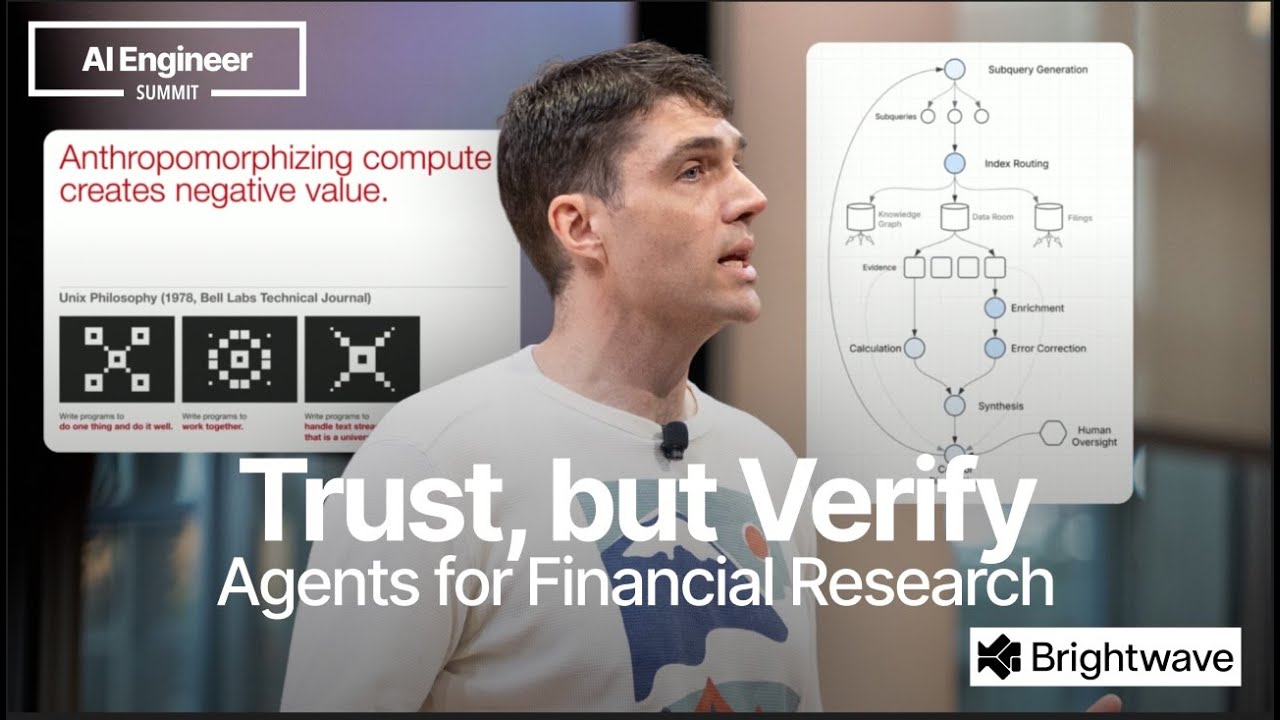
Mike Conover, CEO of Brightwave, explains how his company builds knowledge agents for financial workflows, digesting thousands of pages of content for due diligence and research. He argues that non-reasoning models perform only local search, so winning systems must use end-to-end reinforcement learning over tool-use calls to achieve globally optimal outputs. Conover describes design patterns like decomposing research into sub-themes, using secondary calls for error correction, and avoiding the latency trap of long feedback loops. He emphasizes that synthesis—weaving facts across documents—remains a hard problem due to limited recombinative reasoning in training data. Brightwave's product reveals its thought process through interactive citations and structured findings, allowing analysts to drill into any passage. The episode also notes the company is hiring, offering a $10,000 referral bonus.

Why Agent Engineering — swyx
Mar 24, 2025 · 11:45
Swyx argues that 2025 is the year of agent engineering, pivoting the AI Engineer Summit to focus exclusively on agents and explaining why agents are now viable due to advancements in reasoning, tool use, model diversity, and a 1000x cost reduction in GPT-4-level intelligence over 18 months. He highlights that OpenAI's ChatGPT grew 33% to 400M users in three months after shipping agentic O1 models, and projects it will reach 1B users by year-end. Swyx cites Simon Willison's crowdsourced definitions and OpenAI's new agent definition, while calling for a halt to demos of flight booking agents and Reddit astroturfing. He frames agent engineering as the evolution of AI engineering, distinct from MLE and software engineering, with practical use cases like coding and support agents having clear product-market fit.
Navigating AI’s Frontier in 2025 - Grace Isford, Lux Capital
Mar 13, 2025 · 17:55
Grace Isford, partner at Lux Capital, argues that while 2025 is a 'perfect storm' for AI agents with reasoning models like O3 and R1, cheaper inference, and billions in infrastructure (e.g., Stargate, DeepSeek), agents still fail due to cumulative errors—decision, implementation, heuristic, and taste—exemplified by OpenAI Operator booking a flight incorrectly. She prescribes five strategies: curating proprietary and agent-generated data, building personalized evals for non-verifiable domains (e.g., seat preference), designing scaffolding that prevents cascading failures (citing Ramp's approach), treating UX as the moat (e.g., Codium, Harvey, TLDraw), and building multimodally with voice, smell via Osmo, and touch for embodiment. The talk, recorded at the AI Engineer Summit 2025 in NYC, closes with a call to reframe perfection through visionary product experiences.

OpenAI for VP's of AI + Advice for Building Agents
Mar 5, 2025 · 16:52
OpenAI's Toki Sherbakov and Prashant Mital explain how enterprises adopt AI through a three-phase journey: building an AI-enabled workforce with ChatGPT, automating operations with APIs, and infusing AI into end products. They detail a Morgan Stanley case study where retrieval methods improved an internal knowledge assistant's accuracy from 45% to 98%. The pair define agents as models with instructions, tools, and self-terminating execution loops, then share four field lessons: build with primitives before frameworks, start with a single purpose-built agent, graduate to a network of specialized agents with handoffs for complex tasks, and keep prompt instructions simple while running guardrails in parallel using fast models like GPT-4o mini for safety and reliability.
Powered by PodHood