
Shopify
CompanyA company discussed on AI Engineer.
5 episodes

Building Interactive UIs in VS Code with MCP Apps — Marlene Mhangami & Liam Hampton, GitHub
Jun 6, 2026 · 16:06
Marlene Mhangami and Liam Hampton from GitHub explain MCP Apps, which let server tools return rich interactive UI components inside VS Code Chat via sandboxed iframes, replacing plain text responses. They demonstrate a flame graph profiler that profiles a Go app running bubble sort and Fibonacci, rendering an interactive flame graph directly in the chat window. The MCP server returns data and a resource reference to bundled HTML; VS Code fetches and renders it, enabling live interaction like clicking and querying without leaving chat. Use cases include data exploration, e-commerce checkouts (Shopify), and interactive diagrams (Excalidraw). The iframe is sandboxed for security—like putting a hamster in a cage to prevent it from modifying VS Code settings or calling external APIs. Marlene and Liam walk through building an MCP App from scratch using a skill from the model context protocol repository.

Agent Optimization with Pydantic AI: GEPA, Evals, Feedback Loops — Samuel Colvin, Pydantic
May 7, 2026 · 1:20:40
Samuel Colvin shows how to improve production agents without redeploying using Pydantic AI's GEPA, evals, and Logfire managed variables. GEPA uses a genetic algorithm to evolve prompts, achieving 96.7% accuracy — up from 87% with a simple prompt and 92% with an expert prompt — on a Wikipedia-based political relations task. Managed variables let you update prompts, models, and parameters live via a web interface and A/B test targeting. Evals compare against a golden dataset of 650 MPs; Colvin runs 65 cases in 30 seconds using GPT-4.1. He discusses that prompt optimization is most valuable with private data, that implicit user feedback (e.g., user's next action) can build golden datasets, and that overfitting to small test sets is a risk — the GEPA optimizer may exclude valid relations like 'uncle' if they don't appear in the training split.
MCP UI: Extending the frontier — Liad Yosef and Ido Salomon, MCP Apps
May 6, 2026 · 22:21
In this episode, Ido Salomon and Liad Yosef explain MCP Apps, an MCP extension that lets tools send interactive, branded UI instead of plain text responses inside chat hosts like ChatGPT, Claude, VS Code, Cursor, and Copilot. They argue that text-based chat reduces companies to a wall of text, erasing identity, while MCP Apps preserves branding by returning HTML resources that hosts render as secure, interactive components. The architecture ensures every user click sends a message back to the host (not directly to the backend), keeping interactions in context—as demonstrated with a PostHog funnel analysis in Claude. Adoption includes Shopify, Hugging Face, GitHub, ChatGPT, and Claude, with ChatGPT recommending MCP Apps for building ChatGPT Apps. They note 800 million weekly ChatGPT users (10% of world population), calling this a once-in-20-years opportunity to rethink app distribution. Future work covers reusable views, model-UI interaction, and interoperability with generative UI protocols like A2UI and WebMCP, aiming to standardize UI in chat as the new web.
How AI is changing Software Engineering: A Conversation with Gergely Orosz, @pragmaticengineer
Apr 21, 2026 · 26:42
Gergely Orosz explains how AI is reshaping software engineering, from token maxing at Meta, Microsoft, and Salesforce—where engineers use AI tools to inflate token counts out of fear of layoffs and performance reviews—to the broader shift in the engineer's role toward orchestrating agents rather than managing people. He notes that big tech companies like Uber, Airbnb, and Shopify are building custom internal AI infra (MCP gateways, coding agents) to stay ahead, even tolerating high churn for a six-month competitive edge. Shopify secured GitHub Copilot a year early by offering feedback from 3,000 engineers. Gergely also shares how The Pragmatic Engineer hit product-market fit: 100 paid subscribers before publishing, reaching 1,000 in six weeks, and becoming the #1 paid tech newsletter by focusing on two deep-dive articles per week for two years.
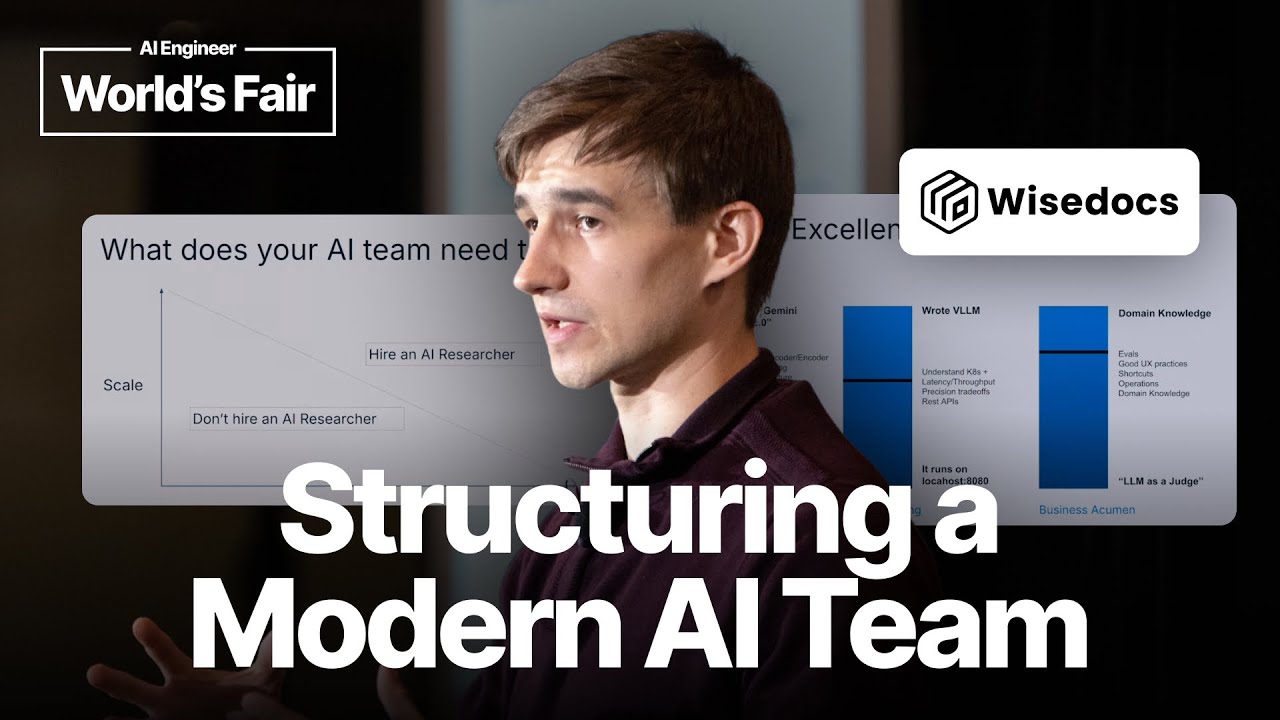
Structuring a modern AI team — Denys Linkov, Wisedocs
Jul 24, 2025 · 17:40
Denys Linkov, who leads ML at Wisedocs, argues that building a modern AI team hinges on identifying your company's bottleneck—shipping features, acquiring users, or scalability—rather than reflexively hiring AI researchers. He introduces Ampere's Wager: trading your entire domain-savvy team for five top-lab researchers is usually a losing bet. For early-stage AI strategy, generalists who blend model training, serving, and business acumen outperform specialists; Linkov lived this in 2021 building a custom MLOps platform for a conversational AI startup and again in 2024 using advanced open-source tools for medical record processing. He stresses reskilling existing teams through weekly learning cadences and moving domain experts from giving feedback to writing evaluations. Hiring should hold context and act on it, verifying trends like 'don't hire juniors' against YC's AI school drawing 2,000 young people.
Powered by PodHood