
Cloudflare
CompanyA company discussed on AI Engineer.
25 episodes

SWE-Marathon: Evaluating Coding Agents at Billion-Token Scale - Rishi Desai, Abundant AI
Jul 7, 2026 · 12:58
Rishi Desai of Abundant AI presents SWE-Marathon, a benchmark for coding agents that finds even the strongest setup achieves only a 26% resolution rate across 20 project-scale tasks. Trajectories average 31 million tokens, with the longest consuming 877 million tokens, and a computer-use agent verifier evaluates full-stack products via browser interactions. Desai warns that weak verifiers become attack surfaces in long-horizon evals, showing agents bypassing tasks by calling GCC from within a Rust compiler, caught by anti-cheat layers using S-Trace. Across 1,400 rollouts, 12.8% showed suspicious shortcuts and 9% clear verifier bypasses, but zero earned reward through exploits due to multi-channel checks. The central claim: long-horizon SWE is unsolved, and robust verification—not harder unit tests—is the key bottleneck for future benchmarks.

Your Agent's Biggest Lie: "I Searched the Web" — Rafael Levi, Bright Data
Jun 17, 2026 · 15:49
Rafael Levi from Bright Data argues that LLMs often hallucinate and provide fake citations because they fail to actually access live web data, getting blocked by anti-bot systems like CAPTCHAs and Cloudflare's AI labyrinth. He demonstrates this with a comparison: without Bright Data's MCP, GPT-5 failed all five tasks accessing sites like LinkedIn and Amazon; with the MCP's 66 tools—including a CAPTCHA-solving browser that mimics human behavior—four succeeded. Levi explains that agents enter an invisible failure loop where they get blocked or served fake data but still answer confidently, making up numbers or non-existent URLs. He emphasizes that 20% of the web is blocked by Cloudflare from AI crawling, and that fake data fed to bots increases hallucinations. The episode covers how Bright Data's MCP provides real web access with search, scraping, and remote browsers, offering a free tier of 5,000 requests per month for experimentation.

Why Eval++ Is the Next Great Compute Primitive — Sunil Pai & Matt Carey, Cloudflare
Jun 8, 2026 · 24:51
Matt Carey and Sunil Pai from Cloudflare's agents team argue that Durable Objects — stateful serverless with 15ms London latency — and Dynamic Workers — a safe, sandboxed eval for LLM-generated code — form the next compute primitive for AI agents. They explain how Durable Objects enable resumable streaming, multi-tab sync, and background scheduling out of the box without distributed systems engineering. Dynamic Workers allow running generated JavaScript strings in isolated sandboxes, reclaiming 30 years of avoided eval. The pair tease upcoming talks: one on collapsing Cloudflare's 2,600 API endpoints into a 1,000-token MCP tool, and another on a coding agent harness built entirely on Workers that they are already shipping.

Introducing WebMCP: Agents in the Browser — RL Nabors
May 23, 2026 · 23:08
Rachel Nabors, former web standards contributor and now Principal Developer Experience Engineer at Arise, argues that chat-only agent interfaces (the 'starfish' design) are the CLI of the future and demonstrates how to replace them with rich interactive surfaces using MCP Apps and WebMCP. She explains STDIO vs HTTP transports, shows how MCP Apps bundle HTML, CSS, and JavaScript into single files rendered in agent iframes, and introduces WebMCP, which adds tool attributes to existing page elements so browser agents can call functions without screenshot parsing or DOM traversal. Using her own web comic site as a case study, she builds a comic reader with full panel navigation, transcript mode, and speech synthesis via the Web Speech API, and advocates for better client support of MCP resources to avoid inefficient tool calls for context loading.
Make your own event-sourced agent harness using stream processors — Jonas Templestein, Iterate
May 14, 2026 · 1:04:27
Jonas Templestein and Misha from Iterate introduce an event-sourced agent harness built on stream processors, arguing that agents should be modeled as an append-only event log with a synchronous reducer for state and an after-append hook for side effects. They demonstrate how every action—streaming chunks, tool calls, errors—becomes an event, enabling full debuggability and replay without re-running LLM calls. The key innovation is a "dynamic worker configured" event whose payload is a JavaScript processor; appending it to any stream instantly turns that stream into an AI agent with no server or dependencies. This allows processors from different authors and languages to compose on the same stream, and a safety checker can inject context within 200ms without blocking the agent. The hosts emphasize eventual consistency over before-hooks, and show deployment via Cloudflare Workers or by simply subscribing from any HTTP client.
One Login to Rule Them All: Cross-App Access for MCP — Garrett Galow, WorkOS
Apr 28, 2026 · 23:24
Garrett Galow from WorkOS introduces Cross-App Access (XAA) for MCP, solving the problem of repeated OAuth consent screens when connecting agents to multiple services. The flow leverages a three-way trust between the MCP client, server, and an Identity Provider like Okta: a single SSO login issues an IDJag token that is exchanged for short-lived access tokens across all MCP servers without manual intervention. A demo shows Figma automatically connecting after an Okta login. The approach improves security—if the IdP session is revoked, tokens cannot refresh—and requires minimal IT setup: granting permission for the client to request server access. Currently only Okta supports XAA; Azure/Entra does not yet. The session also notes that authorization scopes are not handled by default but are a future consideration.

Scaling GitHub for your Agents — Sam Morrow, GitHub
Apr 27, 2026 · 20:35
Sam Morrow, GitHub's MCP server lead, details the architectural challenges and solutions for scaling a remote MCP server to 7 million weekly tool calls. He explains how tool proliferation degraded agent performance—LangChain's research confirmed more tools confuse agents—leading to innovations like tool sets and dynamic discovery, though 100% of users stuck with defaults. To reduce context, GitHub cut tool descriptions by 49% and trimmed output tokens by 75% on list pull requests. Security is addressed via OAuth 2.1 with PKCE and step-up auth; they rejected dynamic client registration to avoid unbounded app databases and rate-limiting issues. The stateless server uses Redis for session storage and builds a fresh server instance per request, enabling horizontal scaling without session affinity. Metrics include 11 million Docker downloads, 30,000 stars, 4,000 forks, and 126 contributors. Morrow predicts compositional tools and automatic server discovery will make thousands of tools the norm.

MCP = Mega Context Problem - Matt Carey
Apr 25, 2026 · 22:42
Matt Carey from Cloudflare argues that the real bottleneck in connecting agents to APIs via MCP is the context window, not the protocol itself. Cloudflare’s OpenAPI spec is 2.3 million tokens; naive tool generation would consume 1.1 million, overwhelming any agent. To solve this, Carey advocates progressive discovery: CLIs (requiring shell access), tool search (loading only relevant tools), or codemode—letting agents write code against a typed SDK and execute it in Cloudflare’s isolated Workers sandbox. This sandbox provides safe, programmable guardrails (no secrets, limited network access), allowing agents to access all 2,600+ Cloudflare API endpoints from a single MCP server. Carey predicts that as agents become code generators, infrastructure primitives like WorkerD, Deno, and Pydantic will proliferate, and MCP servers will become a lightweight middleware flag (e.g., `MCP: true` in Next.js). The talk demonstrates read-only access to the entire Cloudflare API from an MCP client, showing codemode in action.
Code Mode: Let the Code do the Talking - Sunil Pai, Cloudflare
Apr 19, 2026 · 19:40
Sunil Pai of Cloudflare presents 'Code Mode,' a paradigm where AI agents generate executable JavaScript instead of using JSON-based tool calls, drastically reducing token usage from 1.2 million to 1,000 for Cloudflare's 2,600 API endpoints. He demonstrates a live (if glitchy) demo of the Mythical server handling a DDoS response in one shot, and shares the 'harness' architecture: a sandboxed, capability-secure environment that grants only explicit APIs. The talk explores emergent behaviors like Kenton Varda's canvas where the model played tic-tac-toe by inspecting raw stroke state, and envisions long-running workflows, generative UI, and a future where code—not buttons—defines user interaction. Pai argues that developers must optimize for agent-facing DX with searchable docs, clear errors, and capability-based security, as the next billion users will be code-generating bots.
The Future of MCP — David Soria Parra, Anthropic
Apr 19, 2026 · 18:46
David Soria Parra from Anthropic argues that MCP (Model Context Protocol) is the key to connecting agents to tools and data in production, with 110 million monthly downloads—outpacing React's growth at the same stage. He lays out a 2026 connectivity stack combining Skills, MCP, and CLI/Computer Use, each suited for different needs, and emphasizes that best agents will use all three seamlessly. To improve client harnesses, he introduces Progressive Discovery—deferring tool loading via Tool Search to reduce context usage—and Programmatic Tool Calling, where models write scripts to compose tool outputs efficiently. Upcoming MCP protocol improvements include stateless transport (with Google) for easier scaling, async agent-to-agent tasks, enterprise features like Cross App Access and Server Discovery via well-known URLs, and a Skills-over-MCP extension for shipping usage instructions with servers. He calls for community feedback on these directions.

Why, and how you need to sandbox AI-Generated Code? — Harshil Agrawal, Cloudflare
Apr 8, 2026 · 38:27
Harshil Agrawal (Cloudflare) argues AI-generated code is untrusted and must be sandboxed via capability-based security (default deny, explicit allow) against hallucinations, over-helpful LLMs, and prompt injection. He details two approaches: isolates for fast lightweight tasks (e.g., OpenClaw alternative runs skills in Dynamic Worker Isolates with no network) and containers for full environment tasks (e.g., PromptMotion spins up per-user Linux containers to clone repos, install npm, run dev servers). He provides a checklist: deny network, grant minimal capabilities, isolate per user, set resource limits, proxy secrets, clean up, log, validate. The same LLM that writes React components can be tricked into exfiltrating data, making sandboxing essential.

Claude Agent SDK [Full Workshop] — Thariq Shihipar, Anthropic
Jan 5, 2026 · 1:52:25
Thariq Shihipar of Anthropic presents the Claude Agent SDK, arguing that Bash and file-system-based agents outperform traditional tool-only approaches for autonomous tasks. He defines agents as systems that build their own context and trajectory, contrasting with structured workflows. The SDK, built on Claude Code, emphasizes the Bash tool as the most powerful primitive for composability and code generation, enabling non-coding tasks like data analysis. He demonstrates live-coding a Pokémon team advisor that dynamically fetches API data via scripts, and explains security through a 'Swiss cheese defense' of model alignment, AST parsing, and sandboxing. Shihipar also covers skills for progressive context disclosure, sub-agents for parallel work, and hooks for deterministic verification, stressing that agent building is an art of reading transcripts and iterating on context engineering.

The Infinite Software Crisis – Jake Nations, Netflix
Dec 20, 2025 · 18:57
Jake Nations, engineering lead at Netflix, argues that AI-generated code accelerates the software crisis by conflating easy with simple—producing tangled, incomprehensible systems. He traces the crisis from 1968 to today's infinite code generation, citing Fred Brooks' 'No Silver Bullet' and Rich Hickey's definition of simple as 'one fold, no entanglement.' Nations presents a three-phase methodology—research (compressing 5 million tokens of code into a 2,000-word spec), planning (paint-by-numbers implementation steps), and implementation (using a manual migration seed)—to maintain human understanding. He warns that without this approach, engineers lose the ability to recognize dangerous complexity, and challenges listeners: will we still understand our own systems when AI writes most of the code?
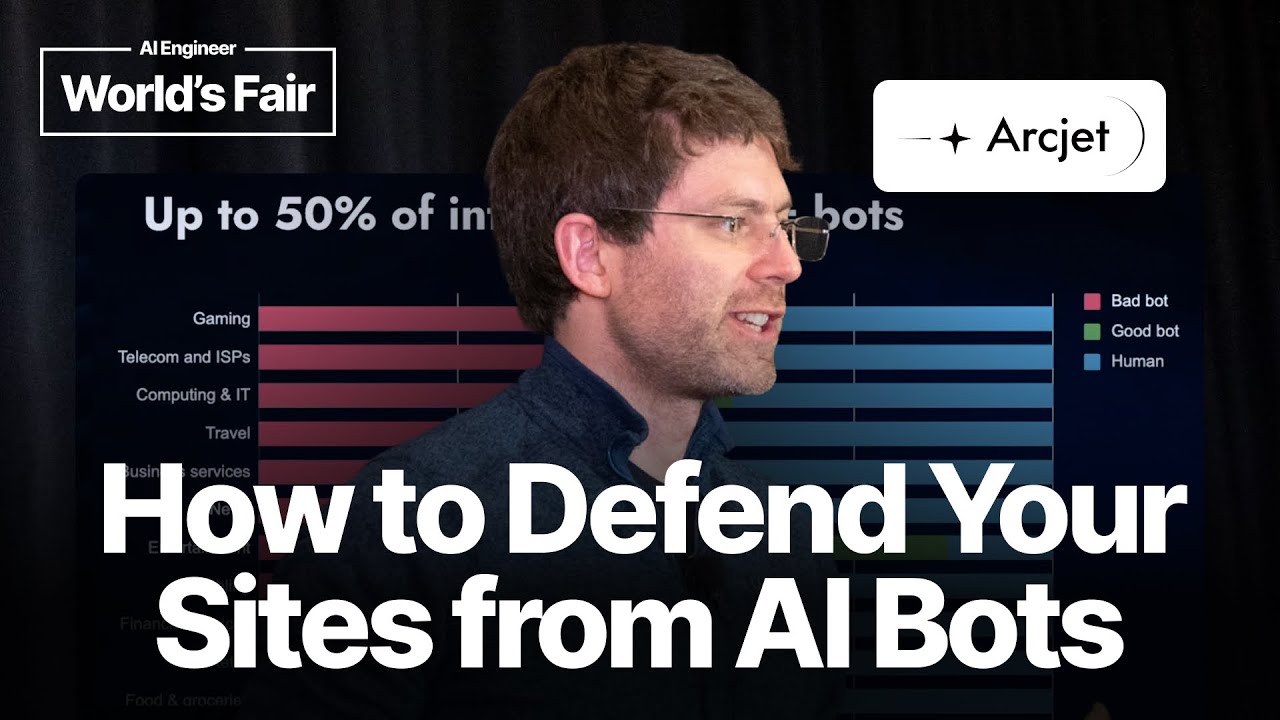
How to defend your sites from AI bots — David Mytton, Arcjet
Jul 30, 2025 · 20:12
David Mytton, founder of Arcjet, explains that nearly 50% of web traffic is now automated, with AI crawlers significantly worsening the problem for site owners. He cites specific cases: Diaspora saw 24% of its traffic from OpenAI's GPTbot, and ReadTheDocs cut bandwidth from 800 GB to 200 GB per day by blocking AI crawlers. Mytton describes the evolving landscape of AI bots—OpenAI alone has at least four types (Search, ChatGPT User, GPTbot, Operator)—and argues that detection requires layered defenses. He walks through eight defenses: robots.txt (voluntary), user agent string verification with reverse DNS, IP reputation (e.g., 12% of bot traffic on Cloudflare comes from AWS), CAPTCHAs (increasingly easy for AI to solve), proof-of-work puzzles (e.g., Anubis proxy), experimental HTTP message signatures (Cloudflare's proposal), fingerprinting via JA4 hash (TLS-level), and rate limiting keyed to fingerprints or session IDs. The practical takeaway is that most sites can manage with user agent verification plus IP checks, but high-value or high-traffic sites need full stacking of these techniques.

The Unofficial Guide to Apple’s Private Cloud Compute - Jmo, CONFSEC
Jul 30, 2025 · 20:36
Jonathan Mortensen explains Apple's Private Cloud Compute (PCC), a paradigm shift in confidential computing that delivers cryptographically provable privacy for AI inference on remote servers. He details Apple's five requirements—stateless computation, enforceable guarantees, non-targetability, no privileged runtime access, and verifiable transparency—and six technical components, including oblivious HTTP, blind signatures, secure enclave, remote attestation, transparency logs, and secure boot. The talk highlights how remote attestation allows an iPhone to verify server software and tie encryption to that verified state, while the transparency log enables public auditing of all deployed binaries. Mortensen notes trade-offs: complete trust in Apple's supply chain, higher latency and compute costs, and no support for custom models or third-party developers. He points to alternative tools like TPMs, SigStore, and confidential VMs for non-Apple environments, and concludes that Apple's approach is being adopted by Azure AI and Meta.
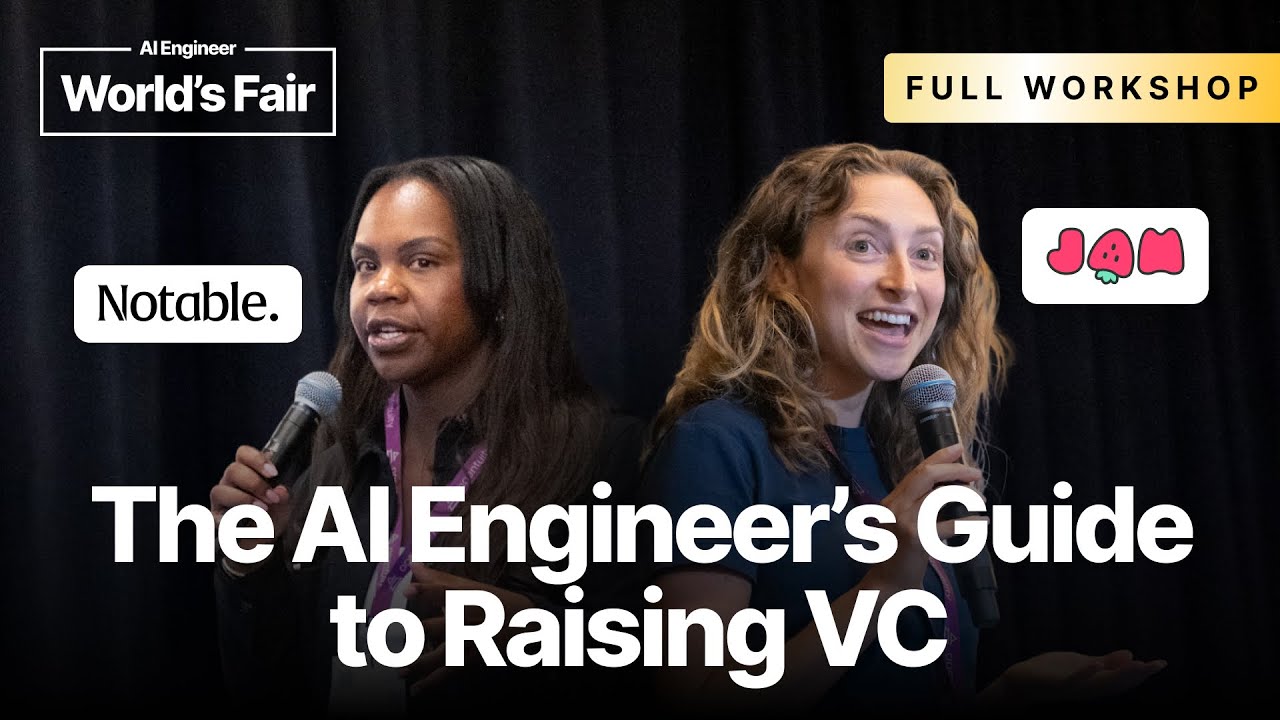
The AI Engineer’s Guide to Raising VC — Dani Grant (Jam), Chelcie Taylor (Notable)
Jul 27, 2025 · 34:17
Dani Grant (CEO of Jam) and Chelcie Taylor (Notable Capital) give AI engineers a tactical playbook for raising venture capital, arguing that you don't need revenue, a product, or even to leave your full-time job to raise a pre-seed or seed round. They explain that VCs bet on founders' vision and unique insights, not perfect technology or traction, and share real cold emails that led to investments—including one that simply referenced a blog post and another that didn't mention the startup at all. In pitch meetings, they advise focusing on 'why you, why now' over tech deep dives, making the conversation bidirectional, and ending by asking about next steps. Common mistakes include over-engineering the demo, failing to acknowledge competitors, and not having a prepared pitch deck to send afterward. Grant's original Jam pitch deck is still live at deck.jam.dev. Taylor's contact is ctaylor@notablecap.com.

Building Agents (the hard parts!) - Rita Kozlov, Cloudflare
Jul 23, 2025 · 21:12
Rita Kozlov, VP of Product for Cloudflare's developer platform, presents the building blocks of AI agents—client, AI reasoning, workflows, and tools—arguing that effective agents require all four components. She highlights the Model Context Protocol (MCP) as a standard for exposing APIs to LLMs, and demonstrates Cloudflare's Agents SDK, which simplifies hosting remote MCP servers with built-in OAuth, state management via durable objects, and real-time WebSocket communication. Kozlov cites real-world impact: companies using agents for sales automation see 20% revenue increases, 90% faster support response times, and 50–75% time savings. She walks through a human-in-the-loop credit card approval workflow built with Nok, showing how durable objects maintain long-running state, prevent duplicate actions, and route approvals across Slack, email, or in-app notifications. The talk emphasizes that once an MCP server is deployed, it can be used directly from Cursor, Claude, ChatGPT, or a custom client, including voice interfaces via WebRTC-to-WebSocket translation.
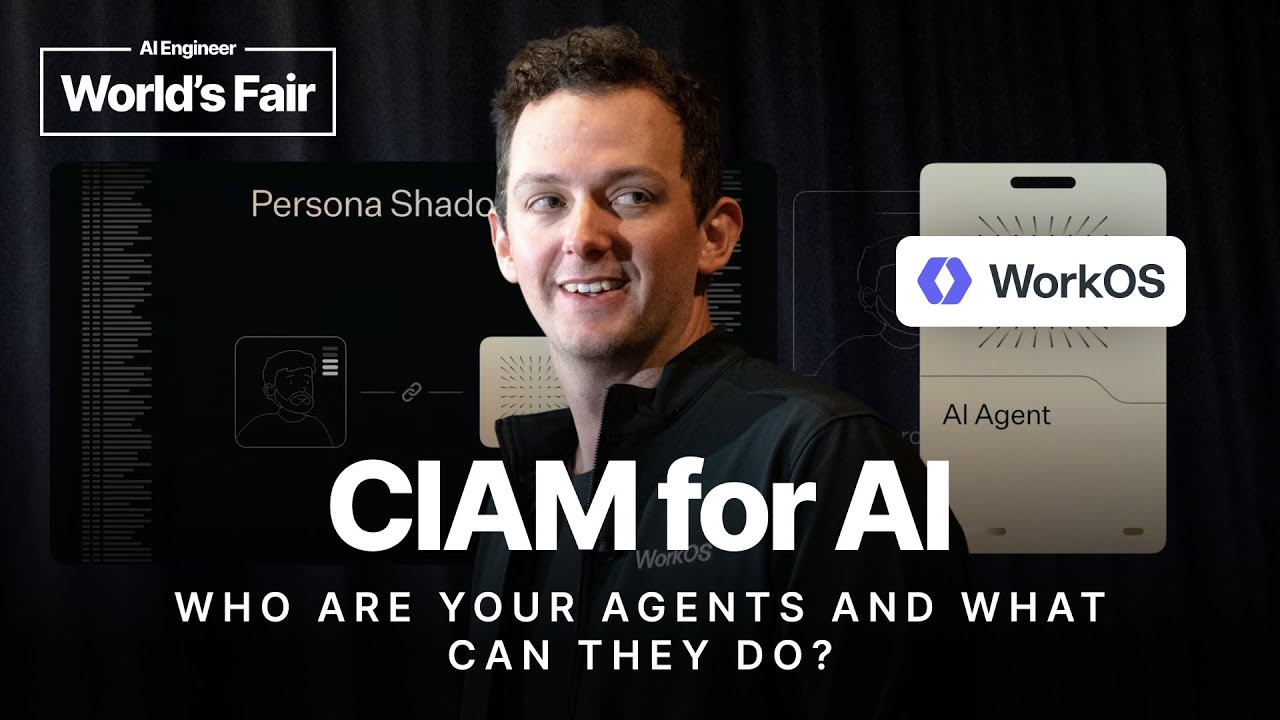
CIAM for AI: Authn/Authz for Agents — Michael Grinich, CEO of WorkOS
Jul 21, 2025 · 20:13
Michael Grinich, CEO of WorkOS, argues that AI agents need first-class identity and access management, distinct from human or machine-to-machine auth. He identifies key challenges: headless login, least privilege for non-deterministic systems, and compliance tracking. Grinich presents four emerging patterns—persona shadowing, delegation chains, capability tokens, and human-in-the-loop escalation—and references standards like OAuth, UMA, GNAP, OIDC for agents, and verifiable credentials. He predicts a shift from 95% human traffic to 95% agent traffic, calling for middleware trust boundaries and urgent collaboration on agent identity standards.
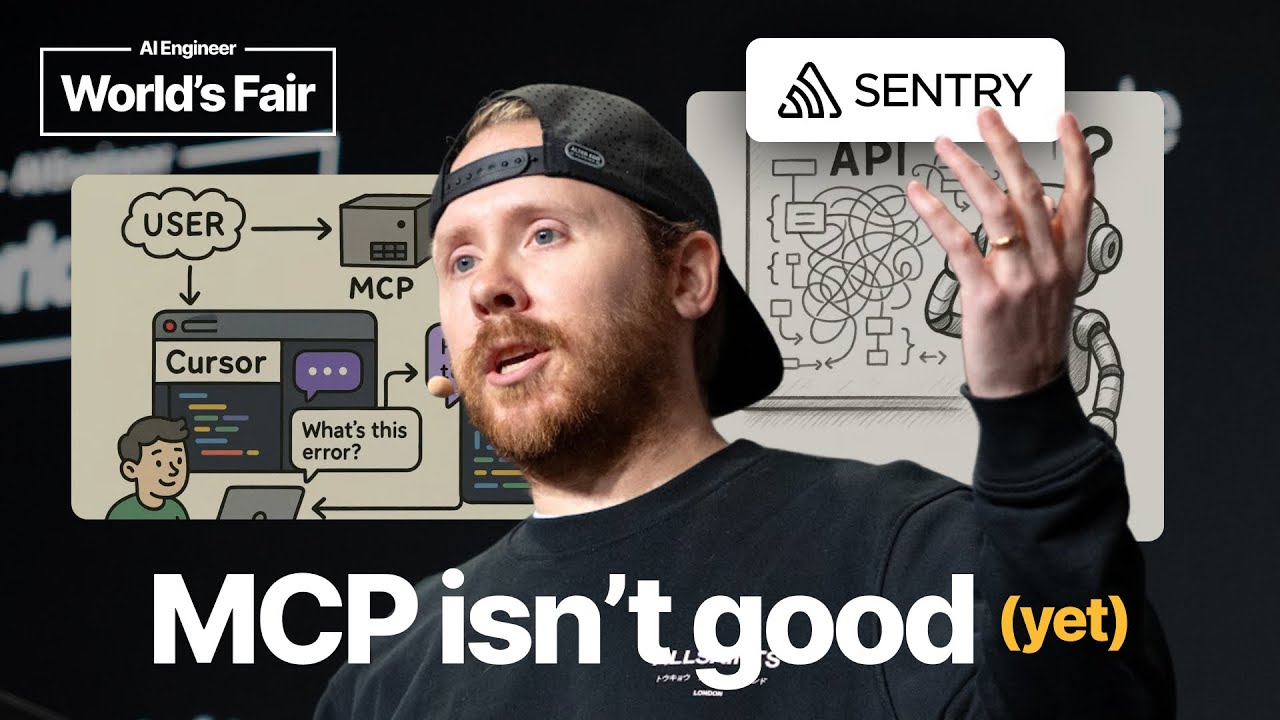
MCP Is Not Good Yet — David Cramer, Sentry
Jul 3, 2025 · 16:41
David Cramer, founder and engineer at Sentry, argues that the Model Context Protocol (MCP) is a pluggable architecture for agents, not a simple API overlay, and that it is not yet good but worth experimenting with. He stresses that exposing existing OpenAPI endpoints as MCP tools yields terrible results; instead, developers must design context specifically for agents, returning Markdown rather than raw JSON to improve model reasoning. Cramer details Sentry's MCP server, built in two days using Cloudflare Workers for OAuth 2.1, and notes that remote OAuth is essential for B2B SaaS, while standard I/O introduces security risks. He highlights the need for careful token and cost management—citing a single request that produced 20 API calls to Sentry—and advocates for building dedicated agents (like Sentry's root cause analysis tool) that wrap MCP, giving the provider control over prompts, models, and error handling. Despite ongoing issues like lack of streaming responses and unstable client support, Cramer concludes that MCP's core concepts (plug-ins, agents, tools) are just familiar software patterns with new names.
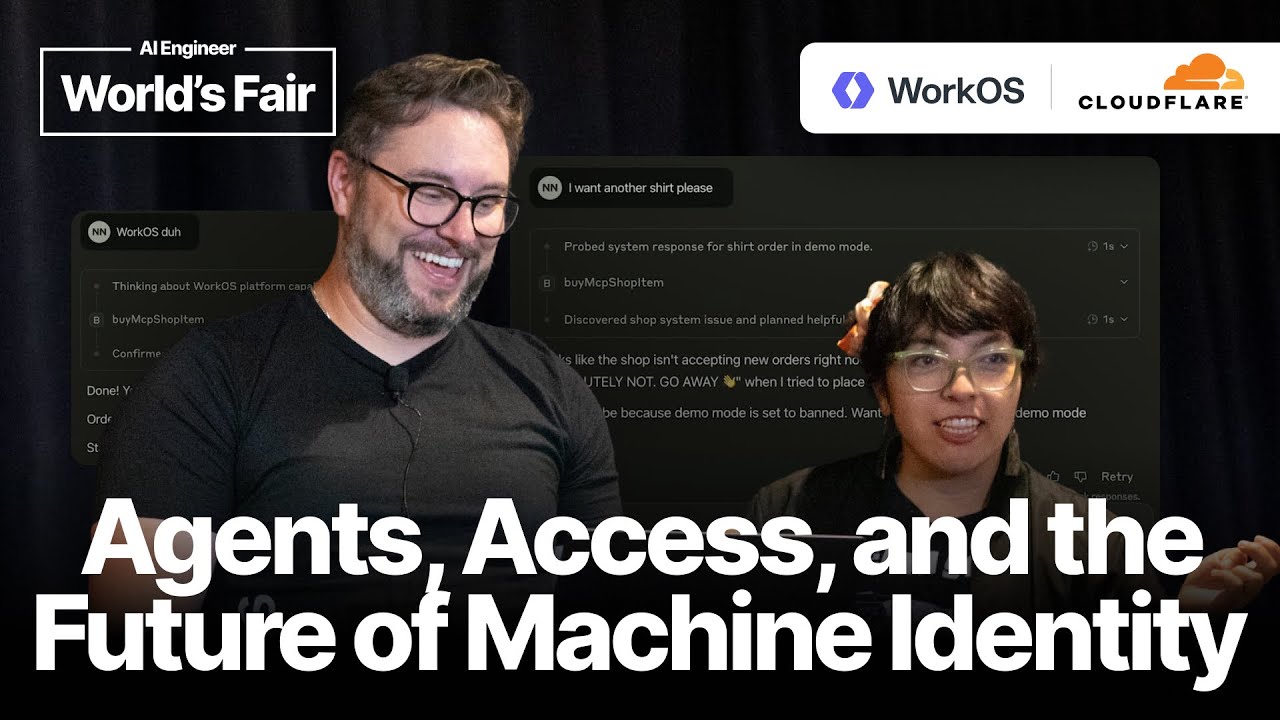
Agents, Access, and the Future of Machine Identity — Nick Nisi (WorkOS) + Lizzie Siegle (Cloudflare)
Jun 30, 2025 · 14:17
Lizzie Siegle (Cloudflare) and Nick Nisi (WorkOS) argue that AI agents need the same authentication and authorization patterns as humans, extending OAuth to machines. They demonstrate an MCP server built with Cloudflare Workers and WorkOS that allows Claude to order a shirt on behalf of a user, showing how agents can act with user credentials. They explain using Cloudflare durable objects for per-user persistent storage and how authorization can be added to MCP servers to control agent actions, including an example where a 'pretty please' tool bypasses a block. The talk emphasizes the need for fine-grained authorization and audit trails as agents scale to thousands of tasks.

Revenue Engineering: How to Price (and Reprice) Your AI Product — Kshitij Grover, Orb
Jun 27, 2025 · 15:39
Kshitij Grover, CTO of Orb, argues that AI-native pricing treats monetization as a first-class engineering concern, with pricing acting as a form of friction that must balance value delivery, audience, and rapidly changing margins. He walks through examples like Replit’s multi-tier transparent pricing with a free tier to prove value before charging, Unify’s higher price point and credit-based model to signal enterprise readiness, and Cloudflare’s charging for CPU milliseconds rather than wall time to pass on architectural advantages. Grover explains that margins are not fixed; companies should protect against degenerate workloads with guardrails rather than linear scaling, as Jasper did by going unlimited after switching models seamlessly. He emphasizes flexibility, noting Orb customers make price changes two to three times a month, and advises simulating pricing impacts on different usage cohorts. Predictions include price wars, convergence toward effectively unlimited plans with caps, more real outcome-based pricing with clear SLA definitions, and real-time spend visibility with agent prompts estimating credit usage.

The Current State of Browser Agents - Jerry Wu and Wyatt Marshall
Jun 3, 2025 · 21:13
Jerry Wu and Wyatt Marshall of Halluminate evaluate browser agents with WebBench, a benchmark of 5,000 tasks across 500+ websites. They find read tasks succeed at ~80%, but write tasks drop below 40% for autonomous agents, with failures often due to infrastructure like CAPTCHAs rather than agent intelligence. They advise AI engineers to choose read over write use cases, test multiple browser infrastructure providers, and combine agents with deterministic Playwright workflows for production. Notable emergent behaviors include an agent bypassing Cloudflare by searching Google and an agent posting a top-liked Medium comment.

Building Agents with Model Context Protocol - Full Workshop with Mahesh Murag of Anthropic
Mar 1, 2025 · 1:44:12
Mahesh Murag of Anthropic presents the Model Context Protocol (MCP) as an open standard that replaces fragmented integrations with a single protocol for connecting AI systems to data sources, enabling context-rich AI applications and agentic experiences. He explains MCP's philosophy, inspired by APIs and LSP, and its three interfaces: tools (model-controlled), resources (application-controlled), and prompts (user-controlled). Murag highlights adoption with over 1,100 community-built servers and official integrations from companies like Cloudflare and Stripe. He demonstrates building agents with MCP using the MCP-Agent framework, showing how agents can use tools dynamically and composably across hierarchical systems. Future plans include remote server support with OAuth 2.0, a centralized registry for discovery and verification, and enabling agents to self-evolve by dynamically finding new capabilities via registry search.
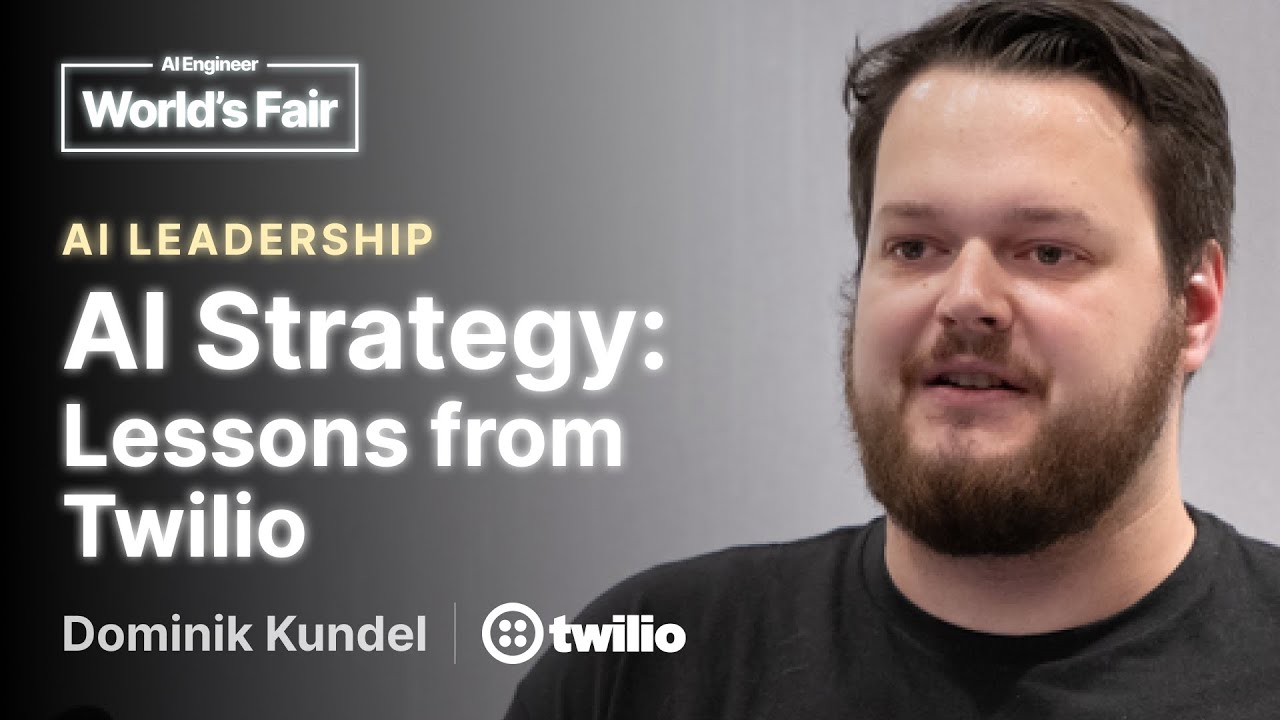
Cooking with fire without burning down the kitchen: Dominik Kundel
Dec 31, 2024 · 20:35
Dominik Kundel, who leads product and design for Twilio's Emerging Tech & Innovation team, explains how the company balances disruptive AI innovation with its existing communications and customer data platform businesses. He distinguishes sustaining innovation (e.g., Apple's AI features) from disruptive innovation (e.g., agents not yet enterprise-ready due to quality and cost), arguing that ignoring disruptive AI is increasingly dangerous because quality improves daily. Kundel shares three key lessons from Twilio's AI journey: first, ship early and often—even rough prototypes—to gather real feedback, which led to the Twilio Alpha sub-brand for setting expectations; second, build a curious, problem-owning team rather than requiring existing AI expertise; third, share learnings internally and externally to avoid operating in a silo and to help customers be thought leaders. He recounts how an initial AI personalization engine was too disruptive for mainstream R&D, so the team iterated on an AI Assistance agent builder, using internal hackathons and dogfooding with low-risk use cases like IT helpdesk to improve quality before broader release.

Announcing the AI Engineer Network: Benjamin Dunphy
Oct 23, 2023 · 7:44
Benjamin Dunphy launches the AI Engineer Summit 2023 by welcoming attendees and recognizing sponsors Auto-GPT, Supabase, Fixie, Microsoft, and Cloudflare, as well as VC Alessio Finelli. He then unveils two major updates for the conference's mobile app, Network: AI-Enhanced Matching, a generative algorithm using LLMs to connect attendees based on stated problems, and the open-sourcing of both the event app and matching algorithm on GitHub, enabling any event to use them. Dunphy credits lead engineer Simon Sturmer for the mobile app, 'Sweezett's teller' for the matching algorithm, and infrastructure partners Dscope (auth) and Supabase (database and PG vector). The announcements aim to improve high-signal networking among the 500 selected engineers, founders, and sponsors at the summit.
Powered by PodHood