
Cerebras
CompanyA company discussed on AI Engineer.
6 episodes

Run Frontier AI at Home — Alex Cheema, EXO Labs
May 26, 2026 · 1:45:02
Alex Cheema of EXO Labs argues that running frontier AI locally has 100x improvement potential in cost and performance, demonstrated with GLM 5.1—a trillion-parameter model—running across four Mac Studios at roughly 20 tokens per second for $40,000. He details kernel fusion that recovered 30% performance on Qwen 3.5 by eliminating unnecessary kernel launches, and RDMA integration that cut node-to-node latency from 300 microseconds to single digits, enabling tensor parallelism to actually scale. Cheema advocates splitting inference: prefill on compute-dense hardware (e.g., an RTX Spark) and decode on high-bandwidth hardware (e.g., Mac), cutting large-prompt inference roughly in half. He warns against misleading benchmarks like one-bit quantized models, and outlines how multi-agent setups, test-time scaling, and continual learning could further improve local inference efficiency. The talk includes a live demo of GLM 5.1 across four Mac Studios connected via Thunderbolt 5, and a preview of EXO's upcoming benchmarking site to track intelligence per Joule.
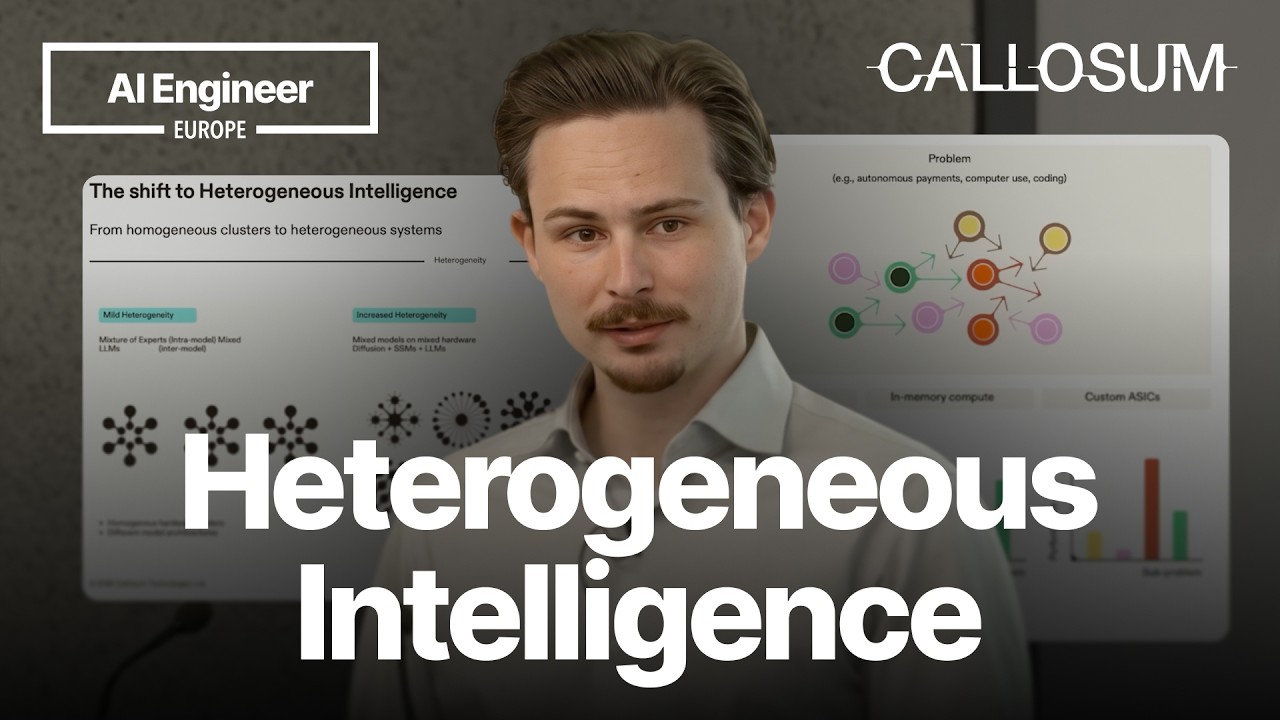
Scaling the Next Paradigm of Heterogeneous Intelligence — Adrian Bertagnoli, Callosum
May 24, 2026 · 15:13
Adrian Bertagnoli, founding engineer at Callosum, argues that the era of homogeneous intelligence—scaling single models on identical chips—is ending, and heterogeneous intelligence, which routes tasks to optimal chips and models, is the next paradigm. He demonstrates this with two case studies: on the Ulong benchmark, running recursive language models on Cerebras instead of GPT-5.2 cuts cost by 7x and latency by 5x while matching accuracy; on Video Web Arena, a mixture of Qwen 3 VL8B and Kimi K2.5 beats GPT-5.2 and Gemini 2.5 by 18% and 25%, while costing 3.7x less and running 3x faster. The key insight is that complex problems decompose into subtasks—like zooming on a webpage—which require different intelligence levels; offloading those to smaller models yields 11x speed and 43x cost improvements. Callosum builds an automation layer that predicts the best model and hardware for each subtask, and has secured a £3 million grant with the UK's Arya institute to operate the first heterogeneous co-located cluster.
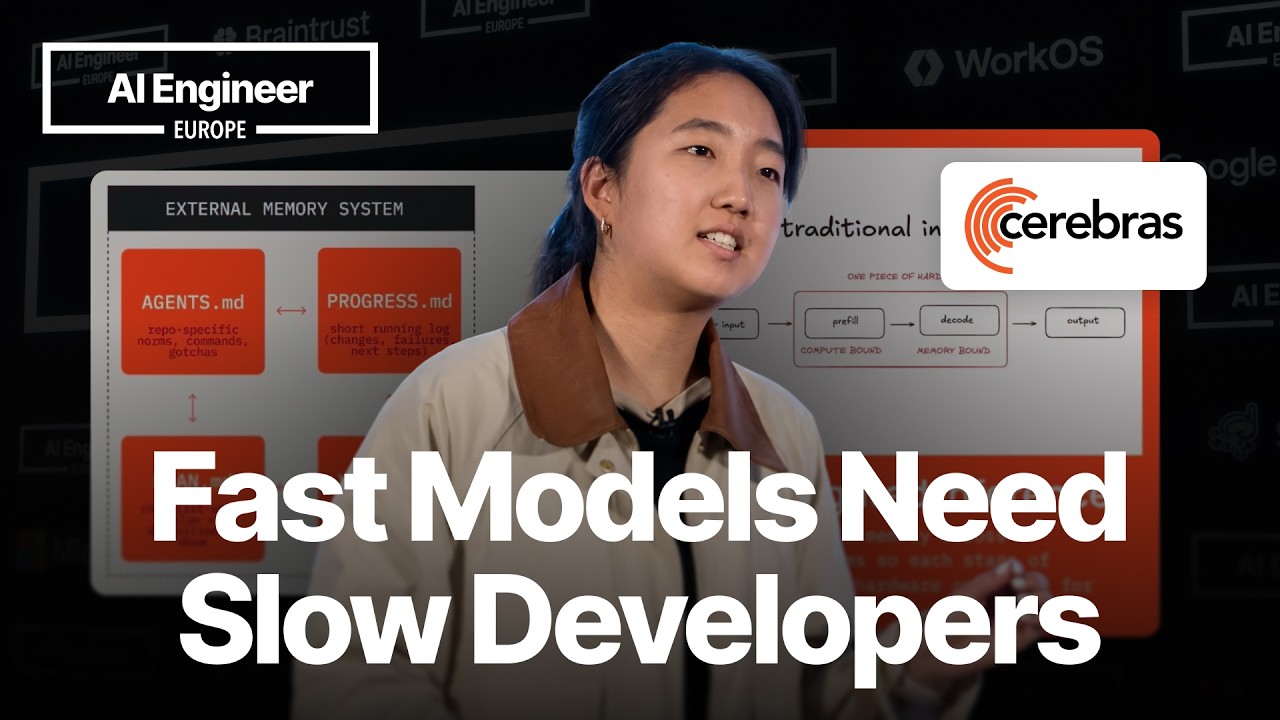
Fast Models Need Slow Developers — Sarah Chieng, Cerebras
May 22, 2026 · 18:02
Sarah Chieng from Cerebras argues that the 20x speed increase of models like Codex Spark (1,200 tokens/sec vs. 40-60 for Sonnet/Opus) forces developers to rethink workflows, or risk generating technical debt at unprecedented scale. She presents a practical playbook: validation and linting become free at every step, so must run continuously; developers can generate 75 component variations across five sub-agents and cherry-pick the best; and with context filling in 30 seconds instead of ten minutes, a four-file external memory system (agents, plan, progress, verify) maintains continuity between sessions. Chieng emphasizes real-time collaboration with the model rather than spawning agents and walking away, and advocates using a slower planner model with a fast executor to orchestrate agents effectively.
OpenAI Codex Masterclass — Vaibhav Srivastav & Katia Gil Guzman
Apr 29, 2026 · 1:01:59
Katia Gil Guzman and Vaibhav Srivastav showcase OpenAI's Codex as a full software engineering agent, not just a coding assistant, powered by models like GPT-5.4 and GPT-5.3 Codex Spark. They demonstrate plugins bundling skills and MCP servers, automations that run scheduled tasks (e.g., Slack or Gmail summaries), and code review that 100% of OpenAI pull requests use by default. Subagents parallelize work across up to 20 agents for tasks like reviewing 45 persona files, with each subagent configurable by model, sandbox mode, and MCP access. New features include Guardian approvals for privileged operations, hooks for custom triggers, and a Cloud Code plugin. The episode also highlights the milestone of 3 million weekly active users, tripled since January, and covers security scanning for vulnerabilities.

From Mixture of Experts to Mixture of Agents with Super Fast Inference - Daniel Kim & Daria Soboleva
Jun 27, 2025 · 53:15
Daria Soboleva and Daniel Kim of Cerebras explain how Mixture of Experts (MoE) architectures enable scaling large language models efficiently by replacing monolithic feedforward networks with specialized experts, a technique used by GPT-4 and Claude. They then introduce Mixture of Agents (MoA), which combines multiple LLMs with custom prompts to outperform frontier models like GPT-4o on complex tasks, reducing a 293-second reasoning problem to 7.4 seconds using Cerebras' ultra-fast inference. The workshop guides participants to build their own MoA system, configure agents for bug fixing and performance optimization on a Python function, and achieve scores up to 120/120. Daniel details Cerebras' wafer-scale chip with 900,000 cores and distributed memory that eliminates memory bandwidth bottlenecks, enabling linear scaling and 15.5x faster inference on Llama 3.3-70B versus GPUs. Daria discusses ongoing research in diffusion models and sparsity, while Daniel notes plans for multimodal APIs and LoRA fine-tuning support.
Lessons from building GenAI based applications — Juan Peredo
Feb 22, 2025 · 33:13
Juan Peredo details the hidden complexities of building GenAI applications, from model hosting and cost control to output validation and observability. He compares local (Ollama) vs cloud hosting (Modal, SkyPilot) and warns that an agent processing 3,000 calls/day with OpenAI O1 costs nearly $300,000/month, while LLaMA 3.3 70B drops that to $50,000/month. He explains techniques to mitigate hallucinations—prompt engineering, guardrails, RAG, and fine-tuning—each with trade-offs like added latency or cost. Peredo advocates externalizing prompts via LangChain Hub for easy iteration and future-proofing, and illustrates agent design with parallel calls to reduce latency. Finally, he stresses observability using tools like LangSmith to debug probabilistic failures, such as an LLM failing on case sensitivity.
Powered by PodHood