
Amazon
CompanyA company discussed on AI Engineer.
19 episodes
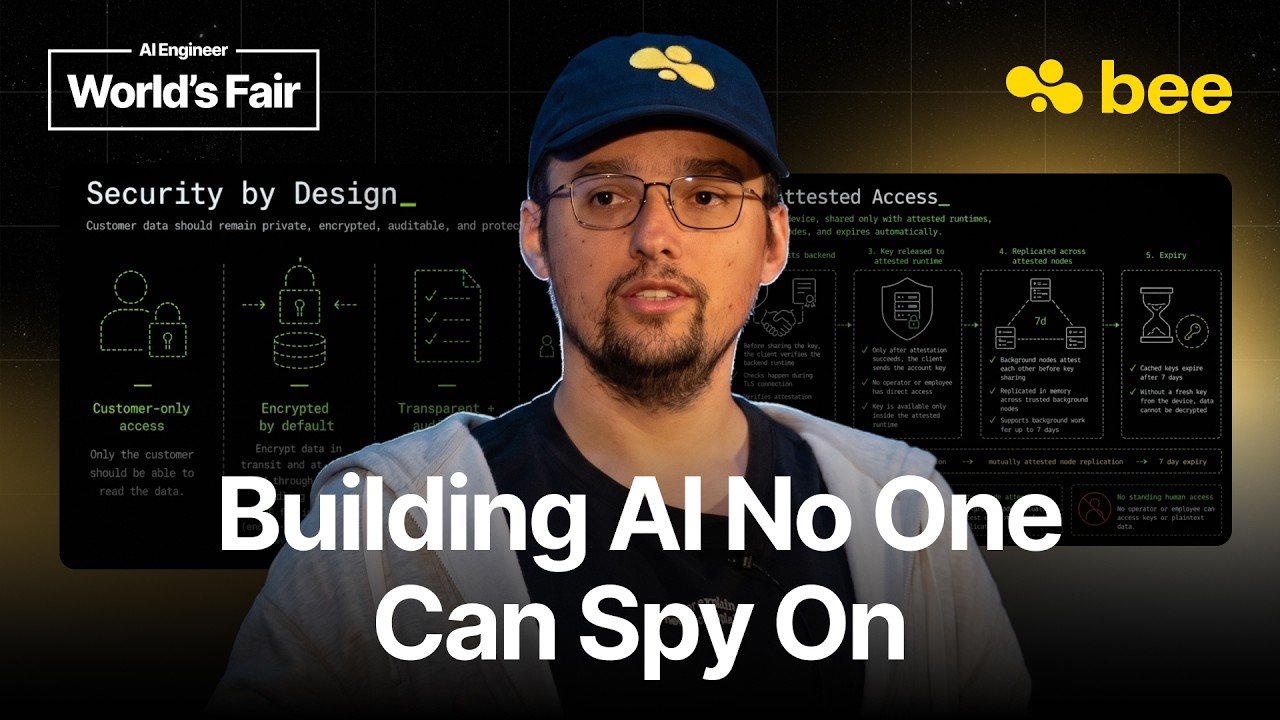
Privacy-Preserving Intelligence — Steve Korshakov, Bee (acq. Amazon)
Jul 20, 2026 · 15:53
Steve Korshakov, founder of Bee (acquired by Amazon), explains how his company built the 'most sensitive capture device on the market' with a guarantee that no one—not even Amazon—can read user data. Bee records everything a user says, generating about 10 million tokens per year, and within a week learns virtually everything about the person. To protect data, the encryption key never leaves the user's phone; the phone runs an attestation pipeline checking workloads against a public transparency log (Sigstore) before sharing the key with backends running in confidential compute. Keys in memory expire after seven days, and a two-tier signing system ensures no insider can ship code unnoticed: a separate Amazon privacy team holds signing keys hardcoded into apps. The entire system is only about 20,000 lines of memory-safe code, most of it verifying attestation, with no homegrown cryptography. Korshakov also discusses the challenges of moving from startup to Amazon, and his view on taming AI agents: sandboxing and not giving them the ability to cause harm.
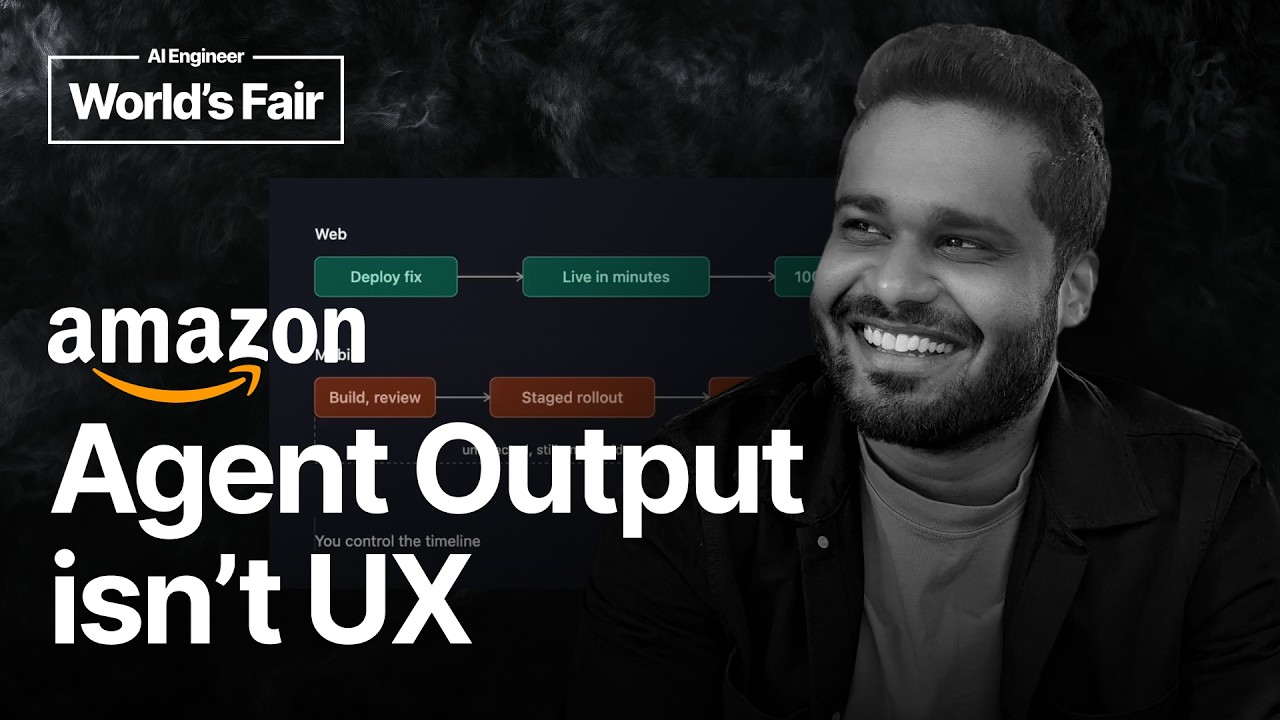
Agent Output Is Not UX: Rendering Layer Your LLM Pipeline Is Missing - Bala Ramdoss, Amazon Lens
Jul 20, 2026 · 14:13
Bala Ramdoss (Amazon) argues that the UI delivery layer—generative UI—determines whether agentic AI features ship successfully, not the model itself. He presents three patterns from building Amazon Lens at scale: (1) a typed, versioned rendering contract where the model selects from a fixed catalog of components (e.g., flight carousel vs. list) and the client falls back safely for unknown types; (2) streaming UI chunks to show skeletons then fill progressively, shifting focus from total latency to time-to-first-chunk; and (3) a Backend-for-Frontend (BFF) that absorbs model output, hydrates actions and conversation context, and reuses existing native components so the AI feels like a natural part of the app. The episode demonstrates that mobile apps, which cannot be patched instantly, require this architecture to avoid crashes and deliver a snappy, trustworthy experience.

The AI bugpocalypse is here. Now what? - Jack Cable, Corridor
Jul 12, 2026 · 19:44
Jack Cable, Co-Founder and CEO of Corridor, argues that frontier AI models can now find and exploit software vulnerabilities at scale, creating an 'AI bugpocalypse' that demands fundamental security changes. He cites 84% of developers using AI coding tools, with models like Mythos outperforming humans in finding vulnerabilities. He notes that basic vulnerability classes like buffer overflows remain prevalent despite decades of known fixes, and that memory-safe languages like Rust can eliminate 60-70% of such bugs, as shown by Android's drop from 75% memory safety vulnerabilities in 2019 to 30% in 2022. He warns that even advanced models introduce vulnerabilities 20-40% of the time (backsbench.com) and points to an Opus 4.6 incident that lost $2M. His recommendations to Congress include preventing vulnerabilities in new code, hardening open-source software, and fostering American open-weight models, arguing that defenders need access to these models to stay ahead.

Your Agent's Biggest Lie: "I Searched the Web" — Rafael Levi, Bright Data
Jun 17, 2026 · 15:49
Rafael Levi from Bright Data argues that LLMs often hallucinate and provide fake citations because they fail to actually access live web data, getting blocked by anti-bot systems like CAPTCHAs and Cloudflare's AI labyrinth. He demonstrates this with a comparison: without Bright Data's MCP, GPT-5 failed all five tasks accessing sites like LinkedIn and Amazon; with the MCP's 66 tools—including a CAPTCHA-solving browser that mimics human behavior—four succeeded. Levi explains that agents enter an invisible failure loop where they get blocked or served fake data but still answer confidently, making up numbers or non-existent URLs. He emphasizes that 20% of the web is blocked by Cloudflare from AI crawling, and that fake data fed to bots increases hallucinations. The episode covers how Bright Data's MCP provides real web access with search, scraping, and remote browsers, offering a free tier of 5,000 requests per month for experimentation.

Introducing WebMCP: Agents in the Browser — RL Nabors
May 23, 2026 · 23:08
Rachel Nabors, former web standards contributor and now Principal Developer Experience Engineer at Arise, argues that chat-only agent interfaces (the 'starfish' design) are the CLI of the future and demonstrates how to replace them with rich interactive surfaces using MCP Apps and WebMCP. She explains STDIO vs HTTP transports, shows how MCP Apps bundle HTML, CSS, and JavaScript into single files rendered in agent iframes, and introduces WebMCP, which adds tool attributes to existing page elements so browser agents can call functions without screenshot parsing or DOM traversal. Using her own web comic site as a case study, she builds a comic reader with full panel navigation, transcript mode, and speech synthesis via the Web Speech API, and advocates for better client support of MCP resources to avoid inefficient tool calls for context loading.
MCP UI: Extending the frontier — Liad Yosef and Ido Salomon, MCP Apps
May 6, 2026 · 22:21
In this episode, Ido Salomon and Liad Yosef explain MCP Apps, an MCP extension that lets tools send interactive, branded UI instead of plain text responses inside chat hosts like ChatGPT, Claude, VS Code, Cursor, and Copilot. They argue that text-based chat reduces companies to a wall of text, erasing identity, while MCP Apps preserves branding by returning HTML resources that hosts render as secure, interactive components. The architecture ensures every user click sends a message back to the host (not directly to the backend), keeping interactions in context—as demonstrated with a PostHog funnel analysis in Claude. Adoption includes Shopify, Hugging Face, GitHub, ChatGPT, and Claude, with ChatGPT recommending MCP Apps for building ChatGPT Apps. They note 800 million weekly ChatGPT users (10% of world population), calling this a once-in-20-years opportunity to rethink app distribution. Future work covers reusable views, model-UI interaction, and interoperability with generative UI protocols like A2UI and WebMCP, aiming to standardize UI in chat as the new web.

Spec-Driven Development: Agentic Coding at FAANG Scale and Quality — Al Harris, Amazon Kiro
Jan 9, 2026 · 1:03:50
Al Harris, principal engineer at Amazon, presents Spec-Driven Development (SDD) with Kiro, an agentic IDE that transforms prompts into structured requirements (EARS format), designs, and property-based tests to ensure code correctness. He argues that upfront specification—augmented by MCP servers for external context—improves reproducibility and quality over pure vibe coding. The talk includes a live demo: building an S3-backed checkpointer for a LangGraph dad joke generator, then discovering Agent Core’s native memory is more idiomatic. Harris contrasts SDD with Cursor’s planning mode, explains how specs evolve as living documentation, and discusses handling session length, context pruning, and brownfield codebases. The result is a claim that spending 5–10 minutes on specs yields higher accuracy and reliable, testable outputs.
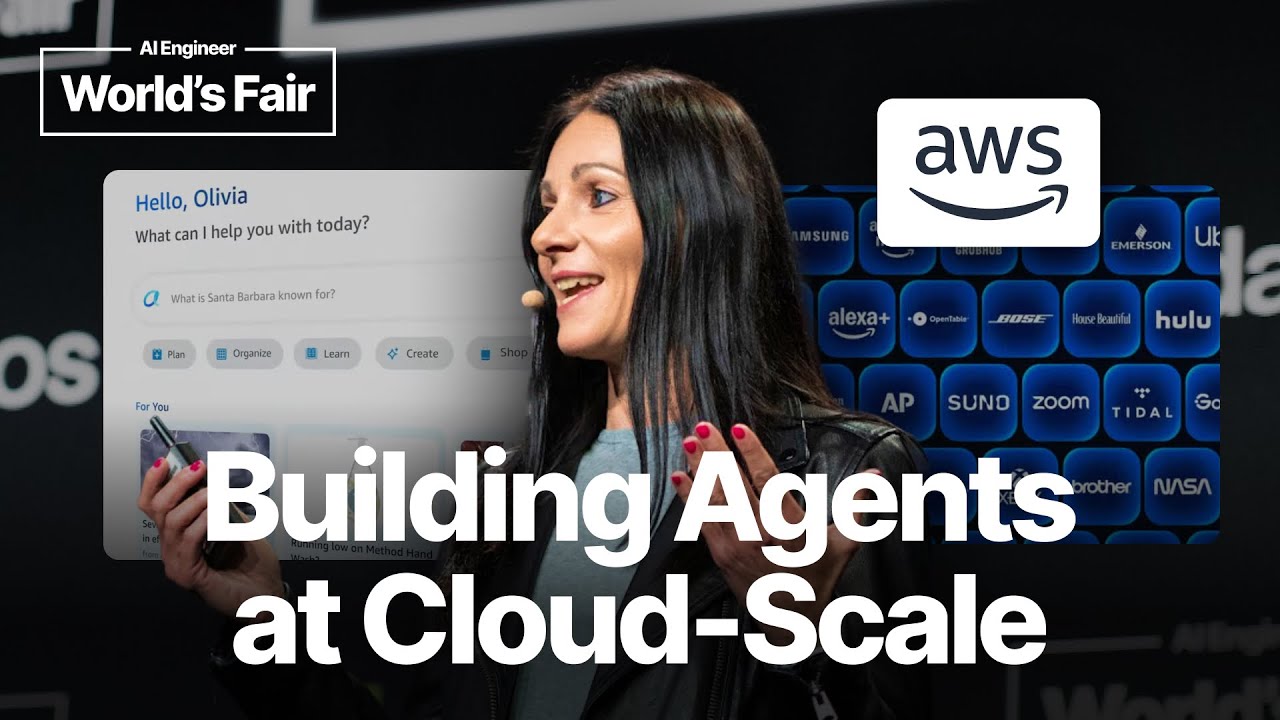
Building Agents at Cloud Scale — Antje Barth, AWS
Aug 2, 2025 · 19:00
AWS Principal Developer Advocate Antje Barth demonstrates how to build and scale AI agents using cloud-native patterns, arguing that specialized agents will reinvent customer experiences. She showcases Alexa Plus, which orchestrates hundreds of expert systems across 600M+ devices and tens of thousands of services, and the Amazon Q Developer CLI agent, shipped in just three weeks. Barth introduces Strands Agents, an open-source Python SDK for building production-ready agents that supports multiple model providers (Claude, Llama, OpenAI) and over 20 prebuilt tools including memory, RAG, and multi-agent workflows. She demonstrates integrating MCP servers via Lambda with DynamoDB for session storage, and previews upcoming A2A protocol support and a future of personal agents connecting to agent stores.
Useful General Intelligence — Danielle Perszyk, Amazon AGI
Aug 2, 2025 · 19:58
Danielle Perszyk, a cognitive scientist at Amazon's AGI SF Lab, argues that general-purpose AI agents like Nova Act must be built to augment human intelligence rather than replace it, drawing parallels to how human cognition relies on controlled hallucinations and social co-evolution. She explains that current agents struggle with basic computer tasks like clicking, typing, and scrolling, so Nova Act combines a specialized version of Amazon Nova trained via RL for UI reliability with an SDK that allows developers to string together atomic actions (act calls) into complex workflows. The lab's vision centers on grounding agents in a shared environment and eventually giving them models of human minds, which requires a common language for humans and agents to reciprocally level up intelligence. Demos with teammates Carolyn (searching apartments) and Fjord (extracting data with Python and parallel browsers) show how Nova Act enables three-line code starts and granular control, positioning the product as a primitive for a cognitive technology that aligns representations and stabilizes human thinking.

When Vectors Break Down: Graph-Based RAG for Dense Enterprise Knowledge - Sam Julien, Writer
Jul 22, 2025 · 15:47
Sam Julien, Director of Developer Relations at Writer, explains how the company built a graph-based RAG system that achieved 86.31% accuracy on the RobustQA benchmark and sub-second response times, significantly outperforming vector search approaches for dense enterprise knowledge. The team moved from simple vector retrieval to a graph-based approach to handle concentrated data where similar terms appear frequently, solving problems like inaccurate chunking and failure with similar documents. They built a specialized model to convert data into graph structures, stored as JSON in a Lucene-based search engine, and incorporated Fusion-in-Decoder with knowledge graphs to lower hallucination rates. Key decisions included focusing on customer needs over hype, staying flexible based on team expertise, and letting research challenge assumptions, leading to features like multi-hop reasoning and complex data format handling.
Dream Machine: Scaling to 1m users in 4 days — Keegan McCallum, Luma AI
Jul 19, 2025 · 19:03
Keegan McCallum, Head of ML Infrastructure at Luma AI, details how the company's Dream Machine model scaled from 500 to 9,000 H100 GPUs within hours to handle 1 million users in four days, outpacing ChatGPT's initial growth. He explains that their initial Triton inference server setup was brittle and ill-suited for multi-GPU, multi-node video models, prompting a re-architecture to a custom serving stack on vanilla PyTorch. To solve work starvation across user tiers, they implemented an SLO-based aging system that ranks jobs by the percentage of their worst-case wait time elapsed. For managing dozens of model versions, they store immutable full Python environments and checkpoints in object storage, with a YAML file controlling active deployments and enabling zero-downtime rollouts across thousands of GPUs. McCallum also discusses partnerships with Nvidia, AMD, and Grok, and how Luma's broader mission is to build general multimodal intelligence that generates, understands, and operates in the physical world.

ComfyUI Full Workshop — first workshop from ComfyAnonymous himself!
Jul 19, 2025 · 51:25
ComfyAnonymous and Yedrick Kosinski present ComfyUI, an open-source node-based canvas for generative AI that has become the top 150 most popular GitHub repos with 78,000 stars and 3 to 4 million active users. Started as a personal project in January 2023, it now supports image, video, audio, 3D, and text models, with 22,000 custom nodes from 3,000 developers. A key feature is embedding full workflows into generated files for easy sharing. The team discusses its story, including ComfyAnonymous's time at Stability AI and founding ComfyOrg, and addresses questions on CFG, VAEs, LoRAs, control nets, API nodes for remote generation, and future plans for cloud inference and improved onboarding.

From PM at Stripe to Building an AI startup, a recent founder's journey - Mounir Mouawad
Jun 3, 2025 · 11:59
Mounir Mouawad, CEO and co-founder of Porsche AI, explains how building an AI startup differs from product roles at Stripe, Google, and Amazon, using video game analogies. He argues user problems are an 'emergent property' requiring hypothesis-driven iteration rather than conventional roadmaps. Product development is gratifying with releases in hours or days, but velocity is a 'stable stick' as opportunities like MCP come and go quickly. The hardest part is outreach without big brand support—like playing Crash Bandicoot without boosters—so he finds people followers, advocates, and partnerships (e.g., with Browserbase) essential. He asks listeners to star Porsche AI's GitHub repo.

The Devops Engineer Who Never Sleeps — Diamond Bishop, Datadog
Apr 22, 2025 · 16:18
Diamond Bishop, Director of AI Engineering at Datadog, explains how his team builds AI agents—the On-Call Engineer and Software Engineer—that automate DevOps tasks like incident investigation, remediation, and postmortem writing. He details how the On-Call Engineer wakes up for alerts, reads runbooks, queries logs and metrics, and suggests fixes to let human engineers sleep. The Software Engineer proactively fixes errors by generating code diffs and pull requests. Bishop shares four key lessons: scope tasks and evaluate rigorously, assemble teams of optimistic generalists and UX experts, adapt UX for human-agent collaboration, and treat observability as critical for debugging multi-step agent workflows. He predicts that within five years, AI agents will surpass humans as primary users of SaaS platforms like Datadog, urging builders to design for agent consumers.

Reverse Conway's law and GenAI: How agents will take over the organisation - Patrick Debois
Feb 22, 2025 · 28:12
Patrick Debois argues that generative AI will reverse Conway's law, reshaping organizations around agents instead of human teams. He traces a progression from AI as a copilot to a team member, then a peer, and eventually a manager, with each stage unbundling human tasks and shrinking team sizes. Debois cites Amazon's AI pricing glitch as a reminder that humans remain needed for failure cleanup, and notes that LLMs mimic human collaboration behaviors, as shown in a multi-agent simulation. He warns of agent toxic behavior and the need for guardrails akin to human codes of conduct, while speculating that companies may replace SaaS with internally built AI services, making performance reviews and ROI calculations for agents inevitable. Debois advises engineers to focus on building the AI that builds their current work, not the work itself.

The Adversarial Path to the Personal Assistant: Sumit Agarwal
Feb 15, 2025 · 18:46
Sumit Agarwal, founder of Ario AI, discusses building a personal AI assistant that uses adversarial ETL to extract users' data from services like Google, Amazon, and Doordash, enabling immediate personalization without manual input. He announces $16M in funding and demonstrates how the assistant generates data portraits, recommends travel and routines based on personal history, and manages schedules by detecting conflicts. Agarwal shares RAG insights: avoid LLMs for trivial math, use search and pre-processed profiles, and present the right data at the right time. Ario Boost, a browser extension, lets users download their data locally in developer mode without creating an account.

Giving a Voice to AI Agents: Scott Stephenson, CEO, Deepgram
Feb 10, 2025 · 13:08
Scott Stephenson, CEO of Deepgram, outlines the evolution of voice AI from slow, domain-specific systems to fast, open-ended conversational agents powered by LLMs, arguing that speed and accuracy are now solved and the key differentiator is contextual understanding. He explains that state-of-the-art speech-to-text and text-to-speech can achieve round-trip latencies under 500 milliseconds—matching human turn-taking—but notes that current systems fail to pass context between components, causing 10-20% of interactions to feel unnatural. Stephenson introduces Deepgram's 'contextual AI' vision, where models are prompted with the full conversation history, including tone, pace, and background audio, enabling the LLM to generate responses and instruct the TTS on delivery. He cautions against monolithic speech-to-speech models for enterprise use due to controllability and cost concerns, advocating for a modular stack that lets businesses optimize each component (e.g., small LLMs for simple tasks like password resets). Deepgram’s upcoming voice AI agent API integrates all components for low latency and offers $250 in free credits for experimentation.

Ionic Launch: Opening the economy to AI agents
Feb 6, 2025 · 5:30
Justin, CEO and co-founder of Ionic Commerce, presents his company's mission to enable AI agents to participate in the economy, starting with ecommerce. He argues that the current web is built for ads, not actions, leaving agents unable to access dynamic product data like stock or shipping. Ionic solves this by partnering with hundreds of merchants, enriching their product feeds via an agentic workflow, and exposing the data through an API that agents can query in their preferred format (relational, vector, graph). The platform also adds a transaction layer so agents can complete purchases in one step using payment tokens. Justin emphasizes that merchants will pay for this service because it provides better attribution and customer relationships than Amazon's cut. Ionic's catalog already includes millions of AI-native SKUs, and developers can start today at docs.ioniccommerce.com.

Realtime Data Connectivity for AI: Tanmai Gopal
Oct 11, 2024 · 7:14
Tanmai Gopal from Hasura introduces Pacha DDN, an AI-powered data access layer that lets LLMs securely query live data from multiple sources, arguing that the key is treating all data—structured, unstructured, and APIs—with a unified SQL-based query language. He demonstrates with a Blockbuster example: writing an email to a top customer by querying database transactions and recent rentals via natural language. The system uses an object model for authorization that applies rules based on data schema and session properties, regardless of data origin. To overcome LLM reasoning limitations, Pacha DDN asks the LLM to write Python code to retrieve data instead of reasoning directly. The talk concludes that for AI to be useful, it needs realtime data access, and Pacha DDN provides a secure, explainable query planner to achieve that.
Powered by PodHood