
Vector Databases
Episodes from AI Engineer about Vector Databases.
3 episodes
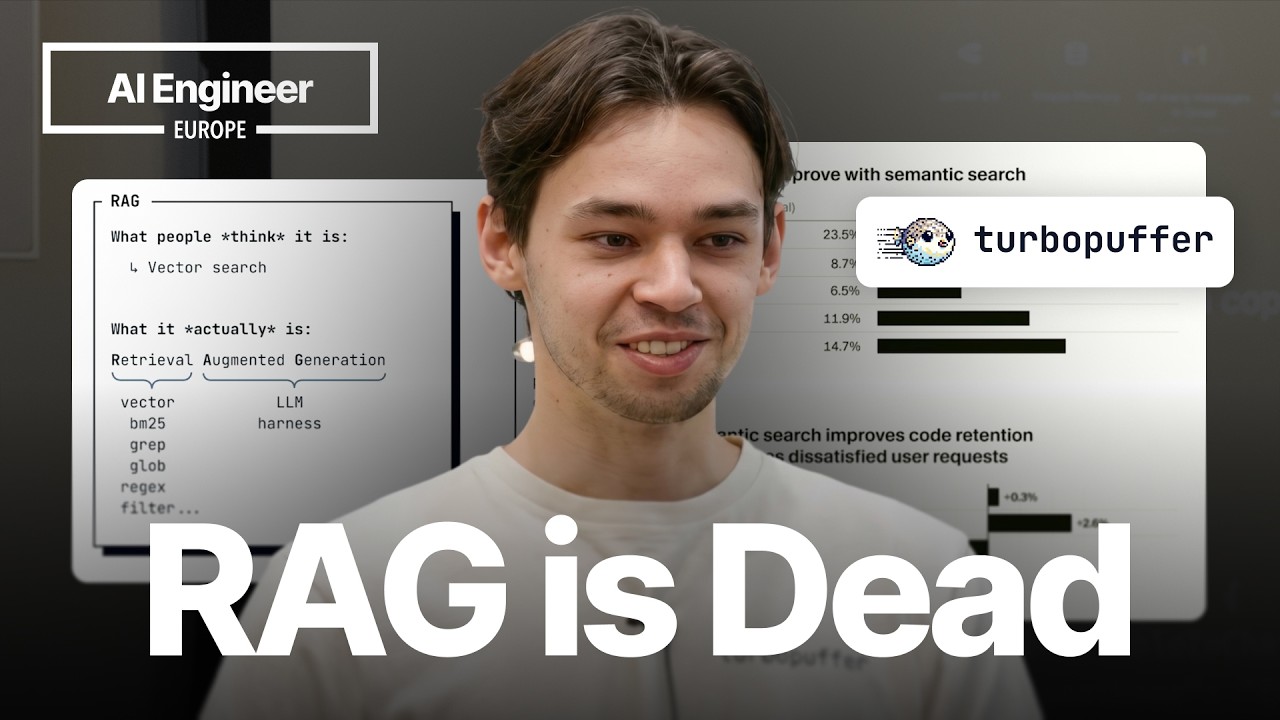
RAG is dead, right?? — Kuba Rogut, Turbopuffer
Jun 9, 2026 · 11:13
Kuba Rogut (Turbopuffer) argues that RAG isn't dead—it's evolving into agentic retrieval, contrasting Cursor's upfront indexing (which boosted answer accuracy 24% in their composer model) with Claude Code's per-session grep approach. He frames embeddings as cached compute, citing Jeff Dean: 'You don't need a trillion at once, you need the right million.'
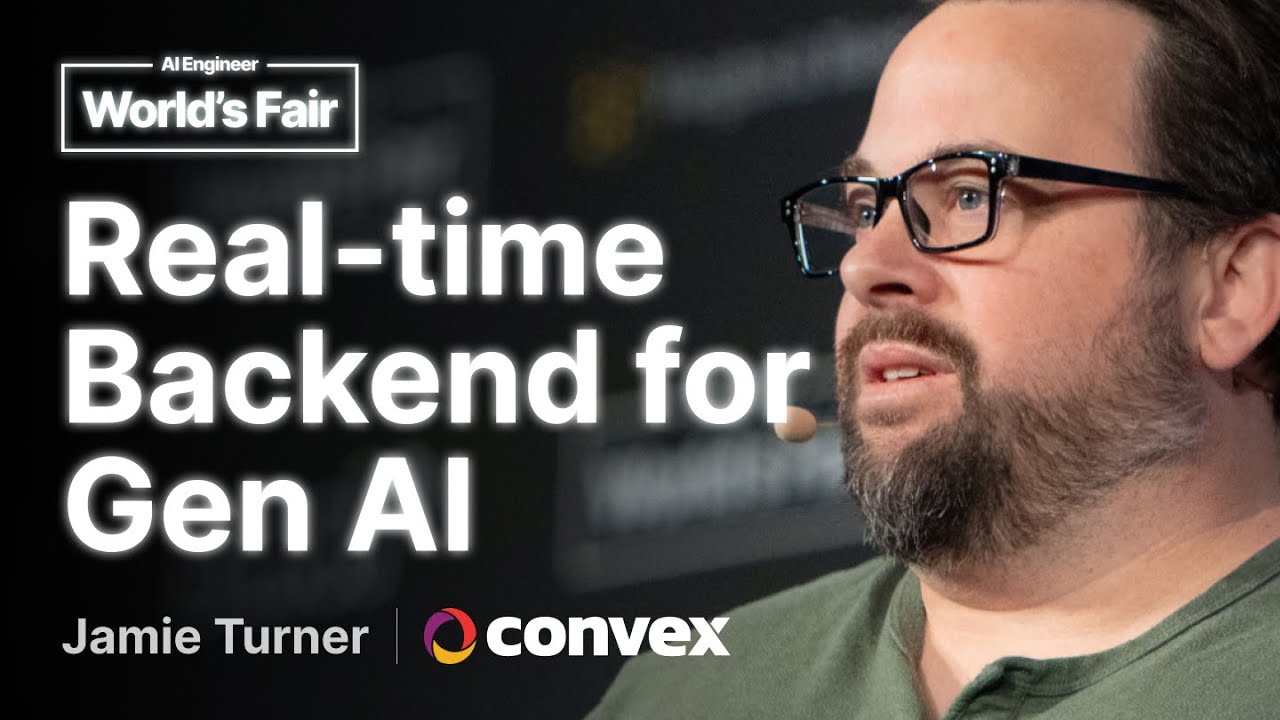
We accidentally made an AI platform: Jamie Turner
Oct 8, 2024 · 5:36
Jamie Turner, co-founder of Convex, explains how his company's backend platform accidentally became an AI platform because its reactive data flow paradigm—extending React's state reactivity to the server with subscribable queries and mutations—perfectly suits generative AI workflows. He describes Convex's architecture as seamlessly syncing state between backend steps and the application, enabling concurrent chains of tasks like automatic speech recognition, summarization, embedding generation, and finding related notes. Turner notes that post-ChatGPT, over 90% of Convex projects are generative AI. To support this shift, Convex added native vector indexes for schema fields and launched a startups program with discounts and exclusive forums. Upcoming high-level components will encapsulate state machines for sophisticated workflows. Turner presents Convex as a way for generative AI engineers to ship quickly and confidently.

Git push get an AI API: Ryan Fox-Tyler
Aug 23, 2024 · 45:01
Ryan Fox-Tyler and Matt Johnson Pint from Hypermode present a hands-on workshop demonstrating how to build and iteratively improve AI features using their platform, focusing on a GitHub issue triage app. They first illustrate the process with a multiplayer game (Hypercategories) that uses AI for classification and scoring. Then they build a trend summary function using OpenAI GPT-4 to summarize repository issues, and a classify issue function with a Hugging Face DistilBERT model for labeling issues as bug, feature, or question. Finally, they add natural language search for similar issues by creating an embeddings model (MiniLM) and a Hypermode collection, enabling vector search without external databases. The workshop emphasizes incremental iteration, mixing AI models with traditional code, and using Hypermode's automatic GraphQL generation and observability to speed development.
Powered by PodHood