
Robotics & Autonomous Systems
Episodes from AI Engineer about Robotics & Autonomous Systems.
5 episodes

Rishabh Garg, Tesla Optimus — Challenges in High Performance Robotics Systems
Aug 25, 2025 · 12:43
Rishabh Garg, a robotics software engineer at Tesla, explains how unexpected robot behaviors often stem from software and hardware integration issues rather than the control policy itself. Using a toy CAN bus system, he demonstrates how communication delays at 1 Mbps can cause loop execution gaps, leading to jitter and stuttering motors. Solutions such as multithreaded pipelining and synchronization primitives can reduce cycle time but introduce new problems like missed messages and desynchronization. He highlights how logging to disk on a Raspberry Pi can freeze the robot for 30 ms, and how priority inversion in the Linux kernel can cause system dropouts for seconds. The episode delivers concrete techniques for diagnosing and resolving these real-time system challenges.

Waymo's EMMA: Teaching Cars to Think - Jyh Jing Hwang, Waymo
Jul 26, 2025 · 17:28
Jyh-Jing Hwang of Waymo presents EMMA, an end-to-end multimodal model built on Gemini that directly processes camera inputs and route text into driving waypoints, achieving state-of-the-art open-loop planning on the NuScenes benchmark without LiDAR or HD maps. Adding chain-of-thought reasoning—identifying critical objects and meta-decisions—further surpasses specialized models like MotionLM on Waymo's 100K dataset. Co-training on tasks such as 3D detection and road graph estimation maintains competitive performance across domains. For evaluation, Waymo leverages generative video models (e.g., Veo2) to simulate diverse conditions like rain and night, testing EMMA's robustness. The work demonstrates how Gemini's generalization can help scale Waymo's autonomous driving to new cities by handling long-tail scenarios.
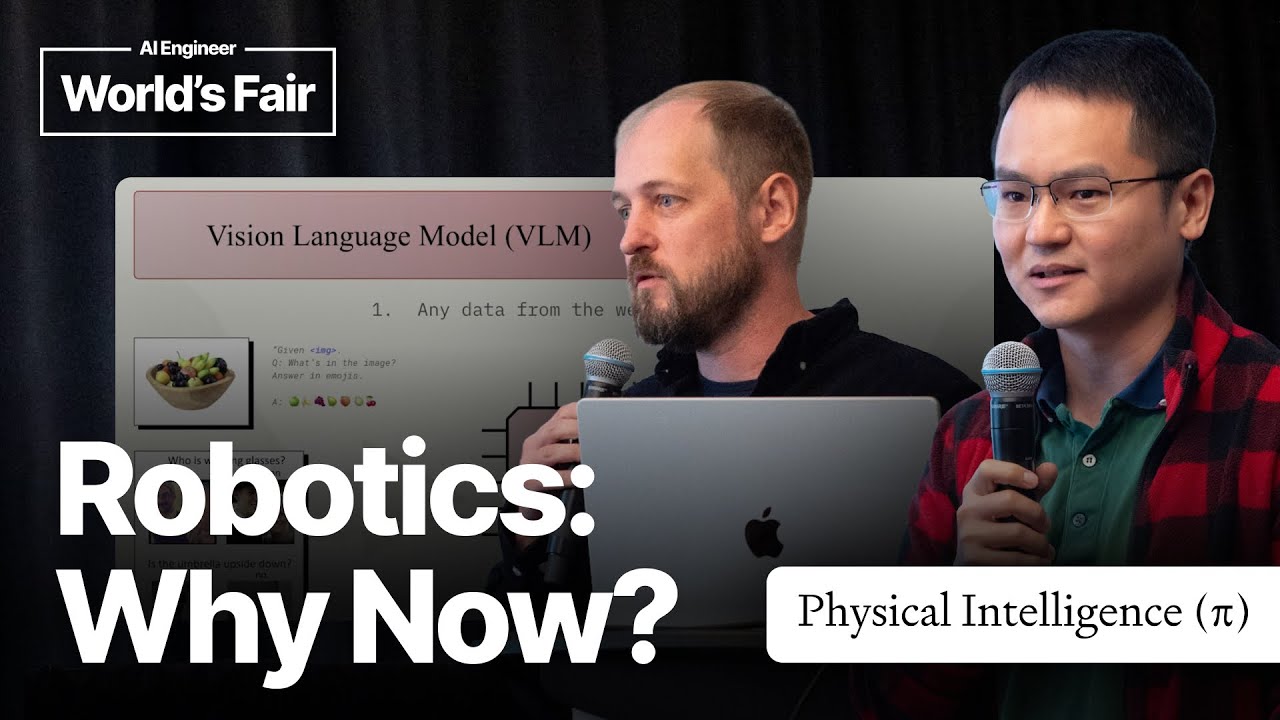
Robotics: why now? - Quan Vuong and Jost Tobias Springberg, Physical Intelligence
Jul 26, 2025 · 18:07
Physical Intelligence's Quan Vuong and Jost Tobias Springberg describe their mission to build a model that can control any robot to do any task, arguing that software intelligence is the main bottleneck in robotics. They explain Vision Language Action models (VLAs) as adaptations of vision language models that output robot actions instead of text. To train these models, they built a data engine from scratch, collecting 10,000 hours of successful episodes via teleoperation in six months. Their latest model, PAIO-5, achieves open-world generalization by training on data from multiple homes, matching or surpassing performance on held-out scenes. They demonstrate this with a policy that performs long-horizon tasks like cleaning an unseen bedroom for up to 10 minutes autonomously. They also highlight a remote coffee-making demonstration on a robot they never touched, showing model portability across hardware.
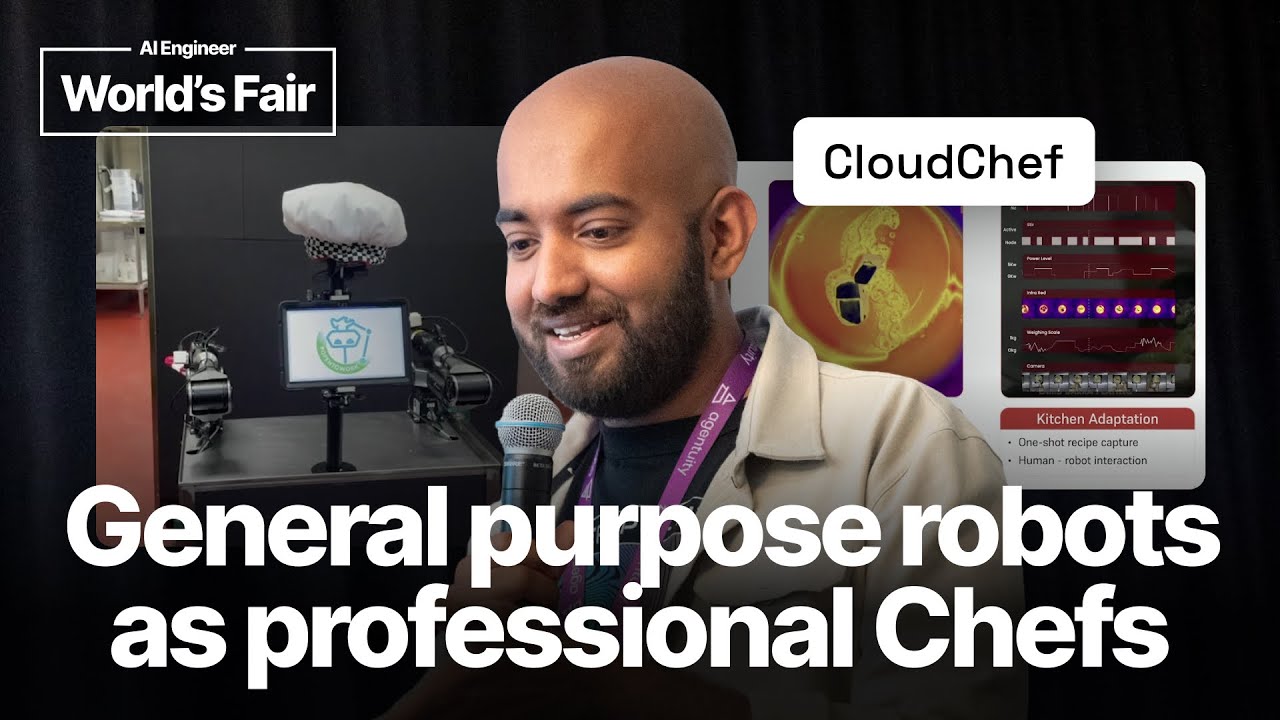
Robots as professional Chefs - Nikhil Abraham, CloudChef
Jul 20, 2025 · 18:58
Nikhil Abraham, CEO of CloudChef, explains how his company turned a general-purpose bimanual robot into a professional chef that works in commercial kitchens for $12 an hour. The robot learns new recipes from a single expert demonstration, using thermal and visual embeddings to handle ingredient and appliance variation. CloudChef's system achieves 95% autonomy and outperforms expert human chefs in cooking decision-making, as evaluated on over 1,000 recipes. The robot is deployed in restaurants like Wingstar and Elan, cooking real meals at 80–95% human speed. Abraham notes that the platform can operate 168 hours a week and aims to expand to tasks like chopping.
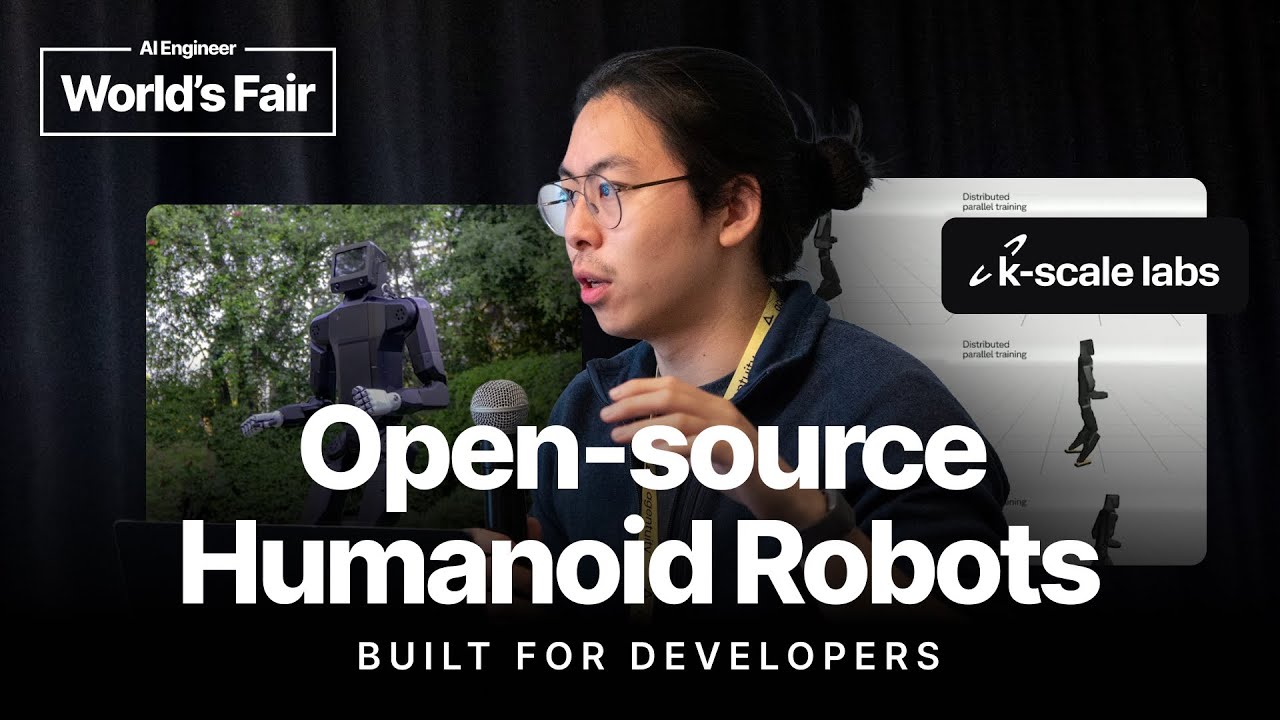
Your Personal Open-Source Humanoid Robot for $8,999 — JX Mo, K-Scale Labs
Jul 2, 2025 · 19:26
Jingxiang Mo, founding engineer at K-Scale Labs, introduces their open-source humanoid robots: the 5-foot K-Bot (pre-order for $8,999, delivered by October) and the 1.5-foot Z-Bot, both fully open-source from hardware to ML models. The K-Bot uses MIT CHiTA actuators, provides up to 250 TOPS compute, runs an RL-based whole-body controller trained with MJX in 1-2 hours, and offers a Python/Rust SDK (pip install kos) with a digital twin simulator for rapid development. Mo emphasizes modularity—swappable end-effectors and upgradable heads—and positions K-Scale as the first US consumer humanoid robotics company, targeting developers and households. The robots are significantly cheaper than competitors (Tesla Optimus at ~60K, Unitree at 40K) and include VR teleoperation, OTA software updates, and a bimonthly hackathon community.
Powered by PodHood