
Quantization
Episodes from AI Engineer about Quantization.
11 episodes

You Might Not Need 50 Diffusion Steps — Ziv Ilan, Nvidia
Jun 16, 2026 · 18:46
Nvidia's Ziv Ilan explains how combining quantization, caching, and step distillation enables near real-time video diffusion on a single Blackwell B200 GPU. Working with Black Forest Labs on Flux 2, dynamic quantization reduces memory and compute, caching skips redundant denoising steps, and distillation cuts steps from fifty to as few as one. The open-source FastGen repo packages these post-training and sharding techniques, achieving 10–200x speedups for real-time generation.

Running LLMs on your iPhone: 40 tok/s Gemma 4 with MLX — Adrien Grondin, Locally AI
Apr 20, 2026 · 10:51
Adrien Grondin, developer of Locally AI, demonstrates how to run Gemma 4 and other LLMs on iPhone using Apple's MLX framework, achieving 40 tokens per second on the latest devices. He explains that MLX is optimized for Apple Silicon and that the open-source mlx-swift-lm GitHub repo enables easy integration into iOS, macOS, and iPadOS apps in under 10 minutes. Grondin recommends quantized models from the Hugging Face MLX community—typically 4-bit to 8-bit—and shows a live demo of Gemma 4 generating text offline. He confirms that mlx-swift-lm supports tool calling, though structured generation is not yet available. He also notes that Locally AI has been acquired by LM Studio, which now lets users run models via MLX or llama.cpp and connect them through OpenAI or Anthropic-compatible APIs.

Running LLMs locally: Practical LLM Performance on DGX Spark — Mozhgan Kabiri chimeh, NVIDIA
Apr 10, 2026 · 10:16
NVIDIA’s Mozhgan Kabiri Chimeh demonstrates that running LLMs locally on the DGX Spark workstation, powered by the GB10 Grace Blackwell superchip and 128GB unified memory, achieves practical performance for models up to 14B parameters. Using a reproducible vLLM benchmarking methodology, she shows that the 14B NVFP4 quantized model delivers 20.19 tokens per second and a time-to-first-token 3.4× faster than the unoptimized 14B base model. The DGX Spark supports the same NVIDIA AI software stack as production environments, enabling local development, fine-tuning, and privacy-sensitive workloads before scaling to the cloud. NVFP4 quantization is highlighted as critical for balancing intelligence and throughput on single-system setups.

[Full Workshop] Reinforcement Learning, Kernels, Reasoning, Quantization & Agents — Daniel Han
Jul 19, 2025 · 2:42:28
Daniel Han of Unsloth presents a technical workshop covering reinforcement learning (RL), kernels, reasoning, quantization, and agents, arguing that RL with verifiable rewards (RLVR) is the key to unlocking LLM capabilities beyond supervised fine-tuning. He explains why open-source models plateaued after September 2024 until DeepSeek-R1 showed that RL can elicit reasoning, and breaks down PPO, GRPO, and the REINFORCE algorithm, emphasizing that GRPO removes the value model for efficiency. Han details how reward functions—not algorithms—are the hardest part, with examples like distance-based scoring for math. He demonstrates a free Colab notebook training a base model to reason, and shows that dynamic quantization can shrink models like DeepSeek-R1 from 730 GB to 140 GB with only ~1% accuracy loss, arguing that GPUs may stop getting faster after FP4 precision.
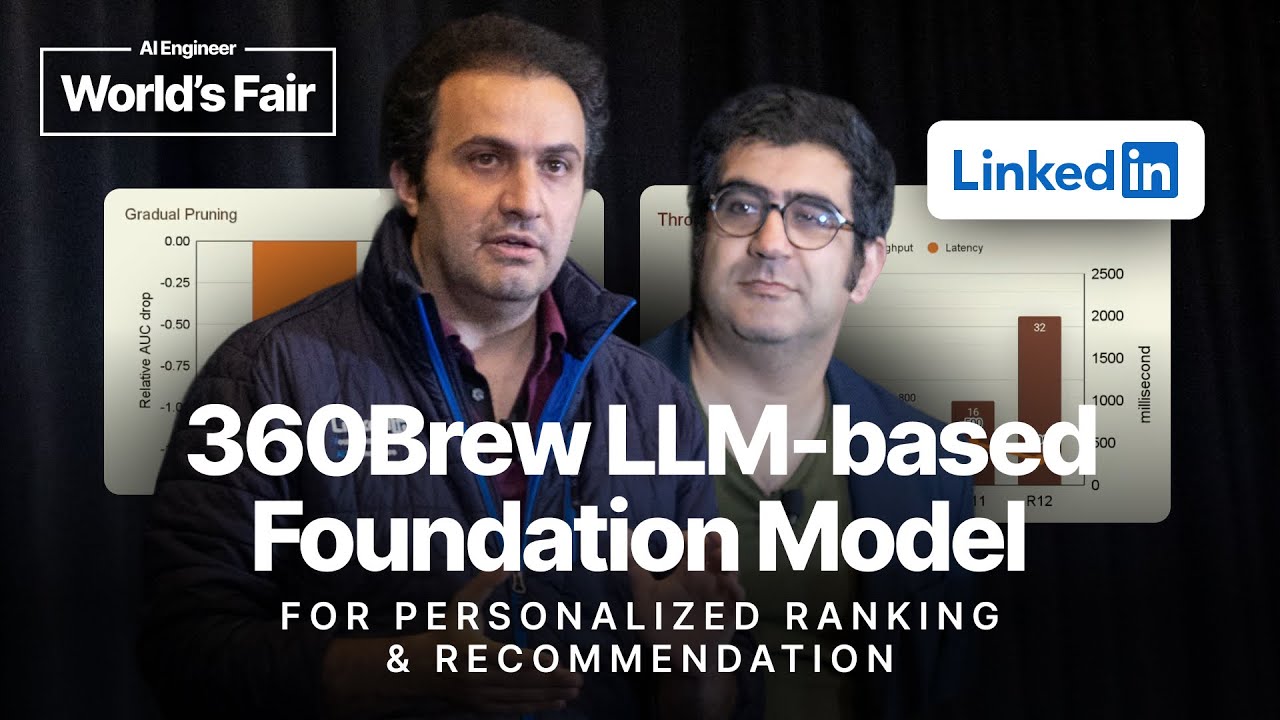
360Brew: LLM-based Personalized Ranking and Recommendation - Hamed and Maziar, LinkedIn AI
Jul 16, 2025 · 22:00
LinkedIn AI's Hamed Firooz and Maziar Sanjabi present BrewXL, a 150-billion-parameter foundation model for ranking and recommendation that personalizes the platform's feeds, jobs, and search. They show that training a large model then distilling to a 3B model outperforms training a small model from scratch. Scaling data, model size (from 7B to 8x22B), and context length all improve performance, though context beyond the trained length degrades accuracy. The model achieves zero-shot generalization on out-of-domain tasks, matching or beating task-specific production models, and significantly reduces the cold-start gap for users with fewer than five interactions. For serving, they combine gradual pruning, mixed-precision quantization (FP8 for most layers, FP32 for the LM head), and 4D attention masks to score up to 500 items without cross-attention, yielding a 7X latency reduction and 30X throughput increase per GPU.

Optimizing inference for voice models in production - Philip Kiely, Baseten
Jul 1, 2025 · 15:13
Philip Kiely of Baseten shows how open-source TTS models like Orpheus TTS, built on a LLaMA 3.2 3B backbone, can be optimized for production inference using LLM tooling such as TensorRT-LLM and FP8 quantization, achieving time-to-first-byte (TTFB) under 150 milliseconds and supporting 16–24 simultaneous streams on a single half-H100 GPU. He argues that because TTS models are architecturally similar to LLMs, techniques like dynamic batching, KV-cache quantization, and Torch Compile on the audio decoder can dramatically reduce latency and increase concurrency. He emphasizes that for real-time voice agents, the goal is not raw tokens per second (real-time requires only 83 TPS for Orpheus) but low TTFB and high throughput to minimize GPU spend. However, Kiely warns that non-runtime factors—such as client code using sequential requests without session reuse or sending traffic to distant data centers—can easily add back the milliseconds saved at the model level, and that infrastructure connecting listening, thinking, and talking pipelines is often the dominant source of latency.
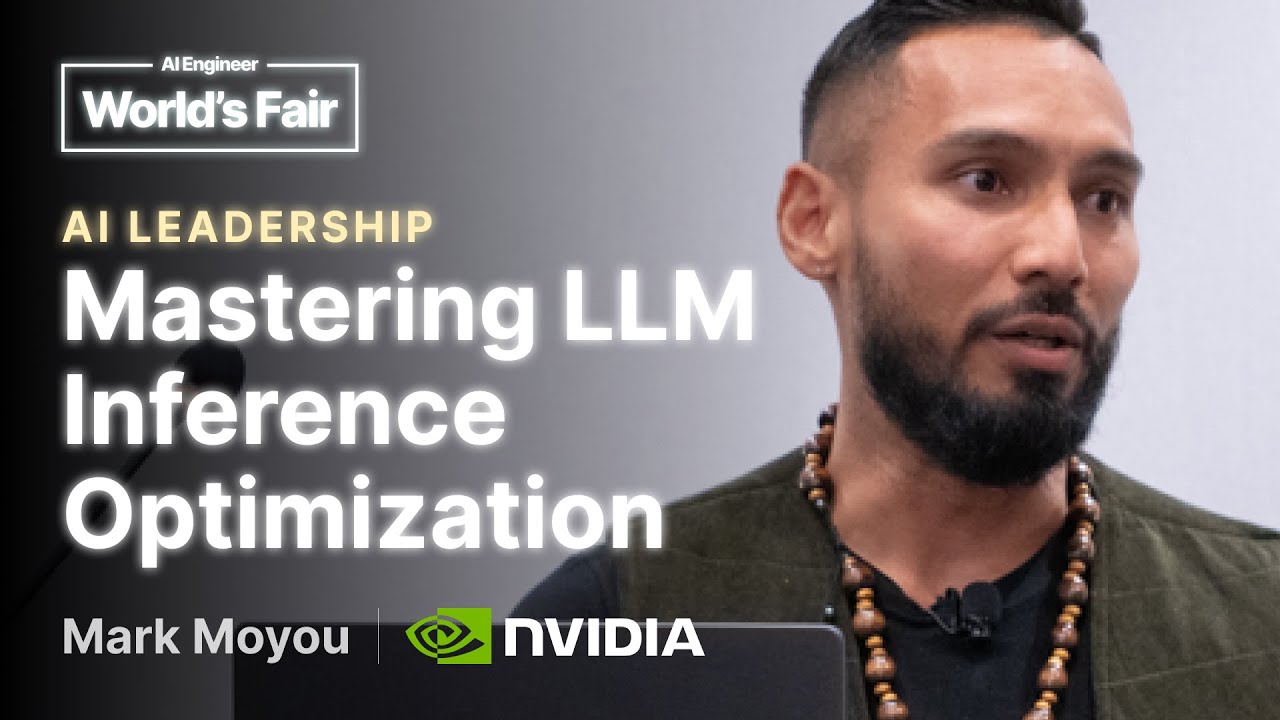
Mastering LLM Inference Optimization From Theory to Cost Effective Deployment: Mark Moyou
Jan 1, 2025 · 33:39
NVIDIA solutions architect Mark Moyou explains that LLM inference differs fundamentally from standard deep learning deployment, requiring careful management of KV Cache, attention mechanisms, and GPU memory to control cost. He details how tokens are processed: prefill computes attention across the entire prompt, then generation produces one token at a time, with KV Cache storing key-value pairs to avoid recomputation. Llama's 32 attention heads and FP8 quantization (halving memory with near-identical accuracy) are cited as key optimizations. Moyou emphasizes measuring time to first token, inter-token latency, and input/output sequence length distributions to size inference engines. He presents NVIDIA's TRT-LLM (model compilation for LLMs) and Triton inference server as tools to maximize throughput, and discusses how query patterns like long-input-short-output or short-input-long-output impact GPU utilization and deployment cost.
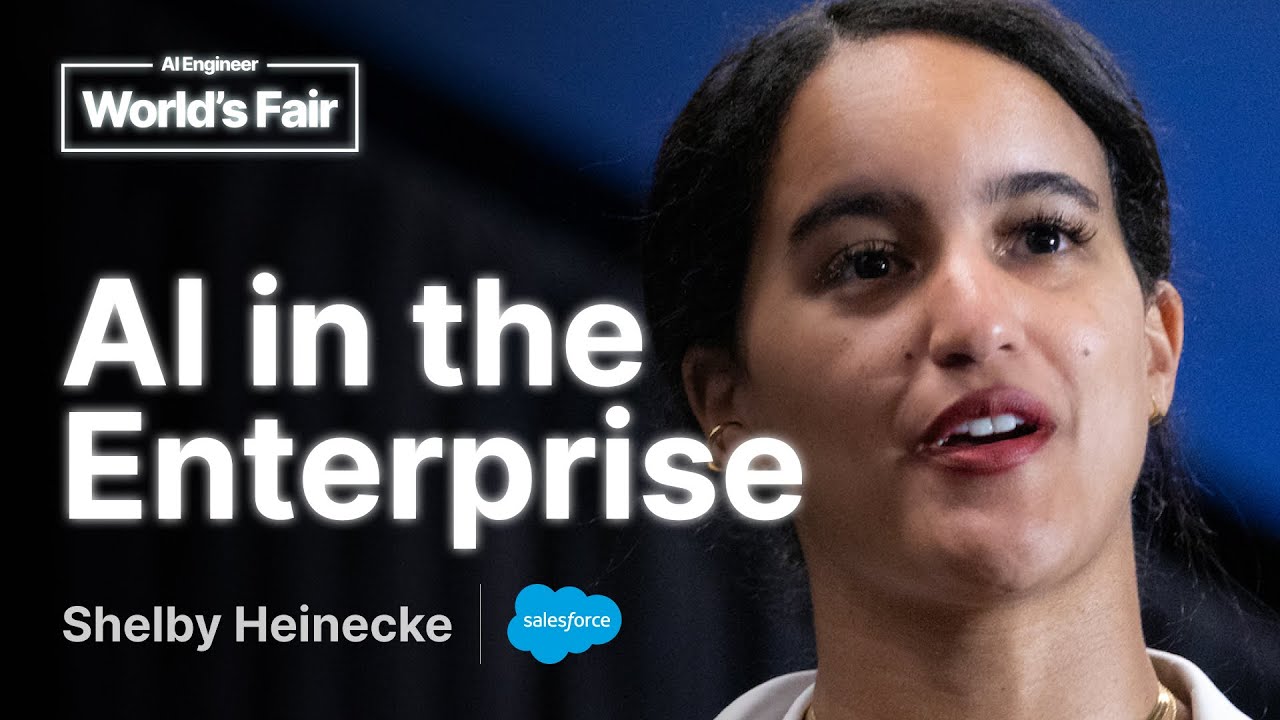
A Practical Guide to Efficient AI: Shelby Heinecke
Nov 18, 2024 · 17:45
Shelby Heinecke, who leads an AI research team at Salesforce, presents five orthogonal dimensions for making AI models efficient: efficient architecture selection, pre-training, fine-tuning, inference, and prompting. She highlights the power of small models like Phi-3 (3.8B parameters outperforming a 7B model), mobile LLM (350M parameters on par with 7B after fine-tuning), and Octopus (2B fine-tuned Gemma exceeding GPT-4 on Android tasks). For efficient inference, she explains post-training quantization, showing 4-bit quantization nearly halves memory usage without performance loss (e.g., LLaMA models), but warns 3-bit can degrade quality. She recommends frameworks like LLaMA CBP and ONNX Runtime for quantization and introduces her team's open-source Mobile AI Bench for evaluating quantized models, including an iOS app to measure latency and battery drain. The central claim is that deploying AI in constrained environments—cloud, on-prem, or edge—demands efficiency, and these practical techniques bridge the gap from demo to production.

From model weights to API endpoint with TensorRT LLM: Philip Kiely and Pankaj Gupta
Sep 13, 2024 · 1:40:01
Philip Kiely and Pankaj Gupta of Baseten lead a workshop on TensorRT-LLM, NVIDIA's high-performance inference framework for LLMs, arguing its use delivers best-in-class throughput and latency on NVIDIA GPUs. They explain that TensorRT-LLM optimizes computational graphs via plugin kernels and in-flight batching, achieving 216 tokens per second and 180ms time to first token on Mistral 7B. The workshop demonstrates building an engine for TinyLlama 1.1B, including FP8 quantization that reduced engine size from 2 GB to 1.2 GB with minimal quality loss. They benchmark a deployed model, showing 7,000 total tokens per second at batch size 64 on an A10G. The presenters compare TensorRT-LLM favorably to VLLM for high-throughput production use and introduce Truss, Baseten's open-source packaging tool, alongside their managed platform for automatic scaling and fast cold starts.

Unlocking Developer Productivity across CPU and GPU with MAX: Chris Lattner
Jul 25, 2024 · 18:33
Chris Lattner, CEO of Modular, presents MAX, a unified AI framework that accelerates Gen AI inference by combining CPU and GPU programming into a single Pythonic model, and Mojo, a new programming language that extends Python to systems programming with 100–1000x speedups. Lattner argues that current fragmentation across PyTorch, ONNX, TensorRT, and hardware-specific libraries slows innovation, and MAX replaces the entire stack—including cuDNN and Intel MKL—with a consistent, compiler-driven approach. He demonstrates that MAX's Int4/Int6 quantization achieves 5x faster performance than llama.cpp on cloud CPUs, and that its GPU matrix multiplication beats NVIDIA's cuBLAS by up to 30%. Mojo enables developers to write for loops and tokenizers (e.g., for LLaMA 3) in Python-like syntax without dropping to C++ or Rust. MAX is free and available now for CPU inference; GPU support launches in September with early access via Discord.

Harnessing the Power of LLMs Locally: Mithun Hunsur
Nov 22, 2023 · 17:09
Mithun Hunsur presents llm.rs, a Rust library for running large language models locally, arguing it gives developers ownership, lower latency, and privacy compared to cloud APIs. He explains how quantization makes inference viable on consumer hardware, and shows that llm.rs supports architectures like LLaMA and Falcon through a unified interface. Practical code examples demonstrate customization, and community projects like LocalAI and LLMchain illustrate real-world use. Hunsur shares his own date-extraction pipeline, fine-tuning a small model with GPT-3 data to replace expensive cloud calls. He also cautions about hardware requirements, trade-offs between speed and quality, and ecosystem churn from rapid innovation.
Powered by PodHood