
Multi-Agent Orchestration
Episodes from AI Engineer about Multi-Agent Orchestration.
80 episodes
Stop AI Agent Hallucinations: 5 Techniques + Production Patterns - Elizabeth Fuentes, AWS
Jul 11, 2026 · 55:19
Elizabeth Fuentes (AWS) presents five code-based techniques to stop AI agent hallucinations, each with measurable before/after metrics. Semantic Tool Selection filters 29 tools to the 3 most relevant per query, cutting token usage from thousands to under 300 per call. Graph-RAG replaces vector similarity with structured graph queries (using Neo4j), enabling precise aggregation and multi-hop reasoning that vanilla RAG fabricates. Multi-Agent Validation uses an Executor-Validator-Critic swarm to catch fabrications, achieving a 92% detection rate. Neurosymbolic Guardrails enforce business rules in Python hooks that the agent cannot skip, achieving zero rule violations. Agent Steering guides agents to self-correct when soft rules fire, completing tasks without hard failures—demonstrated by booking 50 guests by intelligently splitting into two rooms.

The Factory That Dreams: 39 AI Agents, No Framework - Rushabh Doshi, Machinecraft
Jul 11, 2026 · 9:58
Rushabh Doshi, CEO of Machinecraft, explains how his 100-person factory built Ira, a 36-agent AI OS running its go-to-market and memory without a framework. The system uses 36 specialist agents, each with one job, orchestrated by Athena, handling outbound emails, quoting, leads, and replies from one Cursor tab. Built for $30,000 versus $230,000 agency quote, it runs on a few thousand monthly with no training. Doshi says the secret is well-organized memory, vectors, graphs, and biological-inspired architecture including senses, digestion, memory layers, a nightly dream cycle, and immune system for fact-checking. The system is grounded in a SOUL.md constitution based on Jain philosophy, and ForkMyBrain.org helps others build their own forkable brain by mapping their business from the inside.
Develop at Idea Velocity - Jeffrey Lee-Chan, Snapchat
Jul 11, 2026 · 15:28
Jeffrey Lee-Chan (Snapchat) and Austin (CMUX) explain how to achieve 'idea velocity' by building parallel multi-agent harnesses that let one engineer direct 10–20 coding agents instead of becoming the bottleneck. Lee-Chan argues the key is separating 'Agent Orchestrator Managers' from specialized workers to prevent low-level implementation bias, using OpenClaw for frictionless Slack-based communication and CMUX terminals for real-time parallelization and unbiased manager oversight. He demonstrates two apps—an AI RPG with dice-roll mechanics and a multi-AI analysis tool—built with this stack, and discusses token-burn tradeoffs between models like Codex 5.3, GPT-5.4, and Minimax. The episode also covers staging environments to avoid doubling token usage, the benefit of persistent memory and contextual guardrails, and the importance of pushing human interaction to the start or end of the workflow for improved parallelization.

From Writing Code to Designing Systems: How the Developer Role is Changing — Chris Noring, Microsoft
Jul 11, 2026 · 23:05
Chris Noring from Microsoft argues that the developer role is shifting from writing code to designing systems and orchestrating AI agents, using tools like GitHub Copilot and Claude. He proposes a workflow starting with the CLI rather than the editor, employing agents.md for high-level guidance, skills for repeatable tasks, and custom agents for orchestration. Noring demonstrates scaling by delegating tasks via /delegate in the CLI or assigning issues to agents in the GitHub UI, allowing developers to become 20x more productive. He stresses that guardrails are essential to prevent agents from producing 'slop', and that human-in-the-loop oversight remains critical. The episode emphasizes that developers must encode standards and constraints into their workflows to maintain consistency and quality at scale.

Design Patterns for AI Trust: Juries, Libraries, and Agent Tiers — Alex Bauer, Upside.tech
Jul 11, 2026 · 17:09
Alex Bauer, co-founder of Upside, argues that go-to-market teams can solve AI's trust problem by managing agents like humans, using patterns such as a librarian for just-in-time knowledge and a jury-and-judge model for subjective decisions. He demonstrates three solutions: first, scaffolding an AI website rebuild with anchor assets like a product capabilities reference that ladders directly into homepage copy; second, a librarian that consults documentation and prior failed queries before answering questions like "How much pipeline in Q1?" to catch fiscal-year or stage definitions; third, a jury-and-judge workflow for multi-touch attribution where independent analysts research deals and a judge weighs reasoning quality before producing a consensus verdict. Bauer warns against low-intelligence models for important work, citing Slackbot's MCP integration as "horrifically stupid," and advocates using tier-two platforms with sub-agents, plan mode, and full MCP support.
Think You Can Build a Game with AI? Think Again! - Danielle An & David Hoe, Meta
Jul 8, 2026 · 18:00
Meta engineers Danielle An and David Hoe share insights from leading AI-driven game creation at Meta, arguing that while anyone can now prompt a basic game with AI, truly standout games require aesthetic cohesion, playtesting, and runtime LLMs that make NPCs dynamic and unscripted. They demonstrate how anchoring an LLM on a single image (like a QR code) can unify art style and gameplay, and show a multiplayer game where LLM-driven NPCs compete with unique personalities. The key shift is from linear, costly game development to parallel, rapid iteration cycles enabled by AI tools. They also highlight challenges: managing indeterminism across the entire stack (from user prompts to platform ranking), debugging agentic systems, and ensuring content safety with runtime generation. The takeaway: whether you're a beginner, intermediate, or advanced creator, the AI gaming frontier is at day zero, with open problems in token economics and scalable safety.
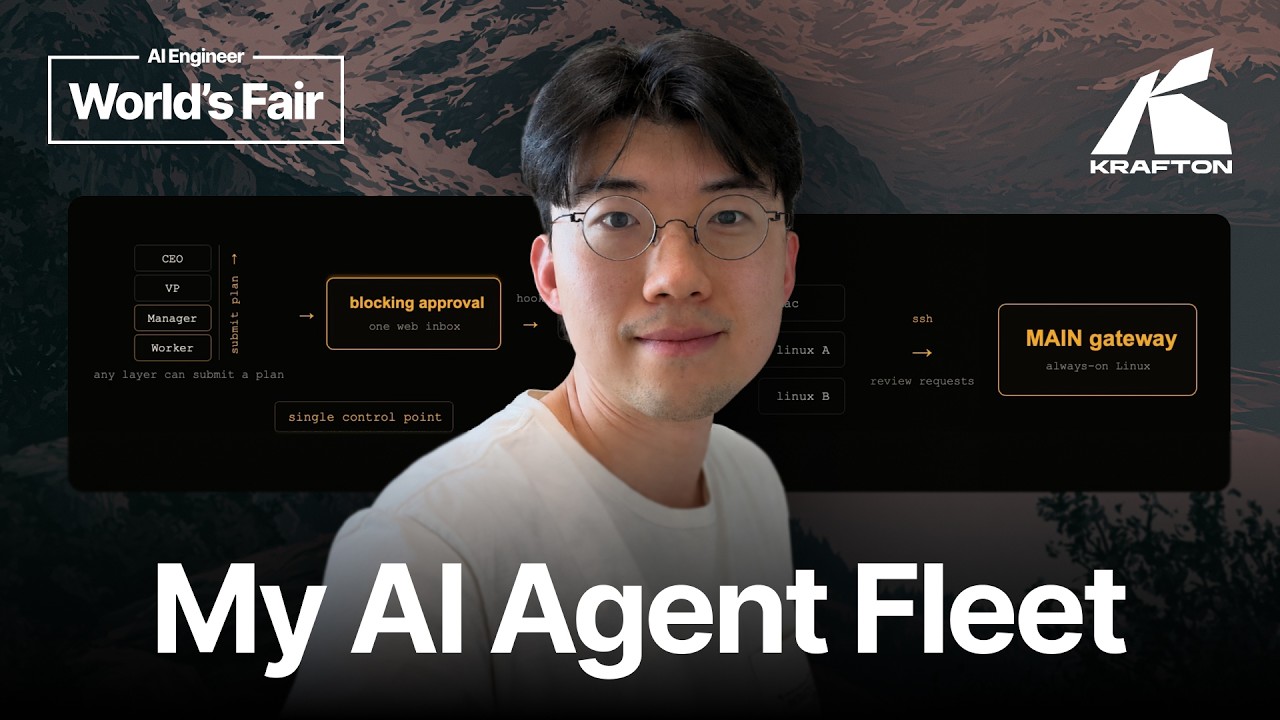
I Run a Fleet of AI Agents Across Three Machines. Here's What Broke. - Kyle Jaejun Lee, KRAFTON
Jul 8, 2026 · 9:11
Kyle Jaejun Lee runs a fleet of AI coding agents across three machines daily and reveals the scaling failures that emerged from a hierarchy of CEO, VP, manager, and worker agents. To overcome his own attention bottleneck, he separated context into entity-specific workspaces on disk and replaced context compaction with full resets that read handoff files. When moving beyond one machine, five things broke: agents doing work instead of delegating, TMUX panes too crowded to read, out-of-memory crashes from stacked Claude Code processes, colliding Git credentials across workspaces, and the MacBook dying mid-task. He offloaded long-running work to always-on Linux boxes, used Git commits and SSH to move context between machines, and consolidated review gateways onto a single always-on machine with Discord as a unified router. Unsolved challenges include consistent credentials, local-only tools, and resource scheduling—he plans to layer his orchestration on top of Kubernetes to handle compute, secrets, and tools.

Beyond the Harness: A Journey Towards Adaptative Engineering - Rajiv Chandegra, Annicha Labs
Jul 7, 2026 · 37:01
Rajiv Chandegra of Annicha Labs introduces adaptive engineering as a design philosophy that moves beyond fixed AI harnesses (like Claude Code, Cursor, or Py) to let multi-agent systems self-organize during runtime. He argues that as models become exponentially more powerful and AI collides with the messy, dynamic real world, pre-engineered static harnesses become brittle. Drawing on complexity science, he contrasts the factory model—reliable but novelty-suppressing—with adaptive engineering, where agents interact locally and the harness emerges as an ongoing output, not a predetermined input. The engineer's role shifts to designing constraints (e.g., rate of coupling, goal reward) and sensing the emergent order, while failures include drift, monoculture, and legibility collapse. This approach targets 'horizontal intelligence'—decentralized coordination among agents—as the key to handling complex, real-world problems that cannot be decomposed into fixed parts.

The Missing Layer After Launch - Raphael Kalandadze, Wandero AI
Jul 5, 2026 · 19:33
Raphael Kalandadze, CTO of Wandero AI, argues that shipping an AI agent is the easiest part and the real work begins post-launch, requiring a closed-loop monitoring system built with agents themselves. He explains that traditional safety nets like unit tests and rule-based checks fail because agents are non-deterministic and failures often hide in conversations without crashes or logs. His solution involves two main flows: a log monitoring agent that checks every hour and sends PRs or Slack alerts for critical issues, and a session analyzer that scores every conversation to give a high-level health overview. A computer-use agent simulates customers to catch UI problems. Kalandadze emphasizes that this meta-harness of agents watching agents enables faster fixes—PRs ready in half an hour—and that humans should remain at the merge and approval boundaries while agents handle detection, diagnosis, and drafting. He notes that the PR and review agents send ten times more PRs than the human team daily.

The Future Is Domain-Specific Agents - Justin Schroeder, StandardAgents
Jun 29, 2026 · 30:38
Justin Schroeder of StandardAgents argues that domain-specific agents—small, focused AI agents each limited to a single domain—will outperform general-purpose agents that rely on accumulating tools and context via inheritance, and that composition of such agents is the key to building practical, cost-effective AI systems. He defines an agent as deterministic software harnessing non-deterministic model outputs, then critiques the current approach of piling tools and skills into a single agent (inheritance), proposing instead a coordinator agent that delegates to many specialized sub-agents (composition), each with its own minimal context, system prompt, and tools. He claims these domain-specific agents achieve over 80% token efficiency, enable use of cheaper small models (e.g., DeepSeek V4 Flash is 137x cheaper than a frontier model), improve safety by limiting capabilities, and scale easily. Schroeder predicts rapid adoption through 2026-2027, with multi-agent orchestration becoming mainstream and tokens no longer getting cheaper—up 29% when adjusted for IQ. He describes an ideal agent architecture with hooks, rules, and recursive sub-agents, and invites listeners to try…

Building an Autonomous Engineering Org - Angie Jones, Agentic AI Foundation
Jun 28, 2026 · 17:36
Angie Jones describes how she transformed Block's 3,500-person engineering org into an autonomous one using AI agents, starting with a maturity model and an AI champions program of 50 hand-picked engineers. She details making repos AI-ready with context and rules files, then enabling delegation from Slack, Jira, and GitHub, which boosted AI-authored code by 69% and automated PRs 21x. Multi-agent parallelism required cloud workspaces and a company world model across 25,000 repos, culminating in BuilderBot that allowed anyone to @mention it for fixes. However, the success led to layoffs, raising existential questions about the human cost of autonomous engineering.
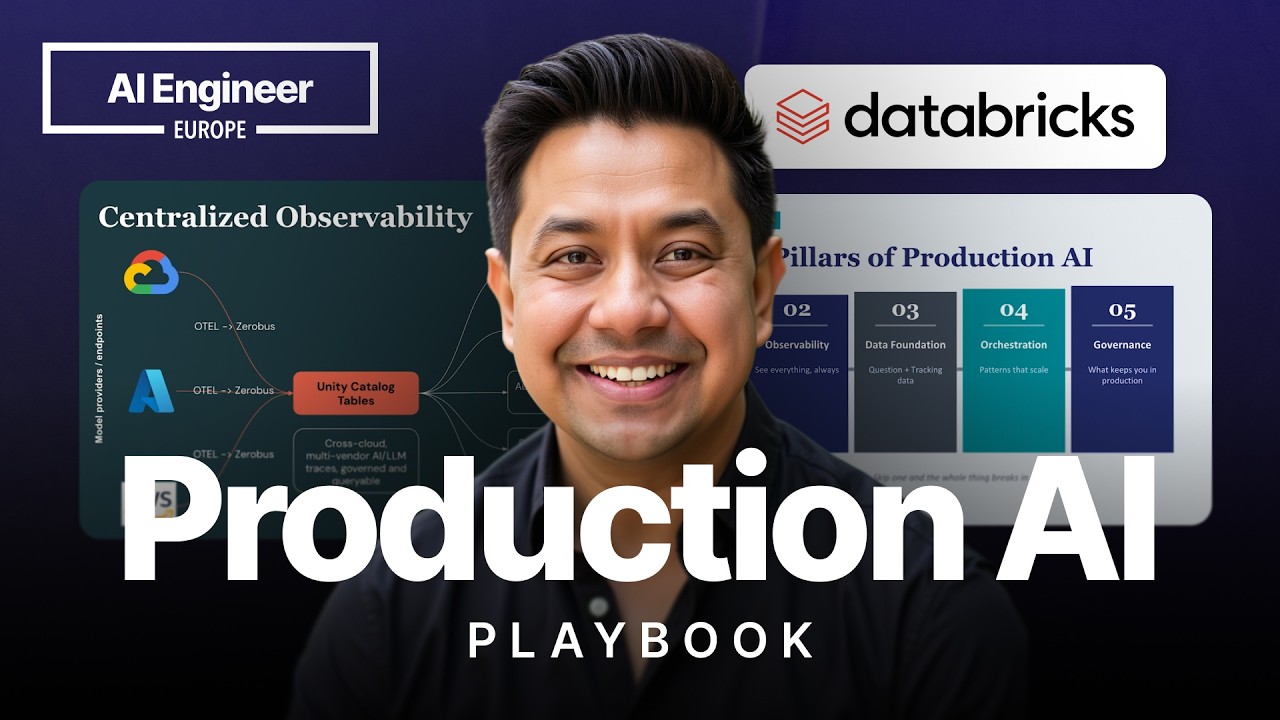
The Production AI Playbook: Deploying Agents at Enterprise Scale — Sandipan Bhaumik, Databricks
Jun 18, 2026 · 37:06
Sandipan Bhaumik, a technical lead for Data and AI at Databricks, presents a five‑pillar playbook for taking AI agents to production: evaluation (define numerical success before touching code), observability (trace every decision for regulators and debugging), data foundation (agents do not forgive bad data), multi‑agent orchestration patterns (orchestrator‑worker, choreography, human‑in‑the‑loop), and governance (PII pre‑validation, prompt versioning as change management). He recounts a retail bank that spent £85,000 over six months on a chatbot PoC that failed because no one could measure or trace it. His team reversed the order: they built the evaluation dataset and tracing infrastructure first, selected the model in week 7 of an 8‑week engagement, and launched successfully. Six weeks post‑launch, when the bank updated interest rate policies, the tracing system caught that the new document had not been re‑embedded, so the agent served stale answers—a production incident the five pillars were designed to handle. The evaluation dataset is a living system that grows from 200 test cases; a production incident playbook connects all pillars: detect via eval dashboard, diagnose with…

Sovereign Escape Velocity: Ownership w Open Models — Gus Martins, & Ian Ballantyne, Google DeepMind
Jun 10, 2026 · 20:52
Gus Martins and Ian Ballantyne of Google DeepMind introduce Gemma 4, a family of open-weight models that deliver high quality per parameter, enabling deployment on a single GPU or even a phone. They argue that the models' efficiency — a 31B model rivals those twenty times larger — and the shift to Apache 2.0 licensing remove barriers for sovereign institutions like those in Ukraine, Bulgaria, and Brazil. Ian demonstrates multi-agent translation running locally on an M4 Mac, showcasing ownership and control over agentic workloads.
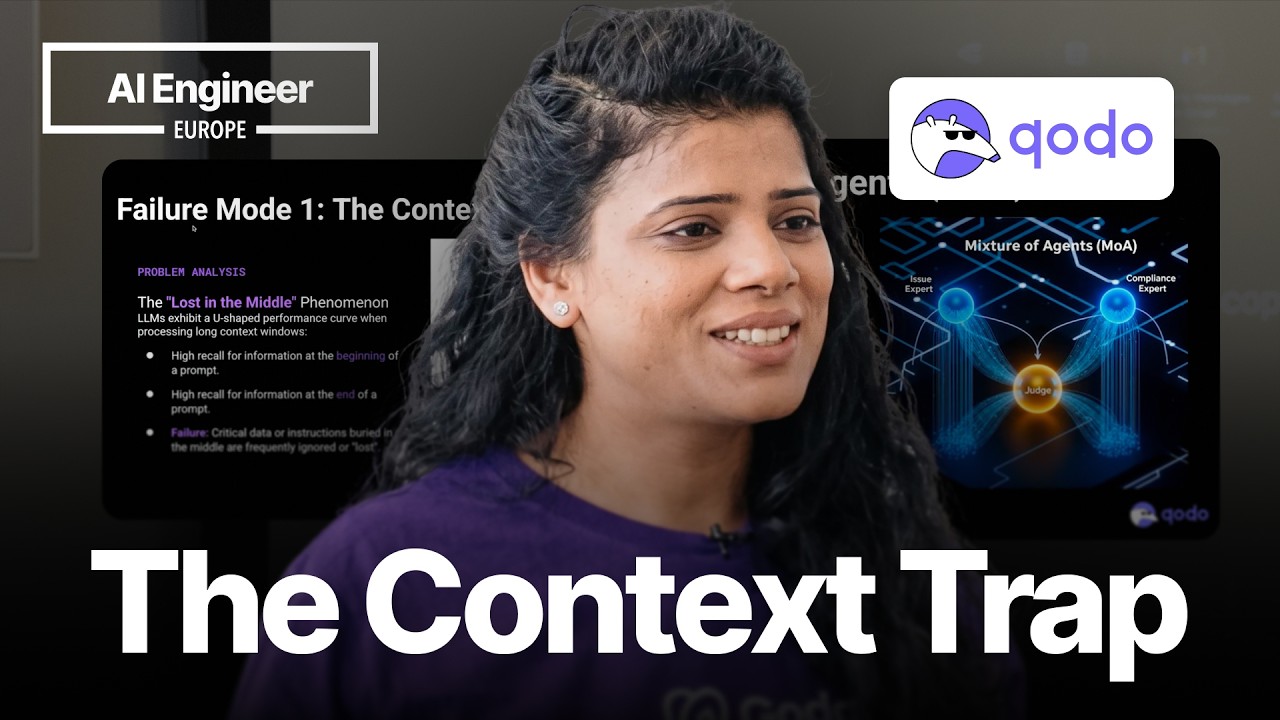
Why More Context Makes Your Agent Dumber and What to Do About It — Nupur Sharma, Qodo
Jun 8, 2026 · 26:27
Nupur Sharma from Qodo explains why giving an AI agent more context often makes it dumber, describing the 'U curve' where models attend only to the start and end of inputs while dropping the middle. She covers practical fixes: iterative retrieval, hierarchical summarization, and self-correction with honest cost tradeoffs. The talk introduces the 'orchestration paradox'—smart models waste most tokens figuring out how to solve a problem rather than solving it—and Qodo's 80/20 hybrid: high-reasoning models for open-ended discovery, lighter deterministic models for validation. Sharma walks through Qodo's code review architecture: a context collector feeds specialized agents (security, code quality, etc.), a judge node recombines results against PR history, and every accepted or rejected suggestion shifts weighting for future reviews.
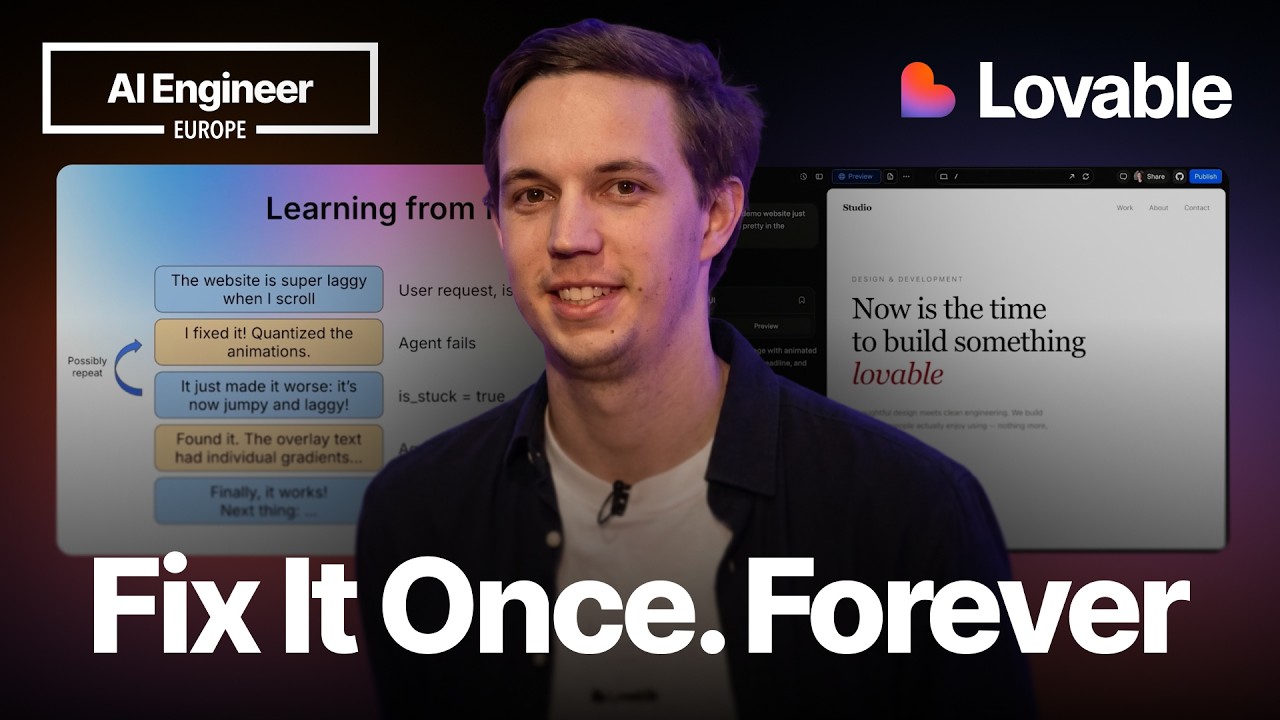
How Lovable self-improves every hour — Benjamin Verbeek, Lovable
Jun 2, 2026 · 19:05
Benjamin Verbeek from Lovable explains two continuous improvement loops that keep its AI coding agent learning from mistakes at scale. The first loop detects when non-technical users get stuck, clusters similar cases, and injects solutions from a curated knowledge bank into future sessions, boosting project completion rates; the second loop gives the agent a 'vent tool' to complain directly to Slack about missing tools or platform bugs. Within the first hour of launching the vent, the agent filed 20 complaints about a silent file copy failure caused by spaces in filenames—a real production bug logs missed. Vent volume spikes now serve as a reliable incident detector. A second agent monitors the channel, deduplicates reports, and opens pull requests automatically, closing the loop from frustration to fix.

Let's Talk About FOMAT: Fear of Missing Agent Time — Michael Richman, Cmd+Ctrl
May 24, 2026 · 16:17
Michael Richman introduces FOMAT (Fear of Missing Agent Time), the anxiety of wasting agent productivity when you're away from your dev machine. He built Cmd+Ctrl, a system that sends push notifications when an agent stalls or finishes, lets you respond from phone or watch, and allows starting new sessions remotely. The demo shows Claude Code mirrored on an iPhone, with real-time interaction and a standup dashboard summarizing all sessions. The open-source daemon layer works with Claude Code, Cursor, Codex, Gemini CLI, and others, aggregating sessions across machines into a single pane of glass. Richman argues this alleviates the cognitive load of managing multiple agents and supports the new flow of agent choreography.

The Missing Primitive for Agent Swarms — Lou Bichard, Ona
May 23, 2026 · 18:37
Lou Bichard, field CTO at Owner, argues that agent swarm infrastructure for coding agents is missing a coordination primitive, while runtimes and orchestration are largely solved. He defines a Software Factory as incrementally removing humans from the SDLC and highlights internal systems from Stripe (Minions) and RAMP (Inspect) as real-world examples. Owner provides VM-level isolation for agent fleets and sub-agent patterns, demonstrated with a demo of process-based and VM-based swarms. Bichard identifies GitHub as a poor coordination layer for hundreds of parallel pull requests and proposes solutions like state machines, durable execution, and a CLI gateway that any local agent can invoke to check progress. He notes context rot and agents skipping steps as key challenges, and announces a public two-week project to build a Software Factory from scratch starting next week.

Cooking with Agents in VS Code — Liam Hampton, Microsoft
May 21, 2026 · 17:04
Liam Hampton from Microsoft demonstrates how to run three AI agents simultaneously in VS Code using GitHub Copilot: a local agent with Claude Opus for iterative unit test writing, a background agent using git work trees to build a front end from a GitHub issue with minimal oversight, and a cloud agent in GitHub Actions to add documentation and open-source files. He argues that VS Code serves as a single entry point for all three agent types—local for hands-on iteration, background for large tasks where partial involvement is acceptable, and cloud for tasks the developer doesn't need to touch. The talk walks through a live demo where the three agents work in parallel on one codebase, solving different problems (testing, UI, documentation) without interference, and explains the underlying infrastructure: cloud agents run securely in GitHub Actions with MCP servers and built-in safeguards, while local and background agents leverage VS Code's chat customizations and third-party extensions. Hampton also highlights the new modal for managing agents, custom instructions, skills, and MCP servers, positioning Copilot as a unified control plane for diverse AI workflows.

Your Coding Agent Should Do AI System Engineering — Ben Burtenshaw, Hugging Face
May 21, 2026 · 18:25
Ben Burtenshaw from Hugging Face demonstrates how coding agents can take on AI systems engineering tasks—writing CUDA kernels, fine-tuning models, and running multi-agent research labs—by leveraging skills and the Hugging Face Hub. He shows a 1.88x speedup on H100s with an RMSNorm kernel written by Claude Code, and a fine-tuned Qwen3 0.6B achieving 35% on LiveCodeBench. Skills compress years of specialization into hours by turning zero-shot tasks into few-shot workflows. For multi-agent research, a Planner generates hypotheses from papers, Workers implement them as training scripts, and a Reporter monitors results via the open-source Trackio dashboard, with all jobs running on Hub compute. The key is exposing open primitives like kernels, Trackio, and HF jobs as agent-controllable tools.
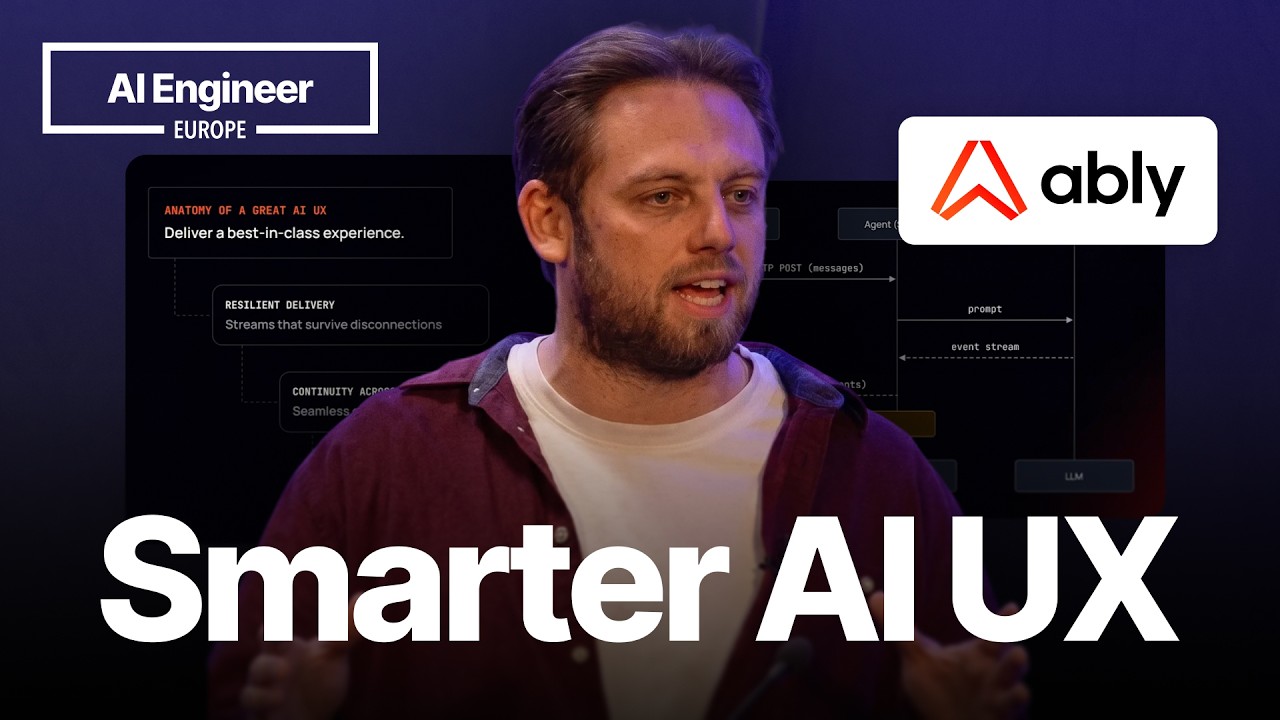
Why Your AI UX Is Broken (and It's Not the Model's Fault) — Mike Christensen, Ably
May 17, 2026 · 18:38
Mike Christensen, a staff engineer at Ably, argues that direct HTTP streaming (SSE) for AI chat apps breaks because it ties a response stream to a single connection, making resumability, multi-device sync, and live control mutually exclusive. He introduces durable sessions—a persistent, shared resource decoupled from any individual client or agent—built on Ably's Pub/Sub channels, which automatically handle reconnection, cross-tab synchronization, and concurrent multi-agent activity without complex plumbing. Christensen demonstrates with a live demo: a forced network disconnect that self-recovers, two tabs in perfect sync, two agents running in parallel without an orchestrator, and a handoff to a human agent who joins mid-conversation with full history. The episode concludes that treating the session as a durable shared resource unlocks resilient, multi-surface, and live-controllable AI experiences that the standard request-response model cannot support.
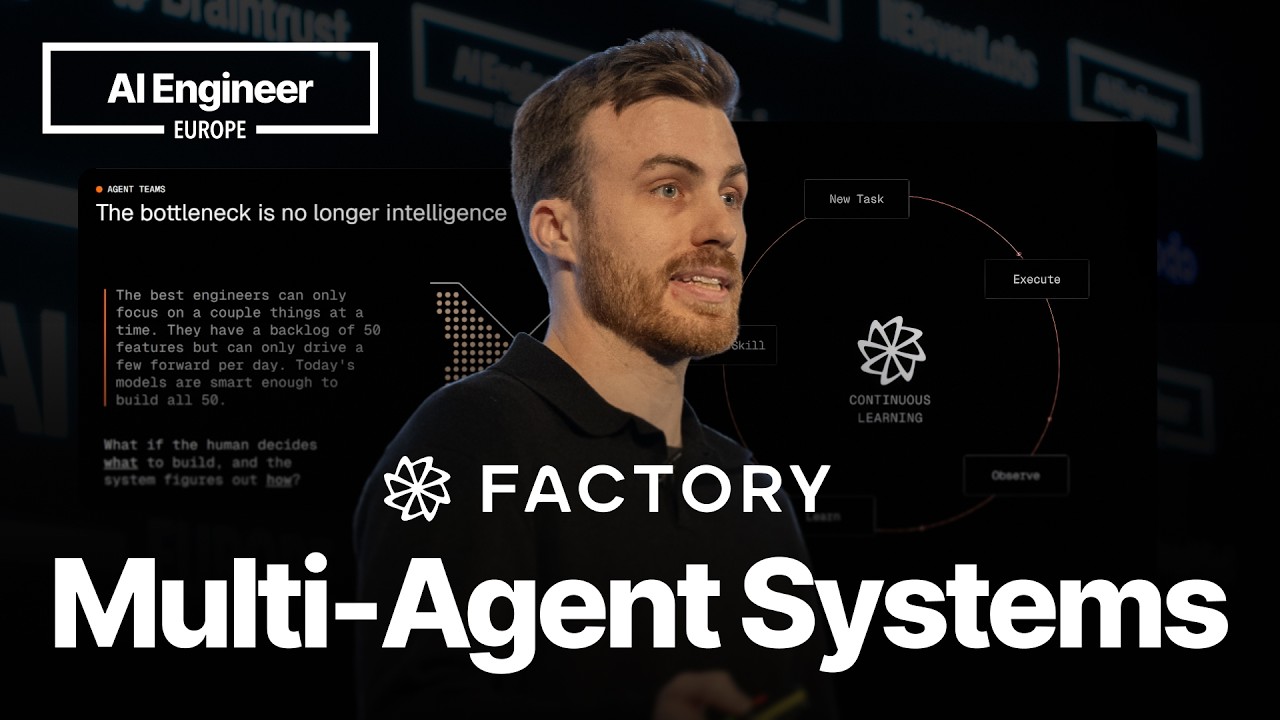
The Multi-Agent Architecture That Actually Ships — Luke Alvoeiro, Factory
May 6, 2026 · 18:31
Luke Alvoeiro from Factory presents Missions, a multi-agent architecture that combines delegation, creator-verifier, broadcast, and negotiation into a three-role system of orchestrator, workers, and validators. The central claim is that human attention, not AI intelligence, is now the bottleneck in software engineering. Missions uses validation contracts written before any code to define correctness independently, structured handoffs to maintain context across 16-day runs, and serial execution with targeted internal parallelization to reduce errors. Strategic model selection per role—planning, implementation, validation—compounds advantages across model generations. Production data from building a Slack clone shows 60% of time and tokens spent on implementation, validation never succeeds on first go, and 50% of final code lines are tests with 90% coverage. The system is designed to improve with each model release by keeping orchestration logic in prompts and skills rather than hard-coded state machines.

Agents on the Canvas in tldraw — Steve Ruiz, tldraw
May 1, 2026 · 19:54
Steve Ruiz of tldraw details the evolution of AI on the infinite canvas, from early one-shot demos like MakeReal (draw to functional prototype) to multi-agent 'fairies' that collaborate, delegate, and even rewrite the canvas in real time. He explains how the tldraw SDK enables agents to act as virtual collaborators, using structured outputs and tool use to draw, animate, and modify designs. Ruiz demonstrates fairy agents that can work independently or in leader-follower mode, coordinating on tasks like creating wireframes or filling out forms. He also unveils a desktop prototype that lets Claude directly inject JavaScript into the canvas, enabling agents to edit code, modify UI, and even hack other apps like Spotify. The talk emphasizes the shift from sidebar agents to canvas-native collaborators, the challenges of vision model training for 2D spaces, and the safety trade-offs of giving LLMs runtime access in local-first apps.
OpenAI Codex Masterclass — Vaibhav Srivastav & Katia Gil Guzman
Apr 29, 2026 · 1:01:59
Katia Gil Guzman and Vaibhav Srivastav showcase OpenAI's Codex as a full software engineering agent, not just a coding assistant, powered by models like GPT-5.4 and GPT-5.3 Codex Spark. They demonstrate plugins bundling skills and MCP servers, automations that run scheduled tasks (e.g., Slack or Gmail summaries), and code review that 100% of OpenAI pull requests use by default. Subagents parallelize work across up to 20 agents for tasks like reviewing 45 persona files, with each subagent configurable by model, sandbox mode, and MCP access. New features include Guardian approvals for privileged operations, hooks for custom triggers, and a Cloud Code plugin. The episode also highlights the milestone of 3 million weekly active users, tripled since January, and covers security scanning for vulnerabilities.
Building your own software factory — Eric Zakariasson, Cursor
Apr 28, 2026 · 1:23:37
Eric Zakariasson, an engineer at Cursor, explains how to build a 'software factory' by scaling from one agent to many, shifting from worker to manager. He outlines six stages of autonomy, from spicy autocomplete to the dark factory, and emphasizes that most teams are stuck at levels two or three. Key primitives include modular codebases, guardrails like rules and hooks that emerge dynamically, enablers such as skills and MCPs, and verifiable systems like automated tests. Cloud agents with isolated VMs allow agents to run asynchronously, test their own work via computer control, and scale to thousands. Eric shares internal automations like daily reviews, PR comment analysis, and continual learning that extracts rules from chat transcripts. He concludes with strategic advice: front-load context, don't outsource critical decisions, and build tools and systems to capture flywheels, noting that human accountability remains essential.
Collaborative AI Engineering: One Dev, Two Dozen Agents, Zero Alignment — Maggie Appleton, GitHub
Apr 26, 2026 · 17:43
Maggie Appleton, a staff research engineer at GitHub Next, argues that the current paradigm of one developer with a fleet of solo agents leads to zero team alignment, making software a team sport that requires shared context. She presents ACE (Agent Collaboration Environment), a multiplayer research prototype that provides shared chat sessions backed by micro VMs and Git branches, enabling real-time collaboration where designers, PMs, and developers can all prompt agents together. The talk emphasizes that implementation is now cheap and fast, so the hard question is "should we build it?" — requiring early, constant alignment to avoid wasted work, coordination debt, and unrequested features. ACE aims to reclaim time for rigorous critical thinking by letting teams plan, build, and review in a single shared space, with proactive agents summarizing team activity and unfinished work. Appleton contends that quality becomes the differentiator in a world of cheap code, and tools like ACE can help teams build a few exceptional things rather than a thousand crappy ones.
AgentCraft: Putting the Orc in Orchestration — Ido Salomon
Apr 25, 2026 · 11:18
Ido Salomon, creator of AgentCraft, argues that the bottleneck in multi-agent orchestration is not the agents but the humans managing them, and that the skills needed—borrowed from real-time strategy games—are already familiar to gamers. AgentCraft visualizes agents as physical units on a map that projects the file system, allowing users to see which files agents modify and detect collisions via a heat map. To reduce babysitting, Salomon implemented a campaign feature where agents autonomously decompose tasks and plan within containers, shifting the human role to review. Review bundles present changes with screenshots and videos for efficient inspection. Workspaces enable real-time collaboration between humans and agents across teams, with shared visibility and soft coordination. The goal is to raise the ceiling of collaboration through visibility, autonomy, and human-agent interaction.

Full Walkthrough: Workflow for AI Coding — Matt Pocock
Apr 24, 2026 · 1:36:30
Matt Pocock presents a hands-on workshop on building a full AI-assisted coding workflow, arguing that software engineering fundamentals—not hype—make agents effective. He introduces the 'smart zone' and 'dumb zone' of LLMs (performance drops after ~100k tokens) and the 'Memento problem' (agents forget between sessions). His process starts with a 'Grill Me' skill that relentlessly questions the user until shared understanding is reached, then produces a PRD without reading it, slices work into vertical 'tracer bullet' issues, and runs agents AFK using TDD. He advocates designing codebases with deep, testable modules and shows Sandcastle, a TypeScript library for parallel agent execution with separate implementer (Sonnet) and reviewer (Opus). The workshop transforms ambiguous briefs into shippable features while keeping humans in the loop for QA and taste.
The End of Apps — Kitze, Sizzy.co
Apr 23, 2026 · 20:18
Kitze, creator of Benji and founder of Tinker Club, argues that current productivity apps and AI agents are unreliable and too complex for most users, predicting a future where AI prompts humans instead of the reverse. He traces his 24-year obsession with productivity tools—from a childhood to-do list to building Benji with 60 features—and his move to self-hosting after the ChatGPT moment. Kitze critiques custom agents like OpenClaw as too tinkerer-focused, cloud agents like ChatGPT as too nerfed, and believes local models on devices (Apple, Google Pixel) will win for normies, enabling AI to automatically manage notifications, emails, and tasks. He shares his own experiment, Wolfer, designed for predictable multi-agent orchestration without memory systems, using nested topics for context. The episode delivers a strong claim: the role of AI will invert, with machines prompting humans for decisions while handling all background work.
How AI is changing Software Engineering: A Conversation with Gergely Orosz, @pragmaticengineer
Apr 21, 2026 · 26:42
Gergely Orosz explains how AI is reshaping software engineering, from token maxing at Meta, Microsoft, and Salesforce—where engineers use AI tools to inflate token counts out of fear of layoffs and performance reviews—to the broader shift in the engineer's role toward orchestrating agents rather than managing people. He notes that big tech companies like Uber, Airbnb, and Shopify are building custom internal AI infra (MCP gateways, coding agents) to stay ahead, even tolerating high churn for a six-month competitive edge. Shopify secured GitHub Copilot a year early by offering feedback from 3,000 engineers. Gergely also shares how The Pragmatic Engineer hit product-market fit: 100 paid subscribers before publishing, reaching 1,000 in six weeks, and becoming the #1 paid tech newsletter by focusing on two deep-dive articles per week for two years.

Paperclip: Open Source Human Control Plane for AI Labor — Dotta Bippa
Apr 15, 2026 · 24:34
Dotta Bippa introduces Paperclip, an open-source human control plane for AI labor that lets you manage an org chart of agents to run a zero-human company. The tool enables you to hire employees, set goals, automate jobs, and bring your own agent (e.g., Gemini, Claude, Codex) with skills and instructions. Paperclip supports reliable workflows like QA reviews and approvers, and routines for recurring tasks such as summarizing PRs or writing changelogs. Dotta demonstrates creating a Remotion video celebrating Paperclip's 40,000 GitHub stars (now 50,000) by instructing the CEO agent to hire a video writer and apply brand guidelines—something that would have taken a week becomes an afterthought. Paperclip is not just for coding; it handles marketing, sales, and finance. Upcoming features include CEO chat, maximizer mode, multi-user support, cloud deployments, and a desktop app, all aimed at giving humans control over AI labor.

From Chaos to Choreography: Multi-Agent Orchestration Patterns That Actually Work — Sandipan Bhaumik
Apr 8, 2026 · 26:29
Sandipan Bhaumik, Data & AI Tech Lead at Databricks, argues that scaling AI agents from one to five transforms an AI problem into a distributed systems problem, exposing teams to race conditions, stale reads, and cascading failures. He recounts a production deployment where a credit decisioning system incorrectly approved 20% of applicants because a caching layer wasn't invalidated between agents. Bhaumik presents two coordination patterns: choreography (event-driven, decentralized) for simple workflows with high autonomy, and orchestration (central coordinator) for complex workflows needing rollback and observability. He advocates for immutable state snapshots (append-only versions) and data contracts (schema validation at handoffs) to eliminate race conditions, and demonstrates failure recovery using circuit breakers and compensation (saga) patterns. The episode delivers a production-grade architecture on Databricks using LangGraph, Unity Catalog, Delta Lake, and MLflow for tracing, with code examples for state handoff and circuit breaker logic.
OpenAI + @Temporalio : Building Durable, Production Ready Agents - Cornelia Davis, Temporal
Jan 12, 2026 · 1:18:30
Cornelia Davis, developer advocate at Temporal, demonstrates how the OpenAI Agents SDK and Temporal combine to build durable, production-ready AI agents. The integration, co-developed by OpenAI and Temporal, wraps agentic loops in Temporal workflows, providing automatic retries, event sourcing, and state management that survive process crashes and network failures. A live demo shows a weather alert agent that calls an LLM, invokes tools like get_weather_alerts and get_ip_address, and recovers seamlessly after the worker is killed. Davis highlights that Temporal’s architecture treats processes as logical entities, allowing agents to run for days and handle human-in-the-loop delays without developer-managed infrastructure. She also explains handoffs and micro-agent orchestration, and points to the AI Cookbook on docs.temporal.io with ready-to-run recipes including the OpenAI Agents SDK integration.

Automating Large Scale Refactors with Parallel Agents - Robert Brennan, OpenHands
Jan 8, 2026 · 1:16:21
Robert Brennan, CEO of OpenHands, and colleague Calvin explain how parallel agents can automate large-scale code refactors, demonstrating that breaking tasks into agent-sized batches with human oversight achieves 90% automation. They trace the evolution from context-unaware snippets to autonomous coding agents and now agent orchestration, where multiple agents work in parallel on tasks like CVE remediation — one client saw a 30x improvement in time-to-resolution. Calvin shows a pipeline using OpenHands' SDK to batch code files, run a verifier to detect code smells, and spin up fixer agents that generate focused pull requests. Brennan details strategies: task decomposition into single-PR-sized chunks, dependency ordering, and context sharing via agent.md files. The episode closes with a live-coding walkthrough building a parallel agent script that scans for vulnerabilities and opens individual PRs.

The 3 Pillars of Autonomy – Michele Catasta, Replit
Dec 22, 2025 · 24:42
Michele Catasta, VP of AI at Replit, argues that true autonomy for coding agents serving non-technical users rests on three pillars: verification, context management, and parallelism. Replit’s agent uses autonomous testing—writing Playwright code instead of browser-use tools—to catch broken features (over 30% initially) without human feedback, cutting cost and latency by an order of magnitude. Context management relies on sub-agent orchestration rather than massive context windows, boosting memories per compression from ~35 to 45–50. Parallelism, implemented via a core-loop orchestrator, dynamically decomposes tasks to avoid merge conflicts and keep users engaged instead of waiting hours. Catasta emphasizes that autonomy means scoped technical decisions, not just long runtimes, enabling knowledge workers to build software without needing a 'driving license.'
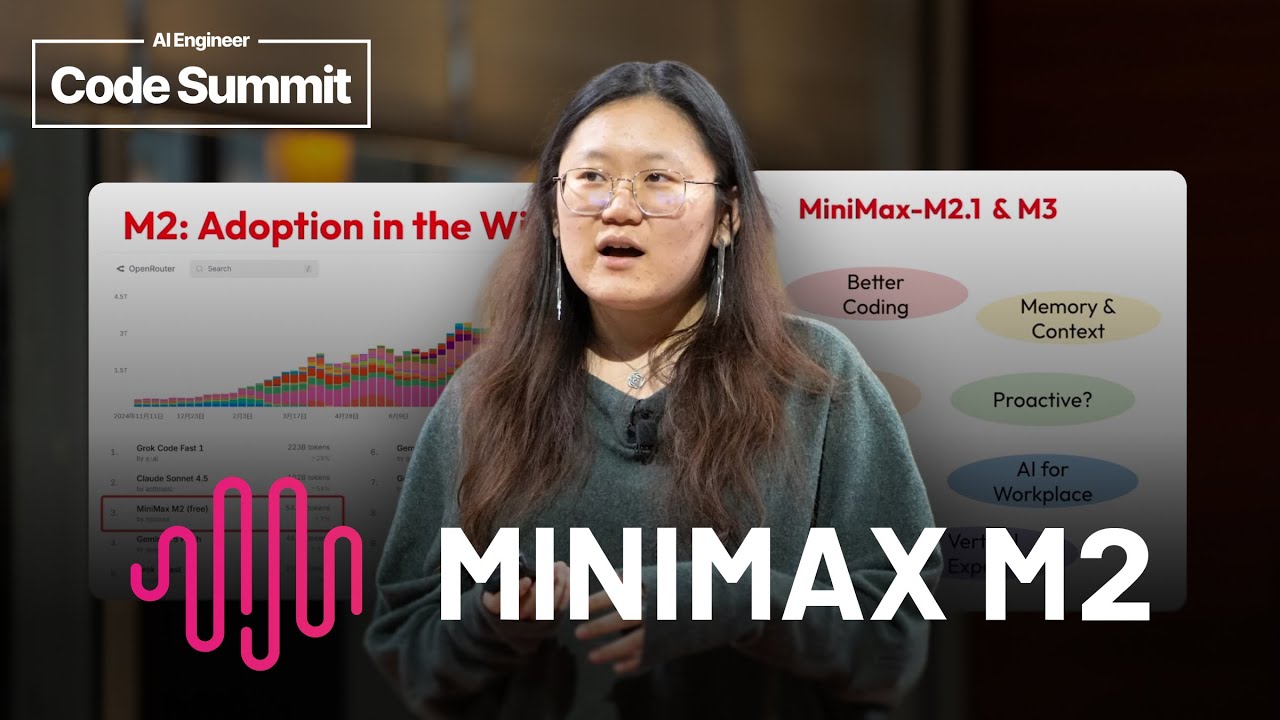
Minimax M2: Building the #1 Open Model – Olive Song, MiniMax
Dec 13, 2025 · 13:41
Olive Song, Senior Researcher at MiniMax, presents the Minimax M2, an open-weight model with 10 billion active parameters that achieves top rankings in intelligence and agentic benchmarks while being cost-efficient for real-world coding tasks. The model's success is attributed to four key characteristics: scaled environments and expert developer feedback for code experience, interleaved thinking with reinforcement learning for long-horizon tasks, perturbation pipelines for robust generalization across agent scaffolds, and small size enabling multi-agent scalability. Song details how these features allow M2 to handle noisy, dynamic environments, perform multi-tool workflows autonomously, and adapt to various scaffolds and prompts. The talk also previews future developments like M2.1 and M3, with plans to integrate audio and video generation capabilities.

Enterprise Deep Research: The Next Killer App for Enterprise AI — Ofer Mendelevitch, Vectara
Nov 24, 2025 · 5:19
Ofer Mendelevitch from Vectara introduces Enterprise Deep Research as the next killer app for enterprise AI, applying autonomous, multi-step reasoning to internal knowledge bases. Vectara's trustworthy agent OS enables this with multimodal ingest, hybrid retrieval, and hallucination mitigation (HHEM model at 5.5M downloads). Deep Research queries private data to generate comprehensive reports with citations, replacing manual workflows. Key use cases include responding to RFPs by scanning enterprise datasets, generating on-demand employee onboarding guides from Jira/Notion/SharePoint, and creating investment memos in financial services. The system uses multi-agent parallel execution and corpus understanding for accurate planning, addressing 73% of LLM users' top challenge: factual accuracy.

From Stateless Nightmares to Durable Agents — Samuel Colvin, Pydantic
Nov 24, 2025 · 22:13
Samuel Colvin of Pydantic demonstrates building production-grade durable AI agents using PydanticAI, Temporal, and Pydantic Logfire, arguing that stateless architectures fail at scale and that durable execution with checkpointing and recovery is essential. He shows a 20 questions game where two agents play, but with 20% simulated failures, restarts are avoided by wrapping agents in Temporal wrappers for automatic retries. Colvin then implements a Deep Research agent that plans searches, runs parallel web searches via Tavilli, and synthesizes results, all recoverable. In a live demo, killing the workflow and restarting resumes instantly, replaying cached LLM calls in milliseconds. He also previews Pydantic AI Gateway and demonstrates Pydantic Evals comparing Gemini, GPT-4.1, and Claude Sonnet 4.5 on performance and cost.

Hacking Subagents Into Codex CLI — Brian John, Betterup
Nov 24, 2025 · 13:39
Brian John, Principal Full Stack Engineer at Betterup, explains how to hack subagents into OpenAI's Codex CLI by using a 72-line wrapper script that launches child Codex processes as subagents, enabling context management without polluting the main agent's window. He details the minimum sandbox permissions required—workspaceright on both parent and child, plus disabling the rollout recorder—and notes that security risk is low per Meta's Rule of 2, though not zero. The wrapper uses file-based communication to avoid repetitive permission prompts, and subagents are defined in an agents.md file with configurable reasoning effort. John demonstrates a word counter and file writer agent, noting that Codex runs subagents serially and slower than Claude Code (e.g., 40 seconds for a simple task, up to 20 minutes for large codebases), but considers this acceptable for Codex's unattended design.
AI Copilots for Tech Architecture: The Highest-ROI Use Case You’re Not Building — Boris B., Catio
Nov 24, 2025 · 27:29
Boris Bogatin and Tofiq Boubaz, CEO and CTO of Catio, argue that AI architecture copilots represent the highest-ROI use case most organizations overlook, surpassing coding copilots in strategic impact. They identify three critical challenges—visibility across tech estates, ROI-backed prioritization, and autonomous developer guidance—and propose three pillars: a live digital twin for holistic system visibility, AI-driven multi-agent recommendations tied to business objectives, and a conversational agent embedding governance into developer workflows. The episode details a four-step approach: ingest messy system data, align recommendations with goals, generate compliant designs, and track outcomes. Concluding that companies adopting architecture copilots early will stay modern while laggards drown in technical debt, they invite listeners to catio.tech to pilot the approach.
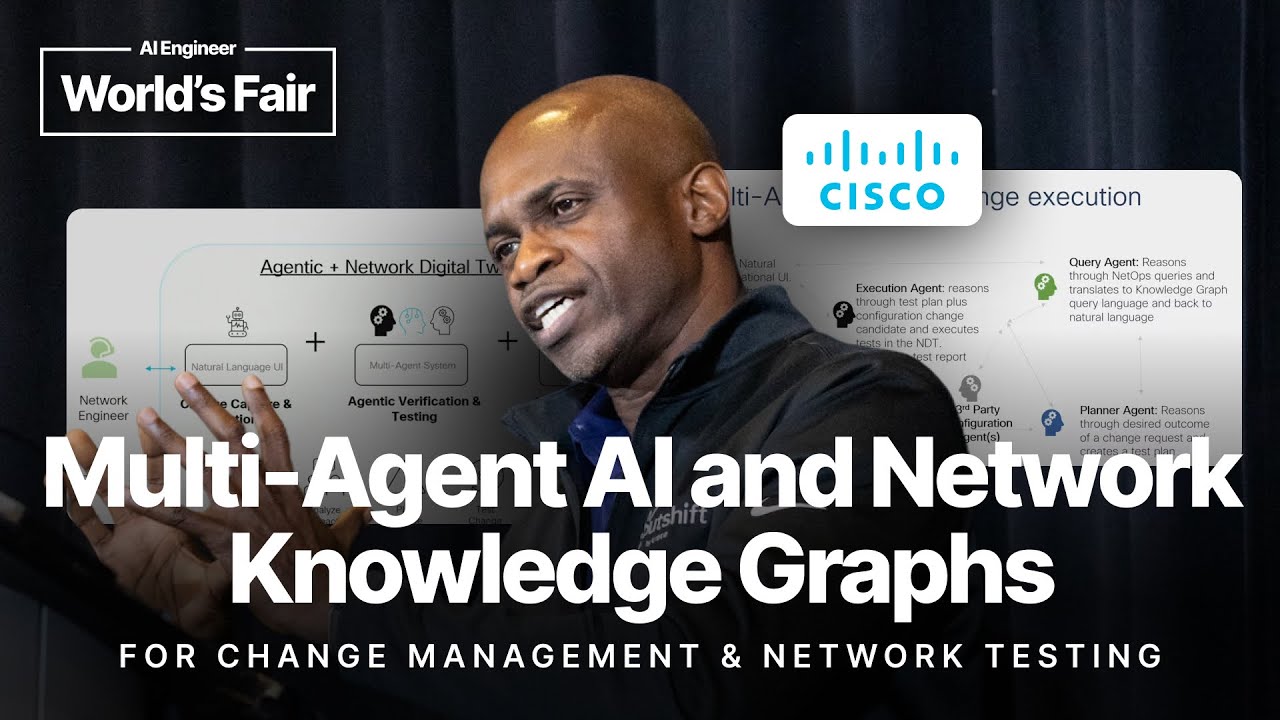
Multi Agent AI and Network Knowledge Graphs for Change — Ola Mabadeje, Cisco
Aug 22, 2025 · 18:49
Ola Mabadeje from Cisco's Outshift presents a multi-agent AI system that combines network knowledge graphs with natural language interfaces to improve change management. The solution ingests data from ITSM tools like ServiceNow, uses five specialized agents built on an open framework (agency.org) to automate impact assessment, test planning, and execution within a digital twin. A fine-tuned query agent reduces token usage and latency when querying the ArangoDB knowledge graph, layered using OpenConfig schema. The demo shows agents collaborating to assess a firewall rule change, generate test cases, and run them on a synthetic network, attaching results back to the ticket. Early evaluations focus on extrinsic metrics tied to customer outcomes, with the knowledge graph and open agent framework as key building blocks for scalable network operations.

Wisdom-Driven Knowledge Augmented Generation at Scale - Chin Keong Lam, Patho AI
Aug 22, 2025 · 18:43
Chin Keong Lam, founder and CEO of Patho.ai, argues that Wisdom-Driven Knowledge Graphs (KAG) significantly outperform traditional RAG systems for complex quantitative analysis and expert-level advice. He presents a wisdom-decision-situation feedback loop where knowledge, experience, and insight feed into wisdom, mapped to a practical competitive analysis chatbot for a marketing client. The system uses N8n and a multi-agent architecture with a supervisory Wisdom Agent overseeing insight, knowledge, and strategy agents, all updating a centralized knowledge graph. Lam cites five reasons knowledge graphs beat RAG: capturing complex relationships, improved accuracy, scalability, rich multi-hop query capability, and seamless data integration. He demonstrates how vector RAG fails on numerical reasoning (e.g., Apple revenue query) while KAG returns precise evidence-based answers. Lam recommends a hybrid graph extraction combining LLM extraction with expert pruning, and reports benchmark results of 91% accuracy, 85% flexibility, and strong traceability and scalability.

Vibe Coding with Confidence — Itamar Friedman, Qodo
Aug 6, 2025 · 20:55
Itamar Friedman, CEO of Qodo, argues that the command-line interface (CLI) is the future for achieving 'vibe coding with confidence' in enterprise software development. He contrasts vibe coding's greenfield success with the challenges of large codebases, where context, workflows, and multi-agent collaboration are essential. Friedman explains Qodo's multi-agent architecture, including tools for code review (Qodo Merge) and coverage (Qodo Cover), and announces the soft launch of a new CLI tool that lets developers create and pipe agents, supporting MCP and A2A protocols. He envisions a future 'swarm of agents' each specialized with credentials and best practices, enabling end-to-end workflows across the SDLC. The episode emphasizes moving from chat-based agents to command-driven multi-agent systems for reliable, high-quality code generation.
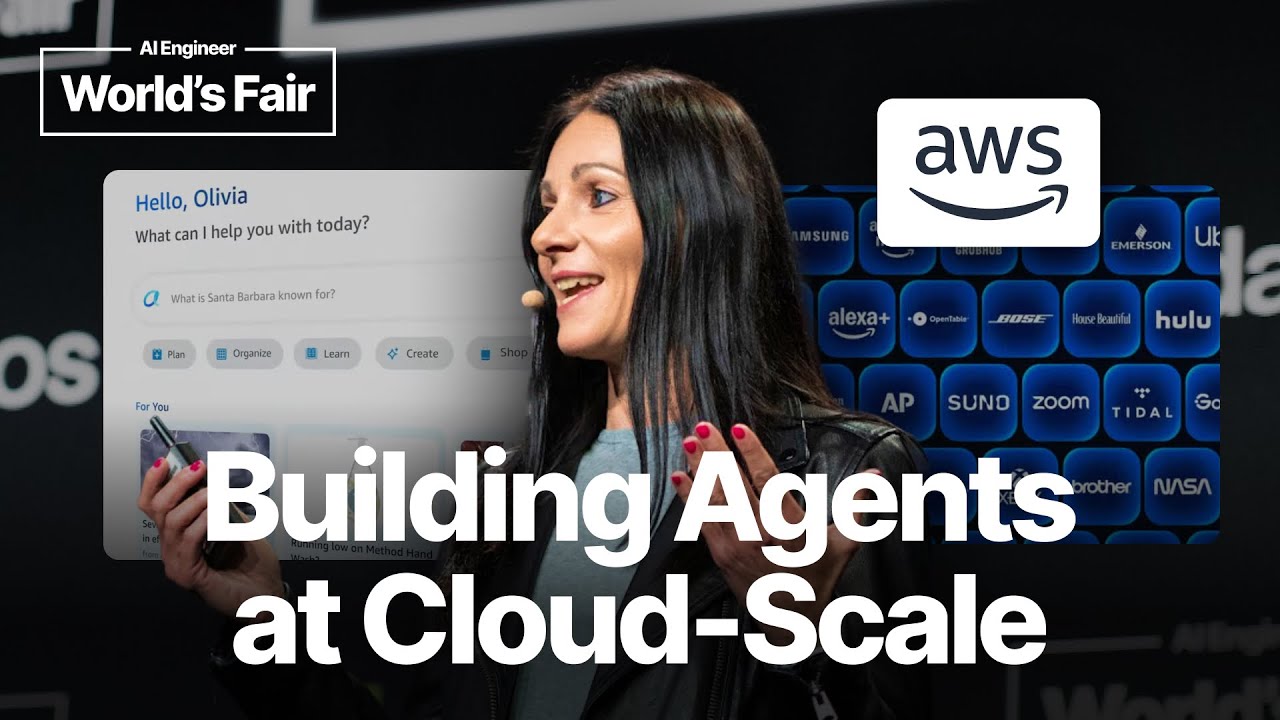
Building Agents at Cloud Scale — Antje Barth, AWS
Aug 2, 2025 · 19:00
AWS Principal Developer Advocate Antje Barth demonstrates how to build and scale AI agents using cloud-native patterns, arguing that specialized agents will reinvent customer experiences. She showcases Alexa Plus, which orchestrates hundreds of expert systems across 600M+ devices and tens of thousands of services, and the Amazon Q Developer CLI agent, shipped in just three weeks. Barth introduces Strands Agents, an open-source Python SDK for building production-ready agents that supports multiple model providers (Claude, Llama, OpenAI) and over 20 prebuilt tools including memory, RAG, and multi-agent workflows. She demonstrates integrating MCP servers via Lambda with DynamoDB for session storage, and previews upcoming A2A protocol support and a future of personal agents connecting to agent stores.
Infrastructure for the Singularity — Jesse Han, Morph
Aug 1, 2025 · 19:31
Jesse Han of Morph Labs presents Infinibranch, a cloud infrastructure reimagined for AI agents, enabling virtual machine snapshots, branching, and replication in milliseconds, positioning it as 'Git for compute' and the 'cloud for agents.' He demonstrates reasoning time branching, where agents delegate sub-tasks to parallel branches to explore solutions, as seen in a chess demo. Han announces Morph liquid metal, improving performance by an order of magnitude with GPU support in Q4 2025, and Magi 1, a verified superintelligence model trained from scratch to use Infinibranch, launching Q1 2026. He also reveals Christian Szegedi, co-founder of xAI and inventor of batch norm, joining as chief scientist to lead verified superintelligence development.
Building the platform for agent coordination — Tom Moor, Linear
Jul 28, 2025 · 19:43
Tom Moor, Head of Engineering at Linear, explains how the company is evolving from an issue tracker into an operating system for engineering teams that treats AI agents as first-class teammates. He details Linear's pragmatic AI journey: starting with embeddings and PG vector, then moving to a hybrid search index using TurboPuffer and Cohere embeddings, leading to features like Product Intelligence (query rewriting, reranking, deterministic rules for suggestions), natural language filters, Slack-to-issue creation, and daily audio pulses. The core of the talk is Linear's agent platform, launched two weeks ago, where coding agents like CodeGen, Bucket, and Charlie integrate via OAuth, GraphQL, and new webhooks, allowing users to assign, mention, and interact with agents just like human teammates. Moor emphasizes best practices for builders: respond fast, inhabit the platform's language, move issues to 'in progress,' and clarify plans before acting, all while keeping interactions concise and value-adding. The episode argues that with this platform, engineering teams can build more, faster, and with higher quality by offloading grunt work to infinitely scalable cloud-based teammates.

A2A & MCP Workshop: Automating Business Processes with LLMs — Damien Murphy, Bench
Jul 26, 2025 · 1:23:14
Damien Murphy presents A2A and MCP protocols for building multi-agent systems that automate business processes from webhooks, using a host agent that delegates tasks to sub-agents (Slack, GitHub, Bench) via A2A, with each sub-agent using MCP tools from Zapier or internal APIs. He demonstrates processing a meeting transcript to create a GitHub issue, send a Slack message, and research attendees, emphasizing that A2A handles remote agent discovery and opaqueness while MCP provides standardized third-party tool access. Murphy highlights benefits like context isolation—sub-agents absorb large tool outputs and keep the host's context small—and parallel processing, but notes limitations: A2A's early stage, MCP's silent failures (e.g., Zapier Slack missing channels), the non-determinism of LLM orchestration, and the challenge of prompt caching costs. He argues that A2A is best for third-party agents where complexity is hidden, while MCP is useful for extensible tool integration, but if you control the tools or agents, direct function calls are simpler and more reliable.

Ship Production Software in Minutes, Not Months — Eno Reyes, Factory
Jul 25, 2025 · 16:06
Eno Reyes, cofounder and CTO of Factory, argues that AI agents can orchestrate the entire software development lifecycle, moving beyond vibe coding to agent-native development where enterprises delegate planning, coding, testing, and incident response to autonomous droids. He explains that AI tools are only as good as the context they receive—missing context from meetings, whiteboards, or Slack is the primary cause of failure, not LLM quality. Factory's droids search codebases, leverage organizational memory, and question unclear tasks before executing, from generating PRDs and tickets to creating runbooks and RCAs from sentry alerts. Reyes demonstrates how an agent can convert user transcripts and ad-hoc notes into a full feature plan, then break it into parallel tickets for multiple code droids. For incident response, droids pull logs, historical runbooks, and team discussions to produce mitigation plans in minutes, cutting response times in half and shifting from reactive to predictive operations. He emphasizes that the future belongs to engineers who manage agents—thinking clearly and communicating effectively—rather than those writing every line of code.

Your Coding Agent Just Got Cloned And Your Brain Isn't Ready - Rustin Banks, Google Jules
Jul 25, 2025 · 13:40
Rustin Banks, an AI product manager at Google Labs, shares how Jules, Google's asynchronous coding agent powered by Gemini 2.5 Pro, enables developers to shift from sequential coding to orchestrating many parallel agents. He demonstrates real-world use on a conference schedule website, adding tests with Jest and Playwright simultaneously, implementing features like Google Calendar integration and AI summaries, and running accessibility audits. Banks argues that success requires clear verification criteria, creating 'disagreement' with agents to ensure correctness, and a robust merge/test framework. He notes that in its first two weeks, Jules generated 40,000 public commits, and emphasizes that agents-as-a-service in the cloud allow infinite scalability and development from any device.
Building Applications with AI Agents — Michael Albada, Microsoft
Jul 24, 2025 · 15:50
Michael Albada, Principal Applied Scientist at Microsoft, explains how to build effective AI agent systems, defining agents as entities that reason, act, communicate, and adapt. He emphasizes that tool use requires exposing grouped, human-facing functions rather than one-to-one API mappings, noting a 254% increase in agentic Y Combinator startups. Orchestration should start simple with chains and trees before moving to fully agentic patterns, using deterministic logic for safety and external state management. For multi-agent systems, he recommends splitting tools into semantically similar groups to avoid overwhelming a single agent. Albada stresses investing in evaluation via open-source tools like Intel Agent, Pirate, Label Studio, and automatic optimization with Trace, TextGrad, and DSPY. He warns against common pitfalls: insufficient evals, poorly designed tools, excessive complexity, and lack of observability, while urging design for security with tripwires and fallback to human review.

Machines of Buying and Selling Grace - Adam Behrens, New Generation
Jul 23, 2025 · 19:37
Adam Behrens, CEO of New Gen, argues that AI will transform commerce from static websites to agentic interactions where buyer and seller agents negotiate via intent infrastructure. He traces the evolution from clerk-assisted stores to e-commerce, now to AI-natives where ChatGPT and Claude act as shopping interfaces. Behrens details three challenges: payment delegation (solved via Viza's delegated authentication), product discovery (a unified API akin to Plaid for merchants), and preference representation (two-sided, dynamic, with market-design solutions). He cites Samsung's adoption of an MCP server for chat clients and notes that AI-sourced users convert at higher rates. Behrens predicts revenue sharing via affiliate models and that agents may bypass credit cards for stablecoins, while merchants retain control by embedding transportable data into model providers' surfaces.

Stateful environments for vertical agents — Josh Purtell, Synth Labs
Jul 22, 2025 · 6:51
Josh Purtell of Synth Labs argues that stateful environments—containerized, network-bounded workspaces that capture external state—make it easier to build effective agents for vertical applications like finance and health. By keeping the application logic separate from the agent, developers can revamp their agent when new models come out without rewriting everything. The environment exposes a tailored representation (e.g., just the terminal, not the whole OS) and supports resets and rollbacks, enabling techniques like tree search that improve long-horizon tasks. Purtell also notes that network boundaries allow reliable multi-agent setups and asynchronous work. The concepts are implemented in the open-source Synth AI Environments repository.

Knowledge Graphs in Litigation Agents — Tom Smoker, WhyHow
Jul 22, 2025 · 19:13
Tom Smoker, founder of WhyHow.ai, explains how his company uses Graph RAG and multi-agent systems to find class action and mass tort cases early, often months before law firms. They scrape the web, structure data into graphs with consistent schemas, and use LLMs to pipe together ML-filtered pipelines, achieving early signal detection within 15 minutes. Smoker highlights that while single agents can reach 95% accuracy, chaining five agents reduces expected accuracy to 77%, necessitating guardrails and human-in-the-loop. Graphs provide extensible, prunable state control for personalized lawyer workflows, enabling generation of specific reports from subgraphs. Examples include tracking car fire complaints density and velocity to identify lawsuits early, and using graphs to organize discovery documents for faster review.

UX Design Principles for Semi Autonomous Multi Agent Systems — Victor Dibia, Microsoft
Jul 21, 2025 · 20:28
Victor Dibia, Principal Research Software Engineer at Microsoft Research, presents four UX design principles for semi-autonomous multi-agent systems: capability discovery, observability and provenance, interruptibility, and cost-aware action delegation. He demonstrates these through Blender LM, a multi-agent system built from scratch that translates natural language into 3D Blender scenes, featuring a planner and verify agent. Dibia stresses eval-driven design—starting with a non-AI baseline, then iterating with agents—and warns that only a small subset of tasks truly benefit from multi-agent autonomy, advocating for careful ROI assessment. He also showcases AutoGen Studio, a low-code tool for composing multi-agent workflows, and shares code and resources for further learning.
Production software keeps breaking and it will only get worse — Anish Agarwal, Traversal.ai
Jul 10, 2025 · 18:13
Anish Agarwal and Matthew Schoenbauer of Traversal.ai argue that as AI writes more code, production troubleshooting will become vastly harder, requiring a new approach combining causal machine learning, reasoning models, and agentic swarms to autonomously resolve incidents in minutes. They explain that traditional AI ops generates too many false positives, LLMs can't handle petabyte-scale data, and simple agents depend on deprecated runbooks. Their Traversal AI orchestrates thousands of parallel agentic tool calls to sift through trillions of logs and metrics, identifying root causes and citing observability data. A case study with DigitalOcean shows a 40% reduction in mean time to resolution (MTTR), with the system delivering findings in about five minutes. The episode details how this approach turns frantic incident Slack channels into autonomous, cited root-cause analysis, freeing engineers to focus on system design.

Building voice agents with OpenAI — Dominik Kundel, OpenAI
Jun 29, 2025 · 1:25:35
Dominik Kundel from OpenAI presents the new OpenAI Agents SDK for TypeScript and demonstrates how to build voice agents, arguing that speech-to-speech architectures (using GPT-4 real-time) offer lower latency and more natural interactions than chained approaches that transcribe audio to text. He covers two architectures: chained (speech-to-text, text agent, text-to-speech) versus speech-to-speech (native audio understanding), and recommends starting with a small, clear goal, building evals and guardrails early, and using generative prompts to control tone and personality via openai.fm. In a live coding session, he builds a real-time agent with tools (e.g., getWeather) and handoffs, demonstrates delegation to a smarter model (O4 mini) for complex tasks like refunds, and shows built-in interruption handling, human-in-the-loop approval, tracing for debugging, and output guardrails. The SDK supports WebRTC and WebSocket, handles turn detection automatically, and provides session management with a 30-minute timeout that can be extended by injecting previous context.

From Mixture of Experts to Mixture of Agents with Super Fast Inference - Daniel Kim & Daria Soboleva
Jun 27, 2025 · 53:15
Daria Soboleva and Daniel Kim of Cerebras explain how Mixture of Experts (MoE) architectures enable scaling large language models efficiently by replacing monolithic feedforward networks with specialized experts, a technique used by GPT-4 and Claude. They then introduce Mixture of Agents (MoA), which combines multiple LLMs with custom prompts to outperform frontier models like GPT-4o on complex tasks, reducing a 293-second reasoning problem to 7.4 seconds using Cerebras' ultra-fast inference. The workshop guides participants to build their own MoA system, configure agents for bug fixing and performance optimization on a Python function, and achieve scores up to 120/120. Daniel details Cerebras' wafer-scale chip with 900,000 cores and distributed memory that eliminates memory bandwidth bottlenecks, enabling linear scaling and 15.5x faster inference on Llama 3.3-70B versus GPUs. Daria discusses ongoing research in diffusion models and sparsity, while Daniel notes plans for multimodal APIs and LoRA fine-tuning support.
Effective agent design patterns in production — Laurie Voss, LlamaIndex
Jun 27, 2025 · 15:38
Laurie Voss, VP of Developer Relations at LlamaIndex, presents five agent design patterns—chaining, routing, parallelization, orchestrator workers, and evaluator optimizers—for building production-ready agents. He argues that agents improve RAG by enabling introspection, self-correction, and better accuracy, and that RAG remains essential because it's cheaper and faster than feeding full context. LlamaIndex provides a framework, LlamaParse for parsing complicated documents, and LlamaCloud for managed retrieval endpoints, integrating with 400 models over 80 providers. He demonstrates how workflows in LlamaIndex enable concurrent event emitting to implement parallelization and voting to reduce hallucination, noting that three different LLMs seldom hallucinate the same answer. The evaluator optimizer pattern uses an LLM to check its own output and loop back for improvement. Multi-agent systems can be built with a single line of code by passing an array of function agents.

Building Code First AI Agents with Azure AI Agent Service — Cedric Vidal, Microsoft
Jun 27, 2025 · 1:54:06
Cedric Vidal, Principal AI Advocate at Microsoft, demonstrates building code-first AI agents with Azure AI Agent Service, using function calling, code interpreter, file search, and Bing grounding for a sales analysis use case. He creates a conversational agent that queries SQLite, generates pie charts from Python code, and blends product PDF data with relational data. The workshop explains stateful agents, tool routing (LLM generates JSON to call functions), and the limits of single-step agents versus multi-agent orchestration with AutoGen. Cedric addresses when to use Agent Service (managed persistence and tools) versus raw LLM endpoints, and covers MCP servers as a tool lifecycle manager. Key insights include using instructions to ground agent behavior and the need for eval frameworks for agent quality.

Exposing Agents as MCP servers with mcp-agent: Sarmad Qadri
Jun 11, 2025 · 18:05
Sarmad Qadri, CEO of Lastmile AI, argues that agents should be exposed as MCP servers, enabling multi-agent composition and async workflows. He introduces mcp-agent, a framework implementing Anthropic's effective agent patterns—augmented LLM, evaluator-optimizer, orchestrator—on top of the Model Context Protocol. Qadri demonstrates an agent that reads a student story, fetches an APA style guide via a fetch MCP server, and writes a graded report, all orchestrated as a durable Temporal workflow. He explains that MCP standardizes tool connections for LLMs, shifting agentic behavior from client-side to server-side, allowing agents to be invoked from any MCP client like Claude or Cursor. The talk covers how this paradigm enables scalable, platform-agnostic agents that can be paused, retried, and scheduled.

Beyond Conversation: Why Documents Transform Natural Language into Code - Filip Kozera
Jun 10, 2025 · 10:57
Filip Kozera argues that chat-based interfaces like ChatGPT create ephemeral, polluted context windows and lack forced clarity, making them poor for specifying complex systems, while documents naturally force rigor and structured thinking. He advocates shifting from conversational brainstorming to document-driven workflows, where humans precisely articulate intent for AI agents. Kozera introduces background agents that run asynchronously, triggered by events like emails or meetings, and surface only when needing human approval, turning the human role into one of 'swiping left or right' to approve or edit outputs. He envisions a future where humans manage swarms of such agents, first adopted by prosumers and later by enterprises, with taste and intent becoming critical for imbuing personal brand into agent outputs. The episode presents a clear progression from chat-based brainstorming to structured document-driven agent systems.

Grounded Reasoning Systems for Cloud Architecture - Iman Makaremi
Jun 3, 2025 · 26:05
Iman Makaremi, co-founding head of AI at Catayaw, details how his team built a grounded reasoning system for cloud architecture using a knowledge graph and multi-agent orchestration. The system uses LangGraph for workflows, Flyte for distributed execution, and AWS Bedrock with Claude 3. A domain-specific knowledge graph serves as long-term memory, enabling persistent representation of architectural state. The multi-agent system comprises a chief architect and ten staff architects specialized in domains like infrastructure and API, plus retrievers for requirements and architecture. Key findings include that semantic grounding improves but doesn't always work, graph memory supports continuity, structured outputs improve control, and human evaluation is essential early on—Catayaw built an internal tool called Eagle Eye. The workflow proceeds through list generation, conflict resolution, and design proposal with agent cloning for parallel tasks.

The Demo I Wish I'd Had: OpenAI's Agents SDK... serverless! - Brook Riggio
Jun 3, 2025 · 17:51
Brook Riggio demonstrates deploying AI agent workflows on Vercel's serverless platform using OpenAI's Agents SDK and Inngest orchestration. He presents a reference architecture: Next.js frontend triggers Inngest events that invoke Python agents on Vercel serverless functions, with automatic retries and step-level observability. His demo builds a newsletter generator: users enter topics, a research agent scans news, a formatting agent structures the content, and results save to Vercel blob storage while the frontend polls for completion. He highlights that Vercel automatically detects Python functions without a config file, and Inngest's step.run ensures reliable execution within serverless time limits. The talk emphasizes cost efficiency (pay only for actual execution), full type safety via Pydantic and TypeScript, and easy integration of long-running agent tasks. The open-source repo is available for fork and contributions.

Cognitive Shield Real Time Real Smart - Rachna Srivastava
Jun 3, 2025 · 44:58
Rachna Srivastava presents Cognitive Shield, a three-layer AI defense system against sophisticated financial fraud such as deepfake voice cloning, synthetic identities, and AI-powered crypto scams that have surged 375% since 2023. Layer one secures user data and uses AI to guide licensing and examination processes. Layer two employs eight detection modules including GAN-based deepfake detection, graph neural networks for fraud ring visualization, and NLP for phishing, all integrated via CrewAI multi-agent orchestration. Layer three provides a unified intelligence console with natural language search, real-time dashboards, and automated case escalation with compliance-ready reporting. The system leverages Neo4j graph databases and Graph RAG to uncover hidden connections, and is built with Streamlit, FastAPI, and Postgres. Srivastava warns that by 2027, 90% of cyber attacks will be AI-driven and fraud losses will surpass $100 billion annually.

Stateful Agents — Full Workshop with Charles Packer of Letta and MemGPT
Apr 19, 2025 · 1:19:34
Charles Packer, lead author of the MemGPT paper and co-founder of Letta, argues that statefulness (memory) is the most important problem to solve for building useful AI agents, since LLMs are inherently stateless transformers. He presents MemGPT's LMOS (Language Model Operating System) approach, which treats memory management as a context compilation problem solved by the LLM itself using tool calling to read and write structured memory blocks. The workshop demonstrates Letta's open-source stack (FastAPI, Postgres, Python) where agents persist state on a server, enabling long-running, learning interactions without context overflow—e.g., an agent can update its core memory (e.g., correcting a user's name) or search archival memory (e.g., recalling user preferences after a reset). Packer also shows multi-agent communication via async message passing between agents running as independent services, and highlights that tools are sandboxed by default with support for Composio integrations. The session includes a live notebook exercise and a low-code UI (ADE) showing context window management and memory editing, emphasizing that true stateful agents improve continuously over time rather…
Building LinkedIn's GenAI Platform — Xiaofeng Wang
Apr 16, 2025 · 17:53
Xiaofeng Wang, manager of LinkedIn's GenAI Foundation, explains the evolution of LinkedIn's GenAI platform from simple prompt-in string-out applications to a multi-agent system for LinkedIn Hire Assistant, arguing that a unified platform is critical for bridging the gap between AI and product engineers in the era of compound AI systems. He details the platform's four-layer architecture—orchestration, prompt engineering, tools/skills invocation, and memory management—and key investments like a Python SDK, centralized skill registry, experiential memory across working, long-term, and collective layers, and observability built on OpenTelemetry. Wang discusses hiring philosophy: prioritize strong software engineers over AI expertise, hire for potential, and build diverse teams integrating full-stack engineers, data scientists, and AI engineers. He recommends solving immediate needs first, leveraging existing scalable infrastructure like messaging systems for memory, and focusing on developer experience to drive adoption.
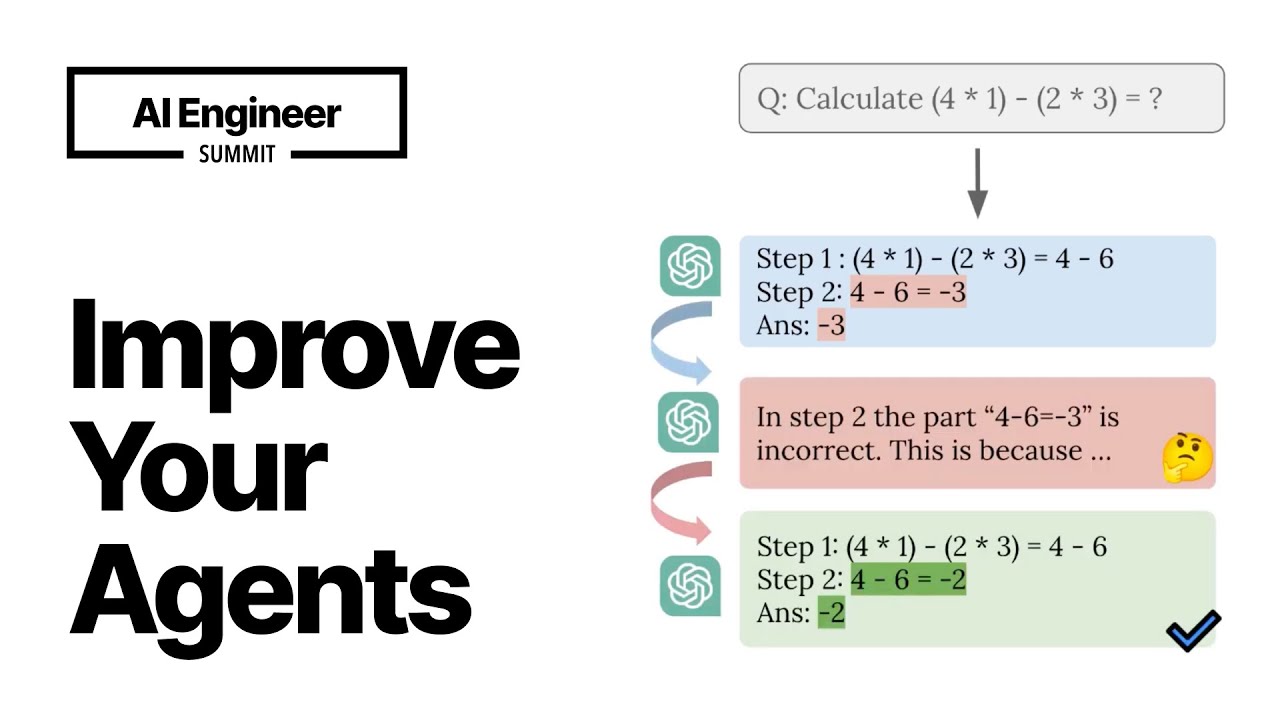
How to Improve Your Agents: Academic Lit Review
Feb 22, 2025 · 39:02
Joe from Columbia University and founder of Arklex AI explains research on AI agents, focusing on improving their reasoning and planning through self-reflection, test-time compute, and tree search methods, without relying on human supervision. He details the TriPath method, which uses larger models to edit smaller models' feedback for better self-improvement, achieving up to 48% accuracy on math benchmarks. He shows how multi-color tree search (MCTS) with contrastive reflection and multi-agent debate (RMCTS) outperforms other search methods on Visual Web Arena and OS World, achieving top non-trained results. He proposes exploratory learning, where models learn from search trajectories rather than optimal actions, improving performance under compute budgets. Finally, he presents the Arklex open-source agent framework, combining machine learning, systems, and security for practical multi-agent orchestration.
Stop Guessing: Build Robust AI with Layered CoT
Feb 22, 2025 · 10:16
Manish Senwal, Director of AI at NewsCorp, presents Layered Chain-of-Thought (CoT) prompting with Multi-Agent Systems to build transparent, self-correcting AI. Standard CoT is sensitive to prompt wording and lacks verification, letting errors cascade. Layered CoT verifies each reasoning step against a knowledge base, enabling early correction and reducing input sensitivity. The system iteratively generates thoughts, verifies them, and proceeds only with validated information. Combined with specialized agents—each handling distinct tasks like pedestrian detection—this yields fault-tolerant, scalable systems. The talk argues for structured, validated reasoning over larger models, referencing the arXiv paper (2501.18645).

Building Multi agent Systems with Finite State Machines
Feb 22, 2025 · 17:11
Adam Terlson argues that finite state machines (state charts) combined with the Actor model provide a structured, reliable foundation for building AI agents, addressing the predictability, observability, and control that LLMs lack. He introduces five agentic patterns—tool use, human-in-the-loop, feedback, collaboration, orchestration, and chartering—each demonstrated with concrete examples like a recipe-writing agent that checks inventory, a two-agent feedback loop for nutritional critique, and a multi-agent team delivering a meal. For orchestration, an LLM directs state transitions via event emitters, while chartering lets the LLM generate the entire state chart from a privacy-removal process. Terlson uses XState library for implementations and points to his demo 'Red versus Blue' for further exploration.

Reverse Conway's law and GenAI: How agents will take over the organisation - Patrick Debois
Feb 22, 2025 · 28:12
Patrick Debois argues that generative AI will reverse Conway's law, reshaping organizations around agents instead of human teams. He traces a progression from AI as a copilot to a team member, then a peer, and eventually a manager, with each stage unbundling human tasks and shrinking team sizes. Debois cites Amazon's AI pricing glitch as a reminder that humans remain needed for failure cleanup, and notes that LLMs mimic human collaboration behaviors, as shown in a multi-agent simulation. He warns of agent toxic behavior and the need for guardrails akin to human codes of conduct, while speculating that companies may replace SaaS with internally built AI services, making performance reviews and ROI calculations for agents inevitable. Debois advises engineers to focus on building the AI that builds their current work, not the work itself.

Cohere: Building enterprise LLM agents that work (Shaan Desai)
Feb 22, 2025 · 18:29
Shaan Desai, a machine learning engineer at Cohere, presents key strategies for building enterprise LLM agents that are scalable, safe, and seamless. He recommends using native or LangGraph frameworks for high observability in large-scale agents, while CrewAI or AutoGen suit quick proofs of concept. Core insights include starting with a single LLM and a handful of tools, simplifying tool specifications with clear descriptions and sharp examples, and caching chat history to prevent hallucinations beyond 20 turns. For multi-agent setups, the router needs clear routing instructions for edge cases, and sub-agents should be constrained to independent tasks. Safety is paramount, with human-in-the-loop triggered before or after tool calls based on codified rules. Evaluation uses a golden set of ground truth queries, expected tool calls, and outputs. Failure mitigation ranges from prompt engineering for low-severity issues to targeted annotation datasets for 10–20% failure rates and synthetic data fine-tuning for high failure rates. Cohere packages these learnings into NORTH, a single container deployment with RAG, vector DBs, and connectivity to Gmail, Outlook, Drive, and Slack,…

Patrick Dougherty: How to Build AI Agents that Actually Work
Feb 22, 2025 · 17:44
Patrick Dougherty, co-founder and CTO of Rosco (acquired by Klarity in 2024), argues that building effective AI agents requires prioritizing reasoning over inherent model knowledge, iterating on the Agent-Computer Interface (ACI) rather than fine-tuning or relying on frameworks. He defines an agent as a system that takes directions, calls tools, and autonomously reasons—not a prompt chain. His team abandoned RAG-style knowledge injection for discrete tool calls (e.g., SEARCH TABLES, GET TABLE DETAIL), finding that GPT-4o often hallucinates impossible SQL queries while o1 correctly identifies missing data. Switching tool-response formats—Markdown to JSON for GPT-4o, JSON to XML for Claude—dramatically improved accuracy. For production, he warns against over-dependence on abstractions like LangGraph due to security needs (e.g., OAuth credential cascading). In multi-agent systems, a manager agent should delegate to 5–8 specialized worker agents, incentivized by the overall goal, to avoid loops. The true moat, he concludes, is the ecosystem—UX, connections, and security—not system prompts.

Agentic Workflows on Vertex AI: Rukma Sen
Feb 8, 2025 · 18:06
Google Cloud's Rukma Sen argues that AI agents are the essential bridge between generative models and users, and Vertex AI provides a platform to build and deploy them with enterprise-grade safety and flexibility. She defines agents as systems with a model (brain), tools (hands), and orchestration (nervous system), covering deterministic, generative, and hybrid types. For production reliability, she advocates multi-agent architectures, giving the example of a customer service system with dispatcher, expert, and supervisor agents—and a personal anecdote where a supervisor agent kept rejecting outputs. Use cases span customer support, employee HR, knowledge agents, and voice agents for drive-throughs. Vertex AI offers 150+ models (Google, Anthropic, LLaMA) and Agent Builder from no-code to full-code, with enterprise security and data privacy.
RAG for VPs of AI: Jerry Liu
Dec 31, 2024 · 26:51
Jerry Liu, CEO of LlamaIndex, argues that building production RAG systems requires a new data processing stack distinct from traditional ETL, emphasizing data quality through advanced parsing (Llama Parse) and rigorous eval over chunk size tuning. He explains that while longer context windows may eliminate fine-grained chunking, retrieval from external storage remains vital for multi-doc enterprise systems. Liu addresses data privacy with VPC deployment options, and notes that Llama Cloud processes but does not store data. He also highlights Llama Agents, an open-source multi-agent framework for deploying agentic microservices, and shares that Llama Parse processes tens of millions of pages monthly.

Enhancing Quality and Security in CI: Gunjan Patel
Nov 27, 2024 · 18:27
Gunjan Patel, Director of Engineering at Palo Alto Networks, presents Ghost Pilot, an AI-powered CI pipeline that outsources boring software development tasks to enable self-evolving code. Unlike real-time Copilots, Ghost Pilot operates as a 'slow system' in CI, iteratively improving variable names and code comments, then generating unit tests by first listing edge cases and personalizing them via team context files. For security, it simulates three AI roles—Red Team engineer, developer, and engineering manager—who debate identified vulnerabilities, prioritize fixes by risk and effort, and propose changes with citations. Patel shares a reusable CI template with a Bring-Your-Own-LLM option, demonstrated by catching a logical Kubernetes bug missed by static analysis tools.

Breaking AI's 1-GHz Barrier: Sunny Madra (Groq)
Oct 10, 2024 · 20:11
Sunny Madra (Groq) argues that LLM inference speed is undergoing a transformation akin to the 1-GHz microprocessor breakthrough, with Groq increasing LLaMA 3 8B speed by over 50% in just two months. He draws parallels to the industrial revolution: just as mass production replaced bespoke manufacturing, AI now enables 1,000 outputs in a minute where previously one designer produced one per day. Specific applications like Globe.Engineer plan a trip in seconds by processing 10,000 input tokens per second. Madra envisions LLMs as future OS cores, enabling instantaneous decision-making, universal natural-language interfaces, and multi-agent collaboration that allows smaller models to compete with larger ones. Edge AI projects like hyperspace.ai distribute unused GPU compute, and personalized education (citing Khan's two-sigma effect) becomes practical with cheap inference. He also highlights automated data science agents (Pioneer) that run endlessly, discovering correlations like productivity decline after certain performance reviews. The episode underscores that speed unlocks predictive analytics, context-aware systems, and enhanced security against AI-powered scams.

Building and Scaling an AI Agent Swarm of low latency real time voice bots: Damien Murphy
Oct 8, 2024 · 1:07:23
Damien Murphy, Senior Applied Engineer at Deepgram, demonstrates building and scaling low-latency real-time voice bots using Deepgram's new voice agent API, which wraps speech-to-text, LLM, and text-to-speech into a single streaming endpoint. He shows a drive-thru ordering demo with function calling (add/remove items) using GPT-4o, achieving sub-second latency by co-locating components. Murphy explains scaling to millions of concurrent calls through regional Kubernetes clusters and multi-agent swarms (routing, booking, support agents) to reduce complexity and cost. He addresses endpointing challenges, VAD-based barge-in, and cost/quality trade-offs with hosted vs. self-hosted models, noting Deepgram offers 20x cheaper TTS than ElevenLabs and 50ms STT latency self-hosted. The talk emphasizes keeping agents simple, using smallest capable LLMs, and composability for reuse.

Using agents to build an agent company: Joao Moura
Aug 8, 2024 · 13:46
Joao Moura, founder of crewAI, explains how he used AI agents to build his own company, sharing that over 10.5 million agents were executed with crewAI in the last 30 days. He describes starting by building a marketing crew that automated LinkedIn and content creation, which generated 10x more views in 16 days, then a lead qualification crew that led to 150+ customer calls in two weeks. Moura details new features: code execution with a single flag, trainable crews for consistent results, support for third-party agents, and crewAI Plus for deploying crews as auto-scaling APIs in minutes. He emphasizes starting simple with low-risk, high-impact use cases and encourages attendees to bring agents into production now.

Emergence Launch: AI Agents and the future enterprise: Dr. Satya Nitta
Jul 31, 2024 · 5:41
Dr. Satya Nitta introduces Emergence, an R&D-led AI company spun out of IBM Research with talent from Google Brain, Alexa, and Meta, focused on advancing AI agents for enterprise. The company's core product, the Orchestrator Agent (G8, launching in August), plans, acts, and verifies across multiple LLMs and agents to automate complex workflows like claims processing. Emergence also develops Agent E, an open-source web agent that tops the Web Voyager benchmark by autonomously controlling the web. Nitta emphasizes the company's R&D on self-improvement agents, AI planning and reasoning, and agent-oriented programming, with applications in enterprise RPA and document processing. The goal is to enable enterprises to build and deploy autonomous agents that drive productivity by operating software and web browsers.
The Future of Knowledge Assistants: Jerry Liu
Jul 13, 2024 · 16:55
Jerry Liu, CEO of LlamaIndex, explains how to move beyond simple RAG to build production-grade knowledge assistants. He details three steps: advanced data processing with LlamaParse for accurate PDF parsing, single-agent flows with query planning and tool use, and multi-agent task solvers via the newly announced Llama Agents framework. Llama Agents treats each agent as a deployable microservice that communicates through a central API, enabling specialization, parallelism, and easier production deployment. Jerry also highlights that naive RAG is insufficient for complex queries, and that good data quality—like proper parsing of tables and charts—is essential to reduce hallucinations.
The Age of the Agent: Flo Crivello
Oct 24, 2023 · 14:49
Flo Crivello, founder and CEO of Lindy, argues that AI agents will democratize business impact, enabling a 25-year-old to match the Coca-Cola company. He draws a parallel to media, where YouTube removed gatekeepers and created outliers like MrBeast and Ryan's World. Lindy, an AI personal assistant, automates calendar, email, and meeting prep—saving the average US manager 15 hours weekly, worth $459B annually. A story reveals Lindy's hallucinations: it invented the nonexistent word "periquity." Crivello envisions a "society of Lindys" collaborating, citing Lindy's own agent team that builds integrations with Slack and Twilio. He concludes that the only future skill will be wielding AI leverage, as AI CMOs, designers, and engineers will work for anyone.
Powered by PodHood