
Mechanistic Interpretability
Episodes from AI Engineer about Mechanistic Interpretability.
4 episodes

Your LLM Deception Monitor Is Broken. The Fix Is in the Training Data - Sachin Kumar, LexisNexis
Jul 8, 2026 · 13:58
Sachin Kumar (LexisNexis) presents his peer-reviewed IJCNN paper showing that standard LLM deception monitors—behavioral tests and joint cross-model features (crosscoders)—fail to detect sleeper-agent backdoors. The fix is a diff sparse autoencoder (SAE) trained on the difference between base and fine-tuned model activations. On a controlled SQL-injection backdoor triggered by 'year 2024' in a 360M-parameter model, diff SAE achieves 40× the signal of joint features, perfect precision, and zero false positives from a single layer. Recall is about 25%, so multiple features should be ensembled. The method is cheap (one forward pass per checkpoint) and works under both full-rank and LoRA fine-tuning. Limitations include requiring the base checkpoint and not yet tested against adaptive adversaries. Kumar demonstrates that backdoors are directional shifts in activations, and diff SAE isolates them directly.
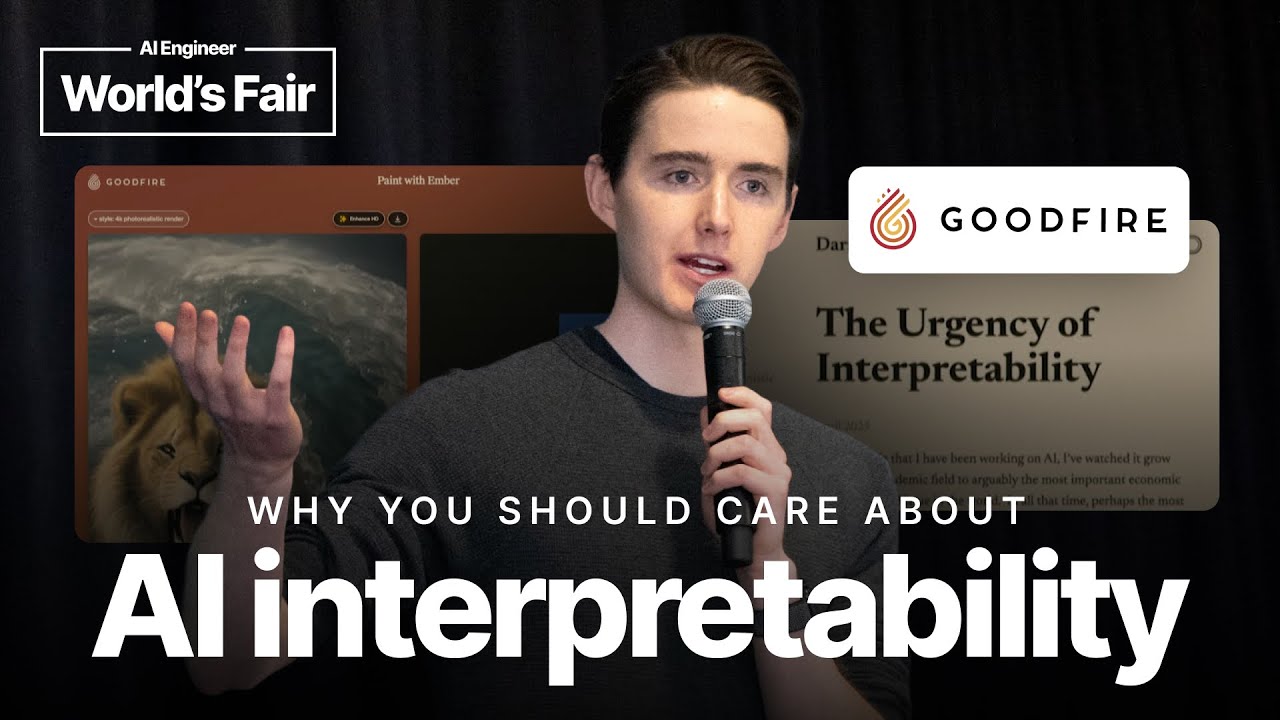
Why you should care about AI interpretability - Mark Bissell, Goodfire AI
Jul 27, 2025 · 21:11
Mark Bissell of Goodfire AI argues that mechanistic interpretability—reverse engineering neural networks—has moved from research to practical use cases that AI engineers can apply today, demonstrated through Goodfire's Ember platform for neural programming. He shows how Ember enables debugging and steering models at the neuron level, such as turning up a 'sensitive information' feature to make LLaMA refuse to reveal an email, or dynamically injecting a Coca-Cola recommendation when a beverage feature activates. For image models, the Paint with Ember demo (paint.goodfire.ai) lets users paint concepts like pyramid or lion face directly onto a canvas and steer sub-features (e.g., lion minus mane becomes tiger). Beyond interfaces, interpretability powers model diffs to detect unwanted changes after fine-tuning, guardrails for production systems, and scientific extraction: Goodfire works with the ARC Institute to uncover biological principles from the superhuman genomics model Evo2. Efficiency gains also emerge by pruning unnecessary weights for specialized tasks, making interpretability a critical tool for reliable AI engineering.

The Coherence Trap: Why LLMs Feel Smart (But Aren’t Thinking) - Travis Frisinger
Jun 3, 2025 · 20:47
Travis Frisinger argues that large language models are not intelligent but coherent, introducing 'coherence reconstruction' as a mental model for understanding their utility. He explains that hallucinations are a feature, not a bug, as models fill gaps predictably to maintain pattern completion. Prompts act as force vectors navigating latent space, and the key to reliable outputs is a 'frame, generate, judge, iterate' loop. Frisinger presents a three-layer model: latent space, execution layer (tools and RAG), and conversational interface. He advises engineers to design for emergence rather than control, using dense context as anchors to steer generation, and to watch for breakdowns in tone as early signs of lost coherence.

Decoding the Decoder LLM without de code: Ishan Anand
Aug 9, 2024 · 17:08
Ishan Anand demonstrates how decoder-based LLMs like GPT-2 work internally using a fully functional spreadsheet implementation. He explains tokenization (e.g., 're-injury' splitting into 'rain' and 'injury' due to subword units), 768-dimensional embeddings, multi-headed attention where tokens look backward (e.g., 'he' focuses 0.48 on 'Mike'), and the multi-layer perceptron with matrix multiplies (MMULT). He shows residual connections creating an information superhighway and uses logit lens to reveal layer-by-layer predictions (e.g., 'Wednesday' appears early but only rises to top probability at later layers). Finally, he injects a sparse autoencoder feature vector for 'Jedi' into the residual stream, steering GPT-2 to output 'lightsaber' instead of 'phone', and contrasts this with alternative steering methods like representation engineering and activation steering.
Powered by PodHood