
LLM-as-Judge
Episodes from AI Engineer about LLM-as-Judge.
19 episodes

Build Evals That Actually Matter - Nick Ung, Lyft
Jul 19, 2026 · 37:45
Nick Ung and Akshay from Lyft explain how to build evals that actually matter for customer-support AI agents, sharing their end-to-end pipeline. They argue offline evals must use a fine-tuned user simulator trained on real rider and driver transcripts to produce messy, frustrated behavior—not an off-the-shelf LLM that sounds too nice. Their LLM judge is treated as a binary classifier, calibrated against human labels using precision and recall, with metrics tied to actionable business outcomes like escalation decisions. They detail a continuous error-analysis loop that feeds production failures back into the offline test set and closes the loop through context, harness, or model learning. The talk also previews their config-driven eval harness with YAML primitives for tasks, datasets, and personas, enabling repeatable runs across development stages.

Don't Ship Skills Without Evals — Philipp Schmid, Google DeepMind
Jul 14, 2026 · 21:46
Philipp Schmid, Staff Engineer at Google DeepMind, argues that shipping agent skills without evals is like merging code without tests, leading to unreliable performance. He explains that most of the 50,000+ skills on Skill Bench lack evals and are often AI-generated, which can negatively impact performance. The talk distinguishes between capability skills (teaching models new tasks) and preference skills (encoding team-specific workflows), with evals enabling retirement of skills as models improve. Schmid shares practical advice: keep skill descriptions concise (under 500 lines), include negative tests, and write directives over passive information. He details a case study creating 117 test cases for the Gemini interactions API, achieving 90% valid code generation using regex-based asserts and LLM-as-judge. The key takeaway: always run ablation tests with and without skills to measure their true impact, and start small with as few as 10-20 eval samples.
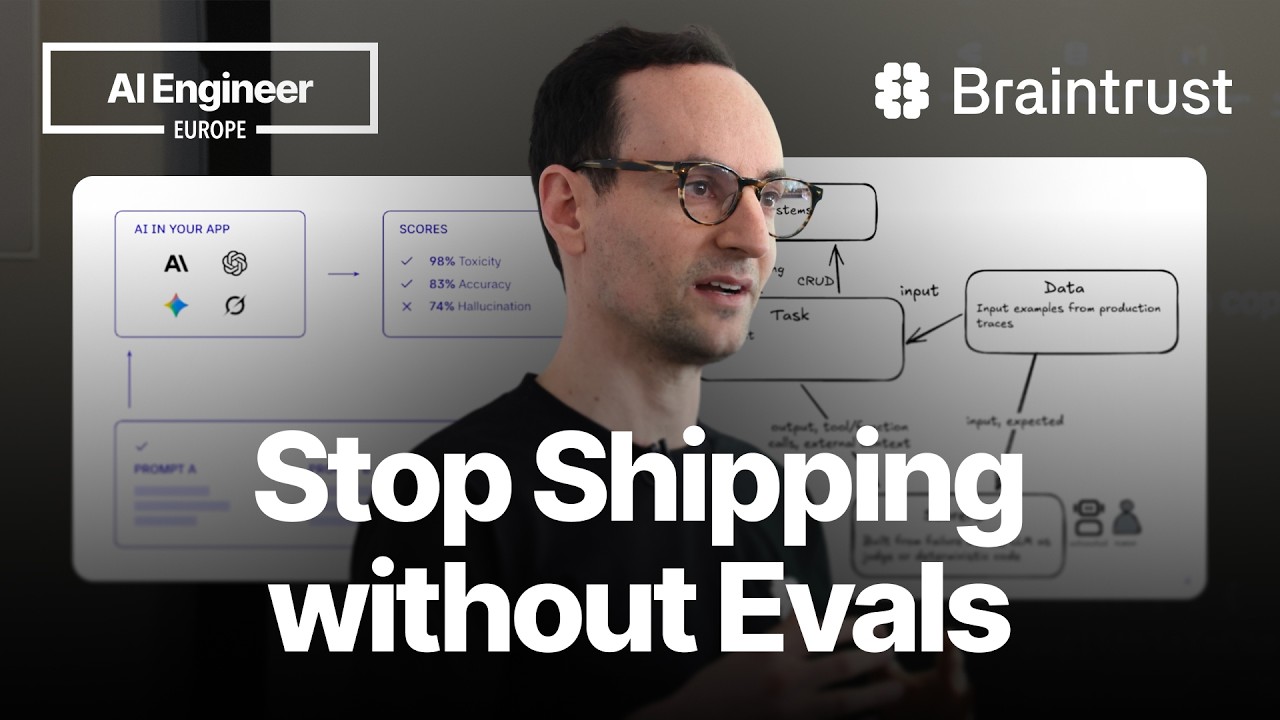
The maturity phases of running evals — Phil Hetzel, Braintrust
May 27, 2026 · 18:34
Phil Hetzel from Braintrust argues that evaluating AI agents should not mimic exhaustive unit tests but instead focus on known failure modes, using a flywheel of production traces to guide improvements. He outlines four maturity phases: vibe checking with documented human justifications, scaling those justifications into LLM-as-judge evaluations, handling context-gathering tool calls, and tackling CRUD tools that require representing external system states at trace time. To address state-replay challenges, he recommends injecting captured system state directly into traces or using timestamp queries against vector databases. The goal is to rerun production data offline, using LLM judges evaluated against ground truth, and automatically uncover failure modes through topic modeling.
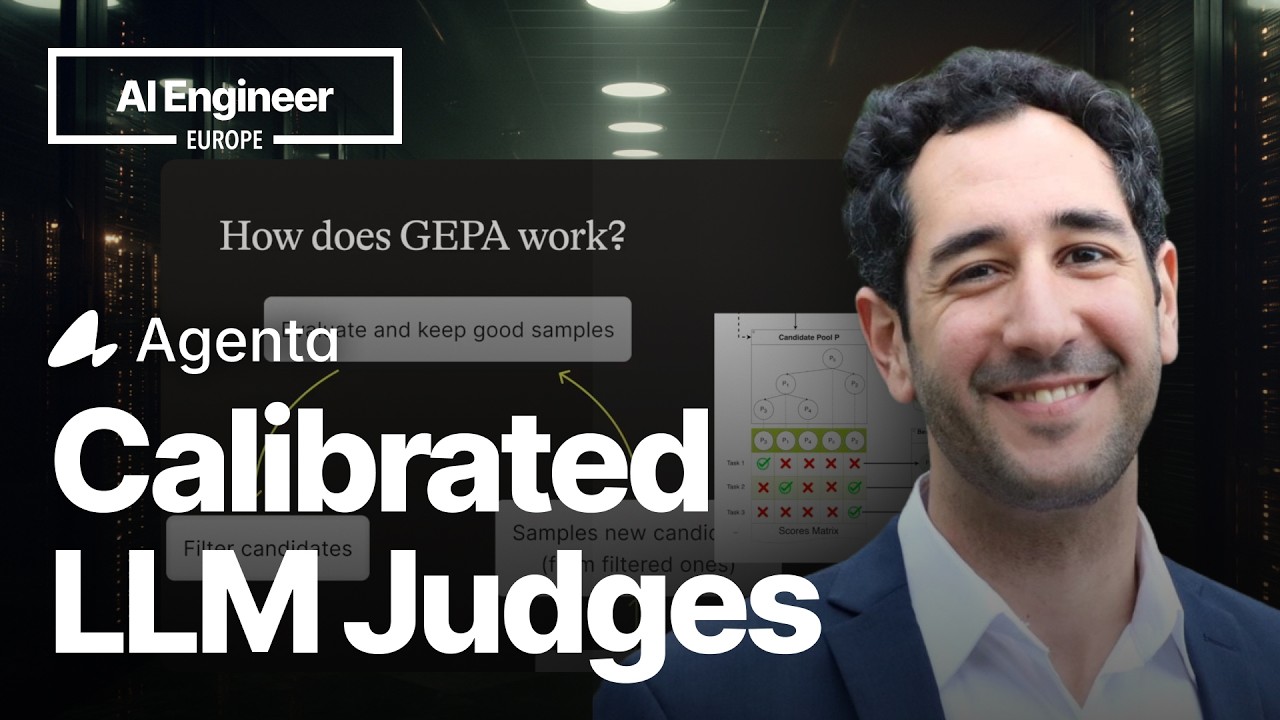
Judge the Judge: Building LLM Evaluators That Actually Work with GEPA — Mahmoud Mabrouk, Agenta AI
Apr 10, 2026 · 40:51
Mahmoud Mabrouk, co-founder of Agenta AI, demonstrates how to build calibrated LLM-as-a-judge evaluators using the GEPA prompt optimization algorithm, arguing that miscalibrated evals are worse than none. He walks through a practical workflow for a customer support agent using the TaoBench airline dataset, covering metric design, data annotation, and GEPA-based optimization. The seed judge achieved 61% accuracy; after optimization, accuracy rose to 74% with reduced bias, though the judge still struggled to fully learn the complex policy. Mabrouk shares key lessons: start with a seed prompt biased toward compliance, use larger models for refinement, overfit to training data first, and beware of high token costs.

Building an Agentic Platform — Ben Kus, CTO Box
Aug 24, 2025 · 19:06
Ben Kus, CTO of Box, argues that building an agentic architecture early was critical to overcoming the limitations of pure LLM-based data extraction for enterprise unstructured content. Starting with simple LLM calls in 2023, Box faced accuracy issues on complex documents, OCR failures, and difficulty handling hundreds of fields. They pivoted to an agentic framework using directed graphs, multi-model voting, and LM-as-a-judge with reflection loops, which dramatically improved accuracy and allowed incremental improvement. This architecture also enabled deep research on customer data and clean separation between agentic logic and system scaling. Kus emphasizes that agentic thinking should be applied early, even to seemingly non-agentic tasks like metadata extraction, and that Box avoids fine-tuning in favor of prompt-based agentic orchestration.
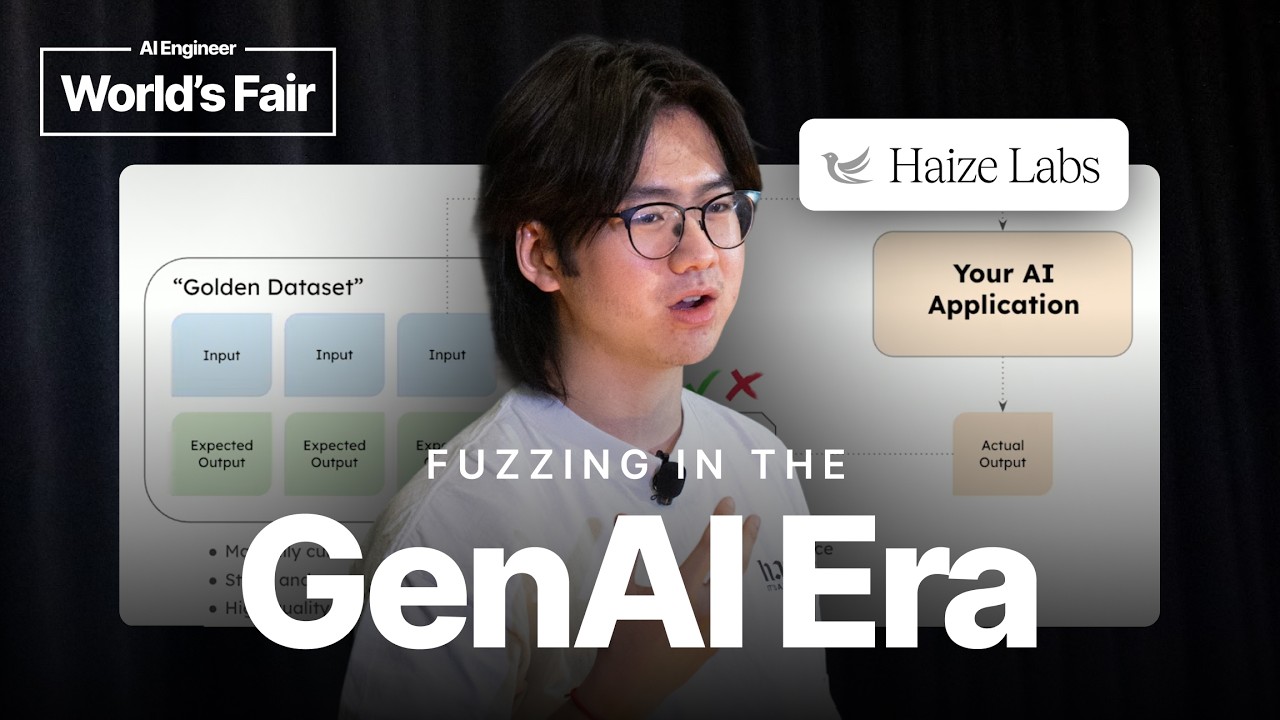
Fuzzing in the GenAI Era — Leonard Tang, Haize Labs
Aug 22, 2025 · 19:12
Leonard Tang of Haize Labs argues that standard evaluation methods fail for GenAI systems due to brittleness (Lipschitz discontinuity), and proposes 'Haizing'—fuzz testing that simulates diverse inputs to uncover corner cases. He details two core problems: scoring outputs via 'judges', where Haize's Verdict library stacks GPT-4 Mini in a self-verified debate ensemble to beat O1 at a third the cost, and RL-tuned judges like a 1.7B parameter model achieving 80.7% on RewardBench. For stimuli generation, he frames it as discrete optimization over natural language, using gradient-based methods and tree search. Case studies include Haizing the largest Hungarian bank's loan calculator, discovering prompt injections in minutes, and boosting a voice agent's ground-truth human agreement by 38% using rubric fanout.

2025 is the Year of Evals! Just like 2024, and 2023, and … — John Dickerson, CEO Mozilla AI
Aug 6, 2025 · 19:14
John Dickerson, CEO of Mozilla AI and former co-founder of Arthur AI, argues that 2025 is finally the year for AI evaluation (evals) due to three converging forces: ChatGPT making AI tangible to the C-suite, enterprise budget freezes that funnelled funding into GenAI pet projects, and the rise of agentic systems acting autonomously. He traces how ML monitoring existed pre-2022 but lacked C-suite attention, with Jamie Dimon’s JPMC spending only $100 million on AI from 2017 to 2021. The ChatGPT launch on November 30, 2022, unlocked CEO discretionary budgets for GenAI, leading to 2023 science projects, 2024 production deployments, and 2025 scaling. Now, as agents reason and act, connecting evals to downstream business KPIs—risk mitigation, revenue gains—is a first-class discussion for CEOs, CFOs, CISOs, and CTOs. Dickerson notes that evaluation companies have shifted to multi-agent system monitoring, and while LLM-as-judge is popular, biases require human validation, with companies like Mercor hiring experts at $50–200/hour to lockstep multi-agent outputs.

Practical tactics to build reliable AI apps — Dmitry Kuchin, Multinear
Aug 3, 2025 · 14:55
Dmitry Kuchin argues that building reliable AI applications requires reverse-engineering evaluation metrics from real-world user scenarios and business outcomes, rather than relying on abstract data science metrics. He recommends using a strong LLM like o3 to generate specific user questions and criteria from knowledge materials, and building these evaluations at the start of development, not the end. This approach lets teams run frequent experiments, catch regressions, and iterate until they have a baseline benchmark. Examples include customer support bots (where the key metric is escalation rate to humans), text-to-SQL (using mock databases), and call center classifiers. Kuchin emphasizes that the process works with any platform and shares his open-source tool Multineer as one option.

Transforming search and discovery using LLMs — Tejaswi & Vinesh, Instacart
Jul 16, 2025 · 21:10
Vinesh Gudla and Tejaswi Tenneti from Instacart detail how they use LLMs to overhaul search and discovery. They address challenges with conventional search: broad queries suffer cold start, tail queries lack engagement data. Using LLMs with Instacart's domain knowledge—e.g., top-converting categories as context—they improved precision by 18 percentage points and recall by 70% for tail queries, and cut zero-result queries. For discovery, LLMs generate complementary/substitute items; but pure LLM suggestions like 'chicken' for 'protein' missed user intent, so they augmented prompts with behavioral data (top categories, subsequent queries) to boost engagement and revenue. They use a hybrid approach: pre-compute offline for head/torso, distilled Llama 8B for long-tail, and LLMs as judges for evaluation. Key takeaways: combining LLM world knowledge with domain-specific data is critical, and evaluation is as hard as generation.

[Evals Workshop] Mastering AI Evaluation: From Playground to Production
Jul 1, 2025 · 1:25:08
In this workshop, Braintrust Solutions Engineers Carlos Esteban and Doug guide participants through the complete AI evaluation lifecycle, from offline testing in the playground to production monitoring. They explain the three core ingredients of an eval—task, data set, and score—and demonstrate how to run evals both via the Braintrust UI and the SDK. The session covers LLM-as-judge vs. deterministic code scores, the importance of starting small with synthetic data, and how to use online scoring and logging to capture real user feedback. Human-in-the-loop review is highlighted as a way to establish ground truth and close the feedback loop. The presenters also address audience questions on bootstrapping data sets, non-determinism in LLM judges, and integrating evals into existing projects.
How to build world-class AI products — Sarah Sachs (AI lead @ Notion) & Carlos Esteban (Braintrust)
Jun 27, 2025 · 1:43:46
Sarah Sachs (AI lead at Notion) and Carlos Esteban (Braintrust) explain that building great AI products requires 10% prompting and 90% evals and observability, with Notion AI using Braintrust to iterate on prompts and models. Sachs details their cycle: curate small datasets, tie them to scoring functions (LLM-as-a-judge with per-sample prompts and heuristic checks), run evals before shipping, and use production logs to catch regressions. She notes Notion AI supports 100M+ users, switches models in under a day, and 60% of enterprise users are non-English—requiring multilingual eval rigor. Carlos and Doug then walk through Braintrust's framework: tasks (prompts, tools, agents), datasets, and scores (0-1). They demonstrate offline evals via playground and SDK, online scoring in production, user feedback capture, human review setup, and remote evals to bridge complex code with the playground. The workshop covers moving from pre-prod evals to production monitoring, closing the feedback loop by adding underperforming spans to datasets.

Prompt Engineering is Dead — Nir Gazit, Traceloop
Jun 27, 2025 · 14:19
Nir Gazit, CEO of Traceloop, argues that manual prompt engineering is ineffective and demonstrates an automated, test-driven alternative. He improves a RAG-based documentation chatbot by 5x without hand-tuning prompts, using an LLM-as-a-judge evaluator with 20 example questions (each with 3 expected facts) and a CrewAI agent that iteratively optimizes the prompt based on evaluation scores. The initial score of 0.4 jumps to 0.9 after just two iterations. Gazit warns of overfitting to the small dataset and suggests splitting into train/test sets. The approach replaces manual tweaking with a 'gradient ascent' on evaluators, effectively vibe-engineering prompts.

7 Habits of Highly Effective Generative AI Evaluations - Justin Muller
Jun 3, 2025 · 25:39
Principal Applied AI Architect Justin Muller argues that generative AI evaluations are the missing piece to scaling, offering seven habits from over 100 projects. He recounts a customer whose document processing workload had 22% accuracy with no evals; after building an evaluation framework, accuracy reached 92% and the system became the largest such workload on AWS in North America. The habits include fast 30-second eval cycles using AI-as-judge, quantifiable scores averaged across numerous test cases, explainable reasoning for both generation and scoring, segmented evaluation through prompt decomposition, diverse test sets covering all use cases, and traditional techniques for numeric outputs or cost/latency. He emphasizes that evaluations should primarily discover errors, not just measure quality, and that prompt decomposition into chained steps often boosts accuracy by removing dead space.

Your Evals Are Meaningless (And Here’s How to Fix Them)
Feb 22, 2025 · 18:50
In this AI Engineering Summit talk, HoneyHive co-founder exposes why most LLM evaluations are meaningless due to criteria drift—where evaluator criteria misalign with user needs—and dataset drift, where test cases don't reflect real-world queries. He argues that static evaluation frameworks from tools like LangChain or Ffragas fail because they measure generic metrics rather than business-specific relevance, citing an e-commerce recommendation system that looked perfect in testing but broke in production. The fix is a three-step iterative alignment process: align evaluators with domain experts via continuous critique and few-shot examples; keep datasets alive by logging production underperformance and flowing those cases back into the test bank; and track alignment over time using F1 scores for binary judgments. Practical advice includes customizing the LLM evaluator prompt, starting with 20 domain expert examples in spreadsheets, and avoiding templated metrics. The speaker emphasizes that evals must evolve continuously, just like the LLM application itself, or they become meaningless.
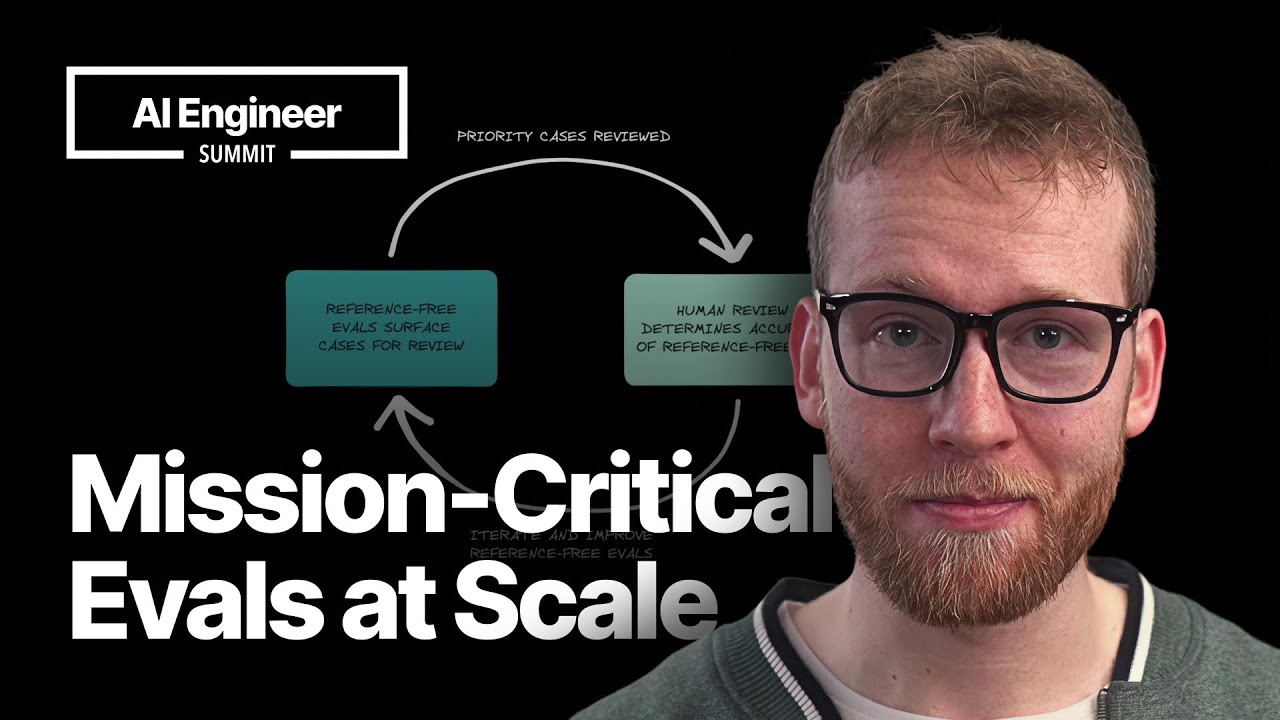
Mission-Critical Evals at Scale (Learnings from 100k medical decisions)
Feb 22, 2025 · 12:15
Christopher Lovejoy, a medical doctor turned AI engineer, explains how Anterior built a real-time reference-free evaluation system to scale mission-critical AI decisions in healthcare to 100,000 per day while maintaining trust. He shows that human reviews don't scale (50 clinicians needed for 5,000 daily reviews) and offline evals miss new edge cases. Instead, Anterior uses an LLM-as-judge to assign confidence scores, dynamically prioritizing high-risk cases for human review. This 'validating the validator' system achieved a 96% F1 score in prior authorization, letting a team of under 10 clinical experts handle tens of thousands of cases. It provides real-time performance estimates, enables rapid error correction, and builds defensibility through proprietary data and iterations only possible at scale.

The GenAI Maturity Curve or You Probably Don't Need Fine Tuning: Kyle Corbitt
Feb 9, 2025 · 18:03
Kyle Corbitt, CEO of OpenPipe, argues that most teams don't yet need fine-tuning and should start with prompted models like GPT-4. He presents a GenAI maturity curve where the trigger to fine-tune is when you hit constraints on cost, latency, or quality consistency—for example, if GPT-4 is 80-90% correct but inconsistent on the last 10-20%. Fine-tuning shifts the paradigm frontier outward, enabling models like fine-tuned LLaMA 38B to outperform GPT-4 at 1/25th the cost. The process has four steps: capture production logs to know your input distribution, prepare high-quality data (using GPT-4 outputs or iterative labeling), train with one-click tools, and evaluate with inner-loop (LLM-as-judge) and outer-loop (business metrics) evals. OpenPipe and other providers make deployment trivial via OpenAI-compatible APIs. The talk delivers a concrete decision framework and a walkthrough so any engineer can fine-tune in under an hour.

How to evaluate a model for your use case: Emmanuel Turlay
Feb 5, 2025 · 7:32
Emmanuel Turlay, CEO of Sematic, explains why evaluating large language models for specific use cases is more difficult than traditional ML evaluation, as metrics like BLEU and ROUGE and benchmarks like GLUE do not measure task-specific performance. He advocates using another LLM as a grader, describing a workflow where a scoring prompt with grading criteria is fed to a model like GPT-4 (best but costly) or FLAN-T5 (good speed–accuracy trade-off) to numerically score outputs. Turlay demonstrates with a politeness evaluation for email closings and introduces AirTrain, a platform that lets users upload datasets, compare models, and visualize metric distributions to make data-driven LLM selections. The episode argues that teams must build custom evaluation procedures rather than relying on generic benchmarks, treating evaluation as a test suite in the ML development pipeline.

What It Actually Takes to Deploy GenAI Applications to Enterprises: Arjun Bansal and Trey Doig
Nov 4, 2024 · 21:30
Trey Doig of Echo AI and Arjun Bansal of Log10 recount Echo AI's journey deploying a GenAI-native conversational intelligence platform for billion-dollar retail brands, focusing on the centrality of accuracy. Echo AI ingests all customer conversations, uses LLMs to surface insights at 100% coverage, but must overcome enterprise trust issues by achieving 95% accuracy within seven days. The platform relies on Log10's auto feedback system, which uses AI-based review to match human accuracy with model speed, yielding a 20 F1 point improvement in one use case. The episode details how Echo AI's solution engineers use Log10 to grade summarizations, catch hallucinations, and track model drift, turning human feedback into curated datasets for fine-tuning. Ultimately, the partnership demonstrates a path to self-improving LLM applications through iterative accuracy measurement and improvement.

Judging LLMs: Alex Volkov
Sep 9, 2024 · 18:39
Alex Volkov, as an LLM judge from 2034, humorously judges AI engineers on their development practices, emphasizing the importance of tracing, iterative prompt engineering, and robust evaluation pipelines. He finds Daniel guilty of deploying without logging, Sasha guilty of premature fine-tuning without prompt iteration, and Morgan guilty of ignoring AI news—commuted to attending ThursdAI. Francisco’s overreliance on programmatic evals leads to a legal loss, while Maxime is 'awesome' for using Weights & Biases Weave. Alex concludes with a primer on evaluation methods: programmatic, human-in-the-loop, and LLM-as-judge, stressing the need to validate validators and create custom criteria. He promotes Weave for tracing and evals, and ThursdAI for staying updated.
Powered by PodHood