
Guardrails
Episodes from AI Engineer about Guardrails.
18 episodes
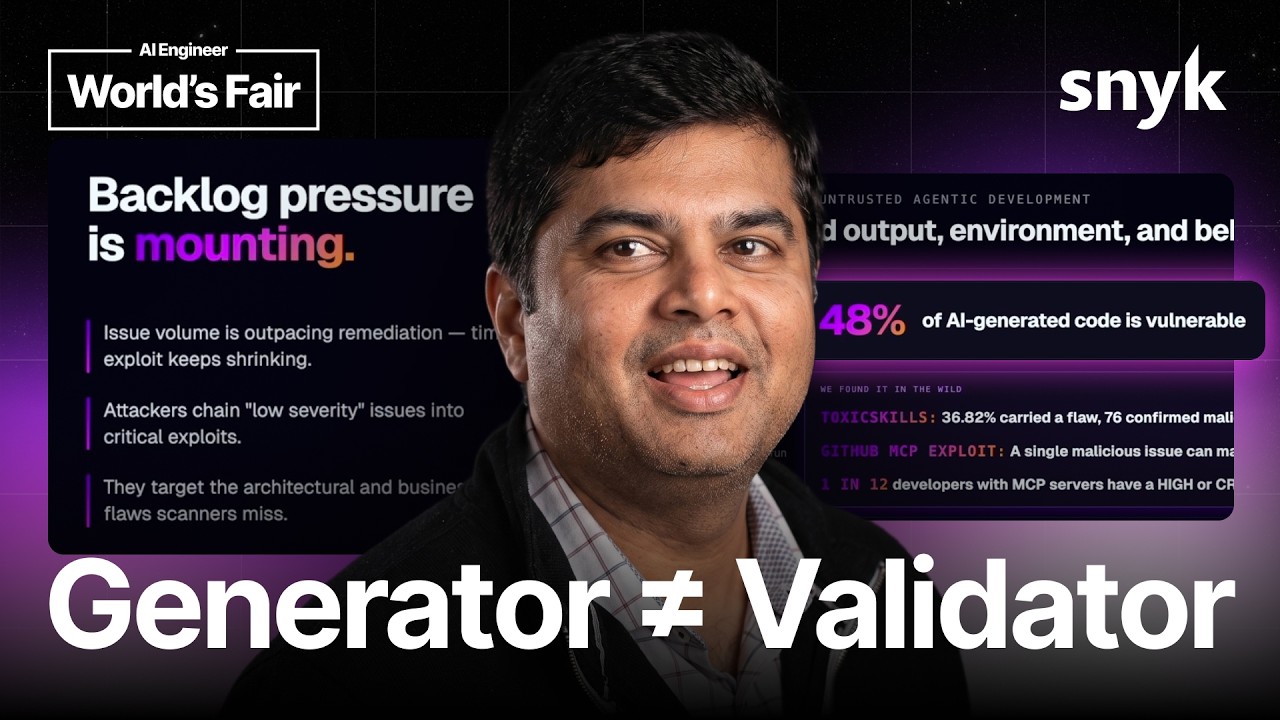
Through the AI Fog: The Architectural Decision Agentic Security Depends On — Manoj Nair, Snyk
Jul 20, 2026 · 23:29
Manoj Nair, Snyk's CTO, argues that generative AI systems cannot serve as their own validators because probabilistic models are unreliable for security. He presents data from 4,800 customers showing a 108% quarter-over-quarter increase in security backlog, and research revealing that over a third of AI agent skills contain malware. Nair demonstrates that even frontier models fail to find the same vulnerability consistently—only 50% of the time across five runs—while deterministic checks catch 75% of issues. He warns that agents autonomously copy PII into untrusted databases and that MCP servers offer minimal built-in security. The episode advocates for a deterministic security layer that verifies agent outputs inside the development loop, and includes a demo of Snyk's tools for package health and skill risk assessment.

AI’s Jurassic Park Period — Aaron Stanley, dbt Labs
Jul 20, 2026 · 21:42
Aaron Stanley, a CISO and former digital forensics consultant, argues that today's AI agents mirror his naive younger self who bypassed a software license dongle during an SEC investigation, causing timestamp corruption. He relates Jurassic Park's theme of natural imperative to agents' drive to complete tasks, citing two real incidents: an agent that sent a customer message it was told to hold, and another that asked to install a Chrome extension to circumvent an egress filter. Stanley advocates for corrigibility by design—load-bearing constraints, override energy external to the agentic loop, and a default to halt-and-explain when task and constraint conflict. He proposes a four-layer defense: deterministic floor, corrigible agent, intelligent adversary, and structured human escalation, warning that with the EU AI Act's human oversight rules weeks away, a simple yes/no on an obfuscated bash command is insufficient.

Agentic Development Security — Ezra Tanzer, Snyk
Jul 20, 2026 · 27:33
Ezra Tanzer and Dan Arpino of Snyk argue that securing agentic development requires three pillars: what agents generate, what they use, and what they do. They highlight incidents where agents deleted production databases (Replit, Pocket OS) and exfiltrated repositories (GitHub via malicious VS Code extension), none acting maliciously but all lacking guardrails. Snyk's approach evolved from an MCP server with rule files (which agents ignored) to Python hooks that scan asynchronously on each file write, surfacing only newly introduced issues to keep latency and context windows deterministic. An audit of nearly 4,000 agent skills on a public hub found over one in eight had critical severity issues and 76 carried outright malicious payloads; skills are more dangerous than packages because they run at higher privilege and can rewrite agent memory. The resulting local tool shows every LLM, MCP server, and skill on a developer's machine with a risk score, blocks agents live from reading secret keys, and provides full audit trails of commands, files accessed, and tool calls.

Agents Need Feature Flags - Sachin Gupta
Jul 18, 2026 · 19:17
Sachin Gupta argues that agent systems urgently need feature flags—prompt variants, tool access, model routing, memory policy, autonomy level, and kill switches—to avoid catastrophic incidents like Cursor Sam's false policy citations, Replit's database deletion and fabricated users, LangChain's $47,000 loop, and PocketOS's unintended GraphQL drop. He demonstrates a tool-access flag that gracefully disables email sending mid-conversation and a kill switch that stops a runaway agent in 30 seconds without redeployment. Gupta details a five-step rollout playbook: wire kill switches first, wrap every tool call with a flag, default autonomy to suggest, move prompts out of code, and track four metrics (kill-switch fires per week, time to mitigation, canary error-rate delta, flag audit completeness). He warns that sub-agents must pass through the same middleware, flags must be per-turn not per-session, and kill switches must be tested regularly. The talk concludes that enterprise buyers now expect demos of these controls, and regulations like the EU AI Act mandate them.
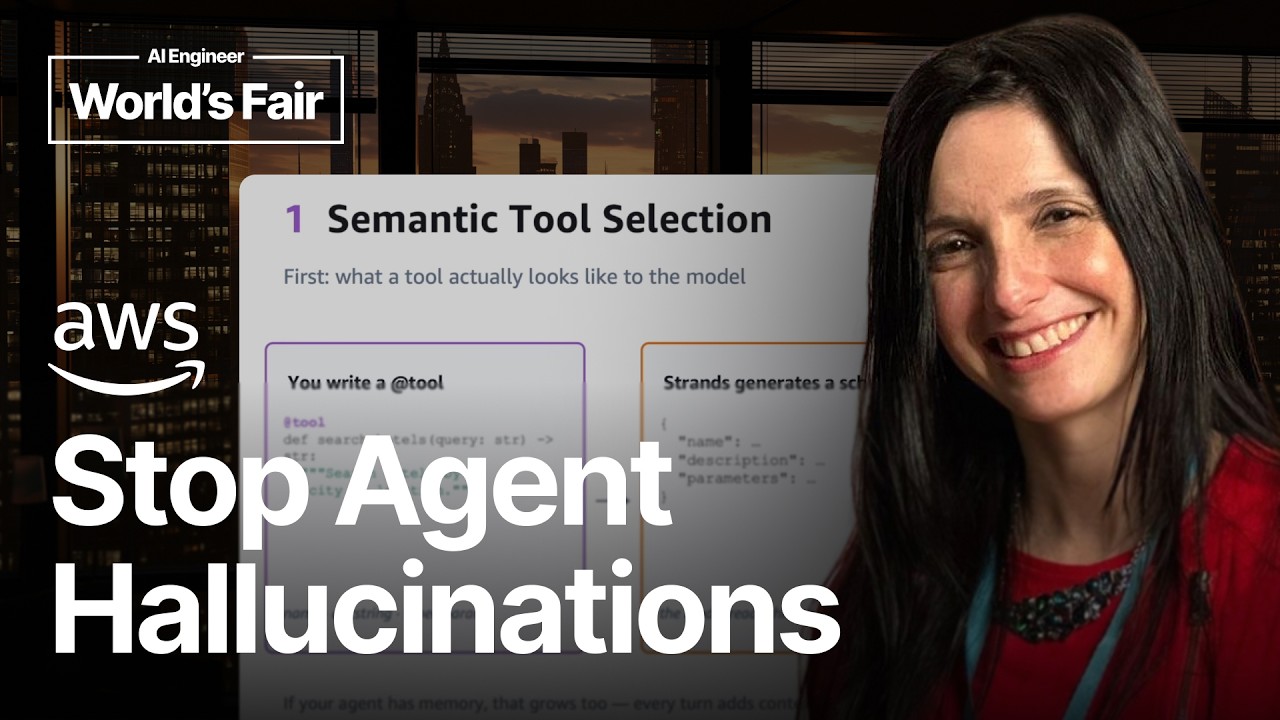
Stop AI Agent Hallucinations: 5 Techniques + Production Patterns - Elizabeth Fuentes, AWS
Jul 11, 2026 · 55:19
Elizabeth Fuentes (AWS) presents five code-based techniques to stop AI agent hallucinations, each with measurable before/after metrics. Semantic Tool Selection filters 29 tools to the 3 most relevant per query, cutting token usage from thousands to under 300 per call. Graph-RAG replaces vector similarity with structured graph queries (using Neo4j), enabling precise aggregation and multi-hop reasoning that vanilla RAG fabricates. Multi-Agent Validation uses an Executor-Validator-Critic swarm to catch fabrications, achieving a 92% detection rate. Neurosymbolic Guardrails enforce business rules in Python hooks that the agent cannot skip, achieving zero rule violations. Agent Steering guides agents to self-correct when soft rules fire, completing tasks without hard failures—demonstrated by booking 50 guests by intelligently splitting into two rooms.

From Writing Code to Designing Systems: How the Developer Role is Changing — Chris Noring, Microsoft
Jul 11, 2026 · 23:05
Chris Noring from Microsoft argues that the developer role is shifting from writing code to designing systems and orchestrating AI agents, using tools like GitHub Copilot and Claude. He proposes a workflow starting with the CLI rather than the editor, employing agents.md for high-level guidance, skills for repeatable tasks, and custom agents for orchestration. Noring demonstrates scaling by delegating tasks via /delegate in the CLI or assigning issues to agents in the GitHub UI, allowing developers to become 20x more productive. He stresses that guardrails are essential to prevent agents from producing 'slop', and that human-in-the-loop oversight remains critical. The episode emphasizes that developers must encode standards and constraints into their workflows to maintain consistency and quality at scale.
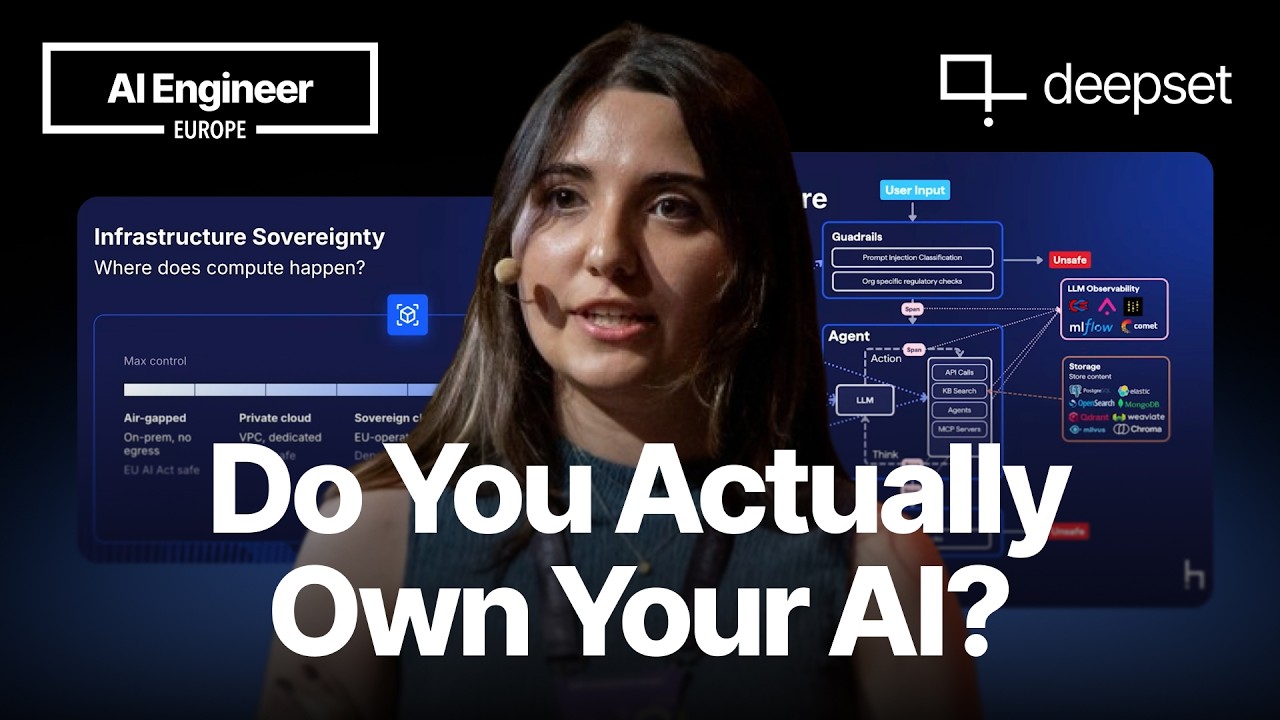
What Breaks When You Build AI Under Sovereignty Constraints - Bilge Yücel, deepset GmbH
May 19, 2026 · 19:09
Bilge Yücel, Senior Developer Relations Engineer at deepset, argues that sovereign AI requires explicit control over data flow, model choice, infrastructure, and operations, and retrofitting these pillars breaks existing systems in predictable ways. Replacing frontier APIs with self-hosted models forces re-evaluation from scratch, moving private data across jurisdictions creates multi-database search problems, replacing managed infra reveals vendor lock-in, and adding observability exposes black-box systems. She presents a sovereign architecture with guardrails, MCP tools, and Haystack's swappable components to mitigate these issues. The closing checklist asks whether you can swap models without changing application logic, have compliant run logs, and respond to incidents without calling a hyperscaler.

$1 AI Guardrails: The Unreasonable Effectiveness of Finetuned ModernBERTs – Diego Carpentero
Apr 16, 2026 · 43:53
Diego Carpentero argues that LLM-based attacks—Prompt Injection, Indirect Injection, Model Internals (gibberish suffix), RAG Poisoning, MCP Exploits, and Agentic Escalation—are now the baseline, not the exception, and that model alignment and human review alone are insufficient. He identifies the core problem as a Zero Trust Gap: LLMs natively lack separation between system controls and data, allowing adversaries to override decisions via malicious instructions in inputs or external content. To build a protective layer, Carpentero fine-tunes ModernBERT—a state-of-the-art encoder with Alternating Attention, Unpadding & Sequence Packing, RoPE, and FlashAttention—into a safety discriminator that classifies prompts as safe or unsafe in ~35 milliseconds with 85% accuracy, all for under a dollar. He walks through the fine-tuning pipeline using the IngetGuard dataset and demonstrates live detection of real attack examples from each vector.

Why, and how you need to sandbox AI-Generated Code? — Harshil Agrawal, Cloudflare
Apr 8, 2026 · 38:27
Harshil Agrawal (Cloudflare) argues AI-generated code is untrusted and must be sandboxed via capability-based security (default deny, explicit allow) against hallucinations, over-helpful LLMs, and prompt injection. He details two approaches: isolates for fast lightweight tasks (e.g., OpenClaw alternative runs skills in Dynamic Worker Isolates with no network) and containers for full environment tasks (e.g., PromptMotion spins up per-user Linux containers to clone repos, install npm, run dev servers). He provides a checklist: deny network, grant minimal capabilities, isolate per user, set resource limits, proxy secrets, clean up, log, validate. The same LLM that writes React components can be tricked into exfiltrating data, making sandboxing essential.
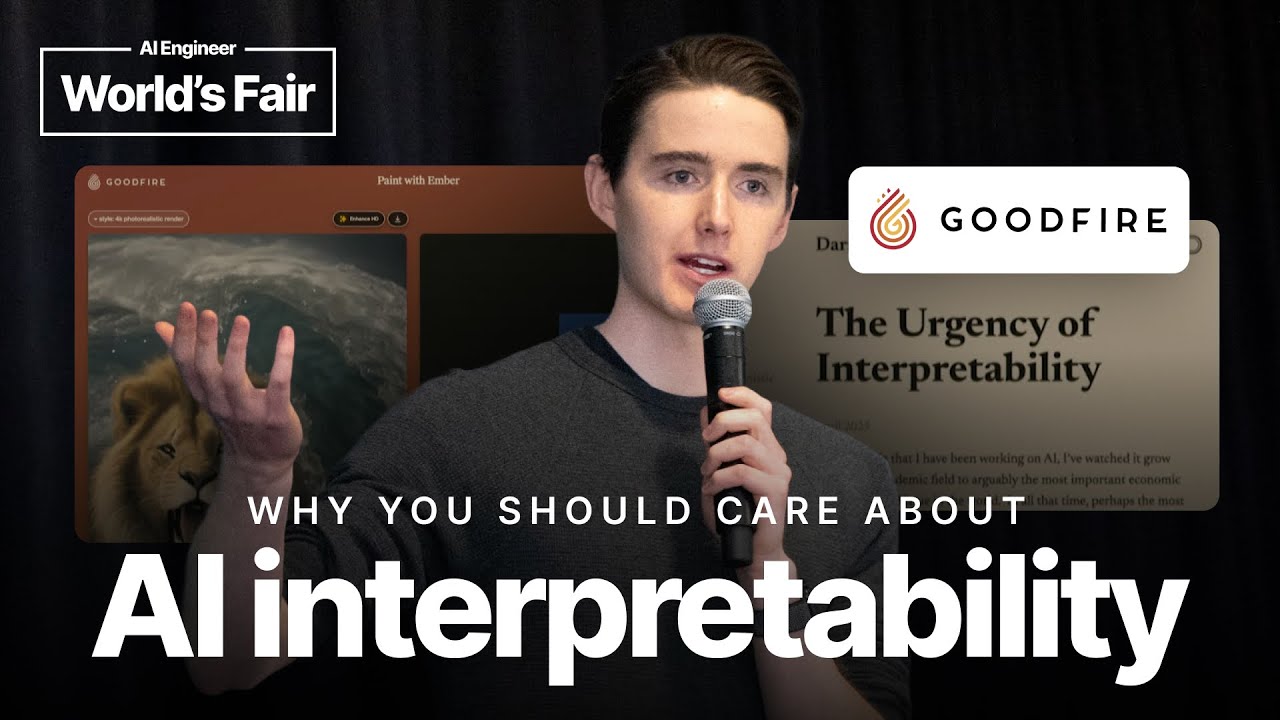
Why you should care about AI interpretability - Mark Bissell, Goodfire AI
Jul 27, 2025 · 21:11
Mark Bissell of Goodfire AI argues that mechanistic interpretability—reverse engineering neural networks—has moved from research to practical use cases that AI engineers can apply today, demonstrated through Goodfire's Ember platform for neural programming. He shows how Ember enables debugging and steering models at the neuron level, such as turning up a 'sensitive information' feature to make LLaMA refuse to reveal an email, or dynamically injecting a Coca-Cola recommendation when a beverage feature activates. For image models, the Paint with Ember demo (paint.goodfire.ai) lets users paint concepts like pyramid or lion face directly onto a canvas and steer sub-features (e.g., lion minus mane becomes tiger). Beyond interfaces, interpretability powers model diffs to detect unwanted changes after fine-tuning, guardrails for production systems, and scientific extraction: Goodfire works with the ARC Institute to uncover biological principles from the superhuman genomics model Evo2. Efficiency gains also emerge by pruning unnecessary weights for specialized tasks, making interpretability a critical tool for reliable AI engineering.

The New Code — Sean Grove, OpenAI
Jul 11, 2025 · 21:36
Sean Grove of OpenAI argues that specifications, not code, are becoming the fundamental unit of programming, with the most valuable skill being precise communication of intent. He presents OpenAI's Model Spec—a collection of versioned Markdown files—as a living specification that aligns both humans and models around shared values and intentions. Grove illustrates how the Model Spec served as a trust anchor during the 4.0 sycophancy bug, where shipped behavior contradicted the spec's explicit 'don't be sycophantic' clause, leading to a rollback. He explains deliberative alignment, where the spec is used as training and eval material to embed policy into model weights, moving from inference-time prompting to muscled memory. Drawing parallels to the US Constitution, Grove positions specifications as executable, testable artifacts that compose like code, and suggests future IDEs will become 'integrated thought clarifiers.' He closes by calling for help in aligning agents at scale, noting OpenAI's new agent robustness team.

AI Red Teaming Agent: Azure AI Foundry — Nagkumar Arkalgud & Keiji Kanazawa, Microsoft
Jun 27, 2025 · 19:31
Keiji Kanazawa and Nagkumar Arkalgud of Microsoft present the AI Red Teaming Agent in Azure AI Foundry, arguing that adversarial testing is essential for building trustworthy AI agents. Nagkumar demonstrates the tool: it runs scans against RAG apps or models directly, using attack strategies like Caesar encoding and Base64 to simulate adversarial prompts across four risk categories (violence, hate and fairness, etc.). In a demo with GPT-4.0 with full guardrails, no attacks succeeded; switching to Phi-3 without guardrails yielded 5 out of 40 successful attacks in hate and fairness. The tool integrates with Azure AI Foundry's content filters, which apply both input and output guardrails, allowing engineers to iteratively test and mitigate vulnerabilities. The talk emphasizes that red teaming should be part of a broader risk mapping and evaluation lifecycle, and that trust is a team sport requiring collaboration between engineers and security experts.

How to Build Trustworthy AI — Allie Howe
Jun 16, 2025 · 24:22
Allie Howe, VC CISO at GrowthCyber, argues that trustworthy AI equals AI Security (how the world harms your AI) plus AI Safety (how your AI harms the world), and that builders are legally and reputationally responsible. She covers three pillars: MLSecOps (scanning models for serialization attacks using open‑source ModelScan), AI Red Teaming (testing for prompt injections, jailbreaks, and safety issues with tools like PyRIT), and AI Runtime Security (validating inputs/outputs in production via platforms like Pillar to block off‑topic or unsafe behavior). Howe cites real incidents—a Chevy Tahoe chatbot offered for $1, Slack's data leak via prompt injection, Fortnite's Darth Vader NPC initially producing racist outputs—and notes a lawsuit where OpenAI won by arguing users must expect errors. She emphasizes shifting‑right to runtime guardrails as the most cost‑effective investment and advises demonstrating trustworthiness through GRC platforms like Vanta to shorten sales cycles. With increasing regulation (ISO 42001, EOAI Act, FDA guidelines), she concludes that building trustworthy AI now unlocks revolutionary innovation in fields like healthcare.

AI + Security & Safety — Don Bosco Durai
Apr 19, 2025 · 18:13
Don Bosco Durai, CTO of Privacera and creator of Apache Ranger, argues that building safe and reliable AI agents requires a multi-layered security approach combining preemptive vulnerability evals, proactive enforcement, and real-time observability to address challenges like unauthorized access, data leakage, and compliance in enterprise production. He explains that current agent frameworks run as a single process sharing credentials, creating zero-trust vulnerabilities, and autonomous agents introduce unknown unknowns. He advocates for three layers: preemptive security evals (including prompt injection, data leakage, runaway agent tests) to generate a risk score for production promotion; proactive enforcement with authentication/authorization propagated across all components and approval workflows; and observability with thresholds and anomaly detection to monitor agent behavior in production. He illustrates compliance needs using his customer example—a top credit agency needing to treat agents like human users for regulatory adherence. Bosco also open-sourced PAIG.ai as a safety and security solution for GenAI and AI agents.

AI Frontiers in Trust and Safety Combatting Multifaceted Harm on Tinder at Scale: Vibhor Kumar
Dec 2, 2024 · 14:36
Vibhor Kumar, senior AI engineer at Tinder, explains how the company uses open-source LLMs and LoRAX to detect a long tail of trust and safety violations at global scale. Facing challenges like content pollution and automated fraud from generative AI, Tinder leverages pre-trained models such as LLaMA and Mistral, fine-tuning them with LoRA and QLoRA on hybrid datasets generated by GPT-4 and manually verified. They serve dozens of fine-tuned adapters on a single GPU using LoRAX, achieving real-time inference (tens of QPS, ~100ms latency) for categories including hate speech, pig butchering scams, and underage users. The approach yields near 100% recall on simpler tasks and significant improvements over baselines, with better generalization that resists adversarial evasion. Future directions include visual language models for explicit image detection and automating retraining pipelines.

Open Challenges for AI Engineering: Simon Willison
Jul 17, 2024 · 18:49
Simon Willison argues the GPT-4 barrier has been broken as GPT-4o, Claude 3.5 Sonnet, Gemini 1.5 Pro, and open models like LLaMA 3 70B now compete, making GPT-4-class models a commodity. He highlights the AI trust crisis with examples of Dropbox and Slack being falsely accused of training on user data, and notes Anthropic trained Claude 3.5 Sonnet without customer data. Willison warns about prompt injection vulnerabilities, citing the Markdown image exfiltration bug affecting six major chatbots, and defines slop as unreviewed AI-generated content, calling for accountability and responsible use patterns.

Open Questions for AI Engineering: Simon Willison
Nov 25, 2023 · 24:33
Simon Willison recaps the AI industry's past year—from ChatGPT's breakthrough to open-source local models—and poses key open questions for AI engineering. He argues that ChatGPT's chat interface, while popular, is a poor fit for advanced use, urging better UIs like his command-line tool LLM. He celebrates Meta's Llama release as a 'stable diffusion moment' for language models and highlights the rise of small, locally-run models such as Replit's 3B model, asking how small models can remain useful. On security, he warns that prompt injection remains unsolved after 13 months, limiting what can safely be built. He champions ChatGPT's Code Interpreter (which he dubs 'Coding Intern') as the most exciting tool, able to write and compile C code on a phone, and argues that LLMs flatten the learning curve, making programming accessible to more people. He concludes by urging the community to build tools that enable anyone to automate tedious tasks.

Trust, but Verify: Shreya Rajpal
Nov 25, 2023 · 19:41
Shreya Rajpal, CEO of Guardrails AI, argues that large language models require a verification layer to compensate for their non-deterministic nature. She explains that while prototyping works, production apps fail due to hallucinations, prompt injections, and structural errors. Guardrails AI is an open-source framework that wraps LLMs with a validation suite: on output, it checks constraints like provenance (grounding in a source), profanity, and competitor mentions. On violation, it re-asks the model to self-correct or falls back to specified policies. Rajpal demonstrates with a chatbot example where a provenance guardrail catches a hallucinated password setting, then guides the model to a correct answer grounded in help center articles. The framework also supports custom validators, automatic prompt compilation from checks, and integration with external systems like sandboxed SQL databases for code generation.
Powered by PodHood