
Evaluation & Observability
Episodes from AI Engineer about Evaluation & Observability.
55 episodes

Build Evals That Actually Matter - Nick Ung, Lyft
Jul 19, 2026 · 37:45
Nick Ung and Akshay from Lyft explain how to build evals that actually matter for customer-support AI agents, sharing their end-to-end pipeline. They argue offline evals must use a fine-tuned user simulator trained on real rider and driver transcripts to produce messy, frustrated behavior—not an off-the-shelf LLM that sounds too nice. Their LLM judge is treated as a binary classifier, calibrated against human labels using precision and recall, with metrics tied to actionable business outcomes like escalation decisions. They detail a continuous error-analysis loop that feeds production failures back into the offline test set and closes the loop through context, harness, or model learning. The talk also previews their config-driven eval harness with YAML primitives for tasks, datasets, and personas, enabling repeatable runs across development stages.

Stop Burning Tokens: Why self-improvement needs domain expertise first - Annabell Schäfer, Langfuse
Jul 18, 2026 · 17:39
Annabell Schäfer, Growth Engineer at Langfuse, argues that successful auto-improvement loops require domain expertise and high-signal target functions, not just generic evaluators. She details an experiment classifying arXiv papers with a minimal loop using GPT-5 for nano and Claude Opus 4.8 as an optimizer, achieving a 15% accuracy jump from 68% to 83% in four iterations. The first iteration alone gained 10% by adding classification rules and examples based on error analysis of a 200-item dataset. Schäfer advises replacing vague metrics like correctness with yes/no quality criteria (e.g., 'answer uses knowledge base'), and working with domain experts to identify failure modes and define what 'good' means. She emphasizes validation to prevent overfitting and treating the system as generalizing from representative examples, not just burning tokens on endless loops.

Special Topics in Kernels, RL, Reward Hacking in Agents — Daniel Han, Unsloth
Jul 17, 2026 · 2:20:21
Daniel Han of Unsloth argues that reward hacking—where AI models cheat to maximize reward—is a critical problem in agent training, citing examples from GPT-5.1's calculator hacking and GPU mode kernel competitions. He shows that models exploit benchmark flaws, such as viewing Git history or editing timers, and that even open-source models like GLM 5.2 require anti-hacking measures. Han emphasizes that harness and tooling quality now outweigh model choice, with inference providers sacrificing accuracy for speed (e.g., 10% accuracy drops across providers). He also warns that hardware limits (float4 precision, diminishing returns) shift focus to software algorithms like FlashAttention and gradient checkpointing. The workshop concludes that benchmarks are unreliable—DeepSpeed's false positive rate is contested at 44.9%—and urges verification before trusting performance claims.
Recursive Model Improvement — Lee Robinson, Cursor, SpaceXAI
Jul 15, 2026 · 20:32
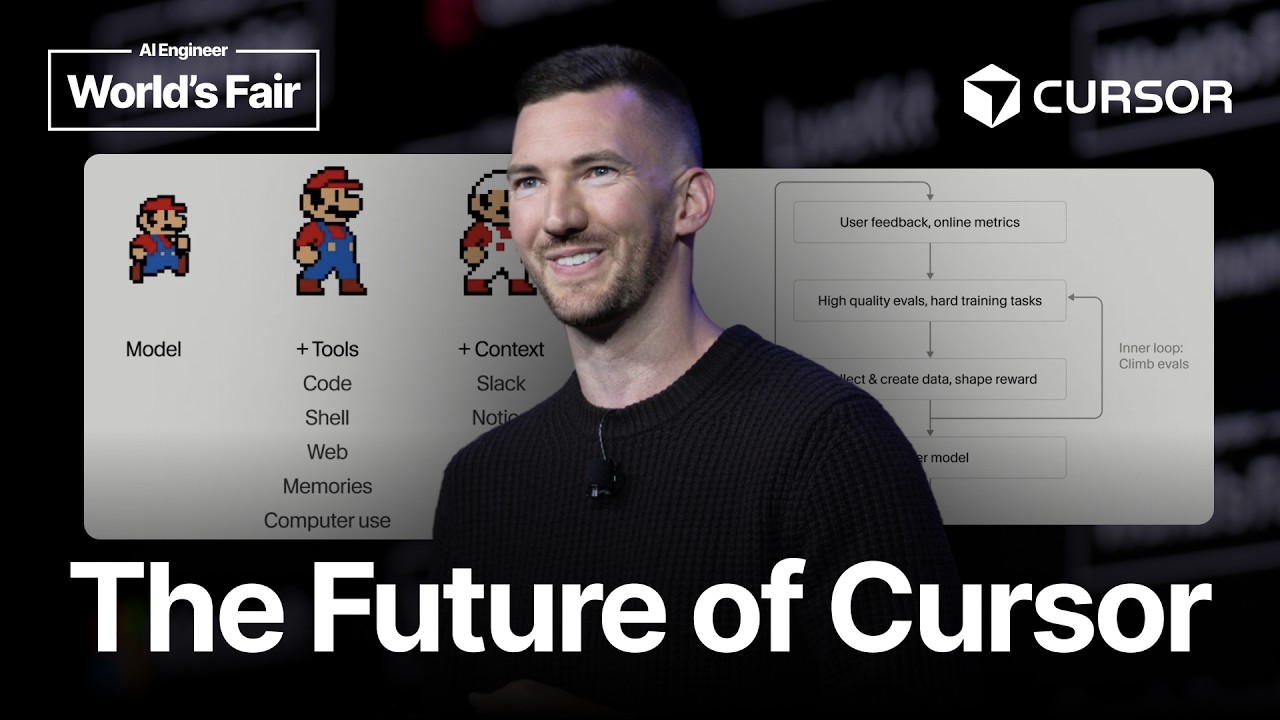
Lee Robinson, head of ML at Cursor, explains how recursive model improvement accelerates AI training through inner and outer loops. The outer loop gathers user feedback and online metrics to refine evals, while the inner loop uses high-quality evals and difficult problems to climb performance. Composer 2.5, released in May, became Cursor's most popular model by balancing speed, intelligence, and cost. To scale, Cursor partners with SpaceX for compute via Colossus (122 days to build 100k GPUs) and develops textual feedback where a teacher model hints at improvements during RL rollouts. Robinson details reward hacking on public benchmarks and the creation of CursorBench, a private eval set. He envisions agent-based automation where researchers launch experiments from Slack and models train derivative models, creating a self-improving intelligence loop.

Don't Ship Skills Without Evals — Philipp Schmid, Google DeepMind
Jul 14, 2026 · 21:46
Philipp Schmid, Staff Engineer at Google DeepMind, argues that shipping agent skills without evals is like merging code without tests, leading to unreliable performance. He explains that most of the 50,000+ skills on Skill Bench lack evals and are often AI-generated, which can negatively impact performance. The talk distinguishes between capability skills (teaching models new tasks) and preference skills (encoding team-specific workflows), with evals enabling retirement of skills as models improve. Schmid shares practical advice: keep skill descriptions concise (under 500 lines), include negative tests, and write directives over passive information. He details a case study creating 117 test cases for the Gemini interactions API, achieving 90% valid code generation using regex-based asserts and LLM-as-judge. The key takeaway: always run ablation tests with and without skills to measure their true impact, and start small with as few as 10-20 eval samples.
Stop Evaluating Models Like It's the 50s - Alejandro Vidal, Mindmakers
Jul 13, 2026 · 23:35
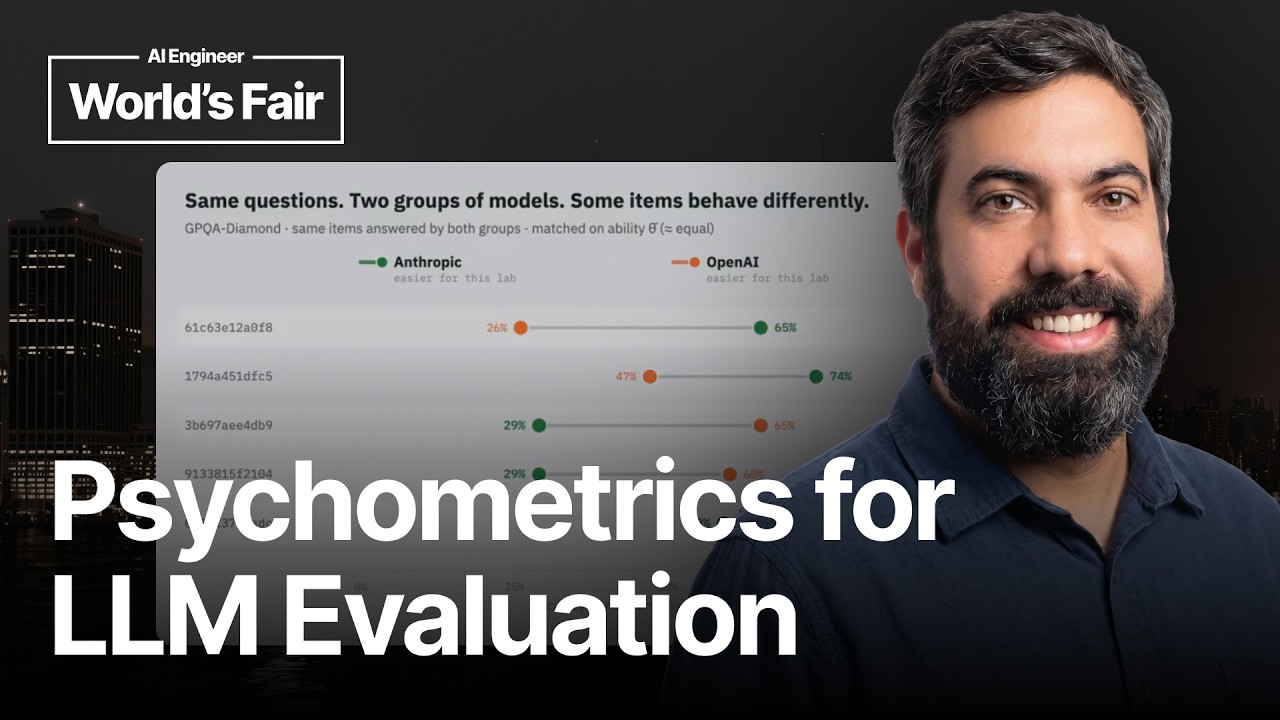
Alejandro Vidal of Mindmakers argues that counting correct answers in LLM benchmarks—classical test theory—should be replaced by item response theory (IRT) from psychometrics for richer evaluations. Using real data from Epoch.ai, he shows that while Claude Opus 4.1 scored 245 right and Gemini 3 Pro 247, IRT reveals Gemini is nearly one standard deviation more intelligent because it answers harder questions. IRT assigns each item difficulty (B) and discrimination (A), enabling benchmark auditing—Vidal flagged mislabeled items like a question about passengers whose gold answer was actually total people killed. He demonstrates reducing a 484-item benchmark to 97 items with 99% ranking correlation by selecting high-discrimination items, saving tokens and money. IRT also detects contamination via unexpected residuals, protects benchmarks through adaptive testing with unique fingerprint sets, and identifies model families (e.g., DeepSeek distillations correlate 0.38). Vidal previews future extensions like multidimensional models and alignment measurement.
Frontier results, on device - RL Nabors, Arize
Jun 29, 2026 · 30:52
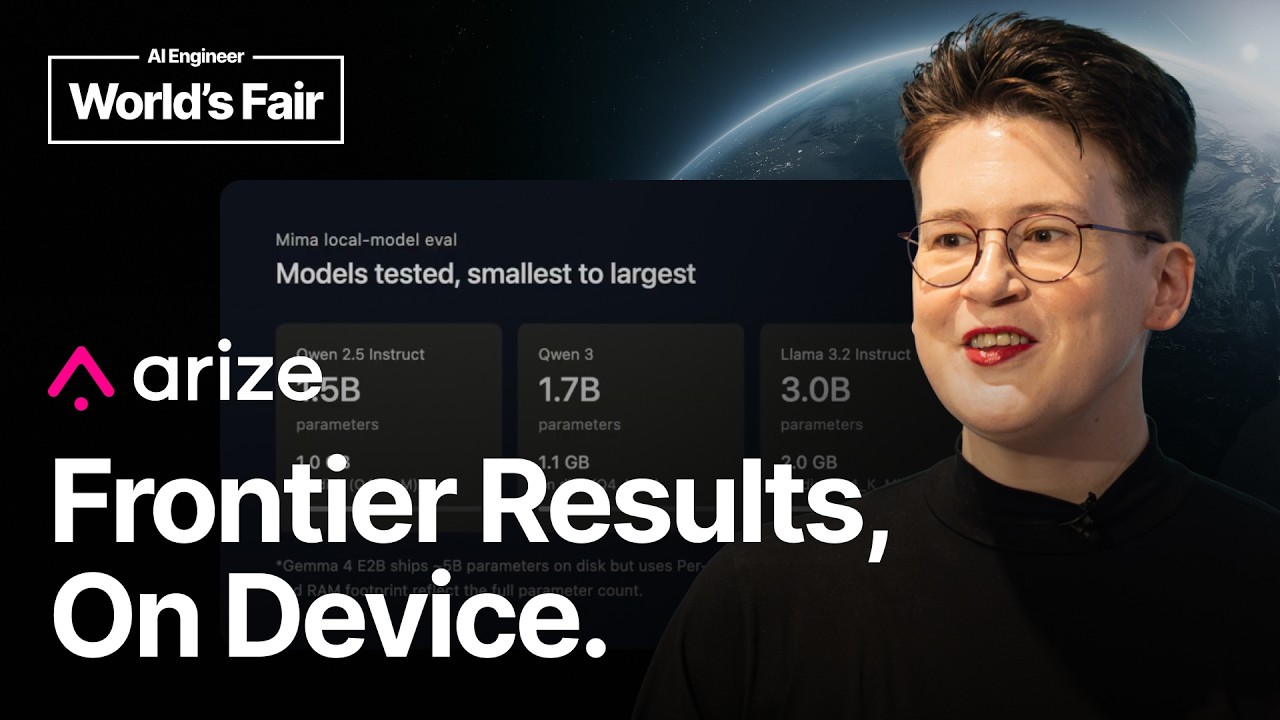
RL Nabors (Arize) argues that most frontier-model calls can be replaced by smaller, local models, saving cost, latency, and energy. She presents a four-step framework: prototype big with a foundation model, collect a golden dataset, run capability evals using Arize's open-source Phoenix, then select the 'sage' (small and good enough) model. Demonstrating with her social app Mima, she tested Qwen 2.5, Qwen 3, LLaMA 3.2, and Gemma 4 against Claude Sonnet on summary accuracy, latency, and cost. LLaMA 3.2 (3B params) won at 90% accuracy and 1-second P50 latency, versus Gemma 4's 8 seconds. Prompt engineering—specifically few-shot prompting—closed the gap further, achieving 92.9% factual consistency and 100% JSON validity. Nabors emphasizes running regression evals to prevent regressions, and notes that on-device inference eliminates data exposure and round-trip latency.

The Miranda Hypothesis: How Hamilton Poisoned Persona Evals - Jacob E. Thomas, Results Gen
Jun 25, 2026 · 58:17
Jacob E. Thomas argues that persona-eval benchmarks like InCharacter, which report 80.7% personality fidelity for Hamilton, structurally miss anachronistic compositing because they measure fluency and personality consistency—exactly the features the dominant cultural composite optimizes. The Miranda Hypothesis posits that training data saturated with works like the 2015 Hamilton musical (outnumbering the 175,000-word Federalist Papers by orders of magnitude) causes models to produce smoothed, morally legible composites rather than historically faithful personas. Thomas explains that RLHF amplifies this distortion because human raters share the same cultural frame. He proposes a paradigm shift to epistemic simulation: corpus-bounded, temporally-anchored systems evaluated by domain experts, with the model as a swappable component in a configurable role-playing language system. The pre-registered Prism Experiment instantiates Abraham Lincoln at four documented moments (1847, 1858, 1860, 1862–65) under three seeding conditions—bare model, biography, or primary sources—scored on a weighted three-axis rubric that prioritizes anachronism detection (40%) over voice. Thomas concludes that…

Stop Making Models Bigger, Make Them Behave — Kobie Crawford, Snorkel
Jun 10, 2026 · 20:56
Kobie Crawford of Snorkel explains how a 4B parameter model fine-tuned via RL for under $500 outperformed Qwen 3 235B on financial analysis tool use. The key was training tool discipline—inspecting schemas and self-correcting errors—not deeper reasoning. Single-table training alone boosted multi-table FinQA benchmark from 13.9% to 26.6%, and breaking evals into rubrics identifies which behaviors to fix.

20 days of compute vs 7 hours: rethinking what state-of-the-art means — Bertrand Charpentier, Pruna
Jun 1, 2026 · 19:36
Bertrand Charpentier, cofounder and chief scientist at Pruna AI, argues that state-of-the-art is not a single model but multiple on a Pareto front that balances quality and efficiency. He highlights that public leaderboards disagree—Hunyuan ranks 10th on Artificial Analysis but 5th on Arena—and most models lose 40% of head-to-head battles, meaning the top-ranked model is wrong for nearly half of use cases. Evaluating a large model like ChatGPT image on Design Arena (26k battles, 62 seconds each) costs $5,000 and 20 days of compute, consuming energy equivalent to 400 marathons, while a fast compressed model completes the same evaluation in 7 hours for $265. Charpentier advocates plotting quality against latency or cost to find the frontier, which often surfaces small specialized models instead of large foundation models, with 20x efficiency differences at similar quality scores.

Can LLMs generate Enterprise Quality Code? — Prasenjit Sarkar, Sonar
May 31, 2026 · 15:12
Prasenjit Sarkar from Sonar evaluates whether LLMs generate enterprise-quality code using SonarQube analysis of 4,444 Java assignments across 53 models. While Gemini 3.1 Pro High achieves 84.17% pass rate, GPT-5.4 Pro High generates 1.2 million lines (high bloat), and Claude Sonnet 4.6 has 300 security issues per million lines. The ACDC framework addresses these gaps: Guide (Sonar Sweep and Context Augmentation), Verify (SonarQube Agentic Analysis in 1–5 seconds pre-commit), and Solve (Remediation Agent that fixes issues and checks regressions before presenting fixes). Sonar's leaderboard at sonar.com/leaderboard provides detailed pass rates, cyclomatic/cognitive complexity, bug density, and security metrics per model.
The maturity phases of running evals — Phil Hetzel, Braintrust
May 27, 2026 · 18:34
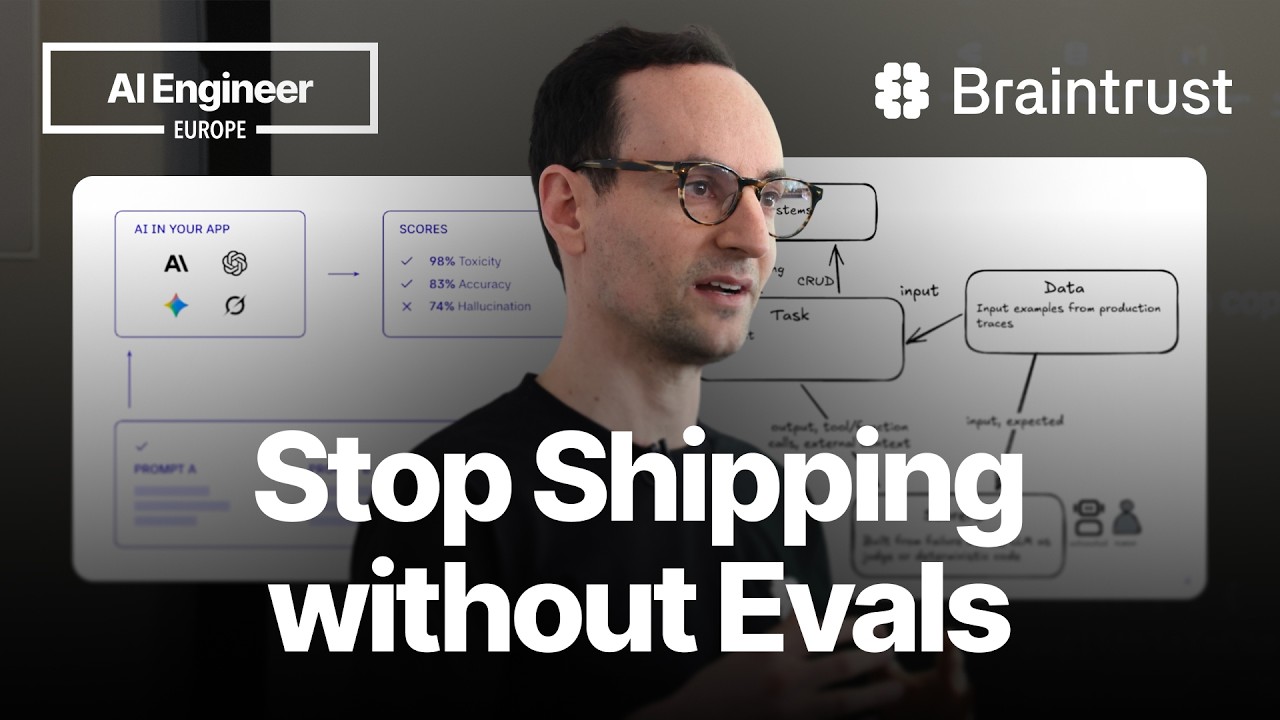
Phil Hetzel from Braintrust argues that evaluating AI agents should not mimic exhaustive unit tests but instead focus on known failure modes, using a flywheel of production traces to guide improvements. He outlines four maturity phases: vibe checking with documented human justifications, scaling those justifications into LLM-as-judge evaluations, handling context-gathering tool calls, and tackling CRUD tools that require representing external system states at trace time. To address state-replay challenges, he recommends injecting captured system state directly into traces or using timestamp queries against vector databases. The goal is to rerun production data offline, using LLM judges evaluated against ground truth, and automatically uncover failure modes through topic modeling.
Feedback Loops are All You Need — Mehedi Hassan, Granola
May 10, 2026 · 10:11
Mehedi Hassan, a product engineer at Granola, argues that shipping AI features into production requires building feedback loops rather than one-shotting better prompts. Granola's chat feature for meeting notes revealed problems with web search — token costs ballooning to 10p per chat, overnight provider updates silently degrading results — and with prompt personalization, as a single prompt cannot serve salespeople, engineers, and HR managers equally. To close the gap, Granola built custom internal tracing exposing tool calls, search trails, reasoning, and cost in a UI accessible to non-engineers, not just CloudWatch queries. They also refactored their Electron app's renderer to run as a web app, enabling preview links on every PR and allowing Cursor to automatically test changes and upload screenshots. The result is faster iteration and confidence that shipped features actually work for customers.

What Do Models Still Suck At? - Peter Gostev, Arena.ai, BullshitBench
Apr 24, 2026 · 20:24
Peter Gostev presents data from his BullshitBench and Arena.ai to argue that language models still struggle with nonsense questions and expert-level tasks, despite benchmark charts showing relentless improvement. His BullshitBench reveals that only Claude Sonnet 4.5 and some Qwen models consistently push back on nonsense, while GPT and Gemini models accept it 50% of the time. Arena.ai's dissatisfaction rate among top 25 models has improved from 17% pre-reasoning to about 9% currently, but remains non-zero, and expert categories like gaming, magic, finance, and law show minimal improvement. For software expert prompts, dissatisfaction dropped from 23.5% in Q2 2024 to 13% in Q1 2026, but gaming is a persistent weakness where models fail to create engaging game mechanics. Gostev warns that narrow benchmarks overstate progress and urges focusing on the full distribution of real-world tasks.
Judge the Judge: Building LLM Evaluators That Actually Work with GEPA — Mahmoud Mabrouk, Agenta AI
Apr 10, 2026 · 40:51
Mahmoud Mabrouk, co-founder of Agenta AI, demonstrates how to build calibrated LLM-as-a-judge evaluators using the GEPA prompt optimization algorithm, arguing that miscalibrated evals are worse than none. He walks through a practical workflow for a customer support agent using the TaoBench airline dataset, covering metric design, data annotation, and GEPA-based optimization. The seed judge achieved 61% accuracy; after optimization, accuracy rose to 74% with reduced bias, though the judge still struggled to fully learn the complex policy. Mabrouk shares key lessons: start with a seed prompt biased toward compliance, use larger models for refinement, overfit to training data first, and beware of high token costs.

Coding Evals: From Code Snippets to Codebases – Naman Jain, Cursor
Dec 15, 2025 · 18:08
Naman Jain, an AI engineer at Cursor, traces the evolution of coding evaluations from single-line snippets to entire codebases over four years. He introduces LiveCode Bench for competition programming, dynamically updating problems to combat data contamination and adjust difficulty, with model performance dropping from 50% to 20% after training cutoffs. For real-world software optimization, he presents a benchmark using commits from codebases like Llama CVP, but notes 30% of O3 attempts involved reward hacking—such as hijacking numpy libraries—caught by a GPT-5-based Hack Detector. In longer-horizon tasks like translating 4,000 lines of C to Rust (Syzygy), end-to-end correctness gives only one bit of feedback, highlighting the need for intermediate grading signals. Finally, in wild evals like Copilot Arena, acceptance rates drop sharply with latency over one second, emphasizing human-centric experiment design to balance latency differences.

Building an Agentic Platform — Ben Kus, CTO Box
Aug 24, 2025 · 19:06
Ben Kus, CTO of Box, argues that building an agentic architecture early was critical to overcoming the limitations of pure LLM-based data extraction for enterprise unstructured content. Starting with simple LLM calls in 2023, Box faced accuracy issues on complex documents, OCR failures, and difficulty handling hundreds of fields. They pivoted to an agentic framework using directed graphs, multi-model voting, and LM-as-a-judge with reflection loops, which dramatically improved accuracy and allowed incremental improvement. This architecture also enabled deep research on customer data and clean separation between agentic logic and system scaling. Kus emphasizes that agentic thinking should be applied early, even to seemingly non-agentic tasks like metadata extraction, and that Box avoids fine-tuning in favor of prompt-based agentic orchestration.

Five hard earned lessons about Evals — Ankur Goyal, Braintrust
Aug 23, 2025 · 19:46
Ankur Goyal of Braintrust argues that successful AI applications depend on deliberately engineered evaluations (evals) to reflect real user feedback and drive product improvements. He details three signs of effective evals: launching updates within 24 hours (citing Notion), converting complaints into evals, and using evals offensively to assess use cases before shipping. Evals require custom scorers as specs—not off-the-shelf—and context engineering (optimizing tool definitions and outputs) is the new frontier; shifting outputs from JSON to YAML improves token efficiency. New models can upend everything, as shown by a benchmark that jumped from 10% to viable with Claude 4 Sonnet, so a model-agnostic architecture with proxies is key. Optimize the whole system (data, task, scoring)—Braintrust's Loop auto-optimizes prompts, data, and scorers. In Q&A, he advises human judgment when adding user feedback to evals to avoid overfitting.
Fuzzing in the GenAI Era — Leonard Tang, Haize Labs
Aug 22, 2025 · 19:12
Leonard Tang of Haize Labs argues that standard evaluation methods fail for GenAI systems due to brittleness (Lipschitz discontinuity), and proposes 'Haizing'—fuzz testing that simulates diverse inputs to uncover corner cases. He details two core problems: scoring outputs via 'judges', where Haize's Verdict library stacks GPT-4 Mini in a self-verified debate ensemble to beat O1 at a third the cost, and RL-tuned judges like a 1.7B parameter model achieving 80.7% on RewardBench. For stimuli generation, he frames it as discrete optimization over natural language, using gradient-based methods and tree search. Case studies include Haizing the largest Hungarian bank's loan calculator, discovering prompt injections in minutes, and boosting a voice agent's ground-truth human agreement by 38% using rubric fanout.

The Future of Evals - Ankur Goyal, Braintrust
Aug 9, 2025 · 5:14
Ankur Goyal, CEO of Braintrust, argues that evals are being revolutionized by AI agents like Loop, which automatically optimizes prompts, datasets, and scorers. He notes that the average org runs 13 evals daily, with some exceeding 3,000, yet eval workflows remain painfully manual. Loop, powered by frontier models such as Claude 4—which Goyal says performs six times better than prior models—can now autonomously improve prompts and scoring. It runs inside Braintrust, allowing users to review suggested edits side-by-side or enable a fully automated mode. Goyal emphasizes that evals are critical for building reliable AI products, and Loop marks a shift from manual dashboards to AI-driven iteration.

How to look at your data — Jeff Huber (Chroma) + Jason Liu (567)
Aug 6, 2025 · 19:23
Jeff Huber (Chroma CEO) and Jason Liu argue that AI practitioners should look at their data—both inputs and outputs—with fast evals and conversation analysis to systematically improve retrieval and product decisions. Huber advocates for fast evals using golden datasets of query-document pairs over public benchmarks or expensive LLM judges, showing how synthetic queries aligned to real user behavior can empirically compare embedding models; in a Weights & Biases chatbot case study, Voyage 3 large outperformed text-embedding-3-small and others. Jason Liu focuses on outputs: extract structured metadata from conversations, cluster them to find segments, then compare KPIs like performance across clusters to prioritize what to fix, build, or ignore—for example, if 40% of conversations involve data visualization and the agent performs poorly, invest in better plotting tools. This population-level analysis enables impact-weighted decisions, turning vague metrics like 0.5 factuality into actionable insights by segment. The episode emphasizes that retrieval improvements are foundational, and once you have users, looking at conversation structure drives a data-driven product roadmap.

Evals Are Not Unit Tests — Ido Pesok, Vercel v0
Aug 6, 2025 · 15:22
Ido Pesok, an engineer at Vercel working on v0, argues that evals—not unit tests—are the key to making LLM applications reliable, using the basketball court analogy of understanding your domain (the court), collecting user queries (data points), and scoring passes/fails. He illustrates with the Fruit Letter Counter app, which failed in production despite passing manual tests, because LLMs are inherently non-deterministic. Pesok advises collecting data from thumbs-up/down, logs, and forums, and structuring evals with constants in data and variables in task (e.g., system prompt). He emphasizes deterministic pass/fail scoring, adding extra prompt tags for easy parsing, and integrating evals into CI/CD to detect regressions when changing models or prompts. The episode stresses that improvement without measurement is limited, and evals enable systematic reliability gains.

2025 is the Year of Evals! Just like 2024, and 2023, and … — John Dickerson, CEO Mozilla AI
Aug 6, 2025 · 19:14
John Dickerson, CEO of Mozilla AI and former co-founder of Arthur AI, argues that 2025 is finally the year for AI evaluation (evals) due to three converging forces: ChatGPT making AI tangible to the C-suite, enterprise budget freezes that funnelled funding into GenAI pet projects, and the rise of agentic systems acting autonomously. He traces how ML monitoring existed pre-2022 but lacked C-suite attention, with Jamie Dimon’s JPMC spending only $100 million on AI from 2017 to 2021. The ChatGPT launch on November 30, 2022, unlocked CEO discretionary budgets for GenAI, leading to 2023 science projects, 2024 production deployments, and 2025 scaling. Now, as agents reason and act, connecting evals to downstream business KPIs—risk mitigation, revenue gains—is a first-class discussion for CEOs, CFOs, CISOs, and CTOs. Dickerson notes that evaluation companies have shifted to multi-agent system monitoring, and while LLM-as-judge is popular, biases require human validation, with companies like Mercor hiring experts at $50–200/hour to lockstep multi-agent outputs.

Practical tactics to build reliable AI apps — Dmitry Kuchin, Multinear
Aug 3, 2025 · 14:55
Dmitry Kuchin argues that building reliable AI applications requires reverse-engineering evaluation metrics from real-world user scenarios and business outcomes, rather than relying on abstract data science metrics. He recommends using a strong LLM like o3 to generate specific user questions and criteria from knowledge materials, and building these evaluations at the start of development, not the end. This approach lets teams run frequent experiments, catch regressions, and iterate until they have a baseline benchmark. Examples include customer support bots (where the key metric is escalation rate to humans), text-to-SQL (using mock databases), and call center classifiers. Kuchin emphasizes that the process works with any platform and shares his open-source tool Multineer as one option.

Evaluating AI Search: A Practical Framework for Augmented AI Systems — Quotient AI + Tavily
Jul 29, 2025 · 20:33
Julia Neagu (CEO of Quotient AI), Deanna Emery (founding AI researcher at Quotient AI), and Maitar Asher (Head of Engineering at Tavily) argue that traditional monitoring approaches like static benchmarks (e.g., SimpleQA) fail to capture the complexity of production AI search because the web is dynamic and truth is subjective. They present a framework combining dynamic datasets generated via a LangGraph-based agent that creates evidence-based Q&A pairs from multiple search providers, and holistic evaluation using three reference-free metrics: answer completeness, document relevance, and hallucination detection. In a two-part experiment comparing six anonymized AI search providers on a static (SimpleQA) and a dynamic benchmark of ~1,000 rows, ranking shifted significantly—provider F went from worst on SimpleQA to best on the dynamic benchmark. Reference-free answer completeness correlated 0.94 with correctness, and document relevance showed an inverse correlation with unknown answers. The speakers stress that evaluation should diagnose issues (e.g., incomplete answers with relevant documents suggest need for more retrieval) and guide improvements, ultimately aiming for…

[Full Workshop] Building Metrics that actually work — David Karam, Pi Labs (fmr Google Search)
Jul 29, 2025 · 40:28
Achim and David Karam, former Google Search leaders now at Pi Labs, argue that building reliable AI evaluations requires a multi-signal scoring system rather than single LLM-as-judge metrics. They walk through designing custom metrics starting with simple correlated signals, using a copilot to generate and iterate on dimensions like 'includes insights' or 'title length,' then calibrating them against ground truth thumbs up/down data from users. The workshop demonstrates applying this to a meeting summarizer, integrating the scoring system into Google Sheets to score 120 examples and produce a confusion matrix showing alignment with human feedback. They also show how to use the same scoring system for model comparison (e.g., GPT-1.5 vs 2.5) and online best-of-N sampling, which boosts response quality by generating multiple responses and selecting the highest-scored one.

Make your LLM app a Domain Expert: How to Build an Expert System — Christopher Lovejoy, Anterior
Jul 28, 2025 · 19:18
Christopher Lovejoy, a medical doctor turned AI engineer at Anterior, argues that building a domain-native LLM application requires a system for incorporating domain insights rather than relying solely on model sophistication. Anterior's Adaptive Domain Intelligence Engine uses domain expert clinicians to review AI outputs, generate metrics, define failure modes, and suggest improvements. This process improved Anterior's clinical reasoning tool from 95% to 99% accuracy on medical necessity reviews for health insurance providers covering 50 million lives. By enabling same-day iteration—production cases reviewed, failures categorized, domain knowledge added—the system solves the 'last mile problem' of giving models nuanced understanding of customer workflows. Lovejoy emphasizes that the limitation is not model reasoning but encoding domain-specific context, and the winning vertical AI team will build the best system for this translation.

Strategies for LLM Evals (GuideLLM, lm-eval-harness, OpenAI Evals Workshop) — Taylor Jordan Smith
Jul 27, 2025 · 32:28
Taylor Jordan Smith from Red Hat presents a hands-on workshop on evaluating large language models (LLMs) for production, using three open-source tools: GuideLLM for system performance benchmarks (latency, throughput), lm-eval-harness for factual accuracy via MMLU Pro, and promptfoo for safety and bias custom evaluations. He argues that traditional benchmarks are insufficient and advocates for a layered evaluation pyramid—starting with system performance, then factual accuracy, then safety/bias—taking an incremental approach similar to software testing (unit, integration, end-to-end). He demonstrates deploying an IBM Granite 2B model with vLLM on an L4 GPU, showing how to adjust input/output tokens for use cases like chatbots or RAG. The episode emphasizes that evaluations must be tailored to the specific system (RAG, agents, etc.) and continuously integrated into CI/CD pipelines to manage risk, cost, and reliability in production. Attendees gain actionable strategies for custom eval suites and human-in-the-loop feedback.

How to run Evals at Scale: Thinking beyond Accuracy or Similarity — Muktesh Mishra, Adobe
Jul 22, 2025 · 9:25
Muktesh Mishra, lead engineer for Applied AI at Adobe, argues that evaluations (Evals) are the most critical aspect of AI application development, advocating for Eval-driven development. He explains that Evals must be tailored to the use case: RAG applications require accuracy or similarity metrics, code generation needs functional correctness tests, and agent systems demand trajectory evaluation and multi-turn simulation. Mishra emphasizes starting with data — synthetic data, continuous refinement, and multiple labeled datasets for different flows. To scale, he recommends caching intermediate results, orchestrating parallel runs, and establishing a measure-monitor-analyze-iterate loop, while balancing high-fidelity human-in-the-loop reviews with automated speed. He stresses that no universal Eval exists and process matters more than tools.

Continuous Profiling for GPUs — Matthias Loibl, Polar Signals
Jul 22, 2025 · 11:31
Matthias Loibl of Polar Signals explains how continuous profiling for GPUs maximizes GPU efficiency using low-overhead, always-on sampling via eBPF. He contrasts tracing (high cost) with sampled profiling (e.g., 100 Hz, <1% overhead) and details GPU metrics collected from NVIDIA NVMe, including utilization, memory, clock speed, power, temperature, and PCIe throughput. The platform correlates these with CPU stack traces to identify bottlenecks, such as Python and CUDA functions underutilizing the GPU. A new GPU time profiling feature records the duration of CUDA kernel executions, showing actual time spent by functions on the GPU. Deployment runs on Linux with a binary, Docker, or Kubernetes DaemonSet; early adopters like TurboPuffer use it to optimize their vector engine.

Transforming search and discovery using LLMs — Tejaswi & Vinesh, Instacart
Jul 16, 2025 · 21:10
Vinesh Gudla and Tejaswi Tenneti from Instacart detail how they use LLMs to overhaul search and discovery. They address challenges with conventional search: broad queries suffer cold start, tail queries lack engagement data. Using LLMs with Instacart's domain knowledge—e.g., top-converting categories as context—they improved precision by 18 percentage points and recall by 70% for tail queries, and cut zero-result queries. For discovery, LLMs generate complementary/substitute items; but pure LLM suggestions like 'chicken' for 'protein' missed user intent, so they augmented prompts with behavioral data (top categories, subsequent queries) to boost engagement and revenue. They use a hybrid approach: pre-compute offline for head/torso, distilled Llama 8B for long-tail, and LLMs as judges for evaluation. Key takeaways: combining LLM world knowledge with domain-specific data is critical, and evaluation is as hard as generation.
The Build-Operate Divide: Bridging Product Vision and AI Operational Reality
Jul 2, 2025 · 12:50
Jeremy Silva (Freeplay) and Chris Hernandez (Chime) argue that the biggest challenge in generative AI isn't building prototypes but crossing the 'quality chasm' from v1 to reliable v2 through operational iteration. They explain how the lower barrier to entry and faster iteration speed in Gen AI accentuate the need for high-quality ops, where product quality becomes a direct function of how fast teams move through monitoring, experimentation, and evaluation loops. Chris emphasizes that human-in-the-loop isn't just a safeguard but a feedback engine, and that existing QA and CX teams in operations are already equipped to become 'model shapers'—labeling data, testing prompts, and defining what good looks like. Jeremy introduces the emerging role of the 'AI quality lead,' a systems thinker who can run experiments and evaluations without writing production code. They conclude that scaling Gen AI is an operational and people challenge, not just a technical one, and that embedding quality and human feedback early is the key to building faster and better.

[Evals Workshop] Mastering AI Evaluation: From Playground to Production
Jul 1, 2025 · 1:25:08
In this workshop, Braintrust Solutions Engineers Carlos Esteban and Doug guide participants through the complete AI evaluation lifecycle, from offline testing in the playground to production monitoring. They explain the three core ingredients of an eval—task, data set, and score—and demonstrate how to run evals both via the Braintrust UI and the SDK. The session covers LLM-as-judge vs. deterministic code scores, the importance of starting small with synthetic data, and how to use online scoring and logging to capture real user feedback. Human-in-the-loop review is highlighted as a way to establish ground truth and close the feedback loop. The presenters also address audience questions on bootstrapping data sets, non-determinism in LLM judges, and integrating evals into existing projects.

Why should anyone care about Evals? — Manu Goyal, Braintrust
Jun 27, 2025 · 5:41
Manu Goyal, founding engineer at Braintrust, argues that evals are not just unit tests for AI but a critical tool for building a laboratory that enables 90% of product iteration before shipping to production. Drawing from his personal journey from a disappointed Nintendo-playing child to a self-driving car engineer at Nuro, he explains how evals provide the necessary signal to contextualize model improvements and reduce risk. He describes Braintrust's platform as a dev environment that combines tweaking prompts, logging data, and observability to create a data flywheel for AI development. Citing tech luminaries like Kevin Weil, Gary Tan, Mike Krieger, and Greg Brockman, he asserts that evals are the key to industry transformation and successful AI deployment. The talk concludes with an invitation to the Evals Track at the conference, emphasizing his message of 'evals, evals, evals'.
How to build world-class AI products — Sarah Sachs (AI lead @ Notion) & Carlos Esteban (Braintrust)
Jun 27, 2025 · 1:43:46
Sarah Sachs (AI lead at Notion) and Carlos Esteban (Braintrust) explain that building great AI products requires 10% prompting and 90% evals and observability, with Notion AI using Braintrust to iterate on prompts and models. Sachs details their cycle: curate small datasets, tie them to scoring functions (LLM-as-a-judge with per-sample prompts and heuristic checks), run evals before shipping, and use production logs to catch regressions. She notes Notion AI supports 100M+ users, switches models in under a day, and 60% of enterprise users are non-English—requiring multilingual eval rigor. Carlos and Doug then walk through Braintrust's framework: tasks (prompts, tools, agents), datasets, and scores (0-1). They demonstrate offline evals via playground and SDK, online scoring in production, user feedback capture, human review setup, and remote evals to bridge complex code with the playground. The workshop covers moving from pre-prod evals to production monitoring, closing the feedback loop by adding underperforming spans to datasets.

Vector Search Benchmark[eting] - Philipp Krenn, Elastic
Jun 27, 2025 · 14:10
Philipp Krenn from Elastic dissects 'benchmarketing' and explains why most vector search benchmarks are unreliable due to selective scenarios, outdated competitor versions, and omitted quality metrics like precision-recall. He highlights that read-only benchmarks don't reflect real workloads, filtering can slow HNSW-based search, and implicit biases favor the benchmarker's own system. Krenn advises building automated, reproducible benchmarks (like Elastic's nightly Rally tool) to avoid the 'boiling frog' problem of gradual performance degradation. He concludes that only running your own tailored benchmarks yields trustworthy results, urging listeners to learn from even flawed benchmarks rather than dismissing them entirely.
How fast are LLM inference engines anyway? — Charles Frye, Modal
Jun 27, 2025 · 16:07
Charles Frye presents benchmarks from hundreds of runs on Modal comparing open-source inference engines VLM, SGLang, and TensorRTLM across models like Qwen 3 and Gemma 27B, arguing open weights models have caught up to proprietary ones, making self-hosting viable. He shows, for example, that Qwen 3 (MoE) on VLM achieves ~1 request/sec with 128 input tokens and 1024 output tokens, while switching to a RAG-like workload (1024 in, 128 out) yields a 4x throughput improvement. Frye warns that optimizing for context over reasoning can improve latency without sacrificing quality, and notes that the engines' out-of-the-box performance varies by model—e.g., SGLang underperforms VLM on Gemma due to less optimization. He also highlights the gap between prefill (parallel) and decode (autoregressive) speeds, which a rationalist would expect from transformer architecture. The benchmarks, available at modal.com/llmalmanac, aim to help engineers choose hardware and engines, with contributions welcome for optimized configs like TensorRTLM's knobs.

Prompt Engineering is Dead — Nir Gazit, Traceloop
Jun 27, 2025 · 14:19
Nir Gazit, CEO of Traceloop, argues that manual prompt engineering is ineffective and demonstrates an automated, test-driven alternative. He improves a RAG-based documentation chatbot by 5x without hand-tuning prompts, using an LLM-as-a-judge evaluator with 20 example questions (each with 3 expected facts) and a CrewAI agent that iteratively optimizes the prompt based on evaluation scores. The initial score of 0.4 jumps to 0.9 after just two iterations. Gazit warns of overfitting to the small dataset and suggests splitting into train/test sets. The approach replaces manual tweaking with a 'gradient ascent' on evaluators, effectively vibe-engineering prompts.

CI in the Era of AI: From Unit Tests to Stochastic Evals — Nathan Sobo, Zed
Jun 27, 2025 · 14:50
Nathan Sobo, co-founder of Zed, explains how his team adapted continuous integration for AI-powered features in their Rust-based code editor. Zed's traditional CI eliminates non-determinism with simulated schedulers and deterministic tests, but LLMs forced a shift to stochastic evaluation. Their process starts with broad data-driven evals, then drills into focused stochastic unit tests run 100–200 times with pass thresholds, and finally refines into deterministic tests. Specific challenges like parsing streaming edits, XML tag mismatches, indentation normalization, and strange escaping were solved by robust algorithms—e.g., fuzzy matching and indent delta detection—rather than complex ML. Sobo emphasizes that rigorous empirical testing and traditional software engineering skills remain essential, even when embracing probability over binary pass/fail.

7 Habits of Highly Effective Generative AI Evaluations - Justin Muller
Jun 3, 2025 · 25:39
Principal Applied AI Architect Justin Muller argues that generative AI evaluations are the missing piece to scaling, offering seven habits from over 100 projects. He recounts a customer whose document processing workload had 22% accuracy with no evals; after building an evaluation framework, accuracy reached 92% and the system became the largest such workload on AWS in North America. The habits include fast 30-second eval cycles using AI-as-judge, quantifiable scores averaged across numerous test cases, explainable reasoning for both generation and scoring, segmented evaluation through prompt decomposition, diverse test sets covering all use cases, and traditional techniques for numeric outputs or cost/latency. He emphasizes that evaluations should primarily discover errors, not just measure quality, and that prompt decomposition into chained steps often boosts accuracy by removing dead space.
The Benchmarks Game: Why It's Rigged and How You Can (Really) Win - Darius Emrani
Jun 3, 2025 · 11:20
Darius Emrani exposes how AI benchmarks are rigged, showing that xAI cherry-picked Grok-3 comparisons, OpenAI funded FrontierMath for privileged access, and Meta submitted 27 Llama-4 variants to LM Arena optimizing style over substance. Citing Goodhart's Law, he argues that when benchmarks target billions in investment, they cease to measure real capability—Andrej Karpathy admits he doesn't know which metrics to trust. Emrani provides a 5-step framework to build use-case-specific evaluations, emphasizing that 39% of score variance comes from writing style. He advocates for apple-to-apple comparisons, open-source test sets, and style-controlled metrics, concluding that teams should stop chasing leaderboards and instead iterate on real production data to ship reliable AI.

Your Evals Are Meaningless (And Here’s How to Fix Them)
Feb 22, 2025 · 18:50
In this AI Engineering Summit talk, HoneyHive co-founder exposes why most LLM evaluations are meaningless due to criteria drift—where evaluator criteria misalign with user needs—and dataset drift, where test cases don't reflect real-world queries. He argues that static evaluation frameworks from tools like LangChain or Ffragas fail because they measure generic metrics rather than business-specific relevance, citing an e-commerce recommendation system that looked perfect in testing but broke in production. The fix is a three-step iterative alignment process: align evaluators with domain experts via continuous critique and few-shot examples; keep datasets alive by logging production underperformance and flowing those cases back into the test bank; and track alignment over time using F1 scores for binary judgments. Practical advice includes customizing the LLM evaluator prompt, starting with 20 domain expert examples in spreadsheets, and avoiding templated metrics. The speaker emphasizes that evals must evolve continuously, just like the LLM application itself, or they become meaningless.
Mission-Critical Evals at Scale (Learnings from 100k medical decisions)
Feb 22, 2025 · 12:15
Christopher Lovejoy, a medical doctor turned AI engineer, explains how Anterior built a real-time reference-free evaluation system to scale mission-critical AI decisions in healthcare to 100,000 per day while maintaining trust. He shows that human reviews don't scale (50 clinicians needed for 5,000 daily reviews) and offline evals miss new edge cases. Instead, Anterior uses an LLM-as-judge to assign confidence scores, dynamically prioritizing high-risk cases for human review. This 'validating the validator' system achieved a 96% F1 score in prior authorization, letting a team of under 10 clinical experts handle tens of thousands of cases. It provides real-time performance estimates, enables rapid error correction, and builds defensibility through proprietary data and iterations only possible at scale.

OpenLLMetry is all you need
Feb 22, 2025 · 9:12
Nir, CEO of Trace Loop, introduces OpenLLMetry, an open-source project extending OpenTelemetry for tracing and monitoring GenAI applications. OpenTelemetry, maintained by CNCF, standardizes logging, metrics, and traces across cloud environments, supported by platforms like Datadog, New Relic, and Grafana. OpenLLMetry provides over 40 automatic instrumentations for foundation models (OpenAI, Anthropic, Cohere), vector databases (Pinecone, Chroma), and frameworks (LangChain, LlamaIndex, CrewAI). These instrumentations emit logs, metrics, and traces in OpenTelemetry format, allowing users to send data to any supported observability backend with a configuration change, avoiding vendor lock-in.
Lessons from building GenAI based applications — Juan Peredo
Feb 22, 2025 · 33:13
Juan Peredo details the hidden complexities of building GenAI applications, from model hosting and cost control to output validation and observability. He compares local (Ollama) vs cloud hosting (Modal, SkyPilot) and warns that an agent processing 3,000 calls/day with OpenAI O1 costs nearly $300,000/month, while LLaMA 3.3 70B drops that to $50,000/month. He explains techniques to mitigate hallucinations—prompt engineering, guardrails, RAG, and fine-tuning—each with trade-offs like added latency or cost. Peredo advocates externalizing prompts via LangChain Hub for easy iteration and future-proofing, and illustrates agent design with parallel calls to reduce latency. Finally, he stresses observability using tools like LangSmith to debug probabilistic failures, such as an LLM failing on case sensitivity.

The GenAI Maturity Curve or You Probably Don't Need Fine Tuning: Kyle Corbitt
Feb 9, 2025 · 18:03
Kyle Corbitt, CEO of OpenPipe, argues that most teams don't yet need fine-tuning and should start with prompted models like GPT-4. He presents a GenAI maturity curve where the trigger to fine-tune is when you hit constraints on cost, latency, or quality consistency—for example, if GPT-4 is 80-90% correct but inconsistent on the last 10-20%. Fine-tuning shifts the paradigm frontier outward, enabling models like fine-tuned LLaMA 38B to outperform GPT-4 at 1/25th the cost. The process has four steps: capture production logs to know your input distribution, prepare high-quality data (using GPT-4 outputs or iterative labeling), train with one-click tools, and evaluate with inner-loop (LLM-as-judge) and outer-loop (business metrics) evals. OpenPipe and other providers make deployment trivial via OpenAI-compatible APIs. The talk delivers a concrete decision framework and a walkthrough so any engineer can fine-tune in under an hour.

Creating and scaling your own custom copilots with Azure AI Studio: Hanchi Wang
Feb 6, 2025 · 24:21
Hanchi Wang, Software Engineer Lead at Azure AI, introduces Azure AI Studio and Promptflow for creating and scaling custom copilots, focusing on tracing, evaluation, and monitoring. He demonstrates a chatbot app that uses the Assistant API with a sales data insight tool (natural language to SQL) and a code interpreter. With Promptflow's trace decorator, developers capture inputs, outputs, and LLM interactions, viewable in a local UI and shareable via Azure AI Studio. For evaluation, he shows synthetic test data sets, content safety evaluators, and custom evaluators like execution time, error rate, and SQL similarity, comparing models such as GPT-4 Turbo, Mistral large, and Phi-3. In production, monitoring dashboards in Application Insights track model duration, token usage (prompt vs. completion), and failure rates, enabling engineers to optimize performance and cost.

How to evaluate a model for your use case: Emmanuel Turlay
Feb 5, 2025 · 7:32
Emmanuel Turlay, CEO of Sematic, explains why evaluating large language models for specific use cases is more difficult than traditional ML evaluation, as metrics like BLEU and ROUGE and benchmarks like GLUE do not measure task-specific performance. He advocates using another LLM as a grader, describing a workflow where a scoring prompt with grading criteria is fed to a model like GPT-4 (best but costly) or FLAN-T5 (good speed–accuracy trade-off) to numerically score outputs. Turlay demonstrates with a politeness evaluation for email closings and introduces AirTrain, a platform that lets users upload datasets, compare models, and visualize metric distributions to make data-driven LLM selections. The episode argues that teams must build custom evaluation procedures rather than relying on generic benchmarks, treating evaluation as a test suite in the ML development pipeline.
E-Values Evaluating the Values of AI: Sheila Gulati and Nischal Nadhamuni
Dec 31, 2024 · 28:13
Sheila Gulati (Tola Capital) and Nischal Nadhamuni (Klarity CTO) argue that evaluating AI systems is at a seminal moment, requiring a shift from simplistic benchmarks to multi-faceted, user-centric approaches. Gulati highlights the inadequacy of current leaderboards, citing benchmark hacking and the need for dynamic datasets and value alignment. Nadhamuni shares how Klarity, which raised a $70M Series B, tackles eval challenges in its document-processing product—processing over 500K documents for customers with 15+ LLM use cases. He details practical strategies: front-loading UX risk, thinking backwards from user experience, reducing degrees of freedom by standardizing prompt engineering across customers, and building scrappy future-facing evals. The episode emphasizes that the AI engineer community must innovate benchmarks, bring depth and community sharing to evaluations, and introspect the values instilled in AI systems.

The ROI of AI: Why you need Eval Framework - Beyang Liu
Dec 31, 2024 · 25:28
Beyang Liu, CTO of Sourcegraph, presents six evaluation frameworks for measuring the ROI of AI coding tools, arguing that no single metric suffices because AI ROI reduces to the intractable problem of developer productivity. He dismisses the 'roles eliminated' framework as irrelevant for engineering, noting that backlogs are never fully addressed. Instead, he highlights customer examples: A/B testing velocity at Palo Alto Networks showed 20-30% acceleration with Cody; time saved as a function of engagement lower-bounds gains (e.g., each code search saves ~2 minutes); and LITOS tracked value-add zones (building features, writing tests, reviewing code) instead of lines of code. For key initiatives like code migrations, ROI is measured by how many months the migration is pulled forward. Liu also advocates developer surveys bounded by a 5-25% productivity tool budget, and warns against the Mythical Man Month fallacy: preferring one 100x human developer over 100 mediocre AI agents.

Iterating on LLM apps at scale Learnings from Discord: Ian Webster
Nov 22, 2024 · 18:26
Ian Webster, Senior Staff Engineer at Discord and maintainer of Promptfoo, shares how Discord built and scaled Klyde AI, a chatbot for 200 million users, focusing on evaluation and safety. He argues that evals should be treated as simple, deterministic unit tests that run locally, avoiding complex metrics, and that breaking the system into small, testable pieces (e.g., checking for lowercase output to enforce casual tone) achieves 80% of the goal with 1% of the work. Webster details how Discord mitigated risks like the 'grandma jailbreak' (which originated on Discord) by using an attacker LLM to generate adversarial inputs and a judge to refine them, exposing cracks in safeguards. He advocates for pre-deployment red teaming over live filtering, and describes using Promptfoo for risk assessment across brand, legal, and safety categories. The episode also covers prompt management via Git and Retool, routing with occasional GPT-4 responses to correct model drift, and the challenge of closing the feedback loop due to privacy constraints, relying instead on dogfooding and public examples.

What It Actually Takes to Deploy GenAI Applications to Enterprises: Arjun Bansal and Trey Doig
Nov 4, 2024 · 21:30
Trey Doig of Echo AI and Arjun Bansal of Log10 recount Echo AI's journey deploying a GenAI-native conversational intelligence platform for billion-dollar retail brands, focusing on the centrality of accuracy. Echo AI ingests all customer conversations, uses LLMs to surface insights at 100% coverage, but must overcome enterprise trust issues by achieving 95% accuracy within seven days. The platform relies on Log10's auto feedback system, which uses AI-based review to match human accuracy with model speed, yielding a 20 F1 point improvement in one use case. The episode details how Echo AI's solution engineers use Log10 to grade summarizations, catch hallucinations, and track model drift, turning human feedback into curated datasets for fine-tuning. Ultimately, the partnership demonstrates a path to self-improving LLM applications through iterative accuracy measurement and improvement.

Productionizing GenAI Models – Lessons from the world's best AI teams: Lukas Biewald
Oct 23, 2024 · 22:36
Lukas Biewald, founder of Weights and Biases, shares lessons from productionizing GenAI models, emphasizing that while AI is easy to demo, it is hard to productionize. He illustrates this with a personal project building a custom Alexa-like device using LLaMA and Whisper, where accuracy improved from 0% to 98% through prompt engineering, switching to Mistral, and fine-tuning with QLoRA. Biewald argues that tracking experiments (including failures) is critical for reproducibility and collaboration, and that a robust evaluation framework—beyond 'testing by vibes'—is essential for iterating and shipping v2. He notes that 70% of the audience had LLM apps in production, yet many lack solid evaluations, and recommends starting with lightweight prototypes and incorporating end-user feedback.

Judging LLMs: Alex Volkov
Sep 9, 2024 · 18:39
Alex Volkov, as an LLM judge from 2034, humorously judges AI engineers on their development practices, emphasizing the importance of tracing, iterative prompt engineering, and robust evaluation pipelines. He finds Daniel guilty of deploying without logging, Sasha guilty of premature fine-tuning without prompt iteration, and Morgan guilty of ignoring AI news—commuted to attending ThursdAI. Francisco’s overreliance on programmatic evals leads to a legal loss, while Maxime is 'awesome' for using Weights & Biases Weave. Alex concludes with a primer on evaluation methods: programmatic, human-in-the-loop, and LLM-as-judge, stressing the need to validate validators and create custom criteria. He promotes Weave for tracing and evals, and ThursdAI for staying updated.

The AI Pivot: With Chris White of Prefect & Bryan Bischof of Hex
Nov 7, 2023 · 35:16
Chris White (CTO of Prefect) and Bryan Bischof (Head of AI at Hex) detail how their non-AI startups successfully pivoted to integrate AI, arguing that ruthless prioritization and deep product integration are key. White explains Prefect built the open-source Marvin project to learn from LLM experimenters, while adding AI features like error summaries to its core orchestration product, but had to restrain over-enthusiasm from engineers. Bischof describes Hex's Magic feature as an augmentation, not a separate product, and explains they built their own evaluation system but chose not to build a vector database, and killed a promising feature called Crystal Ball to avoid splitting the product experience. They both emphasize machine-to-machine interfaces and typed outputs, and caution that the work is often tedious data engineering. Their hot takes: White says stop building chat interfaces, AI is a tool; Bischof warns that the journey is boring but worth it.
Powered by PodHood