
Developer Tool GTM
Episodes from AI Engineer about Developer Tool GTM.
4 episodes
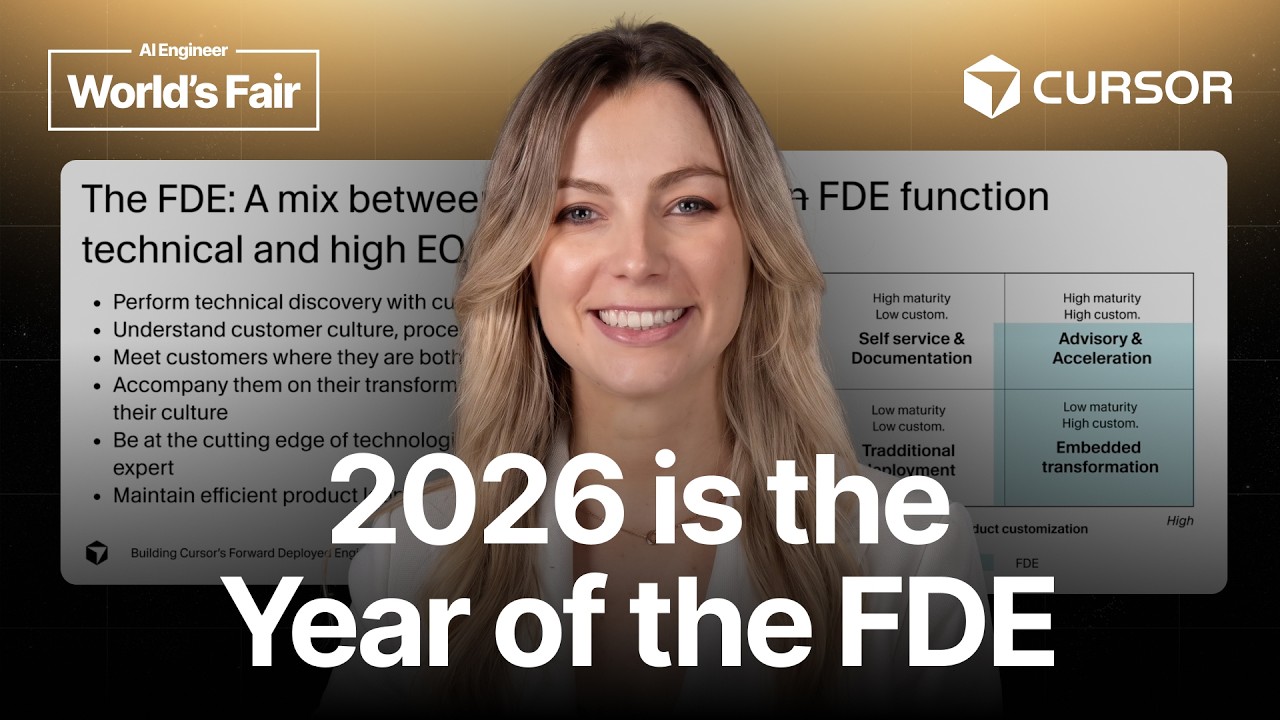
Forward Deployed Engineering at Cursor — Pauline Brunet
Jul 14, 2026 · 20:47
Pauline Brunet, VP of Forward Deployed Engineering at Cursor, explains how to build an effective FDE team by mapping customer digital maturity and product customization to the right engagement model—self-service, traditional SaaS deployment, advisory, or embedded transformation. She defines the ideal FDE as a highly technical engineer with strong customer-facing skills, capable of scoping impactful projects, co-developing with customer teams, and feeding insights back to product. Cursor’s FDE team uses a project-based approach, hires experienced unicorns (5+ year software engineers), and structures around geographies, industries, and product SMEs. Best practices include solving the right problem, defining success metrics upfront, keeping scope directional, involving customers at every step, measuring ROI (revenue, cost, risk), and leaving documentation behind. Brunet advises learning fast, pivoting, partnering with system integrators, and not being afraid to say no to mismatched use cases.

GTM Is You - Victoria Melnikova, Evil Martians
Jul 7, 2026 · 12:35
Victoria Melnikova argues that a founder's personal brand is the most underrated competitive advantage for developer tool startups in 2026, citing interviews with Sam Lambert (Planet Scale), Zeno Rocha, and David Cramer. She presents the Product-Market Fit Compass, a framework from Evil Martians that analyzed 37 successful DevTools, finding that 9 out of 10 times product signal is stronger than revenue, making distribution the bottleneck. Key tactics include moving to San Francisco for network effects, using banners and billboards to signal credibility (as TypeCents did with hundreds of billboards), hosting events like Supabase's user conference, and embracing failures (Zeno Rocha walked away from 300k ARR to start over). Melnikova emphasizes being unapologetically yourself, as AI can amplify but not replace unique personal brands, and notes that founder-led sales builds trust in early-stage startups.

A year of Gemini progress + what comes next — Logan Kilpatrick, Google DeepMind
Jul 10, 2025 · 11:58
Logan Kilpatrick, head of product for Google AI Studio at DeepMind, announces the final update to Gemini 2.5 Pro, which achieves state-of-the-art results on Aider and HLE benchmarks. He details Google's 50x increase in AI inference over the past year, driven by merging research and product teams into DeepMind. The episode outlines Gemini's evolution toward a universal assistant that unifies Google products, with upcoming features including proactivity, native audio and video capabilities (Veo), and smaller models. Kilpatrick also previews developer-focused updates: a SOTA embeddings model, a deep research API, and Veo 3 and Imagine 4 in the API, alongside repositioning AI Studio as a dedicated developer platform.
Your AI Agent Isn't an Engineer: The Art of Thoughtful Anthropomorphism
Feb 22, 2025 · 20:20
Rizel Scarlet, a staff developer advocate at Block, argues that marketing AI agents as "software engineers" creates unrealistic expectations and alienates developers. She explains that such anthropomorphism—attributing human traits to AI—stems from lazy marketing to executives, but it backfires by making developers feel threatened and discrediting products when AI fails to meet human-level performance. Citing a Wired article, she notes 52% of game companies have adopted generative AI, yet 30% of surveyed developers expressed negative sentiment. To build trust, she proposes a framework: understand how AI works (e.g., the agentic loop), use non-human names like "copilot" (pioneered by GitHub), focus on augmentation over replacement, be transparent, give developers control, show real demos (including live troubleshooting), provide clear documentation, and foster open collaboration (e.g., Cursor.Directory). The episode reframes AI as a tool to work in parallel, not a replacement.
Powered by PodHood