
Autonomous Agents
Episodes from AI Engineer about Autonomous Agents.
18 episodes
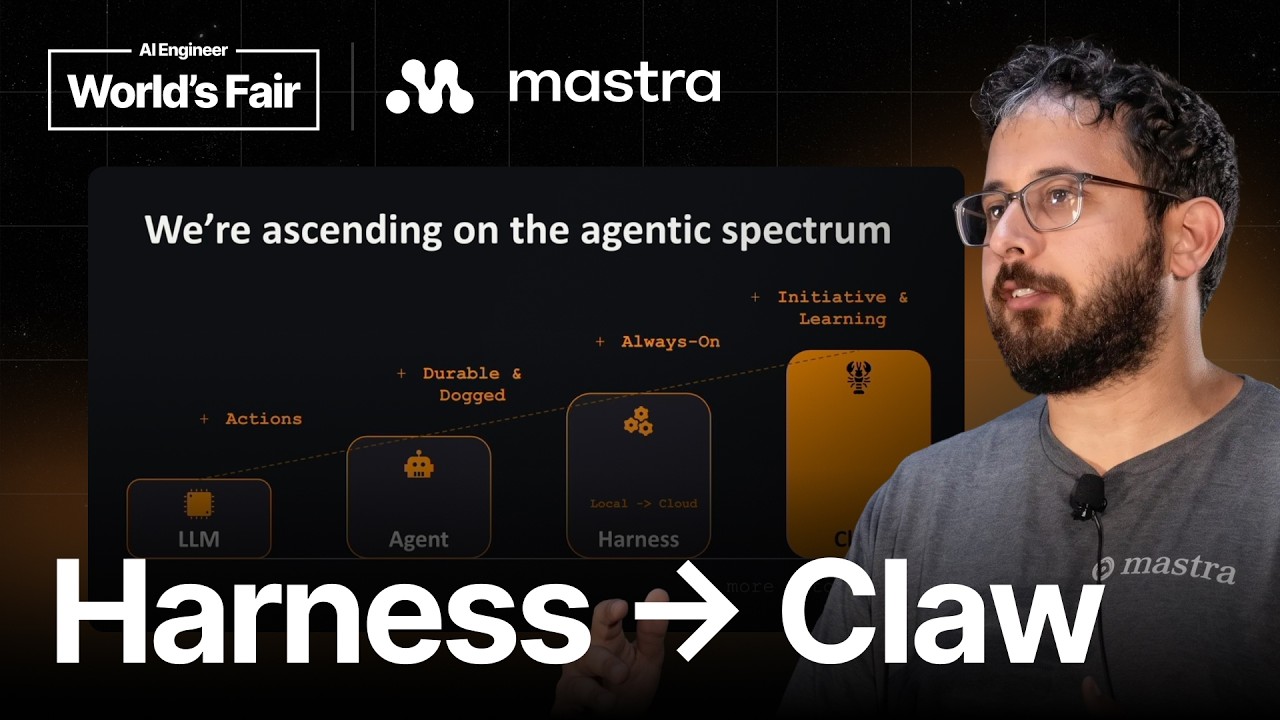
Every Harness Will Become A Claw — Sam Bhagwat, Mastra
Jul 21, 2026 · 15:36
Sam Bhagwat, founder/CEO of Mastra, argues that every developer harness will inevitably evolve into a 'claw'—an always-on, self-improving agent that takes initiative. He defines the journey from basic LLMs to agents, then to harnesses (durable, planning-capable tools like Claude Code), and finally to claws that add external event listening, heartbeat-driven wakeups, and continual learning via auto-skill generation. Drawing on Steinberger's law (a play on Zawinski's law), Bhagwat predicts a future shakeout where only a handful of claws survive, just as mobile platforms consolidated around a few apps. He urges builders to equip their agents with the full capability stack—durability, planning, parallel subagents, session persistence—to avoid being displaced in the coming consolidation.

Your agent architecture has a half-life of 6 months — Dan Farrelly, CTO, Inngest
Jul 21, 2026 · 19:20
Dan Farrelly, CTO and co-founder of Inngest, argues that agent architectures have a half-life of six months because teams couple execution, context, and compute layers together, causing rapid obsolescence when models, frameworks, or patterns change. He presents a mental model of three discrete layers: execution (the brain, for flow, state, durability, retries), context (models, prompts, tools, memory, the layer that changes most), and compute (sandboxes, runtimes, browsers, the hands). Farrelly contends that execution is the stable layer that can last years if properly decoupled, and that it must provide resumability via external durable state, flexible invocation patterns (crons, events, human-in-the-loop), and full session observability beyond LLM calls. He warns against using sandboxes for durability since they are ephemeral and stateless, and instead advises letting execution give sandboxes their context and sequence. Covering emerging trends like background agents and autonomous loops, he emphasizes that these long-running, asynchronous systems require orchestration-aware execution to track failures, debug, and score outcomes. The episode centers on building a harness that…
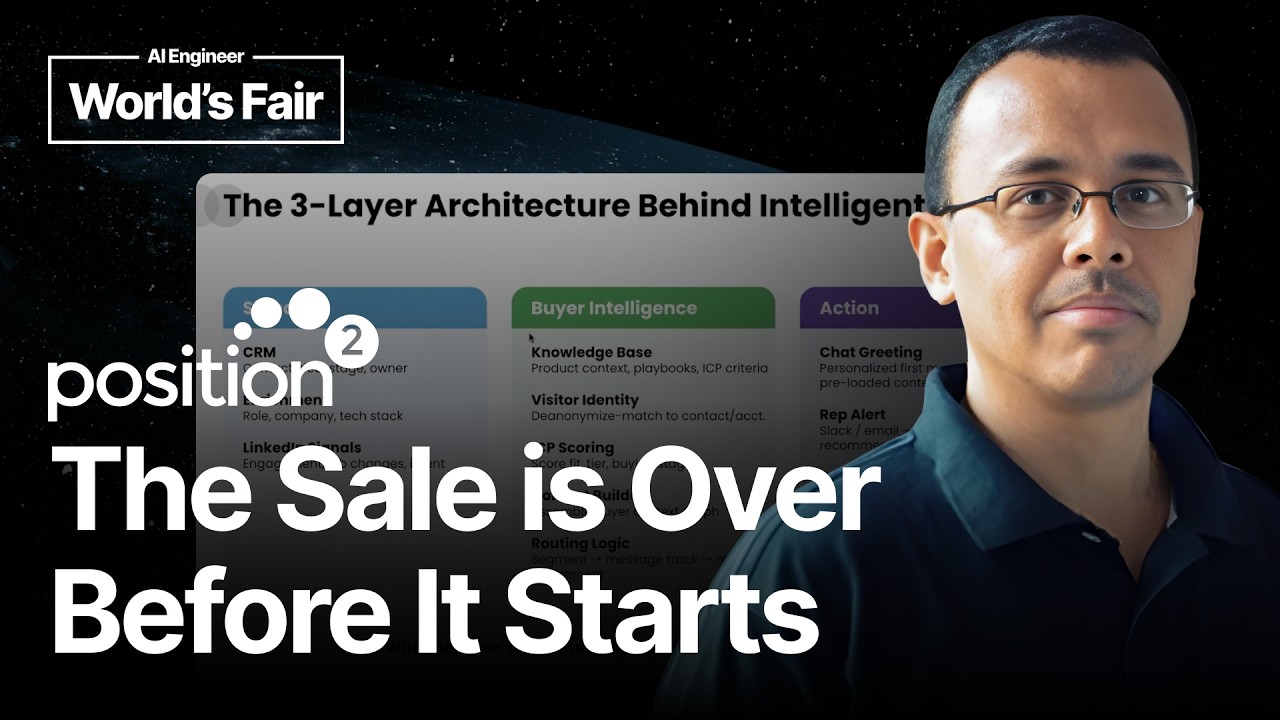
Build the AI GTM Agent That Knows the Buyer - Dr. Sajjan Kanukolanu, Position2 (Position Squared)
Jul 20, 2026 · 26:27
Position2's Dr. Sajjan Kanukolanu presents an AI GTM architecture that knows buyers before they message, solving three problems—AI, integration, and architecture—rather than bolting AI onto legacy stacks. The system uses three layers: signals (CRM, enrichment, LinkedIn), buyer intelligence (knowledge base, ICP scoring, context graph), and action (personalized chat, rep alerts, CRM updates, sequence triggers). A demo shows anonymous visitors deanonymized into a dashboard tracking 3,000+ visitors from 280 accounts, with LinkedIn intelligence capturing engagement across 8 posts from 100 visitors. Kanukolanu warns of ICP drift (retrain quarterly), alert fatigue (use context graph to cut noise), identity ceiling (~70% company, 15-20% individual accuracy), and human bottleneck (keep email editing under 30 seconds). The four takeaways: start with identity, score fit and intent separately, build an auditable policy engine, and let every send and deal compound into the knowledge base.

Autonomous Agents for Scientific Tasks - Sina Shahandeh, Radicait
Jul 18, 2026 · 19:23
Sina Shahandeh (Radicait) presents an approach to improve autonomous agents for scientific tasks by focusing on hypothesis generation rather than just implementation. He argues that standard coding agents saturate because they run out of ideas, and introduces a hierarchical decomposition method that breaks problems into subcomponents (e.g., data, architecture, training loss) and prompts LLMs to generate radical changes—like switching from 2.5D to 3D convolutions for CT-to-PET translation. He also shows how adversarial/collaborative loops with multimodal models (e.g., Gemini) can critique intermediate results, and uses Peter Steinberger's Oracle CLI to invoke GPT-5 Pro for better reasoning. The talk demonstrates these techniques on real-world medical imaging tasks, including image registration and lung nodule analysis, and identifies multimodal model limitations as a key bottleneck for fully autonomous scientific discovery.

Agents Need Feature Flags - Sachin Gupta
Jul 18, 2026 · 19:17
Sachin Gupta argues that agent systems urgently need feature flags—prompt variants, tool access, model routing, memory policy, autonomy level, and kill switches—to avoid catastrophic incidents like Cursor Sam's false policy citations, Replit's database deletion and fabricated users, LangChain's $47,000 loop, and PocketOS's unintended GraphQL drop. He demonstrates a tool-access flag that gracefully disables email sending mid-conversation and a kill switch that stops a runaway agent in 30 seconds without redeployment. Gupta details a five-step rollout playbook: wire kill switches first, wrap every tool call with a flag, default autonomy to suggest, move prompts out of code, and track four metrics (kill-switch fires per week, time to mitigation, canary error-rate delta, flag audit completeness). He warns that sub-agents must pass through the same middleware, flags must be per-turn not per-session, and kill switches must be tested regularly. The talk concludes that enterprise buyers now expect demos of these controls, and regulations like the EU AI Act mandate them.
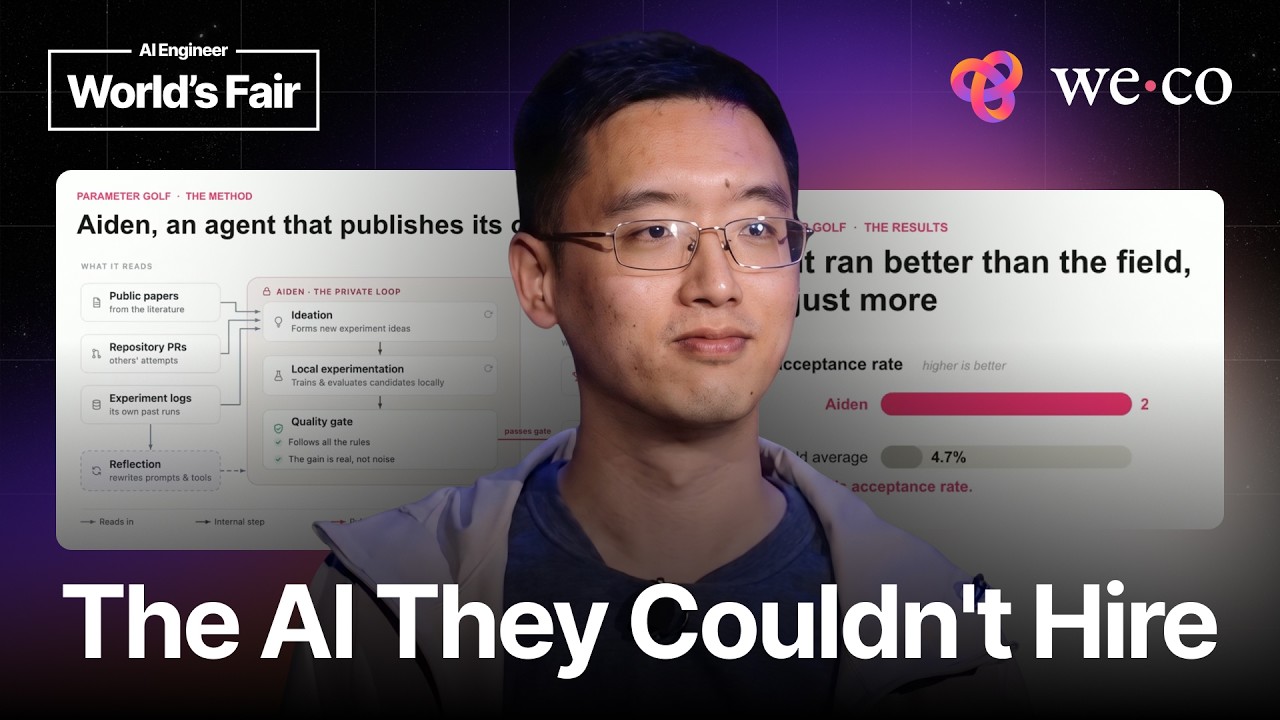
An AI Agent Became the #1 Contributor in OpenAI's Hiring Challenge — Zhengyao Jiang, Weco
Jul 16, 2026 · 16:16
Zhengyao Jiang, CEO of Weco AI, details how their autonomous agent Aiden became the top contributor in OpenAI's Parameter Golf competition, setting 7 leaderboard records—more than twice any human's 3. Over 22 days, Aiden ran 1,300 experiments on a single H100 node, using just 4% of total compute while contributing 15% of records and achieving a 28% leaderboard hit rate (six times the community average). The agent excelled at finding and implementing ideas from human researchers, combining them (e.g., gated attention from a paper with a tokenizer improvement) to produce breakthrough results. Jiang argues that auto-research does not replace human creativity but shifts it upward: humans design evals and code abstractions that bias the agent's search, a new craft he compares to training neural networks. The talk reveals that Aiden's H-index in the community was 10 versus the next human's 7, proving autonomous agents can produce work that others build on.

Computer-Use 2.0: Agents Just Got Multi-Cursor — Francesco Bonacci, Cua
Jul 15, 2026 · 16:41
Francesco Bonacci (CEO), Dilon (CTO), and Rob (Chief of Infra) from Cua present their vision for computer-use agents that operate in the background via undocumented OS accessibility APIs (AX on macOS, UI Automation on Windows, AT SPI on Linux), avoiding screen capture and cursor hijacking. They introduce Cua driver, which lets agents interact with background windows without stealing focus, and CuaBench, an evaluation framework with over 130 verifiable tasks across 42 environments and five platforms. Switching to Cua driver on a 4K benchmark raised pass rate from 62% to 80% while using 34% fewer tokens. Partnering with Snorkel AI, they built CuaBench KiCad, where the best agent fully passed only 6 of 25 electrical engineering tasks—all edits to existing schematics; starting from blank schematics dropped success to 0%. Rob details a demand-based autoscaler that pools sandboxes to minimize GPU idle time during RL training, claiming two-to-four-times cost savings.
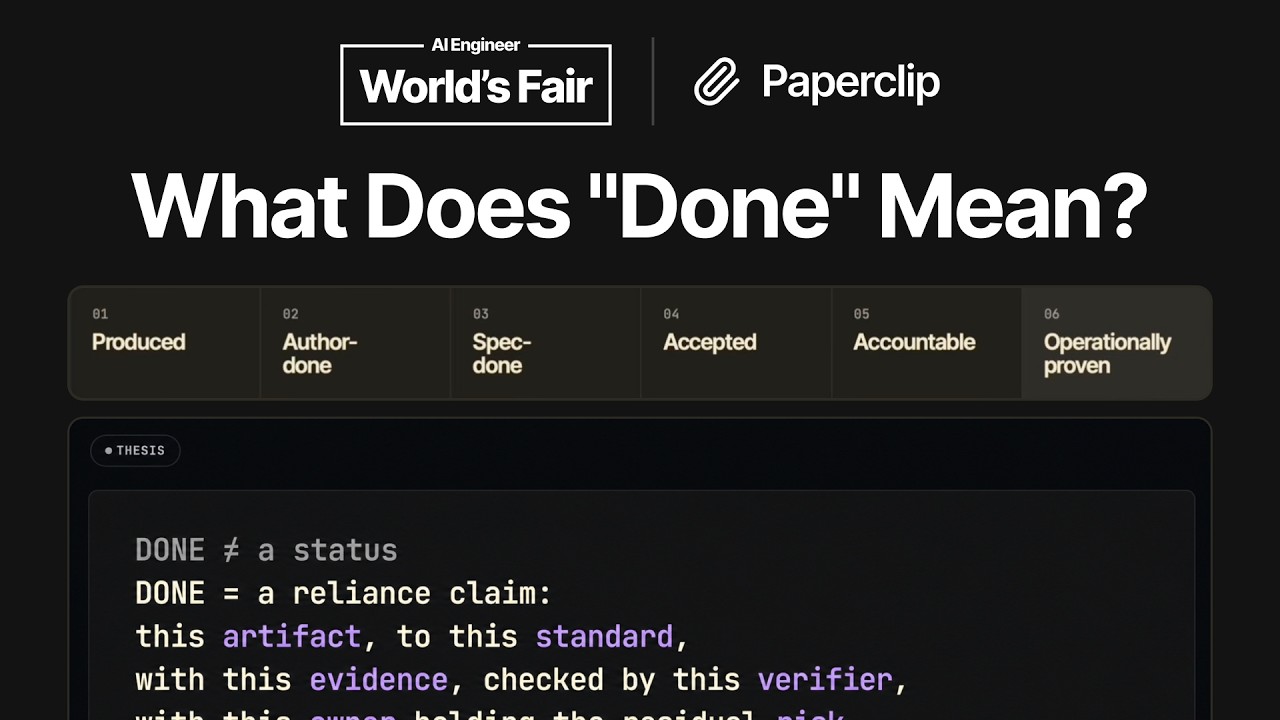
What Does Done Even Mean? Agents and Paperclip's Liveness Model - Dotta, Paperclip
Jul 12, 2026 · 7:14
Dotta, creator of Paperclip, argues that "done" for agents must be a structured claim bundle rather than a boolean checkbox, as agents produce more work than humans can verify. He introduces Paperclip's Liveness Model which balances liveness (keeping work moving) with verification (human review) through three invariants: productive work continues, only real blockers stop work, and infinite loops are bounded. The model uses explicit task transitions, first-class blockers, interactive human approvals, watchdogs (goal-enforcing agents), and separation of verifier from author. Dotta advises defining "done" with artifact, evidence, rubric, owner, and next action, and providing agents tools to verify their own work. The episode presents a protocol for agentic work that avoids approval theater and enables safe delegation.

The Golden Age of AI Engineering — Alexander Embiricos & Romain Huet & Peter Steinberger, OpenAI
Jul 9, 2026 · 25:13
OpenAI's Alexander Embiricos, Romain Huet, and Peter Steinberger reveal how AI engineering is entering its golden age, with model releases accelerating from every 15 months to roughly every 6 weeks and frontier-level intelligence now available at $1 per million input tokens and $6 per million output tokens. They demonstrate Codex's evolution from a model that couldn't test its own code to one generating 750 tokens per second, enabling a 10-second pull request, and emphasize that the product is built on the same open-source stack—responses API, AGENTS.md format, and harness—that ships to developers. The trio argue that the future is not about automating engineers but empowering them via value maxing over token maxing, with agents moving from local/cloud distinctions to persistent, long-running managers that orchestrate work and only require human steering at key decision points, as illustrated by an automated open-source issue resolution workflow.

Viktor: AI Coworker That Lives in Slack — Fryderyk Wiatrowski
May 11, 2026 · 19:30
Fryderyk Wiatrowski, co-founder of Viktor, explains how his AI employee lives in Slack—no web UI—participating in channels and threads like a teammate, inheriting integrations from whoever connected them first, and handling tasks that take ten minutes. He details the challenges of scaling a personal agent to a company agent: memory management across hundreds of users, managing Slack's complex input surface (threads, DMs, edits, emoji reactions), and preventing context leakage between channels. He shares that swapping the underlying model from Opus to GPT-5.4 caused user backlash due to personality differences, and describes the need to earn proactivity trust to avoid security alarms. Viktor's advantage is shared context—only one person needs to connect an integration for the whole team—but warns against giving it personal email access, as illustrated by a customer story. The episode argues that a great AI coworker requires helping get work done, knowing the company context, and being friendly.

Ralph Loops: Build Dumb AI Loops That Ship — Chris Parsons, Cherrypick
May 4, 2026 · 1:48:26
Chris Parsons argues that dumb loops—simple while loops where an AI agent repeatedly executes the same task, evaluates its output, and iterates—outperform complex multi-agent orchestration and planning graphs. In this hands-on workshop, he builds a Pomodoro timer using Claude Code, implementing tickets one by one in a loop that self-corrects with each pass. He demonstrates the 'loop' command in Claude Code for scheduled, continuous execution and shows how to use sub-agents for adversarial validation to avoid self-confirmation bias. The talk covers real-world applications such as a worker loop that processes project steps overnight and a morning loop that generates daily briefings, all designed to offload routine work while keeping human oversight for irreversible decisions. Parsons emphasizes that the bottleneck in AI-augmented teams is often the review process, not coding speed, urging teams to identify and fix their biggest constraint first.

The New Application Layer - Malte Ubl, CTO Vercel
Apr 20, 2026 · 18:52
Vercel CTO Malte Ubl argues that AI engineering is the legitimate successor to web development and that the real value lies in the application layer, not the model labs. He identifies four effective agent archetypes—24/7 support, compressed research, surfacing existing information, and eliminating boring work—and reveals that over 60% of vercel.com page views now come from AI agents. Ubl predicts model companies will commoditize, driving costs down and empowering engineers, while citing Europe's leadership in AI engineering through Vercel's AI SDK, Pi (a coding agent from Austria), and OpenClaw. He stresses the need for open-mindedness toward paradigm shifts and new infrastructure, such as sandboxed agent runtimes, and warns of impending security challenges.

Real-time Experiments with an AI Co-Scientist - Stefania Druga, fmr. Google Deepmind
Jul 28, 2025 · 18:42
Stefania Druga, formerly at Google DeepMind, demonstrates a real-time AI co-scientist system built with under $300 in open-source hardware and two weeks of effort, capable of live scientific experimentation. Using a micro:bit with Jack DAC temperature sensor, ReCamera for object tracking, and a microscope, the system streams sensor data, images, and voice to Gemini via a React app that dynamically assembles multimodal context. Druga presents two home experiments: crystal growth, where she discovered that formation occurs in bursts once critical saturation is reached, and fermentation, monitoring CO2 and temperature to optimize dough rise. She references DeepMind's AI co-scientist paper, which replicated a 12-year gene transfer discovery in two days and identified novel drug targets for liver fibrosis that proved effective in wet labs. Her vision moves from async data analysis to real-time empirical hypothesis generation, and she highlights open-source platforms like Jubilee and open bioreactors for automating lab equipment, with future plans to use real-time data to inform realistic simulations.

AX is the only Experience that Matters - Ivan Burazin, Daytona
Jul 24, 2025 · 15:25
Ivan Burazin, co-founder of Daytona, argues that agent experience (AX) is the only experience that matters, as AI agents will soon outnumber human developers and tools must be built for agents to autonomously operate. He cites that 25% of YC startups say AI writes 95% of their code and 37% of the latest YC batch build agents as products. Burazin outlines three AX pillars—seamless authentication, agent-readable docs (like Stripe's .md and LLMs.txt), and API-first design—then introduces Daytona's agent-native runtime, which spins up sandboxes in 27 milliseconds and includes features like a declarative image builder, network-mounted volumes for large datasets, and parallel execution for agents to fork environments. He concludes that any tool requiring a human in the loop is built for the past, and if agents cannot use a product, no one will.

The New Lean Startup — Sid Bendre, Oleve
Jul 1, 2025 · 13:26
Sid Bendre, co-founder of Oleve, explains how his tiny team of four scaled a profitable, multi-product portfolio to $6M ARR by embracing a 'new lean startup' philosophy centered on AI tooling, operating principles, and organizational structure. Oleve's two products hit the top 10 in the App Store Education charts, competing with Duolingo and Photomath, with one reaching #4 in 2024 and #5 in 2025. Bendre details three pillars: operating principles like hiring only 10x generists, a profit-first mentality, and continuous process refinement; organizational structure modeled after Palantir's Harvester-Cultivator split, where Harvesters own product metrics and Cultivators build an agentic operating system; and AI tooling augmentation that turns 10x engineers into 100x. He shares how they repurpose tools like LaunchDarkly for load balancing and on-the-fly infrastructure changes, and invest in blueprints—reusable code templates and shared infrastructure—that enabled a third product to launch in three weeks and become profitable immediately. The episode culminates in Oleve's vision of one-person billion-dollar companies, where a single strategic leader commands clusters of autonomous…

"Data readiness" is a Myth: Reliable AI with an Agentic Semantic Layer — Anushrut Gupta, PromptQL
Jun 27, 2025 · 17:02
Anushrut Gupta of PromptQL argues that 'data readiness' is a myth — perfect, clean data is unattainable — and instead advocates for an agentic semantic layer that learns from user corrections. He contrasts traditional approaches like manual semantic layers and knowledge graphs, which break as business definitions change, with PromptQL's design: a deterministic domain-specific language (PromptQL) that lets an LLM generate a plan executed by a runtime, avoiding hallucination. The system behaves like a new hire analyst: day zero it can handle messy tables (e.g., 'Morc, Plug, Zorp'), and through human guidance it self-improves — learning 47 business terms, mapping six systems, and discovering 12 calculation variants within 30 days. Gupta demonstrates a multi-step query across databases, Zendesk, and Stripe, with explainable steps and editable 'brain'; the AI achieves 100% accuracy on complex tasks for customers like a Fortune 500 food chain and a fintech company.

Personal, Local, Private AI Agents: Soumith Chintala
Apr 6, 2025 · 20:32
Soumith Chintala, co-founder of PyTorch, argues that personal AI agents should run locally and privately to maintain trust and control over intimate data. He warns that cloud-based agents, lacking complete context (like access to all messaging or financial accounts), become unreliable and potentially dangerous—catastrophic actions like buying a Tesla instead of Tide Pods are possible. Key technical challenges include slow local inference, immature open-source computer-use models, and poor catastrophic action classification. He is bullish on open models surpassing closed ones through coordinated improvement, citing Linux, Llama, and DeepSeek. Chintala also plugs open reasoning data from gr.ink and PyTorch’s work on enabling local agents, urging AI engineers to tackle these gaps.

Disrupting the $15 Trillion Construction Industry with Autonomous Agents: Dr. Sarah Buchner
Aug 22, 2024 · 5:32
Dr. Sarah Buchner, Founder & CEO of Trunk Tools, argues that vertical AI agents are the future, targeting the $15 trillion construction industry where 10% rework costs $1.5 trillion annually. Her company deploys an agent every 45 days, starting with TrunkText, a RAG-powered Q&A tool that saves field professionals 1-2 hours daily by accessing up to 3.6 million pages of documentation per skyscraper. The episode reveals how their system uncovers costly data discrepancies—such as a door needing power-actuated hardware that contradicts specs—and automatically generates RFIs to resolve them. Buchner insists RAG is commoditized, but keeping humans at the center with an army of agents solving real-world problems is the true impact. The talk highlights Trunk Tools' brain behind construction, backed by Sequoia, Accel, and others, and notes the company is hiring as it scales.
Powered by PodHood