
AI Product Management
Episodes from AI Engineer about AI Product Management.
13 episodes
Your AI Product Will Fail Unless You Can Explain It - Veronica Hylak, Hey AI
Jul 5, 2026 · 6:02
Veronica Hylak, an AI product leader with explainers reaching 8 million views, argues that AI products fail because founders cannot explain them clearly, and offers a 3-part fix: identify the wound (the customer’s biggest pain point), make the product click by tying it to a viral story like McDonald's AI drive-thru disaster, and show the transformation from before to after using the product. She demonstrates by contrasting bad pitches like 'agentic orchestration platform' with a wound-first approach: security teams overwhelmed by disconnected tools, then the solution unifies everything. Hylak insists on banning abstract words and instead using mental images like 'smoke alarm for AI behavior.' The episode delivers a concrete framework for turning complex AI into a story people instantly understand and buy, warning that great tech dies quietly if nobody gets it.
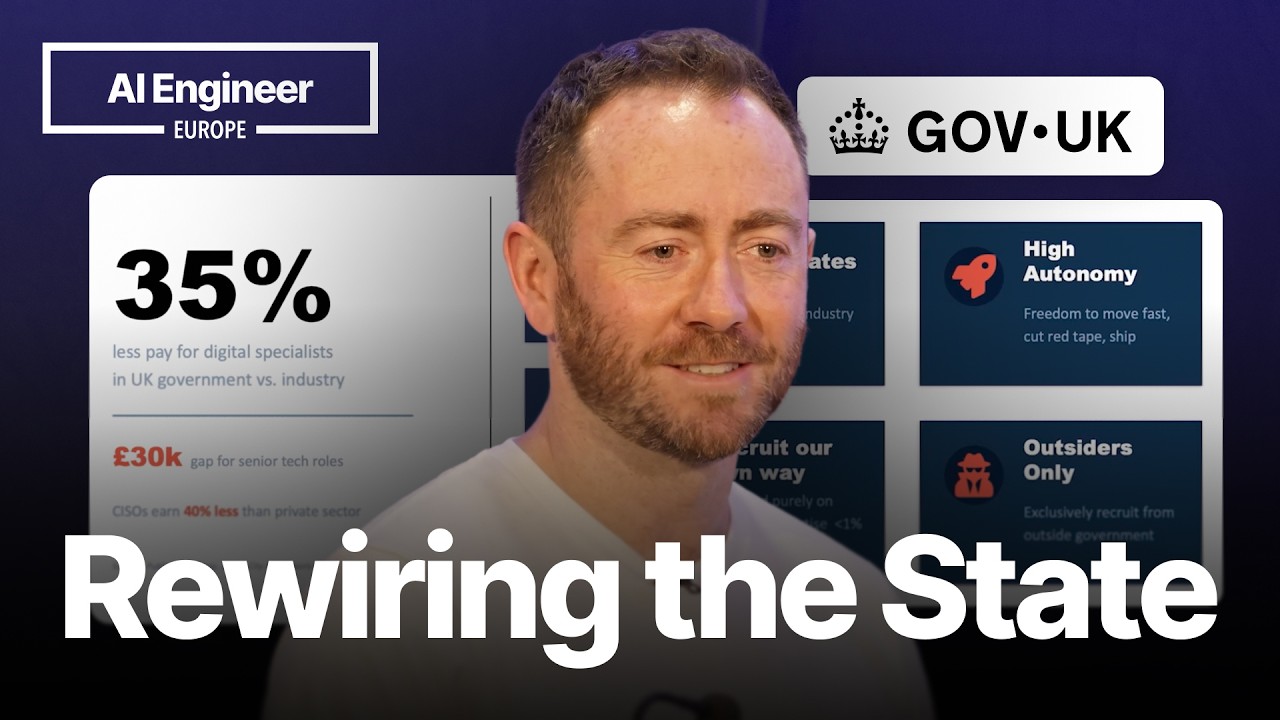
Rewiring the State — Eoin Mulgrew, No. 10 (Downing Street)
May 18, 2026 · 28:18
Eoin Mulgrew, from the Number 10 Data Science team, details how a small insurgent unit at the center of UK government bypasses bureaucracy to rapidly deploy AI. The team recruits exclusively outsiders (0.7% acceptance rate), pays market rates, and ships tools in weeks. Examples include an engineer who saved £1.5M by building a statute-book analysis tool in two weeks, a policy simulation platform for Universal Credit, a delivery red-teaming PMO, and a public service that went from idea to live in two months. The team also placed fellows in the AI Safety Institute, the Incubator for AI (co-creating Xtract with DeepMind to digitize planning applications), and Justice AI, which embeds engineers in prisons. Mulgrew closes with Will, a Y Combinator founder and Harvard dropout, standing outside HMP Wormwood Scrubs with the keys two weeks into the job, urging talented technologists to 'join us, and we'll give you the keys to the state.'

Shipping AI That Works: An Evaluation Framework for PMs – Aman Khan, Arize
Dec 26, 2025 · 1:26:16
Aman Khan, AI PM at Arize, presents a framework for product managers to evaluate LLM-powered products beyond gut-feel 'vibe checks.' He demonstrates building an AI trip planner with multi-agent LangGraph, then using Arize's tracing and prompt playground to iterate on prompts. Khan shows how to create datasets from production traces, run A/B experiments on prompts, and use LLM-as-a-judge evals for friendliness and discount offers, comparing against human labels to refine evaluators. He argues evals are the new requirements docs, enabling PMs to own the product experience by writing acceptance criteria as eval datasets. The talk covers building eval teams, handling variance with temperature settings, and continuously improving golden datasets with hard examples, citing real-world analogies from self-driving cars at Cruise.

Why your product needs an AI product manager, and why it should be you — James Lowe, i.AI
Jul 28, 2025 · 18:37
James Lowe, Head of AI Engineering at the UK Government's Incubator for AI, argues that technical expertise makes AI engineers ideal candidates for the critical role of AI Product Manager, which balances business viability, technological feasibility, user desirability, and the core question of possibility. He shares three hard-won lessons from building products like CONSULT, Minute, and Redbox: resolve AI uncertainties early with evaluations and real-user tests (achieving 1,000x faster and 400x cheaper consultation analysis), experiment widely with features then cut back (streamlining a transcription tool from overwhelming options to a focused Justice Transcribe used for Prime Ministerial meetings), and pivot harder than ever as the landscape shifts (Redbox evolved from digitizing ministerial red boxes to a secure LLM chat client, then to an MCP-based tool provider when Microsoft Copilot Chat went free). The episode emphasizes that AI product management is a mindset, not just a title, and that engineers should step into this leadership gap to build impactful AI products.
Building AI Products That Actually Work — Ben Hylak (Raindrop), Sid Bendre (Oleve)
Jul 24, 2025 · 18:42
Ben Hylak (Raindrop) and Sid Bendre (Oleve) argue that building reliable AI products requires iterative real-world signals over traditional evals. Ben debunks eval myths—evals don't measure product quality, LLM-as-judge fails, and production evals are costly—and stresses tracking explicit signals (thumbs up/down, copy rate) and implicit signals (refusals, frustration) to identify issues. Sid introduces Trellis, a framework for scaling viral AI apps that uses discretization—breaking infinite output into intent buckets—prioritization by volume times negative sentiment times achievable delta, and recursive refinement. Starting with an MVP, teams classify user intents, convert them into semi-deterministic workflows, then repeatedly drill into sub-intents to engineer repeatable, attributable magic. Oleve's approach, powered by Raindrop, has scaled six viral products to $6M ARR profitably with four people.

Build Dynamic Products, and Stop the AI Sideshow — Eliza Cabrera (Workday) + Jeremy Silva (Freeplay)
Jul 23, 2025 · 18:10
Eliza Cabrera (Principal AI Product Manager at Workday) and Jeremy Silva (Product Lead at Freeplay) argue that companies must stop treating AI as a separate 'sideshow' and instead deeply integrate it into product strategy using a crawl-walk-run approach to build dynamic, differentiated experiences. They explain that bolt-on AI products result from centralized AI strategies quarantined from core product, leading to features like chatbots that demonstrate capability but don't solve real customer problems. Workday's example shows starting with Gen AI content generation and translations for knowledge bases (crawl), then a contextually aware assistant that processes PII (walk), and finally agentic capabilities that autonomously act on policy changes (run). The north star is AI products that feel like natural, cohesive parts of the experience, not bolt-on enhancements.

Shipping an Enterprise Voice AI Agent in 100 Days - Peter Bar, Intercom Fin
Jul 18, 2025 · 17:10
Peter Bar, Product Lead at Intercom, details the 100-day build of Fin Voice, an AI voice agent for enterprise phone support. The agent handles knowledge-based queries using a stack of speech-to-text, LLM, text-to-speech, RAG, and telephony, achieving ~1 second latency for simple queries and using filler phrases for longer ones. Key product decisions included focusing on out-of-office hours as an initial wedge, designing conversations for voice differences like answer chunking, and prioritizing integration with human support workflows over model improvements. The team measured success via resolution rate (user confirming resolution or not calling back within 24 hours) and used an LLM-as-judge for quality analysis. Bar argues that voice AI is the next frontier in customer service, citing cost reduction from $7–12 per human-handled call to 3–20 cents per minute with AI.
The Build-Operate Divide: Bridging Product Vision and AI Operational Reality
Jul 2, 2025 · 12:50
Jeremy Silva (Freeplay) and Chris Hernandez (Chime) argue that the biggest challenge in generative AI isn't building prototypes but crossing the 'quality chasm' from v1 to reliable v2 through operational iteration. They explain how the lower barrier to entry and faster iteration speed in Gen AI accentuate the need for high-quality ops, where product quality becomes a direct function of how fast teams move through monitoring, experimentation, and evaluation loops. Chris emphasizes that human-in-the-loop isn't just a safeguard but a feedback engine, and that existing QA and CX teams in operations are already equipped to become 'model shapers'—labeling data, testing prompts, and defining what good looks like. Jeremy introduces the emerging role of the 'AI quality lead,' a systems thinker who can run experiments and evaluations without writing production code. They conclude that scaling Gen AI is an operational and people challenge, not just a technical one, and that embedding quality and human feedback early is the key to building faster and better.

The New Lean Startup — Sid Bendre, Oleve
Jul 1, 2025 · 13:26
Sid Bendre, co-founder of Oleve, explains how his tiny team of four scaled a profitable, multi-product portfolio to $6M ARR by embracing a 'new lean startup' philosophy centered on AI tooling, operating principles, and organizational structure. Oleve's two products hit the top 10 in the App Store Education charts, competing with Duolingo and Photomath, with one reaching #4 in 2024 and #5 in 2025. Bendre details three pillars: operating principles like hiring only 10x generists, a profit-first mentality, and continuous process refinement; organizational structure modeled after Palantir's Harvester-Cultivator split, where Harvesters own product metrics and Cultivators build an agentic operating system; and AI tooling augmentation that turns 10x engineers into 100x. He shares how they repurpose tools like LaunchDarkly for load balancing and on-the-fly infrastructure changes, and invest in blueprints—reusable code templates and shared infrastructure—that enabled a third product to launch in three weeks and become profitable immediately. The episode culminates in Oleve's vision of one-person billion-dollar companies, where a single strategic leader commands clusters of autonomous…
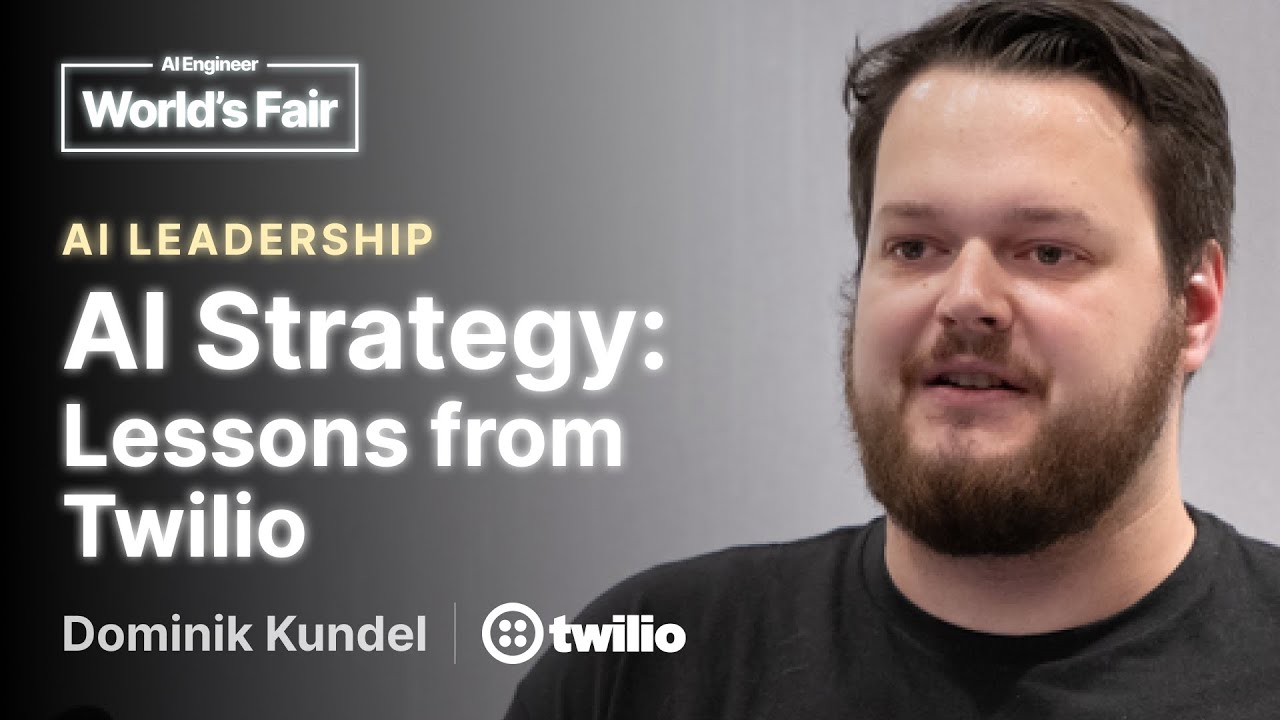
Cooking with fire without burning down the kitchen: Dominik Kundel
Dec 31, 2024 · 20:35
Dominik Kundel, who leads product and design for Twilio's Emerging Tech & Innovation team, explains how the company balances disruptive AI innovation with its existing communications and customer data platform businesses. He distinguishes sustaining innovation (e.g., Apple's AI features) from disruptive innovation (e.g., agents not yet enterprise-ready due to quality and cost), arguing that ignoring disruptive AI is increasingly dangerous because quality improves daily. Kundel shares three key lessons from Twilio's AI journey: first, ship early and often—even rough prototypes—to gather real feedback, which led to the Twilio Alpha sub-brand for setting expectations; second, build a curious, problem-owning team rather than requiring existing AI expertise; third, share learnings internally and externally to avoid operating in a silo and to help customers be thought leaders. He recounts how an initial AI personalization engine was too disruptive for mainstream R&D, so the team iterated on an AI Assistance agent builder, using internal hackathons and dogfooding with low-risk use cases like IT helpdesk to improve quality before broader release.
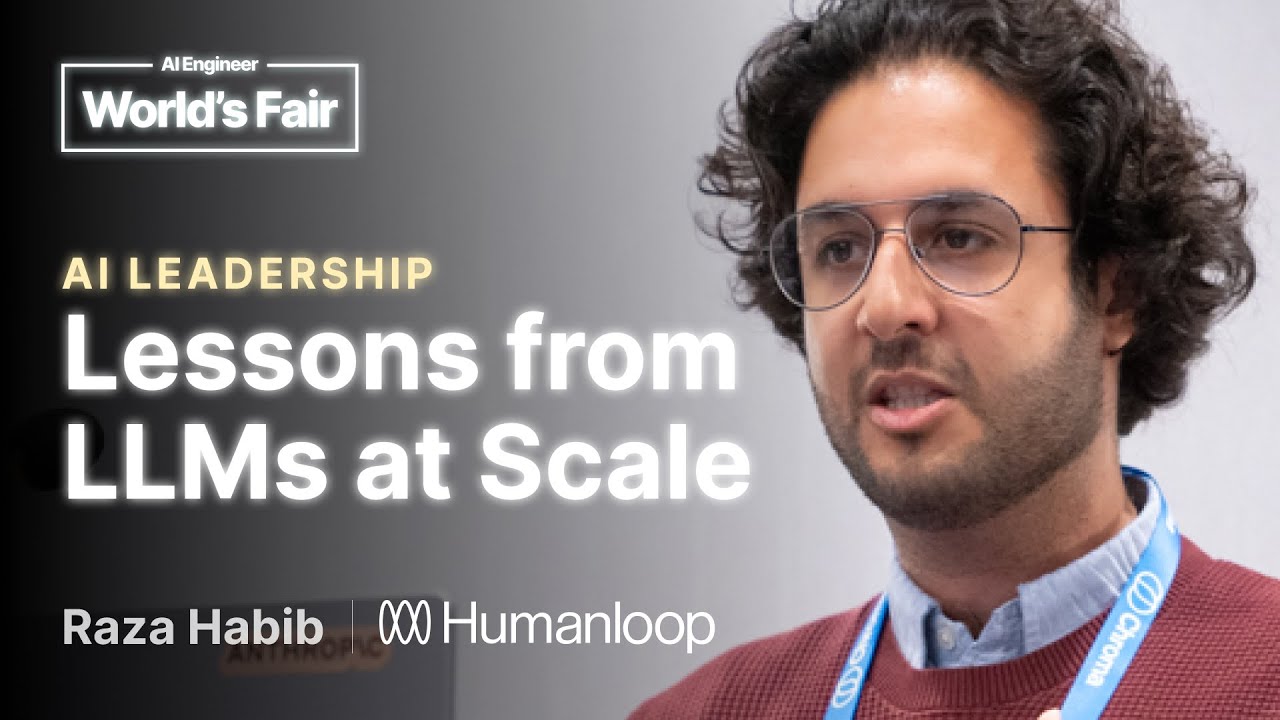
Real ROI: Lessons from Enterprises that have already succeeded with LLMs at Scale: Raza Habib
Dec 31, 2024 · 20:01
Raza Habib, CEO of Humanloop, shares lessons from enterprises like Duolingo, Filevine, and Ironclad that have achieved real ROI with LLMs at scale. He argues that success hinges on centering domain experts (e.g., Duolingo's linguists do all prompt engineering), needing less ML expertise than expected, and breaking down evaluation into small, testable components rather than chasing a single metric. Habib emphasizes collecting end-user feedback (acceptance rates, edits, thumbs up/down) and building tooling for logging, regression testing, and team collaboration. Filevine doubled revenue by launching six LLM-powered products; Ironclad's open-source Rivet logging tool enabled agents to auto-negotiate 50% of contracts. The talk covers how to optimize the four-component chain (base model, prompt, data selection, function calling) and why simpler systems will win as models improve.

The AI emperor has no DAUs why most devs still don't use code AI: Quinn Slack
Nov 20, 2024 · 18:45
Quinn Slack, CEO and cofounder of Sourcegraph, argues that despite massive hype, only about 5% of professional developers actually use Code AI tools, with total recurring revenue from Code AI sitting at roughly $300 million ARR—a fraction of Salesforce's $36 billion. He cites GitHub's 1.3 million paid Copilot subscribers and just 935,000 yearly active users receiving suggestions, revealing the gap between perception and reality. Slack warns that the entire AI ecosystem—foundation models, infra, and applications—risks collapse if usage doesn't grow, and most revenue in AI flows to NVIDIA and chip makers, not software. From building Cody, the number two Code AI product, he shares lessons: hype fools everyone, autocomplete is a freakishly good feature that spoils expectations, while chat and agents are harder to vet and adopt. He advises builders to use their own product daily, ignore customer demands for buzzwords like fine-tuning, and manually build explicit interactions before adding magic. Slack concludes that the industry must collectively dehype and focus on real daily active users to turn the potential into sustained enterprise revenue.

The AI Pivot: With Chris White of Prefect & Bryan Bischof of Hex
Nov 7, 2023 · 35:16
Chris White (CTO of Prefect) and Bryan Bischof (Head of AI at Hex) detail how their non-AI startups successfully pivoted to integrate AI, arguing that ruthless prioritization and deep product integration are key. White explains Prefect built the open-source Marvin project to learn from LLM experimenters, while adding AI features like error summaries to its core orchestration product, but had to restrain over-enthusiasm from engineers. Bischof describes Hex's Magic feature as an augmentation, not a separate product, and explains they built their own evaluation system but chose not to build a vector database, and killed a promising feature called Crystal Ball to avoid splitting the product experience. They both emphasize machine-to-machine interfaces and typed outputs, and caution that the work is often tedious data engineering. Their hot takes: White says stop building chat interfaces, AI is a tool; Bischof warns that the journey is boring but worth it.
Powered by PodHood