
AI Product Design
Episodes from AI Engineer about AI Product Design.
30 episodes

The UX of AI: Making AI-Powered Apps Your Users Don't Hate - Kathryn Grayson Nanz, Progress Software
Jul 18, 2026 · 35:59
Kathryn Grayson Nanz, Senior Design and Developer Advocate at Progress Software, argues that the success of AI-powered applications now depends on user experience rather than model performance. She identifies five pillars—trust, clarity, control, transparency, and meaningful benefit—and provides concrete patterns: citing sources to build trust, streaming text for clarity, allowing undo and version history for control, requesting granular permissions for transparency, and offering templates and next-step actions to ensure meaningful benefit. She emphasizes that developers must design these patterns themselves because AI can only remix existing interfaces, and that users need gradual introduction to AI features to avoid disengagement. The talk stresses that without addressing these UX challenges, users will abandon AI tools after a few failed attempts.
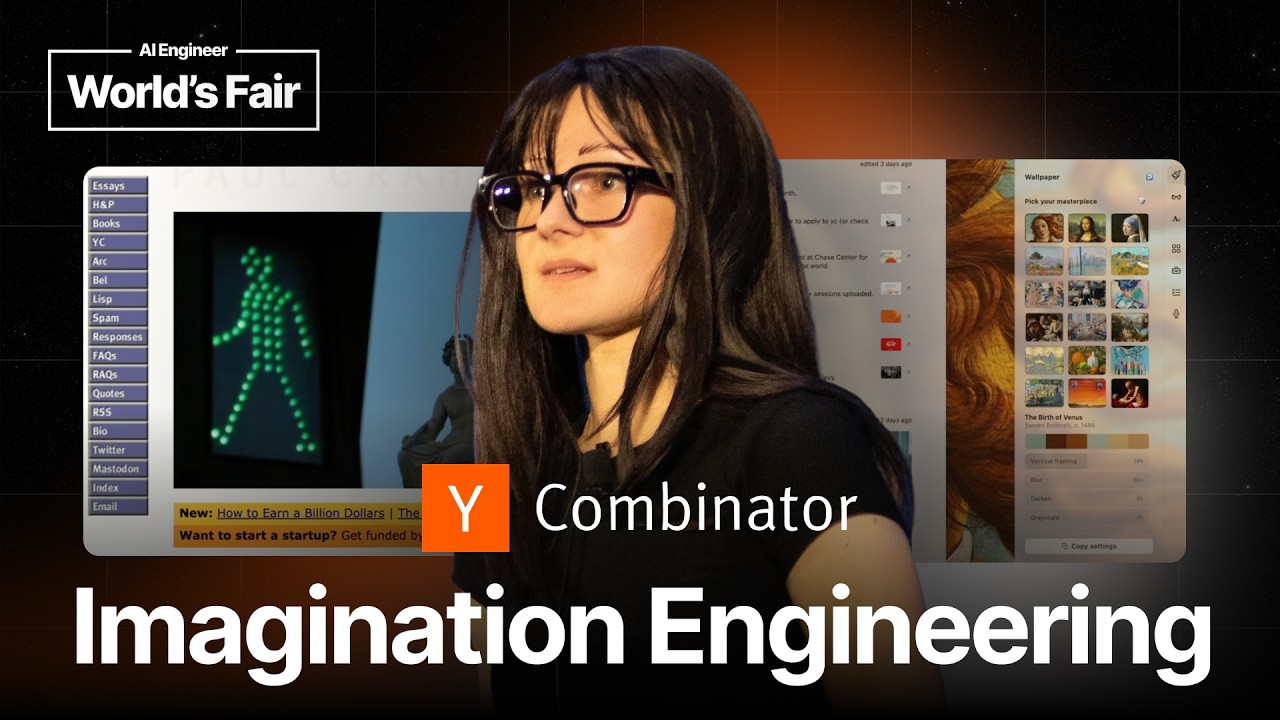
Imagination Engineering — Eve Bouffard, Head of Design, Y Combinator
Jul 16, 2026 · 16:04
Eve Bouffard, Head of Design at Y Combinator, introduces 'Imagination Engineering' as the art of stretching the mind to invent what seems impossible, arguing that idea generation is the new bottleneck as AI models become incredibly capable. She shares her experiment in 'thinking in public' with a Slack channel called 'Eve Thoughts,' where she dumps her stream of consciousness, and then used Opus 4.8 to build a personalized website (EveBouffard.com) that aggregates and visualizes those thoughts. The site dynamically surfaces her projects, quotes, tools, and books, and even applies shaders and translations. She also built 'Shape of Minds'—a tool that analyzes commonalities across history's greatest minds, revealing patterns like taking naps and barely eating. Bouffard demonstrates how to spin up agents on demand for learning and productivity, emphasizing that anyone can now create software on the fly from their stream of consciousness.

Chat and citations won't save your vertical AI - Atul Ramachandran, Filed Inc
Jul 11, 2026 · 15:12
Atul Ramachandran, CTO and co-founder at Filed, argues that chat interfaces and citation trails fail vertical AI because they shift the verification burden back to users, making every error catastrophic. Drawing from Filed's work building AI data entry for tax firms—where they hit 80%+ accuracy against a 50-60% baseline yet still faced complaints—he explains that the real fix is to design for delegation, not participation. He proposes treating the product as a conveyor belt where users are supervisors, using long-running background agents, automatic skills that capture user quirks, monitoring via traces, and control mechanisms like plan approval before irreversible actions. Ramachandran advocates measuring weekly active sessions instead of weekly active users, aiming for sessions to rise while direct user interaction falls. The episode covers these four pillars and the shift in metrics needed to build successful vertical AI products.

Build AI Systems for Discernment, Not Approval - Angel Ortmann Lee, Duolingo
Jul 7, 2026 · 25:53
Angel Ortmann Lee, a Software Engineer at the Duolingo English Test, argues that human-in-the-loop AI systems often fail because humans cognitively surrender—adopting AI output with minimal scrutiny, as seen in a Wharton study where 80% accepted wrong AI answers. At Duolingo, an experiment with fake AI cheating alerts showed skilled proctors flagged legitimate sessions 50% of the time due to automation bias. A simple guideline change emphasizing independent evidence boosted accurate rejections by 21%, proving the fix lies in engineering the interaction, not better models or oversight. Lee outlines design principles: engineer reasoning patterns (e.g., frame humans as investigators), match friction to stakes (add review gates for high-stakes decisions), treat every interaction as a label (capture diffs when humans override AI), and proactively define success metrics to structure interactions that yield high-quality data. The flywheel of intentional design yields a virtuous cycle of better data, models, and human judgment.

The Prompt Is Still a Punch Card - Ted Johnson, JoinIn AI
Jul 2, 2026 · 20:13
Ted Johnson argues that AI interfaces still use the batch protocol of punch cards, forcing humans to adapt to machines rather than the reverse. He introduces three concepts—channel, expression, protocol—to show how expression exploded with LLMs but the protocol remained static. Examples include voice mode misinterpreting a side conversation, PersonaPlex's turn-taking, and a meeting AI that follows group dynamics without prompts. Johnson calls for designing interfaces where AI understands timing, ambiguity, and shared context, moving from prompting to genuine communication.

OpenClaw in Your Hand: Building a Physical AI Terminal - Lech Kalinowski, Callstack
Jun 28, 2026 · 24:36
Lech Kalinowski presents Vault, a dual-display handheld AI terminal built on an ESP32-S3 that runs a local LLM and OpenClaw agents without cloud reliance. The device pairs a fast OLED live surface with a bistable e-paper content display, offering four modes — shell, assist, control, and an LLM-native RPG — all powered by a single lithium-polymer cell. The backend serves GPT-oss 120b via NVIDIA TensorRT-LLM, keeping inference off the microcontroller. Kalinowski shares engineering war stories: blown OLEDs from unstable power supplies, software I2C issues, and noisy encoders. The RPG mode generates four worlds with NPCs and narrative state tracked by the LLM, not dice or HP. Built in three months with 130 commits, the terminal is intentionally distraction-free, targeting quiet spaces where users want text-first AI interaction.

Stop Writing Tone Instructions. Layer Them. - Isadora Martin-Dye, Isadora & Co
Jun 26, 2026 · 20:57
Isadora Martin-Dye, founder of Isadora & Co and builder of AI for a wedding venue, a personal companion, and a missing persons tool, argues brand voice requires a four-layer architecture instead of a single system prompt. The layers are immutable identity (hard rules like never claiming a body), situational mode (adjusting to user's context like grief), example-anchored voice (tone guide), and a post-generation veto (deterministic check catching errors like offering a booked date). Instructions are probabilistic; the veto is deterministic. A prompt will eventually fail; the only question is whether it's caught before reaching a customer. Examples include a wedding AI that must disclose it is AI and not say "I'd love to show you around," and a missing persons tool that must never use "confirmed" or "matched." She notes that multi-tenant voice leaks require identity to never have a default. The veto layer is the cheapest and most critical safeguard.

Taste & Craft: A Conversation with Tuomas Artman, CTO Linear & Gergely Orosz, @pragmaticengineer
Apr 21, 2026 · 29:17
Tuomas Artman, CTO of Linear, warns that AI's ability to instantly ship features risks creating convoluted, low-quality software, arguing that taste and design must guide development. He explains Linear's culture of deliberate product decisions, including a 'zero bug policy' where bugs are fixed within hours, and 'Quality Wednesdays' where engineers find and fix one minute detail each week—resulting in over 2,500 quality fixes. Artman notes that AI lacks human 'taste' and cannot feel user experience nuances like animation timing. He predicts all software engineers will become product engineers, needing to focus on customer needs and UX, and advises aspiring product engineers to build for themselves, talk to customers, and study Apple's Human Interface Guidelines.

AI changes *Nothing* — Dax Raad, OpenCode
Nov 23, 2025 · 16:39
Dax Raad, core contributor to SST and creator of OpenCode, argues that AI changes nothing when building a winning product. In this contrarian talk, he breaks down the three unchanging fundamentals: marketing requires creating things so cool people share them, which AI cannot do because it is too corny; the aha moment demands ruthlessly eliminating friction to get users to that singular moment of understanding, requiring deep taste not algorithmic optimization; retention hinges on building deep primitives first to support power users without sacrificing simplicity for newcomers, a design challenge AI cannot hallucinate. Raad uses examples from ChatGPT's instant aha moment—any input box that responds like a human—and Facebook's poke as a deniable flirting aha moment. He concludes that AI amplifies capabilities but does not save anyone from the hard, creative work of product success.

Form factors for your new AI coworkers — Craig Wattrus, Flatfile
Aug 22, 2025 · 15:35
Craig Wattrus, AI design engineer at Flatfile, argues that designing AI interactions requires treating AI as a new coworker with distinct form factors — invisible, ambient, inline, and conversational — rather than traditional UI. He demonstrates how feeling the material by building tools like a 'chat tuner' to tune AI character shifts from helicopter-parenting to character coaching. Finding the grain involves designing tool UX where AI communicates visually, checks alignment, and hands back control. Courting emergence yields unexpected results: an agent combined two files without being asked and suggested the user contact HR for missing employee IDs. Looking forward, Wattrus explores auto-complete for data transformations, using LLMs to suggest fixes alongside human oversight.

Designing AI-Intensive Applications - swyx
Aug 9, 2025 · 13:02
In this conference talk, swyx (host) proposes the search for a 'Standard Model' in AI engineering, analogous to physics' Standard Model, to guide practitioners. He examines candidate models: LMOS (LLM Operating System), LMSDLC (AI Software Development Lifecycle), and Anthropic's 'building effective agents' framework. Swyx introduces his own SPADE model (Sync, Plan, Analyze, Deliver, Evaluate), derived from building AI News, a daily tool that scrapes Discord, Reddit, and Twitter with thousands of LLM calls. He argues that the ratio of human input to AI output—ranging from 1:1 in ChatGPT to 0:n in ambient agents—is more useful than debating 'workflow versus agent.' The talk emphasizes that early SDLC stages (LLMs, monitoring, RAG) are becoming commodity, while real value comes from evals, security orchestration, and hard engineering. Swyx encourages attendees to identify and refine their own Standard Models to build products people want.

Shipping something to someone always wins — Kenneth Auchenberg (ex. Stripe, VSCode)
Jul 28, 2025 · 16:17
Kenneth Auchenberg, former VSCode and Stripe developer platform lead, argues that great AI products come from rapid iterative loops — shipping continuously viable 'skateboards' to real users rather than aiming for a perfect final product. He advocates for writing launch blog posts before building, working intimately with a few real customers (even texting them), and ignoring constraints like legal initially to design the best product. APIs are harder to change than UI, so early user feedback is critical. In AI, the fundamentals haven't changed: customer knowledge and iteration velocity matter more than ever, even as AI tools accelerate building. The goal should be to run a product feedback loop in under a day.

Everything is ugly, so go build something that isn't — Raiza Martin, Huxe (ex NotebookLM)
Jul 28, 2025 · 25:15
Raiza Martin, former lead of Google's NotebookLM and founder of Huxe, argues that the current chaotic phase of AI product design is a once-in-a-career opportunity to rebuild from first principles, calling everything we use 'the ugliest that it will ever be.' Drawing from her experience forcing NotebookLM into existence against skepticism, she emphasizes that personal clarity of vision fuels product building, and purpose must be relentlessly focused on a single outcome—for NotebookLM, enabling users to upload 50 files and interact with them. She stresses earning trust by nailing deterministic behavior first, noting that 90% of first queries were summarization and failures drove users away forever, then layering on delightful probabilistic features like podcast generation. Finally, she warns against the 'kitchen sink' approach, citing her own Huxe app that did everything but users only used one feature, advocating restraint as an innovation multiplier and focus on one excellent outcome to avoid building ugly products.

Books reimagined: AI to create new experiences for things you know — Lukasz Gandecki, TheBrain.pro
Jul 22, 2025 · 9:44
Łukasz Gandecki of TheBrain.pro presents Books Reimagined, an AI-powered reading companion that adds music, graphics, and conversational AI to books like '1984' and 'The Snow Queen', arguing that AI can create magical experiences by hiding itself behind a polished user interface. He started by vibe-coding a companion for a Trump reelection book to track characters, then iterated into a full multimedia reader. He demonstrates features including 100-millisecond voice response, natural language search via embeddings, and deep research that scans the entire book. Gandecki emphasizes that human curation of AI-generated music and graphics is essential for quality, and he is open-sourcing the player at bookgenius.net.

Excalidraw: AI and Human Whiteboarding Partnership - Christopher Chedeau
Jul 21, 2025 · 16:59
Christopher Chedeau, creator of Excalidraw, explains how to integrate AI into whiteboarding by focusing on turning prompts into editable diagrams rather than static images. He argues that just adding any AI model harms the product, citing a failed attempt to generate realistic images because users don't draw realistically. The successful integration uses Mermaid.js to output Excalidraw files, letting humans modify the AI-generated diagram. He envisions a future of iterative human-AI collaboration, and demonstrates other practical features like auto-naming files, generating illustrations (coming soon), and challenges AI engineers to build a browser-based logo background remover. He concludes that the industry is in a physical-to-virtual transition for AI, and that LLMs work best when targeting a structured domain-specific language.

The Bitter Layout or: How I Learned to Love the Model Picker — Maximillian Piras, Yutori
Jul 21, 2025 · 14:24
In this talk, Maximillian Piras argues that conversational interfaces remain dominant in AI apps not because they are natural, but because they are 'conformable' — able to absorb the next model's capabilities without redesign. He calls this pattern 'The Bitter Layout': an input field, turn-by-turn flow, and a model picker, which prioritizes flexibility over usability. Applying Clayton Christensen's theory of commoditization, Piras claims that as long as scaling laws keep models from commoditizing, the interface itself is the commodity, and designers must conform to the next model. He traces the debate over chat UX from Linus Lee (2022) to Julian Lear (2024), and criticizes the model picker as a 'mode selector' that creates usability issues. Looking ahead, Piras suggests designers shift from procedural thinking to setting goals and constraints, and speculates that future AI UX will be 'grown' like a garden rather than built.

Good design hasn’t changed with AI — John Pham, SF Compute
Jul 21, 2025 · 20:25
John Pham of SF Compute argues that good design principles—speed, trust, accessibility, and delight—remain unchanged even with AI. He demonstrates these through SF Compute's onboarding, which loads in under 300ms using server-side rendering and a 14KB fog image animated with stacked transparent layers and no third-party JavaScript, respecting reduced motion preferences. Trust is built by setting clear expectations (e.g., '3 steps, under a minute'), auto-filling forms via browser autocomplete, and avoiding layout shifts. Delight comes from color psychology to slow users, peak-end bias (ending with a beautiful San Francisco scene), and the GPU habitat: a live video feed of GPUs implemented as stacked divs and a looping video, with a prediction cone that smooths nested menu interactions. Accessibility includes semantic HTML, screen reader testing, and pausing animations for reduced motion. These techniques turn users into super fans while growing total addressable market.

Teaching Gemini to Speak YouTube: Adapting LLMs for Video Recommendations to 2B+DAU - Devansh Tandon
Jul 16, 2025 · 22:51
Devansh Tandon, a Product Manager at Google leading YouTube's discovery system, details how YouTube adapted Gemini LLMs to power its recommendation engine for billions of daily active users. The team built SemanticID, a tokenization system that compresses video features into semantically meaningful tokens, creating a new language for YouTube content. They then continued pre-training Gemini on sequences of user watches to make the model bilingual in English and this video language. For generative retrieval, they prompt the adapted model with user demographics and watch history to output video recommendations as SemanticIDs, achieving 95%+ cost savings to serve at scale. Challenges include serving billions of users with low latency and handling video freshness—Taylor Swift's new music video must be recommendable within minutes. Tandon argues LLM-led recommendations are a bigger consumer application than search and hints at future interactive, steerable recommendations and even personalized content creation.

My AI Thinks I'm Eating My Feelings (and Other Nutritional Insights) - Rami Alhamad
Jun 3, 2025 · 9:59
Rami Alhamad, founder of Alma, presents the AI nutrition companion that simplifies food tracking through voice, text, and photo inputs, using LLMs broken into sequential steps to deliver near-instant feedback. AlmaScore, developed with Harvard’s Dr. Eric Krim, rates meals out of 100 based on nutritional quality. The system learns user preferences continuously via a knowledge dataset and proactively surfaces insights like pairing blueberries with dark chocolate to boost vitamin C absorption. Rami emphasizes that real-time user feedback (a 'How did Alma do?' prompt) outperforms evaluation benchmarks, and that brand design, trusted partnerships, and community-generated data are key differentiators as foundation models commoditize code.

Invisible Users, Invisible Interfaces: Accelerating Design Iteration with AI Simulation - Alex Liss
Jun 3, 2025 · 12:37
Alex Liss, VP of Data Science and AI at Huge, argues that AI should be used as a tool for design itself rather than as a feature, proposing Intelligent Twins—AI simulations of user personas—to accelerate needfinding and interface testing. Citing a trust gap where only 32% of US adults trust AI, he advocates for repairing it by designing better interfaces, not adding chatbots. He demonstrates a global audit of sports websites (NBA, Olympics, Premier League) where Intelligent Twins simulated casual and super fans across 72 tasks, revealing strong navigation but declining performance in information architecture and engagement. The methodology uses computer use agents for visual evaluation and human-in-the-loop review to generate focused design briefs. Limitations include reproducibility and the need for test-and-control validation, with future potential in integrating MCP protocol for turning Figma components into code. Liss concludes that AI simulation can help teams gather insights faster and create simpler, trustworthy interfaces.

ChatGPT is poorly designed. So I fixed it
Jun 3, 2025 · 5:21
Ben Holmes critiques ChatGPT's confusing design, calling it a case of 'shipping the org chart' where voice and text features feel like separate apps. He demonstrates a fix by building FixGPT, an app that allows simultaneous voice and text interaction and smartly routes requests to the right model via tool calls. Using off-the-shelf APIs like 4.0 real-time and simple prompts, Holmes shows how a 'send chat message' tool enables detailed text responses alongside voice, while a reasoning model tool handles complex queries. The source code is available on GitHub, showcasing how to avoid OpenAI's science fair of options.

Designing AI To Scale Human Thought — Jun Yu Tan, Tusk
Jun 3, 2025 · 12:24
Jun Yu Tan, founding engineer at Tusk, argues that AI should augment human thinking rather than automate tasks, introducing three interaction patterns — blind spot detection, cognitive partnership, and proactive guidance — to help users reveal blind spots, spark creativity, and amplify decision-making. At Tusk, this approach caught verified bugs in 43% of pull requests and added nearly 1,000 tests in two months by systematically surfacing edge cases and assumptions. Tan emphasizes progressive, contextual, and bidirectional trust, and advocates for product metrics that track user skill growth, not just engagement. The episode concludes that the most profound technologies make us more thoughtful, not just productive, and that AI should act as a mirror for our minds, showing us blind spots we habitually miss.

Creating Agents that Co-Create — Karina Nguyen, OpenAI
Apr 30, 2025 · 24:22
Karina Nguyen, an AI researcher at OpenAI and former Anthropic researcher, discusses two major AI scaling paradigms—next-token prediction (pretraining) and reinforcement learning on chain of thought—that shift AI from narrow tools to collaborative agents that co-create. Pretraining builds world understanding by predicting the next token, but hard tasks like math and creative writing require chain of thought reasoning, scaled with OpenAI’s O1 model. Post-training via RLHF and synthetic data enables rapid iteration, and the next stage is co-innovators: agents with reasoning, tool use, long context, and creativity. Nguyen shares product lessons from developing ChatGPT and Claude: 100K context via file uploads, ChatGPT Tasks for scheduled reminders that scale with model capabilities, and Canvas as a flexible interface for co-writing, coding, and research that can morph into an IDE, a tutor, or a data scientist. She envisions a future of invisible software creation where AI generates personalized, multimodal outputs on the fly, reducing reliance on clicking links, and the interface becomes a blank canvas that adapts to user intent.

Don't just slap on a chatbot: building AI that works before you ask
Feb 22, 2025 · 5:46
Arthur Objartel of Evil Martians argues that slapping chatbots on products is misguided, advocating instead for proactive AI that assists users before they ask. Drawing from his work on Tegon, an AI-powered issue tracker, he demonstrates three interaction modes—suggestion, action, and question+action—that operate within the natural workflow without chat interfaces. The AI triggers contextually relevant questions and actions, such as splitting issues or suggesting subtasks, all reversible with one click. He proposes three rules: AI supplements user agency, offers recommendations not force, and integrates without breaking flow. Examples extend to code editors catching pitfalls and design tools promoting accessibility. The talk challenges the status quo, urging experimentation beyond reactive chat interfaces.

Personality Driven Development: Exploring the Frontier of Agents with Attitude
Feb 17, 2025 · 18:00
Ben, from Perpetual, argues that anthropomorphizing AI agents—giving them personalities, forms, and preferences—transforms user adoption and engagement, despite significant challenges. He presents examples like Tech Lead, an artichoke recruiter, and hamster teams, showing how form factors create instant understanding and enable price anchoring (e.g., 1/20th the cost of a junior employee). Benefits include easy problem decomposition (specialized agents outperform generalized), branding, and fun. However, downsides include reinforcing stereotypes (100% of generated software engineers appear male), raised performance expectations, difficulty rebranding, distraction from core value, and stark reminders of job replacement—illustrated by a CEO introducing an IC as the one who 'knows what they're doing.' Ben highlights personality-driven development where every instance is bespoke, with prompt-driven preferences (e.g., 'I like Ivy League schools'), making debugging uniquely challenging.

Second Order Effects of AI: Cheng Lou
Oct 28, 2024 · 21:46
Cheng Lou explores how to anticipate second-order effects of AI by examining who is learning, widening information bandwidth, and extrapolating quantity to extremes. He uses chess and Go as examples where AI initially seemed to end human play but actually improved it, likening this to Conway's Game of Life's emergent behavior. He argues AI can aid human learning in drawing through stroke auto-completions and in music via indirect manipulation of spectrograms, shifting focus from automation to personal skill development. He envisions personalized AR language translation to replace one-size-fits-all text, and critiques current UI designs by proposing machine-learned gesture interpretation that considers full context. Finally, he extrapolates generating thousands of AI-curated UI layouts at design time, then using classification at runtime to deliver dynamic, context-aware interfaces, moving beyond static media queries.

The era of unbounded products: Designing for Multimodal IO: Ben Hylak
Sep 25, 2024 · 20:32
Ben Hylak, founder of Dawn and former Apple Vision Pro designer, argues that the key to building intuitive AI products in the era of unbounded interfaces is adding structure—highlighting what matters, establishing hierarchy, and leveraging familiarity—lessons from designing VisionOS. He shows how successful AI apps like Dot, Perplexity, and Claude use structure (e.g., Claude pulling code into artifacts) while the Vercel chatbot's inline dynamic UI is an anti-pattern because it disrupts conversation flow. For agents, spreadsheets (like Clay) make unfamiliar multi-step tasks familiar. Looking ahead, Hylak predicts less prompt engineering via sparse autoencoders for millions of ranked, personalized presets, shifting product evaluation from evals to user analytics as apps become increasingly personalized.

Open Questions for AI Engineering: Simon Willison
Nov 25, 2023 · 24:33
Simon Willison recaps the AI industry's past year—from ChatGPT's breakthrough to open-source local models—and poses key open questions for AI engineering. He argues that ChatGPT's chat interface, while popular, is a poor fit for advanced use, urging better UIs like his command-line tool LLM. He celebrates Meta's Llama release as a 'stable diffusion moment' for language models and highlights the rise of small, locally-run models such as Replit's 3B model, asking how small models can remain useful. On security, he warns that prompt injection remains unsolved after 13 months, limiting what can safely be built. He champions ChatGPT's Code Interpreter (which he dubs 'Coding Intern') as the most exciting tool, able to write and compile C code on a phone, and argues that LLMs flatten the learning curve, making programming accessible to more people. He concludes by urging the community to build tools that enable anyone to automate tedious tasks.

Climbing the Ladder of Abstraction: Amelia Wattenberger
Nov 3, 2023 · 16:47
Amelia Wattenberger, a designer at Adept, argues that AI can augment knowledge work by enabling users to 'zoom out' on information across different levels of abstraction, much like Google Maps hides detail at higher zoom levels. She reframes augmentation as composed of smaller automations, using the example of spreadsheets automating calculations so accountants can focus on analyzing numbers. Wattenberger demonstrates a prototype that uses LLMs to summarize paragraphs of Peter Pan into single sentences at higher zoom levels, and sketches how Adept's AI could extract key factors like Wi-Fi speed and walking distance from Airbnb and hotel listings, presenting them in customizable views and even a scatter plot for comparing 50 listings at once. The talk emphasizes that structured interfaces around AI models—not just chatbots—will transform how we work, and that Adept is building AI to automate tedious tasks while keeping users in control.

The Intelligent Interface: Sam Whitmore & Jason Yuan of New Computer
Nov 2, 2023 · 18:56
Sam Whitmore and Jason Yuan of New Computer advocate for AI interfaces that adapt to human context by using implicit signals like proximity, gesture, and tone, rather than forcing users to adapt to rigid input modes. They demonstrate a pose-detection system that switches between keyboard and voice input based on user distance from the screen. They explore social gestures for rejecting calls and propose new physics metaphors like blending images by shaking an iPad. They argue that probabilistic materials like generative AI require familiar metaphors from nature and human behavior, and that mixing input and output modalities in real time yields more natural experiences. The demos, all speculative fictions, point toward future hardware where context-aware reasoning becomes the norm.
Powered by PodHood