
AI Monetization
Episodes from AI Engineer about AI Monetization.
6 episodes

Mastering AI Pricing — Mayank Pant, Stripe
May 1, 2026 · 24:19
Mayank Pant from Stripe explains that AI companies, growing 3x faster than traditional SaaS, face margin risk from power users and unpredictable compute costs, making hybrid pricing (base fee + usage fee) essential—56% of AI leaders now use it. He presents a five-step framework: define customer-perceived value (e.g., automation, augmentation, enhanced service, improved results), choose a charge metric (consumption, workflow, or outcome-based), adopt hybrid pricing with guardrails like usage caps and automated notifications, and iterate pricing frequently—84% agree fast adaptation is a competitive advantage. Pant illustrates with examples: Gamma charges per deck (not API calls), Intercom prices per resolved ticket. To keep customer-facing prices stable while changing features, he advises abstracting value with credits (e.g., 100 credits/month) that can be internally revalued. Stripe's billing infrastructure supports this iteration, with 78% of AI companies building on Stripe using its subscription, usage, and hybrid billing, plus Metronome for enterprise contracts.
Monetizing AI — Alvaro Morales, Orb
Jul 23, 2025 · 18:18
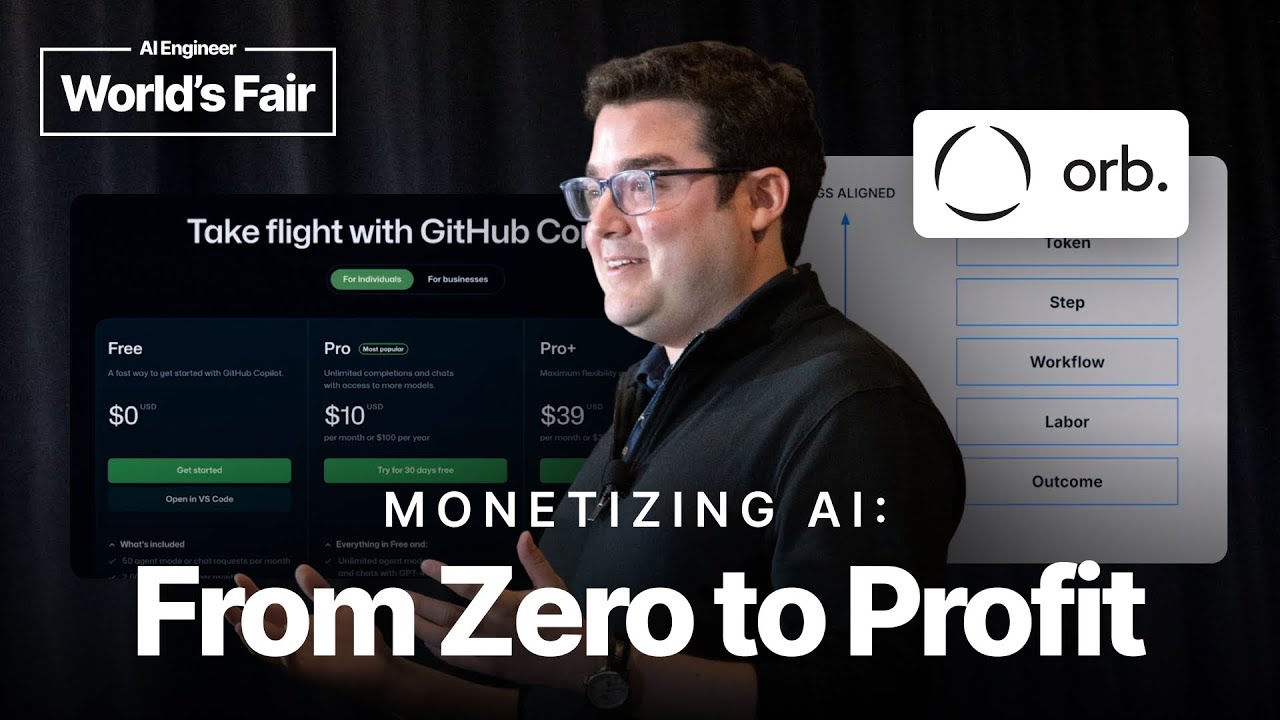
Alvaro Morales, CEO of Orb, argues that traditional subscription-based SaaS pricing fails for AI products due to rapid cost fluctuations, margin pressures, and customer demand for clear ROI. He presents three frameworks: decide between direct monetization (add-on, bundled) or indirect (free to drive upsells) using examples like GitHub Copilot, Notion AI, and Expedia; select a value metric from resource-based tokens (Vercel's v0) to task-based (Zapier) to outcome-based pricing (Intercom's Fin at $0.99 per resolved ticket); and embrace continual experimentation, as AI pricing cycles shrink from years to months. To reduce pricing guesswork, Orb built Simulations, a tool that lets companies backtest alternate pricing strategies on real usage data from closed betas before launch, helping teams like Replit and Perplexity optimize revenue without risking customer trust.

Machines of Buying and Selling Grace - Adam Behrens, New Generation
Jul 23, 2025 · 19:37
Adam Behrens, CEO of New Gen, argues that AI will transform commerce from static websites to agentic interactions where buyer and seller agents negotiate via intent infrastructure. He traces the evolution from clerk-assisted stores to e-commerce, now to AI-natives where ChatGPT and Claude act as shopping interfaces. Behrens details three challenges: payment delegation (solved via Viza's delegated authentication), product discovery (a unified API akin to Plaid for merchants), and preference representation (two-sided, dynamic, with market-design solutions). He cites Samsung's adoption of an MCP server for chat clients and notes that AI-sourced users convert at higher rates. Behrens predicts revenue sharing via affiliate models and that agents may bypass credit cards for stablecoins, while merchants retain control by embedding transportable data into model providers' surfaces.

Revenue Engineering: How to Price (and Reprice) Your AI Product — Kshitij Grover, Orb
Jun 27, 2025 · 15:39
Kshitij Grover, CTO of Orb, argues that AI-native pricing treats monetization as a first-class engineering concern, with pricing acting as a form of friction that must balance value delivery, audience, and rapidly changing margins. He walks through examples like Replit’s multi-tier transparent pricing with a free tier to prove value before charging, Unify’s higher price point and credit-based model to signal enterprise readiness, and Cloudflare’s charging for CPU milliseconds rather than wall time to pass on architectural advantages. Grover explains that margins are not fixed; companies should protect against degenerate workloads with guardrails rather than linear scaling, as Jasper did by going unlimited after switching models seamlessly. He emphasizes flexibility, noting Orb customers make price changes two to three times a month, and advises simulating pricing impacts on different usage cohorts. Predictions include price wars, convergence toward effectively unlimited plans with caps, more real outcome-based pricing with clear SLA definitions, and real-time spend visibility with agent prompts estimating credit usage.

Are MCPs Overhyped? A Rant about MCPs — Henry Mao, Smithery
Jun 3, 2025 · 7:29
Henry Mao, founder of Smithery and MCP steering committee member, argues that despite MCPs standardizing AI agent-service connections, the ecosystem faces fragmentation, high-friction installation, security, and monetization problems. Users struggle with unreliable MCP servers and complex five-step installs, while developers face hosting challenges, lacking tooling, distribution hurdles, and unclear monetization. Smithery aims to solve these as an AI gateway, demoing an agent that finds GitHub issues and creates Linear tickets using curated MCPs. Mao envisions a future dominated by tool calls where agent experience trumps user experience.
The Price of Intelligence - AI Agent Pricing in 2025
Feb 22, 2025 · 20:38
Shitej, co-founder and CTO of Orbe, argues AI agent pricing must continuously evolve, citing Intercom's 99 cent per resolution outcome model, Clay's prospecting credits, and Cursor's tiered usage limits. He stresses aligning pricing with target audience—SMB vs. enterprise—and maintaining simplicity and predictability. Cost structure is key: Character.AI optimized inference to support 100M DAUs, while Jasper leveraged a model decision engine to offer unlimited credits. Shitej emphasizes flexibility, noting OpenAI's price drops force repricing, and predicts 2025 will see more unlimited plans, outcome-based pricing with SLAs, and greater investment in pricing R&D for usage visibility.
Powered by PodHood