
Agent Memory
Episodes from AI Engineer about Agent Memory.
8 episodes
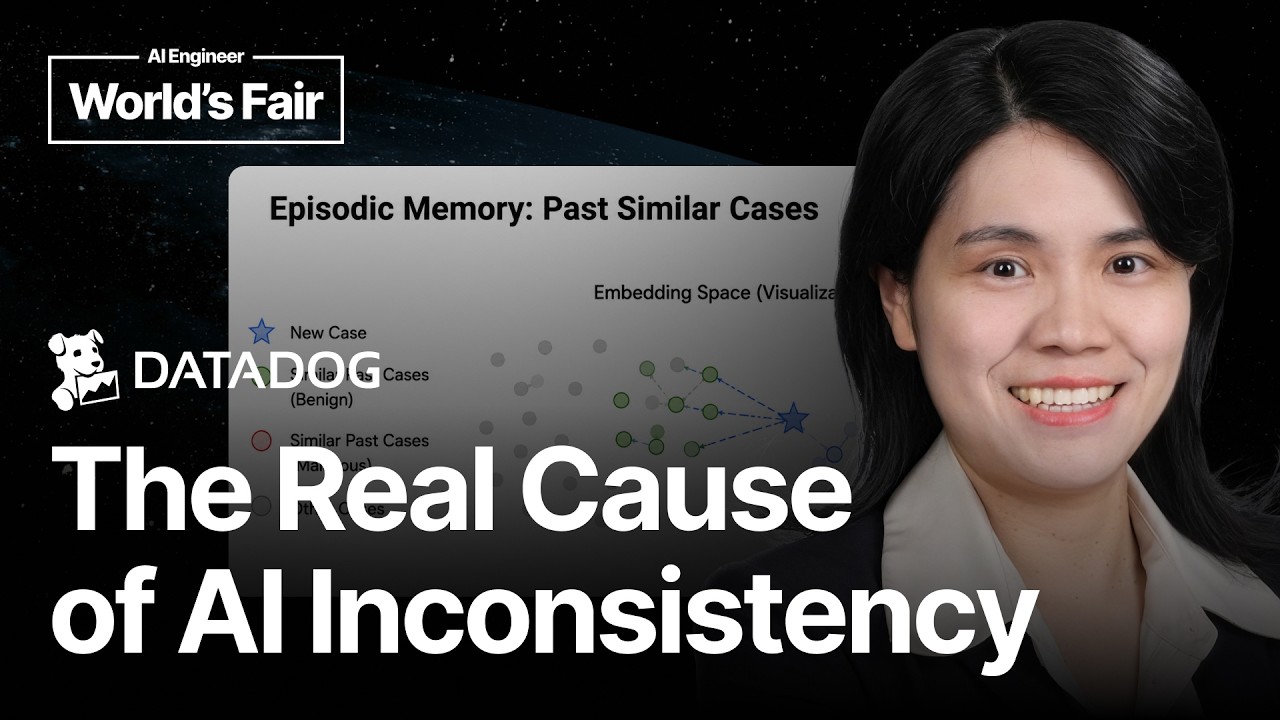
Why Your Agent Disagrees With Itself (And What To Do About It) - Diane Lin, Datadog
Jul 20, 2026 · 25:38
Diane Lin, Tech Lead at Datadog, argues that AI agent inconsistency is not a model failure but a signal of ambiguous data near the decision boundary, known as the gray zone. She presents a workflow combining active learning with semantic memory (domain policies) and episodic memory (past similar cases) to automatically identify flip-flopping outputs, focus human review, and continuously adapt agents without expensive fine-tuning. In a real experiment with 93 cybersecurity alerts, 25% initially flip-flopped; episodic memory reduced that to 10%, with the remainder resolved via human review and policy clarification. Lin emphasizes treating each disagreement as an opportunity to clarify labels and policies, building trustworthy, customer-adaptive agents.

The New Physics of Business — Garry Tan, Y Combinator
Jul 17, 2026 · 21:08
Y Combinator CEO Garry Tan argues founders must build AI-native companies that treat AI as a workforce, not auto-complete, to achieve 400x productivity. He details how skill files (Markdown documents) act as employees, a resolver table as an org chart, and a company brain (like his open-source GBrain) as the memory layer that selects the right context for each task. Tan cites YC's Winter '25 batch where 25% of companies had 95% AI-generated code, and portfolio companies Emergence and Retail reaching $15M ARR with 15 people and $60M with 40 respectively. His core message: never do one-off work—always "skillify" completed tasks into reusable skills, so the organization compounds knowledge daily rather than waking up with amnesia.

The Factory That Dreams: 39 AI Agents, No Framework - Rushabh Doshi, Machinecraft
Jul 11, 2026 · 9:58
Rushabh Doshi, CEO of Machinecraft, explains how his 100-person factory built Ira, a 36-agent AI OS running its go-to-market and memory without a framework. The system uses 36 specialist agents, each with one job, orchestrated by Athena, handling outbound emails, quoting, leads, and replies from one Cursor tab. Built for $30,000 versus $230,000 agency quote, it runs on a few thousand monthly with no training. Doshi says the secret is well-organized memory, vectors, graphs, and biological-inspired architecture including senses, digestion, memory layers, a nightly dream cycle, and immune system for fact-checking. The system is grounded in a SOUL.md constitution based on Jain philosophy, and ForkMyBrain.org helps others build their own forkable brain by mapping their business from the inside.

A Genius With Amnesia - Victor Savkin, Nx
Jun 26, 2026 · 20:00
Victor Savkin, creator of Nx and Polygraph, argues that current coding agents are like a genius with amnesia – they see only a tiny portion of the codebase and forget everything between sessions – and introduces Polygraph, a meta-harness that gives agents full organizational context and perfect memory. He explains that agents are repo-bound and lack episodic memory, forcing humans to re-explain changes (e.g., seven explanations for one UI change across four repos). Polygraph builds a unified dependency graph by analyzing thousands of repos without code changes, lets agents work across multiple repos in a single session, and captures all traces so sessions can be resumed by any agent (Claude or Codex) on any machine. It also enables context-aware queries like 'find every repo that depends on version X of this library' and allows referencing past sessions for best practices. The result is an agent that sees the entire organization's code and remembers every decision, effectively creating a hive mind.

Build Systems, Not Code - Angie Jones, Agentic AI Foundation
Jun 25, 2026 · 19:39
Angie Jones (Agentic AI Foundation) argues that engineering discipline remains essential when building agentic systems, moving the joy of building from writing code to designing system architecture. Using her Relocation Scout house-hunting agent as an example, she walks through applying skills like systems thinking, workflow design, decomposition, separation of concerns, modularity, and algorithmic thinking. She advises using code for deterministic tasks like commute calculation, agents for judgment on listings, and humans for authority to approve tours. Jones stresses defining structured contracts between components, designing for idempotency with memory logging, and threat modeling to treat all external input as untrusted. She advocates baking maintainability into the system with self-documenting workflows so that any agent or human can orient themselves without reverse-engineering prompts.

Viktor: AI Coworker That Lives in Slack — Fryderyk Wiatrowski
May 11, 2026 · 19:30
Fryderyk Wiatrowski, co-founder of Viktor, explains how his AI employee lives in Slack—no web UI—participating in channels and threads like a teammate, inheriting integrations from whoever connected them first, and handling tasks that take ten minutes. He details the challenges of scaling a personal agent to a company agent: memory management across hundreds of users, managing Slack's complex input surface (threads, DMs, edits, emoji reactions), and preventing context leakage between channels. He shares that swapping the underlying model from Opus to GPT-5.4 caused user backlash due to personality differences, and describes the need to earn proactivity trust to avoid security alarms. Viktor's advantage is shared context—only one person needs to connect an integration for the whole team—but warns against giving it personal email access, as illustrated by a customer story. The episode argues that a great AI coworker requires helping get work done, knowing the company context, and being friendly.
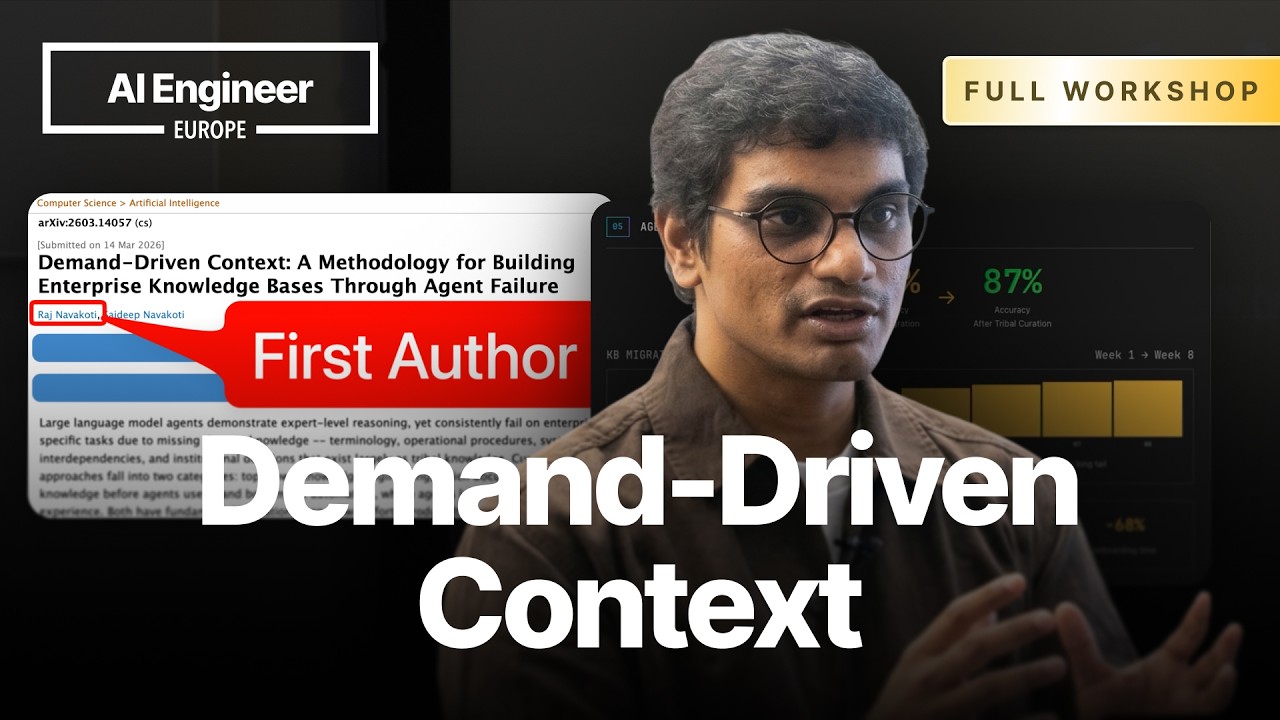
Demand-Driven Context: A Methodology for Coherent Knowledge Bases Through Agent Failure
May 5, 2026 · 1:08:15
Raj Navakoti, a staff software engineer at IKEA, presents a demand-driven context methodology for building coherent knowledge bases by letting AI agents fail on real problems and surfacing missing institutional knowledge. He argues that enterprises should shift from pushing monolithic documentation to a pull approach where agents reveal undocumented tribal knowledge through repeated failures on incidents and Jira tickets. Using a framework with skills, rules, and hooks, he demonstrates how agents can gradually improve confidence scores (from 1.4 to 4.4 over 14 incidents) by documenting discovered context blocks. Navakoti introduces a context gap scanner that automatically analyzes work items against existing documentation to identify critical gaps, outdated information, and duplications. He advocates storing curated knowledge in GitHub for version control and PR-based collaboration, and emphasizes that this approach helps teams know the unknown, enabling agents to manage knowledge rather than just consume it.

"Data readiness" is a Myth: Reliable AI with an Agentic Semantic Layer — Anushrut Gupta, PromptQL
Jun 27, 2025 · 17:02
Anushrut Gupta of PromptQL argues that 'data readiness' is a myth — perfect, clean data is unattainable — and instead advocates for an agentic semantic layer that learns from user corrections. He contrasts traditional approaches like manual semantic layers and knowledge graphs, which break as business definitions change, with PromptQL's design: a deterministic domain-specific language (PromptQL) that lets an LLM generate a plan executed by a runtime, avoiding hallucination. The system behaves like a new hire analyst: day zero it can handle messy tables (e.g., 'Morc, Plug, Zorp'), and through human guidance it self-improves — learning 47 business terms, mapping six systems, and discovering 12 calculation variants within 30 days. Gupta demonstrates a multi-step query across databases, Zendesk, and Stripe, with explainable steps and editable 'brain'; the AI achieves 100% accuracy on complex tasks for customers like a Fortune 500 food chain and a fintech company.
Powered by PodHood