
Zod
ProductA product discussed on AI Engineer.
5 episodes
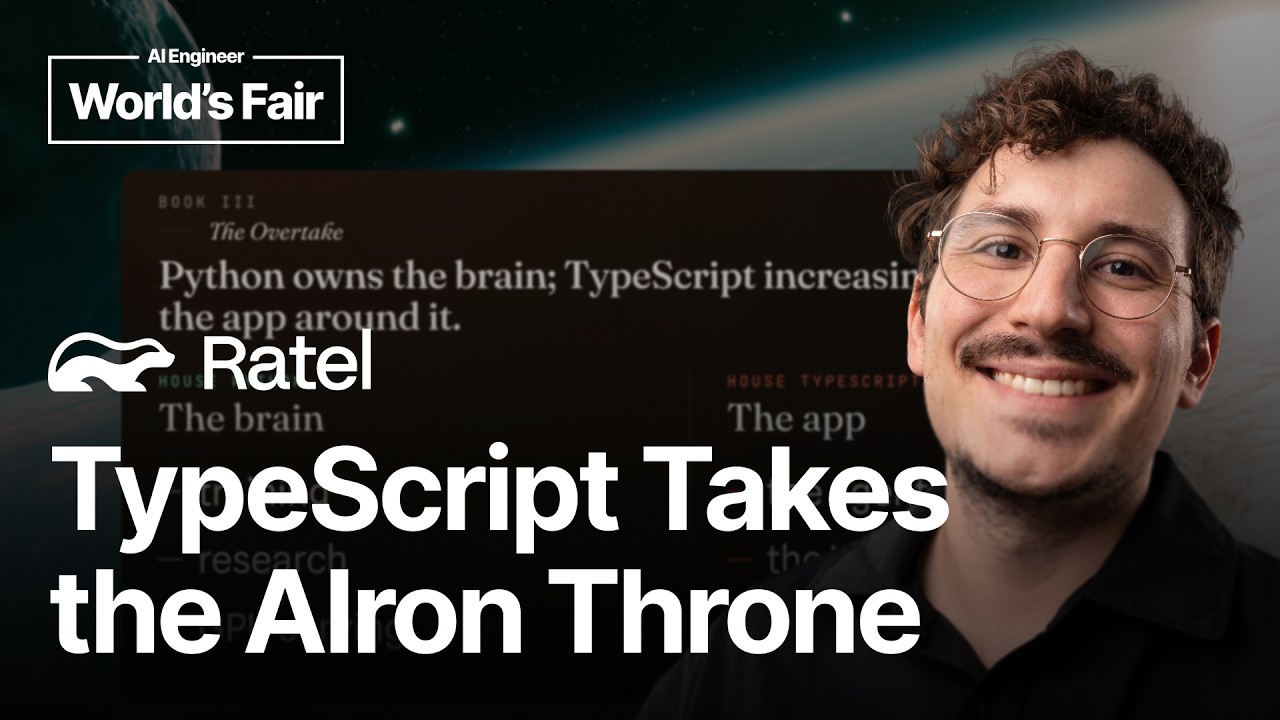
A Song of Types and Agents - Roberto Stagi, Ratel
Jul 12, 2026 · 14:16
Roberto Stagi (Ratel) argues that TypeScript is overtaking Python as the dominant language for building AI agents and applications, driven by the rise of coding agents like Lovable, Claude Code, and Cursor that default to TypeScript. He notes that Python still rules training, research, and GPU serving, but the application layer—where AI is shipped inside products—now belongs to TypeScript. Stagi highlights that TypeScript surpassed Python as the most used language on GitHub in August 2025, with GitHub attributing the shift to AI agents. He cites the Vercel AI SDK growing from 1.6M to 15.1M weekly downloads in one year and npm's rich ecosystem of authentication, payments, and UI packages as reasons to build agents in TypeScript. Consistent end-to-end typing via Zod and a unified codebase for agent loops, tools, backends, and UIs further strengthen the case. Stagi concludes by invoking Atwood's Law: any application that can be written in JavaScript will eventually be written in TypeScript, urging developers to build agents in TypeScript to avoid falling behind.

Harness Engineering: How to Build Software When Humans Steer, Agents Execute — Ryan Lopopolo, OpenAI
Apr 17, 2026 · 46:21
Ryan Lopopolo, a member of technical staff at OpenAI, argues that software engineers must shift to 'harness engineering' where agents produce all code and humans focus on delegation, system design, and guardrails. He describes how his team banned editors, using Codex with skills to manipulate apps, and reduced review friction by automating lint rules and review agents. Lopopolo explains that code is free but human time and model context are scarce, so teams should structure repositories for consistency and use 'garbage collection days' to eliminate recurring slop. He shares practical techniques like writing tests about source code (e.g., file length limits) and using review agents that inject prompts. His future vision involves agents autonomously executing long-horizon work based on token budgets and success metrics, freeing humans for higher-level activities.

[Workshop] AI Pipelines and Agents in Pure TypeScript with Mastra.ai — Nick Nisi, Zack Proser
Jul 12, 2025 · 1:51:14
This hands-on workshop introduces Mastra.ai, a TypeScript framework for building production AI agents and pipelines, and demonstrates how to build an AI meme generator using composable workflows, tools, and agents. Hosts Nick Nisi and Zack Proser walk through creating a multi-step workflow: extract user frustration, find a base meme via ImageFlip, generate captions, and publish the meme at a stable URL. They show how to chain steps with Zod schema validation for deterministic output, then wrap the workflow in an agent that accepts natural language requests. The workshop also covers MCP (Model Context Protocol) and a live demo of MCP.shop for ordering a shirt, emphasizing local iteration with Mastra's playground, built-in memory, and evaluation tools. Real-world patterns include building internal AI assistants for data cleaning, email drafting, and document summarization with minimal code.

Building voice agents with OpenAI — Dominik Kundel, OpenAI
Jun 29, 2025 · 1:25:35
Dominik Kundel from OpenAI presents the new OpenAI Agents SDK for TypeScript and demonstrates how to build voice agents, arguing that speech-to-speech architectures (using GPT-4 real-time) offer lower latency and more natural interactions than chained approaches that transcribe audio to text. He covers two architectures: chained (speech-to-text, text agent, text-to-speech) versus speech-to-speech (native audio understanding), and recommends starting with a small, clear goal, building evals and guardrails early, and using generative prompts to control tone and personality via openai.fm. In a live coding session, he builds a real-time agent with tools (e.g., getWeather) and handoffs, demonstrates delegation to a smarter model (O4 mini) for complex tasks like refunds, and shows built-in interruption handling, human-in-the-loop approval, tracing for debugging, and output guardrails. The SDK supports WebRTC and WebSocket, handles turn detection automatically, and provides session management with a 30-minute timeout that can be extended by injecting previous context.

Vercel AI SDK Masterclass: From Fundamentals to Deep Research
Apr 20, 2025 · 59:52
Nico Albanese from Vercel delivers a workshop on building agents with the AI SDK, demonstrating how to use generateText, tools, and structured outputs to create a deep research clone in Node.js. He shows that switching between models like GPT-4o mini, Perplexity Sonar Pro, and Gemini Flash 1.5 requires only changing one line of code. Tools with maxSteps enable autonomous multi-step agents, as when the model fetches weather data for San Francisco and New York and sums the temperatures across three steps. The deep research workflow generates subqueries (e.g., 'requirements to become a D1 shotput athlete'), searches via Exa with live crawl, evaluates relevance with an evaluate tool that discards irrelevant results, and recursively deepens research using depth and breadth parameters. Finally, o3 mini synthesizes the accumulated research into a structured Markdown report, all in 218 lines of code.
Powered by PodHood