
Zendesk
ProductA product discussed on AI Engineer.
2 episodes
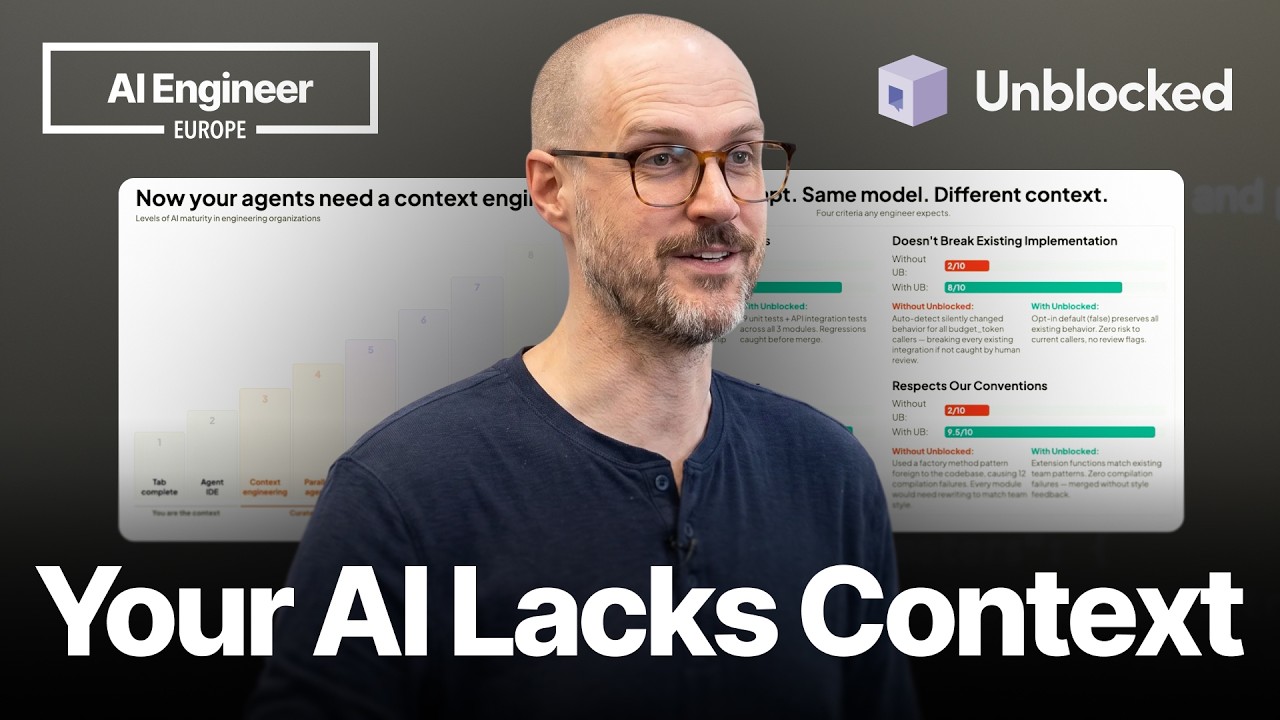
Stop babysitting your agents... — Brandon Waselnuk, Unblocked
May 26, 2026 · 18:54
Brandon Waselnuk of Unblocked argues that the bottleneck for AI coding agents is not access (MCPs, tools) but understanding—they need a context engine that builds a research packet from codebase, Slack, PRs, and org structure before generating code. He debunks three myths: naive RAG suffers from satisfaction of search, more MCPs don't provide reasoning, and million-token windows don't enable effective reasoning. His team's context engine reduced a Zendesk integration task from 2.5 hours and 20.9M tokens (with MCPs only, but code that would have broken production) to 25 minutes and 10.8M tokens, earning a senior engineer's approval with one nitpick. Three hard lessons: optimize for understanding not access, resolve conflicts rather than hide them (e.g., Slack thread where CTO says code is wrong), and never cache answers because context changes daily. He demonstrates a social graph tool (open-sourced Monday) that maps engineers to code areas and collaborators, and shows a demo where the agent's MCP calls the context engine to generate a plan covering factory patterns, library modules, and client registration.

"Data readiness" is a Myth: Reliable AI with an Agentic Semantic Layer — Anushrut Gupta, PromptQL
Jun 27, 2025 · 17:02
Anushrut Gupta of PromptQL argues that 'data readiness' is a myth — perfect, clean data is unattainable — and instead advocates for an agentic semantic layer that learns from user corrections. He contrasts traditional approaches like manual semantic layers and knowledge graphs, which break as business definitions change, with PromptQL's design: a deterministic domain-specific language (PromptQL) that lets an LLM generate a plan executed by a runtime, avoiding hallucination. The system behaves like a new hire analyst: day zero it can handle messy tables (e.g., 'Morc, Plug, Zorp'), and through human guidance it self-improves — learning 47 business terms, mapping six systems, and discovering 12 calculation variants within 30 days. Gupta demonstrates a multi-step query across databases, Zendesk, and Stripe, with explainable steps and editable 'brain'; the AI achieves 100% accuracy on complex tasks for customers like a Fortune 500 food chain and a fintech company.
Powered by PodHood