
A product discussed on AI Engineer.
5 episodes
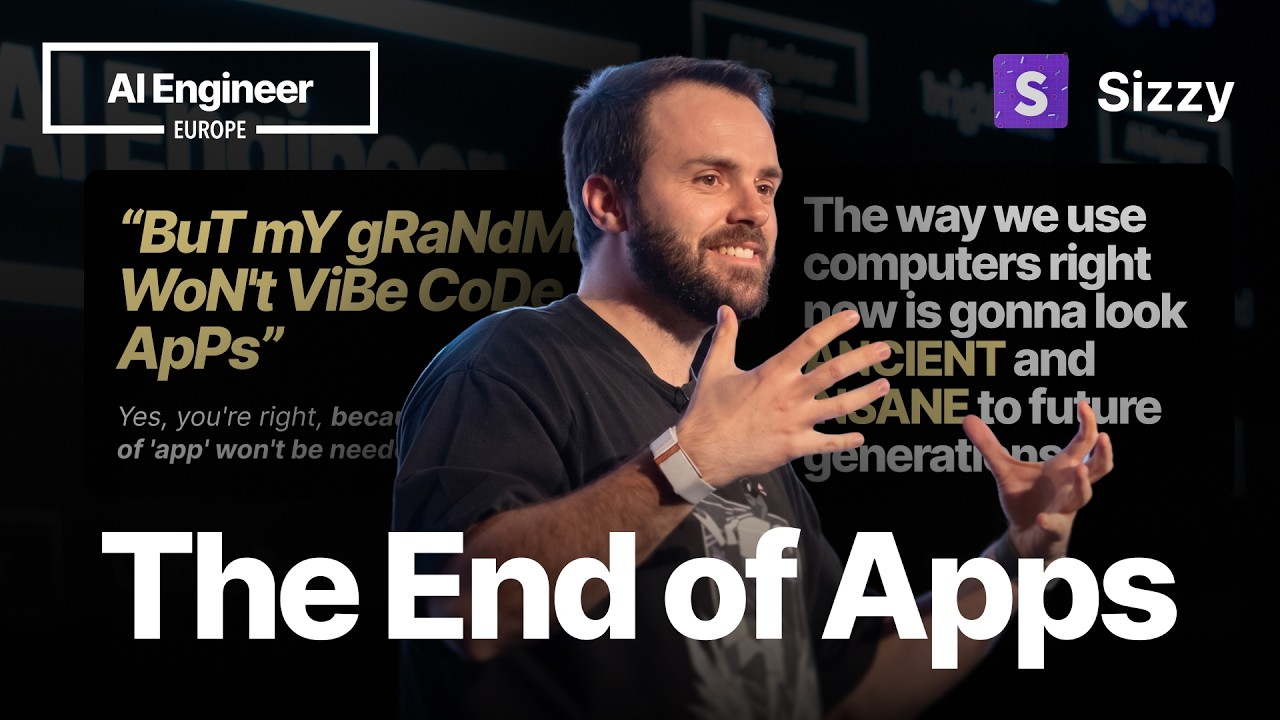
The End of Apps — Kitze, Sizzy.co
Apr 23, 2026 · 20:18
Kitze, creator of Benji and founder of Tinker Club, argues that current productivity apps and AI agents are unreliable and too complex for most users, predicting a future where AI prompts humans instead of the reverse. He traces his 24-year obsession with productivity tools—from a childhood to-do list to building Benji with 60 features—and his move to self-hosting after the ChatGPT moment. Kitze critiques custom agents like OpenClaw as too tinkerer-focused, cloud agents like ChatGPT as too nerfed, and believes local models on devices (Apple, Google Pixel) will win for normies, enabling AI to automatically manage notifications, emails, and tasks. He shares his own experiment, Wolfer, designed for predictable multi-agent orchestration without memory systems, using nested topics for context. The episode delivers a strong claim: the role of AI will invert, with machines prompting humans for decisions while handling all background work.

State of the Claw — Peter Steinberger
Apr 17, 2026 · 44:12
Peter Steinberger, creator of OpenClaw, presents a five-month update on the world's fastest-growing open-source project. He details the project's staggering growth—30,000 commits, nearly 2,000 contributors—and the immense security burden: 1,142 advisories (16.6 per day) with 99 critical, often AI-generated slop that demands human vetting. Steinberger refutes media fearmongering, citing how researchers ignore security docs to fabricate scary scenarios. He clarifies OpenAI did not buy OpenClaw; he joined the company while establishing the OpenClaw Foundation to remain vendor-neutral. He emphasizes the importance of local models for data sovereignty and describes his coding workflow of running 5-6 agent sessions simultaneously, iterating on taste and personality. Future visions include ubiquitous agents, 'Dreaming' for memory reconciliation, and modular plugins. For engineers, he champions taste, system design, and learning to say no.

The Unofficial Guide to Apple’s Private Cloud Compute - Jmo, CONFSEC
Jul 30, 2025 · 20:36
Jonathan Mortensen explains Apple's Private Cloud Compute (PCC), a paradigm shift in confidential computing that delivers cryptographically provable privacy for AI inference on remote servers. He details Apple's five requirements—stateless computation, enforceable guarantees, non-targetability, no privileged runtime access, and verifiable transparency—and six technical components, including oblivious HTTP, blind signatures, secure enclave, remote attestation, transparency logs, and secure boot. The talk highlights how remote attestation allows an iPhone to verify server software and tie encryption to that verified state, while the transparency log enables public auditing of all deployed binaries. Mortensen notes trade-offs: complete trust in Apple's supply chain, higher latency and compute costs, and no support for custom models or third-party developers. He points to alternative tools like TPMs, SigStore, and confidential VMs for non-Apple environments, and concludes that Apple's approach is being adopted by Azure AI and Meta.

My AI Thinks I'm Eating My Feelings (and Other Nutritional Insights) - Rami Alhamad
Jun 3, 2025 · 9:59
Rami Alhamad, founder of Alma, presents the AI nutrition companion that simplifies food tracking through voice, text, and photo inputs, using LLMs broken into sequential steps to deliver near-instant feedback. AlmaScore, developed with Harvard’s Dr. Eric Krim, rates meals out of 100 based on nutritional quality. The system learns user preferences continuously via a knowledge dataset and proactively surfaces insights like pairing blueberries with dark chocolate to boost vitamin C absorption. Rami emphasizes that real-time user feedback (a 'How did Alma do?' prompt) outperforms evaluation benchmarks, and that brand design, trusted partnerships, and community-generated data are key differentiators as foundation models commoditize code.

Beyond APIs: How AI Web Agents Are Automating the "Long Tail" of Knowledge Work
Feb 22, 2025 · 17:44
Arjun and Bhavani present Rtrvr.ai, a universal AI web agent using a text-based approach to autonomously perform tasks across multiple browser tabs at under a penny per page. They argue text-based reduces hallucination compared to vision-based agents like OpenAI's operator, and being a Chrome extension avoids password sharing and accesses logged-in content. Features include deep research navigating multiple pages, dynamic function calling for any third-party API, and graph generation. Rtrvr extracts structured data, performs actions like clicking dropdowns, and processes tabs simultaneously, automating the long tail of knowledge work including market research, LinkedIn automation, and WhatsApp messaging. They claim a distributed subtask approach lowers failure rates and envision collaborative dataset construction, e.g., aggregating local government events.
Powered by PodHood