
UV
ProductA product discussed on AI Engineer.
5 episodes

Modern Post-Training: A Deep Dive — Will Brown, Prime Intellect
Jul 13, 2026 · 46:52
Will Brown of Prime Intellect details the company's open-source ecosystem of post-training tools, including the verifiers and prime-rl libraries, arguing they enable efficient and affordable training of frontier agentic models for enterprises. Verifiers V1 decomposes environments into tasks, harnesses, and runtimes using a decorator pattern and Pydantic, supporting group rewards like conciseness bonuses. Prime-RL is an asynchronous reinforcement learning framework that allows long-horizon coding rollouts to overlap, achieving a GLM-5 step on 28 nodes in under 5 minutes for 131k context, with a 1,000-step run costing roughly $50k. The framework supports custom algorithms including on-policy distillation, GRPO, and self-distillation via decomposable loss and algorithm classes. Prime Intellect's Lab platform offers hosted multi-tenant LoRA training live now, with full fine-tuning arriving soon, enabling enterprises to develop environments on CPU and push them to the cloud for scalable post-training.

Research to Reality: Bringing Frontier ML Research to Production - Vaidas Razgaitis, Higharc
Jun 28, 2026 · 14:57
Vaidas Razgaitis, Senior Research Engineer at Higharc, presents three tactical focus areas to accelerate the handoff of frontier ML research into production features. First, he advocates for a Research Prototype Taxonomy Document—a technical design document tailored for ML that maps domain context, business goals, type safety, persistence, and system architecture. Second, he details Higharc's monorepo of cleanly isolated microservices with a layered API/business logic/data structure, enabling researchers to own individual services. Third, he explains using Graphite for stack diffs to decompose monolithic prototypes into small, reviewable PRs that tap subject matter experts asynchronously. The talk offers diagnostic questions to assess team velocity across these three levers.

Training an LLM from Scratch, Locally — Angelos Perivolaropoulos, ElevenLabs
May 4, 2026 · 1:21:26
Angelos Perivolaropoulos from ElevenLabs walks through building a small GPT-2-like LLM from scratch on a local machine, demonstrating that the core techniques used by major labs are accessible in a few hundred lines of PyTorch code. The workshop uses character-level tokenization (65 tokens) on a Shakespeare dataset to enable fast training with limited compute. The model architecture includes multi-head self-attention, MLP layers, residual connections, and layer normalization, totaling 10 million parameters across six transformer blocks with a 256-token context window. The training loop employs next-token prediction with a warm-up cosine decay learning rate schedule and validation loss to detect overfitting. Inference uses temperature sampling (default 0.7) and top-k sampling to improve creativity. Perivolaropoulos explains that audio and multimodal models share the same transformer foundation but differ in tokenization (e.g., mel-spectrograms for audio) and use specialized losses like L2 or KL divergence, while reasoning models result from post-training base models with high-quality chain-of-thought data.
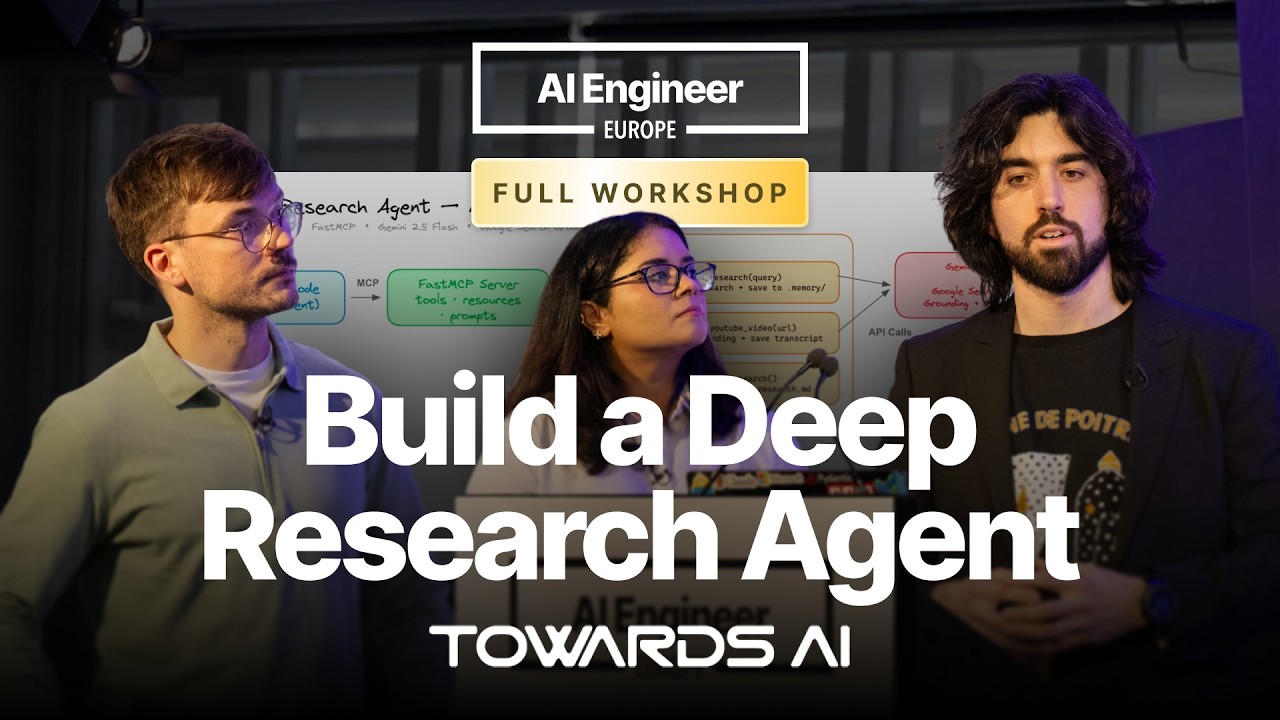
Full Workshop: Build Your Own Deep Research Agents - Louis-François Bouchard, Paul Iusztin, Samridhi
Apr 20, 2026 · 1:57:03
Louis-François Bouchard, Samridhi Vaid, and Paul Iusztin built a combined system of a deep research agent and a deterministic writing workflow to automate high-quality technical content creation, trading flexibility for control. The research agent uses an MCP server (FastMCP) with tools for Google search, YouTube analysis, and report compilation, powered by Gemini and orchestrated by Claude Code. The writing workflow is a static pipeline that loads a user guideline, writing profiles (structure, terminology, character), and few-shot examples into a system prompt, then applies an evaluator-optimizer loop: a reviewer outputs structured pydantic objects with profile/location/comment to flag violations, and the editor applies them in priority order (guideline > research > profile). They stress that research demands autonomy while writing needs constraint, and show how to avoid AI slop by banning specific words and using profiles. For observability, they use Opik to capture all traces, and for evals they built a 20-sample dataset from real LinkedIn posts, split into train/dev/test, to calibrate an LLM judge (binary pass/fail) that they run on dev and test splits to measure F1 and detect…
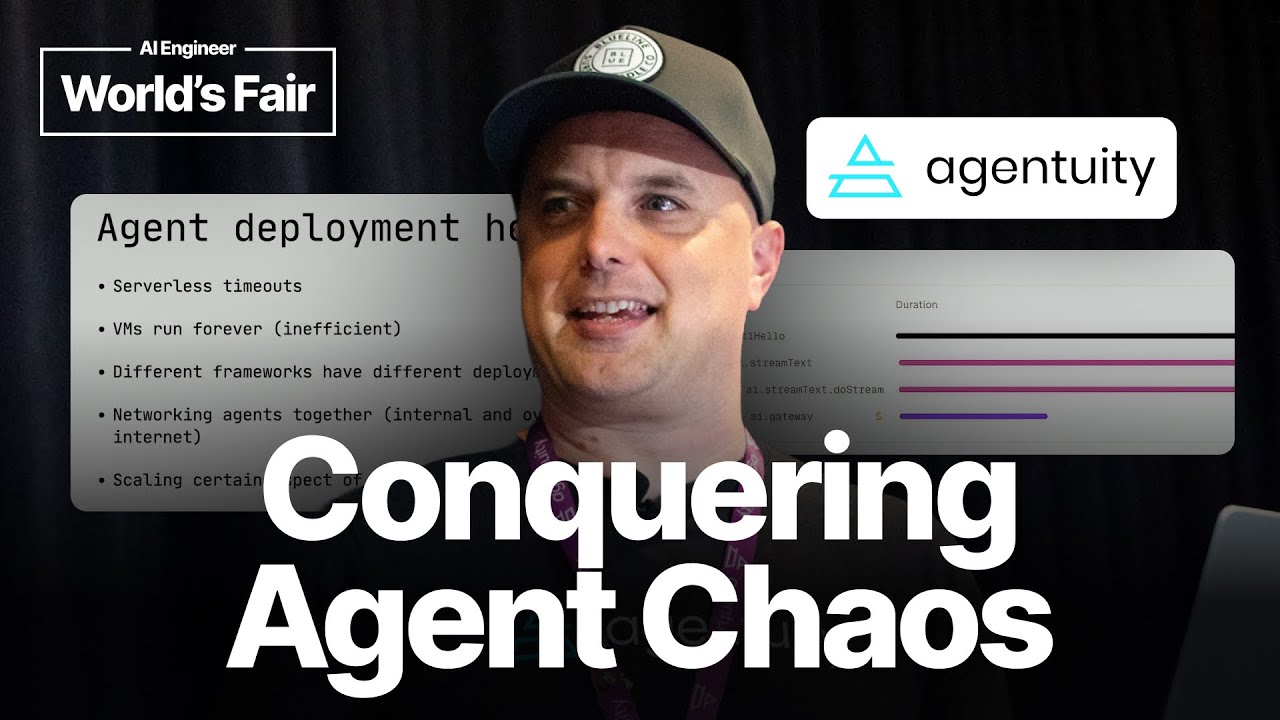
Conquering Agent Chaos — Rick Blalock, Agentuity
Jul 1, 2025 · 14:40
Rick Blalock, founder of Agentuity, argues that deploying AI agents remains the number one headache for developers, citing common issues like serverless timeouts (agents running 15–30 minutes), statelessness, and networking complexities. He demonstrates Agentuity’s platform, which treats agents as first-class infrastructure citizens: users scaffold projects via a CLI (supporting Bun, Python/UV, Node.js), write a simple request handler, and deploy with automatic routing, tunneling, and a built-in AI gateway that tracks costs per run. The platform decouples inputs and outputs—agents can be triggered via email, SMS, webhooks, or cron—and provides human and agent-facing telemetry via OTel tracing. Blalock notes Agentuity already hosts 50–60 internal agents and is building infrastructure agents to replace tools like PagerDuty, with plans to add Slack/Discord integrations and service-level reasoning capabilities.
Powered by PodHood