
A product discussed on AI Engineer.
4 episodes
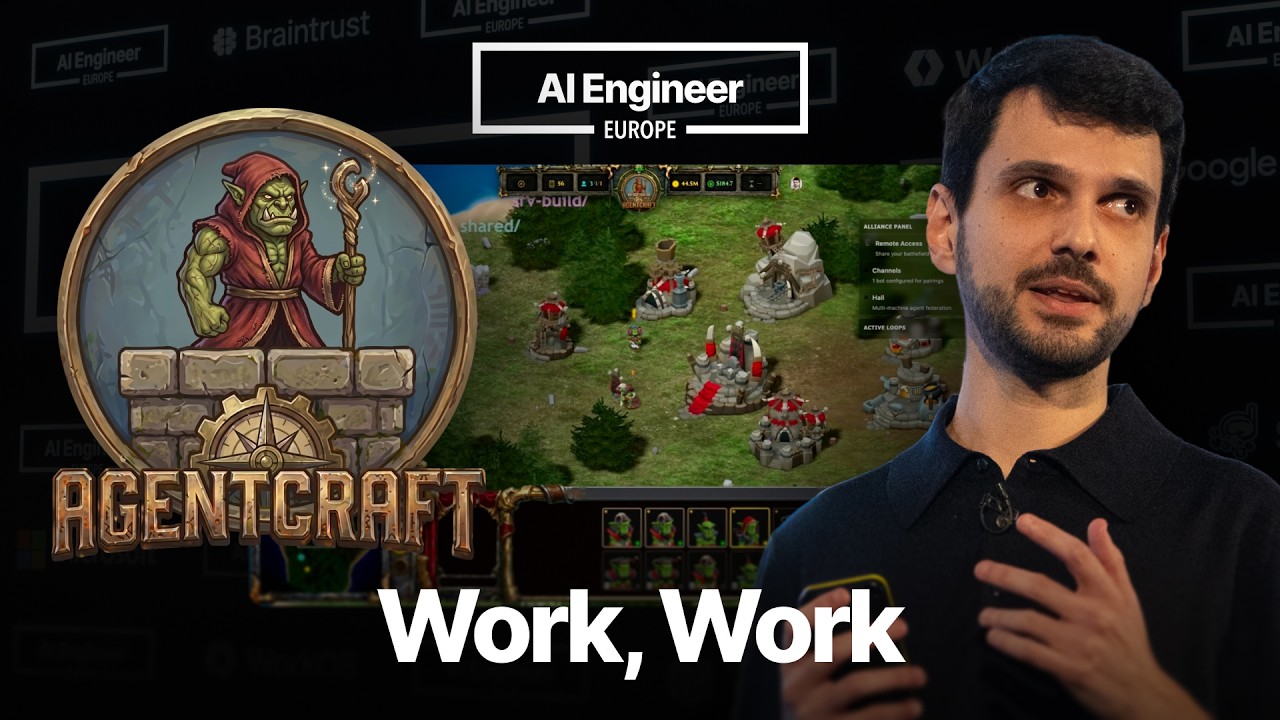
AgentCraft: Putting the Orc in Orchestration — Ido Salomon
Apr 25, 2026 · 11:18
Ido Salomon, creator of AgentCraft, argues that the bottleneck in multi-agent orchestration is not the agents but the humans managing them, and that the skills needed—borrowed from real-time strategy games—are already familiar to gamers. AgentCraft visualizes agents as physical units on a map that projects the file system, allowing users to see which files agents modify and detect collisions via a heat map. To reduce babysitting, Salomon implemented a campaign feature where agents autonomously decompose tasks and plan within containers, shifting the human role to review. Review bundles present changes with screenshots and videos for efficient inspection. Workspaces enable real-time collaboration between humans and agents across teams, with shared visibility and soft coordination. The goal is to raise the ceiling of collaboration through visibility, autonomy, and human-agent interaction.

Paying Engineers like Salespeople – Arman Hezarkhani, Tenex
Dec 19, 2025 · 14:53
Arman Hezarkhani, CTO of Tenex, describes his company's outcome-based compensation model where engineers are paid per story point completed, tying incentives directly to shipped value. He argues that hourly billing and salary with equity fail to motivate engineers to use AI tools effectively, leading to misaligned incentives. Tenex's system involves strategists scoping tickets and engineers receiving a flat base plus quarterly story-point bonuses. Risks like inflated story points, quality drops, and sharp elbows are mitigated by strategist counterbalance, multi-round QA, and a rigorous hiring process. He cites examples: a billboard company's image moderation AI built in two weeks at 96% accuracy, and a retail heat-mapping project with five parallel models. Arman asserts that AI amplifies existing talent, and current compensation must change to unlock potential.

Defying Gravity - Kevin Hou, Google DeepMind
Dec 2, 2025 · 25:10
Kevin Hou from Google DeepMind introduces Antigravity, a new agent-first IDE that combines three surfaces: an AI editor, an agent-controlled Chrome browser, and an Agent Manager. The central claim is that agents should live outside the IDE, enabling longer-running tasks and multimodal interactions. Key features include Artifacts—dynamic representations like plans, screen recordings, and diagrams—that replace raw chain-of-thought with visual summaries. The browser enables context retrieval and verification via screen recordings, while image generation allows iterative design through comments. Hou explains the research-product flywheel: DeepMind researchers use Antigravity internally to identify model gaps, improving capabilities like computer use and instruction following, which then ship in the product. He also details four categories of model improvements: intelligence, tools, long-running tasks, and multimodal, all powered by Gemini 3 Pro and related models.

Just do it. (let your tools think for themselves) - Robert Chandler
Jun 10, 2025 · 6:50
Robert Chandler, co-founder and CTO of WordWare, argues that current low-level MCP tools wrapping APIs directly cause agents to be slow, expensive, and unreliable, citing an example where a Slack MCP took five minutes and failed to send a message. He advocates for agentic MCPs that blur the line between tool and agent, giving tools more agency and simple natural language APIs. Chandler demonstrates WordWare's new MCP toolbox, which turns workflows like a competitor analysis (scraping Twitter, writing to Notion) into a single, reusable tool for agents like Claude. This approach yields highly reliable, repeatable, and aligned results, offloading complex tasks from the main agent and allowing it to focus on reasoning. The episode promotes building tools that think for themselves, following the pattern of specialist teams like the Avengers.
Powered by PodHood