
TLDraw
ProductA product discussed on AI Engineer.
6 episodes

Why Eval++ Is the Next Great Compute Primitive — Sunil Pai & Matt Carey, Cloudflare
Jun 8, 2026 · 24:51
Matt Carey and Sunil Pai from Cloudflare's agents team argue that Durable Objects — stateful serverless with 15ms London latency — and Dynamic Workers — a safe, sandboxed eval for LLM-generated code — form the next compute primitive for AI agents. They explain how Durable Objects enable resumable streaming, multi-tab sync, and background scheduling out of the box without distributed systems engineering. Dynamic Workers allow running generated JavaScript strings in isolated sandboxes, reclaiming 30 years of avoided eval. The pair tease upcoming talks: one on collapsing Cloudflare's 2,600 API endpoints into a 1,000-token MCP tool, and another on a coding agent harness built entirely on Workers that they are already shipping.

Agents on the Canvas in tldraw — Steve Ruiz, tldraw
May 1, 2026 · 19:54
Steve Ruiz of tldraw details the evolution of AI on the infinite canvas, from early one-shot demos like MakeReal (draw to functional prototype) to multi-agent 'fairies' that collaborate, delegate, and even rewrite the canvas in real time. He explains how the tldraw SDK enables agents to act as virtual collaborators, using structured outputs and tool use to draw, animate, and modify designs. Ruiz demonstrates fairy agents that can work independently or in leader-follower mode, coordinating on tasks like creating wireframes or filling out forms. He also unveils a desktop prototype that lets Claude directly inject JavaScript into the canvas, enabling agents to edit code, modify UI, and even hack other apps like Spotify. The talk emphasizes the shift from sidebar agents to canvas-native collaborators, the challenges of vision model training for 2D spaces, and the safety trade-offs of giving LLMs runtime access in local-first apps.

Agents for Everything Else — swyx
May 1, 2026 · 14:10
swyx, co-founder of AI Engineer Conferences, details how his team of nine full‑time people uses coding agents like Devin and Town to run the conference, moving from a non‑AI stack to agents that handle everything from Figma‑to‑website conversion and schedule management to buying a lobster for the event. He claims these agents save “yak shaving” and increase human productivity because employees enjoy faster feedback cycles, leading to more work like animations and polish. The team now manages a 1,000‑person conference with plans to handle 6,000 in San Francisco without growing headcount. Swyx also advocates for “agents for everything else,” predicting that the primary user of software will shift from humans to bots, making APIs and MCPs more important than dashboards. He urges attendees to adopt agents and “prescribe” them to skeptical coworkers.
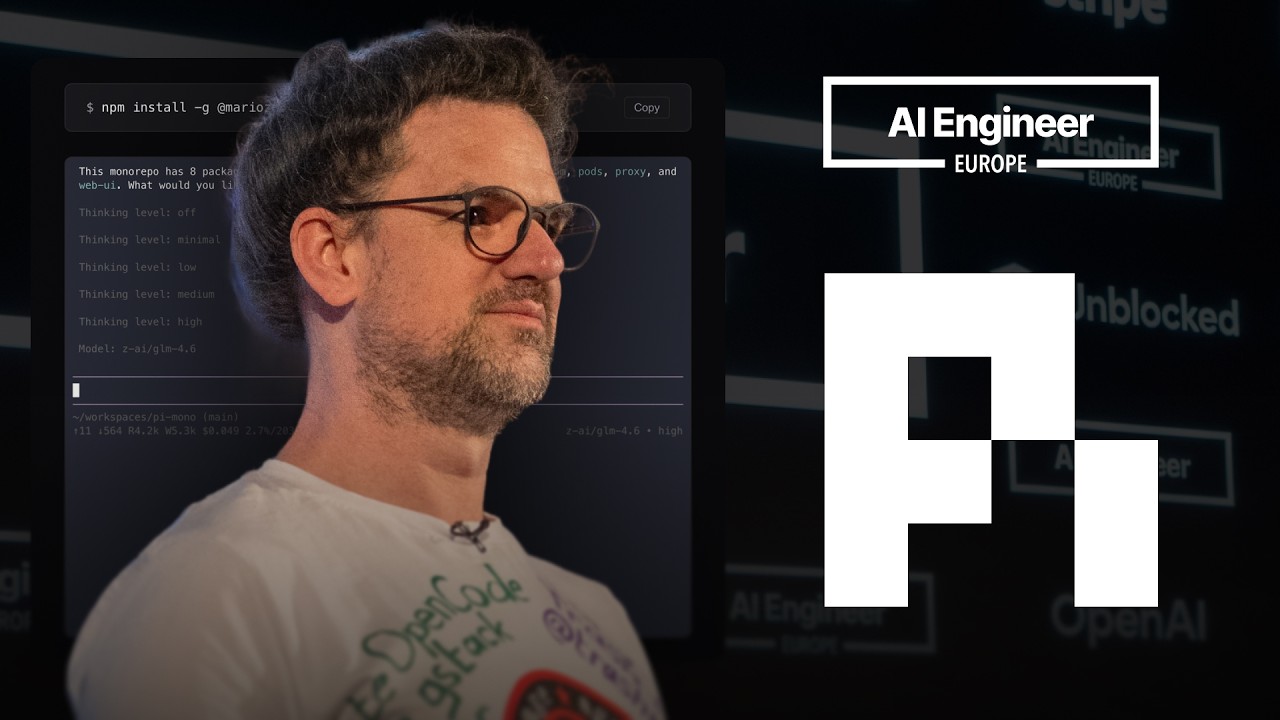
Building pi in a World of Slop — Mario Zechner
Apr 16, 2026 · 18:25
Mario Zechner explains why he built pi, a self-modifying, extensible agent core, after growing frustrated with Cloud Code and Open Code for their buggy features, uncontrolled context management, and zero extensibility. pi strips away complexity, giving the agent just four tools (read, write, edit, bash) and a minimal system prompt, letting it adapt to the user's workflow rather than vice versa. Extensions are TypeScript modules that hot-reload, enabling users to build custom tools, chat rooms, or even play Doom without forking pi. He then attacks clankers — agent-generated pull requests and issues — that are destroying open source, sharing his own tactics like auto-closing PRs with a human-voice request and de-prioritizing OpenClaw interactions. In Act 3, Zechner argues that agents compound errors with zero learning, producing enterprise-grade complexity in weeks, and that long context windows and agentic search are hacks. His prescription: scope agent tasks, modularize codebases, cap generated code review, and always read every line of critical code yourself.

tldraw.computer - Steve Ruiz, tldraw
Jul 21, 2025 · 18:45
Steve Ruiz, founder and CEO of tldraw, demonstrates the company's AI experiments on their infinite canvas, including Make Real—which turns hand-drawn wireframes into working web apps using vision models—and tldraw computer, a visual programming environment where arrows and LLMs power a graph of connected nodes that can execute multi-step prompts, generate images and speech, and even run loops indefinitely. He also shows Draw Fast for real-time image generation and Teach, where Claude can draw and edit shapes on the canvas. The episode explains how tldraw's SDK (tldraw.dev) enables others to build custom canvas applications, and highlights the company's philosophy of 'shitty but amazing' rapid prototyping.

Excalidraw: AI and Human Whiteboarding Partnership - Christopher Chedeau
Jul 21, 2025 · 16:59
Christopher Chedeau, creator of Excalidraw, explains how to integrate AI into whiteboarding by focusing on turning prompts into editable diagrams rather than static images. He argues that just adding any AI model harms the product, citing a failed attempt to generate realistic images because users don't draw realistically. The successful integration uses Mermaid.js to output Excalidraw files, letting humans modify the AI-generated diagram. He envisions a future of iterative human-AI collaboration, and demonstrates other practical features like auto-naming files, generating illustrations (coming soon), and challenges AI engineers to build a browser-based logo background remover. He concludes that the industry is in a physical-to-virtual transition for AI, and that LLMs work best when targeting a structured domain-specific language.
Powered by PodHood