
TextGrad
ProductA product discussed on AI Engineer.
2 episodes
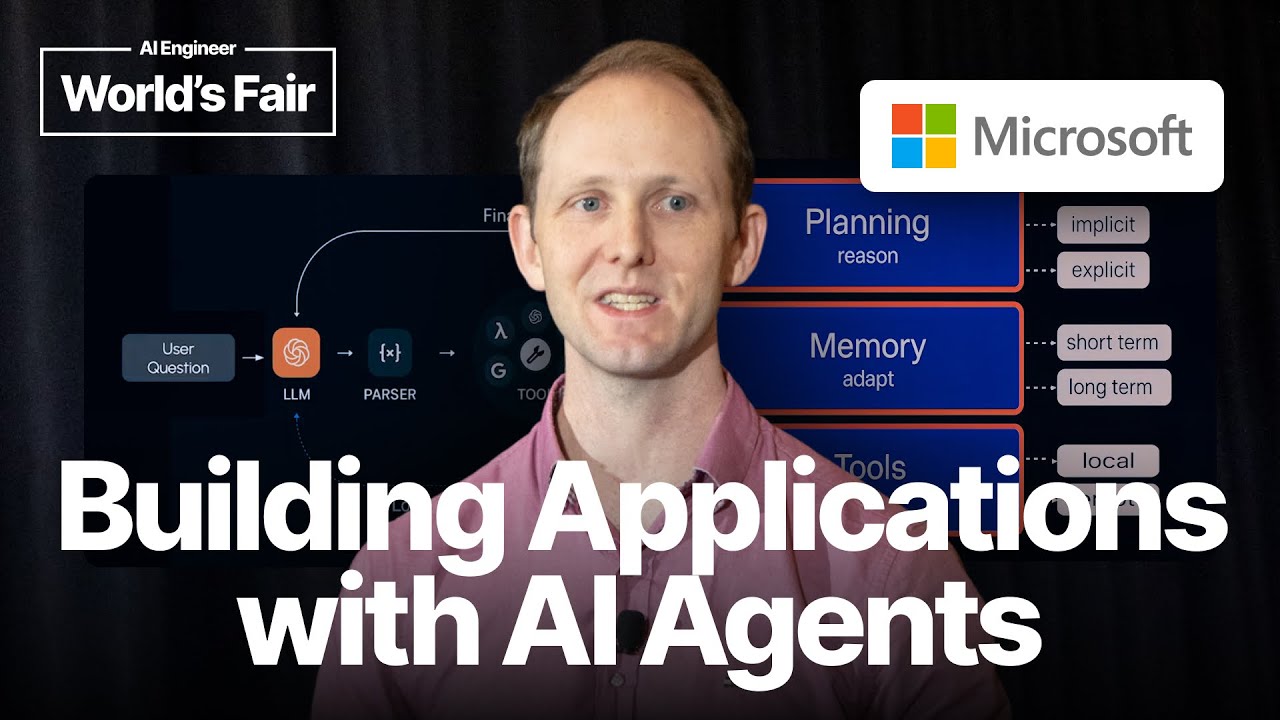
Building Applications with AI Agents — Michael Albada, Microsoft
Jul 24, 2025 · 15:50
Michael Albada, Principal Applied Scientist at Microsoft, explains how to build effective AI agent systems, defining agents as entities that reason, act, communicate, and adapt. He emphasizes that tool use requires exposing grouped, human-facing functions rather than one-to-one API mappings, noting a 254% increase in agentic Y Combinator startups. Orchestration should start simple with chains and trees before moving to fully agentic patterns, using deterministic logic for safety and external state management. For multi-agent systems, he recommends splitting tools into semantically similar groups to avoid overwhelming a single agent. Albada stresses investing in evaluation via open-source tools like Intel Agent, Pirate, Label Studio, and automatic optimization with Trace, TextGrad, and DSPY. He warns against common pitfalls: insufficient evals, poorly designed tools, excessive complexity, and lack of observability, while urging design for security with tripwires and fallback to human review.

The Model Isn’t Wrong—You’re Just Bad at Prompting
Feb 22, 2025 · 8:54
Dan from PromptHub argues that prompt engineering remains critical for improving LLM outputs, covering Chain of Thought, few-shot, and meta prompting techniques. Chain of Thought breaks problems into sub-problems and is built into reasoning models; few-shot prompting works best with just one or two diverse examples, but can degrade performance on reasoning models like O1 and R1. Meta prompting uses LLMs to write or refine prompts, with PromptHub offering model-specific enhancers. For reasoning models, Dan advises minimal prompting, encouraging more reasoning instead of few-shot, and avoiding instructing the model on how to reason. Free resources include PromptHub's templates, the AutoReason prompt, and the Prompt Engineering Substack.
Powered by PodHood