
TensorRT-LLM
ProductA product discussed on AI Engineer.
4 episodes
Introduction to LLM serving with SGLang - Philip Kiely and Yineng Zhang, Baseten
Jul 26, 2025 · 43:42
Philip Kiely and Yineng Zhang introduce SGLang, an open-source fast serving framework for LLMs and VLMs, arguing it offers production-ready performance with day-zero support for new models like DeepSeek and Qwen, and a customizable codebase for contributions. Yineng, a core maintainer, traces SGLang's rapid growth from a December 2023 paper to nearly 15,000 GitHub stars and adoption by xAI, AMD, and Meituan. The workshop demonstrates deploying a first model via Baseten's trunk packaging, then tuning the CUDA Graph max batch size flag on an L4 GPU to maintain CUDA Graph-enabled decoding during higher concurrency, boosting generation throughput. They also cover Eagle 3 speculative decoding, where a draft model derived from the target model speculates tokens; users can benchmark different step and top-k configurations on representative prompts to find optimal settings for production. Finally, they invite contributions via GitHub's 'good first issue' tags and highlight Baseten's job openings.
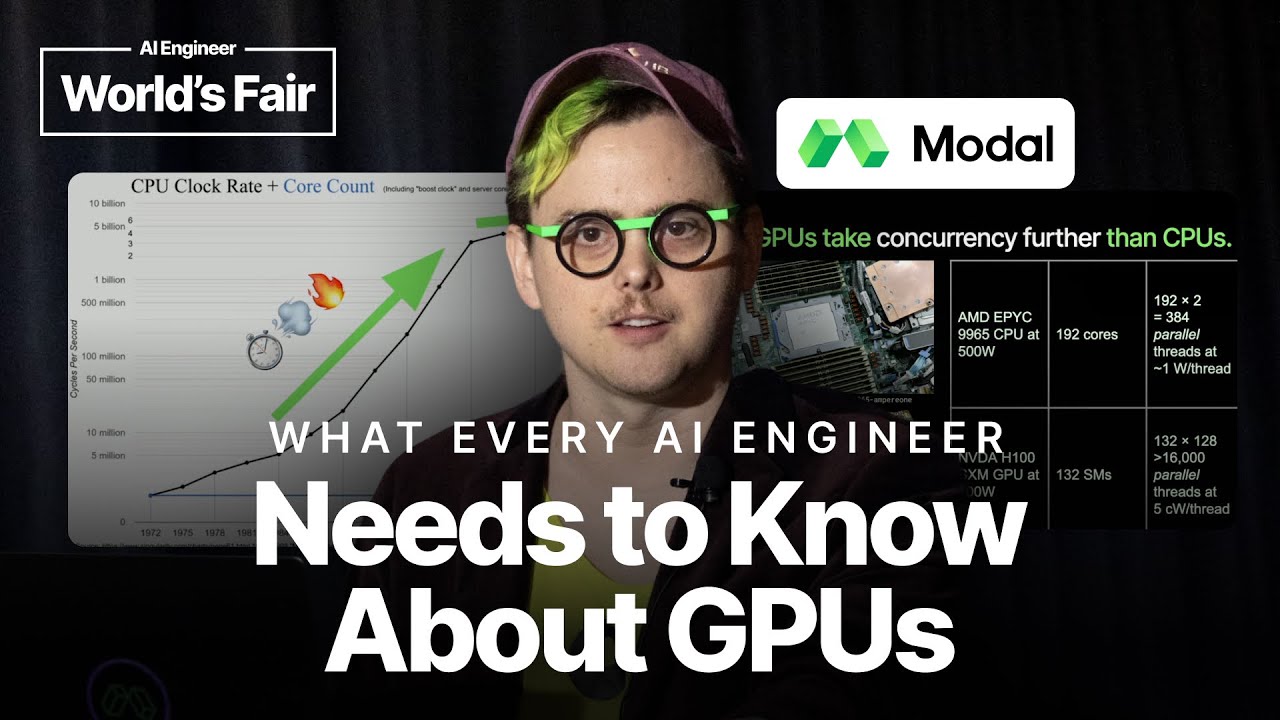
What every AI engineer needs to know about GPUs — Charles Frye, Modal
Jul 20, 2025 · 19:52
Charles Frye of Modal explains that AI engineers need to understand GPU hardware constraints to optimize inference, arguing GPUs embrace bandwidth over latency and that Tensor Cores for low-precision matrix-matrix multiplication are the key resource. He describes how GPUs achieve 16,000+ parallel threads per cycle on H100, and notes Patterson’s Law: bandwidth improves at the square of latency. The main insight: arithmetic intensity favors N² operations per N memory loads, so matrix-matrix operations are efficient while matrix-vector is wasteful. Frye demonstrates that running a small 8B model 1,000 times on the same prompt matches GPT-4 quality, and that multi-token prediction and multi-sample query become nearly free because Tensor Cores handle expanded batches as matrix-matrix multiplications. He recommends using smaller models that fit on a single GPU and scaling via multiple generations.

Optimizing inference for voice models in production - Philip Kiely, Baseten
Jul 1, 2025 · 15:13
Philip Kiely of Baseten shows how open-source TTS models like Orpheus TTS, built on a LLaMA 3.2 3B backbone, can be optimized for production inference using LLM tooling such as TensorRT-LLM and FP8 quantization, achieving time-to-first-byte (TTFB) under 150 milliseconds and supporting 16–24 simultaneous streams on a single half-H100 GPU. He argues that because TTS models are architecturally similar to LLMs, techniques like dynamic batching, KV-cache quantization, and Torch Compile on the audio decoder can dramatically reduce latency and increase concurrency. He emphasizes that for real-time voice agents, the goal is not raw tokens per second (real-time requires only 83 TPS for Orpheus) but low TTFB and high throughput to minimize GPU spend. However, Kiely warns that non-runtime factors—such as client code using sequential requests without session reuse or sending traffic to distant data centers—can easily add back the milliseconds saved at the model level, and that infrastructure connecting listening, thinking, and talking pipelines is often the dominant source of latency.

From model weights to API endpoint with TensorRT LLM: Philip Kiely and Pankaj Gupta
Sep 13, 2024 · 1:40:01
Philip Kiely and Pankaj Gupta of Baseten lead a workshop on TensorRT-LLM, NVIDIA's high-performance inference framework for LLMs, arguing its use delivers best-in-class throughput and latency on NVIDIA GPUs. They explain that TensorRT-LLM optimizes computational graphs via plugin kernels and in-flight batching, achieving 216 tokens per second and 180ms time to first token on Mistral 7B. The workshop demonstrates building an engine for TinyLlama 1.1B, including FP8 quantization that reduced engine size from 2 GB to 1.2 GB with minimal quality loss. They benchmark a deployed model, showing 7,000 total tokens per second at batch size 64 on an A10G. The presenters compare TensorRT-LLM favorably to VLLM for high-throughput production use and introduce Truss, Baseten's open-source packaging tool, alongside their managed platform for automatic scaling and fast cold starts.
Powered by PodHood