
Telegram
ProductA product discussed on AI Engineer.
4 episodes

Build & deploy AI-powered apps — Paige Bailey, Google DeepMind
Apr 29, 2026 · 1:03:20
Paige Bailey, engineering lead for developer relations at Google DeepMind, demonstrates how the company's latest multimodal models and AI Studio platform enable rapid prototyping of AI-powered apps at minimal cost. She showcases Gemini 3.1 Flash Lite analyzing YouTube dinosaur videos for under a penny, the new Build feature constructing a fully functional bookshelf cataloger with Firebase database and Google login, and Gemini Live providing real-time multilingual screen interaction. Other demos include Genie 3 generating playable world models from text prompts, NanoBanana 2 performing cost-effective image editing, Veo 3.1 Lite producing stock footage (e.g., a "vegan basketball food truck" featuring Chef Curry), Lyria 3 creating custom music tracks, and Gemma 4 offering open-source multimodal models that run on mobile devices. Bailey emphasizes that the entire stack—grounded by Google Search and code execution—allows developers to ship ideas that would have been startups years ago, with all code exportable for production use.
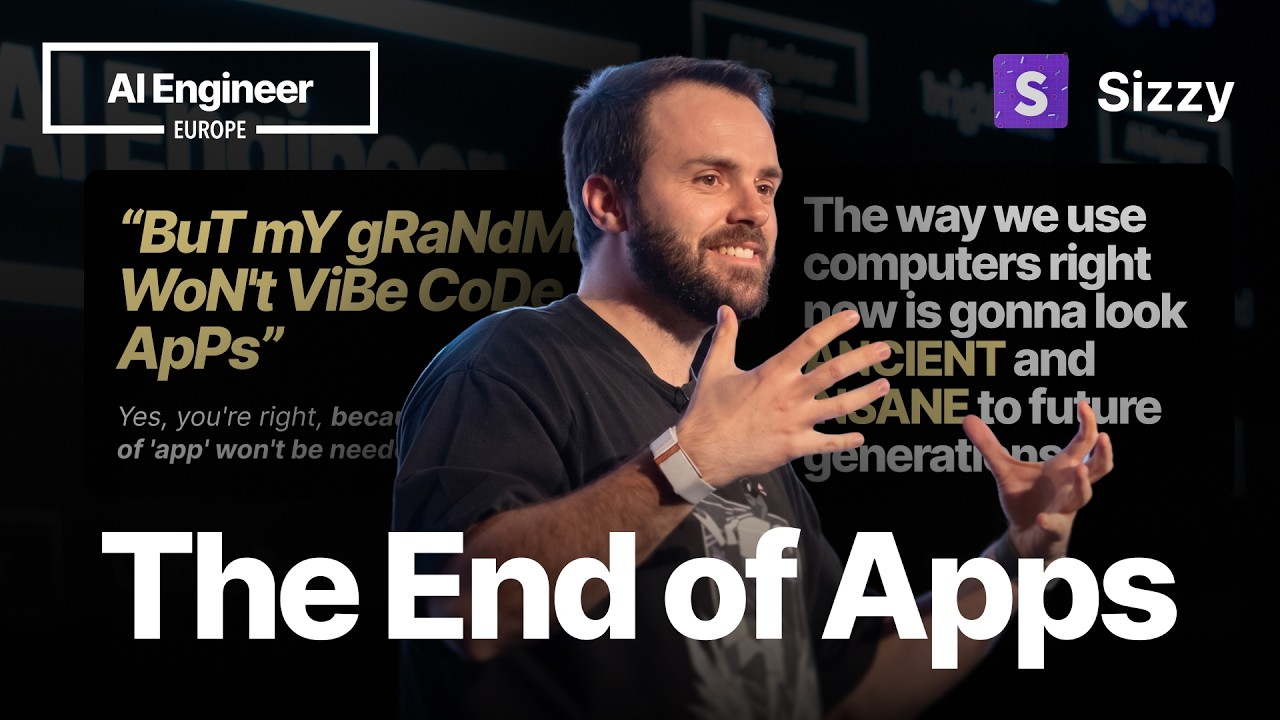
The End of Apps — Kitze, Sizzy.co
Apr 23, 2026 · 20:18
Kitze, creator of Benji and founder of Tinker Club, argues that current productivity apps and AI agents are unreliable and too complex for most users, predicting a future where AI prompts humans instead of the reverse. He traces his 24-year obsession with productivity tools—from a childhood to-do list to building Benji with 60 features—and his move to self-hosting after the ChatGPT moment. Kitze critiques custom agents like OpenClaw as too tinkerer-focused, cloud agents like ChatGPT as too nerfed, and believes local models on devices (Apple, Google Pixel) will win for normies, enabling AI to automatically manage notifications, emails, and tasks. He shares his own experiment, Wolfer, designed for predictable multi-agent orchestration without memory systems, using nested topics for context. The episode delivers a strong claim: the role of AI will invert, with machines prompting humans for decisions while handling all background work.

AI Didn’t Kill the Web, It Moved in! — Olivier Leplus (AWS) & Yohan Lasorsa (Microsoft)
Apr 10, 2026 · 52:55
Yohan Lasorsa (Microsoft) and Olivier Leplus (AWS) argue that AI isn't replacing the web—it's becoming its native layer, embedded in every stage of development. They demo coding agents that use lightweight 'skills' to automate workflows like fetching GitHub issues and testing via Playwright, then show Chrome's MCP server letting agents debug performance across different network conditions. New on-device Web AI APIs (summarizer, proofreader, prompt API) run models locally in the browser, enabling features like auto-writing reviews from an uploaded product image without cloud calls. Finally, they introduce LLMs.txt for guiding AI agents to relevant documentation and Web MCP—a proposal to register native tools on websites (e.g., 'add to cart') so agentic browsers can execute actions without mimicking human clicks. The episode delivers concrete implementations, from coding to deploying AI-ready web apps.
[Workshop] AI Engineering 101
Nov 6, 2023 · 3:02:24
In this hands-on workshop, AI engineer Noah Hein teaches the basics of AI engineering by building five projects with OpenAI's GPT-3, GPT-4, Dall-E, Whisper, and Telegram. Participants create a Telegram bot that uses GPT-3 for chat, implements retrieval-augmented generation (RAG) with embeddings and cosine similarity on MDN docs, generates code with GPT-4 using few-shot prompting, creates images via Dall-E 2, and transcribes voice with Whisper. The session explains core concepts like tokens, chunking, context windows, temperature, and top-p, emphasizing that embeddings and prompt engineering are key to performance. Hein demonstrates that these tools are cheap and accessible—the entire workshop costs about $0.05 in API fees—and shows how AI engineers can integrate multiple models into a single application.
Powered by PodHood