
Tailscale
ProductA product discussed on AI Engineer.
4 episodes
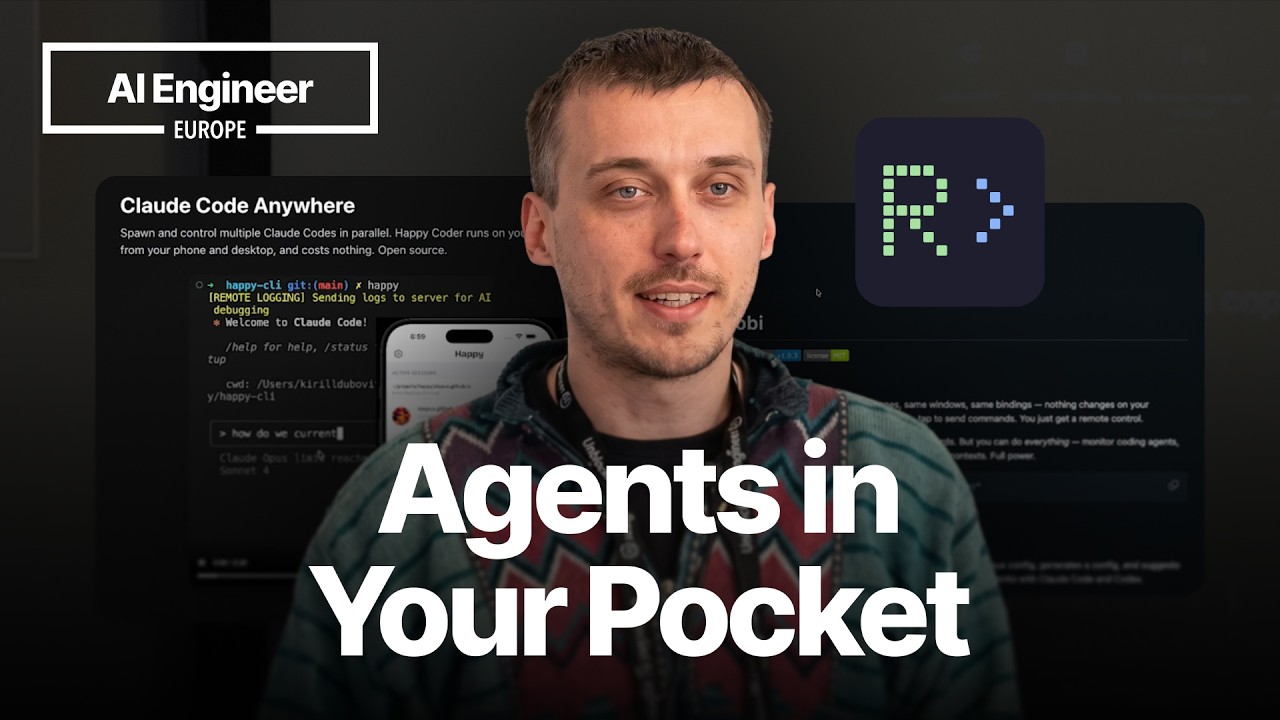
remobi.app: Don't change your terminal workflow for mobile
Jul 12, 2026 · 9:21
Connor Adams presents remobi.app, a progressive web app that lets developers check on their terminal-based coding agents from a mobile phone without changing their existing workflow. Built for TMUX users, it mirrors a user's remote terminal session with gesture controls for zoom, scroll, and pane switching. Adams argues that unlike Claude Code's built-in handoff or dedicated mobile terminals, remobi is agent-agnostic and preserves custom TMUX setups with tools like lazygit and critique. The app uses Tailscale by default for secure remote access, though users can substitute Ngrok or Cloudflare tunnels. Open source and installable via npm, remobi aims to satisfy the compulsive need to monitor agents while away from the desk.
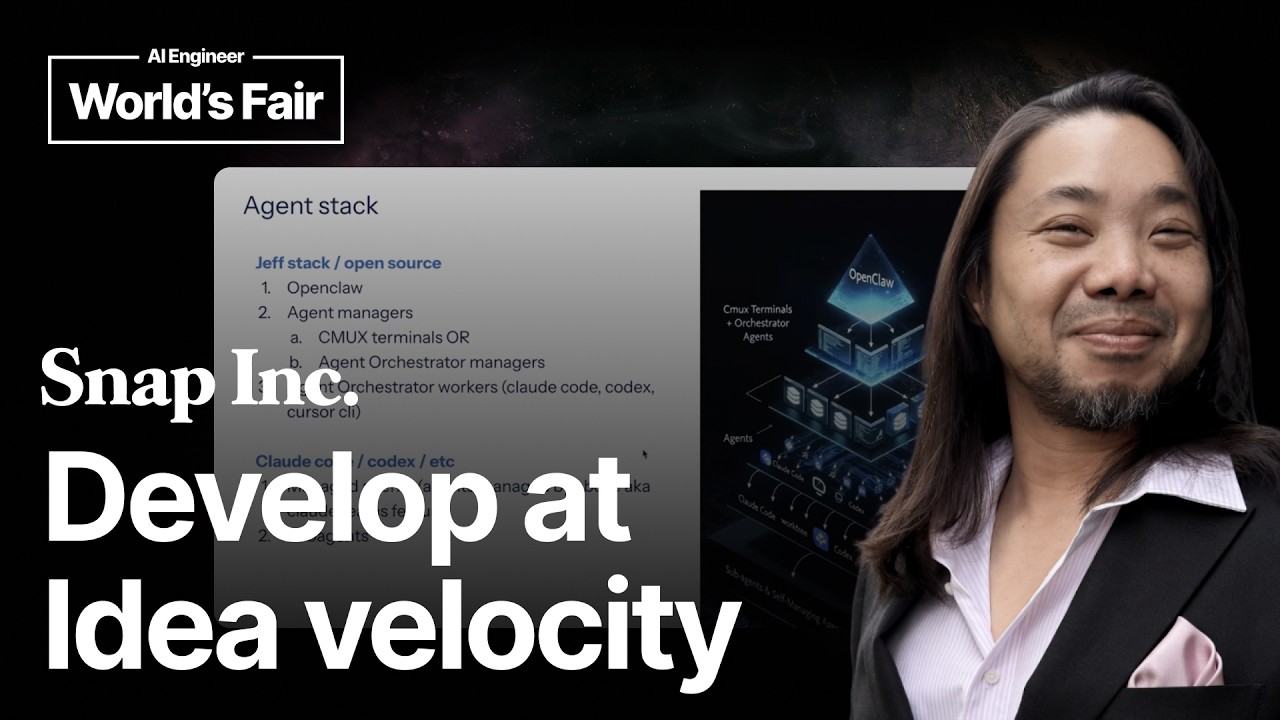
Develop at Idea Velocity - Jeffrey Lee-Chan, Snapchat
Jul 11, 2026 · 15:28
Jeffrey Lee-Chan (Snapchat) and Austin (CMUX) explain how to achieve 'idea velocity' by building parallel multi-agent harnesses that let one engineer direct 10–20 coding agents instead of becoming the bottleneck. Lee-Chan argues the key is separating 'Agent Orchestrator Managers' from specialized workers to prevent low-level implementation bias, using OpenClaw for frictionless Slack-based communication and CMUX terminals for real-time parallelization and unbiased manager oversight. He demonstrates two apps—an AI RPG with dice-roll mechanics and a multi-AI analysis tool—built with this stack, and discusses token-burn tradeoffs between models like Codex 5.3, GPT-5.4, and Minimax. The episode also covers staging environments to avoid doubling token usage, the benefit of persistent memory and contextual guardrails, and the importance of pushing human interaction to the start or end of the workflow for improved parallelization.

Run Frontier AI at Home — Alex Cheema, EXO Labs
May 26, 2026 · 1:45:02
Alex Cheema of EXO Labs argues that running frontier AI locally has 100x improvement potential in cost and performance, demonstrated with GLM 5.1—a trillion-parameter model—running across four Mac Studios at roughly 20 tokens per second for $40,000. He details kernel fusion that recovered 30% performance on Qwen 3.5 by eliminating unnecessary kernel launches, and RDMA integration that cut node-to-node latency from 300 microseconds to single digits, enabling tensor parallelism to actually scale. Cheema advocates splitting inference: prefill on compute-dense hardware (e.g., an RTX Spark) and decode on high-bandwidth hardware (e.g., Mac), cutting large-prompt inference roughly in half. He warns against misleading benchmarks like one-bit quantized models, and outlines how multi-agent setups, test-time scaling, and continual learning could further improve local inference efficiency. The talk includes a live demo of GLM 5.1 across four Mac Studios connected via Thunderbolt 5, and a preview of EXO's upcoming benchmarking site to track intelligence per Joule.

Dream Machine: Scaling to 1m users in 4 days — Keegan McCallum, Luma AI
Jul 19, 2025 · 19:03
Keegan McCallum, Head of ML Infrastructure at Luma AI, details how the company's Dream Machine model scaled from 500 to 9,000 H100 GPUs within hours to handle 1 million users in four days, outpacing ChatGPT's initial growth. He explains that their initial Triton inference server setup was brittle and ill-suited for multi-GPU, multi-node video models, prompting a re-architecture to a custom serving stack on vanilla PyTorch. To solve work starvation across user tiers, they implemented an SLO-based aging system that ranks jobs by the percentage of their worst-case wait time elapsed. For managing dozens of model versions, they store immutable full Python environments and checkpoints in object storage, with a YAML file controlling active deployments and enabling zero-downtime rollouts across thousands of GPUs. McCallum also discusses partnerships with Nvidia, AMD, and Grok, and how Luma's broader mission is to build general multimodal intelligence that generates, understands, and operates in the physical world.
Powered by PodHood