
Streamlit
ProductA product discussed on AI Engineer.
7 episodes
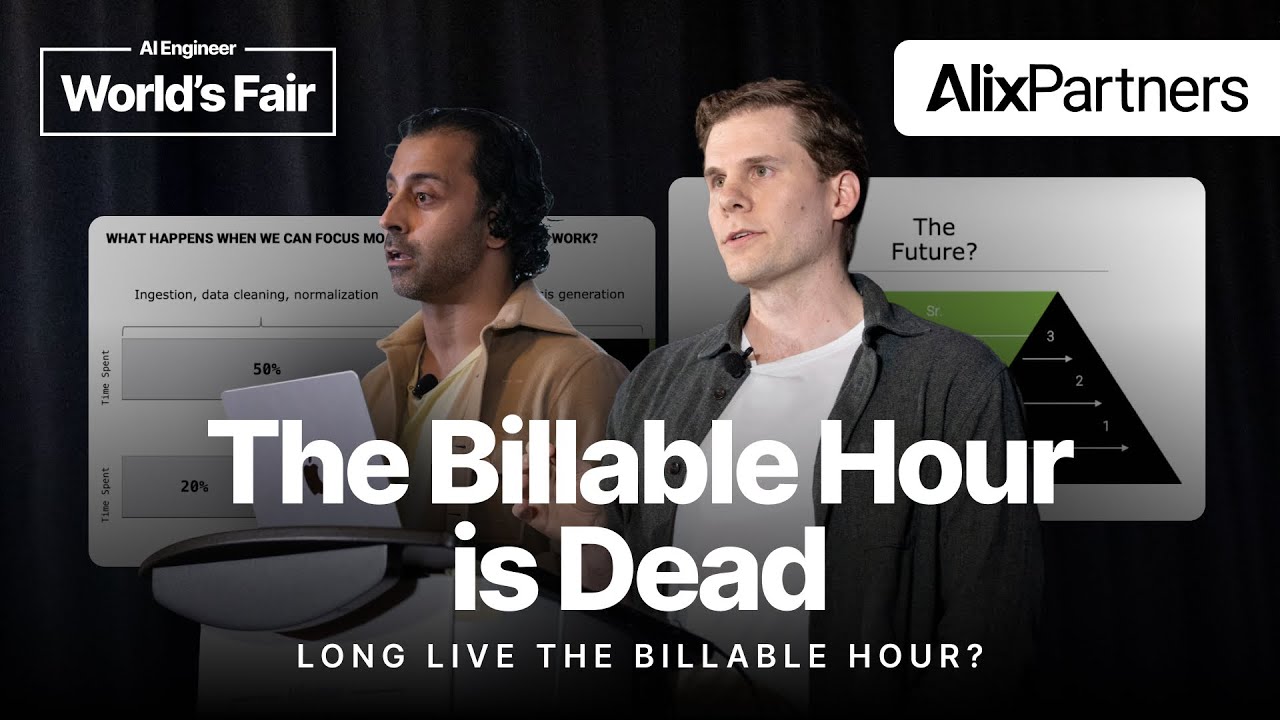
The Billable Hour is Dead; Long Live the Billable Hour — Kevin Madura + Mo Bhasin, Alix Partners
Jul 23, 2025 · 17:04
Kevin Madura and Mo Bhasin from AlixPartners argue that AI is reshaping knowledge work by compressing upfront data ingestion from 50% to 10-20% human effort, enabling analysis of 100% of data rather than the top 20%. They detail three use cases: categorization via structured outputs achieving 95% accuracy on 10,000 vendors in minutes; enterprise-scale RAG that democratizes access to siloed data by teaching LLMs to call APIs; and structured extraction from documents using schemas and log-prob-based confidence scoring. They caution that AI investments face a paradox—89% of CEOs plan agentic AI but NBER finds no earnings impact—and stress that success requires people skills, demos, and a focus on NPS and ROI over chasing shiny new tools. The episode concludes that once Excel-powered LLMs work reliably, AGI will be here.

From Mixture of Experts to Mixture of Agents with Super Fast Inference - Daniel Kim & Daria Soboleva
Jun 27, 2025 · 53:15
Daria Soboleva and Daniel Kim of Cerebras explain how Mixture of Experts (MoE) architectures enable scaling large language models efficiently by replacing monolithic feedforward networks with specialized experts, a technique used by GPT-4 and Claude. They then introduce Mixture of Agents (MoA), which combines multiple LLMs with custom prompts to outperform frontier models like GPT-4o on complex tasks, reducing a 293-second reasoning problem to 7.4 seconds using Cerebras' ultra-fast inference. The workshop guides participants to build their own MoA system, configure agents for bug fixing and performance optimization on a Python function, and achieve scores up to 120/120. Daniel details Cerebras' wafer-scale chip with 900,000 cores and distributed memory that eliminates memory bandwidth bottlenecks, enabling linear scaling and 15.5x faster inference on Llama 3.3-70B versus GPUs. Daria discusses ongoing research in diffusion models and sparsity, while Daniel notes plans for multimodal APIs and LoRA fine-tuning support.
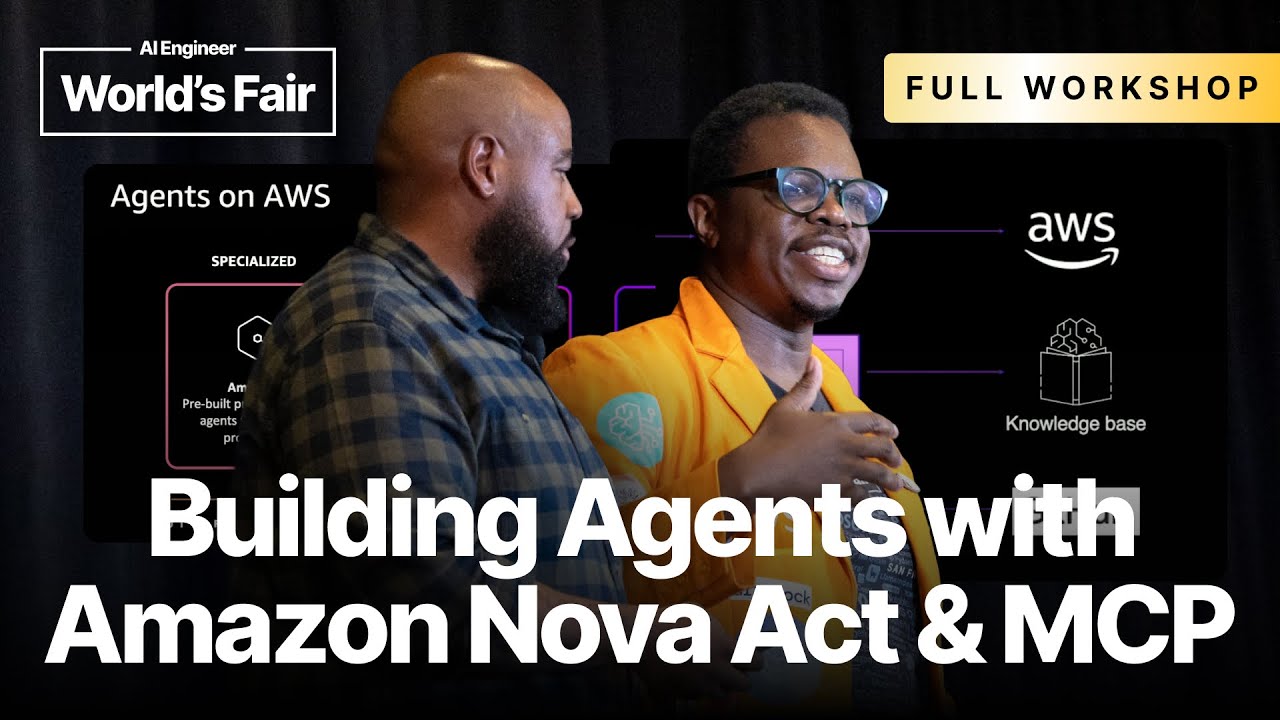
Building Agents with Amazon Nova Act and MCP - Du'An Lightfoot, Amazon (Full Workshop)
Jun 21, 2025 · 1:26:20
Du'An Lightfoot and Benjiro Byami present a workshop on building AI agents with Amazon Nova Act, Model Context Protocol (MCP), and Strands Agents, demonstrating autonomous web navigation and multi-step task execution. Lightfoot explains agentic AI as plan, action, and reasoning, with components like LLM, knowledge base, guardrails, and tools. Nova Act, a research preview, enables browser automation: one demo searches Amazon for a coffee maker and retrieves the product title using natural language commands instead of explicit HTML tags. Byami builds an MCP server for Nova Act, allowing clients like Claude Desktop to control the browser via spoken instructions, then integrates it with Strands Agents, an open-source framework that combines a prompt, LLM, and tools in minimal code. The workshop shows parallel execution (e.g., comparing three monitors) and multi-agent collaboration for tasks like generating a PowerPoint presentation for cloud migration. Limitations include inability to bypass CAPTCHAs and occasional loops in complex websites.

Cognitive Shield Real Time Real Smart - Rachna Srivastava
Jun 3, 2025 · 44:58
Rachna Srivastava presents Cognitive Shield, a three-layer AI defense system against sophisticated financial fraud such as deepfake voice cloning, synthetic identities, and AI-powered crypto scams that have surged 375% since 2023. Layer one secures user data and uses AI to guide licensing and examination processes. Layer two employs eight detection modules including GAN-based deepfake detection, graph neural networks for fraud ring visualization, and NLP for phishing, all integrated via CrewAI multi-agent orchestration. Layer three provides a unified intelligence console with natural language search, real-time dashboards, and automated case escalation with compliance-ready reporting. The system leverages Neo4j graph databases and Graph RAG to uncover hidden connections, and is built with Streamlit, FastAPI, and Postgres. Srivastava warns that by 2027, 90% of cyber attacks will be AI-driven and fraud losses will surpass $100 billion annually.

Function Calling is All You Need — Full Workshop, with Ilan Bigio of OpenAI
Apr 23, 2025 · 1:42:54
Ilan Bigio from OpenAI argues function calling is the essential primitive for building AI agents, demonstrating how to implement memory, delegation, asynchronous task execution, and even self-modifying tools—all using the same loop. Starting from a basic weather tool, he builds an agent that stores user facts in a JSON file, delegates complex requests to o1, runs multiple weather lookups in parallel with asyncio, and creates a Bootstrap agent that writes its own Python functions on the fly. He also shares practical tips from his work on Swarm and the Real-Time API, including a stay-silent function to prevent premature responses and the ability to read scripts with XML tags. The workshop emphasizes that sophisticated agent behaviors emerge from simple function calling patterns without needing heavy frameworks.

Building efficient hybrid context query for LLM grounding: Simrat Hanspal
Feb 5, 2025 · 11:35
Simrat Hanspal from Hasura explains how to build efficient hybrid context queries for LLM grounding using Hasura's GraphQL API, demonstrated via an e-commerce product search use case. The talk covers three query types: semantic search (e.g., 'essential oils for relaxation'), structured search (e.g., 'products less than $500'), and hybrid queries combining both (e.g., 'essential oil diffusers between $500 to $1,000'). Hanspal shows how Hasura unifies relational (Postgres) and vector (Weaviate) databases into a single GraphQL API, auto-vectorizing records via events. A critical security demonstration highlights how role-based permissions (e.g., 'Product Search Bot' role with only select access) prevent malicious insert mutations like adding a fake product with ID 7001. The approach enables secure, dynamic data retrieval for Retrieval-Augmented Generation (RAG) pipelines without building separate APIs.

Build enterprise generative AI apps using Llama 3 at 1,000 tokens/s on the SambaNova AI platform
Sep 11, 2024 · 54:34
SambaNova’s Michelle Matern and Petro Milan present their full-stack AI platform, demonstrating how the SN40L RDU chip enables Llama 3 inference at 1,000 tokens per second. They introduce Samba-1, a composition of 92 expert models behind a single endpoint, and benchmark it against GPT-3.5 and GPT-4 on enterprise tasks like information extraction and text-to-SQL. The workshop then builds a RAG-based Q&A system using LangChain, Unstructured, E5-large-v2 embeddings, ChromaDB, and Llama-3-8B-Instruct at 1,000 tokens per second. Attendees set up the environment, load documents, and run inference with real-time metrics showing time to first token of 0.09 seconds and total inference time of 0.65 seconds.
Powered by PodHood