
Strands
ProductA product discussed on AI Engineer.
4 episodes

Why your agents need decision traces, not just documents — Zach Blumenfeld, Neo4j
May 29, 2026 · 20:12
Zach Blumenfeld from Neo4j argues that context graphs—a graph-based layer storing decision traces, precedence, and causal chains—extend standard RAG to make AI agents more accurate and explainable. A financial analyst agent, for example, can reject or accept a request by retrieving past decision traces and structurally similar precedents via graph embeddings, not just semantic similarity. Neo4j's one-command tool `uvx create-context-graph` scaffolds a full-stack app with backend, frontend, demo data, and MCP server, supporting 22 built-in domains or custom ontology generation. The underlying `neo4j-agent-memory` package handles entity extraction through a spaCy-to-GLiNER-to-LLM pipeline with deduplication and integrates with pydantic AI, LangGraph, Crew, Google ADK, and others. The episode also covers data connectors for GitHub, Notion, Jira, and Slack, and the ability to store and query decision traces with timestamps, though automated trace quality evaluation is still evolving.
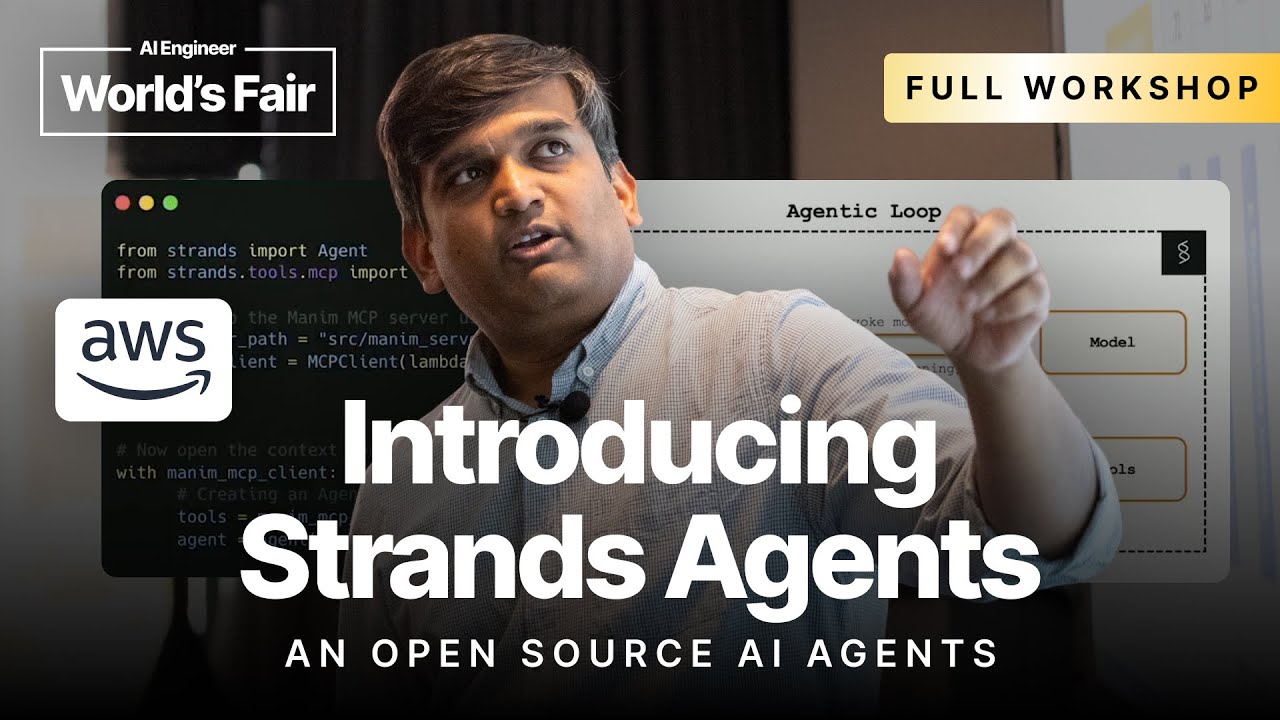
Introducing Strands Agents, an Open Source AI Agents SDK — Suman Debnath, AWS
Jun 27, 2025 · 14:26
Suman Debnath, a Principal ML Advocate at AWS, introduces Strands Agents, an open-source SDK that simplifies AI agent creation by requiring only a model and tools, eliminating scaffolding. He demonstrates building an agent in a few lines of code to read, summarize, and speak a file, using default tools. Another demo integrates Strands with an MCP server to generate animated math videos via Manim, requiring no system prompts—the model reasons autonomously. Custom tools can be created by decorating functions. Strands supports any model via LiteLLM or Bedrock, and is available at strandsagent.com with a GitHub repository for contributions.
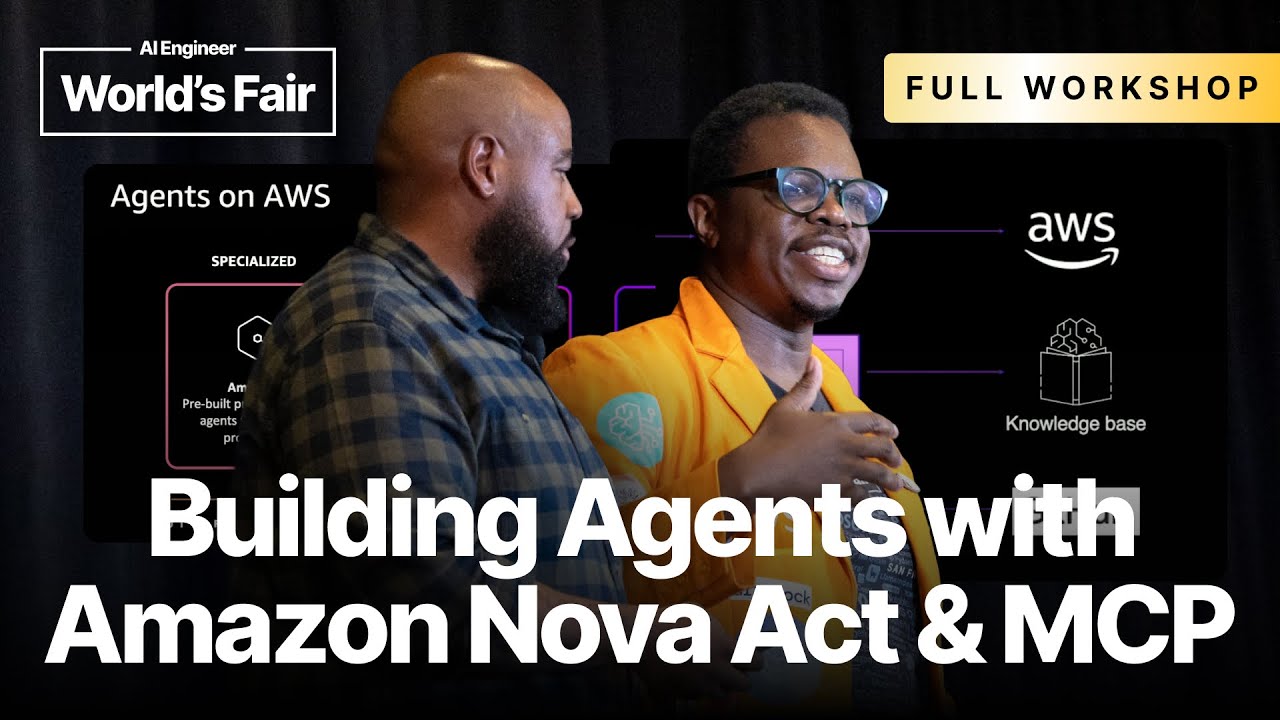
Building Agents with Amazon Nova Act and MCP - Du'An Lightfoot, Amazon (Full Workshop)
Jun 21, 2025 · 1:26:20
Du'An Lightfoot and Benjiro Byami present a workshop on building AI agents with Amazon Nova Act, Model Context Protocol (MCP), and Strands Agents, demonstrating autonomous web navigation and multi-step task execution. Lightfoot explains agentic AI as plan, action, and reasoning, with components like LLM, knowledge base, guardrails, and tools. Nova Act, a research preview, enables browser automation: one demo searches Amazon for a coffee maker and retrieves the product title using natural language commands instead of explicit HTML tags. Byami builds an MCP server for Nova Act, allowing clients like Claude Desktop to control the browser via spoken instructions, then integrates it with Strands Agents, an open-source framework that combines a prompt, LLM, and tools in minimal code. The workshop shows parallel execution (e.g., comparing three monitors) and multi-agent collaboration for tasks like generating a PowerPoint presentation for cloud migration. Limitations include inability to bypass CAPTCHAs and occasional loops in complex websites.
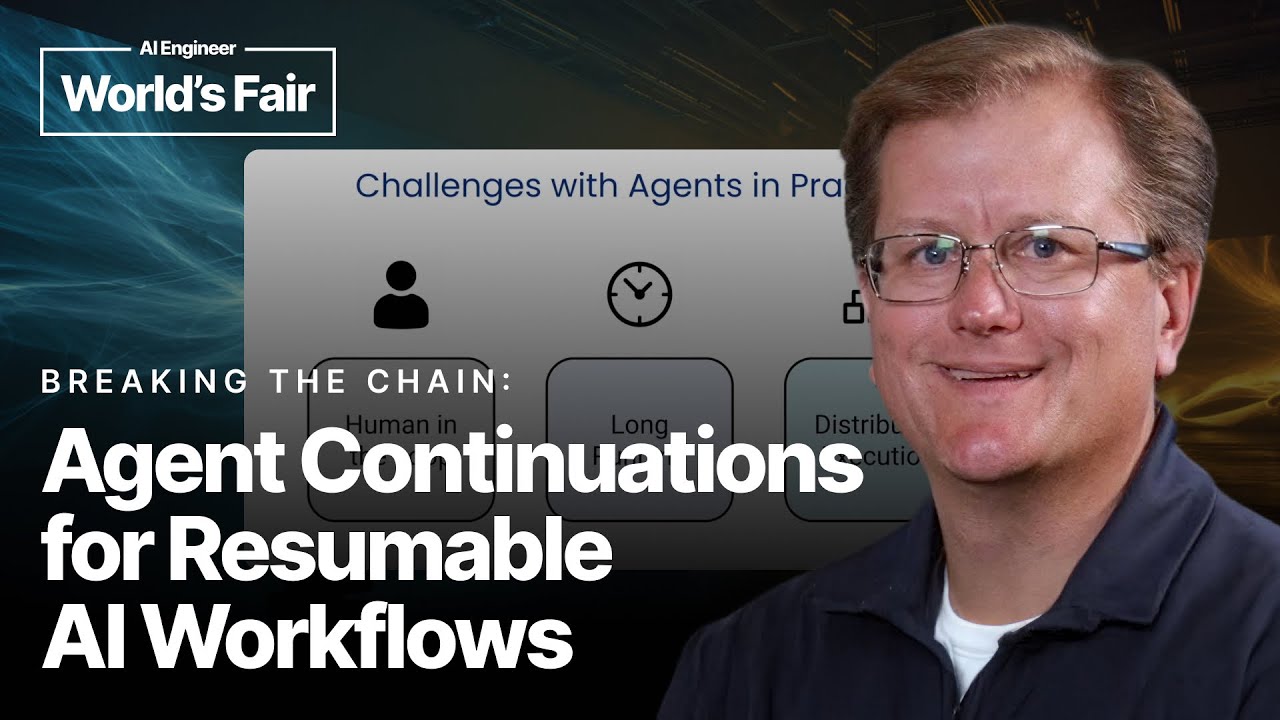
Breaking the Chain: Agent Continuations for Resumable AI Workflows - Greg Benson
Jun 3, 2025 · 27:02
Greg Benson from SnapLogic introduces Agent Continuations, a mechanism to capture and resume the full state of AI agents, enabling human-in-the-loop approval and reliable checkpointing for long-running agent workflows. The solution borrows from programming language continuations: at any suspension point (e.g., a tool needing human approval), the agent’s state is bundled into a JSON continuation object containing the messages array, resume request, and approval metadata. This object can be saved or passed to an application layer, allowing agent loops to be fully shut down and later restored without losing progress. Benson demonstrates with a multi-level HR agent that suspends for human approval of an account authorization tool, then resumes seamlessly. The approach handles arbitrary nesting of subagents and is implemented as an open-source Python prototype that works with any OpenAI-compatible API. Future work includes general suspension triggers and integration with existing frameworks like LangChain or Pydantic AI.
Powered by PodHood