
Stagehand
ProductA product discussed on AI Engineer.
3 episodes

The 3 Pillars of Autonomy – Michele Catasta, Replit
Dec 22, 2025 · 24:42
Michele Catasta, VP of AI at Replit, argues that true autonomy for coding agents serving non-technical users rests on three pillars: verification, context management, and parallelism. Replit’s agent uses autonomous testing—writing Playwright code instead of browser-use tools—to catch broken features (over 30% initially) without human feedback, cutting cost and latency by an order of magnitude. Context management relies on sub-agent orchestration rather than massive context windows, boosting memories per compression from ~35 to 45–50. Parallelism, implemented via a core-loop orchestrator, dynamically decomposes tasks to avoid merge conflicts and keep users engaged instead of waiting hours. Catasta emphasizes that autonomy means scoped technical decisions, not just long runtimes, enabling knowledge workers to build software without needing a 'driving license.'

Don't Build Agents, Build Skills Instead – Barry Zhang & Mahesh Murag, Anthropic
Dec 8, 2025 · 16:22
Barry Zhang and Mahesh Murag of Anthropic argue that instead of building domain-specific agents, developers should build reusable Skills—organized folders of files that package procedural knowledge for agents. They explain that skills are progressively disclosed to protect the context window, use scripts as self-documenting tools, and have already grown to thousands in five weeks, including foundational, partner, and enterprise skills. Skills complement MCP servers by providing expertise while MCP handles connectivity. The future includes treating skills like software with testing and versioning, and enabling agents to create their own skills for continuous learning, ultimately creating a collective knowledge base that makes agents more capable and reliable.
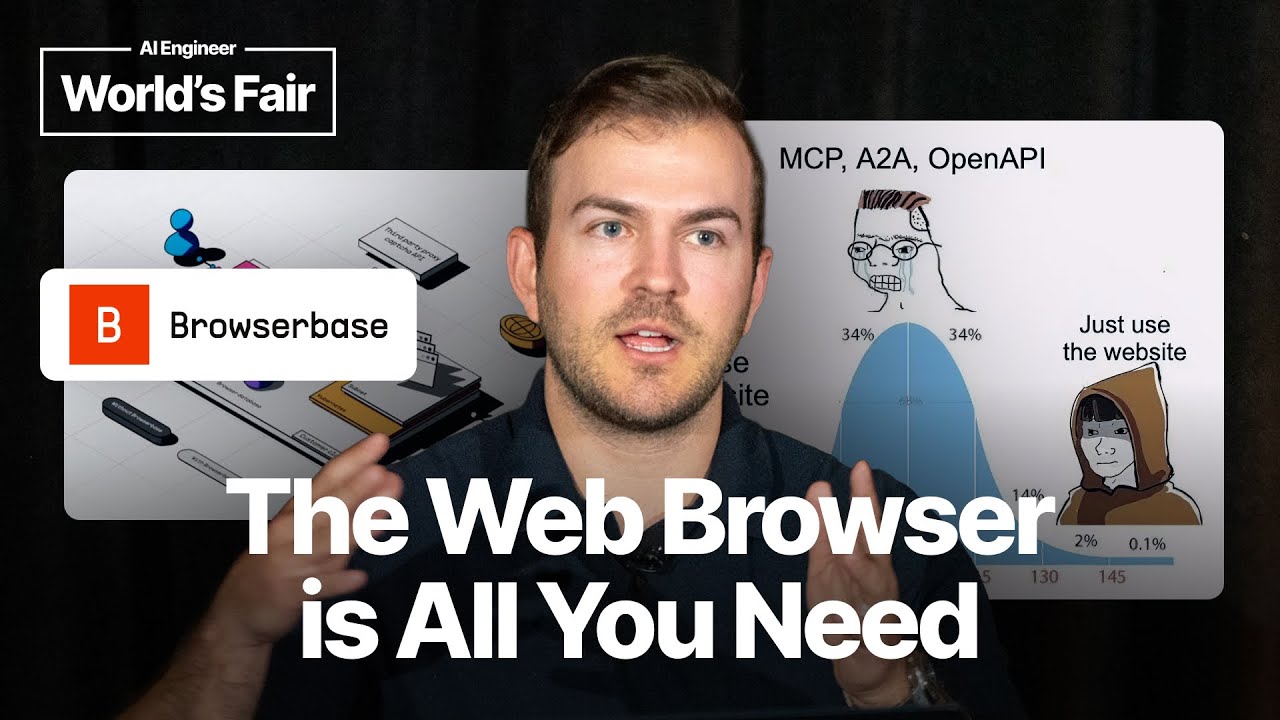
The Web Browser Is All You Need - Paul Klein IV, Browserbase
Jun 20, 2025 · 17:31
Paul Klein IV, founder of Browserbase, argues that the web browser is the default MCP server for the rest of the internet, serving as the essential bridge between AI agents and legacy websites that lack APIs. He distinguishes between web agents (one prompt to many actions, e.g., OpenAI's Operator) and browser tools (one action per prompt), noting that both rely on vision-driven or text-based approaches to parse pages. Klein explains that Browserbase offers a horizontal MCP server for browsing, enabling automation of any website, and stresses the need for custom evals and observability to track agent behavior. In a live demo, he shows an agent navigating sfpca.org to find a dog for adoption, handling unexpected modals. He also addresses captchas, advising good citizenship and hinting at future agent authentication solutions.
Powered by PodHood