
Stable Diffusion
ProductA product discussed on AI Engineer.
8 episodes

GPU Cloud Deployment Without Leaving Your IDE — Audry Hsu, RunPod
Jun 9, 2026 · 20:19
Audry Hsu of RunPod introduces Flash, a Python SDK that deploys GPU cloud functions from a developer's IDE with a single decorator, eliminating the slow iteration cycle of commits, Docker builds, and server allocation. She demonstrates hot reload, swapping Stable Diffusion XL Turbo for DreamShaper instantly, and a pipeline that chains Qwen 3 for prompt generation, DreamShaper for image rendering, and Nano Banana 2 for photo composition. RunPod's serverless H100 pricing is $0.00116 per second, charged only during active inference. Hsu recommends starting with pods for experimentation and switching to serverless when scaling to hundreds of workers across data centers.

FLUX, Open Research, and the Future of Visual AI — Stephen Batifol, Black Forest Labs
May 8, 2026 · 22:32
Black Forest Labs (BFL), the team behind Stable Diffusion and Latent Diffusion, has released a series of open FLUX image models pushing toward visual intelligence. After FLUX.1 and the first open-source editing model FLUX Kontext (7–8 second edits), FLUX.2 achieved state-of-the-art text-to-image and multi-reference editing, and FLUX.2 Klein generates and edits in 300–500 milliseconds for near real-time use. BFL also published Self-Flow, a scalable self-supervised approach that trains multimodal models across images, video, audio, and actions without external encoders, outperforming baselines in all modalities. The episode explains how Self-Flow reduces artifacts (e.g., corrects text rendering and anatomy) and converges 70× faster with representation alignment. BFL’s roadmap includes world models that simulate geometry and interaction, aiming to train agents for robotics and automation.

Building Generative Image & Video models at Scale - Sander Dieleman, Google DeepMind
Apr 21, 2026 · 40:46
Sander Dieleman, a research scientist at Google DeepMind, explains the behind-the-scenes process of building generative image and video models at scale, focusing on diffusion models. He emphasizes that data curation is often underrated and more impactful than model tweaking. Dieleman details how latent diffusion models use learned autoencoders to compress pixels into smaller representations, enabling training on high-resolution video. He describes diffusion as 'spectral autoregression' that generates images coarse-to-fine, and notes that guidance—amplifying the difference between conditional and unconditional predictions—massively improves sample quality at the cost of diversity. On sampling, he contrasts deterministic and stochastic approaches, and covers distillation techniques like consistency models that reduce steps. Dieleman also discusses control signals beyond text, such as camera motion in video generation, and the importance of post-training for conditioning.

ComfyUI Full Workshop — first workshop from ComfyAnonymous himself!
Jul 19, 2025 · 51:25
ComfyAnonymous and Yedrick Kosinski present ComfyUI, an open-source node-based canvas for generative AI that has become the top 150 most popular GitHub repos with 78,000 stars and 3 to 4 million active users. Started as a personal project in January 2023, it now supports image, video, audio, 3D, and text models, with 22,000 custom nodes from 3,000 developers. A key feature is embedding full workflows into generated files for easy sharing. The team discusses its story, including ComfyAnonymous's time at Stability AI and founding ComfyOrg, and addresses questions on CFG, VAEs, LoRAs, control nets, API nodes for remote generation, and future plans for cloud inference and improved onboarding.
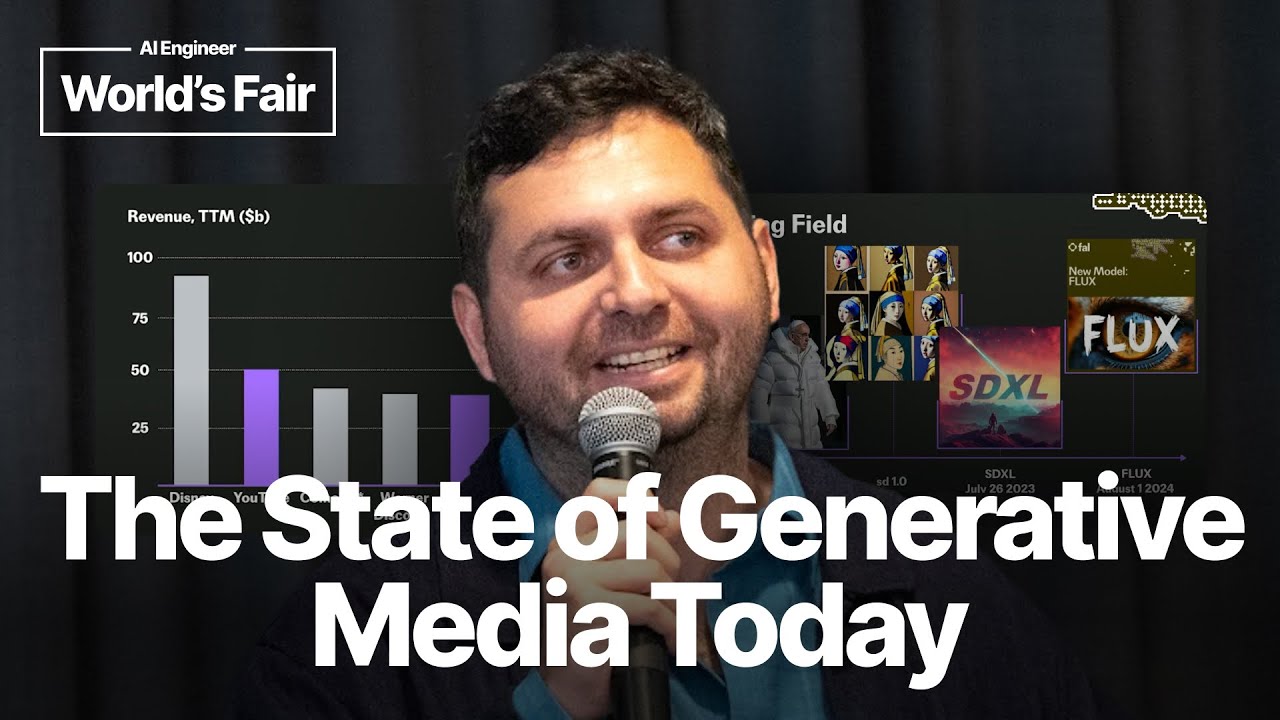
The State of Generative Media - Gorkem Yurtseven, FAL
Jul 16, 2025 · 17:14
Gorkem Yurtseven, co-founder and CTO of fal.ai, argues generative media lowers creation's marginal cost to near zero, transforming advertising and e-commerce. He traces evolution from DALL·E 2 to open-source models like Stable Diffusion and FLUX, with the playing field evening quickly. Video models (Sora, Veo 3) are accelerating: fal's platform saw video usage jump from near zero to 30% of revenue, and he predicts the generative video market 100x-250x bigger than image. Advertising leads with hyper-personalized, interactive ads, like fal's A24 campaign turning selfies into toy soldiers. In e-commerce, virtual try-on is a proven product-market fit. Future real-time video generation will blur games and movies.
Keynote: The AI developer experience doesn't have to suck – why and how we built Modal
Feb 22, 2025 · 21:38
Eric Bernhardson, CEO of Modal, explains why and how his company replaced Kubernetes and Docker with a custom container system to deliver sub-second cold starts for AI developers. Modal turns any Python function into a serverless function with a decorator, runs on thousands of H100s, and fans out to 10,000 parallel calls. To achieve fast startup, Modal built content-addressable storage for deduplication, lazy file loading with prefetching, and uses gVisor for CPU memory snapshotting, cutting Stable Diffusion startup to seconds. The company built its own scheduler and file system, and uses mixed integer programming to manage a global GPU pool across cloud vendors. Customers like Suno use Modal for AI-generated music inference. Modal offers $30/month free credits.

The Weekend AI Engineer: Hassan El Mghari
Nov 22, 2023 · 21:49
Hassan El Mghari shares how he built viral AI apps like RoomGPT and AI Commit, arguing that simple off-the-shelf APIs and focused weekend sprints can attract millions. He describes building 11 side projects in a year, which grew from 20,000 visitors to over 8.5 million unique visitors and 2.8 million sign-ups. Key projects include RoomGPT, which used ControlNet for room redesign and reached 6 million visitors, and AI Commit, an open-source CLI tool adopted by 30,000 developers. He emphasizes using tools like the Vercel AI SDK and v0.dev to accelerate development, making apps free and open source to drive growth, spending 80% of time on UI, and launching quickly with minimal fine-tuning.

Building AI For All: Amjad Masad & Michele Catasta
Oct 23, 2023 · 25:13
Amjad Masad and Michele Catasta announce Replit's AI for all, giving free AI-powered coding to millions of users. They detail the training of Replit Code v1.5, a 3.3B parameter model trained on 1 trillion tokens of code, which outperforms StarCoder 3B and approaches Code LLaMA 7B in Human Eval despite being half the size. The model is optimized for low-latency inference, generating over 200 tokens per second per GPU. Catasta explains the data pipeline using permissively licensed code from The Stack and Replit public repos, with five epochs of repeated high-quality data. The model is released open-source with a commercially permissive license. Partnerships with Glaive AI for instruction fine-tuning, Morph Labs for a novel fill-in-syntax-tree format, and Perplexity for fast model serving are also unveiled.
Powered by PodHood