
Spark
ProductA product discussed on AI Engineer.
4 episodes

When Agents Meet Physical Data: The Other Physics of Agent Harnesses - Dmitry Petrov, DataChain
Jul 20, 2026 · 27:33
Dmitry Petrov of DataChain argues that AI agents fail on unstructured physical data because their intuitions assume cheap recompute, while large-scale video, sensor, and robot data requires a different harness. He cites Anthropic's finding that agents achieve only 21% accuracy on data projects without specific data harnesses, and OpenAI's need for six layers of context even on structured data. Petrov demonstrates DataChain, an open-source Python framework that uses Pydantic schemas to turn messy binary files into queryable databases, an execution engine for distributed processing, incremental checkpoints to avoid recomputing on failure, and a knowledge base of datasets and source code so agents can answer follow-up questions in seconds instead of reprocessing terabytes. In a live demo with Claude Code analyzing 90 dashcam videos, the harness took 24 minutes to extract 100,000 object records, then instantly answered 'how many clips have people?' without rerunning inference. Petrov emphasizes that the key is organizing metadata into star schemas and sharing data lineage across teammates so no one pays the compute cost twice.
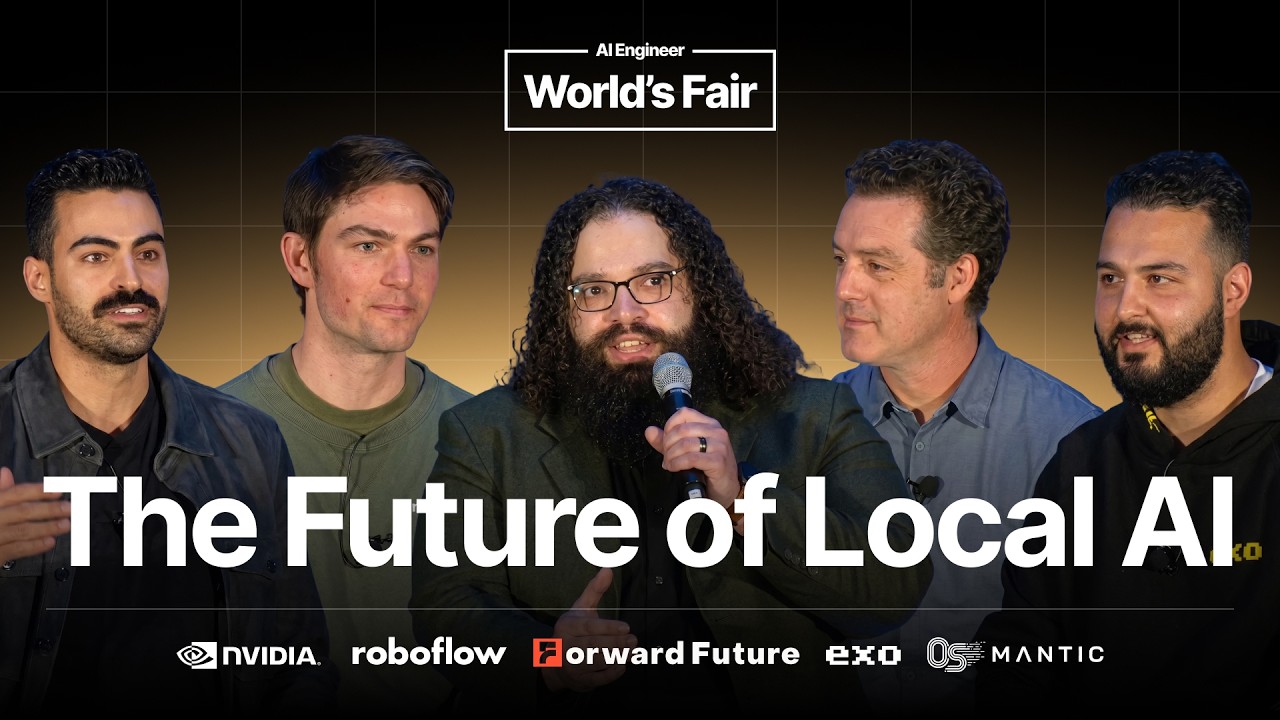
State of the Union: Why Local, Why Now — NVIDIA, Osmantic, Roboflow, EXO Labs, @matthew_berman
Jul 11, 2026 · 44:29
Nader Khalil (NVIDIA), Joseph Nelson (Roboflow), Alex Cheema (Exo Labs), Matthew Berman, and Ahmad Osman (Osmantic, r/LocalLLaMA) argue that local AI is now useful, driven by stronger open models and better hardware. They cite inflection points like Llama 2, DeepSeek v3, and GLM 5.2, which closed the gap with frontier cloud models. Sovereignty and control are key: enterprises need to choose their own model versions and avoid lock-in. Specialized models, such as Roboflow's fine-tuned vision models for deep-sea fish discovery, outperform general ones for specific tasks. Optimization is critical: EXO Labs achieved 10x performance on the DGX Spark by tuning existing NVIDIA kernels. The panel emphasizes that simplicity remains a barrier—most users need point-and-click solutions—and advocates for open-source AI to ensure freedom and innovation.

Automating Large Scale Refactors with Parallel Agents - Robert Brennan, OpenHands
Jan 8, 2026 · 1:16:21
Robert Brennan, CEO of OpenHands, and colleague Calvin explain how parallel agents can automate large-scale code refactors, demonstrating that breaking tasks into agent-sized batches with human oversight achieves 90% automation. They trace the evolution from context-unaware snippets to autonomous coding agents and now agent orchestration, where multiple agents work in parallel on tasks like CVE remediation — one client saw a 30x improvement in time-to-resolution. Calvin shows a pipeline using OpenHands' SDK to batch code files, run a verifier to detect code smells, and spin up fixer agents that generate focused pull requests. Brennan details strategies: task decomposition into single-PR-sized chunks, dependency ordering, and context sharing via agent.md files. The episode closes with a live-coding walkthrough building a parallel agent script that scans for vulnerabilities and opens individual PRs.
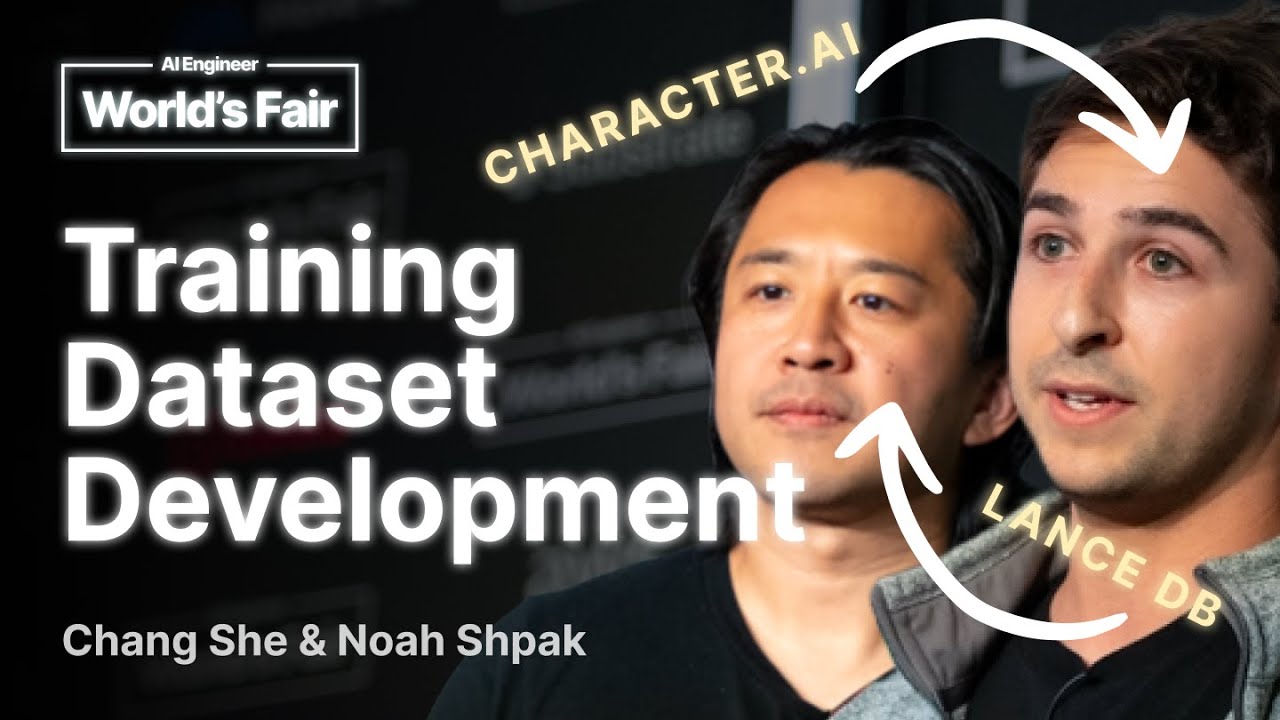
The Hierarchy of Needs for Training Dataset Development: Chang She and Noah Shpak
Oct 15, 2024 · 16:32
Chang She (CEO of LanceDB) and Noah Shpak (AI data platform lead at Character AI) argue that data infrastructure is the critical bottleneck for LLM training, and LanceDB's columnar format solves the 'new cap theorem' for AI: needing fast scans, random access, and handling large multimodal blobs simultaneously. Noah explains how Character AI structures pre-training around wide domain coverage and post-training around granular analytics like token counts and difficulty scores, using synthetic data, quality scoring, and dataset selection to improve models. Chang details how Lance format provides zero-copy schema evolution, time travel, and indexing extensions for vector, scalar, and full-text search, enabling a single table to serve SQL analytics, PyTorch training, and production vector search. The episode emphasizes that speed and iterative dataset management are key to accelerating AI research, with LanceDB facilitating cheap random access and low-infra billion-scale vector search.
Powered by PodHood