
Sora
ProductA product discussed on AI Engineer.
4 episodes

No More Slop – swyx
Dec 22, 2025 · 9:15
In this keynote at the AI Engineer Summit, host swyx declares war on slop — low-quality, inauthentic, inaccurate work produced by both humans and AI — arguing that the AI engineering community must elevate taste and accountability. He introduces Swix's law of anti-slop: the taste needed to fight slop scales with the plummeting cost of generating tokens. Swyx demonstrates how to combat slop using AI itself, citing examples like AI News (which tells readers to skip slow days), prompting techniques to avoid slop, and using sub-agents against context rot. He calls for rejecting autonomy without accountability and urges the audience to say "no more slop" to bosses demanding more lines of code, untested releases, and engagement bait.

Building Effective Voice Agents — Toki Sherbakov + Anoop Kotha, OpenAI
Jul 20, 2025 · 17:17
Toki Sherbakov and Anoop Kotha from OpenAI argue that speech-to-speech models have reached a 'good enough' tipping point for production voice agents, highlighting the shift from chained architectures (transcription + LLM + TTS) to the real-time API's speech-to-speech approach. They detail trade-offs across latency, cost, accuracy, UX, and integrations depending on use case—consumer apps prioritize low latency and expressiveness, while customer service demands accuracy and tool integration. Key design patterns include delegating complex tasks to smarter models like O4 mini, prompting for voice expressiveness and tone, and starting with few tools. For evals, they recommend starting with observability, using SMEs for labeling, then transcription-based LLM-as-judge evals, audio evals with GPT-4 Audio to assess tone and pacing, and synthetic conversations between two real-time clients. Guardrails should run async with a configurable debounce period (e.g., every 100 characters). Examples from Lemonade (early focus on evals and guardrails) and Tinder (customization for brand realism) illustrate successful approaches.
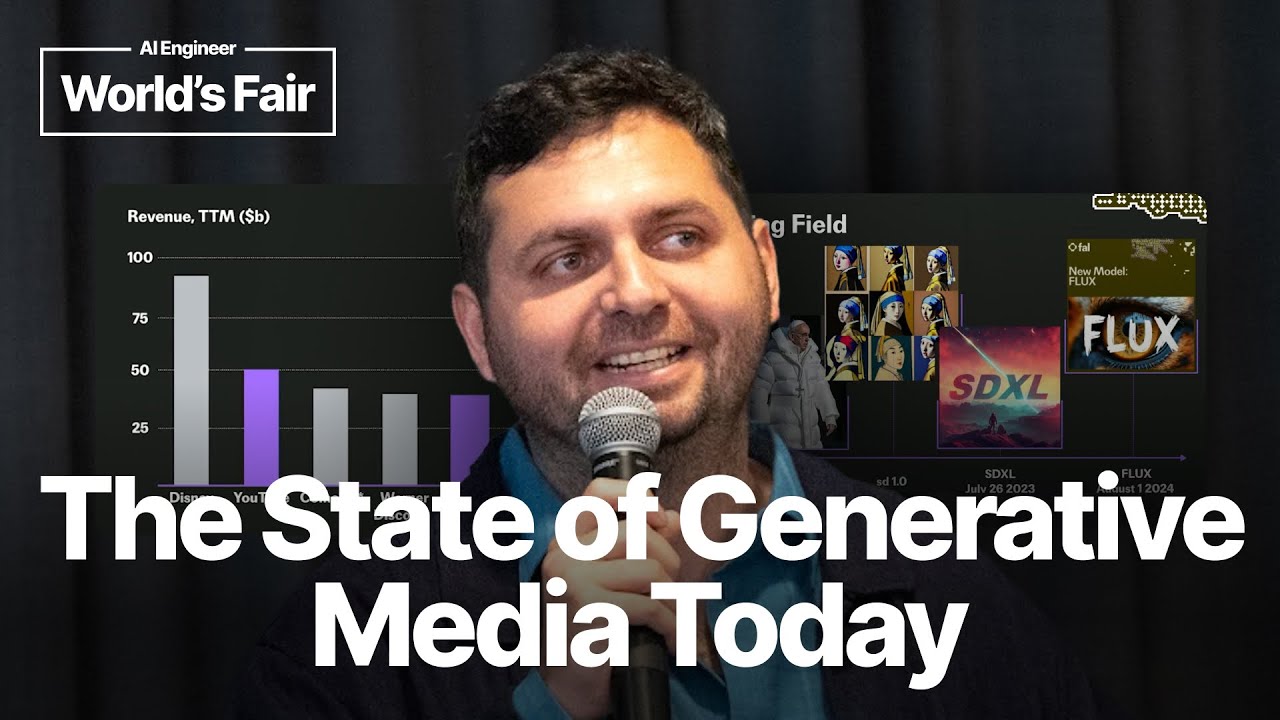
The State of Generative Media - Gorkem Yurtseven, FAL
Jul 16, 2025 · 17:14
Gorkem Yurtseven, co-founder and CTO of fal.ai, argues generative media lowers creation's marginal cost to near zero, transforming advertising and e-commerce. He traces evolution from DALL·E 2 to open-source models like Stable Diffusion and FLUX, with the playing field evening quickly. Video models (Sora, Veo 3) are accelerating: fal's platform saw video usage jump from near zero to 30% of revenue, and he predicts the generative video market 100x-250x bigger than image. Advertising leads with hyper-personalized, interactive ads, like fal's A24 campaign turning selfies into toy soldiers. In e-commerce, virtual try-on is a proven product-market fit. Future real-time video generation will blur games and movies.

From Text to Vision to Voice Exploring Multimodality with Open AI: Romain Huet
Jul 10, 2024 · 23:39
OpenAI's Romain Huet demonstrates GPT-4o's real-time audio, vision, and screen-sharing capabilities at the AI Engineer World's Fair, showing how the omni-model achieves human-like conversational latency, understands emotion, and can be interrupted naturally. He walks through live demos of ChatGPT Desktop recognizing drawings, reading book pages, and pair-coding a responsive travel app using Tailwind CSS. Huet also previews Sora's text-to-video generation and OpenAI's unreleased Voice Engine, which can clone a voice from seconds of audio and translate it into multiple languages while preserving the original speaker's tone. He outlines OpenAI's four focus areas: advancing textual intelligence, faster/cheaper models (GPT-4o is twice as fast as GPT-4 Turbo at half the price), model customization via fine-tuning, and enabling multimodal agents. The talk emphasizes that today's models are the dumbest they'll ever be and urges developers to build for a future where AI works across text, voice, and video.
Powered by PodHood