
Sonic
ProductA product discussed on AI Engineer.
3 episodes

Voice Agents That Handle Interrupts - Chintan Agrawal and Daniel Wirjo, AWS
Jul 20, 2026 · 32:57
AWS Solutions Architects Chintan Agrawal and Daniel Wirjo argue that the hardest problem in production voice agents is audio engineering—not AI—specifically turn-taking, the decision of when an agent should stop speaking or start responding. They present three levels of turn detection: Level 1 uses Silero VAD with a silence timeout (e.g., 300ms default), Level 2 delegates to STT providers like Cartesia or Deepgram for built-in endpointing (p50 ~250-300ms), and Level 3 combines Silero VAD with SmartTurn, an open-source 8MB model achieving 58.9% recall and 68.4% precision while falling back to VAD on low confidence. They show how interruption handling (barge-in) flushes TTS/LLM in ~15ms and distinguish real interruptions from backchannel acknowledgments. Latency budgets are tight: 40ms mic encoding, 52ms network/jitter, 300ms STT+endpointing, 500-650ms LLM time-to-first-byte (dominant bottleneck), and 120-190ms TTS playback, totaling 800-1300ms in standard cloud setups. Co-locating models in one GPU cluster can achieve ~500ms voice-to-voice. For LLMs, Nemotron 3 Ultra and GPT-4.1 achieve ~530ms p50 but GPT-4.1 spikes to 1.7s p95, and multi-turn drift (>15 turns) can break prompt…

Vibes won't cut it — Chris Kelly, Augment Code
Aug 3, 2025 · 15:34
Chris Kelly of Augment Code argues that vibe coding—letting AI write code without review—fails for production systems, where every line of code carries maintenance burden and decisions about architecture, packages, and trade-offs. He contends that code generation is not the job; software engineering is changing code safely, requiring context that LLMs lack despite their human-like output. Claims that generating 30% of code against millions of existing lines leaves little wiggle room, and that complex systems have emergent failures that pattern matching can't fix. He advises documented standards, reproducible environments, easy testing, clear boundaries, and defined tasks—tools every engineer needs. Cites Jeff Atwood: 'The best code is no code at all.' Notes professional engineers are slowest to adopt AI, and suggests code review is the most important skill for an AI-assisted future.
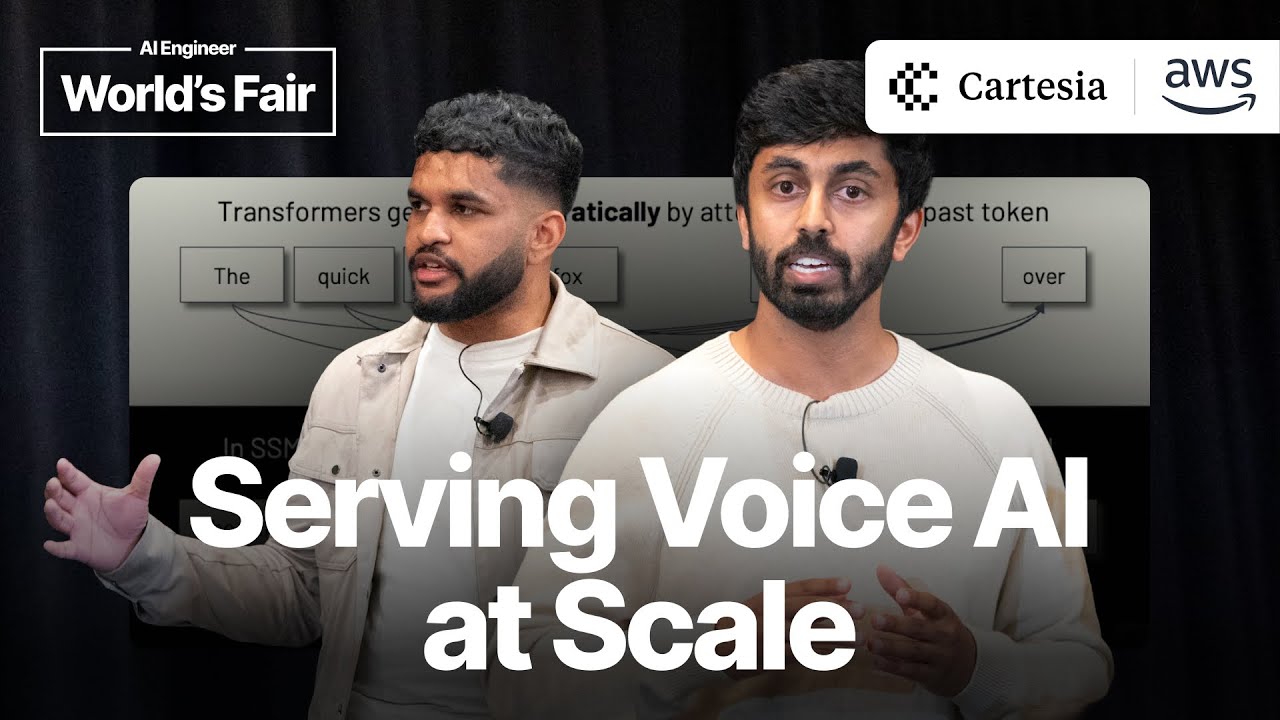
Serving Voice AI at Scale — Arjun Desai (Cartesia) & Rohit Talluri (AWS)
Jun 27, 2025 · 17:05
Arjun Desai of Cartesia AI and AWS's Rohit Talluri discuss scaling voice AI for enterprise, arguing that latency and controllability are critical, with Cartesia's state-space model Sonic 2 achieving 40ms model latency for real-time applications. Desai explains that traditional transformer models scale quadratically, while Cartesia's SSMs maintain O(1) generation, enabling 2.5x faster inference than their earlier models. He emphasizes that edge deployment is 5x faster than cloud round-trips, making local models essential for interactive use cases. On quality, Desai notes that voice AI must handle interruptions, accents, and background noise, and that Cartesia's voice marketplace amplifies human voice actors rather than replacing them. Looking to 2030, he predicts voice AI will become the default interface across healthcare, customer support, and gaming, with interactive models extending beyond audio to full world models.
Powered by PodHood