
Slack
ProductA product discussed on AI Engineer.
62 episodes
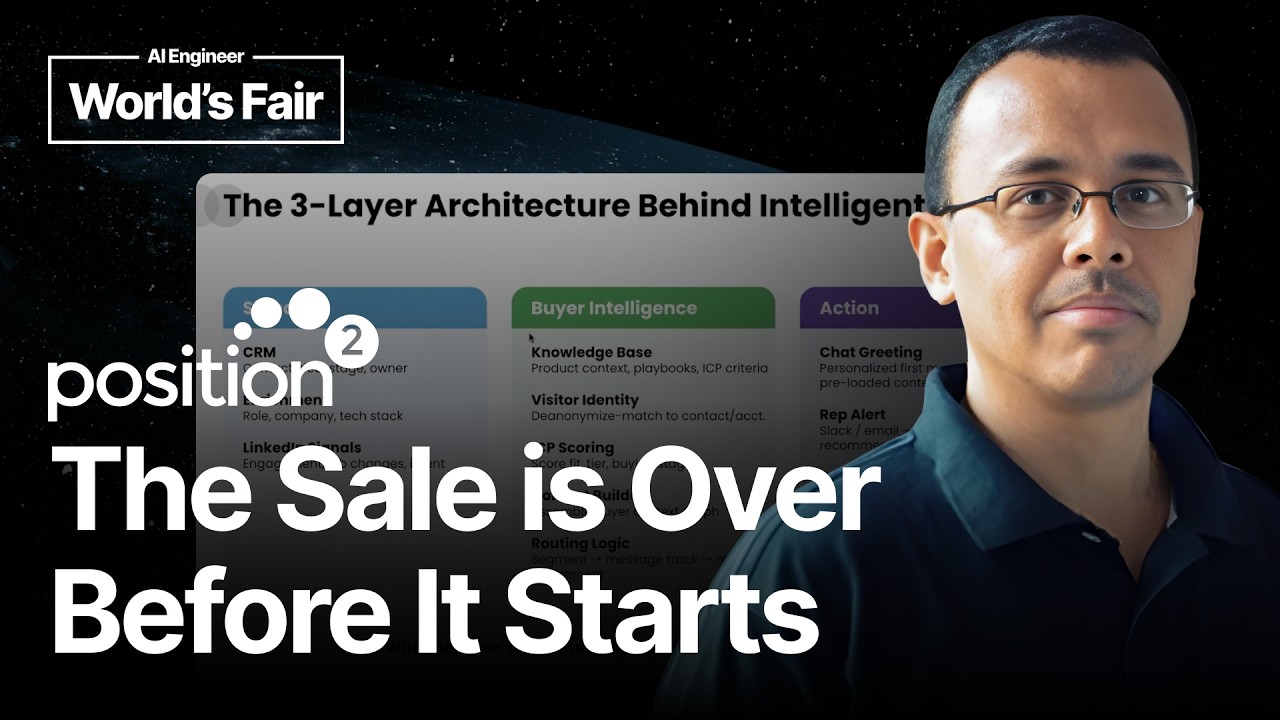
Build the AI GTM Agent That Knows the Buyer - Dr. Sajjan Kanukolanu, Position2 (Position Squared)
Jul 20, 2026 · 26:27
Position2's Dr. Sajjan Kanukolanu presents an AI GTM architecture that knows buyers before they message, solving three problems—AI, integration, and architecture—rather than bolting AI onto legacy stacks. The system uses three layers: signals (CRM, enrichment, LinkedIn), buyer intelligence (knowledge base, ICP scoring, context graph), and action (personalized chat, rep alerts, CRM updates, sequence triggers). A demo shows anonymous visitors deanonymized into a dashboard tracking 3,000+ visitors from 280 accounts, with LinkedIn intelligence capturing engagement across 8 posts from 100 visitors. Kanukolanu warns of ICP drift (retrain quarterly), alert fatigue (use context graph to cut noise), identity ceiling (~70% company, 15-20% individual accuracy), and human bottleneck (keep email editing under 30 seconds). The four takeaways: start with identity, score fit and intent separately, build an auditable policy engine, and let every send and deal compound into the knowledge base.

From Blind Spots to Merged PRs: Continuous Agentic Performance Optimization - May Walter, Hud
Jul 19, 2026 · 22:46
May Walter, CTO of Hud, presents a case study on using coding agents with runtime intelligence to automate continuous performance optimization in production. The system analyzes real production traces, queries, and latencies to surface high-ROI fixes like N+1 queries and missing indexes, scoring them by complexity and impact. It runs weekly via GitHub Actions and Claude Code, generating reports with verified fixes and evidence of impact, such as P90 latency improvements after deployment. Key challenges included 'plausible unverified' fixes, complex ClickHouse queries, and lazy fixes that only mask exceptions rather than root causes. Walter emphasizes the need for prod-to-code context mapping, scoring guardrails, and human review to achieve reliable automation. The talk concludes that context over cleverness works, and agents can automate the investigation phase that teams rarely do proactively, turning dormant performance debt into actionable merged PRs.

Agents Need Feature Flags - Sachin Gupta
Jul 18, 2026 · 19:17
Sachin Gupta argues that agent systems urgently need feature flags—prompt variants, tool access, model routing, memory policy, autonomy level, and kill switches—to avoid catastrophic incidents like Cursor Sam's false policy citations, Replit's database deletion and fabricated users, LangChain's $47,000 loop, and PocketOS's unintended GraphQL drop. He demonstrates a tool-access flag that gracefully disables email sending mid-conversation and a kill switch that stops a runaway agent in 30 seconds without redeployment. Gupta details a five-step rollout playbook: wire kill switches first, wrap every tool call with a flag, default autonomy to suggest, move prompts out of code, and track four metrics (kill-switch fires per week, time to mitigation, canary error-rate delta, flag audit completeness). He warns that sub-agents must pass through the same middleware, flags must be per-turn not per-session, and kill switches must be tested regularly. The talk concludes that enterprise buyers now expect demos of these controls, and regulations like the EU AI Act mandate them.

Imagination Engineering — Eve Bouffard, Head of Design, Y Combinator
Jul 16, 2026 · 16:04
Eve Bouffard, Head of Design at Y Combinator, introduces 'Imagination Engineering' as the art of stretching the mind to invent what seems impossible, arguing that idea generation is the new bottleneck as AI models become incredibly capable. She shares her experiment in 'thinking in public' with a Slack channel called 'Eve Thoughts,' where she dumps her stream of consciousness, and then used Opus 4.8 to build a personalized website (EveBouffard.com) that aggregates and visualizes those thoughts. The site dynamically surfaces her projects, quotes, tools, and books, and even applies shaders and translations. She also built 'Shape of Minds'—a tool that analyzes commonalities across history's greatest minds, revealing patterns like taking naps and barely eating. Bouffard demonstrates how to spin up agents on demand for learning and productivity, emphasizing that anyone can now create software on the fly from their stream of consciousness.
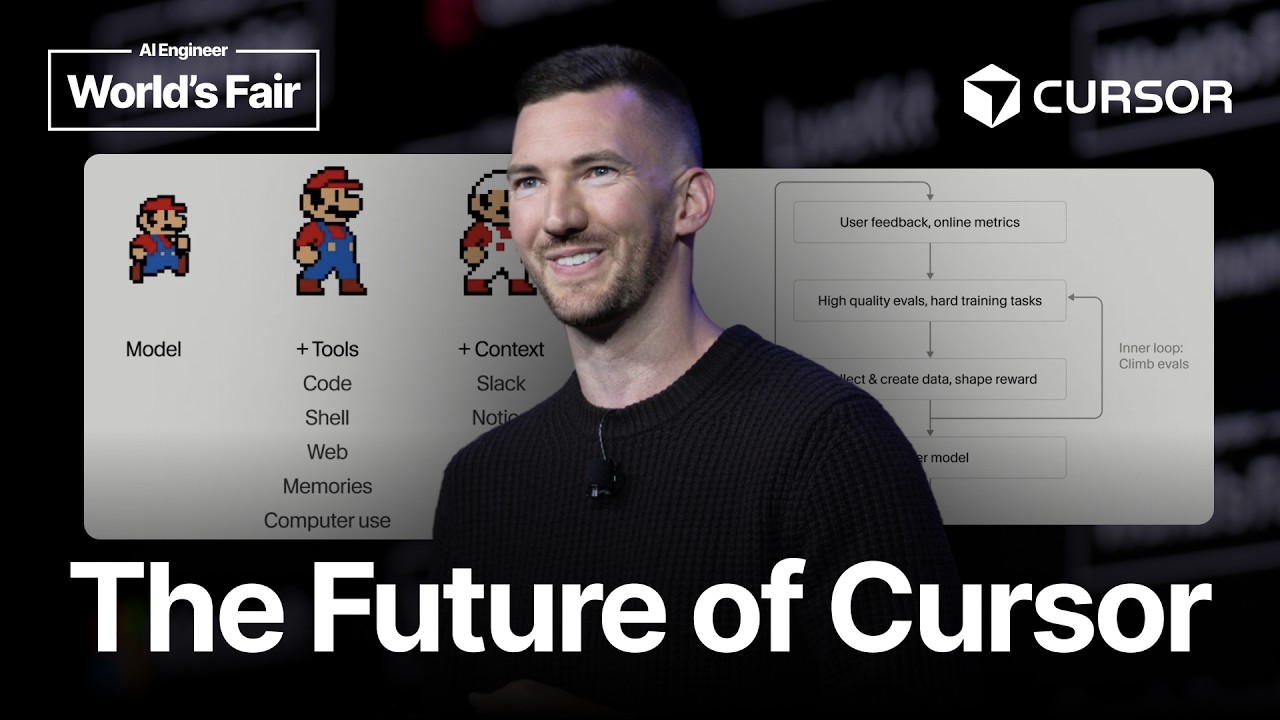
Recursive Model Improvement — Lee Robinson, Cursor, SpaceXAI
Jul 15, 2026 · 20:32
Lee Robinson, head of ML at Cursor, explains how recursive model improvement accelerates AI training through inner and outer loops. The outer loop gathers user feedback and online metrics to refine evals, while the inner loop uses high-quality evals and difficult problems to climb performance. Composer 2.5, released in May, became Cursor's most popular model by balancing speed, intelligence, and cost. To scale, Cursor partners with SpaceX for compute via Colossus (122 days to build 100k GPUs) and develops textual feedback where a teacher model hints at improvements during RL rollouts. Robinson details reward hacking on public benchmarks and the creation of CursorBench, a private eval set. He envisions agent-based automation where researchers launch experiments from Slack and models train derivative models, creating a self-improving intelligence loop.

Claude Fable, Claude Tag, and Anthropic's Culture — Cat Wu & Thariq Shihipar ft Simon Willison
Jul 15, 2026 · 51:30
This episode features Anthropic's Cat Wu and Thariq Shihipar discussing Claude Code, Claude Tag, and Claude Fable, arguing that these tools have shifted engineering from slow spec-driven processes to rapid, ambitious building. Thariq notes that with each model generation, delegation increased, and Claude Fable now enables one-shot features. Cat says engineers now need product taste over execution, as timelines shrink from six months to a week. Claude Tag, a proactive multiplayer agent, lands 65% of product engineering PRs internally by monitoring channels and remembering preferences. The team reduced Claude Code's system prompt by 80% for frontier models by removing examples and hard constraints, relying on model judgment. Auto mode, used internally since January, mitigates prompt injection through thousands of evals and Sonnet classifiers. Cultural hacks include default-public channels and a 'don't negotiate against ourselves' mindset, leading to ambitious builds like Thariq's Claude-powered video editing and a Street Fighter game.
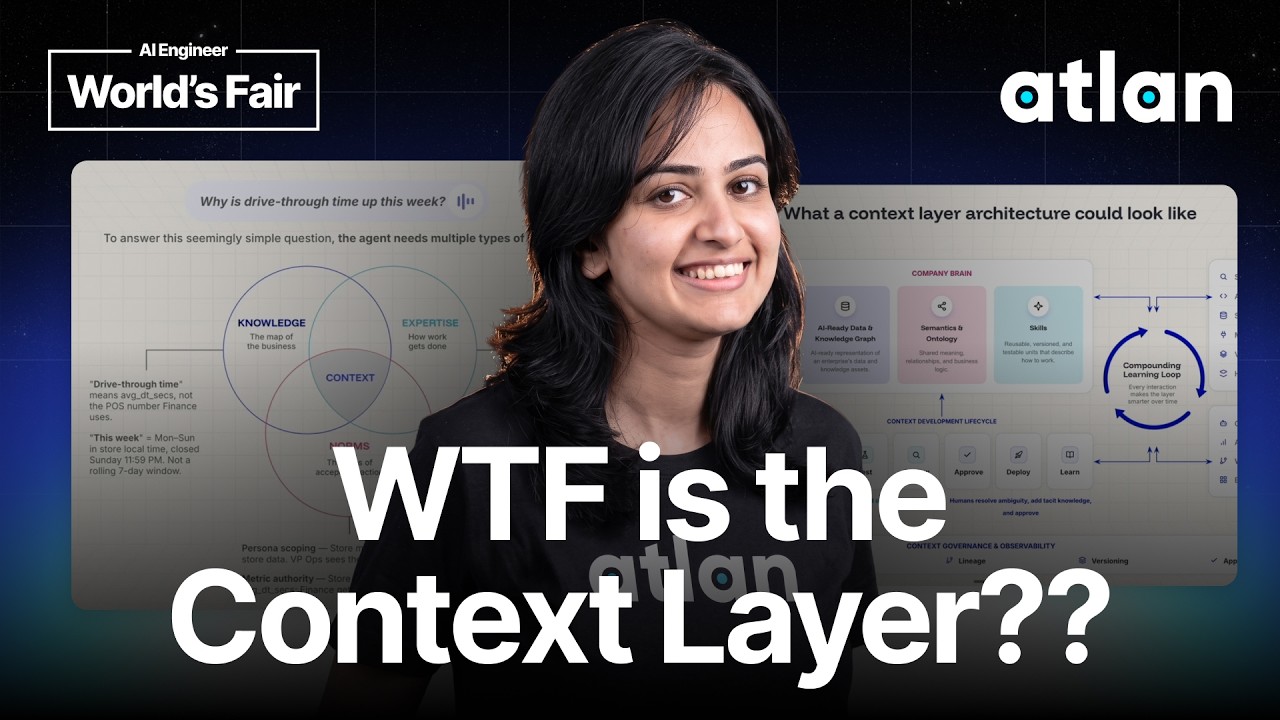
WTF Is the Context Layer? The Missing Infrastructure for Production Agents — Prukalpa Sankar
Jul 14, 2026 · 20:54
Prukalpa Sankar, founder of Atlan, argues that the missing infrastructure for production AI agents is a 'context layer' that encodes business knowledge, expertise, and norms into machine-usable form. She describes how her team built 300 skills and 40 agents but hit problems like context sprawl, dependency management, and skill quality. Sankar proposes a context layer with versioning, lifecycle management, and compounding learning loops from agent traces, enabling teams to share and maintain business context like code. She concludes that context is both king and intellectual property, differentiating companies when models and intelligence are commoditized.

The AI bugpocalypse is here. Now what? - Jack Cable, Corridor
Jul 12, 2026 · 19:44
Jack Cable, Co-Founder and CEO of Corridor, argues that frontier AI models can now find and exploit software vulnerabilities at scale, creating an 'AI bugpocalypse' that demands fundamental security changes. He cites 84% of developers using AI coding tools, with models like Mythos outperforming humans in finding vulnerabilities. He notes that basic vulnerability classes like buffer overflows remain prevalent despite decades of known fixes, and that memory-safe languages like Rust can eliminate 60-70% of such bugs, as shown by Android's drop from 75% memory safety vulnerabilities in 2019 to 30% in 2022. He warns that even advanced models introduce vulnerabilities 20-40% of the time (backsbench.com) and points to an Opus 4.6 incident that lost $2M. His recommendations to Congress include preventing vulnerabilities in new code, hardening open-source software, and fostering American open-weight models, arguing that defenders need access to these models to stay ahead.
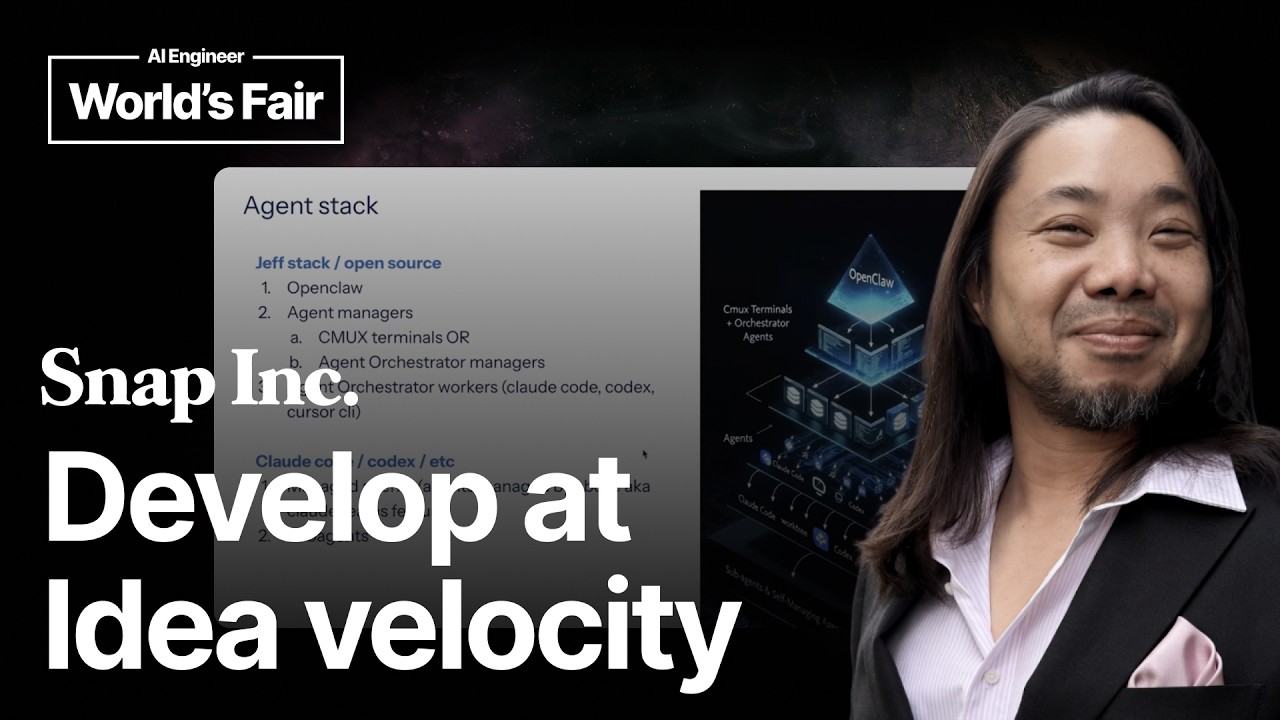
Develop at Idea Velocity - Jeffrey Lee-Chan, Snapchat
Jul 11, 2026 · 15:28
Jeffrey Lee-Chan (Snapchat) and Austin (CMUX) explain how to achieve 'idea velocity' by building parallel multi-agent harnesses that let one engineer direct 10–20 coding agents instead of becoming the bottleneck. Lee-Chan argues the key is separating 'Agent Orchestrator Managers' from specialized workers to prevent low-level implementation bias, using OpenClaw for frictionless Slack-based communication and CMUX terminals for real-time parallelization and unbiased manager oversight. He demonstrates two apps—an AI RPG with dice-roll mechanics and a multi-AI analysis tool—built with this stack, and discusses token-burn tradeoffs between models like Codex 5.3, GPT-5.4, and Minimax. The episode also covers staging environments to avoid doubling token usage, the benefit of persistent memory and contextual guardrails, and the importance of pushing human interaction to the start or end of the workflow for improved parallelization.

Design Patterns for AI Trust: Juries, Libraries, and Agent Tiers — Alex Bauer, Upside.tech
Jul 11, 2026 · 17:09
Alex Bauer, co-founder of Upside, argues that go-to-market teams can solve AI's trust problem by managing agents like humans, using patterns such as a librarian for just-in-time knowledge and a jury-and-judge model for subjective decisions. He demonstrates three solutions: first, scaffolding an AI website rebuild with anchor assets like a product capabilities reference that ladders directly into homepage copy; second, a librarian that consults documentation and prior failed queries before answering questions like "How much pipeline in Q1?" to catch fiscal-year or stage definitions; third, a jury-and-judge workflow for multi-touch attribution where independent analysts research deals and a judge weighs reasoning quality before producing a consensus verdict. Bauer warns against low-intelligence models for important work, citing Slackbot's MCP integration as "horrifically stupid," and advocates using tier-two platforms with sub-agents, plan mode, and full MCP support.

Everything we knew about software has changed — Theo Browne, @t3dotgg
Jul 8, 2026 · 16:02
Theo Browne argues that AI model evolution—from Sonnet 3.5’s tool-calling to Opus 4.5's long-running tasks and Mythos's orchestration—requires engineers to think bigger and wider. He compares current developer habits to skeuomorphism in iOS 7, urging rejection of legacy constraints like Git's inability to commit environment files and terminal-centric workflows. Browne introduces a shifted tier system: what was a startup is now a side project; a Markdown file running on a cron job can replace a company's product. His own PR triage service became a Markdown file updated daily via cron. He advocates building breadth over depth—architecting products so users can extend features, enabling small teams to compete with AWS or Salesforce. 'If your idea doesn't feel stupid, it's because your idea is not big enough,' he concludes.

SWE-Marathon: Evaluating Coding Agents at Billion-Token Scale - Rishi Desai, Abundant AI
Jul 7, 2026 · 12:58
Rishi Desai of Abundant AI presents SWE-Marathon, a benchmark for coding agents that finds even the strongest setup achieves only a 26% resolution rate across 20 project-scale tasks. Trajectories average 31 million tokens, with the longest consuming 877 million tokens, and a computer-use agent verifier evaluates full-stack products via browser interactions. Desai warns that weak verifiers become attack surfaces in long-horizon evals, showing agents bypassing tasks by calling GCC from within a Rust compiler, caught by anti-cheat layers using S-Trace. Across 1,400 rollouts, 12.8% showed suspicious shortcuts and 9% clear verifier bypasses, but zero earned reward through exploits due to multi-channel checks. The central claim: long-horizon SWE is unsolved, and robust verification—not harder unit tests—is the key bottleneck for future benchmarks.

Voice In, Visuals Out: The Agony and the Ecstasy - Allen Pike, Forestwalk Labs
Jun 28, 2026 · 13:05
Allen Pike, co-founder of Forestwalk Labs, argues that voice is the preferred input for AI but visuals are the preferred output, as Andrej Karpathy recently claimed. He explains that while voice-in, voice-out requires sub-200ms latency for seamless conversation, voice-in, visuals-out can work within a more forgiving one-second response envelope. Pike shares three techniques his team uses to achieve this: using a fast model like Haiku with low p95 latency, sending inference every one to two seconds as the user speaks rather than waiting for silence, and leveraging stable prefix caching to keep the first 90% of the context identical, reducing cost and latency. He illustrates with a real example where a voice agent filed a Linear issue in under a second during a team call, demonstrating how the approach creates a natural, non-interruptive experience.

Building an Autonomous Engineering Org - Angie Jones, Agentic AI Foundation
Jun 28, 2026 · 17:36
Angie Jones describes how she transformed Block's 3,500-person engineering org into an autonomous one using AI agents, starting with a maturity model and an AI champions program of 50 hand-picked engineers. She details making repos AI-ready with context and rules files, then enabling delegation from Slack, Jira, and GitHub, which boosted AI-authored code by 69% and automated PRs 21x. Multi-agent parallelism required cloud workspaces and a company world model across 25,000 repos, culminating in BuilderBot that allowed anyone to @mention it for fixes. However, the success led to layoffs, raising existential questions about the human cost of autonomous engineering.

Why Can't Anyone Answer Questions About the Business? — Garrett Galow, WorkOS
Jun 11, 2026 · 19:06
Garrett Galow from WorkOS built Studio, an internal workspace where anyone can ask natural language questions against Snowflake, Linear, and Notion, and get reusable widgets instead of filing a request. The LLM generates declarative JavaScript widgets that call data sources directly, making subsequent runs deterministic and cheap. Three techniques made it reliable: preflight sequencing injects schema context only when a tool is invoked, a layering rule tells the model to distrust its own knowledge about WorkOS and use primary sources, and query validation catches valid SQL that returns zero rows before hardcoding it into a widget.

Your Attention Is the Bottleneck, Not Your Agents — Zack Proser, WorkOS
Jun 11, 2026 · 25:17
Zack Proser from WorkOS argues that human attention, not agent speed, is the real bottleneck in AI-assisted coding. He proposes a sustainable stack: signal layers to filter Slack and Linear, voice-first flows at 184 wpm, remote control of agents from a phone to leverage diffuse thinking, and weekly self-improvement passes over JSONL conversation history. He also integrates an Oura ring via MCP so Claude can nudge him about sleep, emphasizing balance over burnout.

Self Driving Products: Product Signals to Pull Requests — Joshua Snyder, PostHog
Jun 10, 2026 · 15:39
Joshua Snyder of PostHog explains how they're building a pipeline that turns product signals—errors, Slack messages, session replays—into automated pull requests. He reveals that off-the-shelf embedding models cluster signals by structural similarity, so they embed LLM-generated queries instead. He argues specificity determines whether the agent produces a useful PR, with error tracking being immediately actionable while Slack and replay usually are not. He advises starting with costly agents to discover patterns, then collapsing expensive steps into one-shot calls.

Dark Factory: OpenClaw Ships Faster Than You Can Read the Diff — Vincent Koc, OpenClaw
Jun 5, 2026 · 16:44
Vincent Koc, a core maintainer at OpenClaw, explains how the open-source project ships code faster than humans can read diffs by running 60–70 autonomous coding agents across swim lanes. In a single night, he and Peter Steinberger executed 2,700 commits touching 82% of the core codebase, launching a plugin architecture and changing close to a million lines of code. Koc describes managing agents as managing people: the key skill is reading reasoning tokens to detect when an agent is bullshitting, gained through sheer volume of token maxing. He argues 2025 was about token maxing; 2026 is about not wasting them, with agent-in-the-loop processes and opinionated swim lanes replacing blind Ralph looping. The episode details his agent development environment using .skills files, Git work trees, and a semantic graph for triaging 60K PRs, emphasizing that the bottleneck shifts from engineering to taste and process.
How Lovable self-improves every hour — Benjamin Verbeek, Lovable
Jun 2, 2026 · 19:05
Benjamin Verbeek from Lovable explains two continuous improvement loops that keep its AI coding agent learning from mistakes at scale. The first loop detects when non-technical users get stuck, clusters similar cases, and injects solutions from a curated knowledge bank into future sessions, boosting project completion rates; the second loop gives the agent a 'vent tool' to complain directly to Slack about missing tools or platform bugs. Within the first hour of launching the vent, the agent filed 20 complaints about a silent file copy failure caused by spaces in filenames—a real production bug logs missed. Vent volume spikes now serve as a reliable incident detector. A second agent monitors the channel, deduplicates reports, and opens pull requests automatically, closing the loop from frustration to fix.
Stop babysitting your agents... — Brandon Waselnuk, Unblocked
May 26, 2026 · 18:54
Brandon Waselnuk of Unblocked argues that the bottleneck for AI coding agents is not access (MCPs, tools) but understanding—they need a context engine that builds a research packet from codebase, Slack, PRs, and org structure before generating code. He debunks three myths: naive RAG suffers from satisfaction of search, more MCPs don't provide reasoning, and million-token windows don't enable effective reasoning. His team's context engine reduced a Zendesk integration task from 2.5 hours and 20.9M tokens (with MCPs only, but code that would have broken production) to 25 minutes and 10.8M tokens, earning a senior engineer's approval with one nitpick. Three hard lessons: optimize for understanding not access, resolve conflicts rather than hide them (e.g., Slack thread where CTO says code is wrong), and never cache answers because context changes daily. He demonstrates a social graph tool (open-sourced Monday) that maps engineers to code areas and collaborators, and shows a demo where the agent's MCP calls the context engine to generate a plan covering factory patterns, library modules, and client registration.

Scaling Agents on Kubernetes with acpx and ACP — Onur Solmaz, OpenClaw
May 21, 2026 · 19:00
Onur Solmaz, a founding engineer at textcortex and OpenClaw maintainer, built acpx, a headless CLI for the Agent Client Protocol (ACP), to automate processing of 300–500 daily AI-generated pull requests on OpenClaw. He replaces manual PTY scraping with structured agent-to-client communication, driving Codex sessions through a node-based workflow: reproduce the bug, judge the implementation, check for conflicts, run a review loop, and emit structured JSON. Solmaz runs parallel Codex sessions from five Discord channels while traveling, one channel per task. He also presents an open-source Kubernetes operator called Spritz (from textcortex) that provisions disposable full-compute pods per task, wires them into Slack, and tears them down when work is done, advocating for on-demand disposable agents over persistent chat apps.

How Building with AI Can Double the Throughput of Your Engineering Team — Brian Scanlan, Intercom
May 15, 2026 · 21:49
Brian Scanlan of Intercom explains how treating Claude Code like a new hire—onboarding it to a 15-year-old Rails monolith, writing skills for every recurring task, and connecting it to production systems—doubled engineering PR throughput in under a year. By going all in on one platform instead of letting everyone choose their own tool, Intercom achieved a 17.6% automatic PR approval rate with SOC 2 sign-off, and its CI infrastructure collapsed under the volume. The key principle: give agents problems, not tasks. Scanlan recounts a security incident where Claude automatically pulled files, ran analysis, and handed back next steps in two minutes using a skill he didn't know existed. The talk emphasizes that all engineering work—debugging, testing, planning—should be agent-first, and that companies must invest in platform-level adoption and continuous skill improvement.

Building a Chess Coach — Anant Dole and Asbjorn Steinskog, Take Take Take
May 13, 2026 · 18:22
Anant Dole and Asbjørn Steinskog of Take Take Take, Magnus Carlsen's chess app, built an AI chess coach that keeps LLMs as translators rather than reasoners. Stockfish evaluates positions, tactical and positional detectors extract forks, pins, and structural weaknesses, and the LLM only converts those structured signals into English—preventing hallucination. They target sub-3-second latency using Gemini Flash. When a user flags bad commentary, it posts to Slack and injects into a running Claude Code channel via MCP. Claude investigates, modifies prompts or detectors, regenerates commentary, and asks clarifying questions. They run automated evals across 16 scenarios: Gemini Flash at 75%, Claude thinking below 60%, GPT-5 Mini lower. Their key insight: separate data pipeline from language generation, and close the loop with autonomous agents.

Viktor: AI Coworker That Lives in Slack — Fryderyk Wiatrowski
May 11, 2026 · 19:30
Fryderyk Wiatrowski, co-founder of Viktor, explains how his AI employee lives in Slack—no web UI—participating in channels and threads like a teammate, inheriting integrations from whoever connected them first, and handling tasks that take ten minutes. He details the challenges of scaling a personal agent to a company agent: memory management across hundreds of users, managing Slack's complex input surface (threads, DMs, edits, emoji reactions), and preventing context leakage between channels. He shares that swapping the underlying model from Opus to GPT-5.4 caused user backlash due to personality differences, and describes the need to earn proactivity trust to avoid security alarms. Viktor's advantage is shared context—only one person needs to connect an integration for the whole team—but warns against giving it personal email access, as illustrated by a customer story. The episode argues that a great AI coworker requires helping get work done, knowing the company context, and being friendly.
Demand-Driven Context: A Methodology for Coherent Knowledge Bases Through Agent Failure
May 5, 2026 · 1:08:15
Raj Navakoti, a staff software engineer at IKEA, presents a demand-driven context methodology for building coherent knowledge bases by letting AI agents fail on real problems and surfacing missing institutional knowledge. He argues that enterprises should shift from pushing monolithic documentation to a pull approach where agents reveal undocumented tribal knowledge through repeated failures on incidents and Jira tickets. Using a framework with skills, rules, and hooks, he demonstrates how agents can gradually improve confidence scores (from 1.4 to 4.4 over 14 incidents) by documenting discovered context blocks. Navakoti introduces a context gap scanner that automatically analyzes work items against existing documentation to identify critical gaps, outdated information, and duplications. He advocates storing curated knowledge in GitHub for version control and PR-based collaboration, and emphasizes that this approach helps teams know the unknown, enabling agents to manage knowledge rather than just consume it.
Mergeable by default: Building the context engine to save time and tokens — Peter Werry, Unblocked
May 3, 2026 · 1:41:25
Peter Werry of Unblocked argues that context engines—systems that supply AI agents with only the relevant organizational context—are critical to avoid agent doom loops and wasted tokens. He debunks three myths: naive RAG, connecting MCP servers, and bigger context windows do not solve the context problem. Werry describes building a social engineering graph to identify experts and distill team best practices, and shares hard lessons including hiding conflicts and caching answers. In a benchmark task, Unblocked's context engine reduced a 2.5-hour, 21-million-token task to 25 minutes and 10 million tokens. The talk offers a practitioner's guide to building context engines with conflict resolution, personalization, and access control.

Human-in-the-Loop Automation with n8n — Liam McGarrigle
May 2, 2026 · 1:19:22
Liam McGarrigle of n8n shows how to build a secure human-in-the-loop automation agent using n8n's visual workflow system, with a Gmail and Google Calendar management agent as the concrete example. He walks through wiring a chat trigger, an AI agent with simple memory, and tools that the agent can call, such as sending emails and creating calendar events. The key addition is a human review node placed between the agent and destructive tools, which intercepts actions and presents them for approval via chat—preventing accidental sends or event creation. McGarrigle emphasizes naming nodes and writing tool descriptions to guide the LLM correctly, and demonstrates using expressions to format readable approval messages. He also covers extending the agent to Slack, adding scheduled runs for autonomous hourly inbox checks, and using sub-agents for specialized tasks. Additional topics include n8n's native MCP server for integration with Claude Code, enterprise Git-based environments for workflow management, and building custom REST APIs within n8n. The session focuses on giving developers observability and control over AI workflows, ensuring agents are not black boxes.

Agents for Everything Else — swyx
May 1, 2026 · 14:10
swyx, co-founder of AI Engineer Conferences, details how his team of nine full‑time people uses coding agents like Devin and Town to run the conference, moving from a non‑AI stack to agents that handle everything from Figma‑to‑website conversion and schedule management to buying a lobster for the event. He claims these agents save “yak shaving” and increase human productivity because employees enjoy faster feedback cycles, leading to more work like animations and polish. The team now manages a 1,000‑person conference with plans to handle 6,000 in San Francisco without growing headcount. Swyx also advocates for “agents for everything else,” predicting that the primary user of software will shift from humans to bots, making APIs and MCPs more important than dashboards. He urges attendees to adopt agents and “prescribe” them to skeptical coworkers.
OpenAI Codex Masterclass — Vaibhav Srivastav & Katia Gil Guzman
Apr 29, 2026 · 1:01:59
Katia Gil Guzman and Vaibhav Srivastav showcase OpenAI's Codex as a full software engineering agent, not just a coding assistant, powered by models like GPT-5.4 and GPT-5.3 Codex Spark. They demonstrate plugins bundling skills and MCP servers, automations that run scheduled tasks (e.g., Slack or Gmail summaries), and code review that 100% of OpenAI pull requests use by default. Subagents parallelize work across up to 20 agents for tasks like reviewing 45 persona files, with each subagent configurable by model, sandbox mode, and MCP access. New features include Guardian approvals for privileged operations, hooks for custom triggers, and a Cloud Code plugin. The episode also highlights the milestone of 3 million weekly active users, tripled since January, and covers security scanning for vulnerabilities.
Building your own software factory — Eric Zakariasson, Cursor
Apr 28, 2026 · 1:23:37
Eric Zakariasson, an engineer at Cursor, explains how to build a 'software factory' by scaling from one agent to many, shifting from worker to manager. He outlines six stages of autonomy, from spicy autocomplete to the dark factory, and emphasizes that most teams are stuck at levels two or three. Key primitives include modular codebases, guardrails like rules and hooks that emerge dynamically, enablers such as skills and MCPs, and verifiable systems like automated tests. Cloud agents with isolated VMs allow agents to run asynchronously, test their own work via computer control, and scale to thousands. Eric shares internal automations like daily reviews, PR comment analysis, and continual learning that extracts rules from chat transcripts. He concludes with strategic advice: front-load context, don't outsource critical decisions, and build tools and systems to capture flywheels, noting that human accountability remains essential.
Collaborative AI Engineering: One Dev, Two Dozen Agents, Zero Alignment — Maggie Appleton, GitHub
Apr 26, 2026 · 17:43
Maggie Appleton, a staff research engineer at GitHub Next, argues that the current paradigm of one developer with a fleet of solo agents leads to zero team alignment, making software a team sport that requires shared context. She presents ACE (Agent Collaboration Environment), a multiplayer research prototype that provides shared chat sessions backed by micro VMs and Git branches, enabling real-time collaboration where designers, PMs, and developers can all prompt agents together. The talk emphasizes that implementation is now cheap and fast, so the hard question is "should we build it?" — requiring early, constant alignment to avoid wasted work, coordination debt, and unrequested features. ACE aims to reclaim time for rigorous critical thinking by letting teams plan, build, and review in a single shared space, with proactive agents summarizing team activity and unfinished work. Appleton contends that quality becomes the differentiator in a world of cheap code, and tools like ACE can help teams build a few exceptional things rather than a thousand crappy ones.
The End of Apps — Kitze, Sizzy.co
Apr 23, 2026 · 20:18
Kitze, creator of Benji and founder of Tinker Club, argues that current productivity apps and AI agents are unreliable and too complex for most users, predicting a future where AI prompts humans instead of the reverse. He traces his 24-year obsession with productivity tools—from a childhood to-do list to building Benji with 60 features—and his move to self-hosting after the ChatGPT moment. Kitze critiques custom agents like OpenClaw as too tinkerer-focused, cloud agents like ChatGPT as too nerfed, and believes local models on devices (Apple, Google Pixel) will win for normies, enabling AI to automatically manage notifications, emails, and tasks. He shares his own experiment, Wolfer, designed for predictable multi-agent orchestration without memory systems, using nested topics for context. The episode delivers a strong claim: the role of AI will invert, with machines prompting humans for decisions while handling all background work.
The Future of MCP — David Soria Parra, Anthropic
Apr 19, 2026 · 18:46
David Soria Parra from Anthropic argues that MCP (Model Context Protocol) is the key to connecting agents to tools and data in production, with 110 million monthly downloads—outpacing React's growth at the same stage. He lays out a 2026 connectivity stack combining Skills, MCP, and CLI/Computer Use, each suited for different needs, and emphasizes that best agents will use all three seamlessly. To improve client harnesses, he introduces Progressive Discovery—deferring tool loading via Tool Search to reduce context usage—and Programmatic Tool Calling, where models write scripts to compose tool outputs efficiently. Upcoming MCP protocol improvements include stateless transport (with Google) for easier scaling, async agent-to-agent tasks, enterprise features like Cross App Access and Server Discovery via well-known URLs, and a Skills-over-MCP extension for shipping usage instructions with servers. He calls for community feedback on these directions.

State of the Claw — Peter Steinberger
Apr 17, 2026 · 44:12
Peter Steinberger, creator of OpenClaw, presents a five-month update on the world's fastest-growing open-source project. He details the project's staggering growth—30,000 commits, nearly 2,000 contributors—and the immense security burden: 1,142 advisories (16.6 per day) with 99 critical, often AI-generated slop that demands human vetting. Steinberger refutes media fearmongering, citing how researchers ignore security docs to fabricate scary scenarios. He clarifies OpenAI did not buy OpenClaw; he joined the company while establishing the OpenClaw Foundation to remain vendor-neutral. He emphasizes the importance of local models for data sovereignty and describes his coding workflow of running 5-6 agent sessions simultaneously, iterating on taste and personality. Future visions include ubiquitous agents, 'Dreaming' for memory reconciliation, and modular plugins. For engineers, he champions taste, system design, and learning to say no.

Building Intelligent Research Agents with Manus - Ivan Leo, Manus AI (now Meta Superintelligence)
Dec 30, 2025 · 1:21:30
Ivan Leo of Manus AI introduces the Manus API and Manus 1.5, positioning the platform as a general action engine for building intelligent research agents. He demonstrates how the API enables asynchronous task dispatching, file uploads with automatic 48-hour deletion, and webhooks for scalable workflows. The workshop covers creating a Slack bot that integrates Manus's browser operator, file attachments, and connectors to private data sources like Notion. Leo shows real-time demos including a custom French learning app, a conference event scraper with calendar integration, and an invoice processing bot that references company policies. He also discusses the roadmap for memory persistence, document exporting (PPTX/PDF), and enhanced permission systems for browser automation.

Developer Experience in the Age of AI Coding Agents – Max Kanat-Alexander, Capital One
Dec 23, 2025 · 18:20
Max Kanat-Alexander, Capital One executive distinguished engineer, argues that developer experience teams should invest in a 'No Regrets' framework to prepare for an agentic future, regardless of unpredictable AI advancements. He identifies six key inputs that benefit both humans and AI agents: standardized development environments using industry-standard tools, native CLIs and APIs instead of browser automation, deterministic validation with clear error messages, refactoring legacy codebases for testability and reasoning, documenting external context and intentions, and improving code review velocity and quality through assignment and apprenticeship. Without these, bad codebases lead to rubber-stamped PRs and a vicious cycle of decreasing agent productivity; with them, a virtuous cycle accelerates software engineering velocity. Kanat-Alexander emphasizes that what's good for humans is good for AI, and these investments will help developers no matter what the future holds.

The Infinite Software Crisis – Jake Nations, Netflix
Dec 20, 2025 · 18:57
Jake Nations, engineering lead at Netflix, argues that AI-generated code accelerates the software crisis by conflating easy with simple—producing tangled, incomprehensible systems. He traces the crisis from 1968 to today's infinite code generation, citing Fred Brooks' 'No Silver Bullet' and Rich Hickey's definition of simple as 'one fold, no entanglement.' Nations presents a three-phase methodology—research (compressing 5 million tokens of code into a 2,000-word spec), planning (paint-by-numbers implementation steps), and implementation (using a manual migration seed)—to maintain human understanding. He warns that without this approach, engineers lose the ability to recognize dangerous complexity, and challenges listeners: will we still understand our own systems when AI writes most of the code?

Future-Proof Coding Agents – Bill Chen & Brian Fioca, OpenAI
Dec 5, 2025 · 17:48
Bill Chen and Brian Fioca from OpenAI argue that coding agents are booming but fragile, with teams rebuilding harnesses every time models change. They present Codex, OpenAI's combined model and harness, as a stable abstraction layer that handles complexity like context compaction, parallel tool calls, and MCP integration. Key lessons include avoiding overprompting—letting the model use its trained habits rather than forcing foreign instructions—as demonstrated when GPT-5 ran slowly because users told it to examine every file. They describe patterns for using Codex as an SDK, enabling products like GitHub and Cursor to integrate without maintaining their own harness, and highlight future improvements in longer-horizon tasks and self-healing software. The episode concludes that building where models are going, with Codex's SDK, lets teams focus on differentiation rather than infrastructure rewrites.

Layering every technique in RAG, one query at a time - David Karam, Pi Labs (fmr. Google Search)
Jul 29, 2025 · 20:22
David Karam of Pi Labs (formerly Google Search) walks through layering every technique in RAG, from in-memory retrieval to planet-scale search with 70+ corpus mix of token, embeddings, and knowledge graphs, jointly retrieved and re-ranked at 160,000 queries per second in under 200msec. He advocates a Quality Engineering Loop: baseline with simplest methods, analyze losses, then apply incremental techniques based on complexity-adjusted impact. Karam explains why queries like "falafel" are notoriously hard due to ambiguous intent, highlights failures of chunking documents, and shows when BM25 suffices, when relevance embeddings are needed, and when custom embeddings or domain-specific signals (price, popularity, user clicks) become essential. He covers query orchestration via fan-out, supplementary retrieval across back ends, and distillation for cost optimization, concluding that at sufficient complexity, problems must be punted to LLM or UX for graceful degradation.
Shipping Products When You Don't Know What they Can Do — Ben Stein, Teammates
Jul 28, 2025 · 19:34
Ben Stein, founder of Teammates, argues that product management for AI agents requires abandoning traditional specs and embracing uncertainty. He describes how his team discovered emergent behavior when a customer asked to tag an agent in a Google Doc comment—an unplanned feature that worked. Stein advocates thinking in affordances rather than features, using evals as the new spec, and vibe coding to feel interactions before committing. He notes that bugs become ambiguous when behavior is probabilistic, and customer meetings shift from selling vision to co-inventing the future. The episode offers a field guide for product teams navigating boundless surface areas built on unpredictable LLMs.

A2A & MCP Workshop: Automating Business Processes with LLMs — Damien Murphy, Bench
Jul 26, 2025 · 1:23:14
Damien Murphy presents A2A and MCP protocols for building multi-agent systems that automate business processes from webhooks, using a host agent that delegates tasks to sub-agents (Slack, GitHub, Bench) via A2A, with each sub-agent using MCP tools from Zapier or internal APIs. He demonstrates processing a meeting transcript to create a GitHub issue, send a Slack message, and research attendees, emphasizing that A2A handles remote agent discovery and opaqueness while MCP provides standardized third-party tool access. Murphy highlights benefits like context isolation—sub-agents absorb large tool outputs and keep the host's context small—and parallel processing, but notes limitations: A2A's early stage, MCP's silent failures (e.g., Zapier Slack missing channels), the non-determinism of LLM orchestration, and the challenge of prompt caching costs. He argues that A2A is best for third-party agents where complexity is hidden, while MCP is useful for extensible tool integration, but if you control the tools or agents, direct function calls are simpler and more reliable.

Ship Production Software in Minutes, Not Months — Eno Reyes, Factory
Jul 25, 2025 · 16:06
Eno Reyes, cofounder and CTO of Factory, argues that AI agents can orchestrate the entire software development lifecycle, moving beyond vibe coding to agent-native development where enterprises delegate planning, coding, testing, and incident response to autonomous droids. He explains that AI tools are only as good as the context they receive—missing context from meetings, whiteboards, or Slack is the primary cause of failure, not LLM quality. Factory's droids search codebases, leverage organizational memory, and question unclear tasks before executing, from generating PRDs and tickets to creating runbooks and RCAs from sentry alerts. Reyes demonstrates how an agent can convert user transcripts and ad-hoc notes into a full feature plan, then break it into parallel tickets for multiple code droids. For incident response, droids pull logs, historical runbooks, and team discussions to produce mitigation plans in minutes, cutting response times in half and shifting from reactive to predictive operations. He emphasizes that the future belongs to engineers who manage agents—thinking clearly and communicating effectively—rather than those writing every line of code.

Software Development Agents: What Works and What Doesn't - Robert Brennan, OpenHands
Jul 25, 2025 · 16:46
Robert Brennan, creator of the open-source coding agent OpenHands (formerly OpenDevin), argues that while coding is going away, software engineering remains about critical thinking, not typing. He explains that agents like OpenHands operate via a loop between an LLM and tools like a diff-based editor, terminal, and web browser, all sandboxed in Docker. Brennan advises starting small with rote tasks like merge conflicts (99% success) or PR feedback, being specific about frameworks and files, and always reviewing AI-generated code to avoid tech debt. He shares that 90% of his code now goes through the agent, with 10% requiring manual intervention, and warns against auto-merging without human accountability—OpenHands now assigns PRs to the human who triggered them. Key use cases include fixing failing tests, infrastructure changes, database migrations, and greenfield internal apps where vibecoding is acceptable.
Devin 2.0 and the Future of SWE - Scott Wu, Cognition
Jul 25, 2025 · 16:13
Scott Wu of Cognition AI describes an AI 'Moore's Law' for coding agents, with capability doubling every 70 days, propelling Devin from simple migrations to autonomous project work. He traces Devin's evolution through tiers: first repetitive migrations using Playbooks for instruction-following, then isolated bugs with VM snapshots, then multi-file changes with codebase intelligence, and finally backlog killing with self-testing. Each tier required solving different bottlenecks—memory, language server integration, iterative planning, and confidence calibration. Wu argues that the interface and key capabilities shift every 2-3 months, and predicts another 16-64x improvement in the next year.
Building AI Products That Actually Work — Ben Hylak (Raindrop), Sid Bendre (Oleve)
Jul 24, 2025 · 18:42
Ben Hylak (Raindrop) and Sid Bendre (Oleve) argue that building reliable AI products requires iterative real-world signals over traditional evals. Ben debunks eval myths—evals don't measure product quality, LLM-as-judge fails, and production evals are costly—and stresses tracking explicit signals (thumbs up/down, copy rate) and implicit signals (refusals, frustration) to identify issues. Sid introduces Trellis, a framework for scaling viral AI apps that uses discretization—breaking infinite output into intent buckets—prioritization by volume times negative sentiment times achievable delta, and recursive refinement. Starting with an MVP, teams classify user intents, convert them into semi-deterministic workflows, then repeatedly drill into sub-intents to engineer repeatable, attributable magic. Oleve's approach, powered by Raindrop, has scaled six viral products to $6M ARR profitably with four people.

12-Factor Agents: Patterns of reliable LLM applications — Dex Horthy, HumanLayer
Jul 3, 2025 · 17:06
Dex Horthy, founder of HumanLayer, presents the 12-Factor Agents framework for building reliable LLM-powered applications, arguing that production-grade agents are primarily deterministic software with targeted LLM steps rather than fully autonomous loops. He distills patterns: own prompts and context windows, treat tools as JSON and code, use small focused agents with three to ten steps, contact humans via tool calls. Horthy emphasizes context engineering—LLMs are pure functions—and shows how to compact errors, unify state, and add pause/resume via APIs. He shares a DevOps agent that became a bash script, and advocates for outer-loop agents. The framework, which gained 4,000 GitHub stars in two months, treats agents as stateless reducers that meet users on any channel, with engineers controlling the inner loop of token and control flow.

Turning Fails into Features: Zapier’s Hard-Won Eval Lessons — Rafal Willinski, Vitor Balocco, Zapier
Jun 30, 2025 · 16:15
Zapier AI Tech Lead Rafal Willinski and Staff Engineer Vitor Balocco explain how Zapier's evaluation system turns agent failures into targeted improvements through a data flywheel. They detail collecting explicit feedback at critical moments and mining implicit signals like testing behavior, cursing, and user follow-ups. The pair advocates building unit test evals for specific failure modes, then trajectory evals and LLM-as-judge with rubrics to avoid overfitting and capture multi-turn criteria. They share that over-indexing on unit tests hurt model benchmarking, and reasoning models can compare model runs, revealing differences like Claude as a decisive executor versus Gemini's yapping. Ultimately, they argue that the goal is user satisfaction, so A/B testing on a small traffic fraction is the ultimate verification.
How to build world-class AI products — Sarah Sachs (AI lead @ Notion) & Carlos Esteban (Braintrust)
Jun 27, 2025 · 1:43:46
Sarah Sachs (AI lead at Notion) and Carlos Esteban (Braintrust) explain that building great AI products requires 10% prompting and 90% evals and observability, with Notion AI using Braintrust to iterate on prompts and models. Sachs details their cycle: curate small datasets, tie them to scoring functions (LLM-as-a-judge with per-sample prompts and heuristic checks), run evals before shipping, and use production logs to catch regressions. She notes Notion AI supports 100M+ users, switches models in under a day, and 60% of enterprise users are non-English—requiring multilingual eval rigor. Carlos and Doug then walk through Braintrust's framework: tasks (prompts, tools, agents), datasets, and scores (0-1). They demonstrate offline evals via playground and SDK, online scoring in production, user feedback capture, human review setup, and remote evals to bridge complex code with the playground. The workshop covers moving from pre-prod evals to production monitoring, closing the feedback loop by adding underperforming spans to datasets.

Windsurf everywhere, doing everything, all at once - Kevin Hou, Windsurf
Jun 23, 2025 · 16:03
Windsurf head of product Kevin Hou explains the company's philosophy of a shared human-AI timeline and its vision to be everywhere, do everything, and work all the time. The AI ingests context from tools like Google Docs, Figma, GitHub, and Notion, and takes actions beyond coding—opening PRs, deploying, and reviewing code. Windsurf generates 90 million lines of code daily and processes over 1,000 messages per minute. Its new model SWE-1, trained on software engineering workflows, achieves near-frontier performance with a fraction of the resources. Hou emphasizes a data flywheel where user feedback on real workflows drives continuous improvement, arguing that successful AI products in 2025 require harmony among model, data, and application.

MCP: Origins and Requests For Startups — Theodora Chu, Model Context Protocol PM, Anthropic
Jun 18, 2025 · 17:45
Theodora Chu, product manager at Anthropic, explains the origin of the Model Context Protocol (MCP) as an open-source standard for giving LLMs agency to interact with external tools and data, born from two engineers copying context manually. She details MCP's evolution from an internal hack week project to wide adoption by Google, Microsoft, OpenAI, and coding tools like Cursor and VS Code. Key protocol decisions include optimizing for server simplicity over client complexity, adding streamable HTTP for bidirectionality, and fixing authentication via community contributions. Chu outlines three startup opportunities: building high-quality MCP servers for verticals beyond dev tools (80% weight), simplifying server building with hosting/testing/deployment tooling, and creating AI security and observability tools. She emphasizes that models are a third user of servers, so tool design must consider end users, client developers, and the model itself.

Just do it. (let your tools think for themselves) - Robert Chandler
Jun 10, 2025 · 6:50
Robert Chandler, co-founder and CTO of WordWare, argues that current low-level MCP tools wrapping APIs directly cause agents to be slow, expensive, and unreliable, citing an example where a Slack MCP took five minutes and failed to send a message. He advocates for agentic MCPs that blur the line between tool and agent, giving tools more agency and simple natural language APIs. Chandler demonstrates WordWare's new MCP toolbox, which turns workflows like a competitor analysis (scraping Twitter, writing to Notion) into a single, reusable tool for agents like Claude. This approach yields highly reliable, repeatable, and aligned results, offloading complex tasks from the main agent and allowing it to focus on reasoning. The episode promotes building tools that think for themselves, following the pattern of specialist teams like the Avengers.

Beyond Conversation: Why Documents Transform Natural Language into Code - Filip Kozera
Jun 10, 2025 · 10:57
Filip Kozera argues that chat-based interfaces like ChatGPT create ephemeral, polluted context windows and lack forced clarity, making them poor for specifying complex systems, while documents naturally force rigor and structured thinking. He advocates shifting from conversational brainstorming to document-driven workflows, where humans precisely articulate intent for AI agents. Kozera introduces background agents that run asynchronously, triggered by events like emails or meetings, and surface only when needing human approval, turning the human role into one of 'swiping left or right' to approve or edit outputs. He envisions a future where humans manage swarms of such agents, first adopted by prosumers and later by enterprises, with taste and intent becoming critical for imbuing personal brand into agent outputs. The episode presents a clear progression from chat-based brainstorming to structured document-driven agent systems.

The Robots are coming for your job, and that's okay - Elmer Thomas and Maria Bermudez
Jun 3, 2025 · 8:57
Elmer Thomas and Maria Bermudez of Twilio's developer education team explain how they built six single-purpose AI agents to automate repetitive documentation tasks like editing, alt text generation, and jargon simplification, rather than replacing human writers. The agents, powered by GPT-4/01 and validated with tools like Veil Lint and CI tests, reduce hallucinations through layered human review. Maria demos the automated editor, SEO metadata generator, alt text generator, and jargon simplifier. The team’s playbook: identify a pain point, pick a repeatable task, and iterate with weekly user feedback.

Creating Agents that Co-Create — Karina Nguyen, OpenAI
Apr 30, 2025 · 24:22
Karina Nguyen, an AI researcher at OpenAI and former Anthropic researcher, discusses two major AI scaling paradigms—next-token prediction (pretraining) and reinforcement learning on chain of thought—that shift AI from narrow tools to collaborative agents that co-create. Pretraining builds world understanding by predicting the next token, but hard tasks like math and creative writing require chain of thought reasoning, scaled with OpenAI’s O1 model. Post-training via RLHF and synthetic data enables rapid iteration, and the next stage is co-innovators: agents with reasoning, tool use, long context, and creativity. Nguyen shares product lessons from developing ChatGPT and Claude: 100K context via file uploads, ChatGPT Tasks for scheduled reminders that scale with model capabilities, and Canvas as a flexible interface for co-writing, coding, and research that can morph into an IDE, a tutor, or a data scientist. She envisions a future of invisible software creation where AI generates personalized, multimodal outputs on the fly, reducing reliance on clicking links, and the interface becomes a blank canvas that adapts to user intent.

Function Calling is All You Need — Full Workshop, with Ilan Bigio of OpenAI
Apr 23, 2025 · 1:42:54
Ilan Bigio from OpenAI argues function calling is the essential primitive for building AI agents, demonstrating how to implement memory, delegation, asynchronous task execution, and even self-modifying tools—all using the same loop. Starting from a basic weather tool, he builds an agent that stores user facts in a JSON file, delegates complex requests to o1, runs multiple weather lookups in parallel with asyncio, and creates a Bootstrap agent that writes its own Python functions on the fly. He also shares practical tips from his work on Swarm and the Real-Time API, including a stay-silent function to prevent premature responses and the ability to read scripts with XML tags. The workshop emphasizes that sophisticated agent behaviors emerge from simple function calling patterns without needing heavy frameworks.

Self Coding Agents — Colin Flaherty, Augment Code
Apr 21, 2025 · 17:23
Colin Flaherty, founding researcher at Augment Code, describes how the company built an AI coding agent that wrote over 90% of its own 20,000-line codebase with human supervision. The agent autonomously added third-party integrations like Google Search and Linear by searching its own codebase and even used its own Google Search tool to look up Linear API docs. It profiled and optimized itself, replacing synchronous file hashing with a process pool after adding print statements and running sub-copies. Flaherty argues that agent capabilities improve with better context engines, code execution environments, and test harnesses—adding test-driven iteration boosted a bug-fixing benchmark by 20% versus 4% from just upgrading the foundation model. He cautions that agents are general-purpose, not category-specific, and have different strengths than humans, making knowledge bases crucial for onboarding. With code becoming cheap, the focus shifts to product insights and design, while better tests enable greater autonomy and accelerate agent self-improvement.

How to Fail at AI Strategy: Hamel Husain & Greg Ceccarelli
Apr 13, 2025 · 17:03
Greg Ceccarelli and Hamel Husain argue that the most reliable path to AI failure is to follow a set of inverted worst practices, including cultivating disconnect between executives and builders, promising unrealistic AI capabilities, drowning communication in jargon, and avoiding data analysis. They describe how to divide your company by incentivizing secrecy and using jargon like 'agents' to exclude domain experts, ensuring that AI projects are disconnected from real needs. The speakers advocate faking strategy by highlighting random paragraphs from last year's report, announcing vague goals like 'become the global AI leader in everything,' and creating a massive backlog with no timeline. They recommend throwing tools at problems—buying expensive vector databases or switching frameworks—without understanding root causes, and blindly trusting off-the-shelf evaluation metrics like BLEU and ROUGE. Crucially, they insist on never looking at data, using complex systems inaccessible to domain experts, and trusting gut feelings over evidence. This inverted guide guarantees wasted resources, alienated teams, and spectacular failure.

Cohere: Building enterprise LLM agents that work (Shaan Desai)
Feb 22, 2025 · 18:29
Shaan Desai, a machine learning engineer at Cohere, presents key strategies for building enterprise LLM agents that are scalable, safe, and seamless. He recommends using native or LangGraph frameworks for high observability in large-scale agents, while CrewAI or AutoGen suit quick proofs of concept. Core insights include starting with a single LLM and a handful of tools, simplifying tool specifications with clear descriptions and sharp examples, and caching chat history to prevent hallucinations beyond 20 turns. For multi-agent setups, the router needs clear routing instructions for edge cases, and sub-agents should be constrained to independent tasks. Safety is paramount, with human-in-the-loop triggered before or after tool calls based on codified rules. Evaluation uses a golden set of ground truth queries, expected tool calls, and outputs. Failure mitigation ranges from prompt engineering for low-severity issues to targeted annotation datasets for 10–20% failure rates and synthetic data fine-tuning for high failure rates. Cohere packages these learnings into NORTH, a single container deployment with RAG, vector DBs, and connectivity to Gmail, Outlook, Drive, and Slack,…

Enhancing Quality and Security in CI: Gunjan Patel
Nov 27, 2024 · 18:27
Gunjan Patel, Director of Engineering at Palo Alto Networks, presents Ghost Pilot, an AI-powered CI pipeline that outsources boring software development tasks to enable self-evolving code. Unlike real-time Copilots, Ghost Pilot operates as a 'slow system' in CI, iteratively improving variable names and code comments, then generating unit tests by first listing edge cases and personalizing them via team context files. For security, it simulates three AI roles—Red Team engineer, developer, and engineering manager—who debate identified vulnerabilities, prioritize fixes by risk and effort, and propose changes with citations. Patel shares a reusable CI template with a Bring-Your-Own-LLM option, demonstrated by catching a logical Kubernetes bug missed by static analysis tools.

10x Development: LLMs For the working Programmer - Manuel Odendahl
Aug 21, 2024 · 1:14:46
Manuel Odendahl presents a workshop on using LLMs as a translation engine to achieve 10x development productivity, arguing that treating models as cultural rather than purely technological artifacts enables novel techniques like world simulation for code reviews and domain-specific language creation. He demonstrates concrete methods: regenerating responses, editing model outputs, clearing context frequently, and summarizing transcripts into actionable formats. Odendahl introduces his tool Prompto for managing code fragments and emphasizes that fundamental programming knowledge remains essential while API-specific details become less critical. The episode focuses on decomposing problems into language translation steps, using examples such as transforming meeting transcripts into GitHub issues and building applications by instructing the LLM to simulate itself as the app. Odendahl advocates for divergent thinking and human-centered output, noting that all generated artifacts should ultimately serve human understanding.

The Making of Devin by Cognition AI: Scott Wu
Jul 11, 2024 · 20:04
Scott Wu, co-founder and CEO of Cognition AI, demonstrates Devin, a fully autonomous AI software engineer that builds and deploys working applications from plain English instructions, sharing the early lessons and vision behind the product. Devin built a name game website for the AI Engineer World's Fair in minutes, iterating on feedback to hide names, add a streak counter, and deploy the final version. Cognition uses Devin internally for features like a search bar and dashboards; Wu notes that engineers typically spend 80–90% of time on implementation, but Devin frees them to focus on architecture and problem-solving, making them 5–10x more productive while increasing overall demand for software. He also highlights the UX challenges of agents, which require new interactions beyond text completion, and notes that access to Devin is expanding via a waitlist.
The Age of the Agent: Flo Crivello
Oct 24, 2023 · 14:49
Flo Crivello, founder and CEO of Lindy, argues that AI agents will democratize business impact, enabling a 25-year-old to match the Coca-Cola company. He draws a parallel to media, where YouTube removed gatekeepers and created outliers like MrBeast and Ryan's World. Lindy, an AI personal assistant, automates calendar, email, and meeting prep—saving the average US manager 15 hours weekly, worth $459B annually. A story reveals Lindy's hallucinations: it invented the nonexistent word "periquity." Crivello envisions a "society of Lindys" collaborating, citing Lindy's own agent team that builds integrations with Slack and Twilio. He concludes that the only future skill will be wielding AI leverage, as AI CMOs, designers, and engineers will work for anyone.
Powered by PodHood