
Siri
ProductA product discussed on AI Engineer.
5 episodes

Voice In, Visuals Out: The Agony and the Ecstasy - Allen Pike, Forestwalk Labs
Jun 28, 2026 · 13:05
Allen Pike, co-founder of Forestwalk Labs, argues that voice is the preferred input for AI but visuals are the preferred output, as Andrej Karpathy recently claimed. He explains that while voice-in, voice-out requires sub-200ms latency for seamless conversation, voice-in, visuals-out can work within a more forgiving one-second response envelope. Pike shares three techniques his team uses to achieve this: using a fast model like Haiku with low p95 latency, sending inference every one to two seconds as the user speaks rather than waiting for silence, and leveraging stable prefix caching to keep the first 90% of the context identical, reducing cost and latency. He illustrates with a real example where a voice agent filed a Linear issue in under a second during a team call, demonstrating how the approach creates a natural, non-interruptive experience.
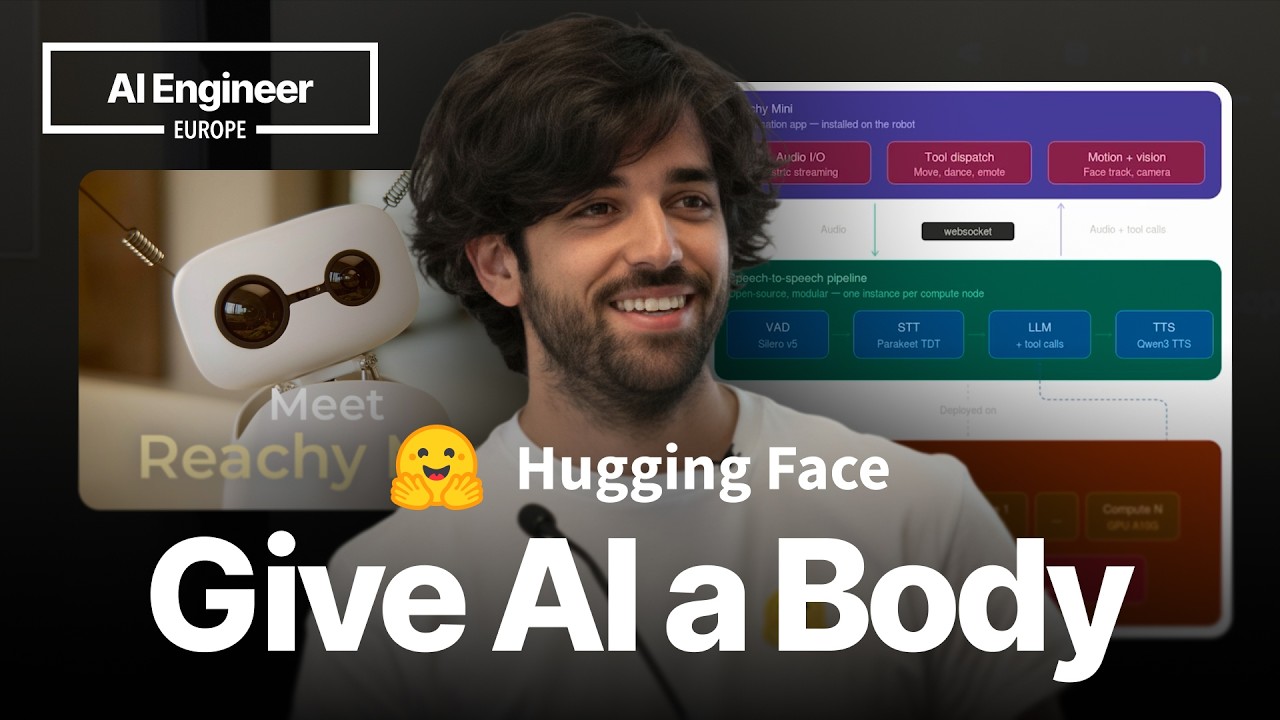
Reachy Mini: the $300 open source robot you can actually hack — Andres Marafioti, Hugging Face
May 29, 2026 · 21:16
Andres Marafioti from Hugging Face presents Reachy Mini, a $300 open source robot shipped to 7,500 people unassembled, and explains that its most popular app is voice conversation. To make that app responsive, his team optimized Qwen3-TTS from a below-real-time 0.8x factor to 5.8x real time by adding streaming, switching to a static KV cache, and enabling CUDA graph captures, cutting time to first audio to under 200 milliseconds. The full voice pipeline runs Parakeet transcription every 150 milliseconds with partial results, feeds Qwen 3.5 27B for the LLM, and uses the optimized TTS, while infrastructure round trips are handled by a load balancer that separates LLM endpoints from conversation nodes. Marafioti argues that expensive humanoid robots limit creativity and access, whereas Reachy Mini's hackable, repairable design invites hackers, students, and dreamers to build new interactions. He demonstrates the robot's ability to take photos, show emotions, and even be pet, and emphasizes that all models and software are open source.

Books reimagined: AI to create new experiences for things you know — Lukasz Gandecki, TheBrain.pro
Jul 22, 2025 · 9:44
Łukasz Gandecki of TheBrain.pro presents Books Reimagined, an AI-powered reading companion that adds music, graphics, and conversational AI to books like '1984' and 'The Snow Queen', arguing that AI can create magical experiences by hiding itself behind a polished user interface. He started by vibe-coding a companion for a Trump reelection book to track characters, then iterated into a full multimedia reader. He demonstrates features including 100-millisecond voice response, natural language search via embeddings, and deep research that scans the entire book. Gandecki emphasizes that human curation of AI-generated music and graphics is essential for quality, and he is open-sourcing the player at bookgenius.net.

Personality Driven Development: Exploring the Frontier of Agents with Attitude
Feb 17, 2025 · 18:00
Ben, from Perpetual, argues that anthropomorphizing AI agents—giving them personalities, forms, and preferences—transforms user adoption and engagement, despite significant challenges. He presents examples like Tech Lead, an artichoke recruiter, and hamster teams, showing how form factors create instant understanding and enable price anchoring (e.g., 1/20th the cost of a junior employee). Benefits include easy problem decomposition (specialized agents outperform generalized), branding, and fun. However, downsides include reinforcing stereotypes (100% of generated software engineers appear male), raised performance expectations, difficulty rebranding, distraction from core value, and stark reminders of job replacement—illustrated by a CEO introducing an IC as the one who 'knows what they're doing.' Ben highlights personality-driven development where every instance is bespoke, with prompt-driven preferences (e.g., 'I like Ivy League schools'), making debugging uniquely challenging.

Giving a Voice to AI Agents: Scott Stephenson, CEO, Deepgram
Feb 10, 2025 · 13:08
Scott Stephenson, CEO of Deepgram, outlines the evolution of voice AI from slow, domain-specific systems to fast, open-ended conversational agents powered by LLMs, arguing that speed and accuracy are now solved and the key differentiator is contextual understanding. He explains that state-of-the-art speech-to-text and text-to-speech can achieve round-trip latencies under 500 milliseconds—matching human turn-taking—but notes that current systems fail to pass context between components, causing 10-20% of interactions to feel unnatural. Stephenson introduces Deepgram's 'contextual AI' vision, where models are prompted with the full conversation history, including tone, pace, and background audio, enabling the LLM to generate responses and instruct the TTS on delivery. He cautions against monolithic speech-to-speech models for enterprise use due to controllability and cost concerns, advocating for a modular stack that lets businesses optimize each component (e.g., small LLMs for simple tasks like password resets). Deepgram’s upcoming voice AI agent API integrates all components for low latency and offers $250 in free credits for experimentation.
Powered by PodHood