
SharePoint
ProductA product discussed on AI Engineer.
4 episodes

On AI and Knowledge — Pablo Castro, Distinguished Engineer & CVP for AI Knowledge, Microsoft
Jul 17, 2026 · 17:35
Pablo Castro, Distinguished Engineer and CVP for AI Knowledge at Microsoft, argues that AI agents require three knowledge types—intrinsic (model training), extrinsic (RAG and grounding), and learned (optimization loops)—and demonstrates how Microsoft's Foundry IQ, Azure AI Search, and Agent Optimizer deliver them. He shows that combining retrieval methods outperforms individual ones, citing Azure AI Search evaluations where combined methods improve evidence recall and answer completeness. He introduces Foundry IQ as a layered system with agentic retrieval that reflects on data to satisfy information needs before returning results. Castro demonstrates creating a knowledge base that connects unstructured data, structured Parquet tables, and the web, then linking it to an agent via MCP server. He also showcases the Agent Optimizer, which uses hill climbing on baseline evaluations to automatically refine agent instructions, tool definitions, and skills based on runtime traces, enabling continuous learning loops that capture organizational differentiation.
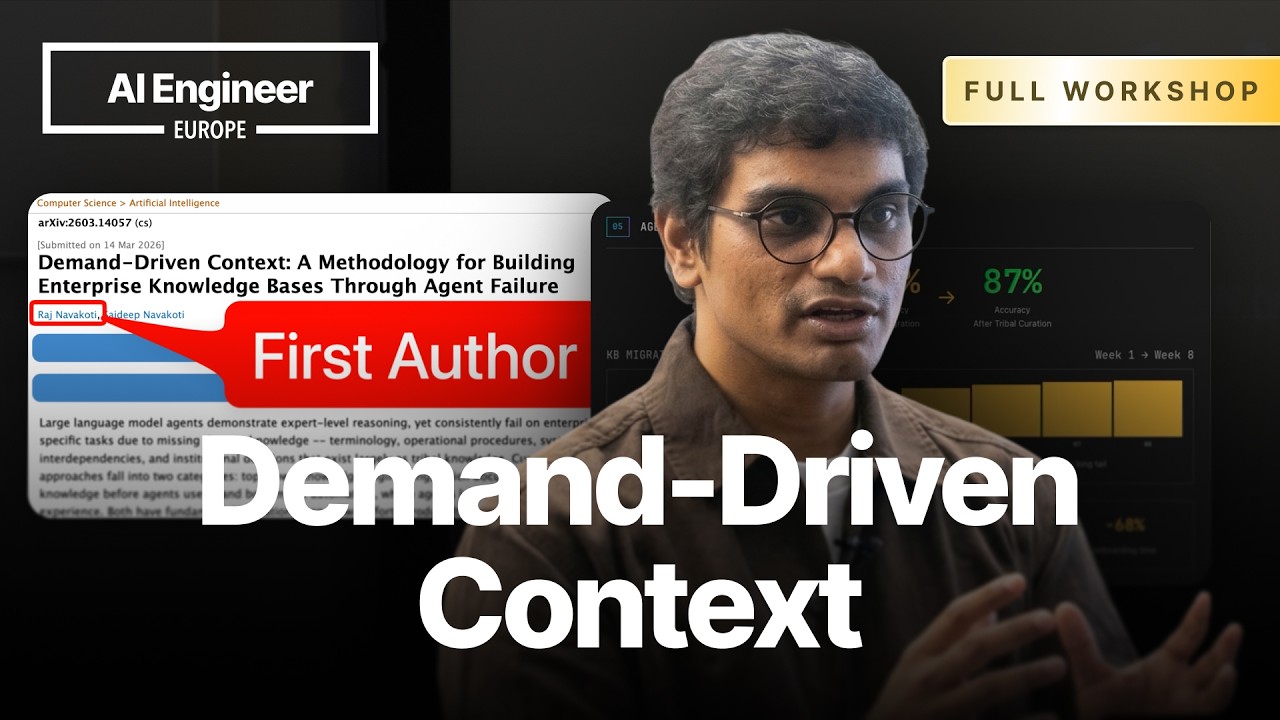
Demand-Driven Context: A Methodology for Coherent Knowledge Bases Through Agent Failure
May 5, 2026 · 1:08:15
Raj Navakoti, a staff software engineer at IKEA, presents a demand-driven context methodology for building coherent knowledge bases by letting AI agents fail on real problems and surfacing missing institutional knowledge. He argues that enterprises should shift from pushing monolithic documentation to a pull approach where agents reveal undocumented tribal knowledge through repeated failures on incidents and Jira tickets. Using a framework with skills, rules, and hooks, he demonstrates how agents can gradually improve confidence scores (from 1.4 to 4.4 over 14 incidents) by documenting discovered context blocks. Navakoti introduces a context gap scanner that automatically analyzes work items against existing documentation to identify critical gaps, outdated information, and duplications. He advocates storing curated knowledge in GitHub for version control and PR-based collaboration, and emphasizes that this approach helps teams know the unknown, enabling agents to manage knowledge rather than just consume it.
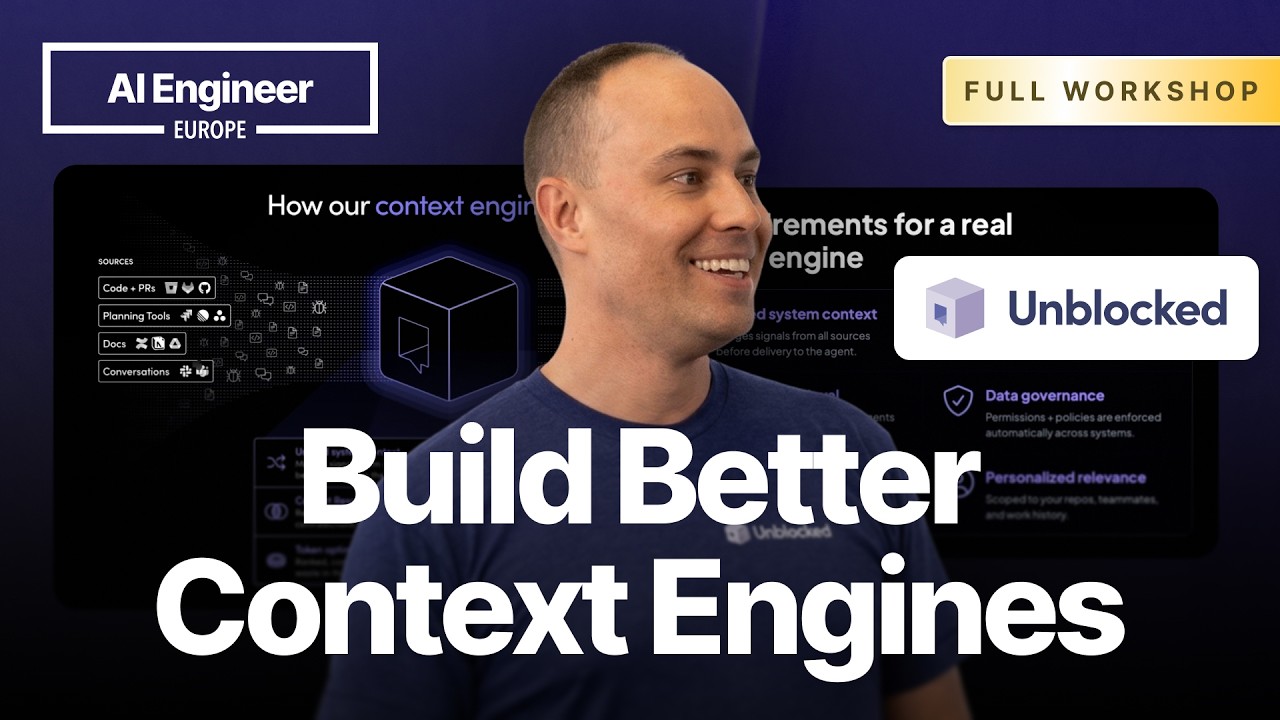
Mergeable by default: Building the context engine to save time and tokens — Peter Werry, Unblocked
May 3, 2026 · 1:41:25
Peter Werry of Unblocked argues that context engines—systems that supply AI agents with only the relevant organizational context—are critical to avoid agent doom loops and wasted tokens. He debunks three myths: naive RAG, connecting MCP servers, and bigger context windows do not solve the context problem. Werry describes building a social engineering graph to identify experts and distill team best practices, and shares hard lessons including hiding conflicts and caching answers. In a benchmark task, Unblocked's context engine reduced a 2.5-hour, 21-million-token task to 25 minutes and 10 million tokens. The talk offers a practitioner's guide to building context engines with conflict resolution, personalization, and access control.
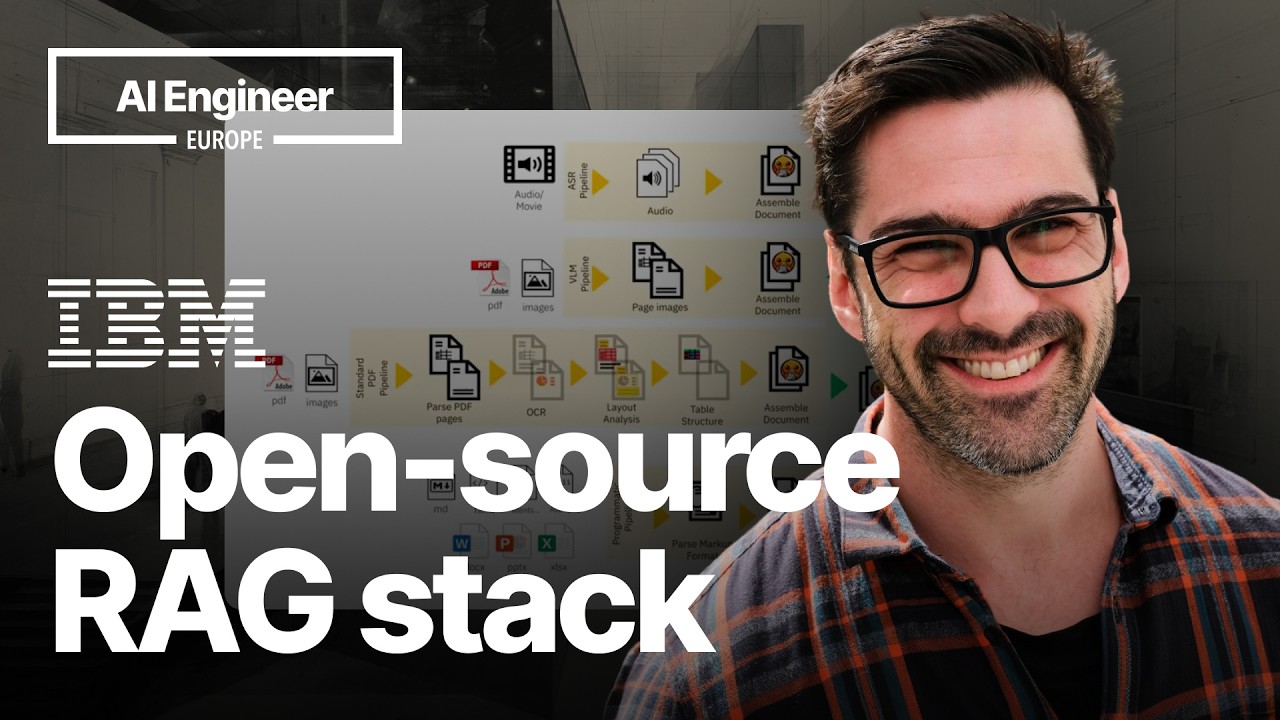
OpenRAG: An open-source stack for RAG — Phil Nash
Apr 8, 2026 · 15:52
Phil Nash introduces OpenRAG, an open-source RAG stack from IBM combining Docling, OpenSearch, and Langflow, arguing that RAG remains hard and custom despite claims it's dead — every business has unique data requiring more than simple vector search. Docling parses PDFs, audio, and more with specialized pipelines, outputting hierarchically chunked text. OpenSearch provides hybrid vector and keyword search using JVector for live indexing and disk-based ANN. Langflow enables visual agentic retrieval where the LLM decides searches with tools like a calculator and MCP servers. The stack supports local models via Ollama, cloud connectors for Google Drive and SharePoint, and an API. Nash demonstrates adding guardrails in Langflow and invites contributions to the open project.
Powered by PodHood